


 Скачать презентацию Theme of lecture 01 Introduction to history
#01Ancinet Kz.Bronze age.ppt
- Количество слайдов: 18
 Theme of lecture #01: Introduction to history. Ancient Kazakhstan. Bronze ages tribes HISTORY OF KAZAKHSTAN Zulfiya Abdikhalikovna Meldibekova candidate of sciences (History)
 Per iodization 1. History of ancient Kazakhstan 2. History of medieval Kazakhstan 3. New history of Kazakhstan 4. Newest history
 History of ancient Kazakhstan Stone age: Paleolithic period, Mesolithic, Neolith Bronze age: Andronov or Begazy. Dandybaev cultures Iron (Metall) age: Sacks, tribal unions
 History of medieval Kazakhstan Early medieval history (6 -9 cc): Turgic period- kaganates Prosperity or Golden age (10 -14 cc): Mongolian invasion, history of post -Mongolian period-foundation of Hordes Late-medieval period(15 -18 cc): formation of Kazakh Khandom
 New history of Kazakhstan Joining of Kazakhstan to Russia, colonial policy of Tsarist on the territory of Kazakhstan National – liberation movements against Russian policy Administrative reforms
 Kazakhstan in modern time. Newest history Standing of Soviet power in Kazakhstan: revolutions, policy of Soviet power, II WW, post-war period, stagnation, perestroika or reconstruction, collapse of USSR Independent Kazakhstan
 The brief content of the lecture: Characteristic of the primitive society. Stages of the primitive society. Historical monuments of the primitive society. Ancient time is the first stage of historical development of humanity from appearance of man till formation of statehood on the territory of Kazakhstan. The science studying people’s life on the basis of material remains is called archeology. Archeologists divide ancient time into 3 parts: stone age, bronze age and metal age. The problem of the origin of the modern human being and the most ancient stages of his development in the Stone Age according to the scientists terminology in one of the complex problem of the science. The modern genetics came to conclusion, that labour played the decisive role in the evolution of man. The other factors – biological and social, participated in the process of anthropogenesis. Man is differed from the animal by his knowing how to work and how to make the labour instruments. The first instruments made from stone by man gave the name to the Stone Age, the early and longest period of the history.
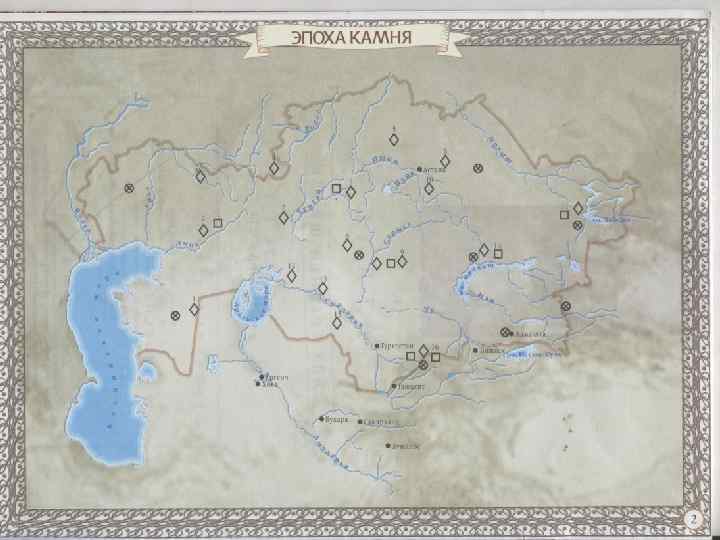
 The brief content of the lecture I. Paleolithic: - Ancient Paleolithic: Doshell – 2, 5 mln. -800 th. B. C. , Shell, Ashell - 800 -140 th. B. C. - Middle Paleolithic: Upper Ashell - Mousterian period – 140 -40 th. B. C. 3. Upper Paleolithic 40 -10 th. B. C. II. Mesolithic XII-V th. B. C. III. Neolithic V-II th. B. C. The first men on the territory of Kazakhstan appeared about 700 -500 th. years ago during The Paleolithic Age: near rivers Isym, Chu, Betpak-Dala. The more numerous sites of the late times were Shabakty, Temirkazgan, Borykazgan etc. During the Mousterian epoch the method of production of stone instruments developed. Among the Mousterian sites discovered in the Karatau, one was situated in Karasai, on the right bank of the Arystandy river. The finds of the Mousterian instruments are known in the middle flow of the Sarysu river in Central Kazakhstan and Priirtyshie. Neolithic. The Neolithic hunters, fishermen and collectors lived in Pri-Ural and Irtysh. The natural environment of that time was almost the same as in our days. The technology of working up of stone in the epoch of Neolithic achieved the highest level, people learned how to saw and polish the stone and make the mini stone-blades (micro-lit). The durable crockery ceramics were made with help of baking by Neolithic people. In the epoch of Upper Neolithic and Eneolithic one more important event was happened in the life of people. The animals have been domesticated and became domestic animals. People began to be occupied with farming. The appearance of the beginnings of mining, mastery of metals, soft-ones – copper, gold, lead took place.
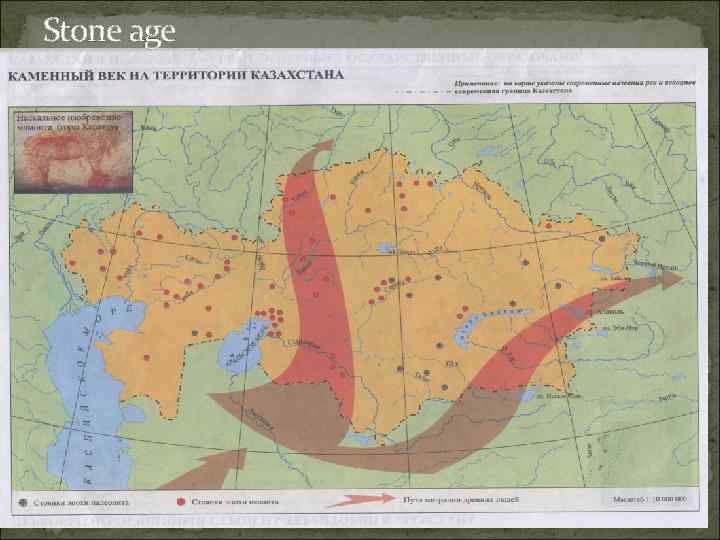 Stone age
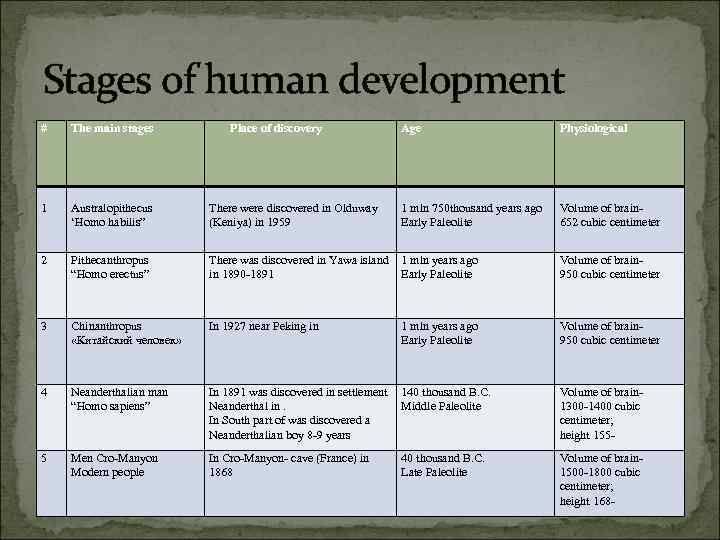 Stages of human development # The main stages 1 Australopithecus ‘Homo habilis” 2 Place of discovery Age Physiological There were discovered in Olduway (Keniya) in 1959 1 mln 750 thousand years ago Early Paleolite Volume of brain 652 cubic centimeter Pithecanthropus “Homo erectus” There was discovered in Yawa island in 1890 -1891 1 mln years ago Early Paleolite Volume of brain 950 cubic centimeter 3 Chinanthropus «Китайский человек» In 1927 near Peking in 1 mln years ago Early Paleolite Volume of brain 950 cubic centimeter 4 Neanderthalian man “Homo sapiens” In 1891 was discovered in settlement Neanderthal in. In South part of was discovered a Neanderthalian boy 8 -9 years 140 thousand B. C. Middle Paleolite Volume of brain 1300 -1400 cubic centimeter; height 155 - 5 Men Cro-Manyon Modern people In Cro-Manyon- cave (France) in 1868 40 thousand B. C. Late Paleolite Volume of brain 1500 -1800 cubic centimeter; height 168 -
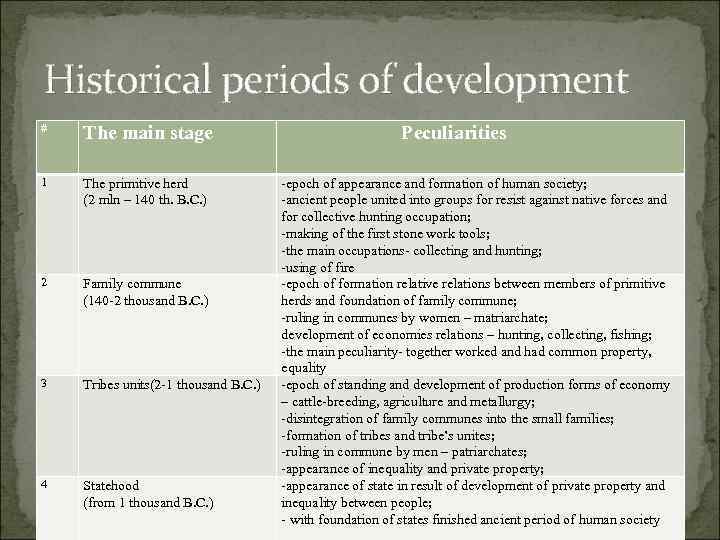 Historical periods of development # The main stage 1 The primitive herd (2 mln – 140 th. B. C. ) 2 Family commune (140 -2 thousand B. C. ) 3 Tribes units(2 -1 thousand B. C. ) 4 Statehood (from 1 thousand B. C. ) Peculiarities -epoch of appearance and formation of human society; -ancient people united into groups for resist against native forces and for collective hunting occupation; -making of the first stone work tools; -the main occupations- collecting and hunting; -using of fire -epoch of formation relative relations between members of primitive herds and foundation of family commune; -ruling in communes by women – matriarchate; development of economies relations – hunting, collecting, fishing; -the main peculiarity- together worked and had common property, equality -epoch of standing and development of production forms of economy – cattle-breeding, agriculture and metallurgy; -disintegration of family communes into the small families; -formation of tribes and tribe’s unites; -ruling in commune by men – patriarchates; -appearance of inequality and private property; -appearance of state in result of development of private property and inequality between people; - with foundation of states finished ancient period of human society
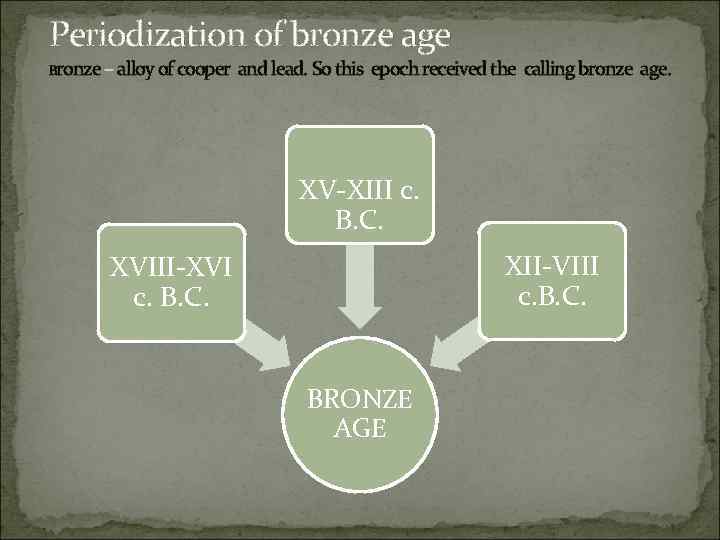 Periodization of bronze age Bronze – alloy of cooper and lead. So this epoch received the calling bronze age. XV-XIII c. B. C. XII-VIII c. B. C. XVIII-XVI c. B. C. BRONZE AGE
 Peculiarities of bronze age: mastering of metal (gold also); appearance of new form economy – transform from settling cattle-breeding to nomadic; development of hoe farming. Farming existed from IV thousand B. C. in Kazakhstan; conception of the first social dividing of labor: cattlebreeding and farming; development of cattle-breeding and farming needed in males power, so, gradually, matriarchate defeated and was replaced by patriarchate
 The main regions of Andronov culture in Kazakhstan Central Kazakhstan( about 30 settlements and 150 graves) divided into 3 periods: 1)early ( нуринский); 2) middle (атасуйский) 3) late (бегазы- дандыбаевский) In North Kazakhstan archeologists found more 80 settlements and graves: Алексеевское, Садчиковское (около реки Тобол) One of the first ancient towns - Arcaim (Аркаим) on the Costanay oblast. In East Kazakhstan were founded more 10 monuments, famous of them- Kanai, Trudnikovo, Malakrasnoyiarka ( Канай, Трудниково, Малокрасноярка) In West Kazakhstan – settlements (Тасты-Бутак, Ахмет-аул, Бесбай, Киргелды) In Semirechie and South of Kazakhstan – the main collections of drawing (Тамгалы, Каратау)
 Social structure The consequences of Nomadic cattle-breeding: transformation of society to patriarchate appearance of family, then private property and social inequality appearance of social groups – tribes chiefs , priests and military commanders. Begazy-Dandybaev’s culture: Archeological culture of late bronze in Central Kazakhstan discovered by Margulan A. Kh. Peculiarities: - Economy based on nomadic cattle-breeding; construction of special types of graves monuments no ordinary funeral (погребальный) ritual (ceremony); appearance of new form of clay dishes; existing of many cooper mines
 Control questions to lecture: 1. Call the names of stone age’s periods. 2. What were the work tools of ancient men? Wright its. 3. Call the periods of development of primitive herds. 4. What does archaeology study? 5. Around which mountain range were findings of the oldest human beings at the territory of Kazakhstan found? 6. What is Tanirkazgan? 7. Who discovered the main culture of bronze age in Kazakhstan? 8. Bronze is an alloy of what? 9. Call the chronological borders of bronze age. 10. What was the name of the first town in Kazakhstan?
 Literature The main: Асфендияров С. Д. История Казахстана (с древних времен): Уч. Пособие / Под ред. А. С. Такенова. – Алма-Ата, 1993. – 2 -е изд. История Казахстана с древнейших времен до наших дней? Очерк. – Алматы: Дэуир, 1993. История Казахстана: Пособие для студентов. – Алматы: Казинтерграф, 1998. Кан Г. В. История Казахстана: Учеб. Пособие. – Алматы: ВШП Эдилет, 2000. Оразбаева А. И. Курс лекций по истории Казахстана для студентов неисторических факультетов. Часть 1. Древняя и средневековая история Казахстана. – Алматы: Казак университетi, 2001. История Казахстана (с древнейших времен до наших дней)? В 5 т. – Алматы. – Т. 1. – 1996; т. 2. – 1997; т. 3. – 2000. Алпысбаев Х. А. Памятники нижнего палеолита Южного Казахстана. – Алма-Ата: Гылым, 1979. Ирмуханов Б. Б. Этническая история древнего Казахстана. – Алматы, 1998. Исмагулов О. Этническая антропология Казахстана. – Алма-Ата, 1977.