



 Theme 7. Circuit and the turnover of capital (funds) of the enterprise
 1. The reproduction process of the capital
 Individual capital - capital of the company, which can company always be profitable if it is continuously re-creates the material conditions of production of the new value. Simple reproduction of individual capital - is a continuous repetition of creative activity. • Circulation of capital - is one cycle of its motion, which covers the production and circulation of goods produced and completed the return of capital in its original form of money. Continuously occurring movement of capital forms its turnover. • That capital was able to fully commit trafficking takes time - time traffic.
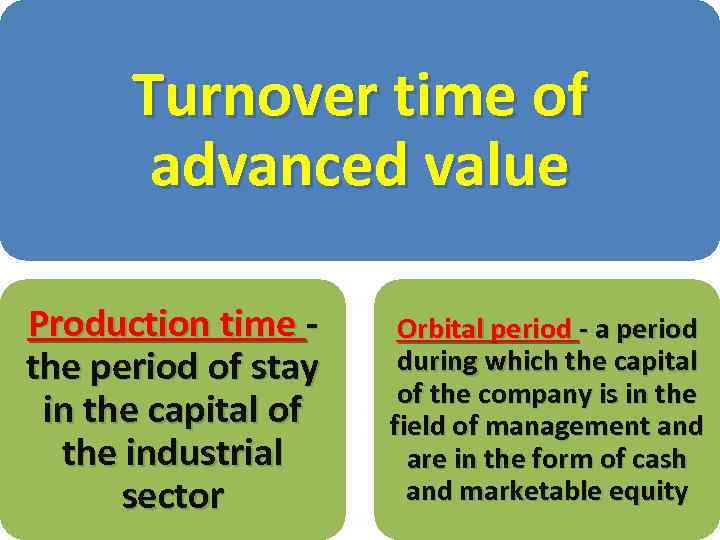 Turnover time of advanced value Production time the period of stay in the capital of the industrial sector Orbital period - a period during which the capital of the company is in the field of management and are in the form of cash and marketable equity
 2. Basic and working capital.
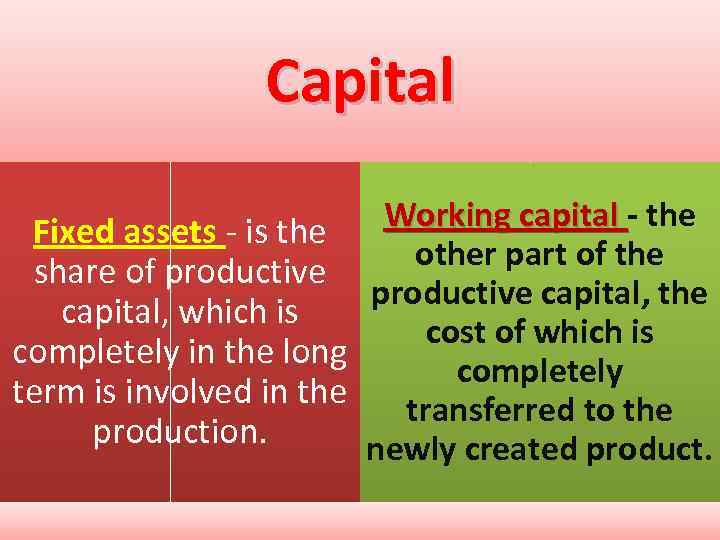 Capital Working capital - the Fixed assets - is the other part of the share of productive capital, the capital, which is cost of which is completely in the long completely term is involved in the transferred to the production. newly created product.
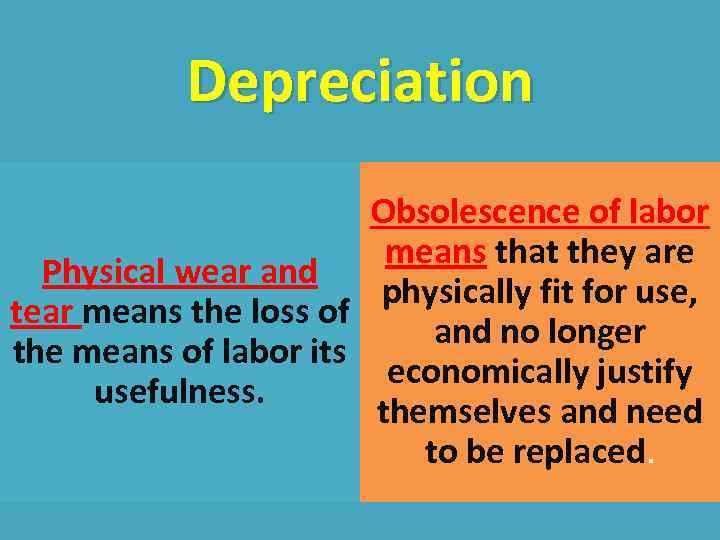 Depreciation Obsolescence of labor means that they are Physical wear and physically fit for use, tear means the loss of and no longer the means of labor its economically justify usefulness. themselves and need to be replaced.
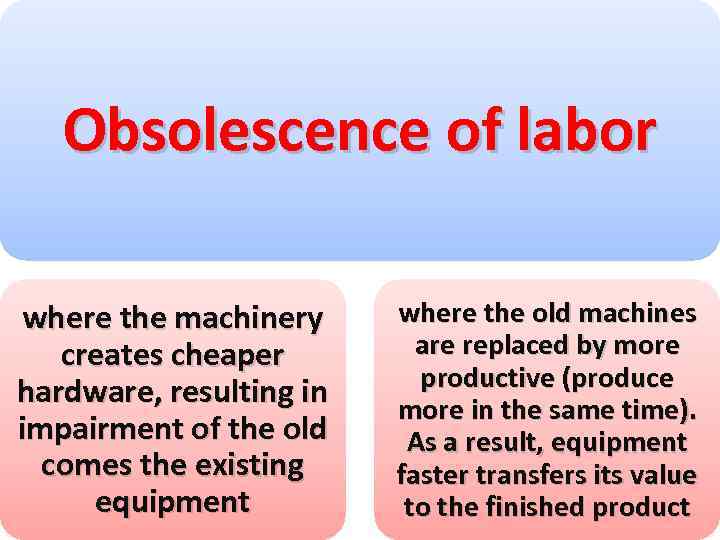 Obsolescence of labor where the machinery creates cheaper hardware, resulting in impairment of the old comes the existing equipment where the old machines are replaced by more productive (produce more in the same time). As a result, equipment faster transfers its value to the finished product
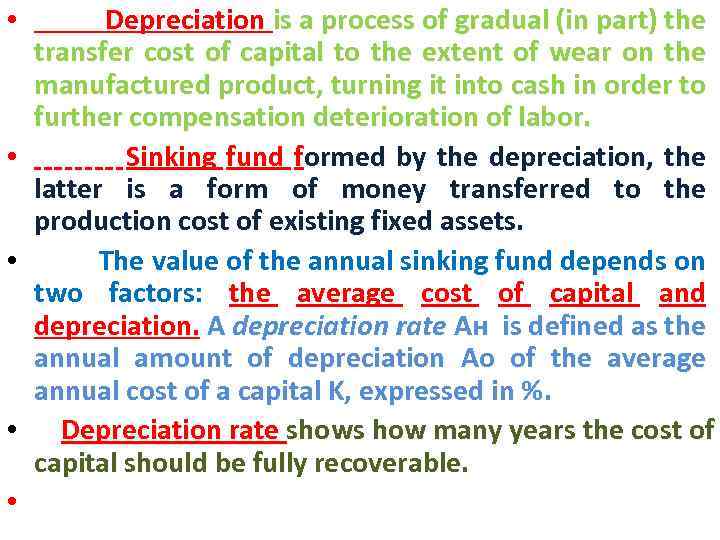 Depreciation is a process of gradual (in part) the transfer cost of capital to the extent of wear on the manufactured product, turning it into cash in order to further compensation deterioration of labor. • Sinking fund formed by the depreciation, the latter is a form of money transferred to the production cost of existing fixed assets. • The value of the annual sinking fund depends on two factors: the average cost of capital and depreciation. A depreciation rate Ан is defined as the annual amount of depreciation Ао of the average annual cost of a capital K, expressed in %. • Depreciation rate shows how many years the cost of capital should be fully recoverable. • •
 Renovation - the update fixed capital, the economic process of substitution, retired due to wear and tear, the new means of labor (full recovery). • Expanded reproduction of the firm means an increase in the size of capital, which leads to an increase in the production of new value. Increase in size is the current capital is due to the accumulation. The accumulation of capital - is the increment of money and material resources, going on extended reproduction. This capital can be called investment in the future.
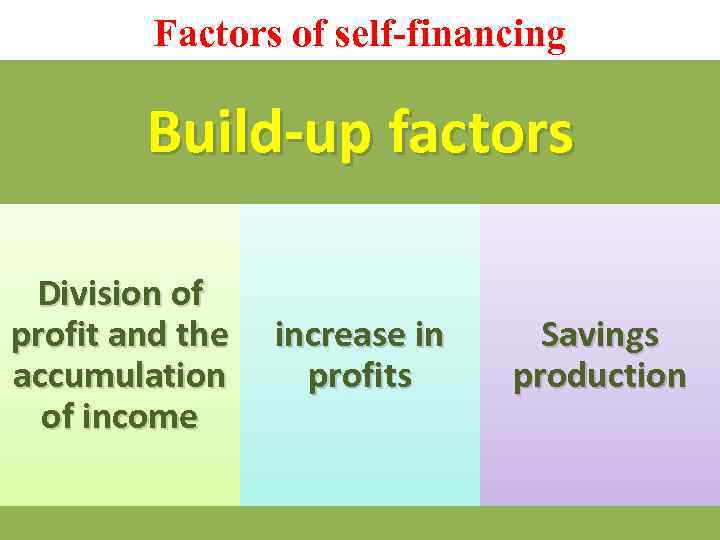 Factors of self-financing Build-up factors Division of profit and the accumulation of income increase in profits Savings production
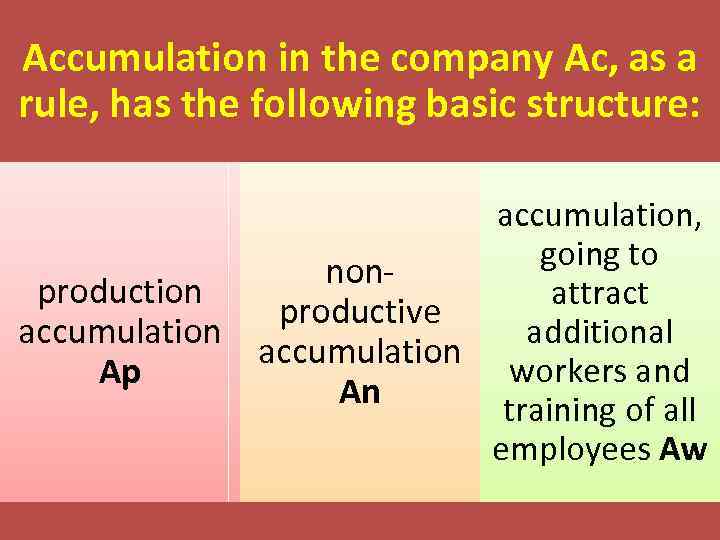 Accumulation in the company Ac, as a rule, has the following basic structure: production accumulation Ap accumulation, going to nonattract productive additional accumulation workers and An training of all employees Aw
 Capital formation or investment spent on increasing the number of production and increase in reserves (reserves and insurance funds). Non-productive accumulation fund is to increase the non-production sphere (housing services and health care), and the additional cost of training and skills development.
 3. Investments as a source of financing of productive assets.
 • Investment - is the cost of production and accumulation of the means of production and an increase in inventories.
 To finance investment firms or use their profits turn to the market for money-capital loans
 • Most businesses to finance investment borrow money in the bank. The use of borrowed money capital they pay interest on loans. • Loan interest is a charge for the use of money capital, in other words, it is the price of money capital. • Rate (rate) is calculated as the percent ratio of debt to the value of money capital of borrowing, expressed as a percentage.