


 Скачать презентацию THEME 6 OLD ENGLISH ETYMOLOGICAL PECULIARITIES LECTURE 1
THEME 6.pptx
- Количество слайдов: 19
 THEME 6. OLD ENGLISH ETYMOLOGICAL PECULIARITIES. LECTURE 1. A Process of Word Formation in Old English
 OUTLINE: • Common Germanic words. • OE borrowings. • Word-building in OE.
 NATIVE WORDS: 1. Common Indo-European Words 2. Common Germanic Words 3. English Proper Words
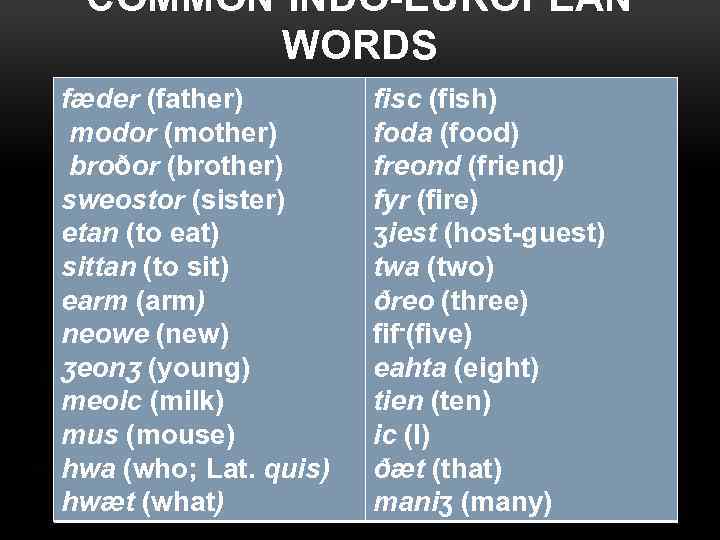 COMMON INDO-EUROPEAN WORDS fӕder (father) modor (mother) broðor (brother) sweostor (sister) etan (to еat) sittan (to sit) earm (arm) neowe (new) ʒеоnʒ (young) meolc (milk) mus (mouse) hwa (who; Lat. quis) hwӕt (what) fisc (fish) foda (food) freond (friend) fyr (fire) ʒiest (host-guest) twa (two) ðreо (three) fif-(five) eahta (eight) tien (ten) ic (I) ðӕt (that) maniʒ (many)
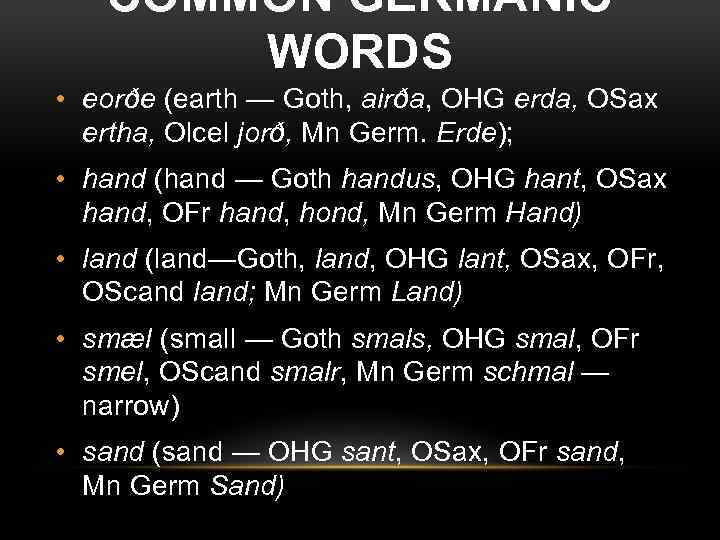 COMMON GERMANIC WORDS • eorðe (earth — Goth, airða, OHG erda, OSax ertha, Olcel jorð, Mn Germ. Erde); • hand (hand — Goth handus, OHG hant, OSax hand, OFr hand, hond, Mn Germ Hand) • land (land—Goth, land, OHG lant, OSax, OFr, OScand land; Mn Germ Land) • smӕl (small — Goth smals, OHG smal, OFr smel, OScand smalr, Mn Germ schmal — narrow) • sand (sand — OHG sant, OSax, OFr sand, Mn Germ Sand)
 ENGLISH PROPER WORDS A small group including such wellknown roots as: “boy” “girl” “bird” “bad”
 OLD ENGLISH BORROWINGS • Celtic • Latin: 1. words, borrowed from Latin by the Germans before the V century; 2. words, borrowed by the Angles and the Saxons from the latinized Celtic tribes; 3. words that became popular in England in connection with the spread of the Christian religion in Britain
 THE 1 ST GROUP OF LATIN BORROWINGS: 1. Words denoting trade relations between the Romans and the Germanic tribes 2. Names of things the Romans traded in 3. Names of fruits and fruit trees 4. Words denoting objects of home life 5. Words connected with building roads and cities
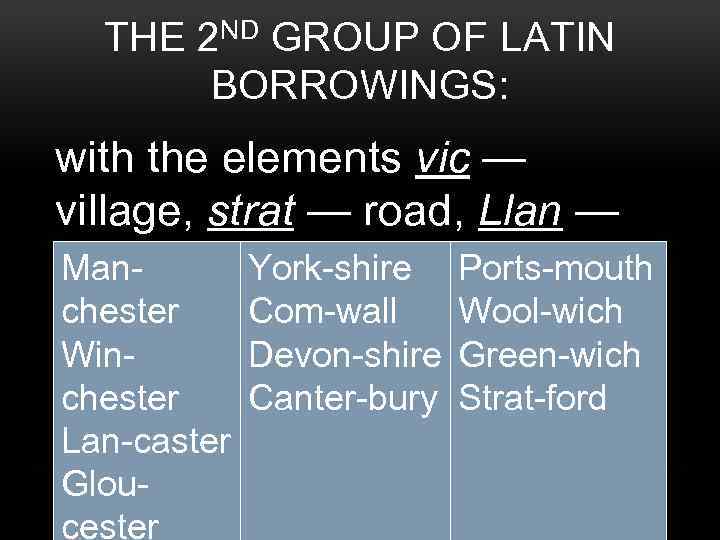 THE 2 ND GROUP OF LATIN BORROWINGS: with the elements vic — village, strat — road, Llan — church York-shire Ports-mouth Manchester Com-wall Wool-wich Win. Devon-shire Green-wich chester Canter-bury Strat-ford Lan-caster Gloucester
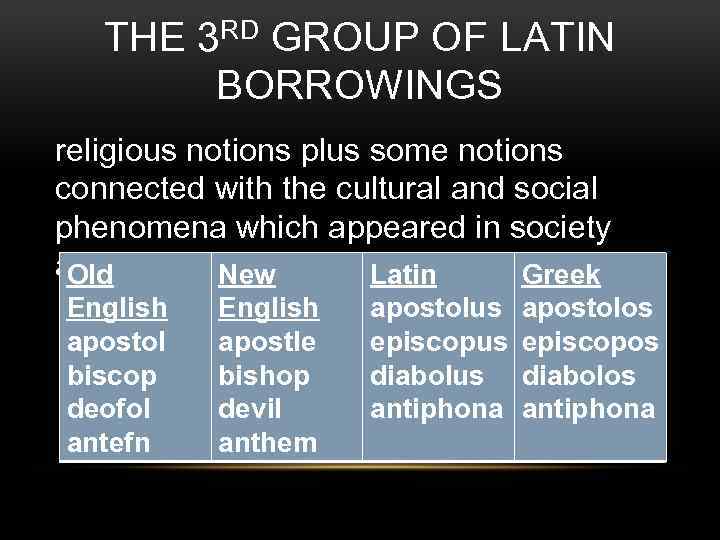 THE 3 RD GROUP OF LATIN BORROWINGS religious notions plus some notions connected with the cultural and social phenomena which appeared in society after this event Old New Latin Greek English apostol biscop deofol antefn English apostle bishop devil anthem apostolus episcopus diabolus antiphona apostolos episcopos diabolos antiphona
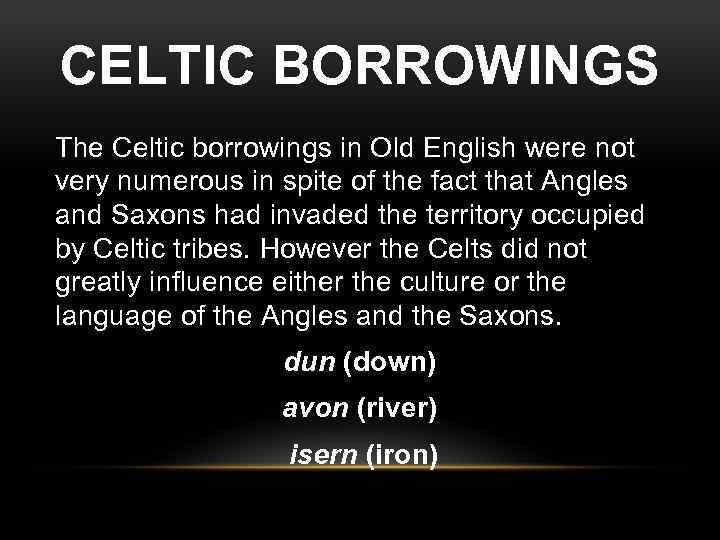 CELTIC BORROWINGS The Celtic borrowings in Old English were not very numerous in spite of the fact that Angles and Saxons had invaded the territory occupied by Celtic tribes. However the Celts did not greatly influence either the culture or the language of the Angles and the Saxons. dun (down) avon (river) isern (iron)
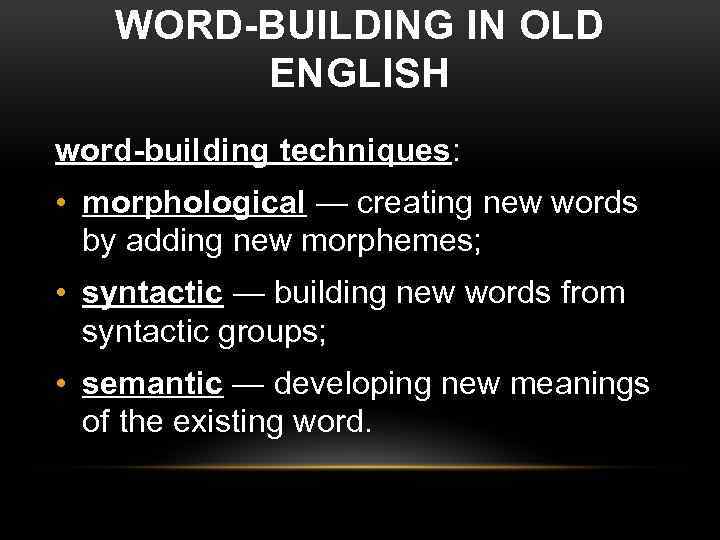 WORD-BUILDING IN OLD ENGLISH word-building techniques: • morphological — creating new words by adding new morphemes; • syntactic — building new words from syntactic groups; • semantic — developing new meanings of the existing word.
 MORPHOLOGICAL WORDBUILDING is the way of adding morphemes to make new words, known as affixation (prefixes and suffixes).
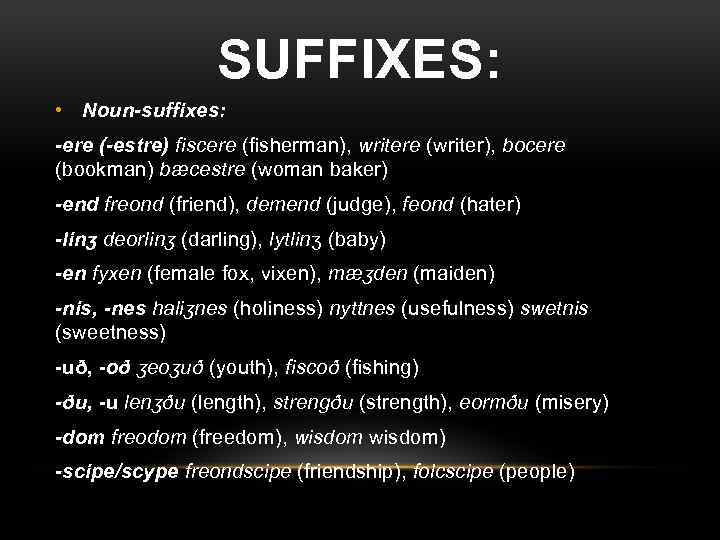 SUFFIXES: • Noun-suffixes: -ere (-estre) fiscere (fisherman), writere (writer), bocere (bookman) bӕcestre (woman baker) -end freond (friend), demend (judge), feond (hater) -linʒ deorlinʒ (darling), lytlinʒ (baby) -en fyxen (female fox, vixen), mӕʒden (maiden) -nis, -nes haliʒnes (holiness) nyttnes (usefulness) swetnis (sweetness) -uð, -оð ʒеоʒиð (youth), fiscoð (fishing) -ðu, -u lenʒðu (length), strengðu (strength), eormðu (misery) -dom freodom (freedom), wisdom) -scipe/scype freondscipe (friendship), folcscipe (people)
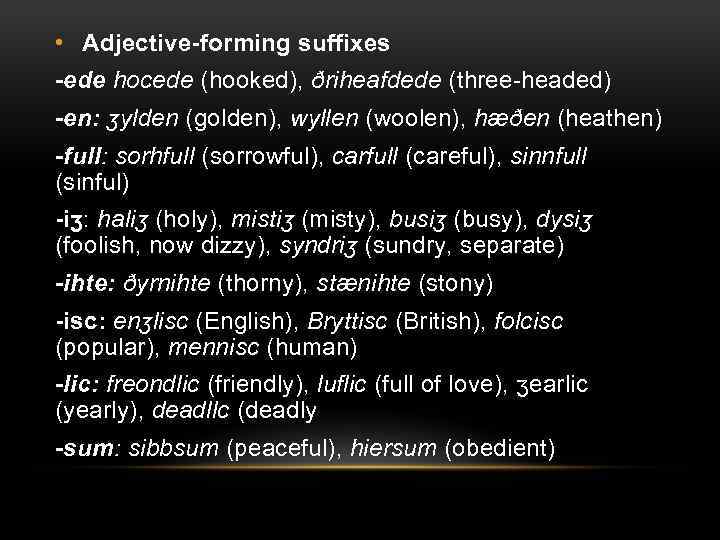 • Adjective-forming suffixes -ede hocede (hooked), ðriheafdede (three-headed) -en: ʒylden (golden), wyllen (woolen), hӕðen (heathen) -full: sorhfull (sorrowful), carfull (careful), sinnfull (sinful) -iʒ: haliʒ (holy), mistiʒ (misty), busiʒ (busy), dysiʒ (foolish, now dizzy), syndriʒ (sundry, separate) -ihte: ðyrnihte (thorny), stӕnihte (stony) -isc: enʒlisc (English), Bryttisc (British), folcisc (popular), mennisc (human) -lic: freondlic (friendly), luflic (full of love), ʒearlic (yearly), deadllc (deadly -sum: sibbsum (peaceful), hiersum (obedient)
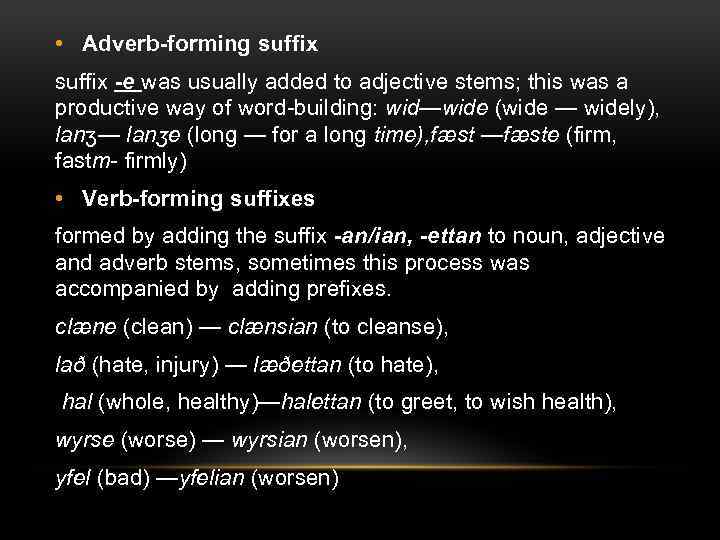 • Adverb-forming suffix -e was usually added to adjective stems; this was a productive way of word-building: wid—wide (wide — widely), lanʒ— lanʒe (long — for a long time), fӕst —fӕste (firm, fastm- firmly) • Verb-forming suffixes formed by adding the suffix -an/ian, -ettan to noun, adjective and adverb stems, sometimes this process was accompanied by adding prefixes. сlӕnе (clean) — clӕnsian (to cleanse), lað (hate, injury) — lӕðettan (to hate), hal (whole, healthy)—halettan (to greet, to wish health), wyrse (worse) — wyrsian (worsen), yfel (bad) —yfelian (worsen)
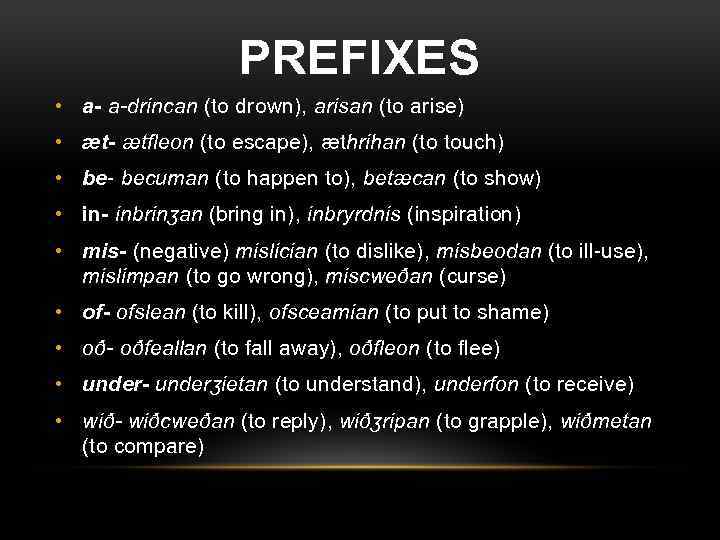 PREFIXES • a- a-drincan (to drown), arisan (to arise) • ӕt- ӕtfleon (to escape), ӕthrihan (to touch) • be- becuman (to happen to), betӕcan (to show) • in- inbrinʒan (bring in), inbryrdnis (inspiration) • mis- (negative) mislician (to dislike), misbeodan (to ill-use), mislimpan (to go wrong), miscweðan (curse) • of- ofslean (to kill), ofsceamian (to put to shame) • оð- oðfeallan (to fall away), oðfleon (to flee) • under- underʒietan (to understand), underfon (to receive) • wið- wiðcweðan (to reply), wiðʒripan (to grapple), wiðmetan (to compare)
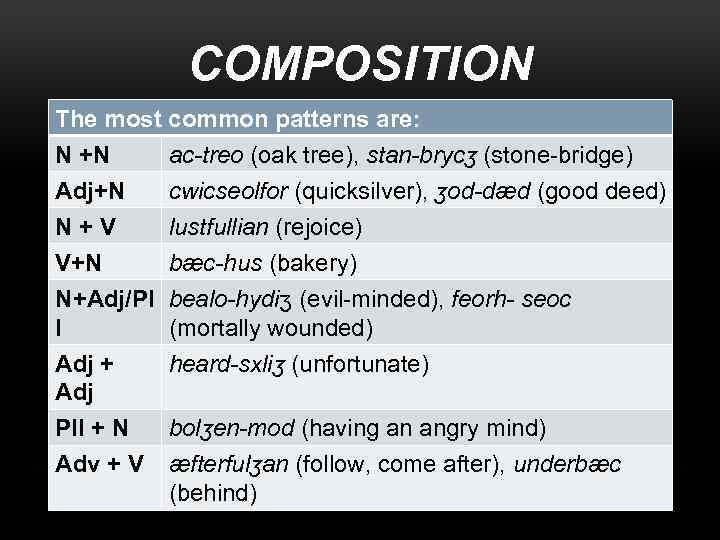 COMPOSITION The most common patterns are: N +N ac-treo (oak tree), stan-brycʒ (stone-bridge) Adj+N cwicseolfor (quicksilver), ʒod-dӕd (good deed) N+V lustfullian (rejoice) V+N N+Adj/PI I Adj + Adj bӕc-hus (bakery) bealo-hydiʒ (evil-minded), feorh- seoc (mortally wounded) heard-sxliʒ (unfortunate) PII + N Adv + V bolʒen-mod (having an angry mind) ӕfterfulʒan (follow, come after), underbӕc (behind)
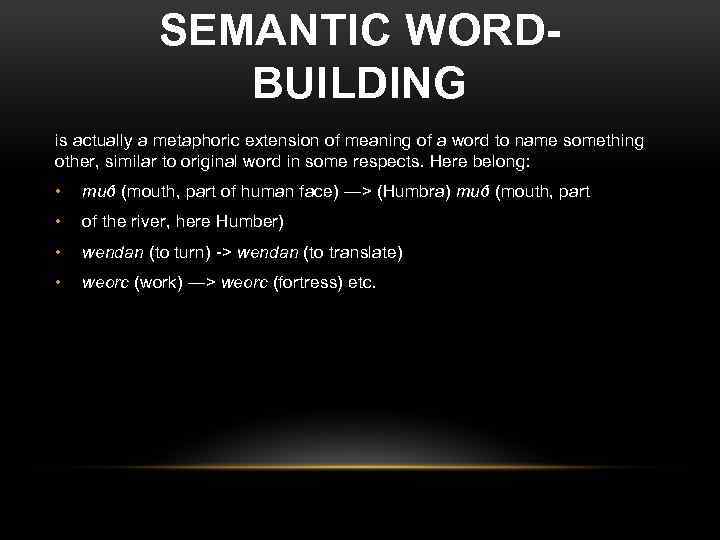 SEMANTIC WORDBUILDING is actually a metaphoric extension of meaning of a word to name something other, similar to original word in some respects. Here belong: • muð (mouth, part of human face) —> (Humbra) muð (mouth, part • of the river, here Humber) • wendan (to turn) -> wendan (to translate) • weorc (work) —> weorc (fortress) etc.