


 Скачать презентацию Theme 6 Classical Sociology Readings to class ØEmile
classics-6.ppt
- Количество слайдов: 15
 Theme 6. Classical Sociology Readings to class: ØEmile Durkheim on Morality and Society. Selected Writings. The University of Chicago Press, 1973, Chapters 6 -8, pp. 63 -133 ØWeber M. Economy and Society. Berkeley: University of California Press, 1978, Vol. 2, Chapters X, XI, pp. 941 -1005
 Sociology § Projects of social science tended to become hermetic philosophical systems § Sociology as special branch of scientific knowledge has to be constituted § Concept of subject-matter § Concept of method
 Emile Durkheim (1858 -1917) Ø § § § ‘The Division of Labour in Society’ (1893), ‘The Rules of Sociological Method’ (1895), ‘Suicide’ (1897) Sociology is possible and necessary science because of existence of social reality as the reality of special kind (sui generis) Social reality is more real than reality of individuals Subject-matter of sociology is constituted by social facts that are modes of activity, thinking, and feeling which exist apart individuals and have coercive power in relation to individuals Method of sociology is experimental method because social facts must be considered as things Social facts avoid the researcher’s control and the only possibility for sociology to be experimental science is comparative method
 Function of Division of Labor Adam Smith: increase in productivity Karl Marx: increase in productivity but alienation Durkheim: maintenance of solidarity in modern society
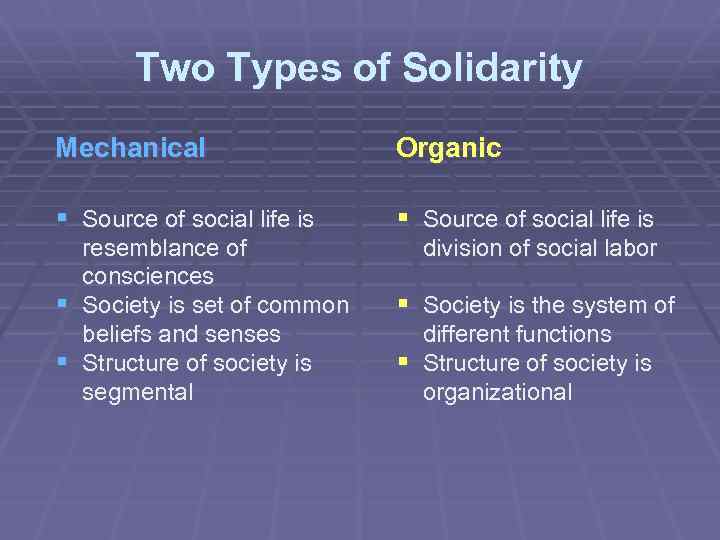 Two Types of Solidarity Mechanical Organic § Source of social life is § § Society is the system of § resemblance of consciences Society is set of common beliefs and senses Structure of society is segmental division of social labor § different functions Structure of society is organizational
 Anomie § Lack of social regulation in modern society § uncertainty of social norms as orientations for individual activities because of social change § Negative consequences: deviant behavior, conflicts, alienation from society § Solution: associations providing collectivity in the modern society
 Suicide § Suicide rates in the modern societies are explained sociologically: lack of individuals’ integration into community § Four types of suicide: Ø Egoistic motivated by the individual consciousness Ø Altruistic motivated by the collective consciousness Ø Anomic provoked by the uncertainty of values and norms Ø Fatalist provoked by the over-regulation § Classical sociological approach: to interrelate different phenomena of human life (suicide rates and economic development or suicide rates and divorce rates) and relate any phenomenon to society (suicide and social integration)
 Max Weber (1864 -1920) Ø § § § ‘Protestant Ethic and the Spirit of Capitalism’ (1905), ‘Economy and Society’ (1921) There is no any social reality outside interacting individuals Sociology as one of sciences about culture has to be developed on the base of anti-positivist approach Social actions constitute the subject-matter of sociology The cause of action is the subjective meaning which is not observable but can be interpreted The properly sociological method of interpretative explanation should be exercised through construction of ideal types
 Four Types of Social Action Ø Purposive-rational action based on calculation of gains, efforts, and consequences of definite action Ø Value-rational action based on belief in absolute necessity of definite action Ø Traditional action based on custom to exercise definite action Ø Affective action based on spontaneous emotional reaction to situation
 Origins of Capitalism Weber wrote: § Capitalism as a system of economic activities oriented to profits and accumulation of money exist for long time § Modern capitalism is basically industrial, productive in contrast to ancient and medieval adventurous capitalism combining trade and conquest § Modern capitalism is developed by people acting rationally while ancient and medieval economies were maintained by traditional action § Modern capitalism emerged through activities of people which conducted their life rationally § Protestantism proclaiming and imposing upon its adepts ideas of personalized religion, predestination, vocation, self-discipline developed ethic and mode of life which were favorable to capitalism But… § Early capitalism in Italy during the 14 -15 th centuries emerged long before Reformation § Jewish communities contributed to the development of capitalism in Germany in the 17 -19 th centuries as much as Protestants § Marginalized minorities were excluded from traditionally valued activities and were to develop new activities providing them with means of life
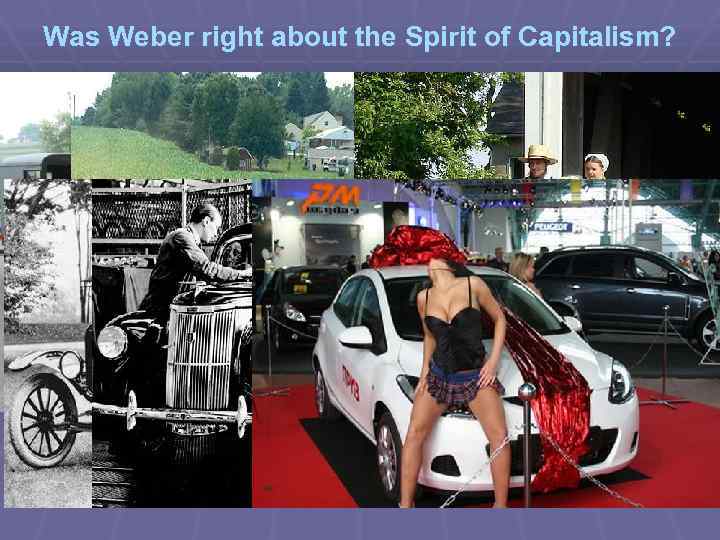 Was Weber right about the Spirit of Capitalism?
 Four Types of Authority § Power is the ability to achieve desired ends despite resistance from others § Authority is legitimated power as people recognize the rulers’ right to govern § Rational-legal authority is legitimated through trust in formal rules and procedures exercised by officials § Traditional authority is legitimated through respect for long-established ruling group (family, estate, class etc. ) § Charismatic authority is legitimated through strong belief in extraordinary abilities of leader § …?
 ‘Iron Cage’ of Rationalization is the fate of Western civilization: § § Distinctive social institutions Large-scale organizations Specialization Impersonality of rules as a result – efficiency, predictability… but dehumanization: § Bureaucracy taking people as cases (files) § Routines and over-regulation § Decline of imagination and human spirit
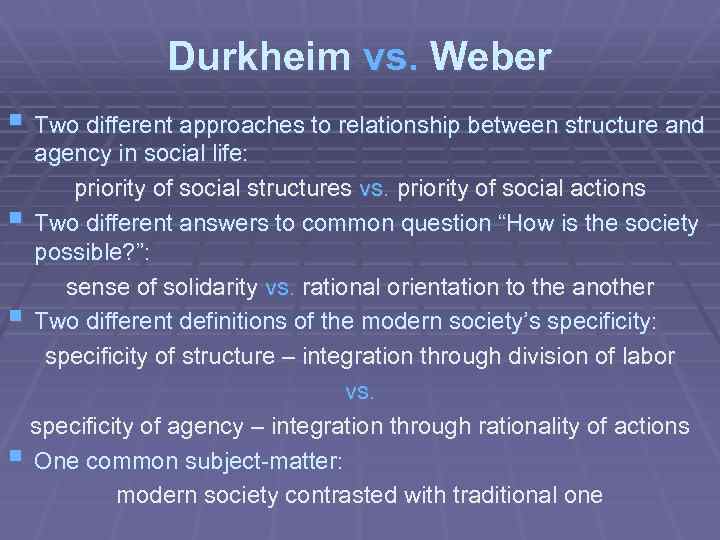 Durkheim vs. Weber § Two different approaches to relationship between structure and agency in social life: priority of social structures vs. priority of social actions § Two different answers to common question “How is the society possible? ”: sense of solidarity vs. rational orientation to the another § Two different definitions of the modern society’s specificity: specificity of structure – integration through division of labor vs. specificity of agency – integration through rationality of actions § One common subject-matter: modern society contrasted with traditional one
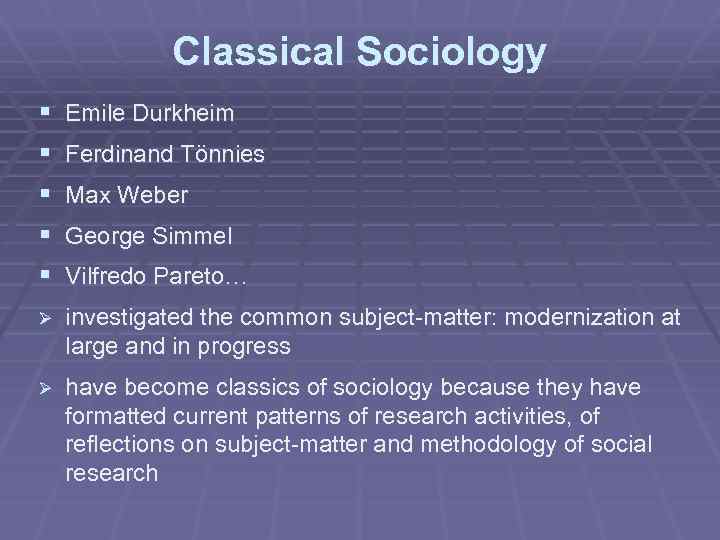 Classical Sociology § § § Emile Durkheim Ø investigated the common subject-matter: modernization at large and in progress Ø have become classics of sociology because they have formatted current patterns of research activities, of reflections on subject-matter and methodology of social research Ferdinand Tönnies Max Weber George Simmel Vilfredo Pareto…