


 Скачать презентацию Theme 4 Social Science Positivism Readings to class
classics-4.ppt
- Количество слайдов: 15
 Theme 4. Social Science: Positivism Readings to class: ØComte A. Plan of the Scientific Operations Necessary for Reorganizing Society, in The Crisis of Industrial Civilization. The Early Essays of Auguste Comte. London: Heinemann Educational Books, 1974, pp. 111 -181 ØTurner J. The Origins of Positivism: The Contributions of Auguste Comte and Herbert Spenser, in Handbook of Social Theory. Ed. by G. Ritzer and B. Smart. London: SAGE Publications, 2001, Chapter 3, pp. 30 -42
 Social Science Ø Progress of knowledge, technology, and economy Ø Problems with ideological manipulation, class conflicts, poverty Ø Concept of society as an entity that is more complex than political order and economic one Ø Concepts of social order and social progress
 Auguste Comte (1798 -1857) Ø ‘Plan of the Scientific Operations Necessary for Reorganizing Society’ (1822) Ø ‘The Course of Positive Philosophy (1830 -42) þ The positive (based on observed facts and practically useful) knowledge must displace prejudices and speculative discourses þ Scientists ought to elevate politics to the rank of a science of observation developing a new branch of knowledge – social science
 Development of Knowledge All branches of knowledge pass through three states: Ø Theological or fictitious Ø Metaphysical or abstract Ø Scientific or positive þ Theological knowledge: small number of isolated observations are bound by the ideas of supernatural forces (knowledge in its infancy) þ Metaphysical knowledge: multiplied number of observed facts are connected by the ideas of the phenomena essences (knowledge in its adolescence) þ Scientific knowledge: all observed phenomena become connected by the general laws confirmed by the very facts (knowledge in its maturity)
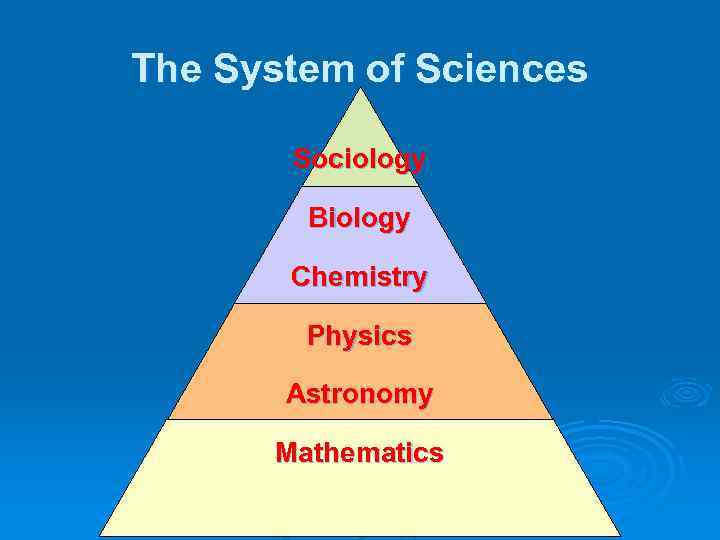 The System of Sciences Sociology Biology Chemistry Physics Astronomy Mathematics
 Sociology þ is non philosophical knowledge about society: laws as interconnections among observed facts instead of ideas of transcendent or transcendental causes þ is divided into ‘social statics’ and ‘social dynamics’: functional structures providing stability of society (‘social order’) and structural changes provoking transformation of society (‘social progress’) þ is theoretical science for practical purposes: elaboration of policies maintaining social order and providing social progress þ becomes possible only at the positive state of human knowledge but at the same time is necessary as a driving force and instrument of establishment of the new, positive state of society
 Evolution of Society þ Civilization creates social organization þ Civilization consists in science, fine arts, and industry and it progresses according to law of intellectual evolution þ At theological stage people’s beliefs empower priests and warriors (men in arms) which maintain social order on behalf of god(s) þ The metaphysical attitudes of conscious expanded by philosophers and lawyers provoke reforms, revolts, and revolutions that destroy the social order þ At the scientific stage people organized by scientists and industrialists develop new social order
 Evolution of Society þ Progress of knowledge and society is defined by the rigorous law þ Theological state of knowledge and military society till the 14 th century þ Metaphysical state of knowledge and social disorder from the 14 th to 18 th century þ Scientific state of knowledge and industrial society arise by the 19 th century þ Different social and cultural conditions among nations are determined by additional factors: race, climate, political activity
 Industrial Society: Progress vs. Order þ Technological developments and economic growth provided by scientists and industrialists þ Scientists and industrials displace priests and aristocrats which were traditional authorities and guarantees of the natural consensus in society þ Industries concentrate the masses of workers whose living standards are low but potential of social destruction is high þ The policy of patronage performed by upper classes could not resolve the ‘workers problem’ and compensate the lack of social consensus
 Positive Politics Ø In ‘The System of Positive Politics’ (1851 -54) the problem of social order is resolved through social progress þ The next stage of intellectual and social evolution is a new theological synthesis þ Scientific religion of Humanity presupposes cult of the humanity as a Great being and heroes of human progress (pantheon headed by Newton) þ The social order is provided not by coercion but by consensus on the base of the sacred idea of progress
 Positivism as a Theory of French Revolution þ Three phases of French history in the late 18 th – early 19 th century: ancient regime, revolution, restoration þ The ‘law of three states’ is a generalization of the revolution genesis and an extrapolation of that process on the whole human history þ The ‘new theological synthesis’ is the utopia elaborated on the base of scientific analysis
 Herbert Spenser (1820 -1903) Ø Following A. Comte, Spenser in ‘Social Statics’ (1851) has developed the concept of social state of humankind as the state of consensus maintained when individuals’ needs are satisfied Ø His own system of positive knowledge Spenser has presented in the ‘Principles’: ‘First Principles’ (1862), ‘The Principles of Biology’ (1864 -67), ‘The Principles of Psychology’ (1855 -72), ‘The Principles of Sociology’ (1874 -96), ‘The Principles of Ethics’ (1892 -98) Ø Concept of evolution: the universal tendency of development is the growth of objects through differentiation of parts with distinct functions and integration of different parts into the complex entity Ø The nature pass through three stages of general evolution: non-organic, and super-organic Ø Sociology studies the super-organic stage as the evolution of society
 Theory of Society Ø Society is an super-organic body which grows with increase of population whose life is organized by society Ø Individuals are elements of social organism, but in contrast to biological organism where parts exist for the whole, social organism exists to satisfy individuals’ needs Ø The society’s structure gets more complex with development of specific organs performing functions necessary for the whole social organism persistence Ø The developed society includes three systems of organs according to three main functions: regulation, production, distribution Ø Each functional system is constituted by social institutions which are stable patterns of human activities Ø The general social evolution pass from military society to industrial society
 Military Society vs. Industrial Society Ø Coercive integration Ø The state control Ø Economic autarchy Ø System of fixed statuses Ø Cooperative integration Ø Civil society Ø Economic openness Ø System of changeable statuses
 Evolutionism as a Theory of Liberal Reforms in England Ø Spenser did not introduced specific revolution phase between military society and industrial society because British history in the 19 th century provided him only with facts about ‘step-bystep’ reforms Ø Spenser in contrast to Comte’s conservative utopia elaborated some liberal utopia: ü Society exists for individuals ü Individual’s freedom is the main criterion of social progress ü Ideal social order combines free competition and mutual esteem of rights