 Скачать презентацию Theme 4 Financial system of the Republic of
Тема 4 Фин.система англ.ppt
- Количество слайдов: 38



Theme 4 Financial system of the Republic of Kazakhstan
Financial system of the Republic of Kazakhstan consists of: I. National finances II. Finances of economic subjects III. Household finances (population)
Financial system can be presented as a range of the following systems: tax, budget, pensionary, bank, payment, monetary as well insurance sector, bond market and investment funds
I. National finances
National finances can be presented by the following levels: А. State budget В. Off-budget funds С. State credit and state debts
А. State Budget Republican budget Local budget
Republican budget • Ø Ø Ø • • • Financing of national activities: State targeted complex programmes defense Maintenance of law and order, boarder control State control Development of social field Implementation of international commitments, structural reorganization of economics and its stabilization Sectoral balance Support of social level of population.
Means of Local Budget go to: • • • Regulation of economic processes Deployment of productive forces Development of territorial infrastructure Reproduction of labor recourses Financing of social expenses
В. Off-Budget Funds • It is a significant part of financial system of the Republic of Kazakhstan which represents a range of money recourses used by the state on certain needs. It also has legislative sources of formation.
Example: State Saving Pension Fund (SSPF) of the Republic of Kazakhstan • Legal entity which works on the attraction of pension contributions by depositors, and pension payments in established order in accordance with the legislation system of KZ. It also carries out an activity on forming pension assets and its investments to state securities, bank deposits, securities of international financial organizations.
There are such off-budget funds in the Republic of Kazakhstan as: • Investment Fund • Innovation Fund • Fund of national welfare «Samryk-Kazina»
The only one shareholder is the government of the Republic of Kazakhstan which takes part in controlling the fund. Authorized capital is formed by the government by means of face value shares payment at republican budget means expenses.
National Fund , Off-budget Fund which were formed on August 23, 2000 take an important place in the financial system of the Republic of Kazakhstan It is presented by financial assets of the state which are kept on the Government’s account in the National bank of the Republic of Kazakhstan as well as the property except intangible assets.
The main aim of the National Fund is: • the provision of the stable economic development of the state, accumulation of the financial assets, decreasing the economic dependence on oil sector and influence of unfavorable external factors.
Functions of the National Fund • saving • stabilization.
Formation sources of the National Fund of the Republic of Kazakhstan are: • 1) budget incomings into the National Fund of the Republic of Kazakhstan: • - direct taxes from oil companies which are : corporate income tax, excess profit tax; bonuses, portion on product share; export rent tax of raw oil, gas condensate; • - incomings from privatization of state property which in fact is republican property of mining and manufacturing sectors; • - incomings from agricultural site sale ; • 2) investment profit from National fund administration ;
National Fund of the Republic of Kazakhstan expends: • 1) by way of a guarantee transfer from National Fund of PK to republican budget on implementation of the budget programs (subprograms) on the fiscal year – 1 trillion. 200 bln. tg; • 2) by way of target transfers from National Fund of KZ to the republican budget on special purposes defined by the President of the Republic of Kazakhstan; • 3) it covers expenses related to National Fund administration and to holding of annual audit.
С. State Credit presents credit relations between the state and creditors or borrowers (legal and physical people)
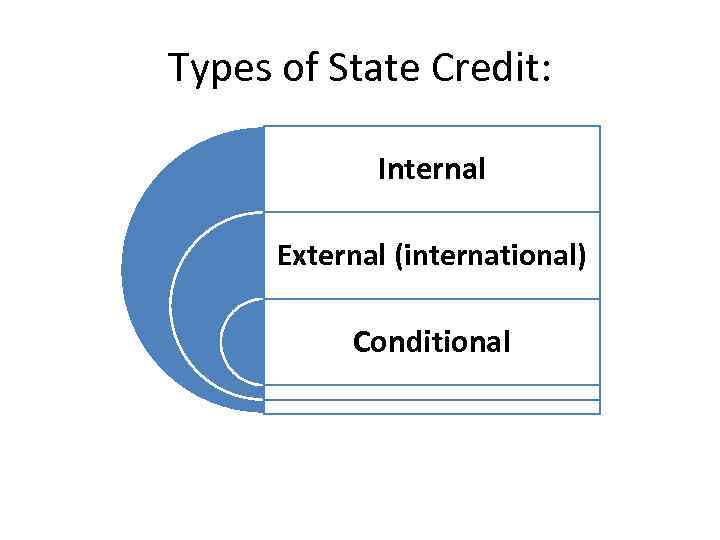
Types of State Credit: Internal External (international) Conditional
Internal State Credit • State-credit relations appear between government, local authorities, firms, organizations and population of the country as borrowers and creditors at the same time.
External State Credit • Government, local authorities, banks, other countries’ companies are involved into relations from one side and international financial-banking organizations from other side. The side which issues a loan is called state-donor or donor-organization and a country which gets a loan is called a countryrecipient.
Conditional State Credit • Is presented as governmental obligations which provide guarantees to creditors of foreign countries and are given to Kazakhstani borrowers: companies, organizations, enterprises, local authorities. In case loan conditions are not followed, the government is responsible for local borrowers and pays the loan amount from the budget.
The main form of the State Credit: • State loans – credit relations where the government is mainly presented as a debtor.
State Debt • is an outstanding amount of issued and unpaid state loans (including the interest rate).
State Debt • Attracts money resources by means of the state loans for broadening the reproduction and for meeting social needs. State debt is paid by the government at the expense of the state budget funds.
Slide Title • II. Finances of economic subjects
2. Finances of commercial economic subjects Principles of finances organization in commercial enterprises: 1. Commercial calculation 2. Planning 3. Equality of all forms of property 4. Available of financial reserves.
Principle of commercial calculation: • Self-repayment • Self-Financing Indication of commercial calculation: • Financial independence • Financial responsibility • Financial interest
Principle of Planning Financial activity of the enterprise is foreseen by calculation of its parameters proceeding from targets, aims of production , methods of its achievement, sequence and deadline. Financial plan

Principe of equality for all forms of companies’ and organizations’ property. • Commercial calculation is realized as a state guarantee providing stable relations and development of different property forms. The proprietor has a right to own, dispose the property into any economic activities within the law.
Availability of financial reserves (reserve fund, risk fund ) • In percentage to value of social and productive development funds • Stable norm standards from profit by means of deduction Financial reserves are for: • Elimination of temporary financial difficulties and provision of normal labor conditions • Financing expenses connected with productive and social development
3. Financial Funds of enterprises • • Authorized Fund Reserve Fund Saving Fund Consumption Fund Wage Fund Currency Fund Repair Fund

Slide title III. Household finances
Household Finances • Represent economical money relations on forming and utilization of money funds. The main purpose is to ensure household members with social and material conditions for life.
Household financial recourses are represented in form of solitary money funds: • Consumption fund is for meeting personal needs of certain group of people – e. g. family (buying food, payment for different services and etc. ); • Saving fund (отложенных потребностей) is for long-term perspective, for buying goods in the future or can be used as capital for making profit.
Structure of household financial resources: • 1) own means – money earned by each family member (salary, profit from commercial activities); • 2) means received on the market (loans, dividends, interest rate); • 3) means received after redistribution (pensions, benefits, budget and off-budget loans).
Financial resources of population are: • Pension savings in pension saving funds (on 1. 01. 2012 savings are 2, 651 trillion tenge); • Deposits of population in second level banks about 5, 9 trillion tenge; • Some means in the State fund of social insurance

Slide title • Thank you for your attention!!!
Скачать презентацию Theme 4 Financial system of the Republic of
Тема 4 Фин.система англ.ppt