


 Скачать презентацию Theme 3 Money Market 1 The essence of
а3 Денежный рынок.ppt
- Количество слайдов: 152
 Theme 3 "Money Market" 1. The essence of the money market. 2. Institutional model of the money market. 3. The structure of the money market. 4. Demand for money. 5. The money supply. 1
 1. The essence of the money market 2
 Money market Sector of the market, which provides a sale of money as a specific commodity, creates demand, supply and price for this commodity. 3
 Money Market – is a network of special (banking and financial) institutions that provide the interaction of supply and demand for money as a specific product. Under the money market we have to understand the market of highly liquid assets. 4
 The price of "goods" (money), which is bought and sold in the market, is the cost of borrowing. The rate of interest on the money market is the basis for determining the percentage in the market of loan capital. 5
 From an economic point of view, the money market is the relationship of three concepts: • money; • income; • rate of interest. 6
 The key functions of the money market is to balance demand supply of money and the formation of a market rate of interest as the price of money. 7
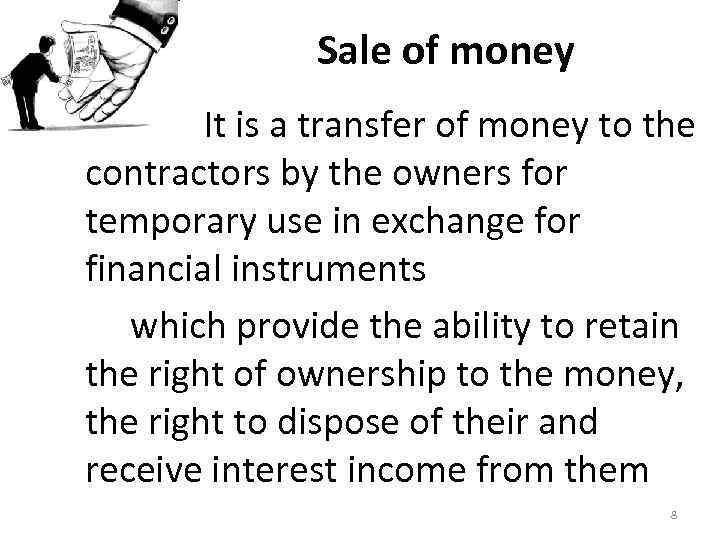 Sale of money It is a transfer of money to the contractors by the owners for temporary use in exchange for financial instruments which provide the ability to retain the right of ownership to the money, the right to dispose of their and receive interest income from them 8
 Purchase of money It is a form of obtaining by market players at his disposal a sum of money in exchange for financial instruments 9
 Financial Instruments They are obligations of the buyer of money to the seller of money 10
 Non-debt financial instruments They are commitment to providing the right to participate in the management of money and perticipate in the buyer's income, so that the seller of money saves not only the right to own them, but also saves the right to dispose of money (shares, insurance contracts) 11
 Debt financial instruments They are obligations, by which the buyer must return to the seller the sum of money, which buyer received from him and must pay the income for using the money 12
 Deposit liabilities According to them the seller transfers money at the disposal of buyers, upon their return, and pays an interest income (current and term deposits, certificates of deposit and savings, trust deposits) 13
 Loan liabilities Sellers on them, handing money to the buyer, make certain restrictions on the right to dispose of the money (loan agreements, bonds, notes) 14
 The specific characteristics of the money market 1. Purchase and sale of money are provided only if the one subject of market has available resources, and other subject needs these resources; 2. The transfer of money from the owner to their recipient is provided by using financial instruments; 15
 3. Due to purchase their money the seller does not lose ownership of the sold amount of money and he freely gives the right to dispose of money to the buyer at agreed conditions; 4. At the moment of sale the seller does not receive money equivalent, and the buyer does not receive the real property rights, because the buyer has money temporarily; 16
 5. The purpose of buying and selling of money is to obtain additional income: ‐ the seller has a percentage and ‐ the buyer has a profits. 17
 2. Institutional model of the money market 18
 Direct financing Transfer of funds via the market directly from their owner to those who need them for actual use. 19
 • Capital funding: the company buys money in exchange for the right to participate in the ownership (shares); • Borrowing: the company buys money in exchange for the obligation to return them in future with the payment of interest (through bonds). 20
 Indirect financing it is the movement of money from the lender to the borrower via the market through financial intermediaries. 21
 Financial intermediaries – they are special companies that accumulate money in the money market and forward them to borrowers on a commercial basis. 22
 3. The structure of the money market 23
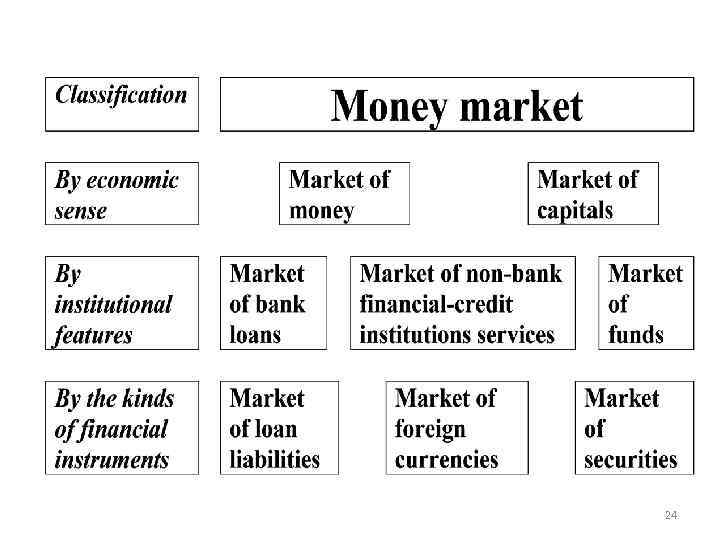 24
24
 Structuring of the money market by functions 25
 Interbank market Provides banking operations for placement of temporary free funds in the form of interbank deposits and loans. 26
 Open market Provides purchase and sale of securities (short‐ term obligations of the state) by the central bank. 27
 Money market ‐ a segment of the money market, where short‐term funds (up to 1 year) are bought. Classical operations in the money market: interbank lending, bill discounting, short‐term deposit and loan agreements, transactions in the secondary market with short‐ term government obligations. 28
 Capital market - a segment of the money market, at which the medium‐ and long‐term funds (over 1 year) are bought. Classical operations in the capital market: transactions with equity instruments (shares and bonds), medium‐ and long‐term deposit and lending agreement, the operations of non‐bank financial institutions. 29
 Market of bank loans is the accumulation of surplus funds and grant loans for terms of repayment, maturity and payment. Institutional organizations: commercial banks. 30
 Market of non-bank financial institutions’ services provides the accumulation of savings and placing them in earning assets. Institutional bodies: the insurance companies, pension funds, investment funds, financial companies 31
 Stock Market moves non‐ bank debt, which is driven by the stock values. Institutional bodies ‐ the stock exchanges. 32
 Market of loan commitments covers the relationship of banks and their clients on the formation and placement of credit. 33
 Foreign exchange market covers the relationships between economic agents about the purchase and sale of foreign currency on the basis of supply and demand. 34
 Securities market includes both credit relations and the relationship of co‐ownership, which are formed by the issue of a special document (securities) that can be sold, bought, redeemed 35
 Money market depends on the following factors: ‐ Cyclical changes in the economy, ‐ The rate of inflation ‐ Features of national monetary policy. 36
 4. Demand for money 37
 Demand for money • It is the amount of money, which an economic agents tend to have available at any moment of time • It is a solvency requirement or the amount of money, which buyers can and are going to pay for necessary goods and services. 38
 Money is necessary to carry out transactions; in other words, it provides liquidity. This creates a trade‐off between the liquidity advantage of holding money and the interest advantage of holding other assets. 39
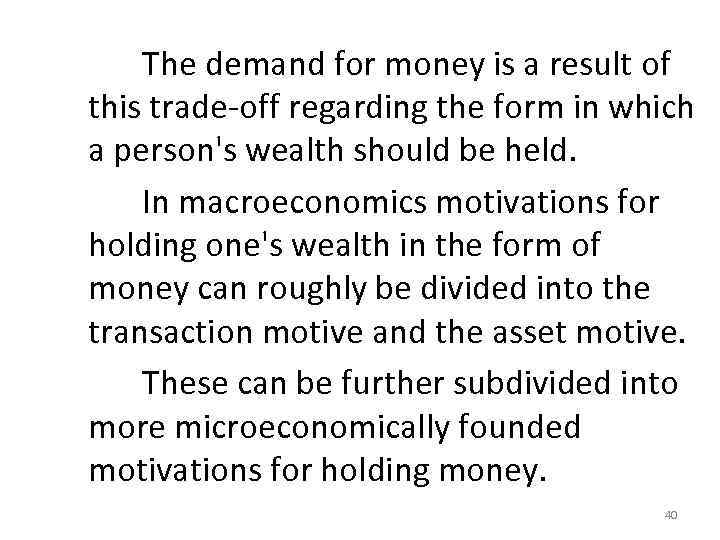 The demand for money is a result of this trade‐off regarding the form in which a person's wealth should be held. In macroeconomics motivations for holding one's wealth in the form of money can roughly be divided into the transaction motive and the asset motive. These can be further subdivided into more microeconomically founded motivations for holding money. 40
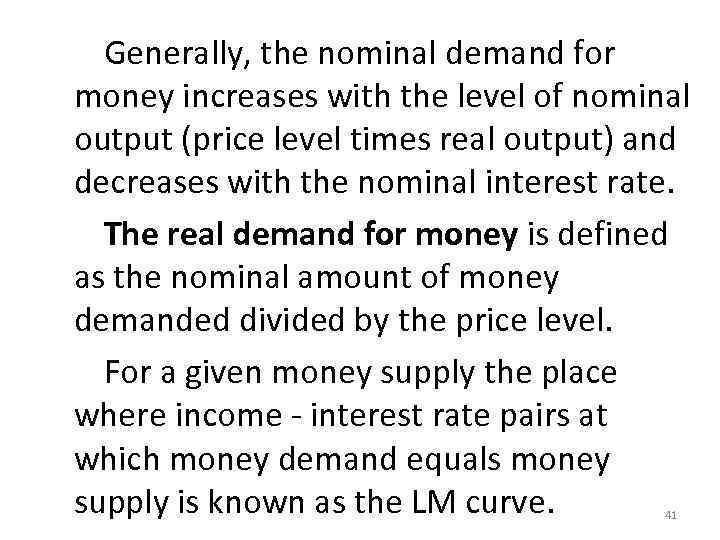 Generally, the nominal demand for money increases with the level of nominal output (price level times real output) and decreases with the nominal interest rate. The real demand for money is defined as the nominal amount of money demanded divided by the price level. For a given money supply the place where income ‐ interest rate pairs at which money demand equals money supply is known as the LM curve. 41
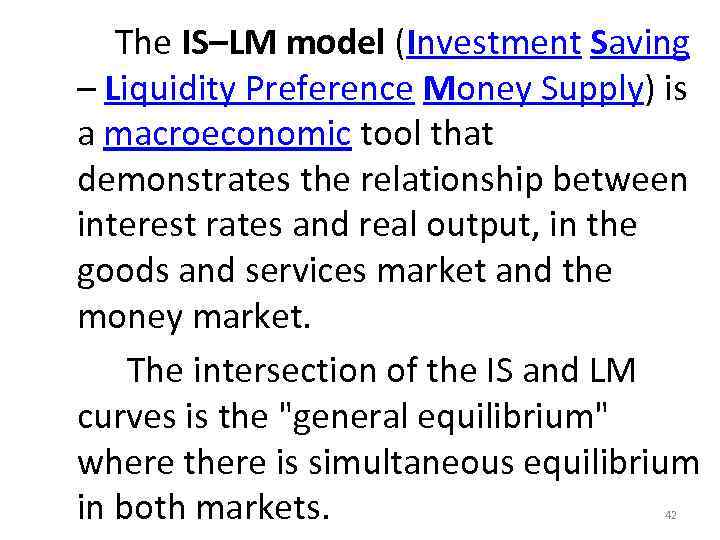 The IS–LM model (Investment Saving – Liquidity Preference Money Supply) is a macroeconomic tool that demonstrates the relationship between interest rates and real output, in the goods and services market and the money market. The intersection of the IS and LM curves is the "general equilibrium" where there is simultaneous equilibrium in both markets. 42
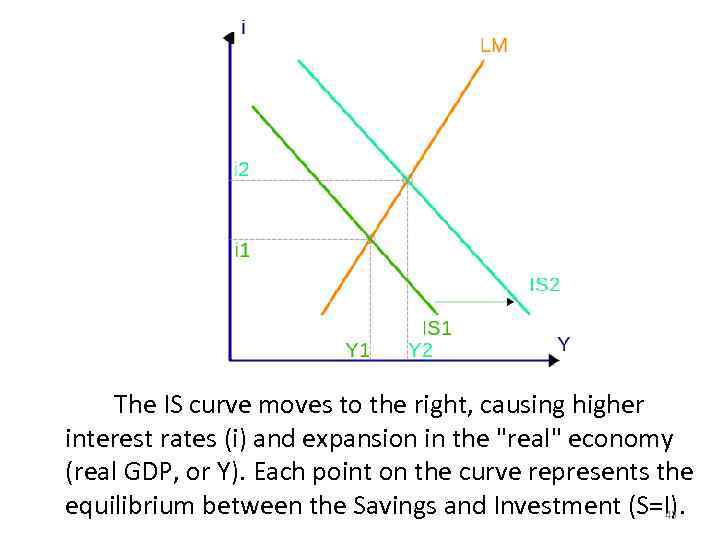 The IS curve moves to the right, causing higher interest rates (i) and expansion in the "real" economy (real GDP, or Y). Each point on the curve represents the equilibrium between the Savings and Investment (S=I). 43
 The magnitude of the volatility of money demand has crucial implications for the optimal way in which a central bank should carry out monetary policy and its choice of a nominal anchor. Conditions under which the LM curve is flat, so that increases in the money supply have no stimulatory effect (a liquidity trap), play an important role in Keynesian theory. This situation occurs when the demand for money is infinitely elastic with respect to the interest rate. 44
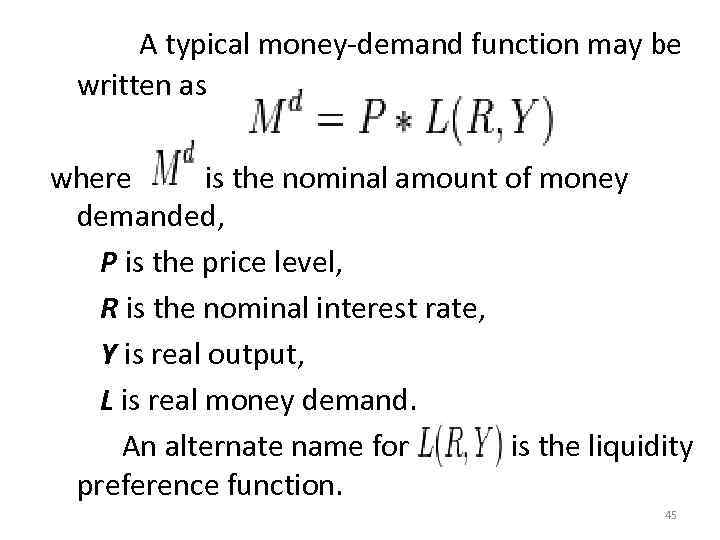 A typical money‐demand function may be written as where is the nominal amount of money demanded, P is the price level, R is the nominal interest rate, Y is real output, L is real money demand. An alternate name for is the liquidity preference function. 45
 Motives for holding money 1. Transaction motive The transactions motive for money demand results from the need for liquidity for day‐to‐day transactions in the near future. This need arises when income is received only occasionally (say once per month) in discrete amounts but expenditures occur continuously. 46
 2. Quantity theory The most basic "classical" transaction motive can be illustrated with reference to the Quantity Theory of Money. 47
 According to the equation of exchange MV = PY, where M is the stock of money, V is its velocity (how many times a unit of money turns over during a period of time), P is the price level and Y is real income. Consequently PY is nominal income or in other words the number of transactions carried out in an economy during a period of time. 48
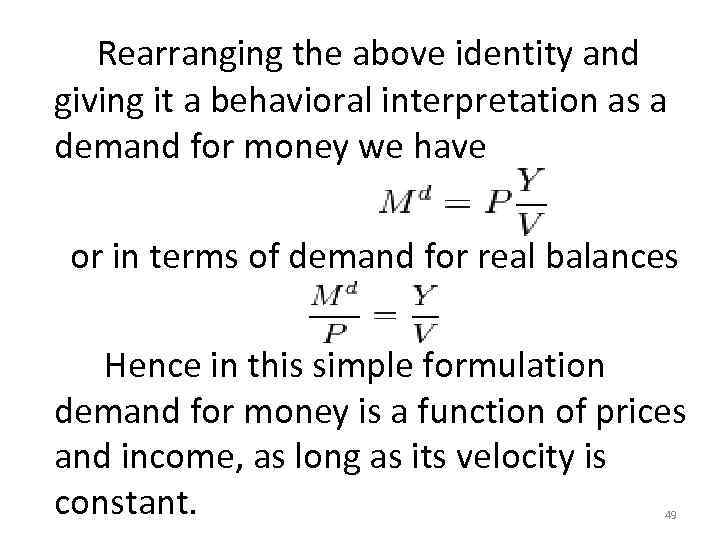 Rearranging the above identity and giving it a behavioral interpretation as a demand for money we have or in terms of demand for real balances Hence in this simple formulation demand for money is a function of prices and income, as long as its velocity is constant. 49
 3. Inventory models The amount of money demanded for transactions is also likely to depend on the nominal interest rate. This arises due the lack of synchronization in time between when purchases are desired and when factor payments (such as wages) are made. 50
 While workers may get paid only once a month they generally will wish to make purchases, and hence need money, over the course of the entire month. The most well‐known example of an economic model that is based on such considerations is the Baumol‐Tobin model. In this model an individual receives his income periodically, for example, only once per month, but wishes to make purchases continuously. 51
 The person could carry his entire income with him at all times and use it to make purchases. However, in this case he would be giving up the (nominal) interest rate that he can get by holding his income in the bank. The optimal strategy involves holding a portion of one's income in the bank and portion as liquid money. 52
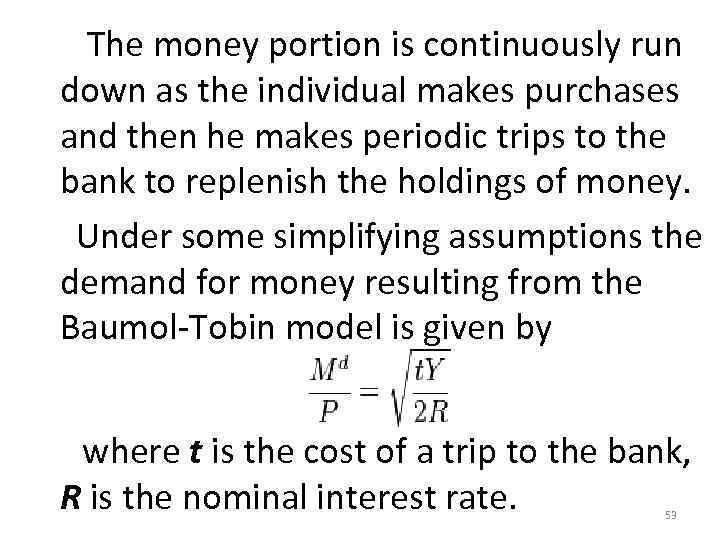 The money portion is continuously run down as the individual makes purchases and then he makes periodic trips to the bank to replenish the holdings of money. Under some simplifying assumptions the demand for money resulting from the Baumol‐Tobin model is given by where t is the cost of a trip to the bank, R is the nominal interest rate. 53
 The key difference between this formulation and the one based on a simple version of Quantity Theory is that now the demand for real balances depends on both income (positively) or the desired level of transactions, and on the nominal interest rate (negatively). 54
 4. Microfoundations for money demand While the Baumol‐Tobin model provides a microeconomic explanation for the form of the money demand function, it is generally too stylized to be included in modern macroeconomic models, particularly dynamic stochastic general equilibrium models. 55
 As a result most models of this type resort to simpler indirect methods which capture the spirit of the transactions motive. The two most commonly used methods are the cash‐in‐advance model (sometimes called the Clower Constraint model) and the money in the utility function model (sometimes referred to as the 'MIU' or the Sidrauski model). 56
 In the cash‐in‐advance model agents are restricted to carrying out a volume of transactions equal to or less than their money holdings. In the MIU model, money directly enters agents‘ utility functions, capturing the 'liquidity services' provided by money. 57
 5. Asset motive The asset motive treats money, in the broader sense of including interest‐ bearing bank deposits, as a particular type of a financial asset among many others. While it is still assumed that money is held in order to carry out transactions, this approach focuses on the potential return on various assets (including money) as an additional motivation. 58
 6. Speculative motive John Maynard Keynes, in laying out speculative reasons for holding money, stressed the choice between money and bonds. If agents expect the future nominal interest rate (the return on bonds) to be lower than the current rate they will then reduce their holdings of money and increase their holdings of bonds. 59
 If the future interest rate does fall, then the price of bonds will increase and the agents will have realized a capital gain on the bonds they purchased. This means that the demand for money in any period will depend on both the current nominal interest rate and the expected future interest rate (in addition to the standard transaction motives which depend on income). 60
 The fact that the current demand for money can depend on expectations of the future interest rates has implications for volatility of money demand. If these expectations are formed, as in Keynes' view, by "animal spirits" they are likely to change erratically and cause money demand to be quite unstable. 61
 7. Portfolio motive The portfolio motive also focuses on demand for money over and above that required for carrying out transactions. The basic framework is due to James Tobin, who considered a situation where agents can hold their wealth in a form of a low risk/low return asset (here, money) or high risk/high return asset (bonds or equity). 62
 Agents will choose a mix of these two types of assets (their portfolio) based on the risk‐expected return trade‐off. For a given expected rate of return, more risk averse individuals will choose a greater share for money in their portfolio. Similarly, given a person's degree of risk aversion, a higher expected return (nominal interest rate plus expected capital gains on bonds) will cause agents to shift away from safe money and into risky assets. 63
 Like in the other motivations above, this creates a negative relationship between the nominal interest rate and the demand for money. However, what matters additionally in the Tobin model is the subjective rate of risk aversion, as well as the objective degree of risk of other assets, as, say, measured by the standard deviation of capital gains and losses resulting from holding bonds and/or equity. 64
 Empirical estimations of money demand functions Friedman and Schwartz in their 1963 work A Monetary History of the United States argued that the demand for real balances was a stable function of income and the interest rate. For the time period they were studying this appeared to be true. 65
 However, shortly after the publication of the book, due to changes in financial markets and financial regulation money demand became more unstable. Various researchers showed that money demand became much more unstable after 1975. Ericsson, Hendry and Prestwich (1998) consider a model of money demand based on the various motives outlined above and test it with empirical data. 66
 The basic model turns out to work well for the period 1878 to 1975 and there doesn't appear to be much volatility in money demand, in a result analogous to that of Friedman and Schwartz. This is true even despite the fact that the two world wars during this time period could have led to changes in the velocity of money. 67
 However, when the same basic model is used on data spanning 1976 to 1993, it performs poorly. In particular, money demand appears not to be sensitive to interest rates and there appears to be much more exogenous volatility. The authors attribute the difference to technological innovations in the financial markets, financial deregulation, and the related issue of the changing menu of assets considered in the definition of money. 68
 Later work by Lawrence Ball suggests that the use of adapted aggregates, such as near monies, can produce a more stable demand function. Through his research, Ball was able to show that using the return on near monies produced smaller deviations than previous models. 69
 Importance of money demand volatility for monetary policy If the demand for money is stable then a monetary policy which consists of a monetary rule which targets the growth rate of some monetary aggregate (such as M 1 or M 2) can help to stabilize the economy or at least remove monetary policy as a source of macroeconomic volatility. 70
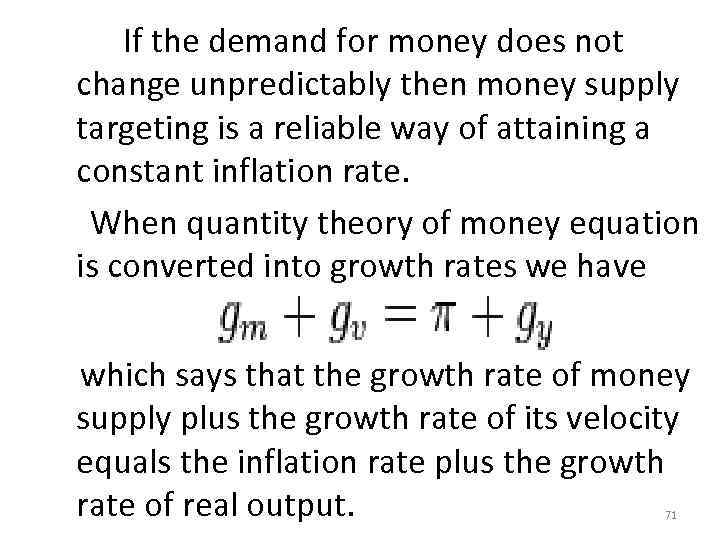 If the demand for money does not change unpredictably then money supply targeting is a reliable way of attaining a constant inflation rate. When quantity theory of money equation is converted into growth rates we have which says that the growth rate of money supply plus the growth rate of its velocity equals the inflation rate plus the growth rate of real output. 71
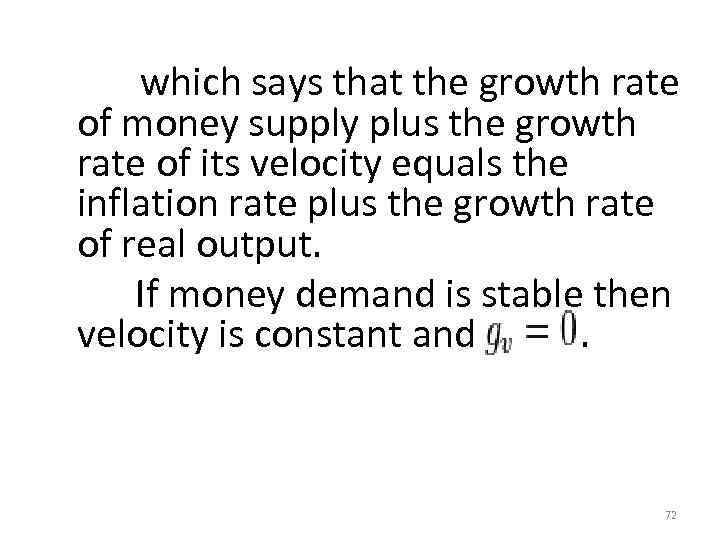 which says that the growth rate of money supply plus the growth rate of its velocity equals the inflation rate plus the growth rate of real output. If money demand is stable then velocity is constant and . 72
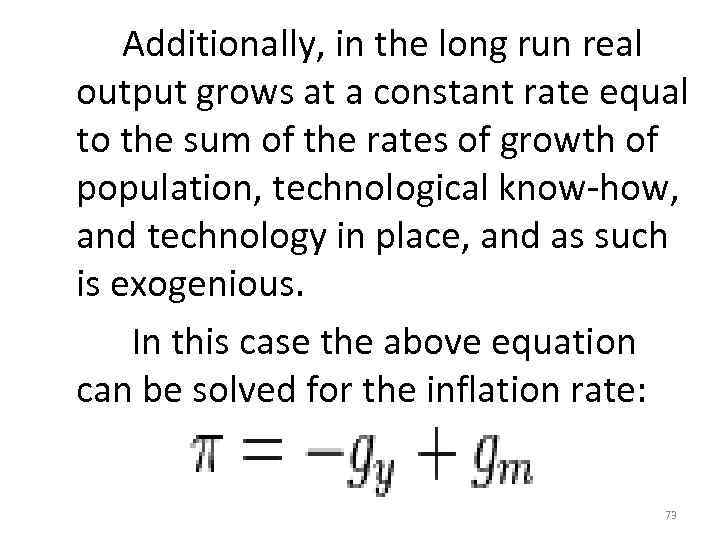 Additionally, in the long run real output grows at a constant rate equal to the sum of the rates of growth of population, technological know‐how, and technology in place, and as such is exogenious. In this case the above equation can be solved for the inflation rate: 73
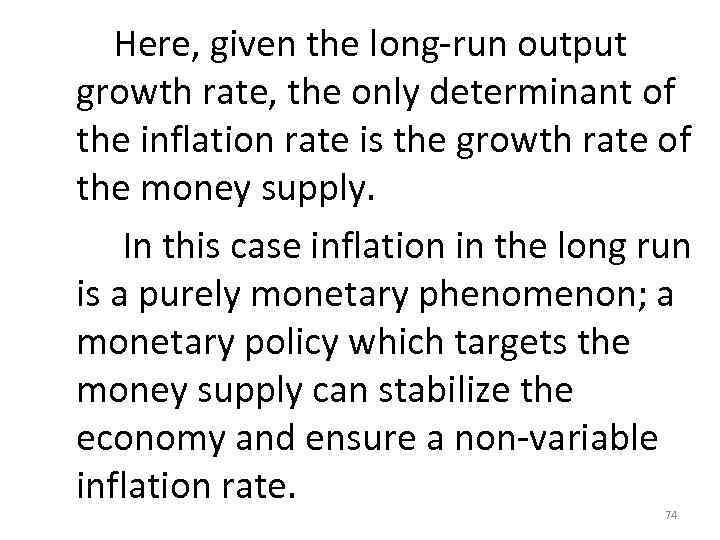 Here, given the long‐run output growth rate, the only determinant of the inflation rate is the growth rate of the money supply. In this case inflation in the long run is a purely monetary phenomenon; a monetary policy which targets the money supply can stabilize the economy and ensure a non‐variable inflation rate. 74
 This analysis however breaks down if the demand for money is not stable — for example, if velocity in the above equation is not constant. In that case, shocks to money demand under money supply targeting will translate into changes in real and nominal interest rates and result in economic fluctuations. 75
 An alternative policy of targeting interest rates rather than the money supply can improve upon this outcome as the money supply is adjusted to shocks in money demand, keeping interest rates (and hence, economic activity) relatively constant. The above discussion implies that the volatility of money demand matters for how monetary policy should be conducted. 76
 If most of the aggregate demand shocks which affect the economy come from the expenditure side, the IS curve, then a policy of targeting the money supply will be stabilizing, relative to a policy of targeting interest rates. However, if most of the aggregate demand shocks come from changes in money demand, which influences the LM curve, then a policy of targeting the money supply will be destabilizing. 77
 Factors which can cause the demand for money to change 1. Interest Rates 2. Consumer Spending 3. Precautionary Motives 4. Transaction Costs for Stocks and Bonds 5. Change in the General Level of Prices 6. International Factors 78
 Factors Which Increase the • • Demand for Money A reduction in the interest rate. A rise in the demand for consumer spending. A rise in uncertainty about the future and future opportunities. A rise in transaction costs to buy and sell stocks and bonds. 79
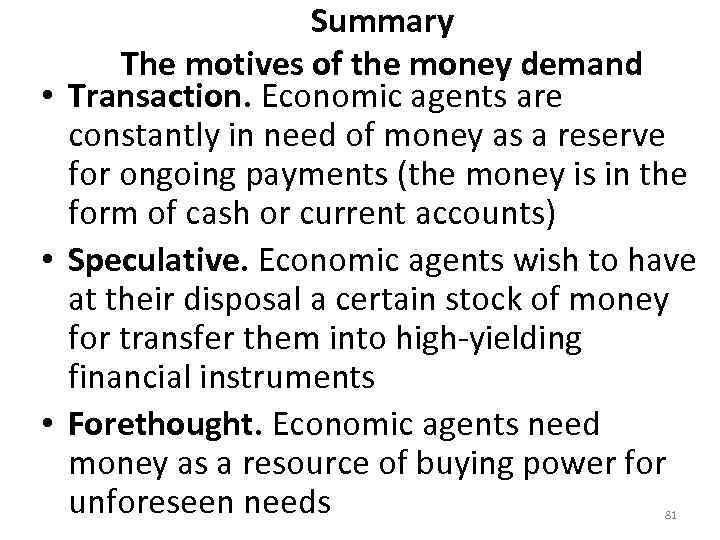
 • A rise in inflation causes a rise in the nominal money demand but real money demand stays constant. • A rise in the demand for a country's goods abroad. • A rise in the demand for domestic investment by foreigners. • A rise in the belief of the future value of the currency. • A rise in the demand for a currency by central banks (both domestic and foreign). 80
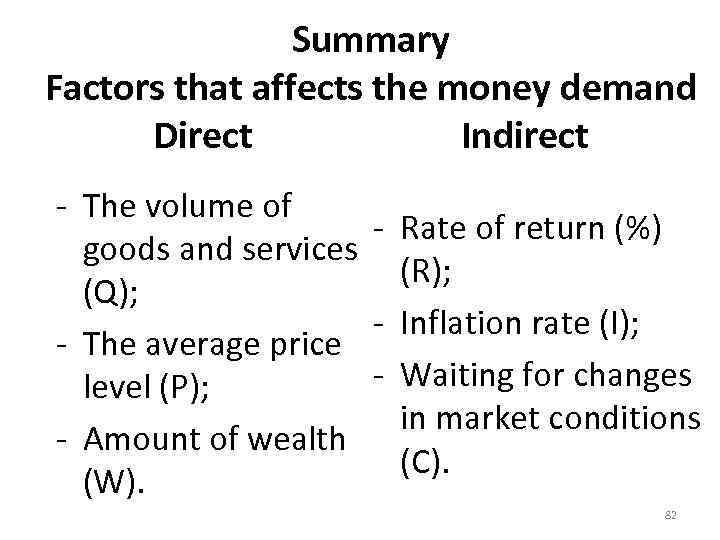
 Summary The motives of the money demand • Transaction. Economic agents are constantly in need of money as a reserve for ongoing payments (the money is in the form of cash or current accounts) • Speculative. Economic agents wish to have at their disposal a certain stock of money for transfer them into high‐yielding financial instruments • Forethought. Economic agents need money as a resource of buying power for unforeseen needs 81
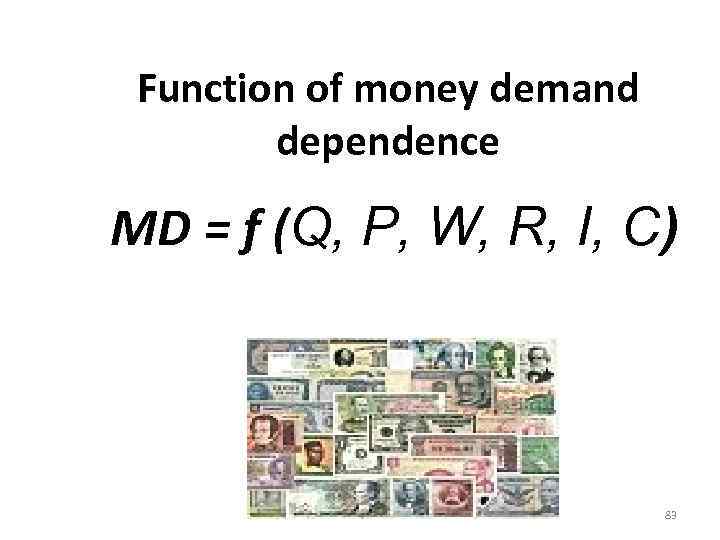
 Summary Factors that affects the money demand Direct Indirect ‐ The volume of ‐ goods and services (Q); ‐ ‐ The average price ‐ level (P); ‐ Amount of wealth (W). Rate of return (%) (R); Inflation rate (I); Waiting for changes in market conditions (C). 82
 Function of money demand dependence МD = f (Q, P, W, R, I, C) 83
 5. The supply of money 84
 Money supply (MS) The desire of economic agents to lend a portion of their money to generate income 85
 Public and private sector analysts have long monitored changes in money supply because of its effects on the price level, inflation, exchange rate, business cycle. That relation between money and prices is historically associated with the quantity theory of money. There is strong empirical evidence of a direct relation between money‐supply growth and long‐term price inflation, at least for rapid increases in the amount of money in the economy. 86
 That is, a country such as Zimbabwe which saw rapid increases in its money supply also saw rapid increases in prices. This is one reason for the reliance on monetary policy as a means of controlling inflation. The nature of this causal chain is the subject of contention. Some economists argue that the money supply is endogenous (determined by the workings of the economy, not by the central bank) and that the sources of inflation must be found in the distributional structure of the economy. 87
 Those economists seeing the central bank's control over the money supply as feeble say that there are two weak links between the growth of the money supply and the inflation rate. First, in the aftermath of a recession, when many resources are underutilized, an increase in the money supply can cause a sustained increase in real production instead of inflation. Second, if increase in the money supply could have either no effect, or an unpredictable effect on the growth of nominal GDP. 88
 Public and private sector analysts have long monitored changes in money supply because of its effects on the price level, inflation, exchange rate, business cycle. That relation between money and prices is historically associated with the quantity theory of money. There is strong empirical evidence of a direct relation between money‐supply growth and long‐term price inflation, at least for rapid increases in the amount of money in the economy. 89
 In USA money is used as a medium of exchange, a unit of account, a store of value. There is no single "correct" measure of the money supply. Instead, there are several measures, classified along a spectrum or continuum between narrow and broad monetary aggregates. Narrow measures include only the most liquid assets, the ones most easily used to spend (currency, checkable deposits). Broader measures add less liquid types of assets (certificates of deposit). 90
 It corresponds to the way that different types of money are more or less controlled by monetary policy. Narrow measures include those more directly affected and controlled by monetary policy, whereas broader measures are less closely related to monetary‐policy actions. It is a matter of perennial debate as to whether narrower or broader versions of the money supply have a more predictable link to nominal GDP. 91
 The different types of money are typically classified as "M"s. The "M"s usually range from M 0 (narrowest) to M 3 (broadest) but which "M"s are actually focused on in policy formulation depends on the country's central bank. The typical layout for each of the "M"s is as follows: 92
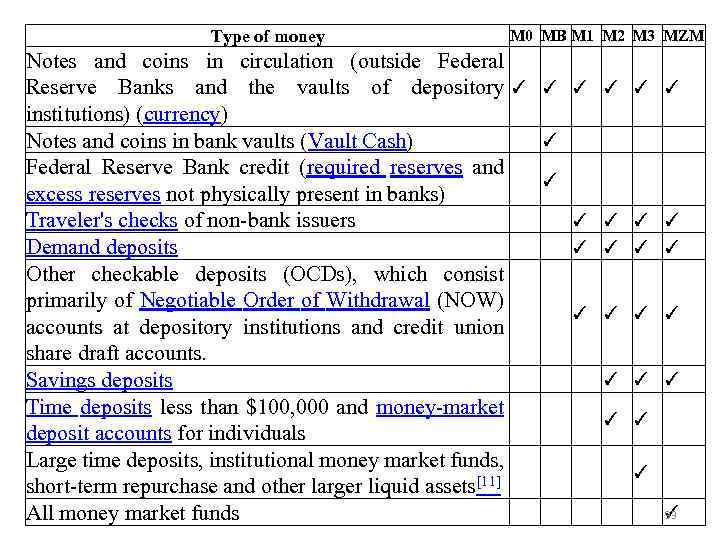 Type of money M 0 MB M 1 M 2 M 3 MZM Notes and coins in circulation (outside Federal Reserve Banks and the vaults of depository ✓ ✓ ✓ institutions) (currency) ✓ Notes and coins in bank vaults (Vault Cash) Federal Reserve Bank credit (required reserves and ✓ excess reserves not physically present in banks) ✓ ✓ Traveler's checks of non-bank issuers ✓ ✓ Demand deposits Other checkable deposits (OCDs), which consist primarily of Negotiable Order of Withdrawal (NOW) ✓ ✓ accounts at depository institutions and credit union share draft accounts. ✓ ✓ ✓ Savings deposits Time deposits less than $100, 000 and money-market ✓ ✓ deposit accounts for individuals Large time deposits, institutional money market funds, ✓ [11] short-term repurchase and other larger liquid assets ✓ 93 All money market funds
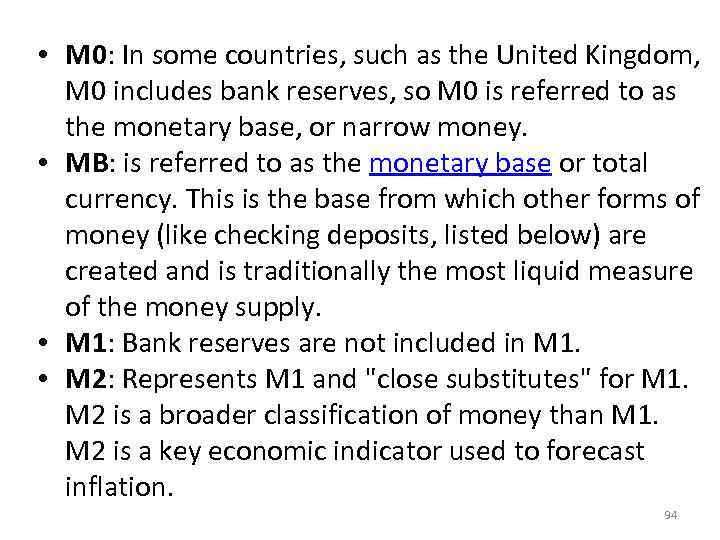 • M 0: In some countries, such as the United Kingdom, M 0 includes bank reserves, so M 0 is referred to as the monetary base, or narrow money. • MB: is referred to as the monetary base or total currency. This is the base from which other forms of money (like checking deposits, listed below) are created and is traditionally the most liquid measure of the money supply. • M 1: Bank reserves are not included in M 1. • M 2: Represents M 1 and "close substitutes" for M 1. M 2 is a broader classification of money than M 1. M 2 is a key economic indicator used to forecast inflation. 94
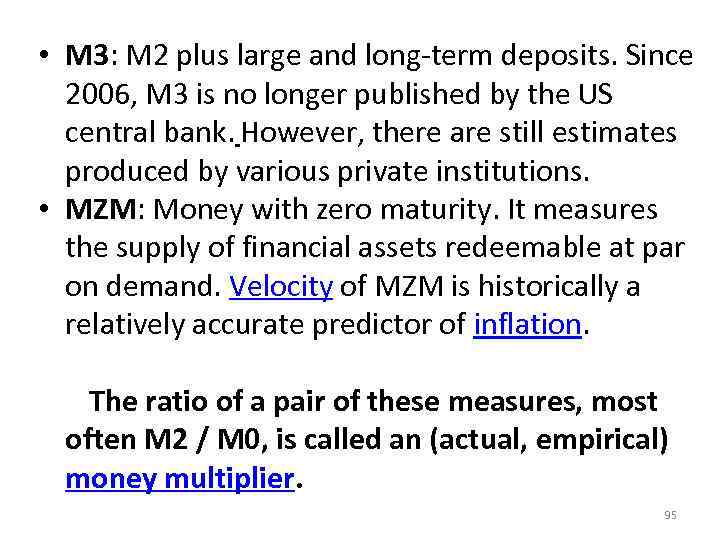 • M 3: M 2 plus large and long‐term deposits. Since 2006, M 3 is no longer published by the US central bank. However, there are still estimates produced by various private institutions. • MZM: Money with zero maturity. It measures the supply of financial assets redeemable at par on demand. Velocity of MZM is historically a relatively accurate predictor of inflation. The ratio of a pair of these measures, most often M 2 / M 0, is called an (actual, empirical) money multiplier. 95
 The different forms of money in government money supply statistics arise from the practice of fractional‐ reserve banking. Whenever a bank gives out a loan in a fractional‐reserve banking system, a new sum of money is created. This new type of money is what makes up the non‐M 0 components in the M 1 -M 3 statistics. In short, there are two types of money in a fractional‐reserve banking system: • central bank money (obligations of a central bank, including currency and central bank depository accounts) • commercial bank money (obligations of commercial banks, including checking accounts and savings accounts) 96
 In the money supply statistics, central bank money is MB while the commercial bank money is divided up into the M 1 -M 3 components. Generally, the types of commercial bank money that tend to be valued at lower amounts are classified in the narrow category of M 1 while the types of commercial bank money that tend to exist in larger amounts are categorized in M 2 and M 3, with M 3 having the largest. 97
 In the US, reserves consist of money in Federal Reserve accounts and US currency held by banks (also known as "vault cash"). Currency and money in Fed accounts are interchangeable (both are obligations of the Fed. ) Reserves may come from any source, including the federal funds market, deposits by the public, and borrowing from the Fed itself. 98
 A reserve requirement is a ratio a bank must maintain between deposits and reserves. Reserve requirements do not apply to the amount of money a bank may lend out. The ratio that applies to bank lending is its capital requirement. 99
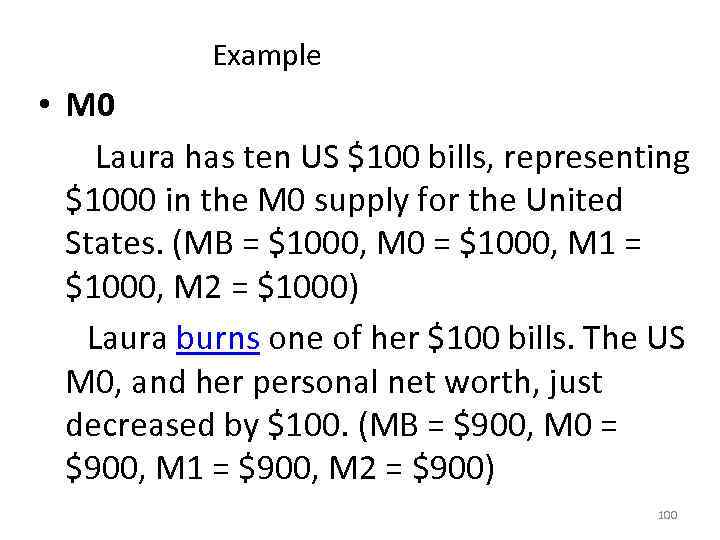 Example • M 0 Laura has ten US $100 bills, representing $1000 in the M 0 supply for the United States. (MB = $1000, M 0 = $1000, M 1 = $1000, M 2 = $1000) Laura burns one of her $100 bills. The US M 0, and her personal net worth, just decreased by $100. (MB = $900, M 0 = $900, M 1 = $900, M 2 = $900) 100
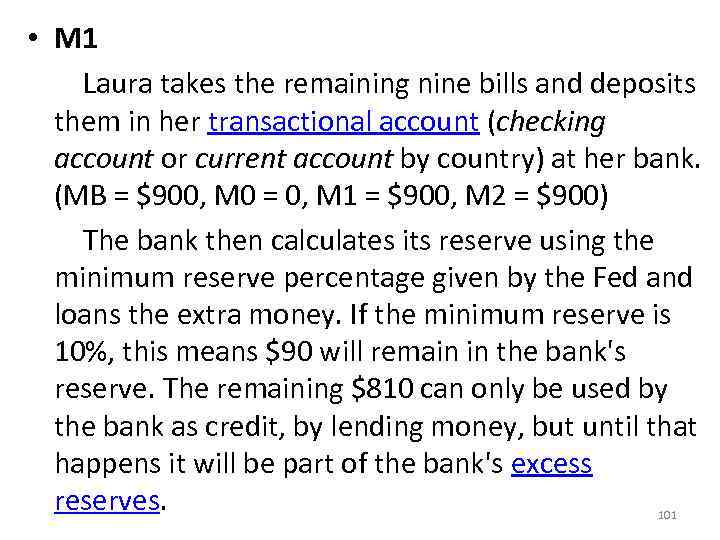 • M 1 Laura takes the remaining nine bills and deposits them in her transactional account (checking account or current account by country) at her bank. (MB = $900, M 0 = 0, M 1 = $900, M 2 = $900) The bank then calculates its reserve using the minimum reserve percentage given by the Fed and loans the extra money. If the minimum reserve is 10%, this means $90 will remain in the bank's reserve. The remaining $810 can only be used by the bank as credit, by lending money, but until that happens it will be part of the bank's excess reserves. 101
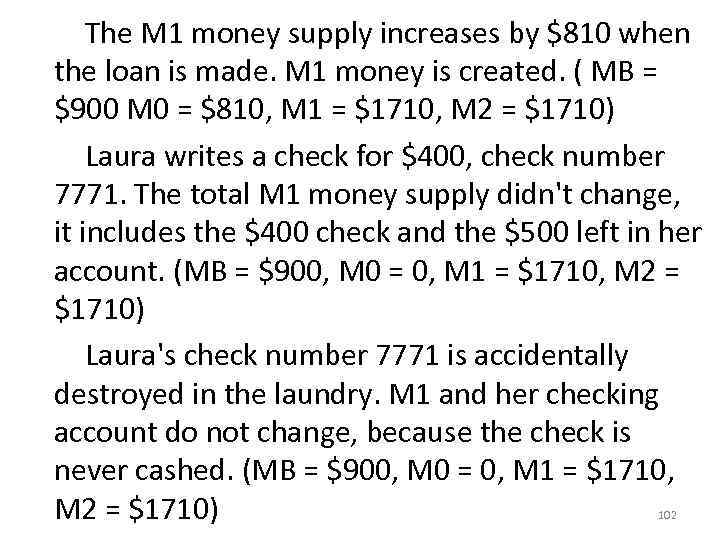 The M 1 money supply increases by $810 when the loan is made. M 1 money is created. ( MB = $900 M 0 = $810, M 1 = $1710, M 2 = $1710) Laura writes a check for $400, check number 7771. The total M 1 money supply didn't change, it includes the $400 check and the $500 left in her account. (MB = $900, M 0 = 0, M 1 = $1710, M 2 = $1710) Laura's check number 7771 is accidentally destroyed in the laundry. M 1 and her checking account do not change, because the check is never cashed. (MB = $900, M 0 = 0, M 1 = $1710, M 2 = $1710) 102
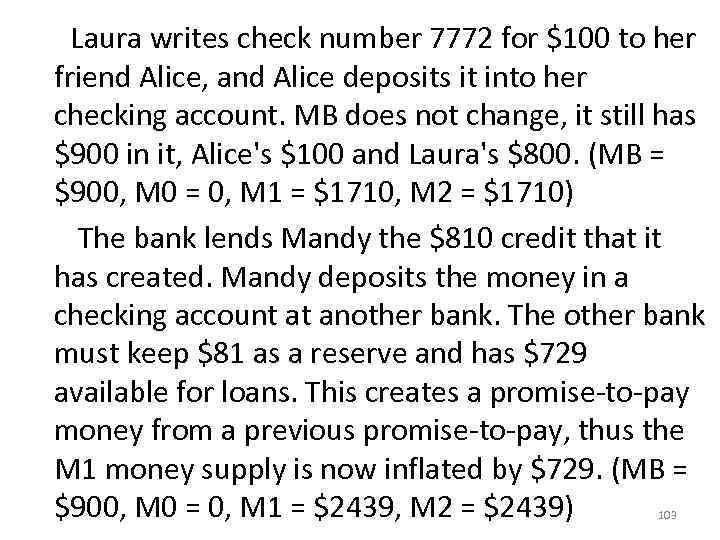 Laura writes check number 7772 for $100 to her friend Alice, and Alice deposits it into her checking account. MB does not change, it still has $900 in it, Alice's $100 and Laura's $800. (MB = $900, M 0 = 0, M 1 = $1710, M 2 = $1710) The bank lends Mandy the $810 credit that it has created. Mandy deposits the money in a checking account at another bank. The other bank must keep $81 as a reserve and has $729 available for loans. This creates a promise‐to‐pay money from a previous promise‐to‐pay, thus the M 1 money supply is now inflated by $729. (MB = $900, M 0 = 0, M 1 = $2439, M 2 = $2439) 103
 Mandy's bank now lends the money to someone else who deposits it on a checking account on yet another bank, who again stores 10% as reserve and has 90% available for loans. This process repeats itself at the next bank and so on, until the money in the reserves backs up an M 1 money supply of $9000, which is 10 times the MB money. (MB = $900, M 0 = 0, M 1 = $9000, M 2 = $9000) 104
 • M 2 Laura writes check number 7774 for $1000 and brings it to the bank to start a Money Market account (these do not have a credit‐creating charter), M 1 goes down by $1000, but M 2 stays the same. This is because M 2 includes the Money Market account in addition to all money counted in M 1. 105
 • Foreign Exchange Laura writes check number 7776 for $200 and brings it downtown to a foreign exchange bank teller at Credit Suisse to convert it to British Pounds. On this particular day, the exchange rate is exactly USD 2. 00 = GBP 1. 00. The bank Credit Suisse takes her $200 check, and gives her two £ 50 notes (and charges her a dollar for the service fee). 106
 Meanwhile, at the Credit Suisse branch office in Hong Kong, a customer named Huang has £ 100 and wants $200, and the bank does that trade (charging him an extra £. 50 for the service fee). US M 0 still has the $900, although Huang now has $200 of it. The £ 100 notes Laura walks off with are part of Britain's M 0 money supply that came from Huang. 107
 The next day, Credit Suisse finds they have an excess of GB Pounds and a shortage of US Dollars, determined by adding up all the branch offices' supplies. They sell some of their GBP on the open FX market with Deutsche Bank, which has the opposite problem. The exchange rate stays the same. 108
 The day after, both Credit Suisse and Deutsche Bank find they have too many GBP and not enough USD, along with other traders. Then, to move their inventories, they have to sell GBP at USD 1. 999, that is, 1/10‐cent less than $2 per pound, and the exchange rate shifts. None of these banks has the power to increase or decrease the British M 0 or the American M 0 (unless they burn bills); they are independent systems. 109
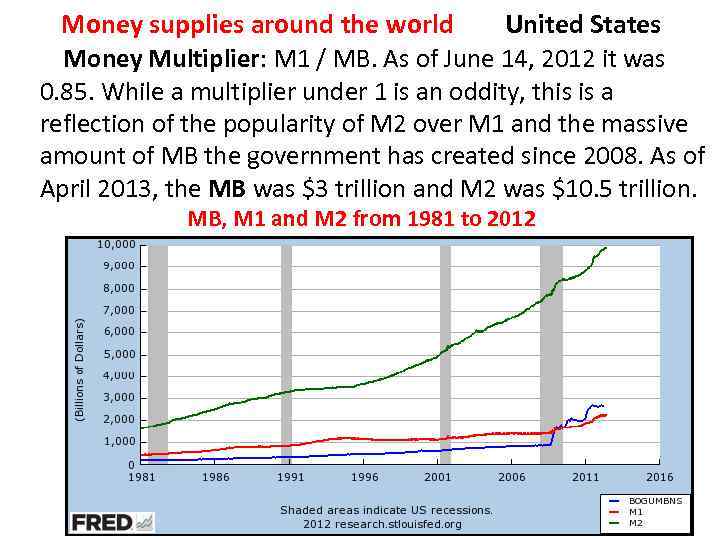 Money supplies around the world United States Money Multiplier: M 1 / MB. As of June 14, 2012 it was 0. 85. While a multiplier under 1 is an oddity, this is a reflection of the popularity of M 2 over M 1 and the massive amount of MB the government has created since 2008. As of April 2013, the MB was $3 trillion and M 2 was $10. 5 trillion. MB, M 1 and M 2 from 1981 to 2012 110
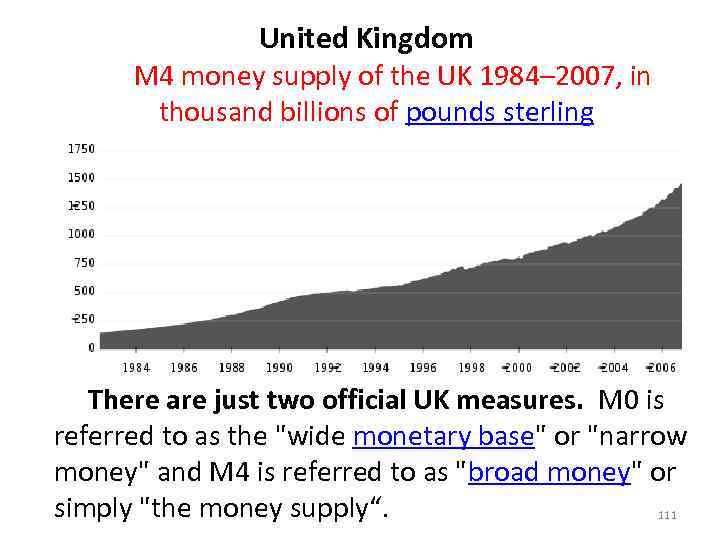 United Kingdom M 4 money supply of the UK 1984– 2007, in thousand billions of pounds sterling There are just two official UK measures. M 0 is referred to as the "wide monetary base" or "narrow money" and M 4 is referred to as "broad money" or simply "the money supply“. 111
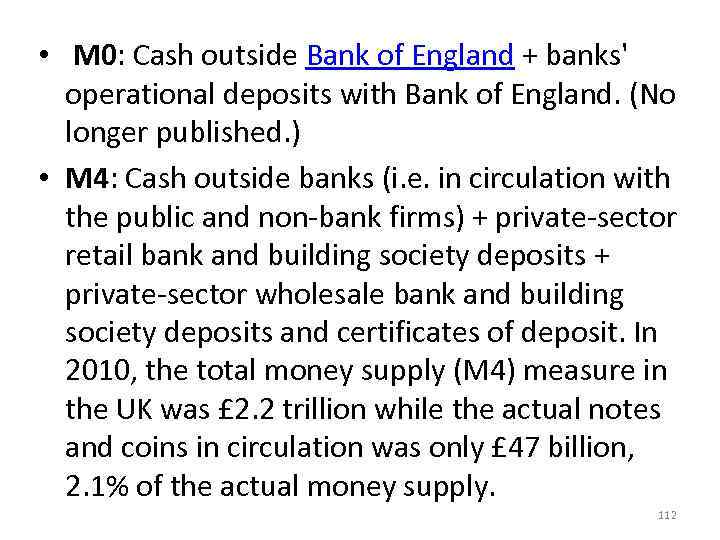 • M 0: Cash outside Bank of England + banks' operational deposits with Bank of England. (No longer published. ) • M 4: Cash outside banks (i. e. in circulation with the public and non‐bank firms) + private‐sector retail bank and building society deposits + private‐sector wholesale bank and building society deposits and certificates of deposit. In 2010, the total money supply (M 4) measure in the UK was £ 2. 2 trillion while the actual notes and coins in circulation was only £ 47 billion, 2. 1% of the actual money supply. 112
 There are several different definitions of money supply to reflect the differing stores of money. Due to the nature of bank deposits, especially time‐restricted savings account deposits, the M 4 represents the most illiquid measure of money. M 0, by contrast, is the most liquid measure of the money supply. 113
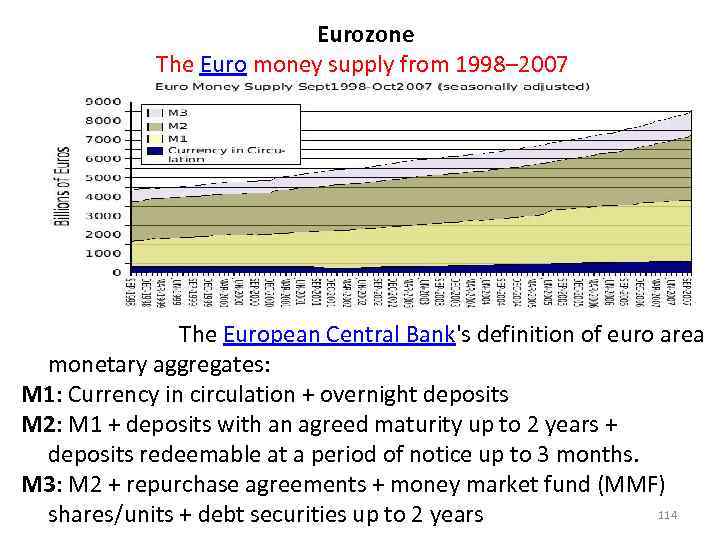 Eurozone The Euro money supply from 1998– 2007 The European Central Bank's definition of euro area monetary aggregates: M 1: Currency in circulation + overnight deposits M 2: M 1 + deposits with an agreed maturity up to 2 years + deposits redeemable at a period of notice up to 3 months. M 3: M 2 + repurchase agreements + money market fund (MMF) 114 shares/units + debt securities up to 2 years
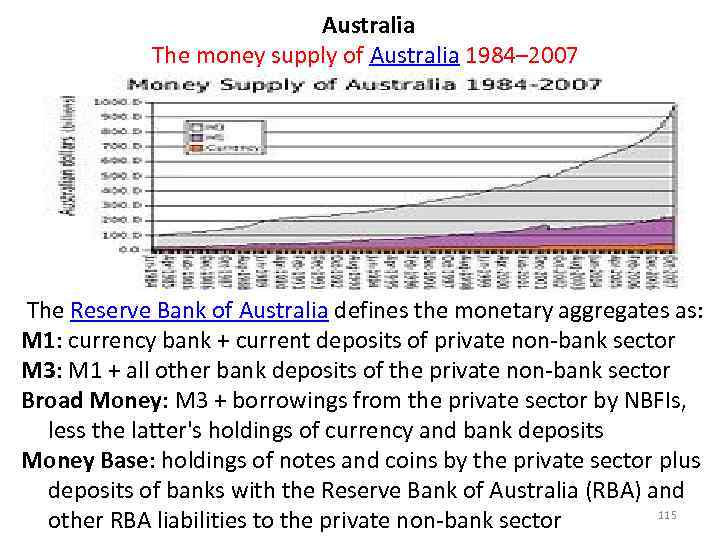 Australia The money supply of Australia 1984– 2007 The Reserve Bank of Australia defines the monetary aggregates as: M 1: currency bank + current deposits of private non‐bank sector M 3: M 1 + all other bank deposits of the private non‐bank sector Broad Money: M 3 + borrowings from the private sector by NBFIs, less the latter's holdings of currency and bank deposits Money Base: holdings of notes and coins by the private sector plus deposits of banks with the Reserve Bank of Australia (RBA) and 115 other RBA liabilities to the private non‐bank sector
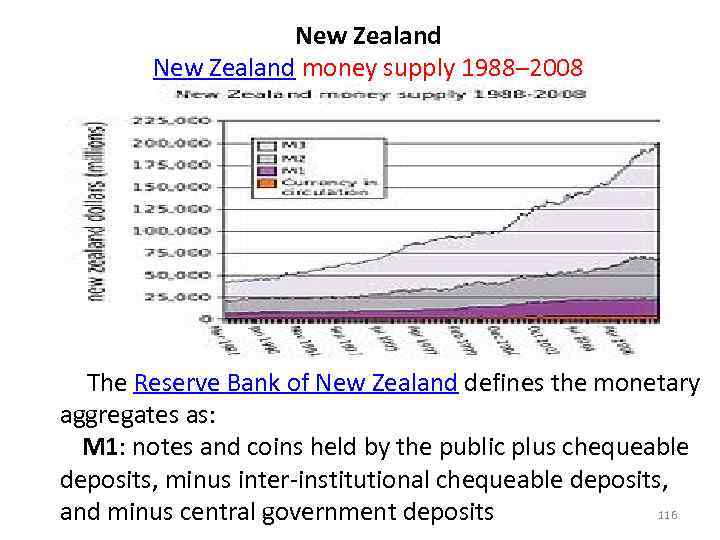 New Zealand money supply 1988– 2008 The Reserve Bank of New Zealand defines the monetary aggregates as: M 1: notes and coins held by the public plus chequeable deposits, minus inter‐institutional chequeable deposits, 116 and minus central government deposits
 M 2: M 1 + all non‐M 1 call funding (call funding includes overnight money and funding on terms that can of right be broken without break penalties) minus inter‐institutional non‐M 1 call funding M 3: the broadest monetary aggregate. It represents all New Zealand dollar funding of M 3 institutions and any Reserve Bank repos with non‐M 3 institutions. M 3 consists of notes & coin held by the public plus NZ dollar funding minus inter‐M 3 institutional claims and minus central government deposits 117
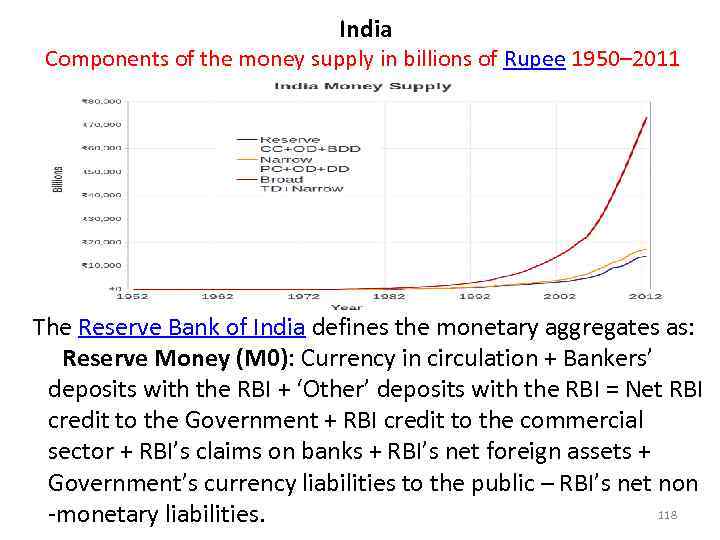 India Components of the money supply in billions of Rupee 1950– 2011 The Reserve Bank of India defines the monetary aggregates as: Reserve Money (M 0): Currency in circulation + Bankers’ deposits with the RBI + ‘Other’ deposits with the RBI = Net RBI credit to the Government + RBI credit to the commercial sector + RBI’s claims on banks + RBI’s net foreign assets + Government’s currency liabilities to the public – RBI’s net non 118 ‐monetary liabilities.
 M 1: Currency with the public + Deposit money of the public (Demand deposits with the banking system + ‘Other’ deposits with the RBI). M 2: M 1 + Savings deposits with Post office savings banks. M 3: M 1+ Time deposits with the banking system = Net bank credit to the Government + Bank credit to the commercial sector + Net foreign exchange assets of the banking sector + Government’s currency liabilities to the public – Net non‐monetary liabilities of the banking sector (Other than Time Deposits). M 4: M 3 + All deposits with post office savings banks (excluding National Savings Certificates). 119
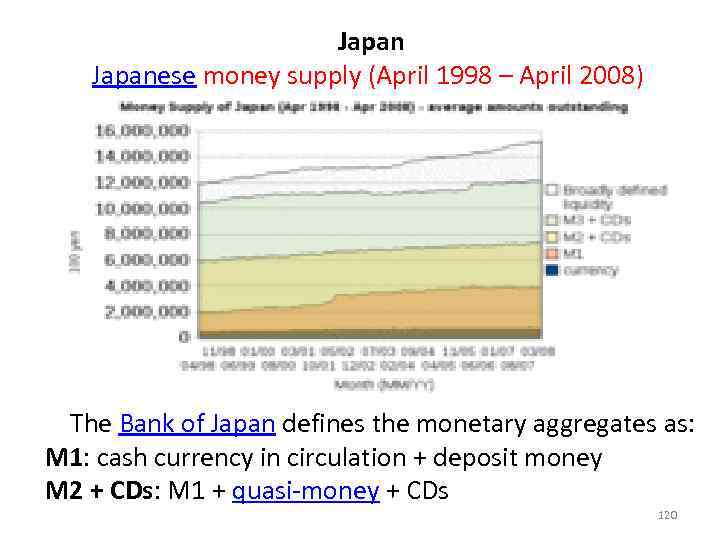 Japanese money supply (April 1998 – April 2008) The Bank of Japan defines the monetary aggregates as: M 1: cash currency in circulation + deposit money M 2 + CDs: M 1 + quasi‐money + CDs 120
 M 2 + CDs: M 1 + quasi‐money + CDs M 3 + CDs: (M 2 + CDs) + deposits of post offices + other savings and deposits with financial institutions + money trusts Broadly defined liquidity: (M 3 + CDs) + money market + pecuniary trusts other than money trusts + investment trusts + bank debentures + commercial paper issued by financial institutions + repurchase agreements and securities lending with cash collateral + government bonds + foreign bonds 121
 Monetary base consolidated indicator of cash reserve of banking system, based on which the money supply is formed through the money multiplier 122
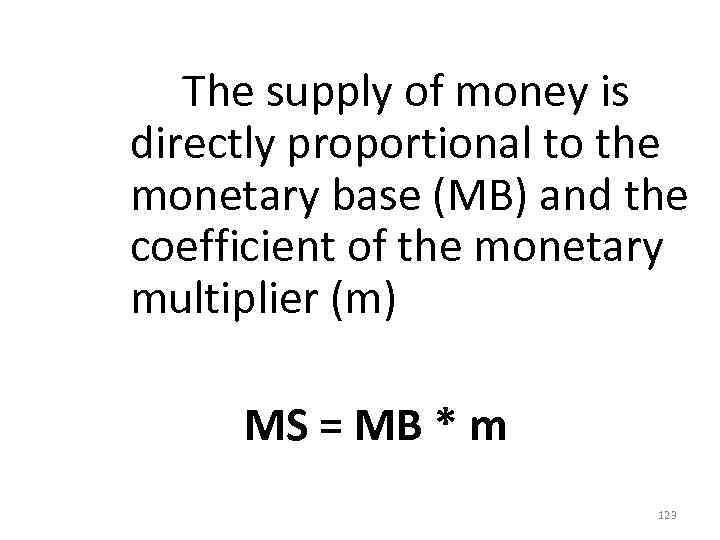 The supply of money is directly proportional to the monetary base (MB) and the coefficient of the monetary multiplier (m) МS = MB * m 123
 In order to understand the factors that determine the supply of money, one must first understand the role of the banking sector in the money‐creation process. Banks perform two crucial functions. First, they receive funds from depositors and, in return, provide these depositors with a checkable source of funds or with interest payments. Second, they use the funds that they receive from depositors to make loans to borrowers; that is, they serve as intermediaries in the borrowing and lending process. 124
 When banks receive deposits, they do not keep all of these deposits on hand because they know that depositors will not demand all of these deposits at once. Instead, banks keep only a fraction of the deposits that they receive. The deposits that banks keep on hand are known as the banks' reserves. When depositors withdraw deposits, they are paid out of the banks' reserves. 125
 The reserve requirement is the fraction of deposits set aside for withdrawal purposes. The reserve requirement is determined by the nation's banking authority, a government agency known as the central bank. Deposits that banks are not required to set aside as reserves can be lent to borrowers, in the form of loans. Banks earn profits by borrowing funds from depositors at zero or low rates of interest and using these funds to make loans at higher rates of interest. 126
 A balance sheet for a typical bank summarizes the bank's assets and liabilities. Assets are valuable items that the bank owns and consist primarily of the bank's reserves and loans. Liabilities are valuable items that the bank owes to others and consist primarily of the bank's deposit liabilities to its depositors. In Table , the bank's assets (reserves and loans) total $1 million. The bank's liabilities (deposits) total $1 million. Assets must always be equal to liabilities. 127
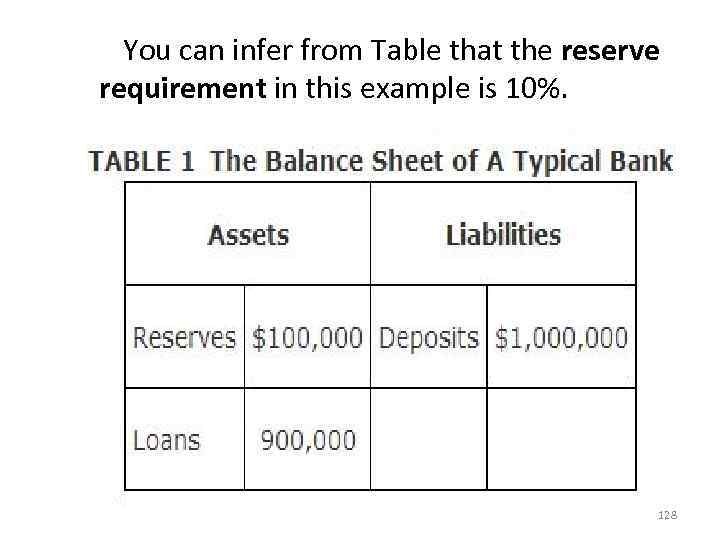 You can infer from Table that the reserve requirement in this example is 10%. 128
 A balance sheet for a typical bank summarizes the bank's assets and liabilities. Assets are valuable items that the bank owns and consist primarily of the bank's reserves and loans. Liabilities are valuable items that the bank owes to others and consist primarily of the bank's deposit liabilities to its depositors. In Table , the bank's assets (reserves and loans) total $1 million. The bank's liabilities (deposits) total $1 million. Assets must always be equal to liabilities. 129
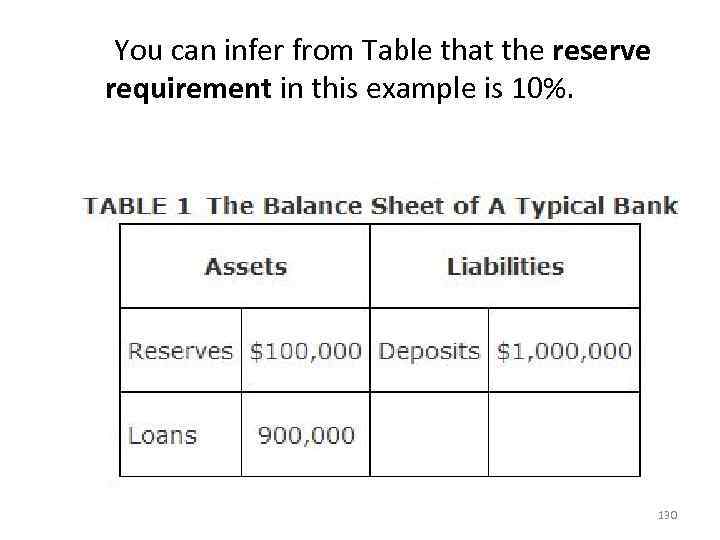 You can infer from Table that the reserve requirement in this example is 10%. 130
 How banks create money. Consider what happens when the same bank receives a $100, 000 deposit from one of its depositors. The bank is required to set aside 10% of this deposit, or $10, 000, as reserves. It then lends out its excess reserves—in this case, the remaining $90, 000 of the initial deposit. Suppose, for the sake of simplicity, that all borrowers redeposit their loans into the same bank. 131
 The bank thus receives $90, 000 in new deposits of which it sets $9, 000 aside as reserves and lends out all of its excess reserves. Suppose again that all borrowers redeposit their loans in the same bank, that the bank sets aside a portion of these deposits, and that the bank then lends out the remainder, which is again redeposited in the bank and so on. This repeated chain of events is summarized at the next slide. 132
 133
133
 If one were to follow this multiple deposit expansion process to its completion, the end result would be that the bank's deposits would increase by $1 million, its loans would increase by $900, 000, and its reserves would increase by $100, 000, all due to the initial deposit of $100, 000. 134
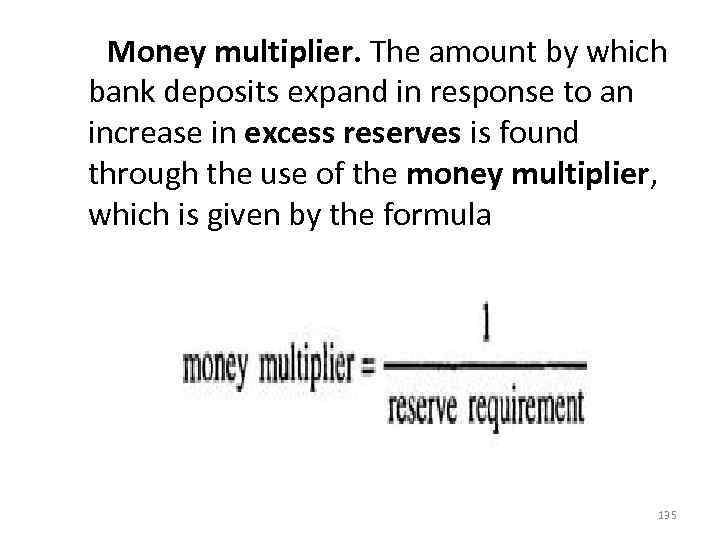 Money multiplier. The amount by which bank deposits expand in response to an increase in excess reserves is found through the use of the money multiplier, which is given by the formula 135
 In the example of deposit expansion found in Table, the reserve requirement is 10%; so, the money multiplier in this case is (1/. 10) = 10. The excess reserves resulting from the initial deposit of $100, 000 are $90, 000. Multiplying $90, 000 by the money multiplier, 10, yields $900, 000, which is the amount of additional deposits created by the banking system as the result of the initial $100, 000 deposit. 136
 In reality, loan recipients do not deposit all of their loan funds into a bank. More typically, they hold a fraction of their loan funds as currency. If some loan funds are held as currency, then there is a leakage of money out of the banking system. In this case, the money multiplier will still be greater than 1, but it will be less than the inverse of the reserve requirement. 137
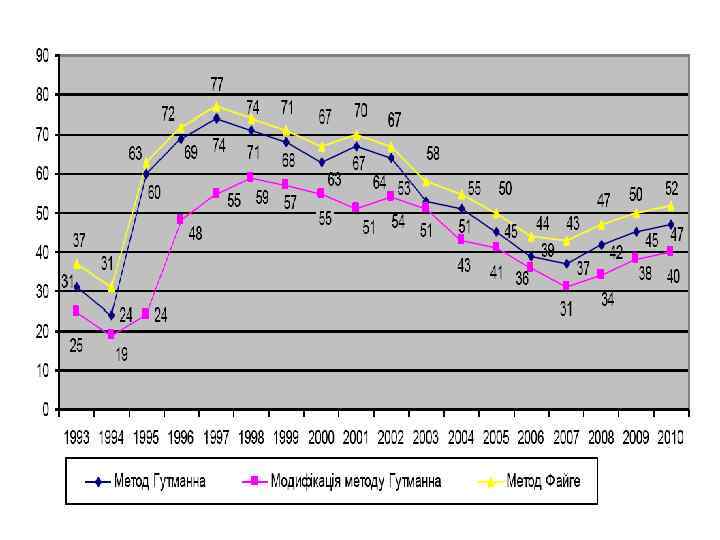
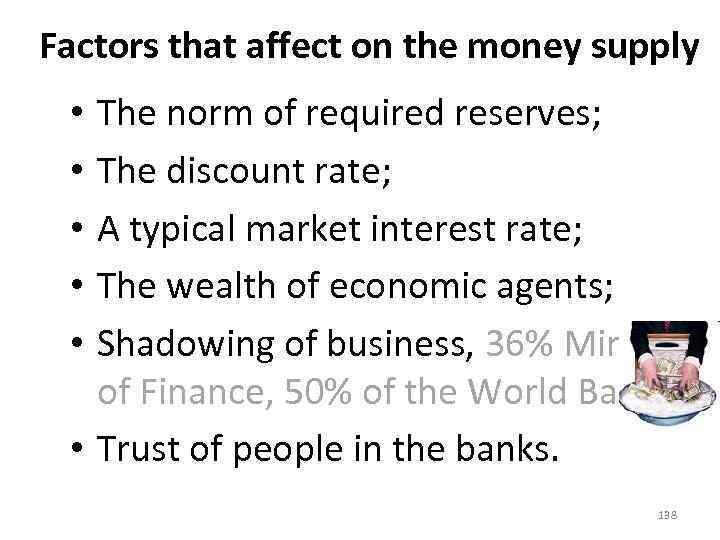 Factors that affect on the money supply The norm of required reserves; The discount rate; A typical market interest rate; The wealth of economic agents; Shadowing of business, 36% Ministry of Finance, 50% of the World Bank • Trust of people in the banks. • • • 138
 139
139
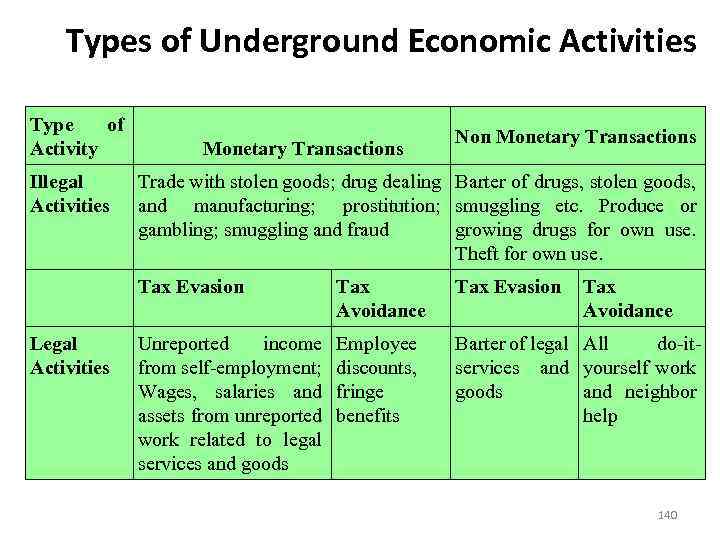 Types of Underground Economic Activities Type of Activity Monetary Transactions Non Monetary Transactions Illegal Activities Trade with stolen goods; drug dealing Barter of drugs, stolen goods, and manufacturing; prostitution; smuggling etc. Produce or gambling; smuggling and fraud growing drugs for own use. Theft for own use. Tax Evasion Tax Avoidance Tax Evasion Legal Activities Unreported income from self-employment; Wages, salaries and assets from unreported work related to legal services and goods Employee discounts, fringe benefits Barter of legal All do-itservices and yourself work goods and neighbor help Tax Avoidance 140
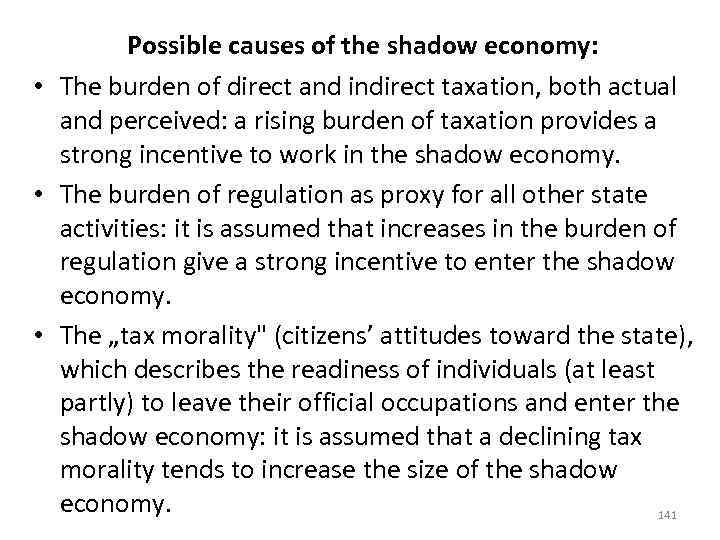 Possible causes of the shadow economy: • The burden of direct and indirect taxation, both actual and perceived: a rising burden of taxation provides a strong incentive to work in the shadow economy. • The burden of regulation as proxy for all other state activities: it is assumed that increases in the burden of regulation give a strong incentive to enter the shadow economy. • The „tax morality" (citizens’ attitudes toward the state), which describes the readiness of individuals (at least partly) to leave their official occupations and enter the shadow economy: it is assumed that a declining tax morality tends to increase the size of the shadow economy. 141
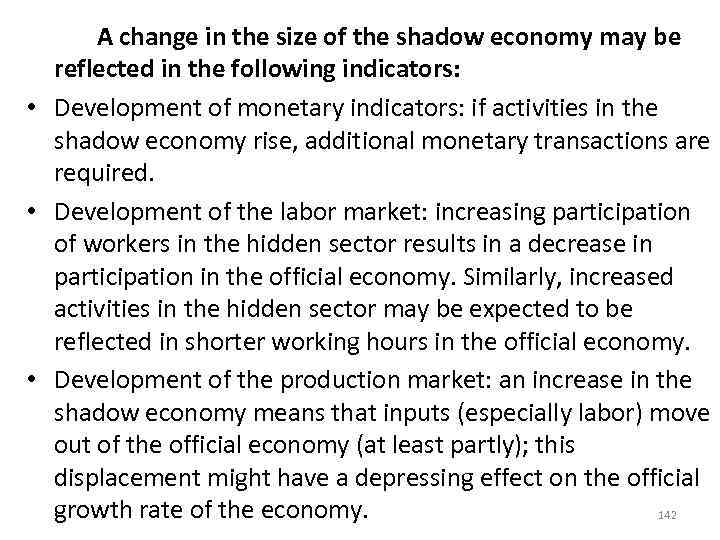 A change in the size of the shadow economy may be reflected in the following indicators: • Development of monetary indicators: if activities in the shadow economy rise, additional monetary transactions are required. • Development of the labor market: increasing participation of workers in the hidden sector results in a decrease in participation in the official economy. Similarly, increased activities in the hidden sector may be expected to be reflected in shorter working hours in the official economy. • Development of the production market: an increase in the shadow economy means that inputs (especially labor) move out of the official economy (at least partly); this displacement might have a depressing effect on the official growth rate of the economy. 142
 143
143
 3. Monetary statistics 3. 1. Surveys of financial corporations 3. 1. 4. Monetary aggregates 1 3. 1. 4. 1. Monetary aggregates and counterparts M 3 2 Period 1 2005 2006 2007 2008 2009 2010 2011 2012 January February March April May June July August September October November December 2013 January Liabilities Shares Other Net Domestic excluded and other items foreign credit 6 M 3–M 2 from M 3 3 equity 4 (net) assets 5 M 2–M 1 M 2 total M 1 total М 0 M 1–M 0 2 3 4 5 6 7 outstanding amounts at end of period, in millions of hryvnias 194 071 193 145 98 573 60 231 38 341 94 573 261 063 259 413 123 276 74 984 48 292 136 138 396 156 391 273 181 665 111 119 70 546 209 608 515 727 512 527 225 127 154 759 70 369 287 400 487 298 484 772 233 748 157 029 76 719 251 023 597 872 596 841 289 894 182 990 106 904 306 947 685 515 681 801 311 047 192 665 118 382 370 754 925 1 650 4 884 3 200 2 526 1 031 3 714 1 726 1 417 3 536 1 922 447 208 160 10 11 12 31 404 1 377 81 825 55 634 – 2 442 67 041 99 527 – 7 749 51 443 233 751 10 911 – 16 121 250 931 87 005 16 507 277 972 100 225 115 732 289 111 106 544 114 759 369 308 376 185 379 510 381 101 381 265 388 254 394 647 403 801 408 040 414 048 424 239 447 901 3 474 3 463 3 156 6 750 6 173 3 089 2 720 2 655 2 651 2 823 2 721 2 072 1 028 1 676 1 830 2 009 2 173 2 132 2 280 2 388 2 349 2 196 2 083 141 294 669 298 704 286 370 288 532 275 742 280 482 282 397 285 656 290 855 294 962 297 665 299 326 780 110 777 901 326 496 197 973 128 522 451 405 2 209 144 287 623 675 471 679 687 691 302 703 689 701 072 710 387 720 992 725 079 731 734 729 664 729 031 773 199 671 997 676 224 688 146 696 939 694 899 707 298 718 272 722 424 729 083 726 841 726 310 771 126 302 690 300 040 308 636 315 839 313 634 319 044 323 625 318 623 321 043 312 793 302 072 323 225 184 631 186 467 187 913 194 475 194 801 200 356 201 472 200 759 199 756 194 974 190 945 203 245 118 059 113 573 120 724 121 364 118 834 118 688 122 152 117 865 121 287 117 819 111 127 119 980 8 9 106 910 108 905 102 950 102 479 99 677 96 362 92 731 91 977 91 171 92 130 91 068 77 787 13 146 752 248 631 440 027 778 432 809 174 860 545 966 570 115 925 962 153 122 182 966 789 119 221 963 231 124 890 971 819 118 433 960 230 107 370 981 993 119 845 978 555 118 304 986 795 117 175 998 935 100 627 1 018 325 89 926 1 029 922 114 860 1 035 593 80 986 108 141 144 1 040 722
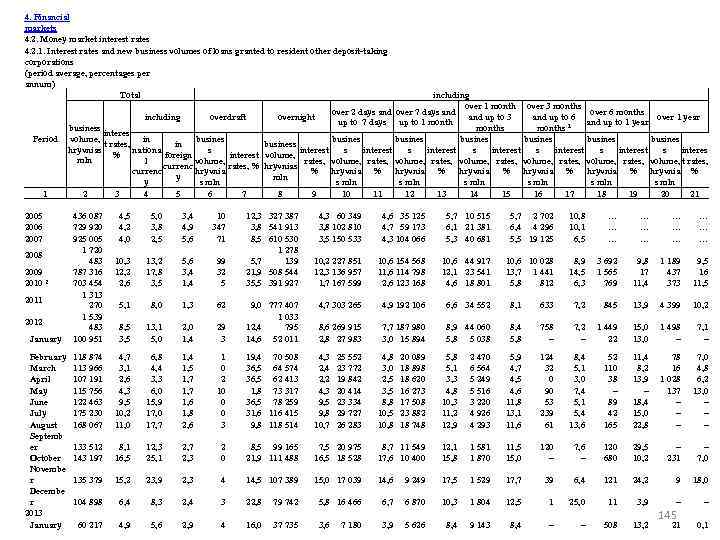 4. Financial markets 4. 2. Money market interest rates 4. 2. 1. Interest rates and new business volumes of loans granted to resident other deposit-taking corporations (period average, percentages per annum) Total Period 1 2005 2006 2007 2008 2009 2010 2 2011 2012 January February March April May June July August Septemb er October Novembe r Decembe r 2013 January including over 1 month over 3 months over 2 days and over 7 days and over 6 months and up to 3 and up to 6 including overdraft overnight over 1 year up to 7 days up to 1 month and up to 1 year months 1 business interes volume, in busines busines t rates, in business hryvnias interest s interest s interes nationa s s % foreign interest volume, mln rates, volume, rates, volume, t rates, l volume, currenc rates, % hryvnias currenc hryvnia % hryvnia % y mln y s mln s mln 2 3 4 5 6 7 8 9 10 11 12 13 14 15 16 17 18 19 20 21 436 087 729 920 925 005 1 720 483 787 316 703 454 1 313 270 1 539 483 100 951 4, 5 4, 2 4, 0 5, 0 3, 8 2, 5 3, 4 4, 9 5, 6 10 347 71 10, 3 12, 2 2, 6 13, 2 17, 8 3, 5 5, 6 3, 4 1, 4 99 32 5 5, 1 8, 0 1, 3 62 8, 5 3, 5 13, 1 5, 0 2, 0 1, 4 29 3 9, 0 777 407 1 033 12, 4 795 14, 6 52 011 118 874 113 966 107 191 115 756 122 463 175 230 168 067 4, 7 3, 1 2, 6 4, 3 9, 5 10, 2 11, 0 6, 8 4, 4 3, 3 6, 0 15, 9 17, 0 17, 7 1, 4 1, 5 1, 7 1, 6 1, 8 2, 6 1 0 2 10 0 0 3 19, 4 70 508 36, 5 64 574 36, 5 62 413 1, 8 73 317 36, 5 78 259 31, 6 116 415 9, 8 118 514 4, 3 2, 4 2, 2 4, 3 9, 5 9, 8 10, 7 133 512 143 197 8, 1 16, 5 12, 3 25, 1 2, 7 2, 3 2 0 8, 5 99 165 21, 9 111 488 135 379 15, 2 23, 9 2, 3 4 14, 5 107 389 104 898 6, 4 8, 3 2, 4 3 22, 8 60 217 4, 9 5, 6 2, 9 12, 3 327 387 3, 8 541 913 8, 5 610 530 1 278 5, 7 139 21, 9 508 544 35, 5 391 927 4 5, 7 10 515 6, 1 21 381 5, 3 40 681 5, 7 2 702 6, 4 4 296 5, 5 19 125 10, 8 10, 1 6, 5 … … … 10, 2 227 851 12, 3 136 957 1, 7 167 599 10, 6 154 568 11, 6 114 798 2, 6 123 168 10, 6 44 917 12, 1 23 541 4, 6 18 801 10, 6 10 028 13, 7 1 441 5, 8 812 8, 9 14, 5 6, 3 3 692 1 565 769 9, 8 17 11, 4 1 189 437 373 9, 5 16 11, 5 4, 7 303 265 4, 9 192 106 6, 6 34 552 8, 1 633 7, 2 845 13, 9 4 399 10, 2 8, 6 269 915 2, 8 27 983 7, 7 187 980 3, 0 15 894 8, 9 44 060 5, 8 5 038 8, 4 5, 8 758 – 7, 2 – 1 449 22 15, 0 13, 0 1 498 – 7, 1 – 20 089 18 898 18 620 16 273 17 508 23 882 18 748 5, 1 3, 3 4, 8 10, 3 11, 2 12, 9 2 470 6 564 5 249 5 516 3 220 4 926 4 293 5, 9 4, 7 4, 5 4, 6 11, 8 13, 1 11, 6 124 32 0 90 53 239 61 8, 4 5, 1 3, 0 7, 4 5, 1 5, 4 13, 6 52 110 38 – 89 42 165 11, 4 8, 2 13, 9 – 18, 4 15, 0 22, 8 78 16 1 028 137 – – – 7, 0 4, 8 6, 2 13, 0 – – – 8, 7 11 549 17, 6 10 400 12, 1 15, 8 1 581 1 870 11, 5 15, 0 120 – 7, 6 – 120 680 29, 5 10, 2 – 231 – 7, 0 15, 0 17 039 14, 6 9 249 17, 5 1 529 17, 7 39 6, 4 121 24, 2 9 18, 0 5, 8 16 466 37 735 4, 6 35 125 4, 7 59 173 4, 3 104 066 7, 5 20 975 16, 5 18 528 79 742 16, 0 4, 3 60 349 3, 8 102 810 3, 5 150 533 25 552 23 772 19 842 20 414 23 334 29 727 26 283 6, 7 6 870 10, 3 1 804 12, 5 1 25, 0 11 3, 9 – – 3, 6 4, 8 3, 0 2, 5 3, 5 8, 8 10, 5 10, 8 7 180 3, 9 5 626 8, 4 9 143 8, 4 – – 508 145 13, 2 21 0, 1
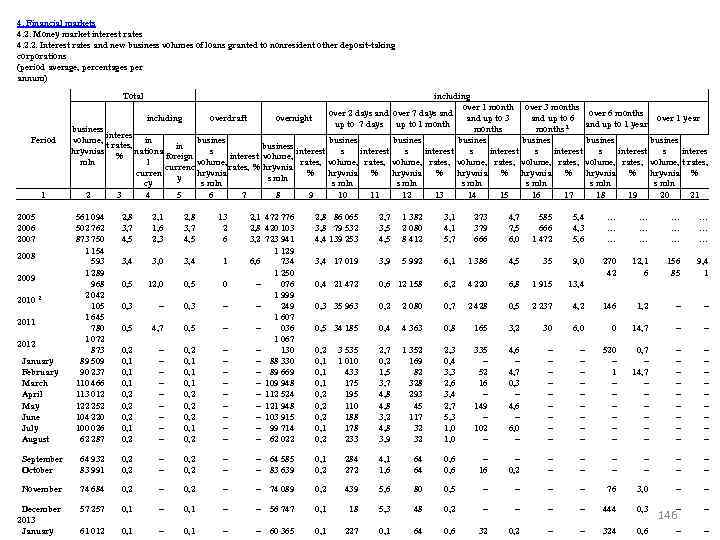 4. Financial markets 4. 2. Money market interest rates 4. 2. 2. Interest rates and new business volumes of loans granted to nonresident other deposit-taking corporations (period average, percentages per annum) Total Period 1 2005 2006 2007 including over 1 month over 3 months over 2 days and over 7 days and over 6 months and up to 3 and up to 6 including overdraft overnight over 1 year up to 7 days up to 1 month and up to 1 year months 1 business interes volume, in busines busines t rates, in business hryvnias interest interest nationa s s s interest s interes % foreign interest volume, mln rates, volume, rates, volume, t rates, l volume, currenc rates, % hryvnia curren hryvnia % hryvnia % y s mln cy s mln s mln 2 3 4 5 6 7 8 9 10 11 12 13 14 15 16 17 18 19 20 21 2, 8 3, 7 4, 5 2, 1 1, 6 2, 3 2, 8 3, 7 4, 5 13 2 6 3, 4 3, 0 3, 4 1 0, 5 12, 0 0, 5 0 0, 3 – 0, 5 4, 7 0, 5 – January February March April May June July August 561 094 502 762 873 750 1 154 593 1 289 968 2 042 105 1 645 780 1 072 873 89 509 90 237 110 466 113 012 122 252 104 220 100 026 62 287 0, 2 0, 1 0, 1 0, 2 0, 2 0, 1 0, 2 – – – – – 2, 1 472 776 2, 8 420 103 3, 2 723 941 1 129 6, 6 734 1 250 – 076 1 999 – 249 1 607 – 036 1 067 – 130 – 88 330 – 89 669 – 109 948 – 112 524 – 121 948 – 103 915 – 99 714 – 62 022 September October 64 932 83 991 0, 2 – – November 74 684 0, 2 – 0, 2 December 2013 January 57 257 0, 1 – 61 012 0, 1 – 2008 2009 2010 2 2011 2012 2, 8 86 065 3, 8 79 532 4, 4 139 253 2, 7 3, 5 4, 5 1 382 2 080 8 412 3, 1 4, 1 5, 7 273 379 666 4, 7 7, 5 6, 0 585 666 1 472 5, 4 4, 3 5, 6 … … … 3, 4 17 019 3, 9 5 992 6, 1 1 386 4, 5 35 9, 0 270 42 12, 1 6 156 85 9, 4 1 0, 4 21 472 0, 6 12 158 6, 2 4 220 6, 8 1 915 13, 4 0, 3 35 963 0, 2 2 080 0, 7 2 428 0, 5 2 237 4, 2 146 1, 2 – – 0, 5 34 185 0, 4 4 363 0, 8 165 3, 2 30 6, 0 0 14, 7 – – 0, 2 0, 1 0, 2 0, 1 0, 2 3 535 1 010 433 175 195 110 188 178 233 2, 7 0, 2 1, 5 3, 7 4, 8 3, 2 4, 8 3, 9 1 352 169 82 328 293 45 117 32 32 2, 3 0, 4 3, 3 2, 6 3, 4 2, 7 5, 3 1, 0 335 – 52 16 – 149 – 102 – 4, 6 – 4, 7 0, 3 – 4, 6 – 6, 0 – – – – – 520 – 1 – – – 0, 7 – 14, 7 – – – – – – – 64 585 – 83 639 0, 1 0, 2 284 272 4, 1 1, 6 64 64 0, 6 – 16 – 0, 2 – – – – 74 089 0, 2 439 5, 6 80 0, 5 – – 76 3, 0 – – 0, 1 – – 56 747 0, 1 18 5, 3 48 0, 2 – – 444 0, 3 – – 0, 1 – – 60 365 0, 1 227 0, 1 64 0, 6 32 0, 2 – – 324 0, 6 – – 146
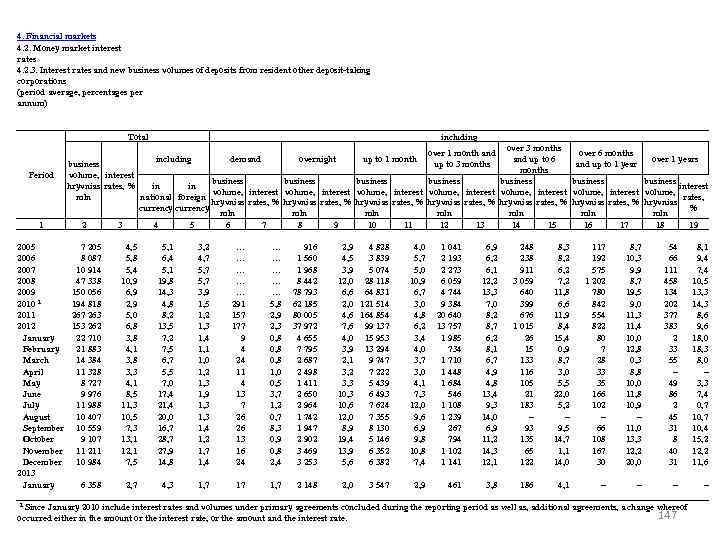 4. Financial markets 4. 2. Money market interest rates 4. 2. 3. Interest rates and new business volumes of deposits from resident other deposit-taking corporations (period average, percentages per annum) Total including over 3 months over 6 months and up to 6 over 1 years and up to 1 year business months volume, interest business business hryvnias rates, % in in interest volume, interest volume, mln national foreign rates, hryvnias rates, % hryvnias rates, % hryvnias currency % mln mln 2 3 4 5 6 7 8 9 10 11 12 13 14 15 16 17 18 19 including Period 1 demand overnight up to 1 month over 1 month and up to 3 months 2005 7 205 4, 5 5, 1 3, 2 … … 916 2, 9 4 828 4, 0 1 041 6, 9 248 8, 3 117 8, 7 54 8, 1 2006 8 087 5, 8 6, 4 4, 7 … … 1 560 4, 5 3 839 5, 7 2 193 6, 2 238 8, 2 192 10, 3 66 9, 4 2007 10 914 5, 1 5, 7 … … 1 968 3, 9 5 074 5, 0 2 273 6, 1 911 6, 2 575 9, 9 111 7, 4 2008 47 338 10, 9 19, 8 5, 7 … … 8 442 12, 0 28 118 10, 9 6 059 12, 2 3 059 7, 2 1 202 8, 7 458 10, 5 2009 150 056 6, 9 14, 3 3, 9 … … 78 793 6, 6 64 831 6, 7 4 744 13, 3 640 11, 8 780 19, 5 134 13, 3 2010 1 194 818 2, 9 4, 8 1, 5 291 5, 8 62 185 2, 0 121 514 3, 0 9 384 7, 0 399 6, 6 842 9, 0 202 14, 3 2011 267 263 5, 0 8, 2 157 2, 9 80 005 4, 6 164 854 4, 8 20 640 8, 2 676 11, 9 554 11, 3 377 8, 6 2012 153 262 6, 8 13, 5 1, 3 177 2, 3 37 972 7, 6 99 137 6, 2 13 757 8, 7 1 015 8, 4 822 11, 4 383 9, 6 January 22 710 3, 8 7, 2 1, 4 9 0, 8 4 655 4, 0 15 953 3, 4 1 985 6, 2 26 15, 4 80 10, 0 2 18, 0 February 21 883 4, 1 7, 5 1, 1 4 0, 8 7 795 3, 9 13 294 4, 0 734 8, 1 15 0, 9 7 12, 8 33 18, 3 March 14 384 3, 8 6, 7 1, 0 24 0, 8 2 687 2, 1 9 747 3, 7 1 710 6, 7 133 8, 7 28 0, 3 55 8, 0 April 11 328 3, 3 5, 5 1, 2 11 1, 0 2 498 3, 2 7 222 3, 0 1 448 4, 9 116 3, 0 33 8, 8 – – May 8 727 4, 1 7, 0 1, 3 4 0, 5 1 411 3, 3 5 439 4, 1 1 684 4, 8 105 5, 5 35 10, 0 49 3, 3 June 9 976 8, 5 17, 4 1, 9 13 3, 7 2 650 10, 3 6 493 7, 3 546 13, 4 21 22, 0 166 11, 8 86 7, 4 July 11 988 11, 3 21, 4 1, 3 7 1, 2 2 964 10, 6 7 624 12, 0 1 108 9, 3 183 5, 2 10, 9 2 0, 7 August 10 407 10, 5 20, 0 1, 3 26 0, 7 1 742 12, 0 7 355 9, 6 1 239 14, 0 – – 45 10, 7 September 10 559 7, 3 16, 7 1, 4 26 8, 3 1 947 8, 9 8 130 6, 9 267 6, 9 93 9, 5 66 11, 0 31 10, 4 October 9 107 13, 1 28, 7 1, 2 13 0, 9 2 902 19, 4 5 146 9, 8 794 11, 2 135 14, 7 108 13, 3 8 15, 2 November 11 211 12, 1 27, 9 1, 7 16 0, 8 3 469 13, 9 6 352 10, 8 1 102 14, 3 65 1, 1 167 12, 2 40 12, 2 December 10 984 7, 5 14, 8 1, 4 24 2, 4 3 253 5, 6 6 382 7, 4 1 141 12, 1 122 14, 0 30 20, 0 31 11, 6 2013 January 6 358 2, 7 4, 3 1, 7 17 1, 7 2 148 2, 0 3 547 2, 9 461 3, 8 186 4, 1 – – 1 Since January 2010 include interest rates and volumes under primary agreements concluded during the reporting period as well as, аdditional agreements, a change whereof 147 occurred either in the amount or the interest rate, or the amount and the interest rate.
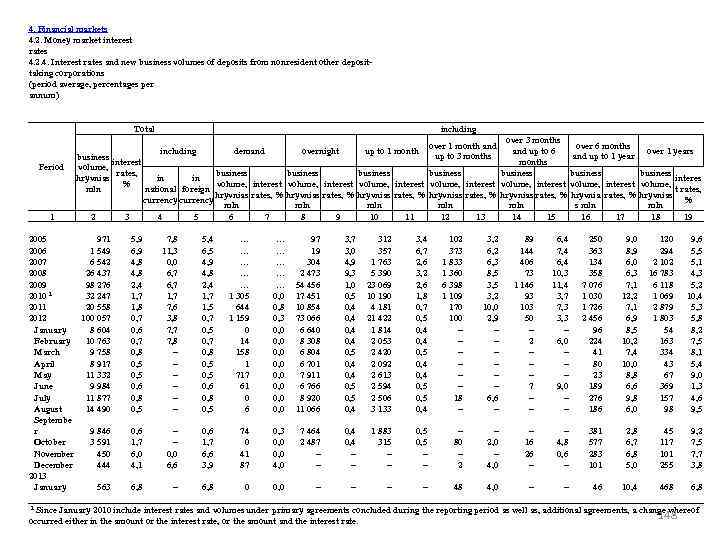 4. Financial markets 4. 2. Money market interest rates 4. 2. 4. Interest rates and new business volumes of deposits from nonresident other deposittaking corporations (period average, percentages per annum) Total including over 3 months over 6 months and up to 6 over 1 years and up to 1 year business months interest volume, rates, business business hryvnias in in interes % volume, interest volume, interest volume, mln national foreign t rates, hryvnias rates, % hryvnias rates, % hryvnias currency % mln mln mln s mln 2 3 4 5 6 7 8 9 10 11 12 13 14 15 16 17 18 19 including Period 1 demand overnight up to 1 month over 1 month and up to 3 months 2005 971 5, 9 7, 8 5, 4 … … 97 3, 7 312 3, 4 102 3, 2 89 6, 4 250 9, 0 120 9, 6 2006 1 549 6, 9 11, 3 6, 5 … … 19 3, 0 357 6, 7 373 6, 2 144 7, 4 363 8, 9 294 5, 5 2007 6 542 4, 8 0, 0 4, 9 … … 304 4, 9 1 763 2, 6 1 833 6, 3 406 6, 4 134 6, 0 2 102 5, 1 2008 26 437 4, 8 6, 7 4, 8 … … 2 473 9, 3 5 390 3, 2 1 360 8, 5 73 10, 3 358 6, 3 16 783 4, 3 2009 98 276 2, 4 6, 7 2, 4 … … 54 456 1, 0 23 069 2, 6 6 398 3, 5 1 146 11, 4 7 076 7, 1 6 118 5, 2 2010 1 32 247 1, 7 1 305 0, 0 17 451 0, 5 10 190 1, 8 1 109 3, 2 93 3, 7 1 030 12, 2 1 069 10, 4 2011 20 558 1, 8 7, 6 1, 5 644 0, 8 10 854 0, 4 4 181 0, 7 170 10, 0 103 7, 3 1 726 7, 1 2 879 5, 3 2012 100 057 0, 7 3, 8 0, 7 1 159 0, 3 73 066 0, 4 21 422 0, 5 100 2, 9 50 3, 3 2 456 6, 9 1 803 5, 8 January 8 604 0, 6 7, 7 0, 5 0 0, 0 6 640 0, 4 1 814 0, 4 – – 96 8, 5 54 8, 2 February 10 763 0, 7 7, 8 0, 7 14 0, 0 8 308 0, 4 2 053 0, 4 – – 2 6, 0 224 10, 2 163 7, 5 March 9 758 0, 8 – 0, 8 158 0, 0 6 804 0, 5 2 420 0, 5 – – 41 7, 4 334 8, 1 April 8 917 0, 5 – 0, 5 1 0, 0 6 701 0, 4 2 092 0, 4 – – 80 10, 0 43 5, 4 May 11 332 0, 5 – 0, 5 717 0, 0 7 911 0, 4 2 613 0, 4 – – 23 8, 8 67 9, 0 June 9 984 0, 6 – 0, 6 61 0, 0 6 766 0, 5 2 594 0, 5 – – 7 9, 0 189 6, 6 369 1, 3 July 11 877 0, 8 – 0, 8 0 0, 0 8 920 0, 5 2 506 0, 5 18 6, 6 – – 276 9, 8 157 4, 6 August 14 490 0, 5 – 0, 5 6 0, 0 11 066 0, 4 3 133 0, 4 – – 186 6, 0 98 9, 5 Septembe r 9 846 0, 6 – 0, 6 74 0, 3 7 464 0, 4 1 883 0, 5 – – 381 2, 8 45 9, 2 October 3 591 1, 7 – 1, 7 0 0, 0 2 487 0, 4 315 0, 5 80 2, 0 16 4, 8 577 6, 7 117 7, 5 November 450 6, 0 0, 0 6, 6 41 0, 0 – – – 26 0, 6 283 6, 8 101 7, 7 December 444 4, 1 6, 6 3, 9 87 4, 0 – – 2 4, 0 – – 101 5, 0 255 3, 8 2013 January 563 6, 8 – 6, 8 0 0, 0 – – 48 4, 0 – – 46 10, 4 468 6, 8 1 Since January 2010 include interest rates and volumes under primary agreements concluded during the reporting period as well as, аdditional agreements, a change whereof 148 occurred either in the amount or the interest rate, or the amount and the interest rate.
 149
149
 Questions to test the learning material: 1. Explain, please, the essence of the money market. 2. Please give us a definition of "sale of money" and "purchase money". 3. Please give us a definition of "non‐debt financial instruments" and "debt financial instruments". 4. Please list the specific characteristics of the money market. 150
 Questions to test the learning material: 1. Please give us a definition of "direct financing" and "indirect funding ". 2. Describe, please, the structure of the money market. 3. Please list the motives of the money demand. 4. Please give us a definition of "money supply". 151
 152
152