 Скачать презентацию Theme 13 Unemployment and inflation are both manifestations
Theme 13.ppt
- Количество слайдов: 14



Theme 13. Unemployment and inflation are both manifestations of economic instability
1. Essence and basic forms of unemployment
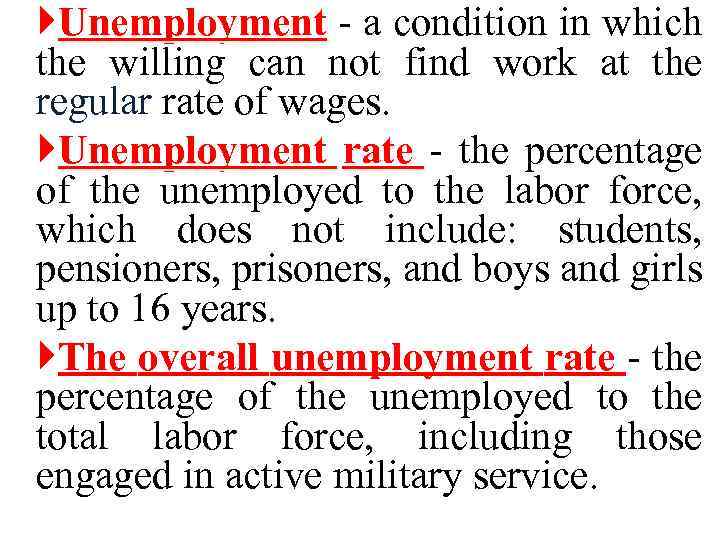
Unemployment - a condition in which the willing can not find work at the regular rate of wages. Unemployment rate - the percentage of the unemployed to the labor force, which does not include: students, pensioners, prisoners, and boys and girls up to 16 years. The overall unemployment rate - the percentage of the unemployed to the total labor force, including those engaged in active military service.
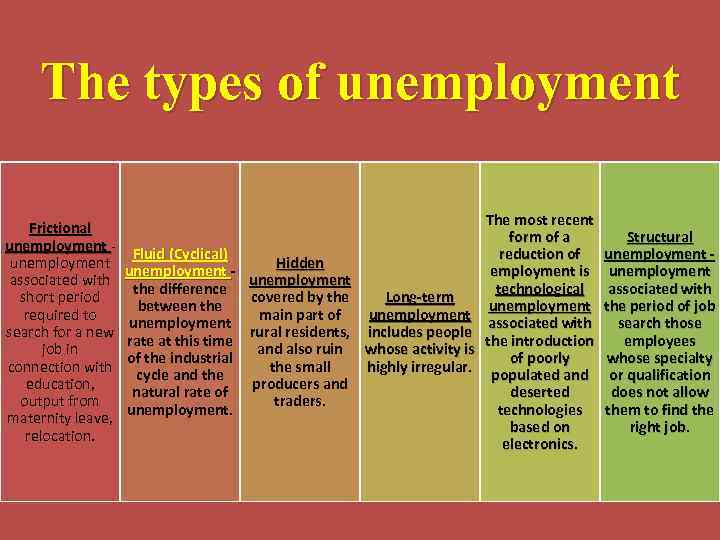
The types of unemployment Frictional unemployment associated with short period required to search for a new job in connection with education, output from maternity leave, relocation. Fluid (Cyclical) Hidden unemployment the difference covered by the Long-term between the main part of unemployment rural residents, includes people rate at this time and also ruin whose activity is of the industrial the small highly irregular. cycle and the producers and natural rate of traders. unemployment. The most recent form of a reduction of employment is technological unemployment associated with the introduction of poorly populated and deserted technologies based on electronics. Structural unemployment associated with the period of job search those employees whose specialty or qualification does not allow them to find the right job
Employment rate - the percentage of the adult population employed that are not on welfare, in shelters, nursing homes, etc. Full employment does not mean complete absence of unemployment. Natural rate of unemployment - a set of frictional and structural unemployment and the unemployment rate is associated with a stable economy, when the real national product is at the natural rate, and lacks both slowing and accelerating inflation or when the expected rate of inflation is equal to the actual level of inflation.
In modern conditions, employment status based on the following principles: • freely chosen employment - everyone has the right to freely dispose of their abilities to work • Productive employment - activities related to meeting the personal and social needs and bringing them to earnings • Legislative regulation of employment, measures to promote employment and social protection against unemployment • Full-time - the right to work and to protection against unemployment
2. The effect of unemployment rate on the value of GNP. The Law of Oaken
In cyclical unemployment production capacity is not fully utilized and the amount of GDP less than that which would be at full employment. The difference between potential output at full employment GDP and actually achieved in cyclical unemployment GDP is GDP gap. The Law of Oaken expresses the relationship between the level of unemployment or lost in GDP. If the actual unemployment rate exceeds the natural rate of 1%, the gap in GDP of approximately 2. 5%. This ratio (1: 2. 5) allows us to calculate the absolute loss associated with any level of unemployment.
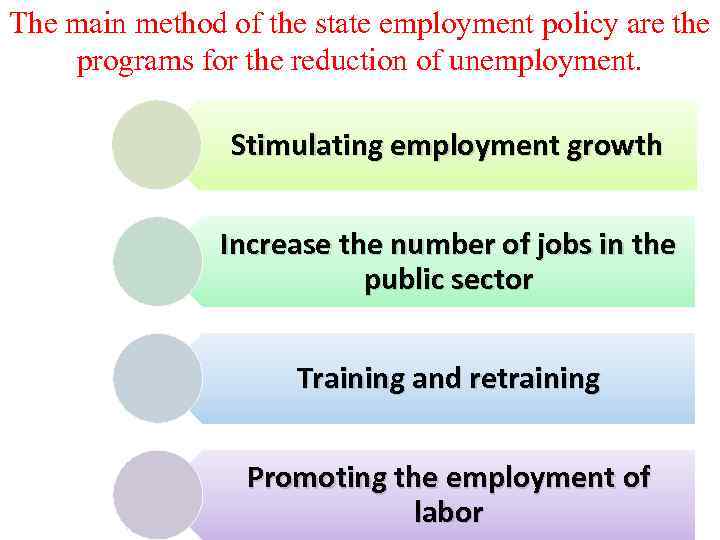
The main method of the state employment policy are the programs for the reduction of unemployment. Stimulating employment growth Increase the number of jobs in the public sector Training and retraining Promoting the employment of labor
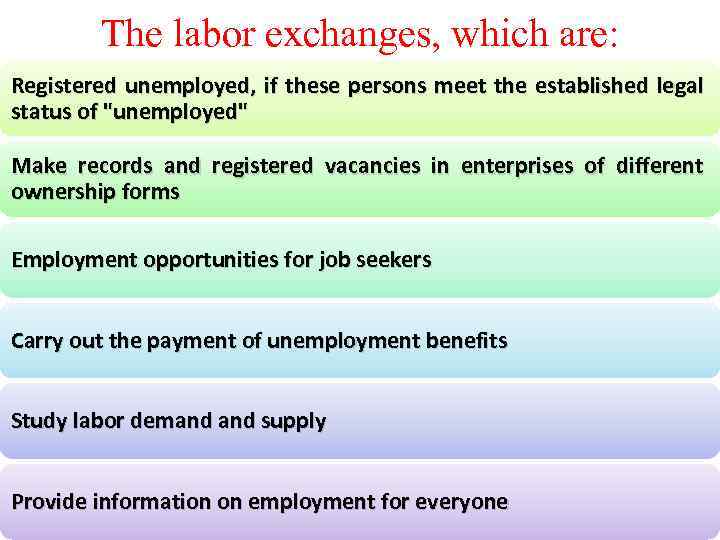
The labor exchanges, which are: Registered unemployed, if these persons meet the established legal status of "unemployed" Make records and registered vacancies in enterprises of different ownership forms Employment opportunities for job seekers Carry out the payment of unemployment benefits Study labor demand supply Provide information on employment for everyone

3. Inflation and its causes
The essence of inflation is that the national currency depreciates in relation to goods, services and foreign currency, preserving the stability of its purchasing power.
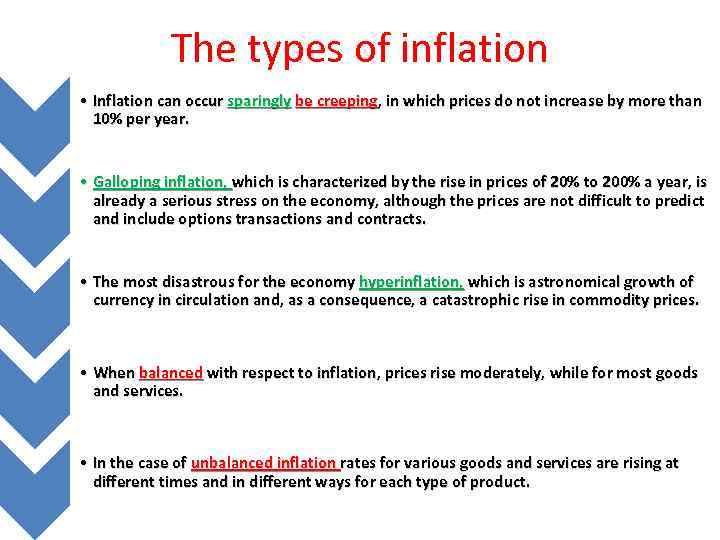
The types of inflation • Inflation can occur sparingly be creeping, in which prices do not increase by more than 10% per year. • Galloping inflation, which is characterized by the rise in prices of 20% to 200% a year, is already a serious stress on the economy, although the prices are not difficult to predict and include options transactions and contracts. • The most disastrous for the economy hyperinflation, which is astronomical growth of currency in circulation and, as a consequence, a catastrophic rise in commodity prices. • When balanced with respect to inflation, prices rise moderately, while for most goods and services. • In the case of unbalanced inflation rates for various goods and services are rising at different times and in different ways for each type of product.
The types of inflation • Expected inflation can be predicted for any period of time, and it is often a direct result of government action. • Unexpected inflation is characterized by a sudden jump in prices, which adversely affects the taxation system and the money, if there is a population of inflation expectations. • Demand pull - the imbalance between supply and demand on the demand side. • Cost inflation - rising prices due to increased production costs.
Скачать презентацию Theme 13 Unemployment and inflation are both manifestations
Theme 13.ppt