



 THEME 10. THE NATIONAL ECONOMY AS A SYSTEM
 1. NATIONAL ECONOMY AS A SYSTEM
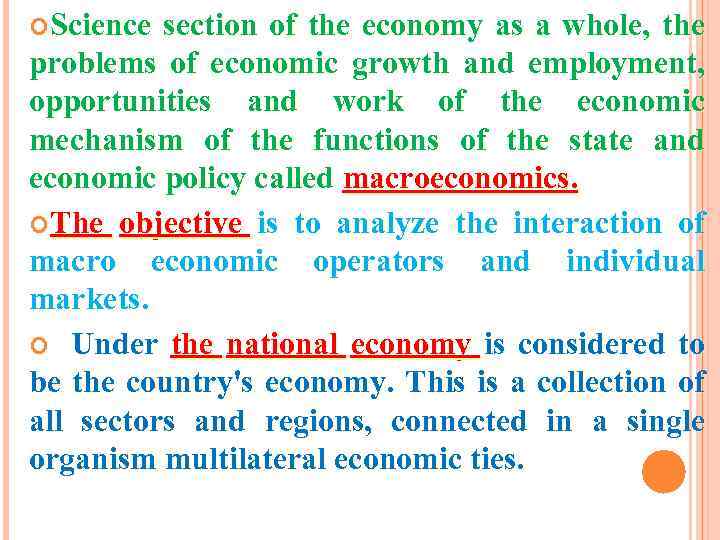 Science section of the economy as a whole, the problems of economic growth and employment, opportunities and work of the economic mechanism of the functions of the state and economic policy called macroeconomics. The objective is to analyze the interaction of macro economic operators and individual markets. Under the national economy is considered to be the country's economy. This is a collection of all sectors and regions, connected in a single organism multilateral economic ties.
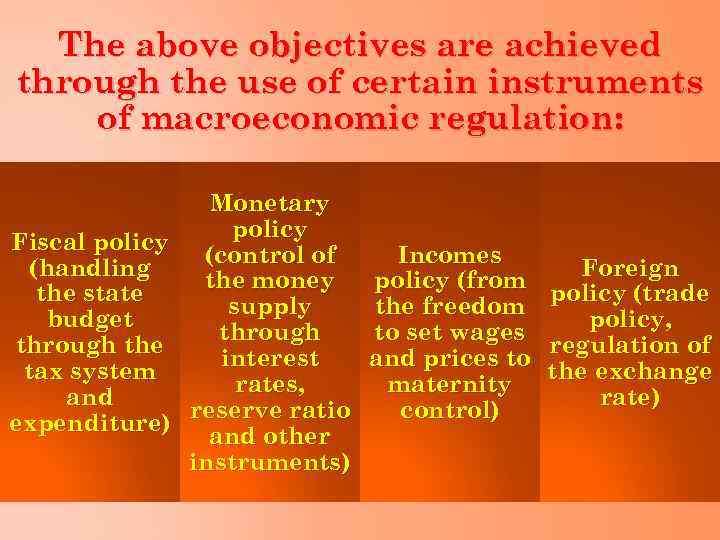 The above objectives are achieved through the use of certain instruments of macroeconomic regulation: Monetary policy Fiscal policy (control of (handling the money the state supply budget through the interest tax system rates, and reserve ratio expenditure) and other instruments) Incomes policy (from the freedom to set wages and prices to maternity control) Foreign policy (trade policy, regulation of the exchange rate)
 2. SYSTEM OF NATIONAL ACCOUNTS
 A summary of the economic development of the state is reflected in the national accounts National Accounts - a collection of various macroeconomic indicators.
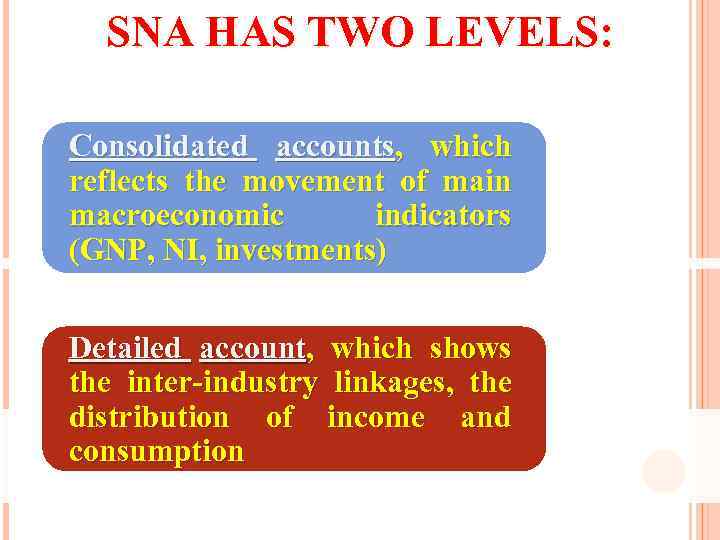 SNA HAS TWO LEVELS: Consolidated accounts, which reflects the movement of main macroeconomic indicators (GNP, NI, investments) Detailed account, which shows the inter-industry linkages, the distribution of income and consumption
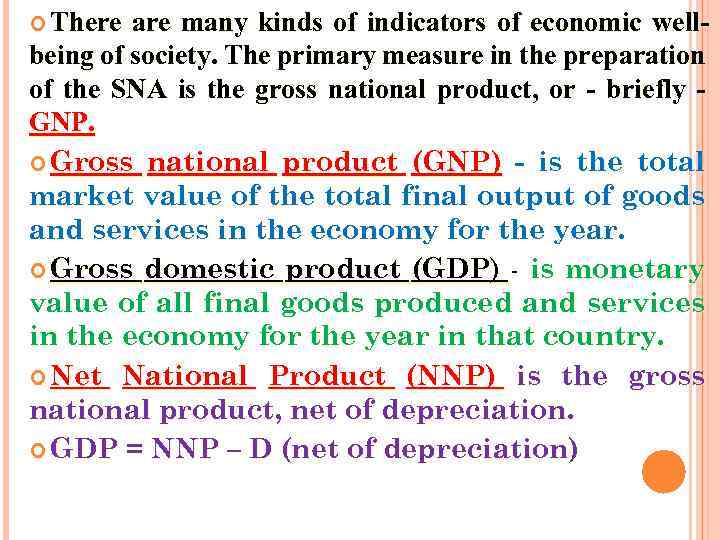 There are many kinds of indicators of economic wellbeing of society. The primary measure in the preparation of the SNA is the gross national product, or - briefly GNP. Gross national product (GNP) - is the total market value of the total final output of goods and services in the economy for the year. Gross domestic product (GDP) - is monetary value of all final goods produced and services in the economy for the year in that country. Net National Product (NNP) is the gross national product, net of depreciation. GDP = NNP – D (net of depreciation)
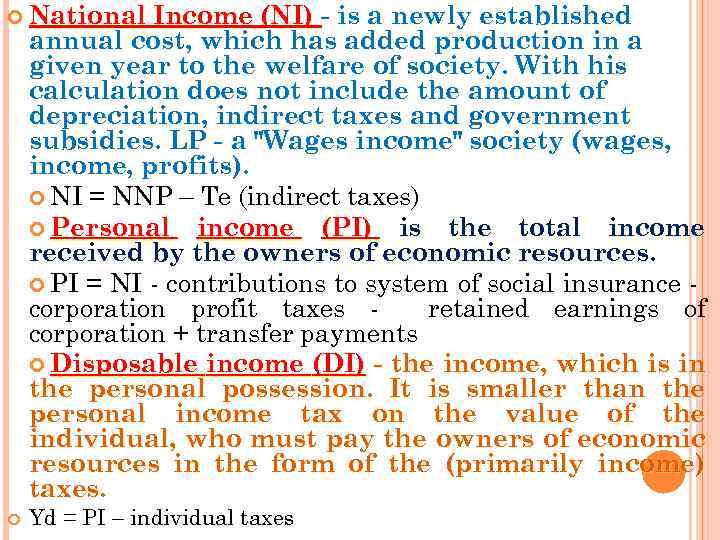 National Income (NI) - is a newly established annual cost, which has added production in a given year to the welfare of society. With his calculation does not include the amount of depreciation, indirect taxes and government subsidies. LP - a "Wages income" society (wages, income, profits). NI = NNP – Te (indirect taxes) Personal income (PI) is the total income received by the owners of economic resources. PI = NI - contributions to system of social insurance corporation profit taxes retained earnings of corporation + transfer payments Disposable income (DI) - the income, which is in the personal possession. It is smaller than the personal income tax on the value of the individual, who must pay the owners of economic resources in the form of the (primarily income) taxes. Yd = PI – individual taxes
 3. METHODS OF MEASURING G NP
 GNP has two sides of expenditure revenue
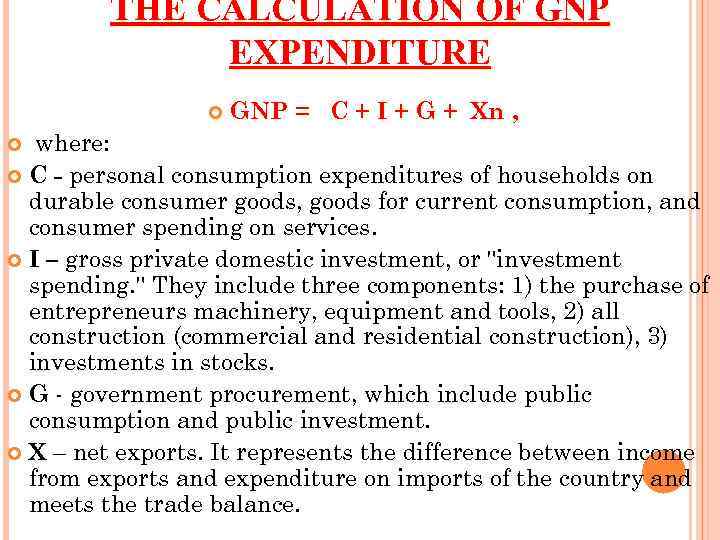 THE CALCULATION OF GNP EXPENDITURE GNP = C + I + G + Xn , where: C - personal consumption expenditures of households on durable consumer goods, goods for current consumption, and consumer spending on services. I – gross private domestic investment, or "investment spending. " They include three components: 1) the purchase of entrepreneurs machinery, equipment and tools, 2) all construction (commercial and residential construction), 3) investments in stocks. G - government procurement, which include public consumption and public investment. X – net exports. It represents the difference between income from exports and expenditure on imports of the country and meets the trade balance.
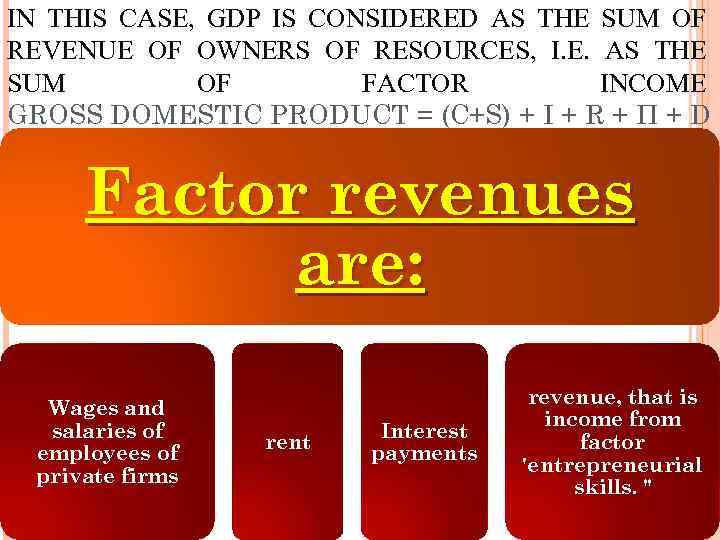 IN THIS CASE, GDP IS CONSIDERED AS THE SUM OF REVENUE OF OWNERS OF RESOURCES, I. E. AS THE SUM OF FACTOR INCOME GROSS DOMESTIC PRODUCT = (C+S) + I + R + Π + D Factor revenues are: Wages and salaries of employees of private firms rent Interest payments revenue, that is income from factor 'entrepreneurial skills. "
 THE CALCULATION OF GNP "VALUE ADDED" With this method, the calculation of GNP must sum of value added by all sectors and industries in the economy. An objective analysis of the economy is possible only with a stable (or comparable) price level. Analysis of the price level is necessary in order to: - To know whethere have inflation or deflation, - Reduced to a single base heterogeneous components of total production.
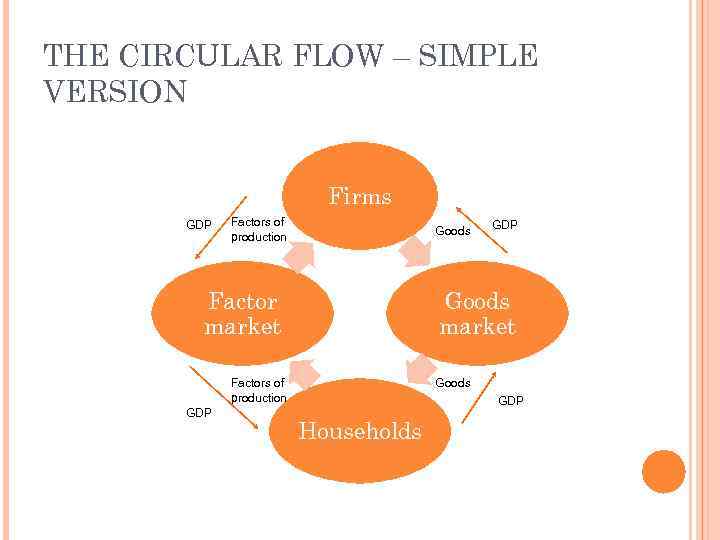 THE CIRCULAR FLOW – SIMPLE VERSION Firms GDP Factors of production Goods Factor market Goods market Factors of production GDP Goods GDP Households
 MODELING A FIRM Before we look at the more detailed version of the circular flow, we will illustrade the model of the firm. A firm in our model is a unit which adds value to products. These products may be raw material, semimanufactured goods, final goods and services. By adding value, we mean that the firm acquires the good, adds value to it and then sells it. A supermarket adds value to a final good by making it more available to consumers and a bakery adds value to flour when it bakes bread. From the diagram we see that the value added in a firm must be equal to the compensation to the factors of production. This must be the case since the net flow of money for a firm must be zero (remember that profits become return to capital – a compensation to the owners of the firm).
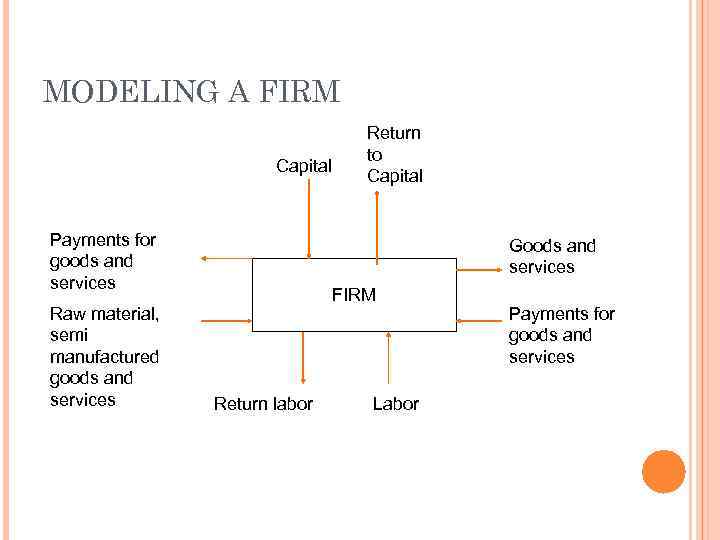 MODELING A FIRM Capital Payments for goods and services Raw material, semi manufactured goods and services Return to Capital Goods and services FIRM Return labor Labor Payments for goods and services
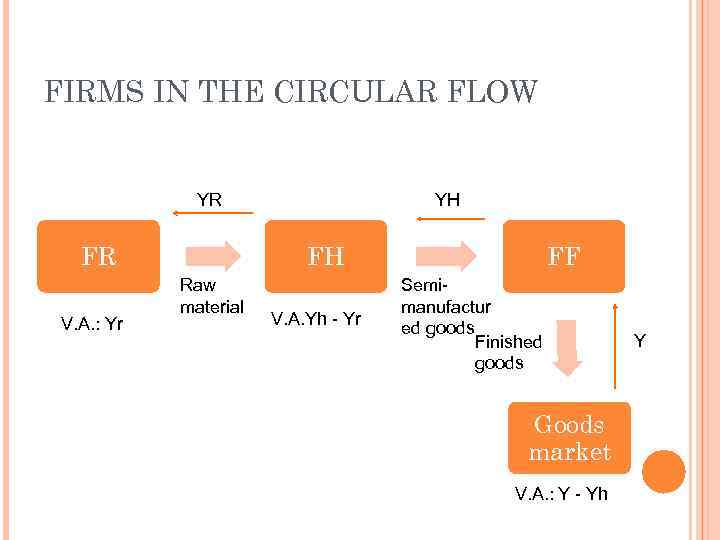
 FIRMS IN THE CIRCULAR FLOW We aivide all firms into three categories: FR consists of all firms that acquire raw material (iron ore, farm products and so on), FH all those that produce semi-manufactured goods (steel, pulp and so on) and FF all firms producing finished goods (software, cars and so on). We use the symbol Y for GDP. All of Y will go to the firms in the FF box. However, if we sum the value added from all firms, we will get exactly Y. If YR is the total value of all goods going from FR to FH, then the total value added from all firms in the FR box is equal to YR (they do not purchase any goods to which they add value) In the same way, if the total value of all goods going from FH to FF is given by YH, then the total value added from all firms in the FH box is YH – YR. In the same way, the total value added for all firms in the FF box will be equal to Y – YH. If we sum all the value added from all firms, we get YR +(YH – YR) + (Y – YH) = Y The total return to the factor market = Sum of all value added = GDP
 FIRMS IN THE CIRCULAR FLOW YR FR V. A. : Yr YH FH Raw material V. A. Yh - Yr FF Semimanufactur ed goods Finished goods Goods market V. A. : Y - Yh Y
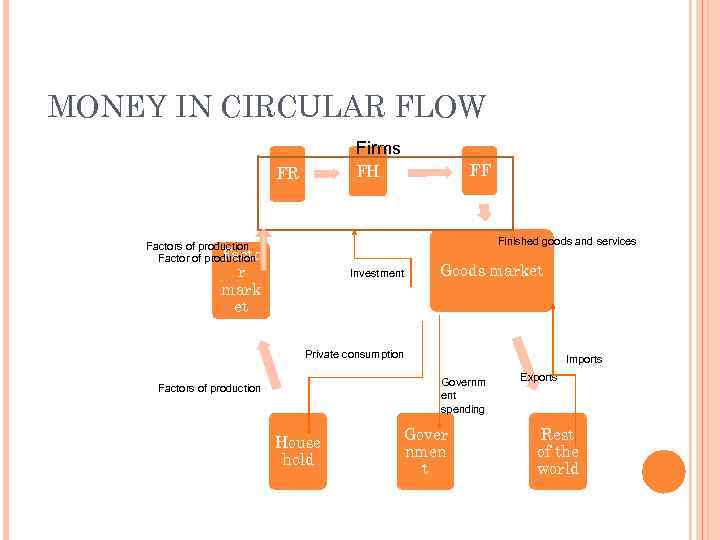 MONEY IN CIRCULAR FLOW Firms FF FH FR Finished goods and services Factors of production Factor of production r mark et Investment Goods market Private consumption Imports Governm ent spending Factors of production House hold Gover nmen t Exports Rest of the world
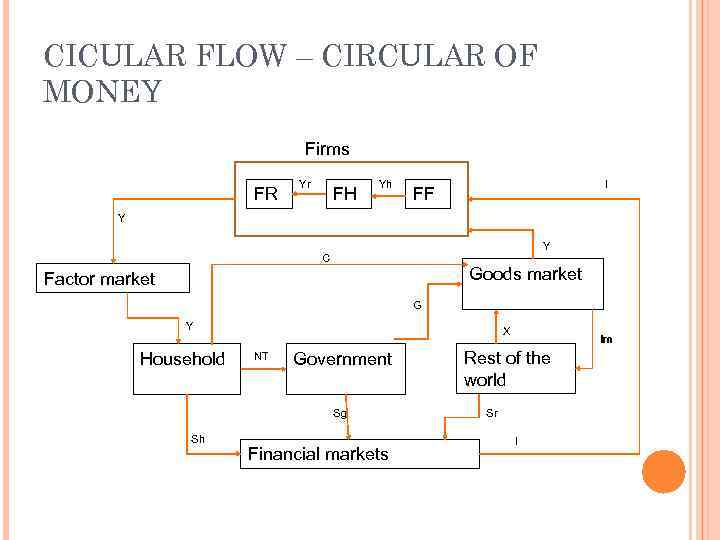 CICULAR FLOW – CIRCULAR OF MONEY Firms FR Yr FH Yh I FF Y Y C Goods market Factor market G Y Household X NT Government Sg Sh Financial markets Im Rest of the world Sr I
 EXAMPLE OF VALUE ADDED METHOD Consider the case of a table that a retailer sells for 400$. If the retailer sells 10 tables, this amounts to 4000$ of output. However, before the retailer can sell the tables, other steps in the chain must occur. First, the retailer must purchase the tables from a manufacturer for say, 200$ per table. Second, the manufacturer has to purchase wood from a lumberyard at a cost, say, of 100$ per table. If we were to count every stage of the production process, then output might seem to be 7000$. That is: 100$x 10 + 200$x 10 + 400$x 10 = $7000 WRONG $100 x 10 + (200 -100)x 10 + (400 -200) x 10 = $4000 CORRECT