


 Скачать презентацию The Yin Yang Approach to Measures of
f45547249ad385de2f62a9384bfeebfb.ppt
- Количество слайдов: 10
 The Yin / Yang Approach to Measures of Merit: Where does science end art begin? Adam Siegel file name Senior Analyst Northrop Grumman Analysis Center August 2003
 Introduction and Outline u Caveat: – Briefing represents author’s personal opinions, not necessarily Northrop Grumman (or USG) – Concept briefing, not ‘definitive’ analysis – Goal: Spark discussion rather than impart results Long-discussed Measures of Effectiveness (MOEs) only part of the equation – especially for “effects-based operations” (EBO) u Complicted mix from MOPs to Mo. PEs u Each level of analysis requires different mix of tools, techniques, academic & intellectual skills and approaches u Questions: u – Reinforcing or conflicting approaches? – What should be dominant?
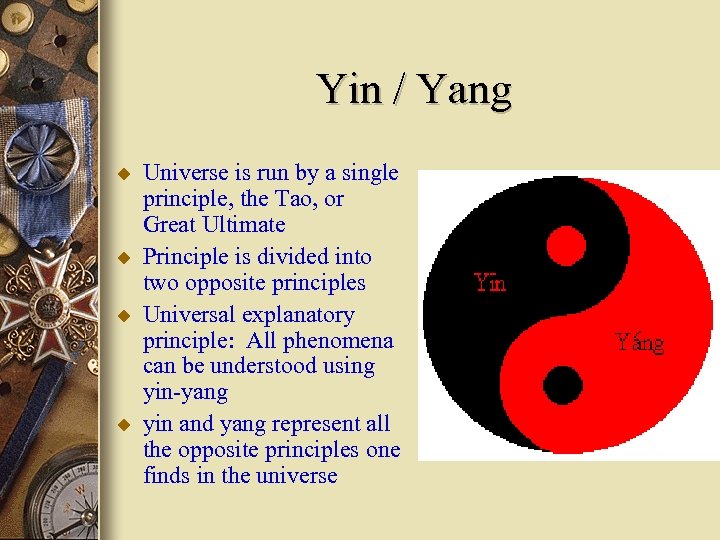 Yin / Yang u u Universe is run by a single principle, the Tao, or Great Ultimate Principle is divided into two opposite principles Universal explanatory principle: All phenomena can be understood using yin-yang yin and yang represent all the opposite principles one finds in the universe
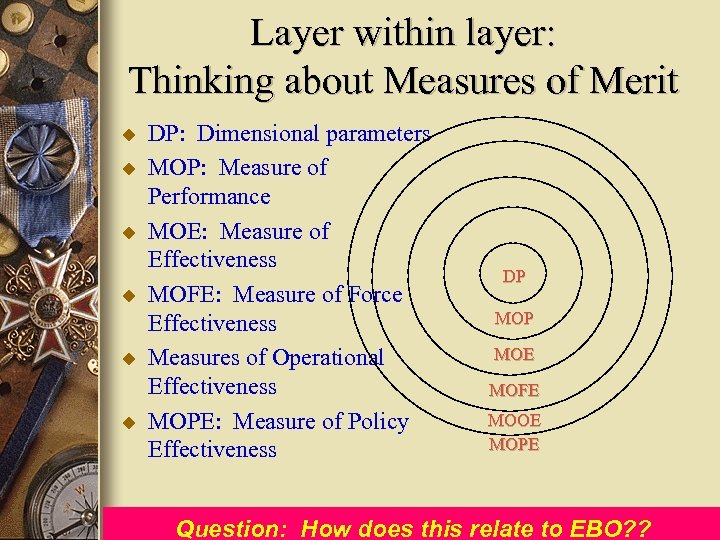 Layer within layer: Thinking about Measures of Merit u u u DP: Dimensional parameters MOP: Measure of Performance MOE: Measure of Effectiveness MOFE: Measure of Force Effectiveness Measures of Operational Effectiveness MOPE: Measure of Policy Effectiveness DP MOE MOFE MOOE MOPE Question: How does this relate to EBO? ?
 Some “case studies” re “MOM” analysis Patriot performance in Desert Storm u Operation Allied Force u 9/11 u
 u Patriots and Desert Storm Background – Iraqi SCUD ballistic missile threat – Patriot • developed for fixed-wing air defense • Software modifications to deal with TBMs • Deployed to Saudi Arabia and Israel u Operational experience – Initial claims of high-success rate in intercepts • Undercut by later and more detailed analysis • In the end, seemingly ineffective (potentially counterproductive) tactically – Critically important operationally and strategically • Forces believed they were protected – aided force morale • Israel and Saudi populations perceived active defense • Critical to keeping Israel from retaliating against Iraq – which might have shattered coalition u Thus – tactical failure, operational /strategic / policy success
 Operation Allied Force u Background – Air campaign re Serbian activity in Kosovo – Generally perceived before conflict that several days of exemplary bombing would suffice … 78 days later – Strike operations against: • Fielded Serbian forces and facilities directly supporting them • “Strategic” target sets – No allied ground forces (Importance of UCK / KLA? ) u Operational experience – Claims of successes in attacking fielded forces • Undercut by later and more detailed analysis • In the end, unclear tactical effects (at best) – “Strategic” target sets • Operators perceived stringent ROE restrictions • Unclear links to adversary decision making – Why did Milosevic surrender? • Multiple theories from pressure of air campaign on Serbian public and/or cronies; demonstrated NATO willingness to stay the course; emerging threat of a ground offensive; Russian pressure u Thus – operational success (enemy surrender) with uncertain understanding as to why
 u Background 9/11 – Al Qaeda suicide terrorist attacks using airliners as WMD – Uncertain Al Qaeda intent … potentially • Tactically: kill many? ‘shock’ the world? • Operationally: damage U. S. ? gain recruits for Al Qaeda? • Strategic: drive U. S. from Middle East? galvanize revolutionary Islam? weaken U. S. -Saudi relations? weaken Saudi gov / regime? u Operational experience – Tactical success: Aircraft caused massive destruction, potentially largest news event in history to date – Operational success: Massive economic – Strategic – mixed: Initial boost to al Qaeda, potentially undercut by U. S. /world move into Afghanistan and improved anti-terrorist operations, U. S. forces departing Saudi Arabia, worsened U. S. -Arab relations u Thus, for al Qaeda – clear tactical ‘victory’, likely operational ‘success’, with uncertain link to long-term strategic objectives
 CASE ‘LESSONS” u u Tactical, operational, and policy success not necessarily clearly linked “Predictive” ability uncertain – Extremely difficult to link technical, quantitatively measurable activity to decision-making processes – In these cases, what “DP” links to “MOPE” existed? u Quantitative and qualitative measures – Both relevant for understanding situations – But at different points of the MOM spectrum – Which provided path toward best support of (strategic) decision-making?
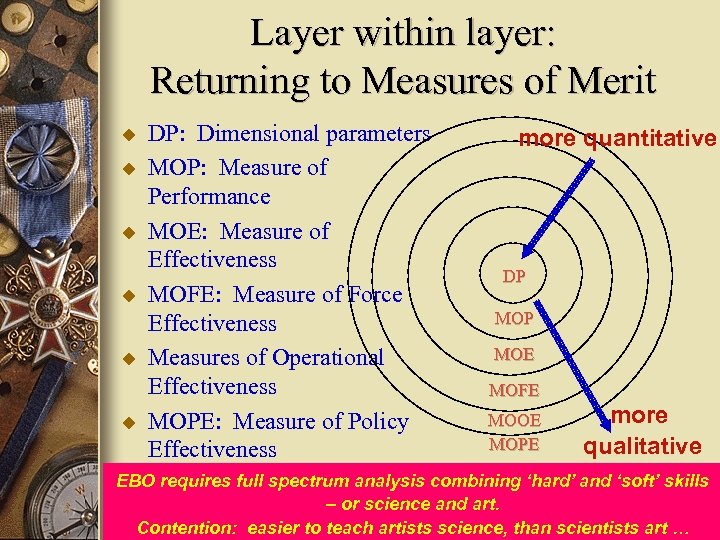 Layer within layer: Returning to Measures of Merit u u u DP: Dimensional parameters MOP: Measure of Performance MOE: Measure of Effectiveness MOFE: Measure of Force Effectiveness Measures of Operational Effectiveness MOPE: Measure of Policy Effectiveness more quantitative DP MOE MOFE MOOE MOPE more qualitative EBO requires full spectrum analysis combining ‘hard’ and ‘soft’ skills – or science and art. Contention: easier to teach artists science, than scientists art …