


 Скачать презентацию The Writing Process and Grammar Workshopp Different
17389f03c8324a55bdf21649e52b1c4b.ppt
- Количество слайдов: 57
 The Writing Process and Grammar Workshopp
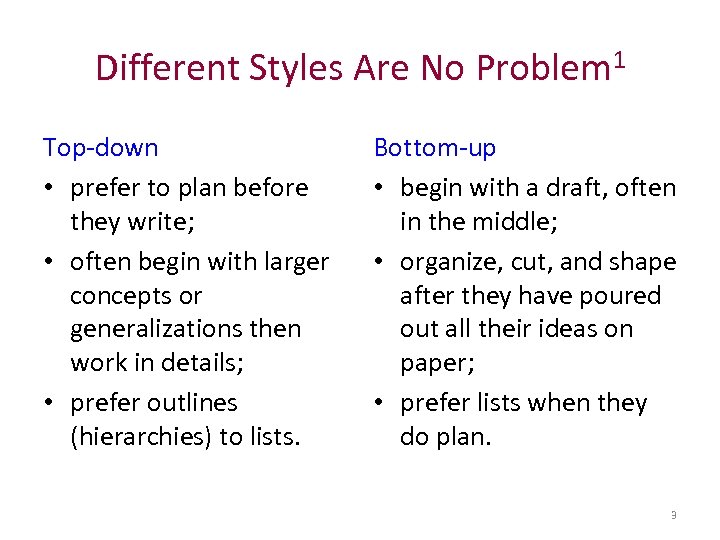 Different Styles Are No Problem 1 Top-down • prefer to plan before they write; • often begin with larger concepts or generalizations then work in details; • prefer outlines (hierarchies) to lists. Bottom-up • begin with a draft, often in the middle; • organize, cut, and shape after they have poured out all their ideas on paper; • prefer lists when they do plan. 3
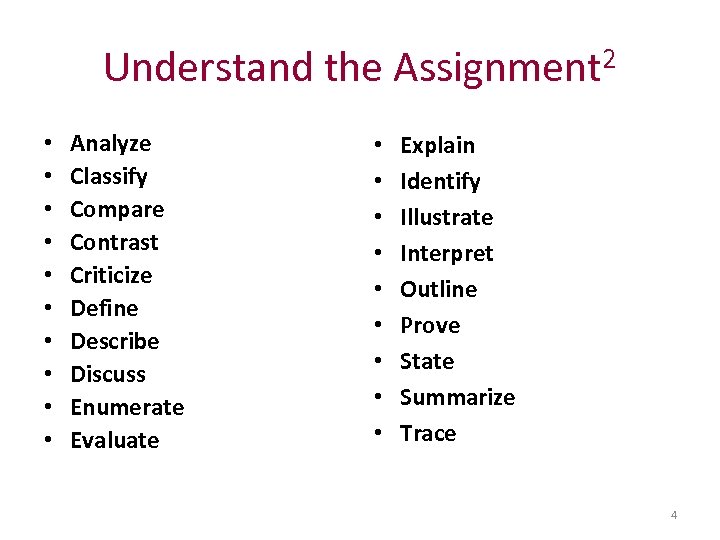 Understand the Assignment 2 • • • Analyze Classify Compare Contrast Criticize Define Describe Discuss Enumerate Evaluate • • • Explain Identify Illustrate Interpret Outline Prove State Summarize Trace 4
 Select a Topic 3 • The topic should be interesting to you. • The topic should be researchable. • Avoid topics that are overworked. 5
 Do Your Research • Begin researching and reading about the topic to gain information. • Read the material assigned by your professor. The libraries on campus will help you. http: //library. tamu. edu 6
 Develop a Working Thesis 4 • A thesis statement is the main idea of your paper. • Developing a working thesis should be among your first priorities. – Working is the operative word here. – Your thesis may change through the writing process. 7
 Develop a Working Thesis • What is my subject? Is my purpose to inform or to persuade? • Which aspects of my subject should I emphasize? • Is my subject similar to another subject that may be familiar to my readers? • If my subject is an event or object, what caused or created it? Would understanding the cause or a precedent make it easier for my audience to understand my subject? • What effects has my subject had or is it likely to have? Are the effects important or unexpected? 8
 Develop a Working Thesis • The working thesis should have two parts: the topic itself and your comment on the topic. • The chosen topic should be at the first of the sentence and what you want to say about it at the end. The Aggie network is valuable. 9
 Consider Your Audience 5 Writers who fail to understand their readers may fail to reach their goals. It is important to provide the context, tone, and language suitable to the audience you are addressing. 10
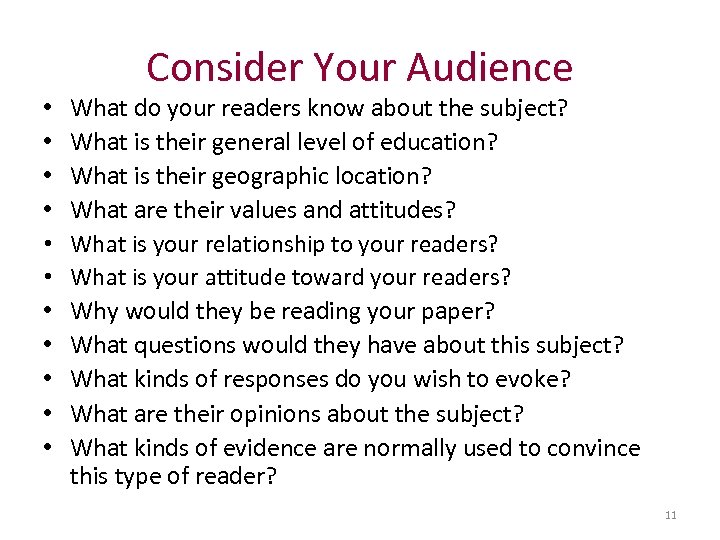 • • • Consider Your Audience What do your readers know about the subject? What is their general level of education? What is their geographic location? What are their values and attitudes? What is your relationship to your readers? What is your attitude toward your readers? Why would they be reading your paper? What questions would they have about this subject? What kinds of responses do you wish to evoke? What are their opinions about the subject? What kinds of evidence are normally used to convince this type of reader? 11
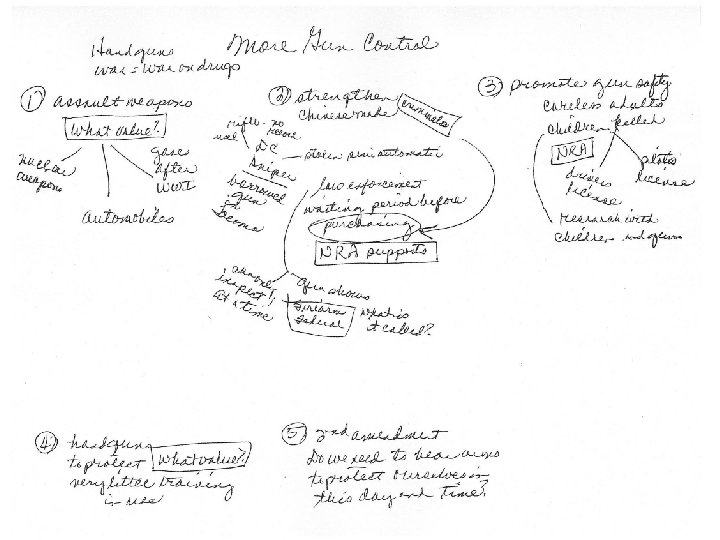
 Prewriting 6 • • Keep a journal Use journalists’ questions Ask analytical questions Brainstorm and list Freewrite Cluster Venn Diagram 12
 13
13
 Organize • Look at the questions you answered when you were developing your working thesis. • Look at your prewriting. • Find the main ideas or categories of your thinking. • Put less important items under more important items. • Make an outline (or not). • Decide how you will set up your paper. • How can you organize the paper to achieve your objective? 14
 Argument Talk about any concessions or counter-arguments at the first of the paper to get them out of the way. One way to set up your argument: 2 nd strongest argument (We remember what we hear first, second best. ) Weakest argument (We forget the stuff in the middle. ) Strongest argument (We remember what we hear last, best. ) You want the last word. 15
 Compare/Contrast 7 Use the Venn diagram to find the similarities and differences between the two topics. Ways to set up you paper: – Subject by subject: This pattern discusses Subject A, then Subject B, then how the subjects compare and contrast. – Point by point: This pattern discusses each point and how Subject A compares or contrasts with Subject B on that point. 16
 Problem/Solution Begin by describing the problem. Then discuss the possible solutions that you do not propose. Be fair. Introduce your proposed solution. To get the disadvantages of your solution out of the way, talk about them first. End with the advantages of your solution. 17
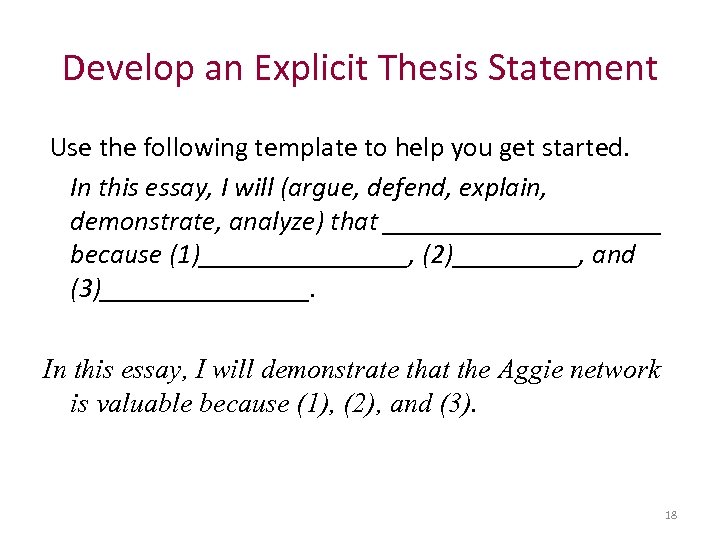 Develop an Explicit Thesis Statement Use the following template to help you get started. In this essay, I will (argue, defend, explain, demonstrate, analyze) that __________ because (1)________, (2)_____, and (3)________. In this essay, I will demonstrate that the Aggie network is valuable because (1), (2), and (3). 18
 Write a Draft • • Introduction—should provide context so that your reader knows what you will be discussing. Body—your argument, discussion, etc. Conclusion—restate the argument, wrap up the discussion, recommend a solution. Place your thesis in a position that is clear to your reader. 19
 Support/Elaboration When you make a general statement, be sure to support or elaborate your idea: – Facts – Opinions—especially the opinions of experts on the subject – Reasons – Examples – Cause/Effect Think “fat old rats eat cheese enchiladas. ” 20
 Writing Style • Word Choice – Be concise. Delete meaningless words. • Here is an example of the use of strategy in the game of basketball by the Aggie coaches. • This passage shows how the Aggie basketball coaches use strategy. – Avoid redundancy. • Fully and complete, any and all – Use an appropriate level of vocabulary. – Avoid slang and clichés. – Define key terms. 21
 Writing Style 8 • Simplify – This must be done prior to any other action. – This must be done first. – In the event the information is available by the first of the year. – If the information is available by the first of the year. 22
 Writing Style • For emphasis, put the important information of the sentence at the end. – Tech’s claim that the referees at Saturday’s game were unfair appears in the last part of the newspaper article. – In the last part of the newspaper article, Tech claims that the referees at Saturday’s game were unfair. 23
 Writing Style Things to avoid: – Overusing the word very. – Beginning sentences with There is or There are. • There are many people who want to become Aggies. • Many people want to become Aggies. There and where = places They’re = they are Their = possessive 24
 Incubate 9 By this time, you have been so immersed in the paper that you probably can’t think straight, so you should give yourself time off to let your ideas simmer. Solutions or ideas may develop in the unconscious before taking conscious shape. When you go back to the paper, you will probably see things that you were not aware of before. This is another important reason not to put off writing the paper until the last minute. 25
 Revise 10 • Global Revision – Changes in paragraph structure or order – Changes in content. – Changes at the whole document level. 26
 Revise 11 • Read the paper aloud. • List the main idea of each paragraph. – Does each paragraph support your thesis? – Are your paragraphs organized effectively? • Think of thesis as an umbrella that covers all the points in the paper. • Refine thesis statement. Does it explicitly state your main idea and purpose? 27
 Revise • Check the paper’s development. – Are there sufficient details? – Is the logic valid? – Are the major points connected? – Are the relationships between them expressed clearly? – Have you used transitions to help your reader see the relationships? 12 28
 Revise 13 • Review your diction. – Try to anticipate your readers’ response to your words. • The media’s exploitation of the Watergate scandal showed how biased it was already. • The media’s coverage of the Watergate scandal suggests that perhaps some in the media had already determined Nixon’s guilt. 29
 Revise • Remember your readers. – Everything you say should keep that reader in mind. – Write as clearly and concisely as possible. – At the same time, give your readers all the information they need to understand what you are saying. 30
 Revise 14 • Local Revision – Changes in sentence structure, grammar, mechanics, format, diction. – Changes at the sentence level. 31
 Use Punctuation to Create Sentence Variety. • Knowing how to punctuate gives you control over the types and lengths of your sentences. • Vary sentence types and lengths so your writing does not get choppy. • Use punctuation to make the rhythm of your prose interesting and to emphasize particular ideas. 32
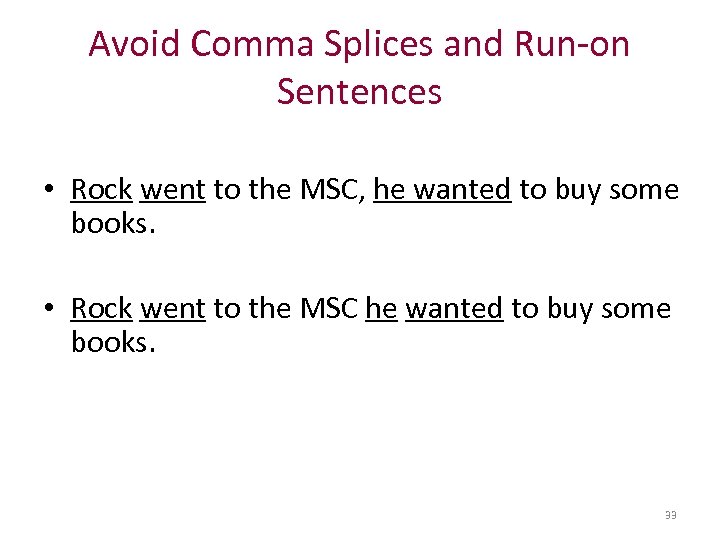 Avoid Comma Splices and Run-on Sentences • Rock went to the MSC, he wanted to buy some books. • Rock went to the MSC he wanted to buy some books. 33
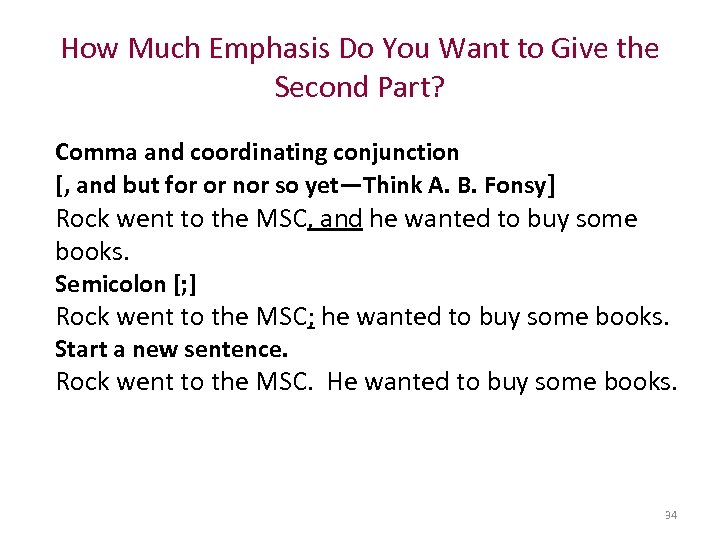 How Much Emphasis Do You Want to Give the Second Part? Comma and coordinating conjunction [, and but for or nor so yet—Think A. B. Fonsy] Rock went to the MSC, and he wanted to buy some books. Semicolon [; ] Rock went to the MSC; he wanted to buy some books. Start a new sentence. Rock went to the MSC. He wanted to buy some books. 34
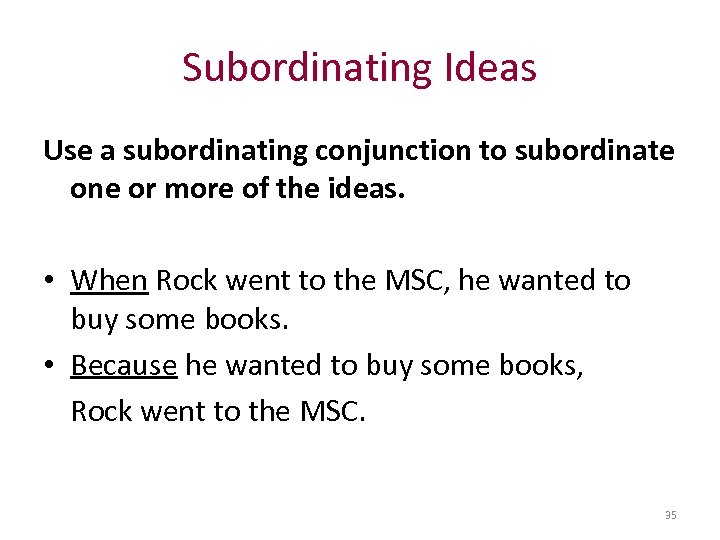 Subordinating Ideas Use a subordinating conjunction to subordinate one or more of the ideas. • When Rock went to the MSC, he wanted to buy some books. • Because he wanted to buy some books, Rock went to the MSC. 35
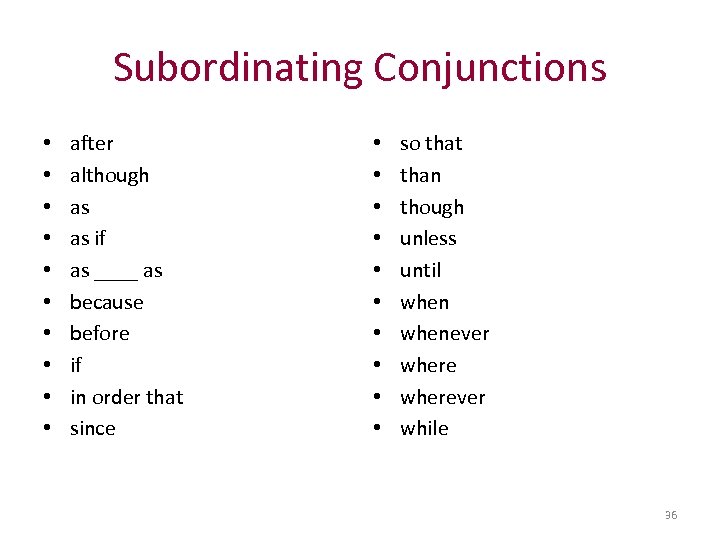 Subordinating Conjunctions • • • after although as as if as ____ as because before if in order that since • • • so that than though unless until whenever wherever while 36
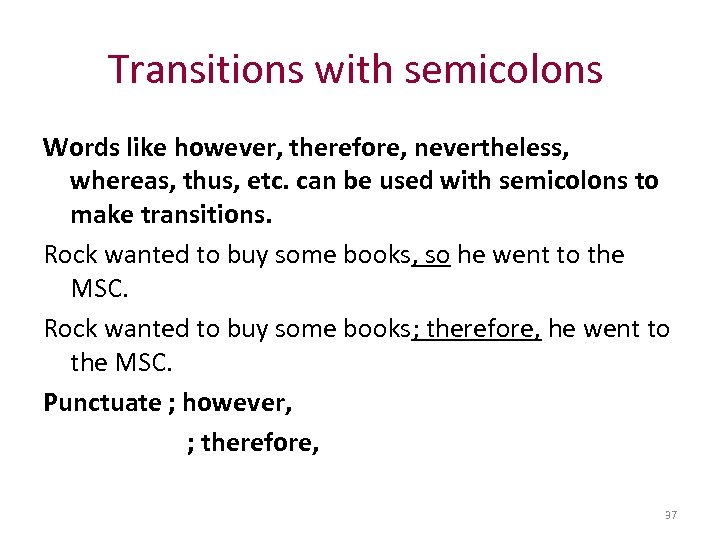 Transitions with semicolons Words like however, therefore, nevertheless, whereas, thus, etc. can be used with semicolons to make transitions. Rock wanted to buy some books, so he went to the MSC. Rock wanted to buy some books; therefore, he went to the MSC. Punctuate ; however, ; therefore, 37
 Commas 2. If the phrase or clause is essential for the sentence to make the sense you want, do not use commas. • The boy wearing the Maroon Out shirt is my brother. • The girl who is waving the Spirit Towel is his date. There a number of boys and girls. 38
 Commas 3. If the word, phrase, or clause is not essential for your sentence to make the sense you want, do use commas. • I can, however, tell you about the picture. • The boy, wearing the Maroon Out shirt, is my brother. • The girl, who is waving the Spirit Towel, is his date. There is only one boy and one girl. 39
 Commas 4. When using an introductory word, phrase, or dependent clause to begin a sentence, use a comma. • Today, females are students at TAMU. • During the last thirteen football seasons, I have seen every Aggie home game. • Because the Aggie spirit is exciting, I always enjoy the games. 40
 Possessive Nouns 5. End a singular noun with an apostrophe followed by an “s. ” • Kyle Field’s capacity is over 86, 000. End a plural noun ending in “s” with the “s” followed by an apostrophe. • Many Aggies’ memories of the bonfire are happy and spirit-filled. 41
 Possessive Nouns End a plural noun not ending in “s” with an apostrophe followed by an “s. ” Women’s soccer is an important sport at Texas A&M. 42
 Possessive Pronouns Whereas, the possessive of a noun is always formed by adding an apostrophe, the possessive of a personal pronoun is never formed by adding an apostrophe. Possessive personal pronouns: my, mine, yours, his, hers, its Its = possessive Your = possessive Their = possessive It’s = contraction for it is You’re = contraction for you are They’re = contraction for they are 43
 Proper Punctuation to Incorporate a Quotation into a Sentence If the introductory material is a sentence, add the quotation after a colon. Eleanor Roosevelt spent many years feeling insecure before she realized this idea: “No one can make you feel inferior without your consent. ” 44
 Proper Punctuation to Incorporate a Quotation into a Sentence If the introductory material is not an independent clause, use a comma. Eleanor Roosevelt states, “No one can make you feel inferior without your consent. ” 45
 Proper Punctuation to Incorporate a Quotation into a Sentence If you include the words of a quotation into one of your sentences, use square brackets [ ] and ellipses. . I agree with Eleanor Roosevelt that “[n]o one can make you feel inferior without your consent. ” It is impossible to “. . . make you feel inferior without your consent” (Roosevelt). 46
 Agreement of Subjects and Verbs 7. Make the subject and verb agree with each other, not with words that come between them. • One of the most famous Aggies is reviewing the March-in. Of the most famous Aggies is a prepositional phrase. One is the subject of the sentence. 47
 Prepositions About, above, across, against, Among, around, at, after, Before, beside, behind, between, Beyond, by, down, during Into, far, from, in, except, Near, off, to, over, Past, throughout, through, toward, on, up Without, until, with, under 48
 Misplaced Modifiers 8. An introductory modifier should always refer to the subject of the sentence. • After carrying the mini-fridge up the dorm stairs, it wouldn’t fit in the doorway to the room. Did it carry the mini-fridge up the dorm stairs? • After carrying the mini-fridge up the dorm stairs, the Fish found that it wouldn’t fit in the doorway to the room. 49
 Parallel Construction 9. If you name a series, always use the same elements throughout the list. • At Fish Camp, we learned Aggie yells, singing the “Aggie War Hymn, ” about the traditions, and made new friends. • At Fish Camp, we learned Aggie yells, sang the “Aggie War Hymn, ” talked about the traditions, and made new friends. • At Fish Camp, we had fun learning the Aggie yells, singing the “Aggie War Hymn, ” talking about the traditions, and making new friends. • At Fish Camp, we learned to do Aggie yells and to sing the “Aggie War Hymn. ” 50
 Active and Passive Voice 10. If the subject of the sentence does the action, the verb is in active voice. The Aggie men’s basketball team beat Colorado’s basketball team this week. If the subject of the sentence receives the action, the verb is in passive voice. The tu women’s basketball team was beaten by the Aggies this week. 51
 Avoid Using Passive Voice Generally speaking, writing is stronger when you use active voice with strong, active verbs. SMU’s soccer team was driven to the wall by the Aggies in the game on Saturday. Last Saturday, the Aggies drove SMU to the wall in the NCAA soccer play-offs. 52
 Use Passive Voice in These Situations When the action is more important than the actor. • Underwater research in the Gulf of Mexico is conducted by Texas A&M Galveston. When the actor is unknown. • Some important information was leaked by a source in the White House. 53
 Use Passive Voice in These Situations When the receiver of the action is more important than the actor. • The President was questioned by the press in this matter. To avoid revealing the actor. • The President stated, “Mistakes were made. ” 54
 Omit Unnecessary Words Instead of writing “Scientific research generally depends on fully accurate data if it is to offer theories that will allow us to predict the future in a plausible way. ” write “To offer theories that plausibly predict the future, scientific research depends on accurate data. ” 55
 Miscellaneous • To, too – Think spoiled brat: I’m toooooo tired to go. – I want to go tooooo. • Affect, effect – A=act – E=end • Separate • Very 56
 End Notes 1. 2. 3. 4. 5. 6. 7. 8. 9. 10. 11. 12. 13. 14. Mary Compton and Yeo Ju Choi. “Write Academic, ” http: //writingcenter. tamu. edu (accessed February 7, 2006). University Writing Center, Texas A&M University, “Understanding the Assignment, ” http: //writingcenter. tamu. edu/content/view/32/77/ (accessed August 1, 2005). University Writing Center, Texas A&M University, “Selecting a Topic, ” http: //writingcenter. tamu. edu/content/view/28/77/ (accessed August 1, 2005). University Writing Center, Texas A&M University, “Developing a Thesis, ” http: //writingcenter. tamu. edu/content/view/16/77/ (accessed August 1, 2005). University Writing Center, Texas A&M University, “Audience Analysis, ” http: //writingcenter. tamu. edu/content/view/117/77/ (accessed August 1, 2005). University Writing Center, Texas A&M University, “Getting Started, ” http: //writingcenter. tamu. edu/content/view/17/77/ (accessed February 14, 2006). University Writing Center, Texas A&M University, “Compare and Contrast Essays, ” http: //writingcenter. tamu. edu/content/view/14/76/ (accessed February 14, 2006). Compton, Mary and Yeo Ju Choi, “Write Academic. ” Purdue University Online Writing Lab, “Editing and Proofreading, ” http: //owl. english. purdue. edu/handouts/general/gl_edit. html (accessed January 12, 2006). Mary Compton and Yeo Ju Choi, “Write Academic. ” Purdue University Online Writing Lab, “Editing and Proofreading. ” University Writing Center, Texas A&M University, “Transition Words and Phrases, ” http: //writingcenter. tamu. edu/content/view/92/78/ (accessed February 14, 2006). Purdue University Online Writing Lab, “Editing and Proofreading. ” Mary Compton and Yeo Ju Choi, “Write Academic. ” 57