


 Скачать презентацию The Writing Process 2003 Prentice Hall wpro
d965a56694f80d9f30a9c4007edadfd2.ppt
- Количество слайдов: 17
 The Writing Process © 2003 Prentice Hall wpro 1
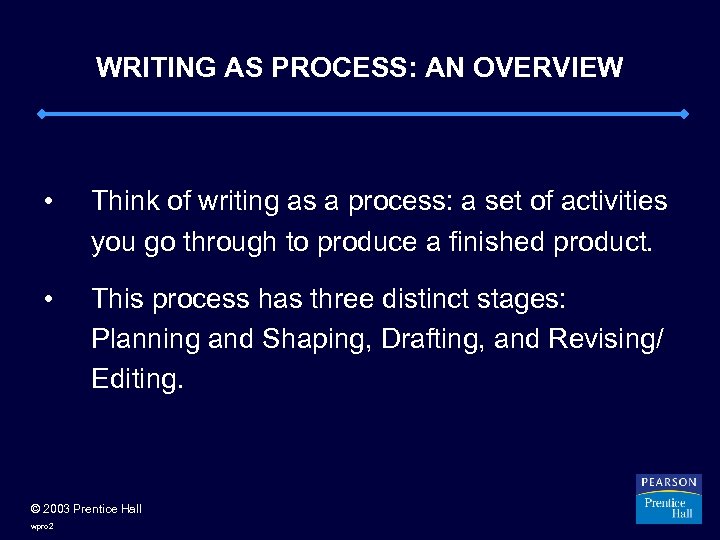 WRITING AS PROCESS: AN OVERVIEW • Think of writing as a process: a set of activities you go through to produce a finished product. • This process has three distinct stages: Planning and Shaping, Drafting, and Revising/ Editing. © 2003 Prentice Hall wpro 2
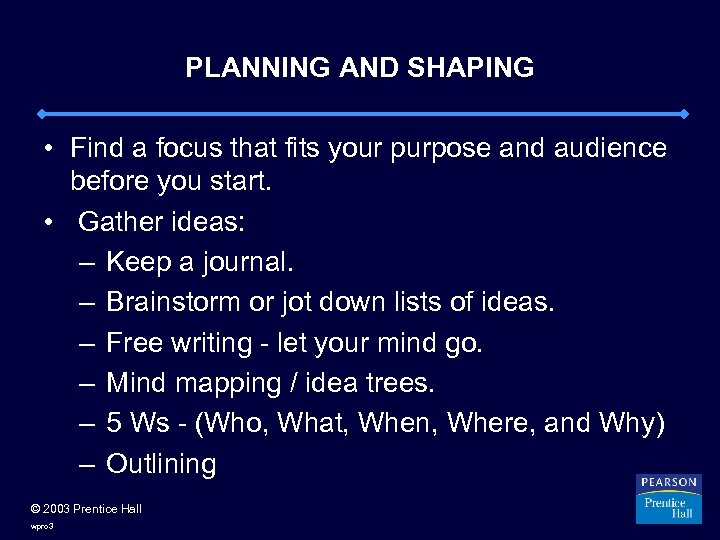 PLANNING AND SHAPING • Find a focus that fits your purpose and audience before you start. • Gather ideas: – Keep a journal. – Brainstorm or jot down lists of ideas. – Free writing - let your mind go. – Mind mapping / idea trees. – 5 Ws - (Who, What, When, Where, and Why) – Outlining © 2003 Prentice Hall wpro 3
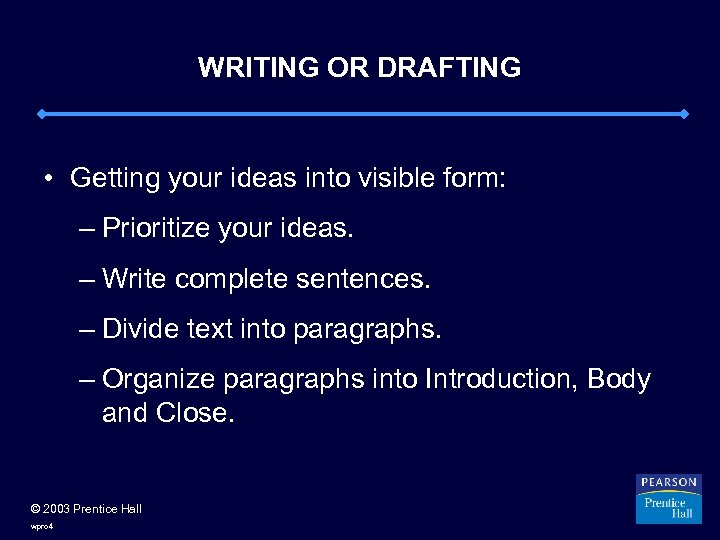 WRITING OR DRAFTING • Getting your ideas into visible form: – Prioritize your ideas. – Write complete sentences. – Divide text into paragraphs. – Organize paragraphs into Introduction, Body and Close. © 2003 Prentice Hall wpro 4
 EDITING: EVALUATING YOUR DRAFT CRITICALLY AND MAKING CHANGES • Large-scale changes: adding text, cutting, replacing words/phrases, rearranging parts. • Editing: checking the correctness of grammar, spelling, punctuation and mechanics. • Proofreading: are there any typos? © 2003 Prentice Hall wpro 5
 WRITING AS PROCESS: LET’S COMPARE METHODS • Think of the most unusual or eccentric person you have ever met. • In 20 minutes, write a paragraph describing this person to your classmates. Concentrate on getting each sentence right as you go. • Do not rewrite your paragraph. © 2003 Prentice Hall wpro 6
 PLANNING AND SHAPING: PART I About your person, answer these questions: • When/where did you meet? • What does he or she look/sound like? Face/ clothing/ hair/ body/ language/ accent? • What are his or her tastes in movies/ books/ music/ food/ cars? • How did he or she surprise/ teach/ inspire you? • Why should your classmates be interested in him or her? © 2003 Prentice Hall wpro 7
 PLANNING AND SHAPING: PART II • Close your eyes and imagine “X” doing something he or she typically does. Imagine every detail. • Freewrite for 5 minutes about your image. – Write quickly. – Don’t edit as you go - just put down the words as fast as you can. – If you get stuck, just write “I’m stuck, I’m stuck…” until you think of something. © 2003 Prentice Hall wpro 8
 DRAFTING • FOCUSING: • DRAFTING: – Look at your free – Write a paragraph writing paragraph. developing the idea you just wrote – Take a new page down. and write down in one sentence “X”’s – Use any relevant single most striking/ details from your unusual feature. list or free writing. © 2003 Prentice Hall wpro 9
 REVISING & EDITING • REVISING: Your classmates are the audience. Will you need additional detail for them to visualize what you mean? Make those additions now. • EDITING: Check your paragraph for correctness of sentence structure, grammar, spelling and punctuation and correct errors now. © 2003 Prentice Hall wpro 10
 COMPARISON • Reread the paragraph you wrote without going through the process and compare it to the “processed” one. • How do they differ? • Which one is better? © 2003 Prentice Hall wpro 11 • If the “processed” paragraph is better, which phase of the process helped you most? • How will you use this information when you write?
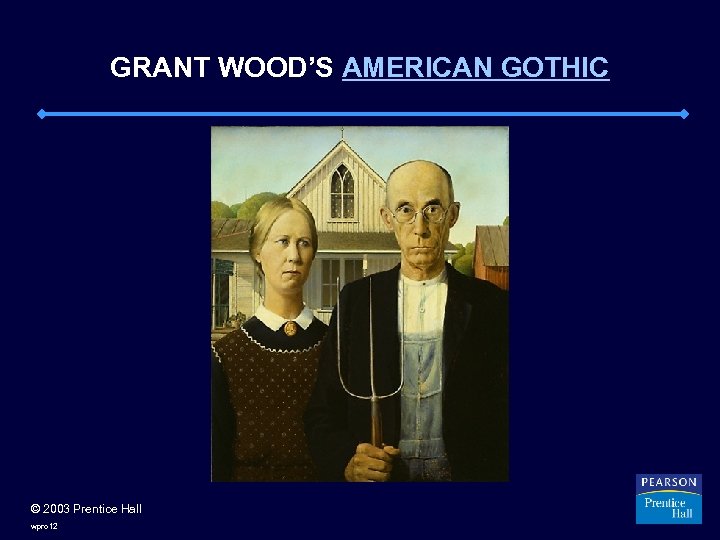 GRANT WOOD’S AMERICAN GOTHIC © 2003 Prentice Hall wpro 12
 AMERICAN GOTHIC: WRITING AS PROCESS EXERCISE • Look carefully at the picture provided of American Gothic, the famous painting by artist Grant Wood (1892 -1942). Notice the details and mood of the composition. © 2003 Prentice Hall wpro 13 • Prepare to use the four process steps to write about the painting: – Planning and Shaping – Drafting – Revising – Editing
 PLANNING AND SHAPING • Use single words or phrases to describe the following aspects of the painting: – Background/ sky/ house/ shed – People/ facial expressions/ hair/ eyes/ pitchfork/ hand – How are the people similar? Different? What is their relationship to each other? © 2003 Prentice Hall wpro 14 • Review your list of details. • Answer this question in a single complete sentence: – What central impression do the details seem to convey?
 DRAFTING • Write your sentence out at the top of a new sheet of paper. • Write a draft of a paragraph supporting your sentence. • Include as many details from your list as you can. © 2003 Prentice Hall wpro 15
 REVISING • DETAIL: How have the details you mentioned help create the central impression of the painting? • ORGANIZATION: Is your paragraph organized? Coherent? Does it support your core sentence? • WORD CHOICE: Are your words precise? Replace any fuzzy words with more precise ones. © 2003 Prentice Hall wpro 16
 EDITING • Review your paragraph for correctness of sentence structure, grammar, spelling and punctuation. • Make any necessary changes. © 2003 Prentice Hall wpro 17