 Скачать презентацию The World s Last Great Wilderness Antarctica British Antarctic
4c93b585d18951ee6ec5bddc68da77b9.ppt
- Количество слайдов: 17



The World’s Last Great Wilderness (Antarctica) British Antarctic Survey
The Antarctic continent • Coldest, driest, windiest, highest, and least accessible continent • Winter population 1000 people, 10, 000 in summer • 10, 000 tourists visit for a few days in summer • Ice covered for the last 25 million years • Less than 1% of continent is ice free • Once the home of dinosaurs, trees and plants • An insect is the “lion” of the Antarctic
The Southern Ocean • Fifty million seals & 15 million penguins • Regional fishery of global economic value • History of over-exploitation. Seals, whales. penguins and fish • Fishery for krill and fish regulated by science-backed international body under Antarctic Treaty • Pirate fishing due to lack of effective policing • Decline of albatross due to mortality on long lines of tuna fishermen in sub-Tropics
The Antarctic Treaty • Antarctica is “a natural reserve devoted to peace and science” • The Antarctic Treaty manages the region’s wildlife • Mining is forbidden • The Treaty runs indefinitely • Forty-four countries have acceded to the Antarctic Treaty (80% of the world population) • All 44 countries have to agree to Treaty revisions
“Green” fallacies about the Antarctic • • The Antarctic Treaty expires in 50 years Mining is only banned for 50 years Antarctica is under threat from developers People working in the Antarctic have polluted the continent • Antarctica still has to be saved • Penguins fall over backwards when planes fly overhead!
Home truths from the Antarctic • The Antarctic is the most rigorously protected region of the world • The protection is legally backed • International inspection teams monitor compliance with the Antarctic Treaty • Man’s footprint on Antarctica is practically invisible • More “pollution” enters the region through the atmosphere than is generated there (DDT, CFCs )
Antarctic discoveries • The destruction of the ozone layer • A 400, 000 year demonstration of the link between greenhouse gases and climate • The global impact of the Industrial Revolution • A reduction of the height of the ionosphere consistent with “global warming” • Lakes beneath the Antarctic ice sheet believed to contain life forms possibly millions of years old
Antarctica is part of the world • The Earth system involves the whole Earth • Antarctic studies are essential • There can be no weak link in understanding the Earth system • Climate feedbacks involving ice, snow, sea ice and ocean currents provide the greatest challenges in predicting the future
The Arctic • Contains cities, towns and universities • Indigenous population share the region with new settlers • All Arctic land is under the jurisdiction of a sovereign state • UK scientists regularly work in the Arctic • There is far more science activity in the Arctic compared to the Antarctic
The Antarctic ice sheet • Ice up to three miles (4500 m) thick • Coldest surface temperature -89 degrees C • Enough ice for each person in the world to have a block 180 m by 180 m • If all melted, sea level could rise 65 metres • If all the glaciers doubled their speed of flow it would take 12, 000 years for the ice to float into the Southern Ocean
Antarctic ice and sea level rise • A small change in the size of the Antarctic ice sheet would be serious for sea level • One small part of Antarctica is above freezing in the summer - the Antarctic Peninsula. • The Antarctic Peninsula is warming and its coastline is changing • Maps of Antarctica need updating regularly because of the changes to the coastline • The disintegration of ice shelves from the Antarctic Peninsula has had no effect on sea level • Most of Antarctica is not warming • In a warmer world more snow will fall over the Antarctic • Enhanced Antarctic snowfall is possibly the only natural way that sea level rise can be slowed
Future developments in Antarctica • Exploring the largest lake under the ice sheet • Obtaining a reliable climate record over half a million years • Exploiting natural “antifreeze” in Antarctic organisms • Studying the effects of increased UV-radiation and “global warming” on Antarctic life • Celebrating the centenaries of the historic expeditions of Scott, Shackleton and Bruce
Antarctic Schools Pack • Fifteen sections : each with worksheet and tasks and resources for multiple photocopying • Teachers notes • Sent free to every UK secondary school • Aimed at A-level standard • Written by British Antarctic Survey scientists and an educational advisor • Published by the Foreign and Commonwealth Office
Antarctic Schools Pack • • The nature of Antarctica Discovery of Antarctica Living and working in Antarctica Science in Antarctica The Antarctic Treaty System Geology in Antarctica Antarctic ice The Antarctic climate • The ozone hole • Geospace • Terrestrial and freshwater lake ecosystems • Marine ecosystems • Management and conservation of marine species • Environmental protection of Antarctica • Tourism in Antarctica
Feedback on Antarctic Schools Pack • “An essential resource for school or college” • “Packed with a variety of up-to-date and relevant information that can be used flexibly in the classroom” • “Mori” poll voted it one of the best four resources available for study of environmental change • Received Gold Award of Geographical Association in Spring 2000
Future teaching resources on Antarctica • BAS has signed a partnership agreement with the Geographical Association • First priority is to develop a Work Package at GCSE level on Antarctica • Propose to develop materials for Primary Schools • BAS welcomes feedback on the Schools Pack • BAS will develop www. antarctica. ac. uk
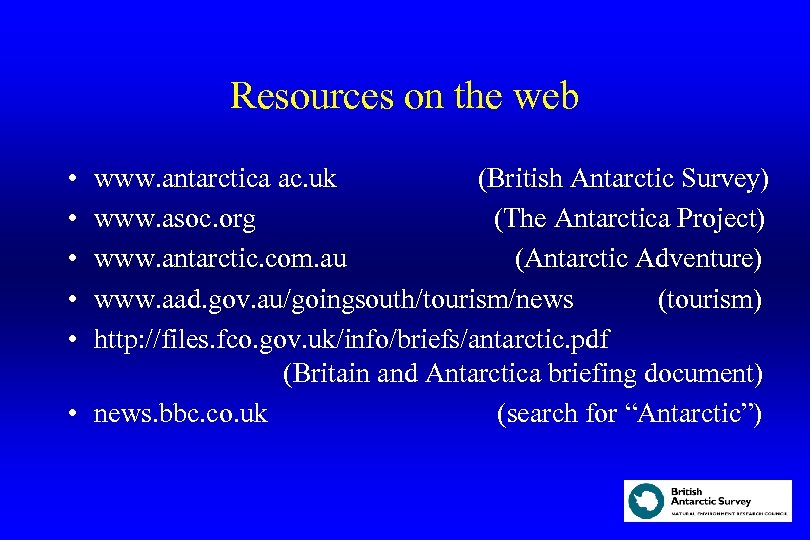
Resources on the web • • • www. antarctica ac. uk (British Antarctic Survey) www. asoc. org (The Antarctica Project) www. antarctic. com. au (Antarctic Adventure) www. aad. gov. au/goingsouth/tourism/news (tourism) http: //files. fco. gov. uk/info/briefs/antarctic. pdf (Britain and Antarctica briefing document) • news. bbc. co. uk (search for “Antarctic”)
Скачать презентацию The World s Last Great Wilderness Antarctica British Antarctic
4c93b585d18951ee6ec5bddc68da77b9.ppt