


 Скачать презентацию The World Intellectual Property Organization An Organization for
867bb9c0275b100480b9a2f94ce15bc6.ppt
- Количество слайдов: 22
 The World Intellectual Property Organization An Organization for the future. . Welcome
 Presentation • History of Int’l IP System • WIPO Today • WIPO’s Main Activities
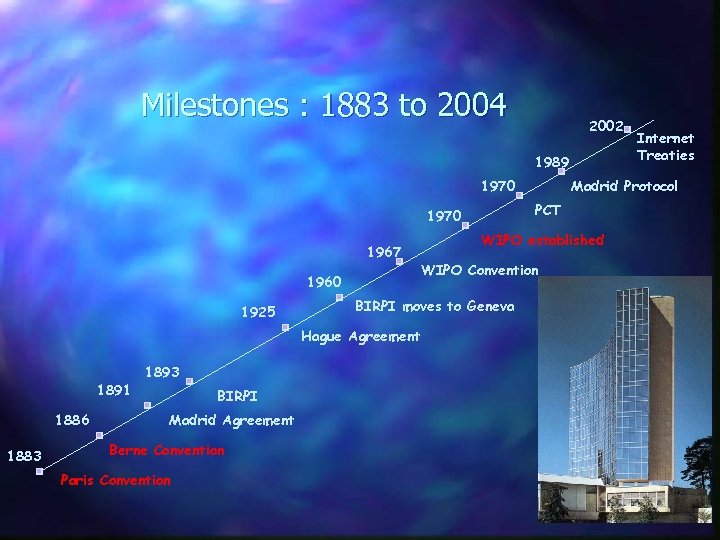 Milestones : 1883 to 2004 2002 1989 1970 1967 1960 1925 1891 1886 1883 1893 BIRPI Madrid Agreement Berne Convention Paris Convention WIPO established WIPO Convention BIRPI moves to Geneva Hague Agreement Madrid Protocol PCT 1970 Internet Treaties
 Basic Facts about WIPO’s Mission: To promote the protection of IP rights worldwide and extend the benefits of the international IP system to all member States Status: An int’l intergovernmental organization Member States: 183 Staff: 915 from 94 countries Treaties Administered: 24 Decisions by: GA, CC, WIPO Conference Guiding Principles: Transparency, Accountability, Consensus
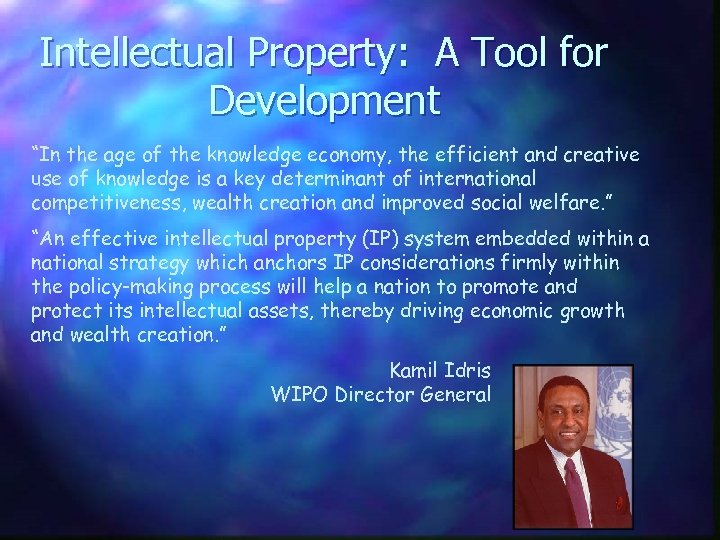 Intellectual Property: A Tool for Development “In the age of the knowledge economy, the efficient and creative use of knowledge is a key determinant of international competitiveness, wealth creation and improved social welfare. ” “An effective intellectual property (IP) system embedded within a national strategy which anchors IP considerations firmly within the policy-making process will help a nation to promote and protect its intellectual assets, thereby driving economic growth and wealth creation. ” Kamil Idris WIPO Director General
 Strategic Goals n Promotion of an IP culture – – – n n build a foundation for more solid & extensive IP culture better understanding & use of IP system. Greater respect for IP rights IP policies as part of Nat’l Dvpt. Strategies Development of balanced IP laws responsive to emerging needs Delivery of quality global IP protection systems Enhanced Access to IP System – practical solutions to empower all stakeholders to develop, protect, enforce, manage and commercially exploit IPRs for development
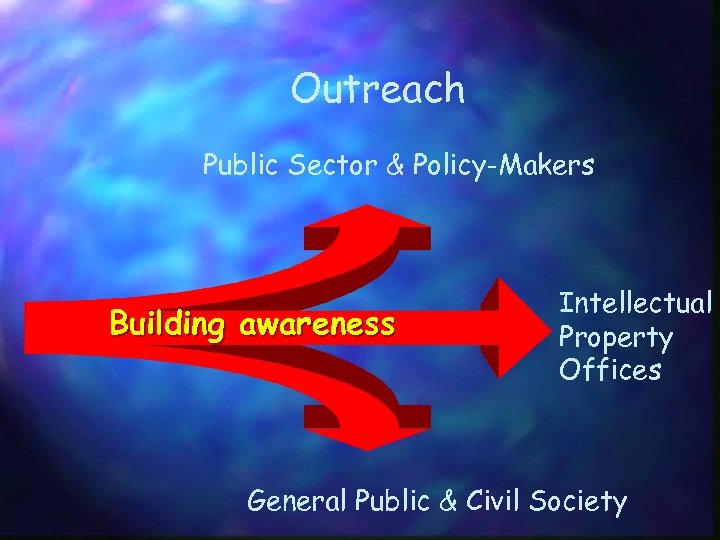 Outreach Public Sector & Policy-Makers Building awareness Intellectual Property Offices General Public & Civil Society
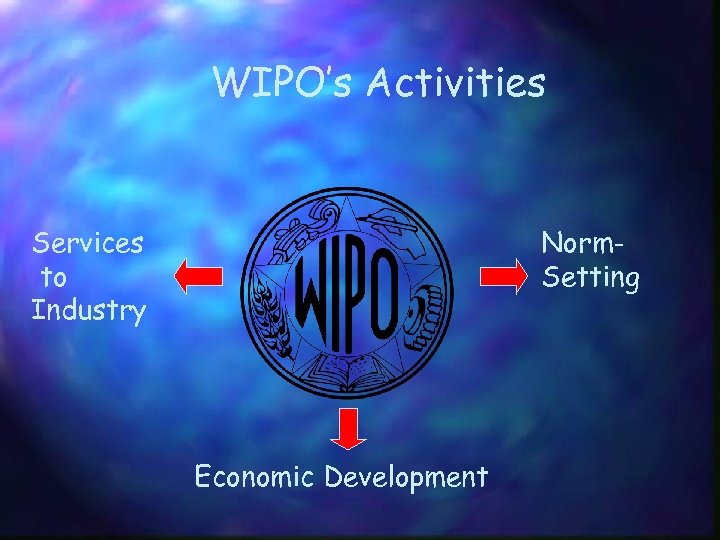 WIPO’s Activities Services to Industry Norm. Setting Economic Development
 Norm Setting n AIM: Progressive development of international IP law for an IP system that is: – – – n balanced/responsive to emerging needs effective in encouraging innovation/creativity sufficiently flexible to accommodate national policy objectives Address/provide info. on current & emerging issues in IP - (review/discussion of topical issues in standing committees).
 Norm Setting atents A Success Story: Functional challenges: (success has generated operational issues) Political challenges: (greater public scrutiny) > Clarify current/emerging issues > Discuss improvements in op. principles/practice > Address issues in line with national/international economic development strategies Aim: Take into account interests of all stakeholders. A system that is balanced, reliable, swift, user-friendly, accessible, cost-effective
 Norm Setting opyright & Related Rights: - encourage broader use of system - ensure it is in line with digital environ. Priorities: Implementation of WCT/WPPT (major step forward in updating CR at international level) Build consensus on topical issues
 Norm Setting rademarks, Designs, Geographical Indications Tools for domestic/international commerce, marketing strategies n n n Develop int’l TM law (TLT Revision) Legal advice Promote convergence of admin. practices Soft Law approach Promote dvpt. /use of registration systems
 Norm Setting Traditional Knowledge, Access to Genetic Resources, Folklore Aim: Generate practical benefits from using IPS/use IP assets to support socio-ec. development, cultural integrity of communities/address concerns of indigenous peoples, etc Genetic Resources & Benefit Sharing Traditional Knowledge & Innovations. IGC (2000): Int’l Forum for tackling issues at several interlocking levels debating broad policy and legal questions; sharing practical experience; and developing practical tools and mechanisms Current situation: Maturing process - common objectives/ core principles. WIPO GA: new mandate - international dimension/no outcome excluded
 Economic Development To maximize strategic use of IP for development by: - updating IP legislation - upgrading IP infrastructure - demystifying IP - promoting understanding of policy options offered by IPS Approach: tailored to specific national needs (NFAPs, etc. via regional offices) Focus Shift: deliverables, capitalize on assistance rendered.
 Emphasis on …. Networks - synergistic relationships n Outreach n Training n Collective Copyright Management Organizations n Innovation Promotion n
 Training WIPO Worldwide Academy n Distance Learning Program n Professional Training n Policy Dvpt. , Tchg & Rsrch n Approach: Training trainers n n Partnerships with Academic Institutions/IGOs/NGOs - synergies for dvpt. Joint programs/publications, promo. materials
 Economic Development Innovators & SMEs n n Dynamic Economic Sector Aim: improve IP awareness to enable formulation & implementation of: – policies; – programs; – strategies to enhance strategic use of IP assets by innovators/SMEs e. g. licensing agreements; finance; IP information to monitor competitors, etc.
 Services Enhancement of global protection systems to further simplify and reduce costs of obtaining protection in multiple countries for: I. PATENTS (PCT): - PCT Reform - E-filing TRADEMARKS (MADRID) INDUSTRIAL DESIGNS (HAGUE) GEOGRAPHICAL INDICATIONS (LISBON) MICRO-ORGANISMS (BUDAPEST)
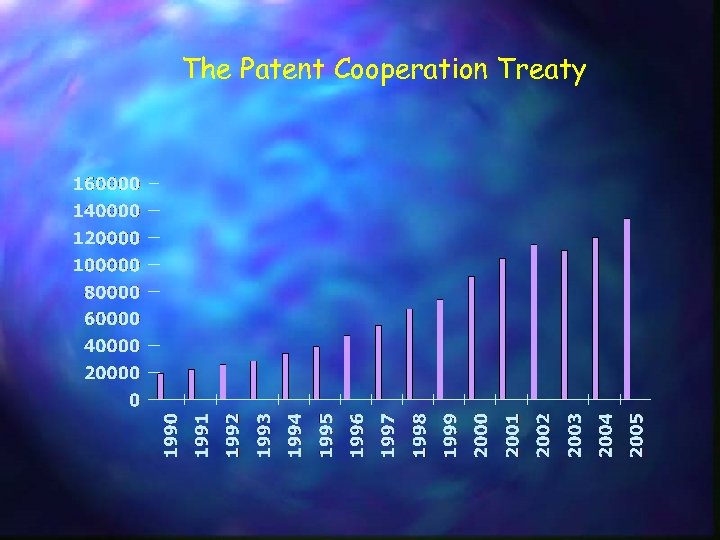 The Patent Cooperation Treaty
 Services Alternative dispute resolution (ADR) offered by WIPO Arbitration & Mediation Center - tailormade D R procedures, e. g. : - UDRP criteria: - identical/confusingly similar - legitimate interest - bad faith - cost-effective and expeditious procedure (see http: //arbiter. wipo. int) - WIPO Trademark Database Portal (http: //ecommerce. wipo. int/databases/trademark/)
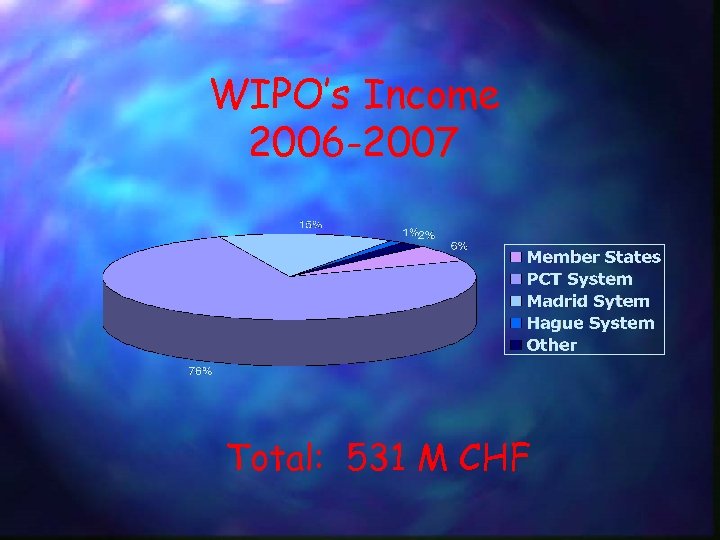 WIPO’s Income 2006 -2007 Total: 531 M CHF
 The World Intellectual Property Organization http: //www. wipo. int cathy. jewell@wipo. int Thank you