


 Скачать презентацию The World Food Crisis Fred Magdoff July 11
6d2336d5a7b742149763bf92c99a8b58.ppt
- Количество слайдов: 65
 The World Food Crisis Fred Magdoff July 11, 2008 fmagdoff@uvm. edu
 1. ) There is a catastrophic food crisis. 2. ) In addition to “routine” hunger. 3. ) It is interacting with a longer term underlying food crisis and making it worse.
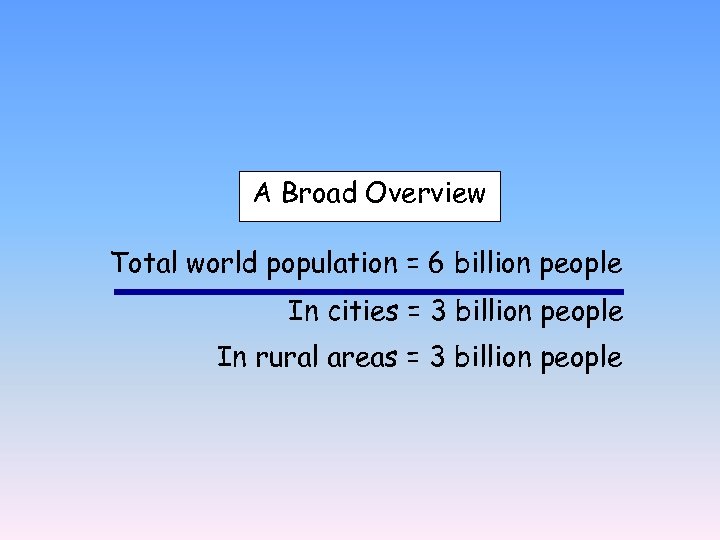 A Broad Overview Total world population = 6 billion people In cities = 3 billion people In rural areas = 3 billion people
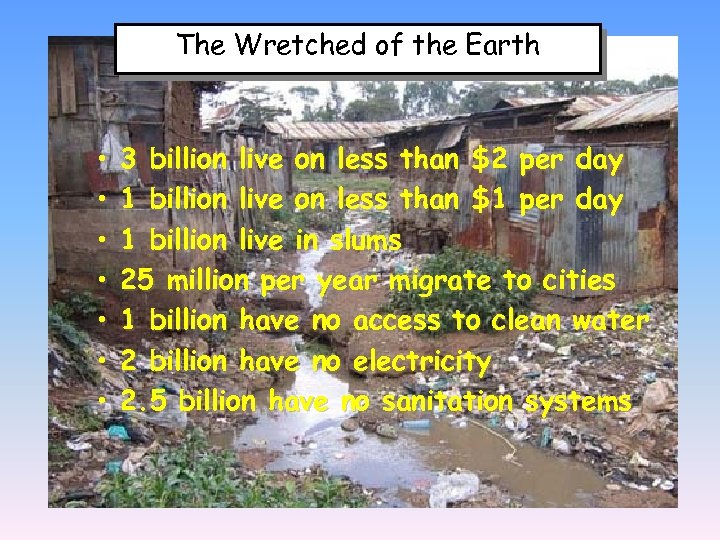 The Wretched of the Earth • • 3 billion live on less than $2 per day 1 billion live on less than $1 per day 1 billion live in slums 25 million per year migrate to cities 1 billion have no access to clean water 2 billion have no electricity 2. 5 billion have no sanitation systems
 Hunger • The UN estimates that 840 million people suffer from undernourishment, although the number may be considerably higher. • The number suffering from mineral shortages, food insecurity and temporary food shortage may approach 3 billion.
 Hunger amid plenty in the U. S. • In 4 million U. S. families (with 9 million people) someone skipped meals because of lack of food. • 12 million U. S. families (with about 34 million people) are “food insecure. ” • Huge increases in the last decade in those using food pantries, food shelves, soup kitchens, etc.
 Hunger frequently occurs amid plenty in poor countries too Poor in India Starve as Surplus Wheat Rots (New York Times, 12/12/02) Want Amid Plenty, An Indian Paradox: Bumper Harvests and Rising Hunger (Wall St. Journal, 6/25/04)
 There is enough food produced world wide—and usually within most countries—to feed everyone.
 Why are people hungry? Because they are poor (working or not) and living in an economic system—capitalism—that a) needs, creates, and maintains an underclass—the reserve army of labor, and that b) does not admit a “right” to basic necessities such as food.
 Food is no different than any other commodity— Automobiles Jewelry Clothing Books, etc.
 The availability of food to people reflects very unequal economic and political power relationships within and between countries.
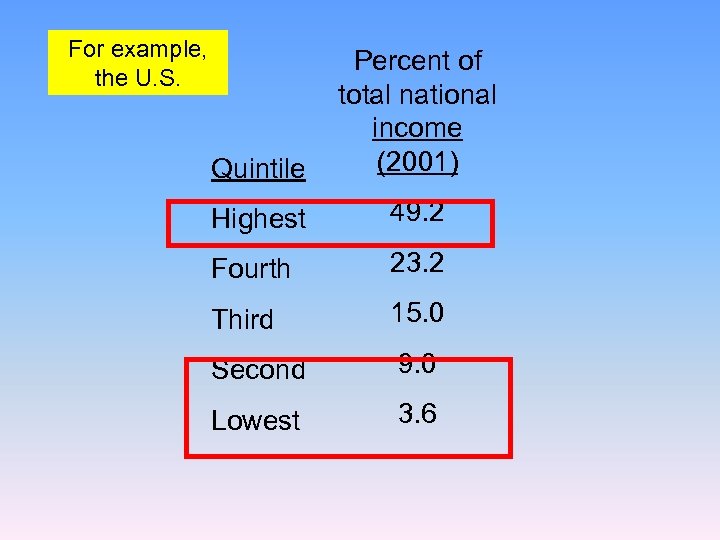 For example, the U. S. Quintile Percent of total national income (2001) Highest 49. 2 Fourth 23. 2 Third 15. 0 Second 9. 0 Lowest 3. 6
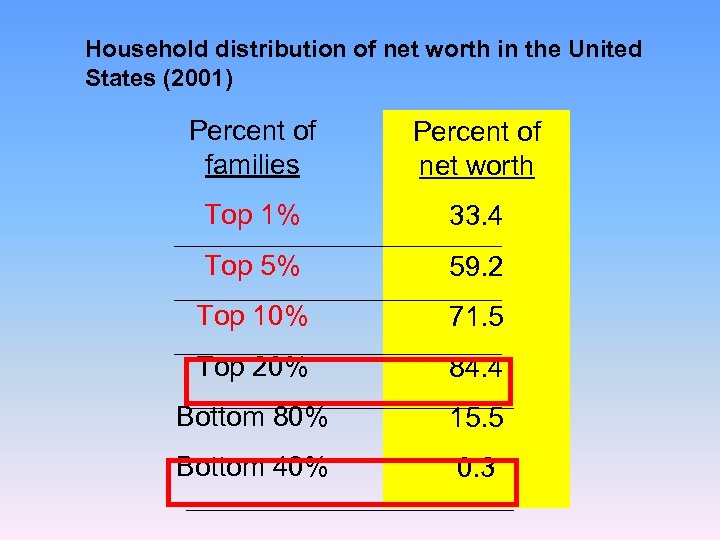 Household distribution of net worth in the United States (2001) Percent of families Percent of net worth Top 1% 33. 4 Top 5% 59. 2 Top 10% 71. 5 Top 20% 84. 4 Bottom 80% 15. 5 Bottom 40% 0. 3
 The Current Crisis Bangladeshi demonstrators protest over high food prices and low wages
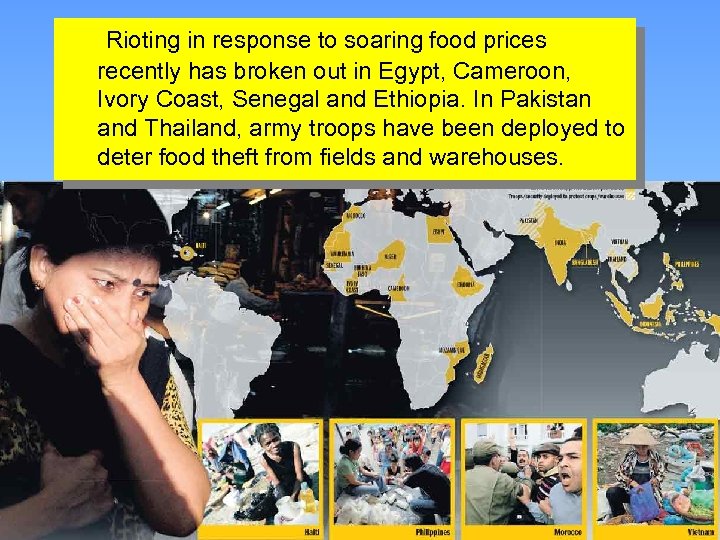 Rioting in response to soaring food prices recently has broken out in Egypt, Cameroon, Ivory Coast, Senegal and Ethiopia. In Pakistan and Thailand, army troops have been deployed to deter food theft from fields and warehouses.
 Haiti’s President Tries to Halt Crisis Over Food April 10, 2008 The police in Haiti struggled Wednesday to control looting and rioting over high food prices…
 Food Inflation, Riots Spark Worries for World Leaders — Wall Street Journal, April 14, 2008
 World Bank President Robert Zoellick warned in a recent speech that 33 countries are at risk of social upheaval because of rising food prices. Those could include Indonesia, Yemen, Ghana, Uzbekistan and the Philippines. In countries where buying food requires half to three-quarters of a poor person's income, "there is no margin for survival, " he said.
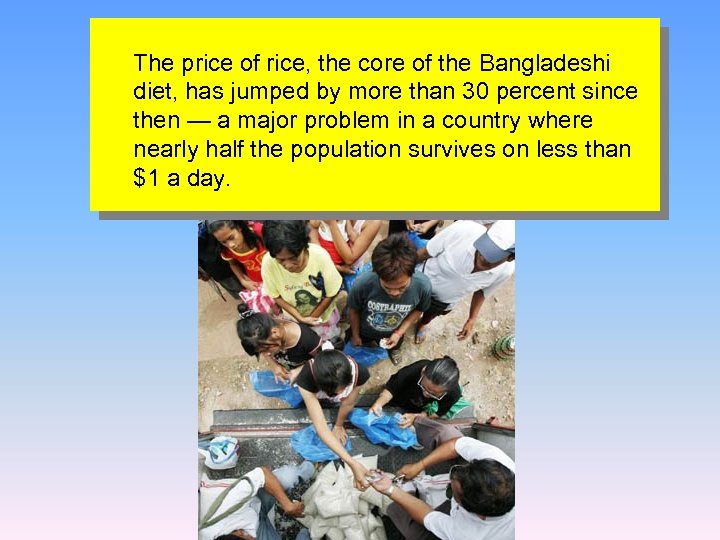 The price of rice, the core of the Bangladeshi diet, has jumped by more than 30 percent since then — a major problem in a country where nearly half the population survives on less than $1 a day.
 An adviser to the country's Ministry of Food, A. M. M. Shawkat Ali, warned of a 'hidden hunger' in Bangladesh and economists estimate 30 million of the country's 150 million people could go hungry — a crisis that could become a serious political problem for the military-backed government.
 "Inflation of staples is really out of control. We've never seen this before…If we don't react now, this summer will be full of danger. ” —WFP representative Gian Carlo Cirri
 The world's poor ``are living very close to the edge as it is…If they are pushed further, they are typically the first who will spark unrest. '’ — Robert Zeigler, director-general of the International Rice Research Institute in the Philippines. NOTE: NYT op-ed 4/26/08
 Rising prices threaten millions with starvation, despite bumper crops The Independent (UK) Sunday, 2 March 2008 There has never been anything remotely like the food crisis that is now increasingly gripping the world, threatening millions with starvation. For it is happening at a time of bumper crops.
 Where Every Meal Is a Sacrifice Washington Post, April 28, 2008 Philippines Introduces Cash Subsidies and Cheaper Rice for the Poor NY Times, April 28, 2008 Food crisis: UN to reveal battle plan AFP, April 28, 2008 Food prices rise, sending NYC food bank into crisis. AP, April 26, 2008 School lunch programs hit hard by food prices. AP, July 9, 2008
 UN, Afghan government appeal for aid to meet food crisis Jul 9, 2008, 10: 09 GMT Kabul - The government of Afghanistan and the United Nations on Wednesday appealed for more than 404 million dollars in aid to feed 4. 5 million Afghans who are in desperate need as a result of the worldwide rise in food prices, poor harvests and drought.
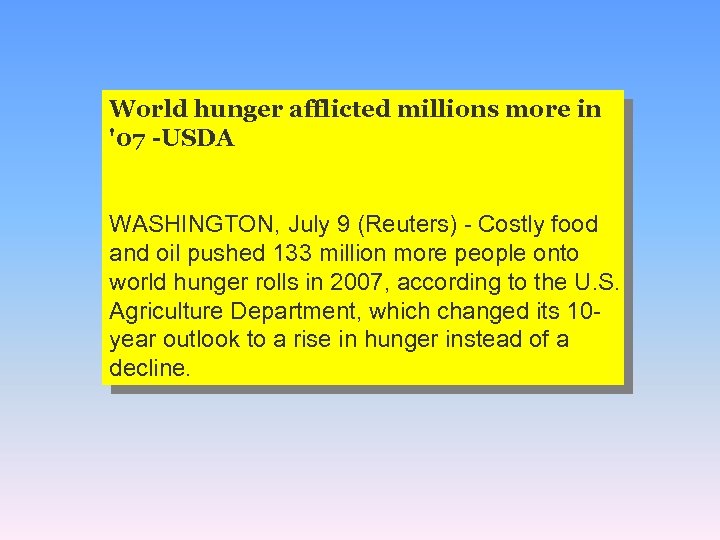 World hunger afflicted millions more in '07 -USDA WASHINGTON, July 9 (Reuters) - Costly food and oil pushed 133 million more people onto world hunger rolls in 2007, according to the U. S. Agriculture Department, which changed its 10 year outlook to a rise in hunger instead of a decline.
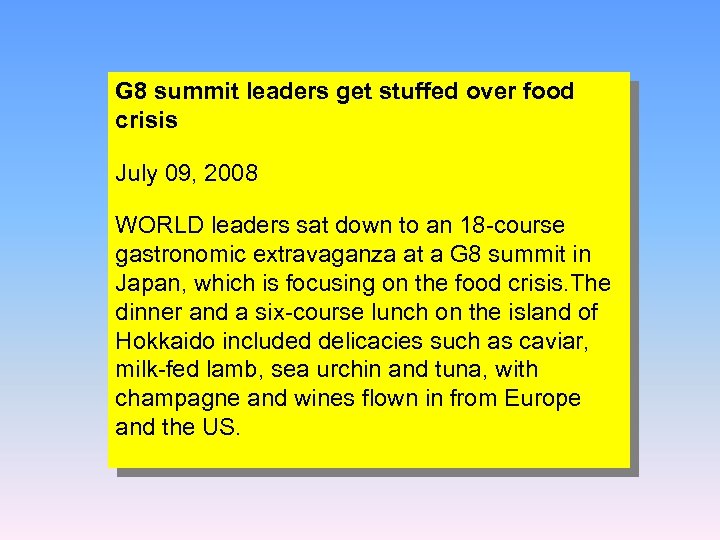 G 8 summit leaders get stuffed over food crisis July 09, 2008 WORLD leaders sat down to an 18 -course gastronomic extravaganza at a G 8 summit in Japan, which is focusing on the food crisis. The dinner and a six-course lunch on the island of Hokkaido included delicacies such as caviar, milk-fed lamb, sea urchin and tuna, with champagne and wines flown in from Europe and the US.
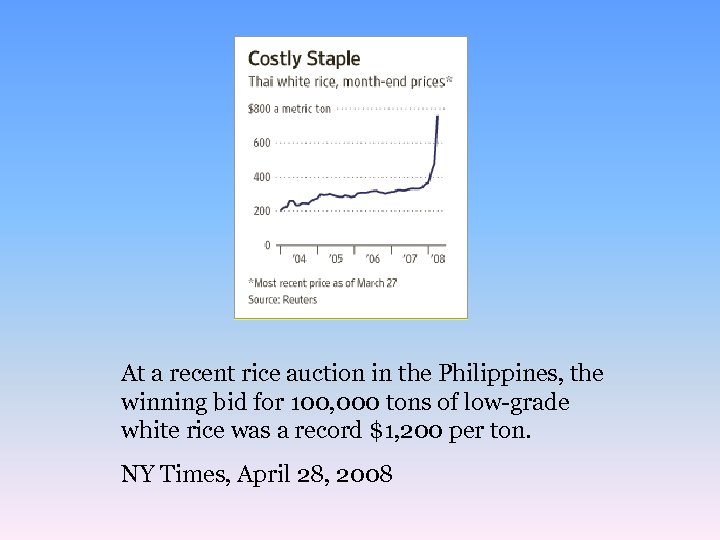 At a recent rice auction in the Philippines, the winning bid for 100, 000 tons of low-grade white rice was a record $1, 200 per ton. NY Times, April 28, 2008
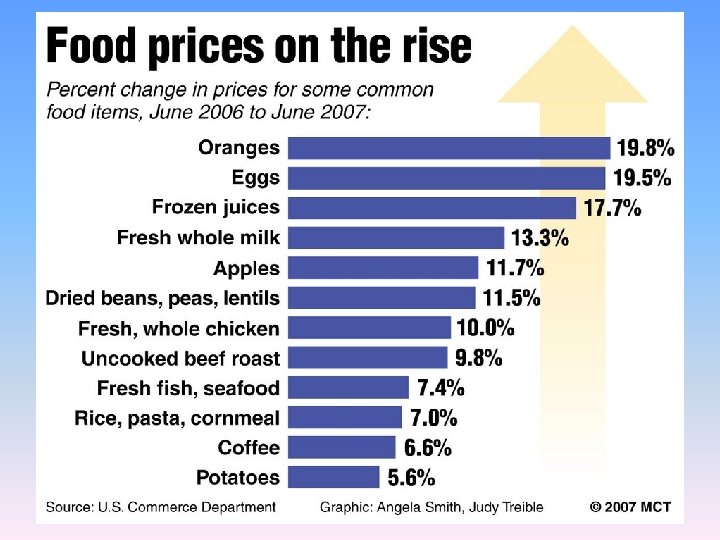
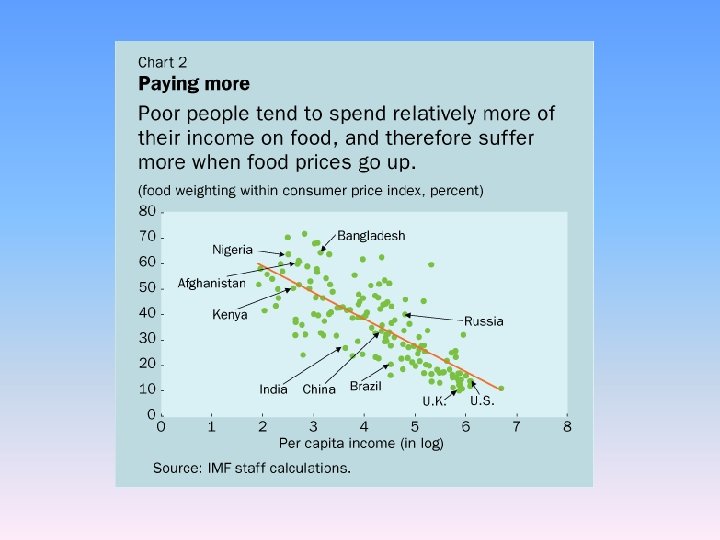
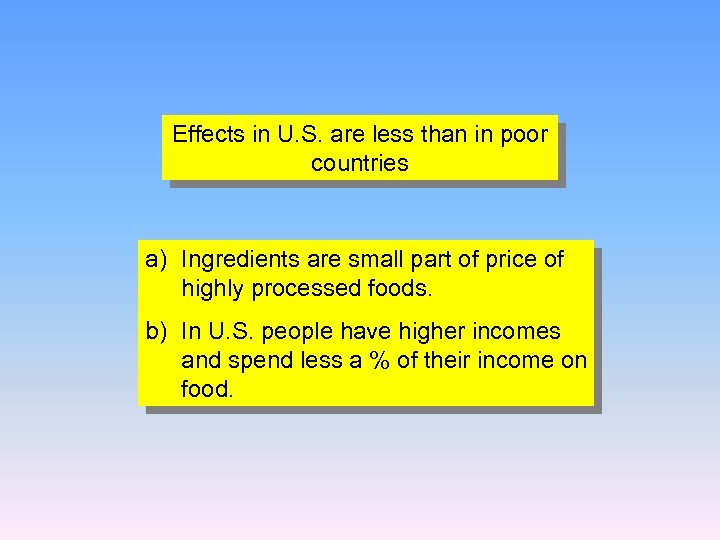 Effects in U. S. are less than in poor countries a) Ingredients are small part of price of highly processed foods. b) In U. S. people have higher incomes and spend less a % of their income on food.
 Causes of Current Crisis
 • Increase in fuel prices a) Use of significant amount of crop land to produce crops for biofuels (20 % of U. S. corn used for ethanol production in 2007).
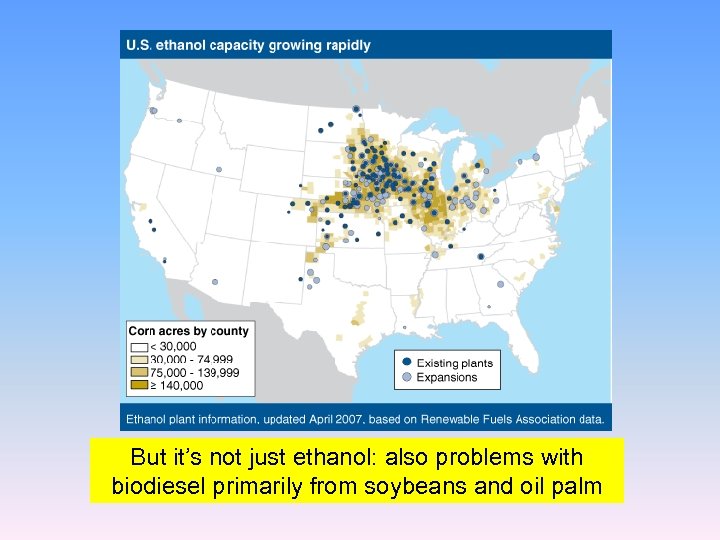 But it’s not just ethanol: also problems with biodiesel primarily from soybeans and oil palm
 • Increase in fuel prices b) Conventional large scale agricultural production is VERY energy intensive: machinery, fuel, irrigation, pesticides, fertilizers (esp. N — DAP has close to tippled in price), drying, etc.
 • Increase in meat consumption (Per capita consumption has more than doubled in last 50 years and it takes 8, 5, and 3 lbs grain to produce 1 lb of beef, pork, and chicken. ) • Formerly self-sufficient countries now importing food. • Weather (Australia, Bangladesh) • Speculation (local hoarding as well as speculation in the “commodities super cycle. ”)
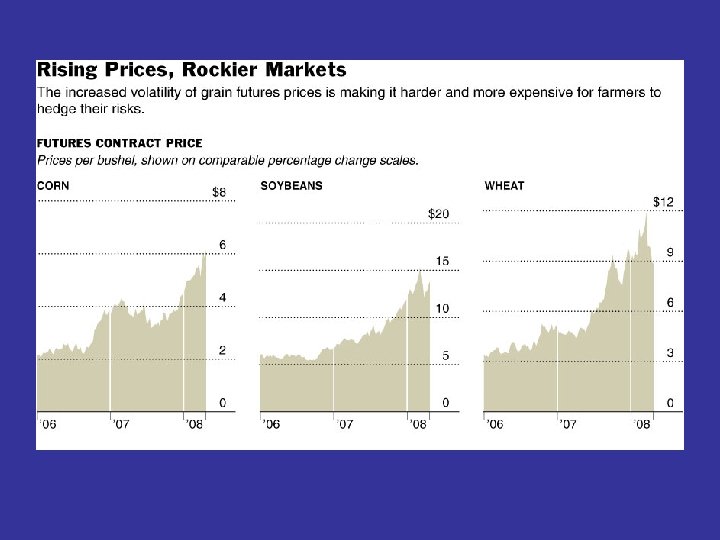
 Wall Street Grain Hoarding Brings Farmers, Consumers Near Ruin Bloomberg April 28, 2008 Commodity-index funds control a record 4. 51 billion bushels of corn, wheat and soybeans through Chicago Board of Trade futures, equal to half the amount held in U. S. silos on March 1.
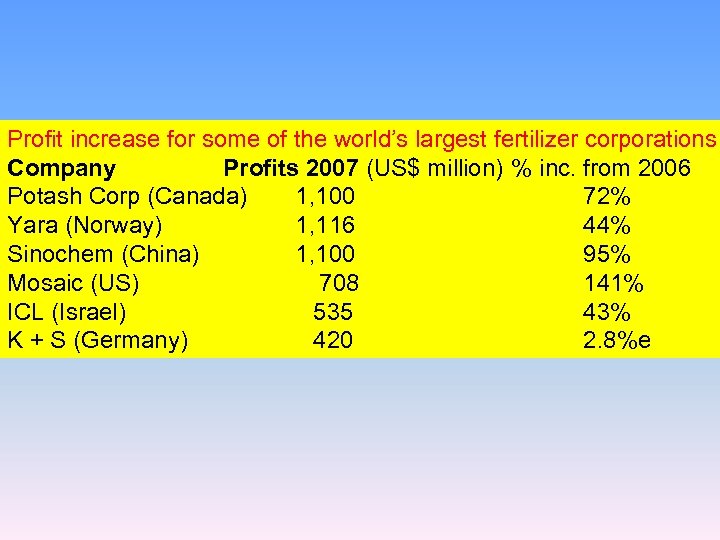 Profit increase for some of the world’s largest fertilizer corporations Company Profits 2007 (US$ million) % inc. from 2006 Potash Corp (Canada) 1, 100 72% Yara (Norway) 1, 116 44% Sinochem (China) 1, 100 95% Mosaic (US) 708 141% ICL (Israel) 535 43% K + S (Germany) 420 2. 8%e

 Grain Companies' Profits Soar As Global Food Crisis Mounts Wall St. Journal April 30, 2008 At a time when parts of the world are facing food riots, Big Agriculture is dealing with a different sort of challenge: huge profits.
 On Tuesday, grain-processing giant Archer-Daniels. Midland Co. said its fiscal third-quarter profits jumped 42%, including a sevenfold increase in net income in its unit that stores, transports and trades grains such as wheat and corn, as well as soybeans. Monsanto Co. , maker of seeds and herbicides, Deere & Co. , which builds tractors, combines and sprayers, and fertilizer maker Mosaic Co. all reported similar windfalls in their latest quarters.
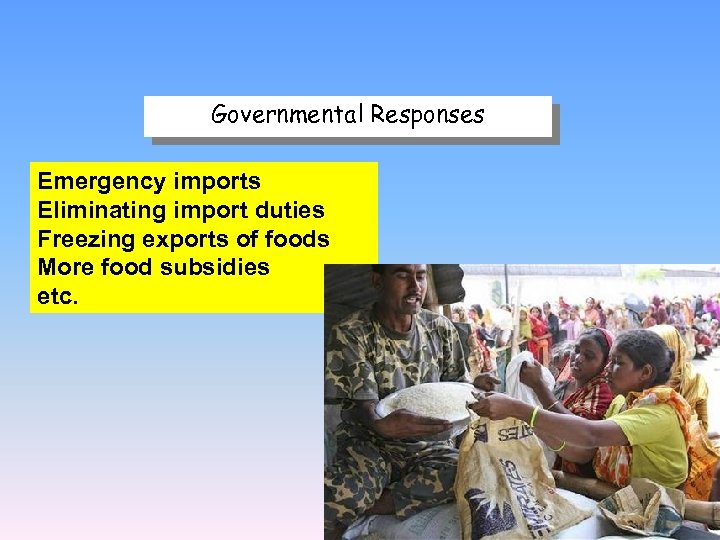 Governmental Responses Emergency imports Eliminating import duties Freezing exports of foods More food subsidies etc.
 Governmental Responses Bush Orders $200 Million in Food Aid By Associated Press 4: 31 PM EDT, April 14, 2008 (NOTE: A congressional analysis shows the Iraq war costs taxpayers almost $2 billion a week. )
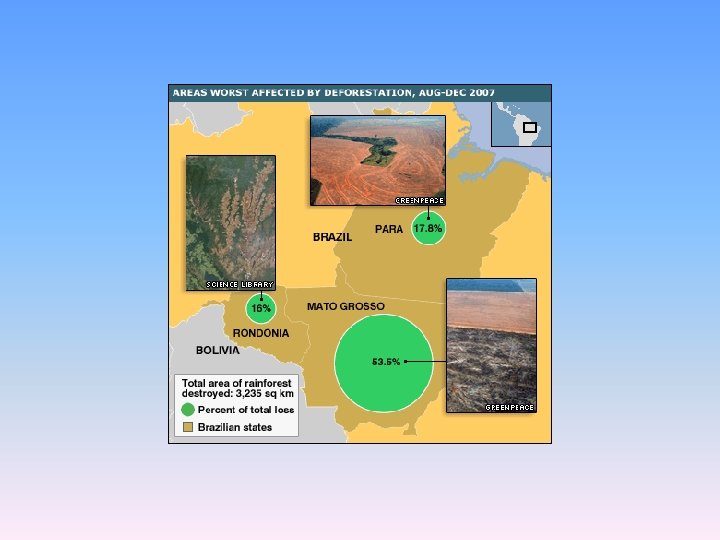
 Business Responses • Rapid increase in land prices in US and abroad • Increased deforestation in Amazon • Corporations and private capital purchasing land abroad (Brazil, Uruguay, Argentina, etc. ) • Large profit possibilities
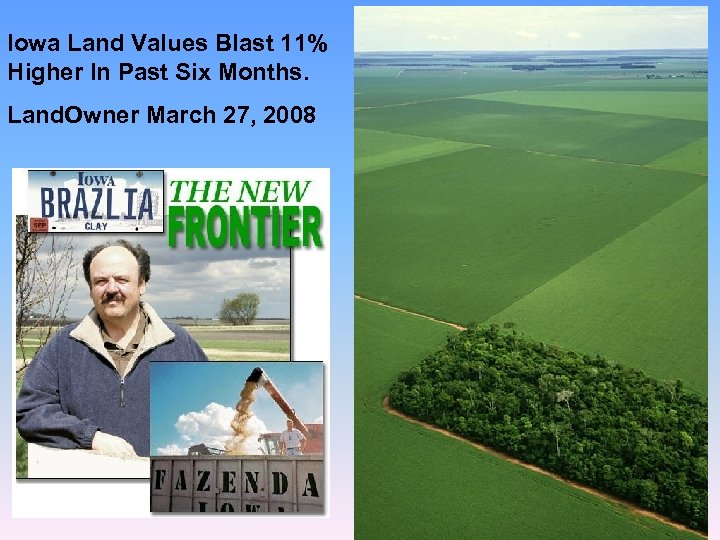 Iowa Land Values Blast 11% Higher In Past Six Months. Land. Owner March 27, 2008
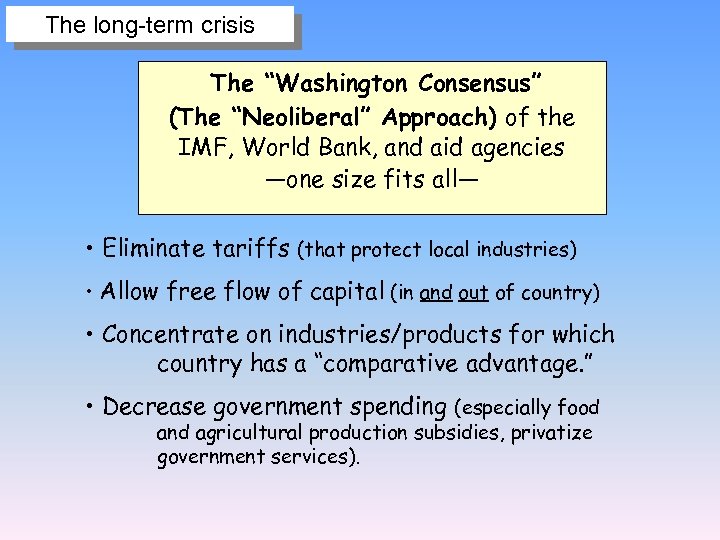 The long-term crisis The “Washington Consensus” (The “Neoliberal” Approach) of the IMF, World Bank, and aid agencies —one size fits all— • Eliminate tariffs (that protect local industries) • Allow free flow of capital (in and out of country) • Concentrate on industries/products for which country has a “comparative advantage. ” • Decrease government spending (especially food and agricultural production subsidies, privatize government services).
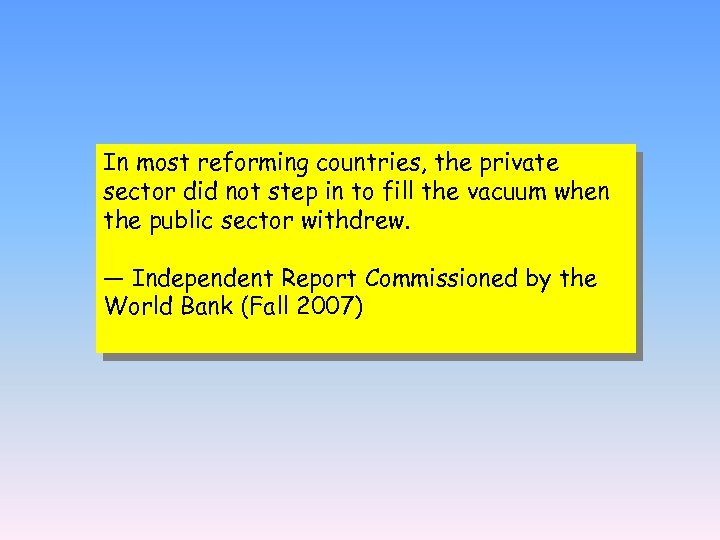 In most reforming countries, the private sector did not step in to fill the vacuum when the public sector withdrew. — Independent Report Commissioned by the World Bank (Fall 2007)
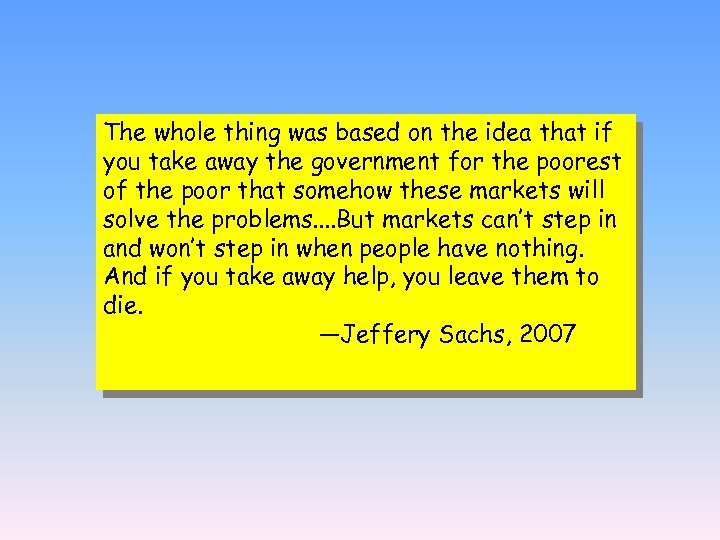 The whole thing was based on the idea that if you take away the government for the poorest of the poor that somehow these markets will solve the problems. . But markets can’t step in and won’t step in when people have nothing. And if you take away help, you leave them to die. —Jeffery Sachs, 2007
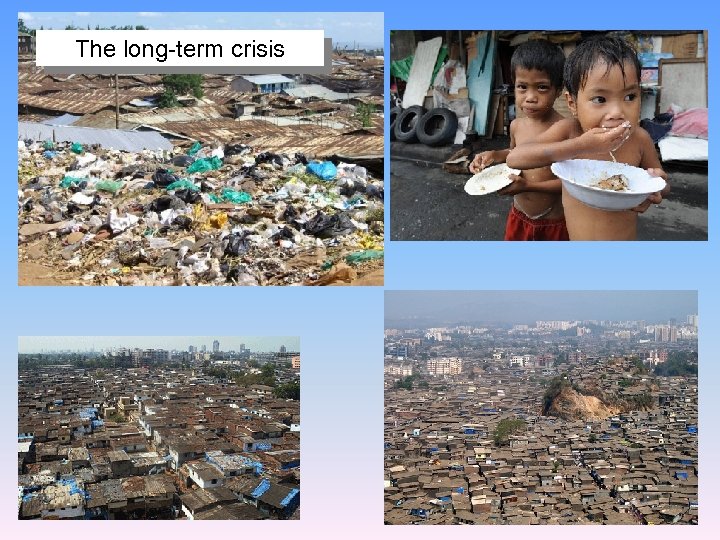 The long-term crisis
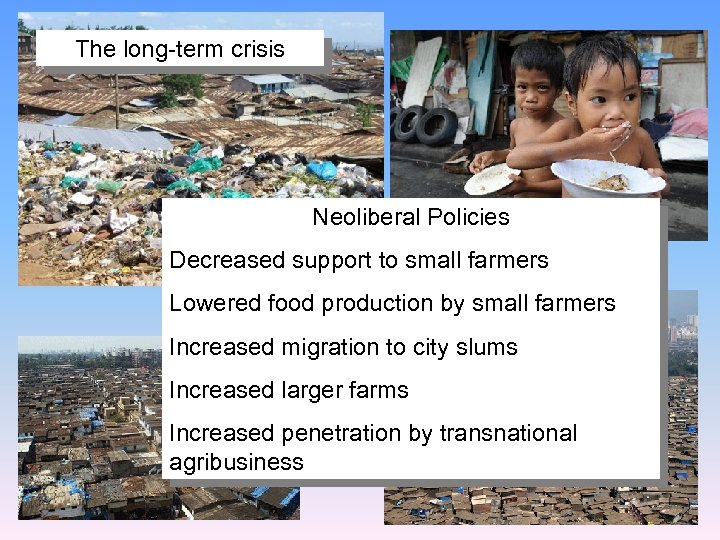 The long-term crisis Neoliberal Policies Decreased support to small farmers Lowered food production by small farmers Increased migration to city slums Increased larger farms Increased penetration by transnational agribusiness

 The no-till system in Mato Grosso soybean harvesters followed by maize planter


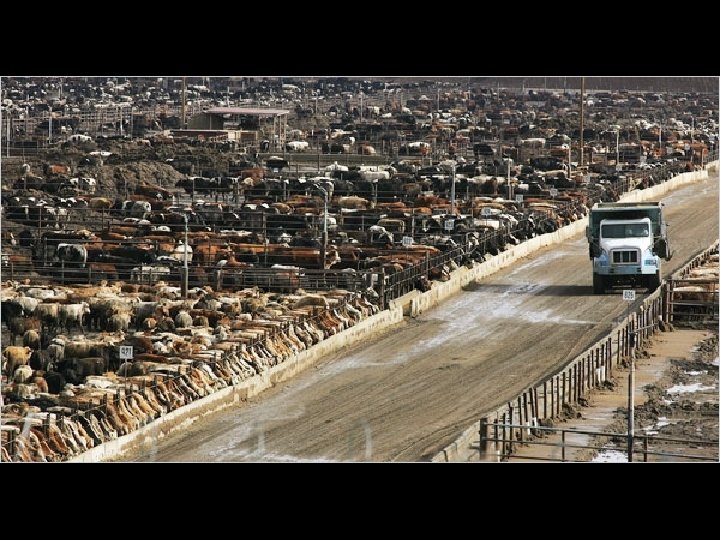
 The Future? • Fewer than 20 million highly productive and mechanized farmers can grow all the world’s food? (Note: one person in Brazil — the governor of the state of Mato Grosso, the “soybean king” — controls about 500, 000 acres. )
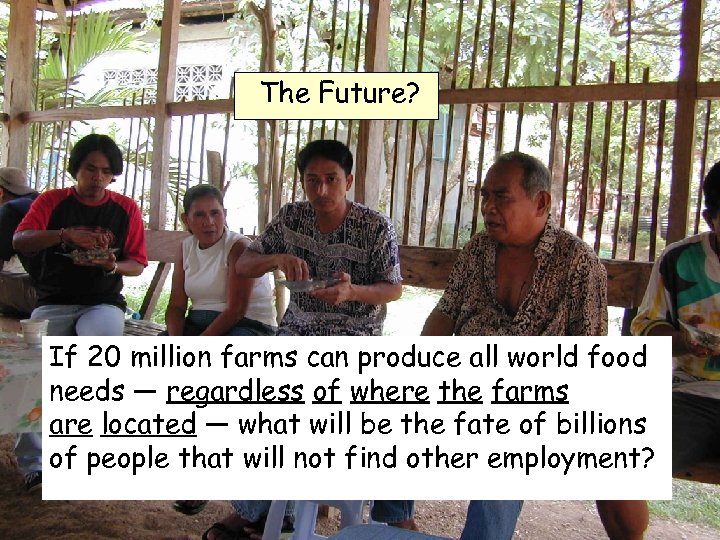 The Future? If 20 million farms can produce all world food needs — regardless of where the farms are located — what will be the fate of billions of people that will not find other employment?
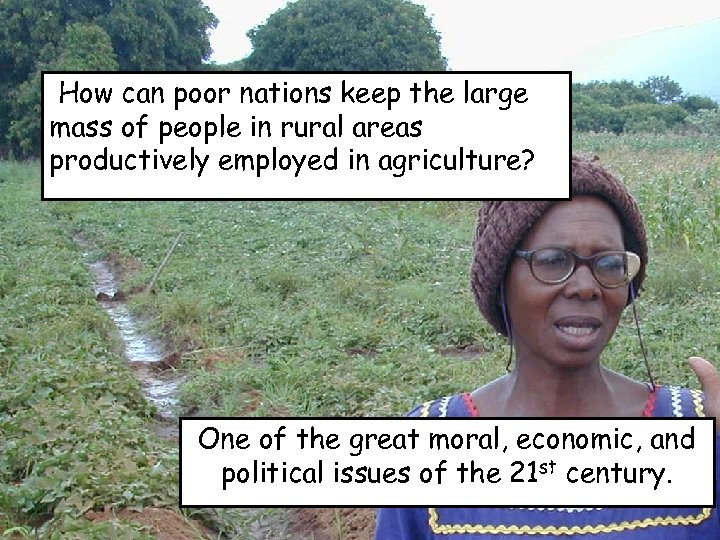 How can poor nations keep the large mass of people in rural areas productively employed in agriculture? One of the great moral, economic, and political issues of the 21 st century.
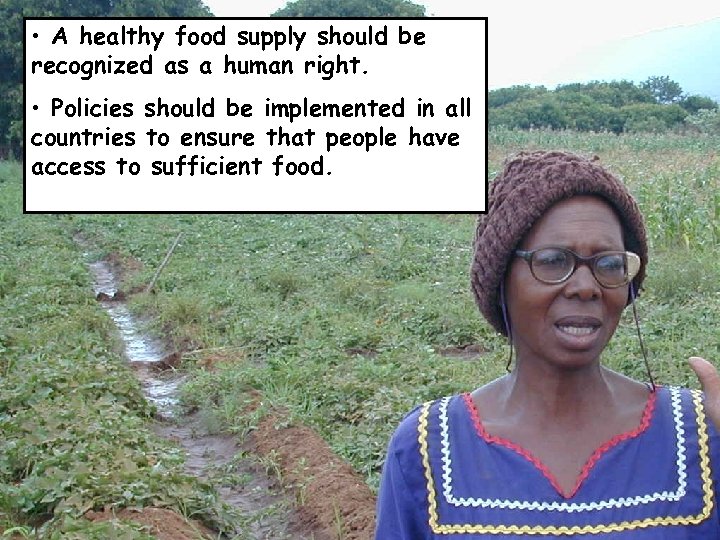 • A healthy food supply should be recognized as a human right. • Policies should be implemented in all countries to ensure that people have access to sufficient food.
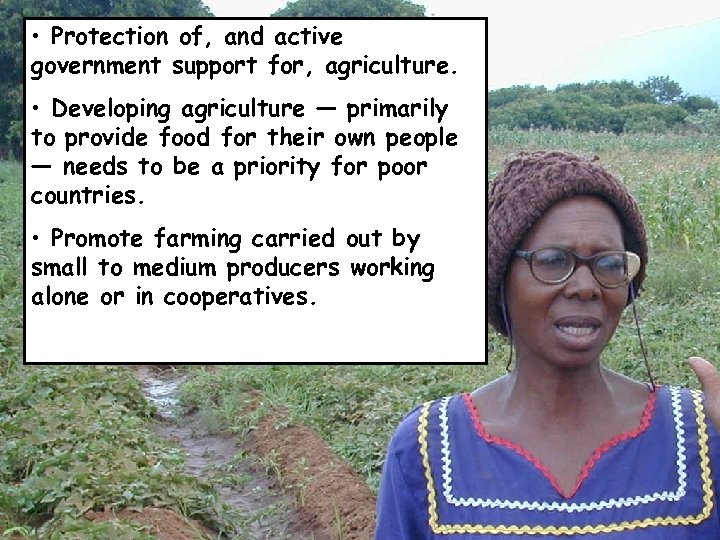 • Protection of, and active government support for, agriculture. • Developing agriculture — primarily to provide food for their own people — needs to be a priority for poor countries. • Promote farming carried out by small to medium producers working alone or in cooperatives.
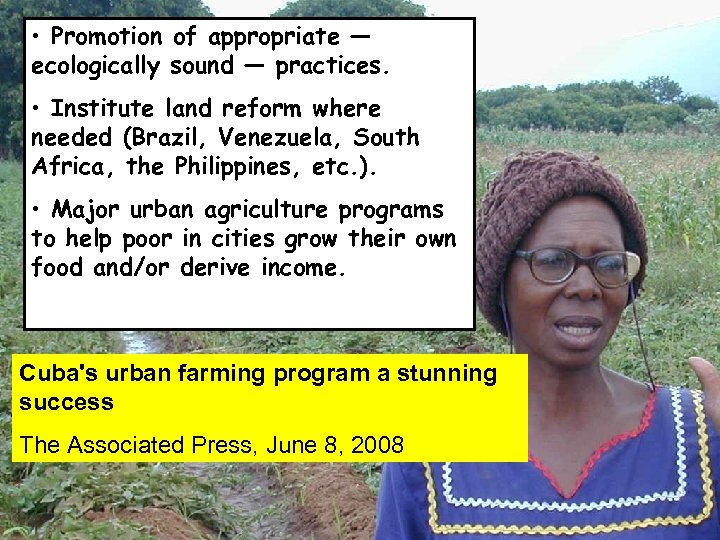 • Promotion of appropriate — ecologically sound — practices. • Institute land reform where needed (Brazil, Venezuela, South Africa, the Philippines, etc. ). • Major urban agriculture programs to help poor in cities grow their own food and/or derive income. Cuba's urban farming program a stunning success The Associated Press, June 8, 2008
 Monthly Review, May 2008
 www. uvm. edu/~fmagdoff/worldfoodcrisis. BRECT. ppt fmagdoff@uvm. edu