


 Скачать презентацию The World at War The World at
6139f06194c5f781c219a0ec9af97953.ppt
- Количество слайдов: 53
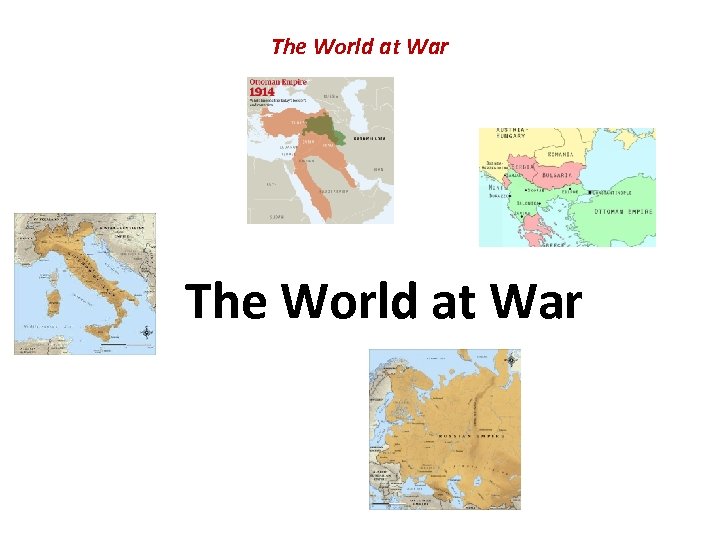 The World at War
 The World at War “The Great War” First War to take place across the World Atlantic, Pacific, Mediterranean, Africa, Middle East, Europe, Russia, China First War to have countries fighting Look today at the conflict away from the Western Front Unfortunate that it turned out to be the “First World War”
 Not Just Trenches and Poems The Middle East The Eastern Front
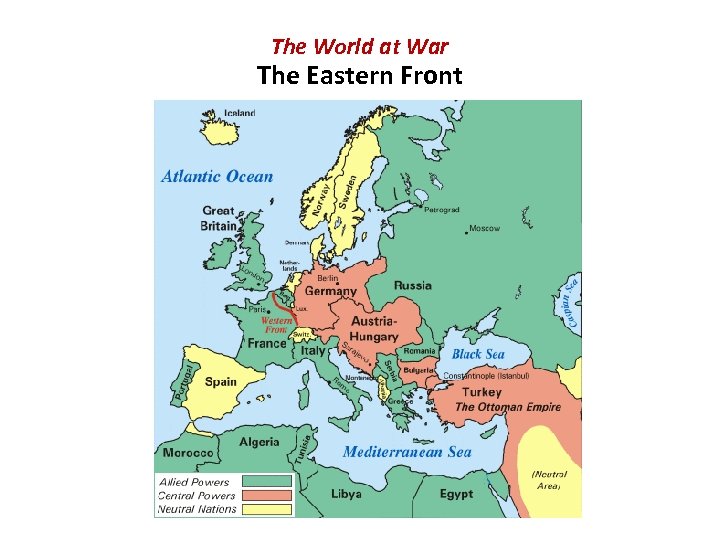 The World at War The Eastern Front
 The World at War Russia vs Germany and Austro Hungary • Never settled to trench warfare as Western front • Early invasion of Prussia and later success against Austro. Hungary led to German forces being diverted East • Leader of Russian forces was initially Grand Duke Nicholas (first Cousin once removed to Tsar) • In 1915 Grand Duke removed and Tsar takes direct control • Continued military failure contributes to February 1917 revolution
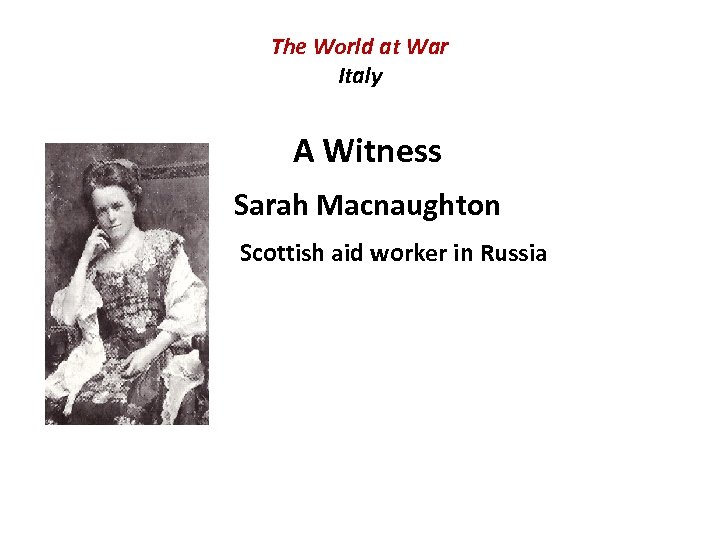 The World at War Italy A Witness Sarah Macnaughton Scottish aid worker in Russia
 Not Just Trenches and Poems The Middle East Italy
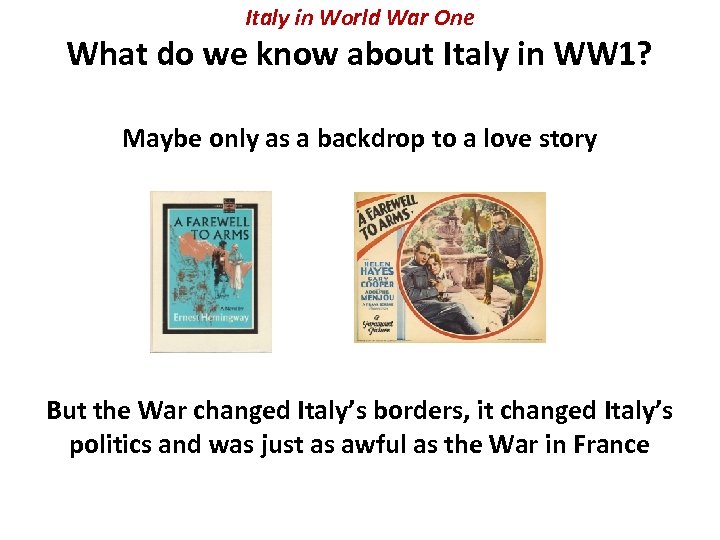 Italy in World War One What do we know about Italy in WW 1? Maybe only as a backdrop to a love story But the War changed Italy’s borders, it changed Italy’s politics and was just as awful as the War in France
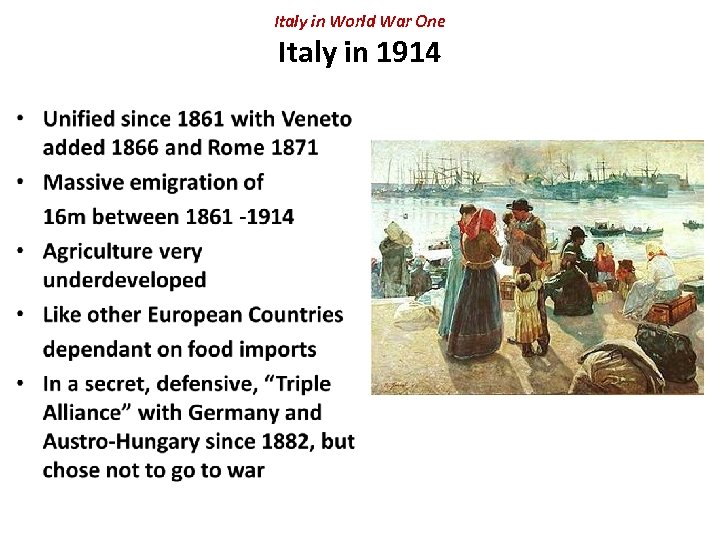 Italy in World War One Italy in 1914
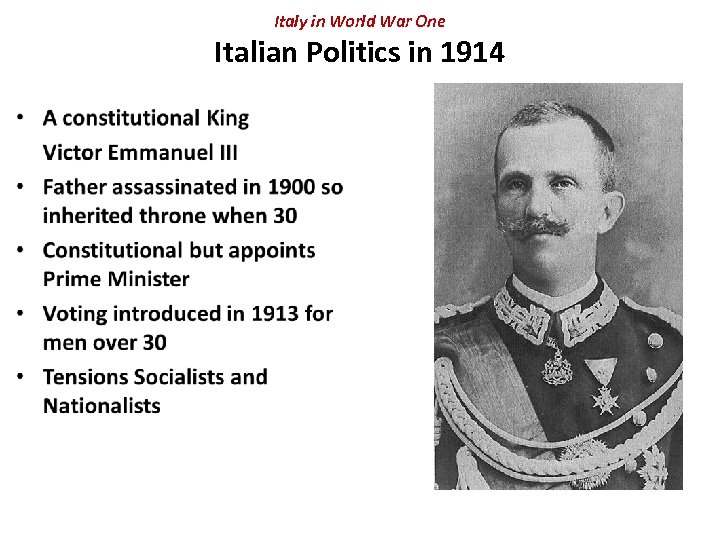 Italy in World War One Italian Politics in 1914
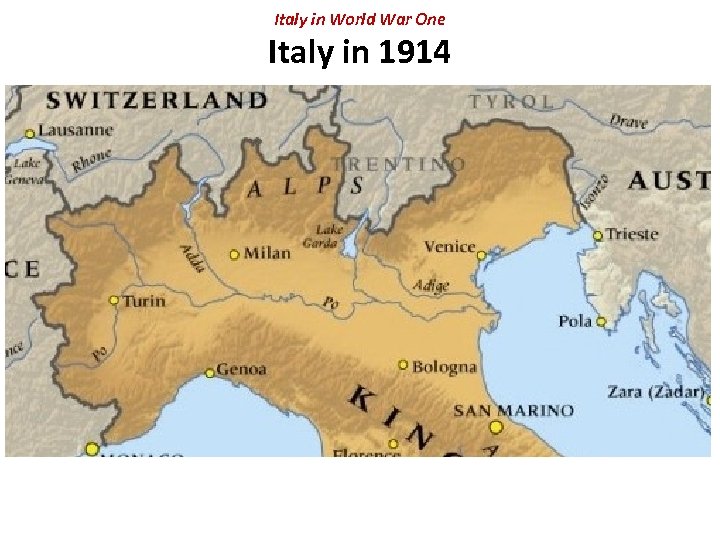 Italy in World War One Italy in 1914
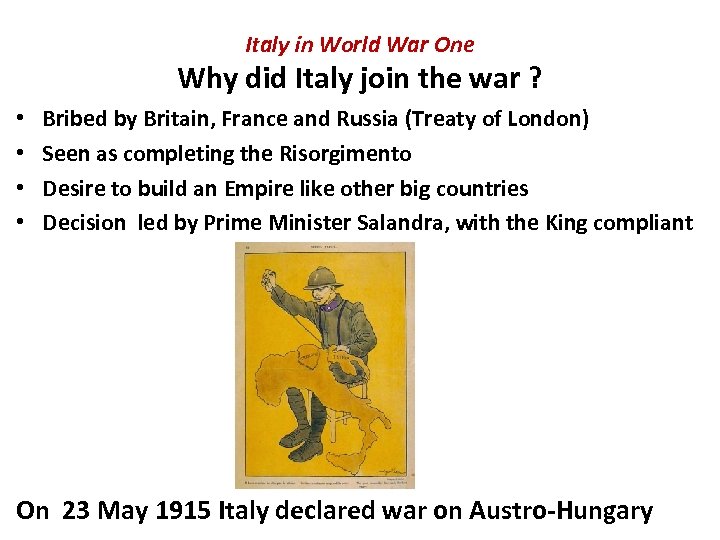 Italy in World War One Why did Italy join the war ? • • Bribed by Britain, France and Russia (Treaty of London) Seen as completing the Risorgimento Desire to build an Empire like other big countries Decision led by Prime Minister Salandra, with the King compliant On 23 May 1915 Italy declared war on Austro-Hungary
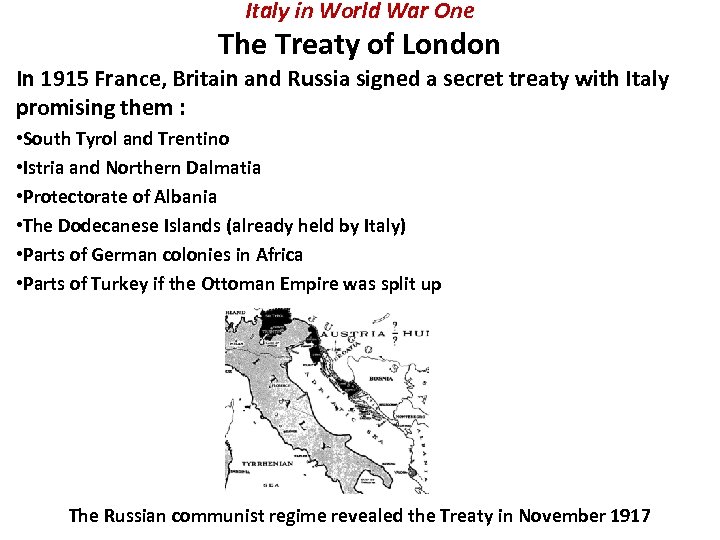 Italy in World War One The Treaty of London In 1915 France, Britain and Russia signed a secret treaty with Italy promising them : • South Tyrol and Trentino • Istria and Northern Dalmatia • Protectorate of Albania • The Dodecanese Islands (already held by Italy) • Parts of German colonies in Africa • Parts of Turkey if the Ottoman Empire was split up The Russian communist regime revealed the Treaty in November 1917
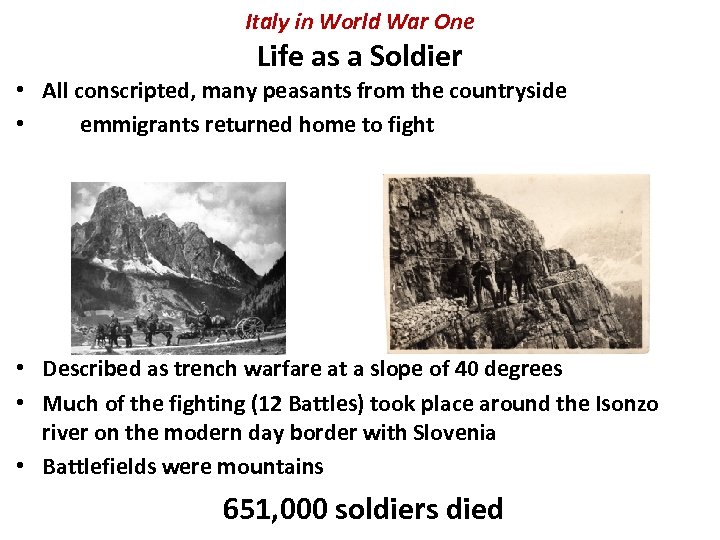 Italy in World War One Life as a Soldier • All conscripted, many peasants from the countryside • emmigrants returned home to fight • Described as trench warfare at a slope of 40 degrees • Much of the fighting (12 Battles) took place around the Isonzo river on the modern day border with Slovenia • Battlefields were mountains 651, 000 soldiers died
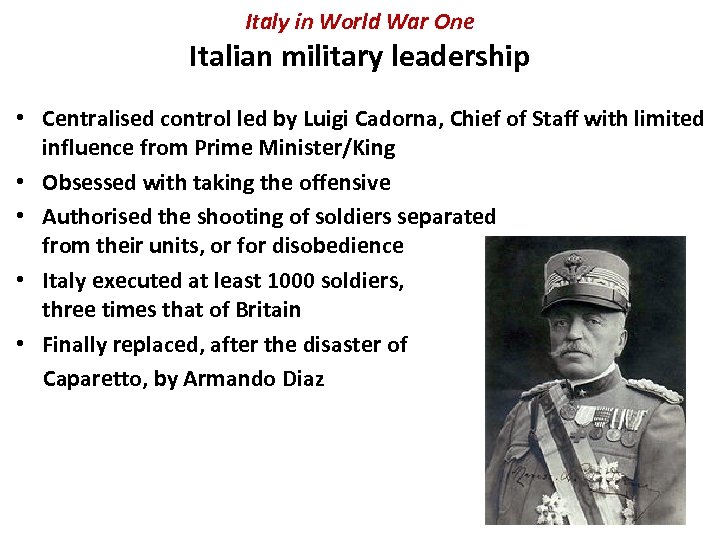 Italy in World War One Italian military leadership • Centralised control led by Luigi Cadorna, Chief of Staff with limited influence from Prime Minister/King • Obsessed with taking the offensive • Authorised the shooting of soldiers separated from their units, or for disobedience • Italy executed at least 1000 soldiers, three times that of Britain • Finally replaced, after the disaster of Caparetto, by Armando Diaz
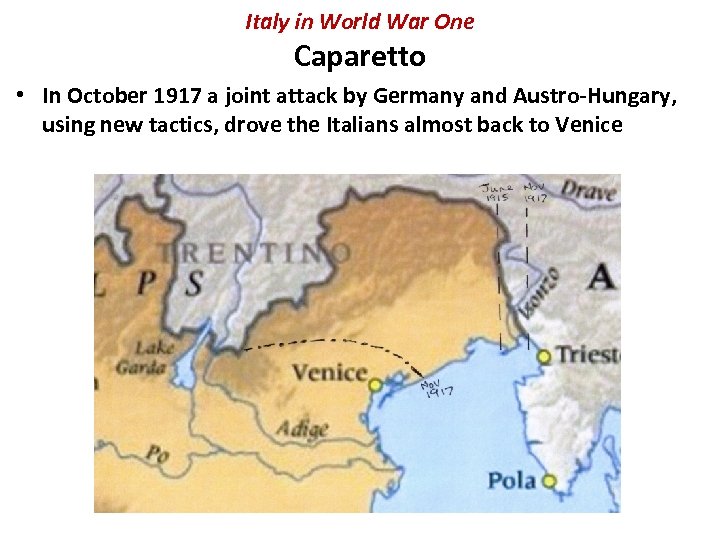 Italy in World War One Caparetto • In October 1917 a joint attack by Germany and Austro-Hungary, using new tactics, drove the Italians almost back to Venice
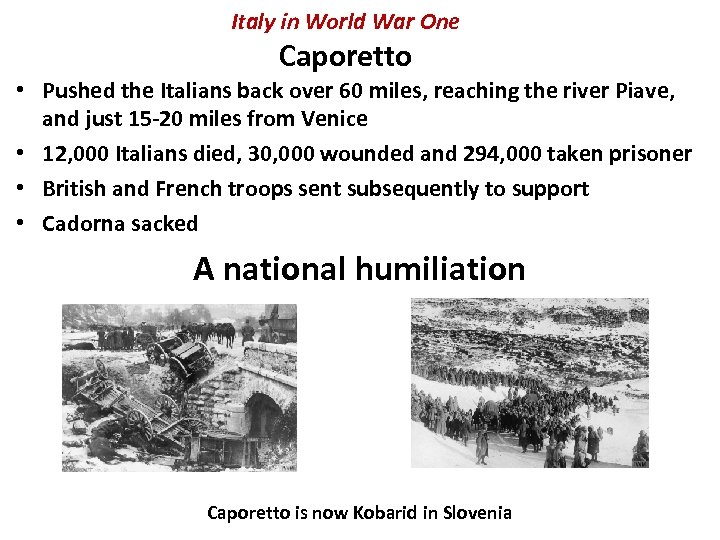 Italy in World War One Caporetto • Pushed the Italians back over 60 miles, reaching the river Piave, and just 15 -20 miles from Venice • 12, 000 Italians died, 30, 000 wounded and 294, 000 taken prisoner • British and French troops sent subsequently to support • Cadorna sacked A national humiliation Caporetto is now Kobarid in Slovenia
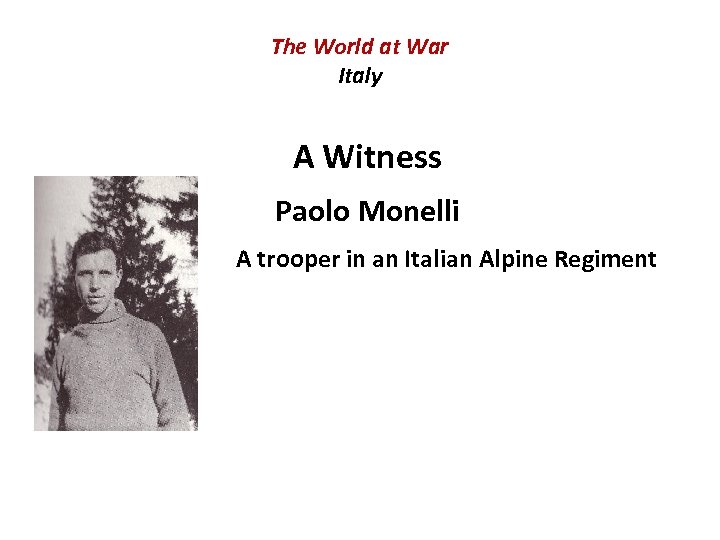 The World at War Italy A Witness Paolo Monelli A trooper in an Italian Alpine Regiment
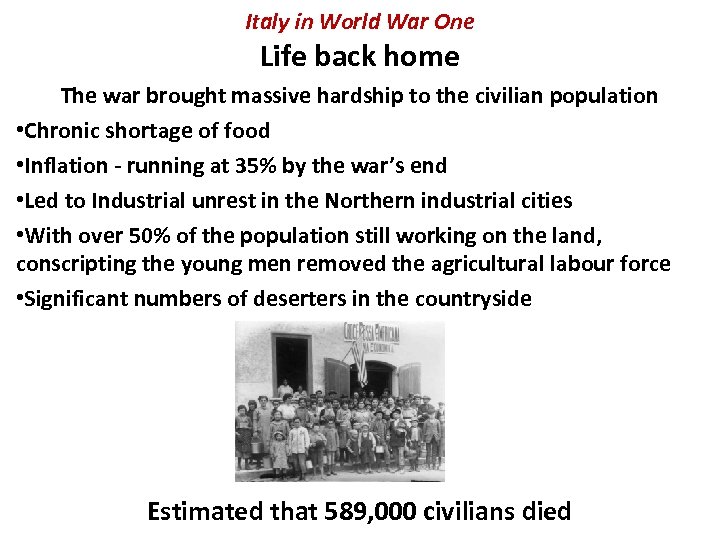 Italy in World War One Life back home The war brought massive hardship to the civilian population • Chronic shortage of food • Inflation - running at 35% by the war’s end • Led to Industrial unrest in the Northern industrial cities • With over 50% of the population still working on the land, conscripting the young men removed the agricultural labour force • Significant numbers of deserters in the countryside Estimated that 589, 000 civilians died
 Italy in World War One What did Italy get at the end of the War The Versailles Peace Conference ignored previous agreements, and introduced new countries and kingdoms Italy got some of the Treaty of London promises: • South Tyrol and Trentino - YES • Istria and Northern Dalmatia – PARTLY (Istria only) • Protectorate of Albania - NO • The Dodecanese Islands (already held by Italy)- PARTLY (Rhodes only) • Parts of German colonies in Africa - NO • Parts of Turkey if the Ottoman Empire was split up – NO Nationalists saw it as a “mutilated” victory
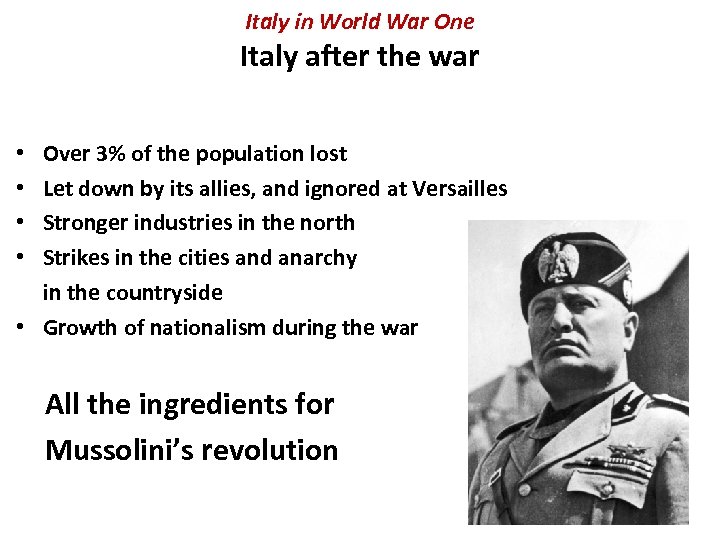 Italy in World War One Italy after the war Over 3% of the population lost Let down by its allies, and ignored at Versailles Stronger industries in the north Strikes in the cities and anarchy in the countryside • Growth of nationalism during the war • • All the ingredients for Mussolini’s revolution
 Not Just Trenches and Poems The Middle East The Balkans "Some damn foolish thing in the Balkans“ (Otto von Bismark, 1897)
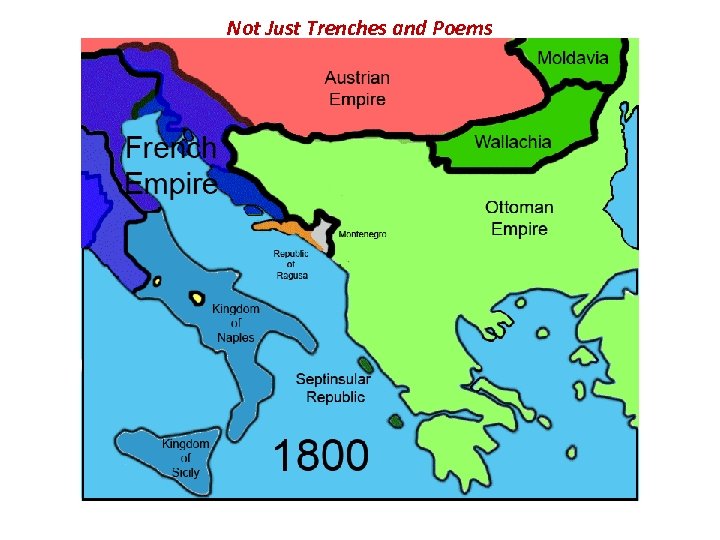 Not Just Trenches and Poems The Balkans
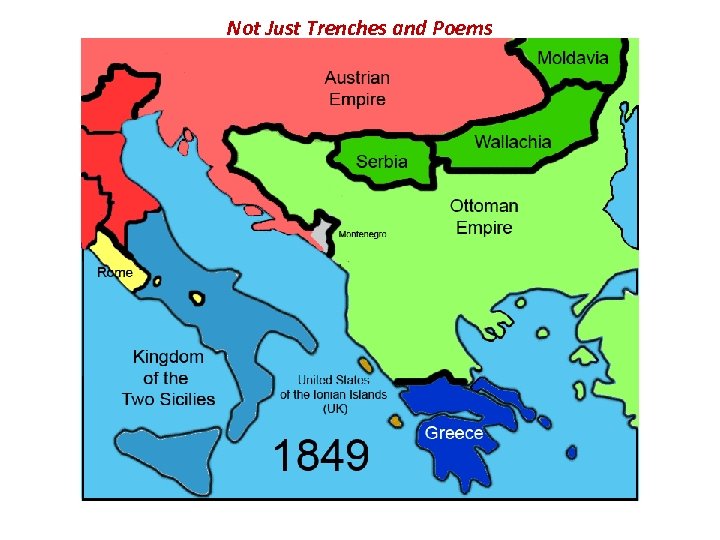 Not Just Trenches and Poems The Balkans
 Not Just Trenches and Poems The Balkans
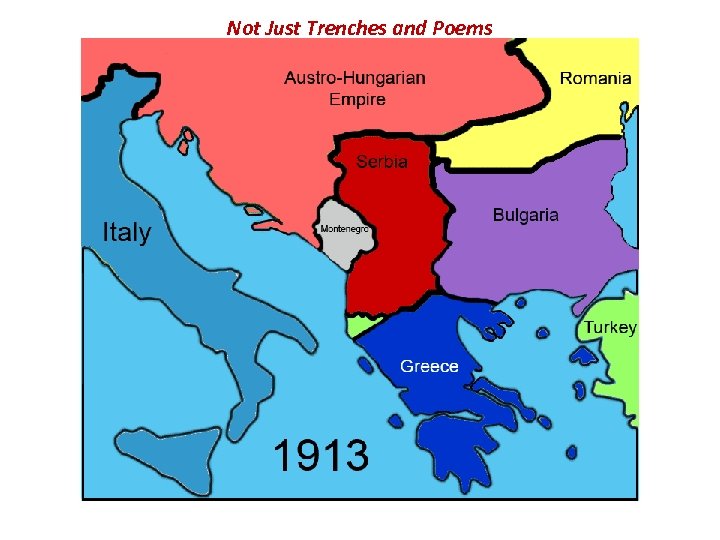
 Not Just Trenches and Poems The Balkan Wars 1912 -1913 • French investment had funded Serbian military development • Russia moved to create Balkan League, seeing it as potential ally against Austro-Hungary in the future • France tried to stop 1 st Balkan War, telling Russia it would not take part in a conflict between Russia and Austro-Hungary • British would not intervene to stop the war starting, but encouraged Greece to join, to counter Russian ambitions • Austro-Hungary were trying to deal with internal unrest of its Slav populations and saw Serbia’s rise as fuelling them • Germany was officially a supporter of the Ottomans but thought Bulgaria could be a useful future ally The Great Powers furthered their own aims through the Balkan Countries
 Not Just Trenches and Poems The Balkans Events in the Balkans • 28 June 1914 Assassination Archduke Franz Ferdinand • 28 July Austro-Hungarian forces invade Serbia – beaten back • 5 November 2 nd Attack by Austro-Hungary – got as far as Belgrade until they were beaten back • 23 September 1915 Bulgaria joins the Central Powers, despite the Entente’s best efforts • 7 October Austro-Hungarians and Germans attack • October 1915 British and French forces arrive in Salonika (Greece), limited role in helping Serbians • 14 October Bulgaria attacks • 10 February 1916 Serbian Army is evacuated from Albania Germans have clear railway link to Ottomans
 Not Just Trenches and Poems The Balkans Events in the Balkans • August 1916 – Allied forces attack on Bulgarian Front, moved front 25 miles • October 1916 – Bulgaria invades part of Greece. Greek king in favour of letting them, Greek Officers were not. They launch a coup and take the Northern part of Greece • Jan 1917 – Blockade of Athens in support of the coup • June 1917 Greek King exiled and Greece declares war • May 1918 Allies take the offensive, Bulgaria starts secret peace negotiations • 14 September 1918 Major Allied offensive against Bulgarians • 30 September armistice with Bulgaria – French forces head towards Hungary, British forces towards Constantinople
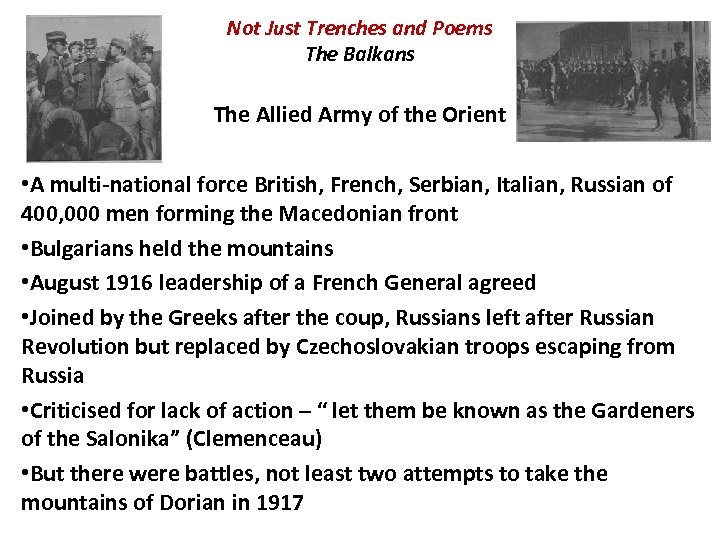 Not Just Trenches and Poems The Balkans The Allied Army of the Orient • A multi-national force British, French, Serbian, Italian, Russian of 400, 000 men forming the Macedonian front • Bulgarians held the mountains • August 1916 leadership of a French General agreed • Joined by the Greeks after the coup, Russians left after Russian Revolution but replaced by Czechoslovakian troops escaping from Russia • Criticised for lack of action – “ let them be known as the Gardeners of the Salonika” (Clemenceau) • But there were battles, not least two attempts to take the mountains of Dorian in 1917
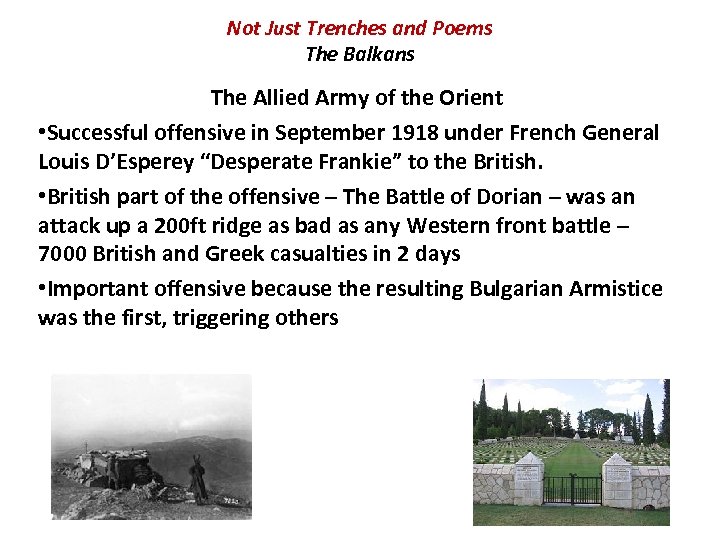 Not Just Trenches and Poems The Balkans The Allied Army of the Orient • Successful offensive in September 1918 under French General Louis D’Esperey “Desperate Frankie” to the British. • British part of the offensive – The Battle of Dorian – was an attack up a 200 ft ridge as bad as any Western front battle – 7000 British and Greek casualties in 2 days • Important offensive because the resulting Bulgarian Armistice was the first, triggering others
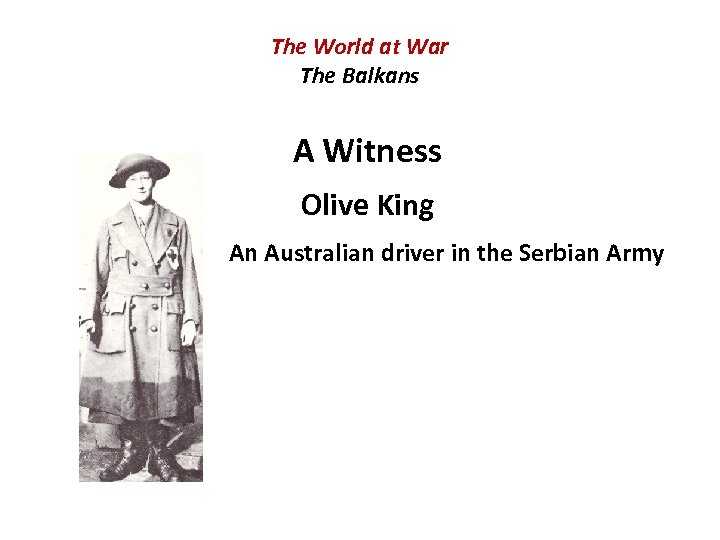 The World at War The Balkans A Witness Olive King An Australian driver in the Serbian Army
 Not Just Trenches and Poems The Balkans Afterwards 16% of Serbian population died – War, Typhus, Starvation and Ethnic Cleansing
 Not Just Trenches and Poems The Middle East
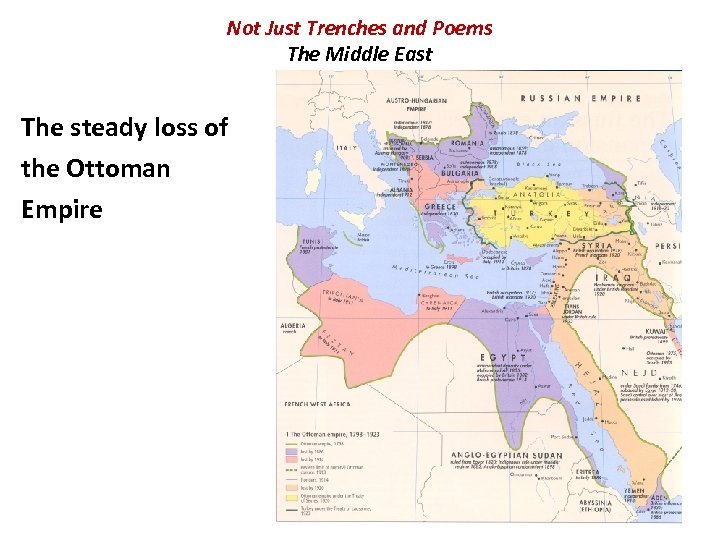 Not Just Trenches and Poems The Middle East The steady loss of the Ottoman Empire
 Not Just Trenches and Poems The Middle East British Interests in the Middle East • Suez canal key to linking the Empire • Anglo-Persian Oil company(oil discovered 1908) • Aden – Key port to control seas in area • Egypt – Both Mediterranean base and the canal • Cyprus – Leased to British in 1878, another important base • Competition with the other colonial powers • Countering Russian expansion (and supporting Russia during the war) More strategic for Britain than Belgium ?
 Not Just Trenches and Poems The Middle East Interest of other powers • Germany – Close commercial partner with Ottoman Empire • Germany – Divert Allies resources • Ottoman Empire – potential for winning back some lost territory • Russia – Gain territory in North-East of Ottoman Empire (Armenia, Baku Oilfields) and Black Sea
 Not Just Trenches and Poems The Middle East The Fighting in the Middle East • Late 1914 The British land an Anglo-Indian force at Basra protecting the pipeline and indicating intentions • Early 1915 the Central, primarily Ottoman, powers strike towards Suez but are pushed back Late 1915 an British (Anglo-Indian) force moved out of Basra up the Tigris river towards Baghdad. They went too far and were besieged in Kut-el- Amara leading to the British Army’s worst surrender (13, 000 men), in April 1916. • The army in Basra was reinforced with men and material, and this lead to the capture of Baghdad in March 1917, although an offensive across the Sinai failed.
 Not Just Trenches and Poems The Middle East The Fighting in the Middle East • In 1917 the Russian revolution eased pressure on the Ottomans, submarine warfare threatened supplies to Britain, and additional support was needed on the Western front. • Late 1917 a new British General – Allenby- led an advance through Gaza to Jerusalem but in 1918 much of his infantry had to be sent to France to stem the German spring offensive. • In September 1918 Allenby destroyed the remaining Ottoman forces and the British military controlled the peninsular Throughout there was the support of Arab “Guerrilla” forces funded and supported by the British, with other groups supporting the Ottomans
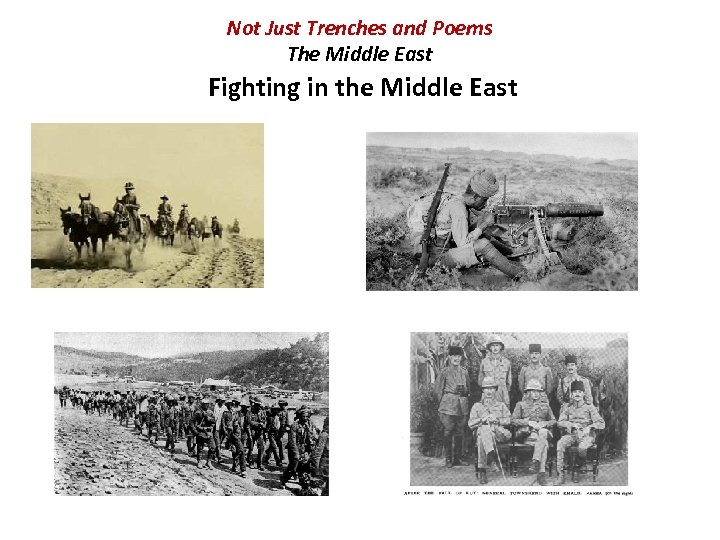
 Not Just Trenches and Poems The Middle East Fighting in the Middle East was not the Trenches ! • Heat, dust and disease • Long distance movements needed lots of supplies moved, especially WATER • Cavalry was more important, several battles used them • Extensive use of Anglo-Indian troops and Australian units • Ottoman troops supplemented by German and Austro-Hungarian troops and equipment • British estimated as having over ½ million casualties (dead, wounded, sick) but 90% were non battle casualties
 Not Just Trenches and Poems The Middle East Fighting in the Middle East
 Not Just Trenches and Poems The Middle East Fighting in the Middle East • Ottoman troops, with some German Generals commanding their troops and with limited German troops in support • Ottoman Empire troops not only responsible for the Armenian Massacres but also gave poor treatment to prisoners and undertook killing of other Christian populations • After the siege of Kut of the 13, 000 prisoners taken only 30% survived the war because of poor treatment • The majority of local Arab population not involved
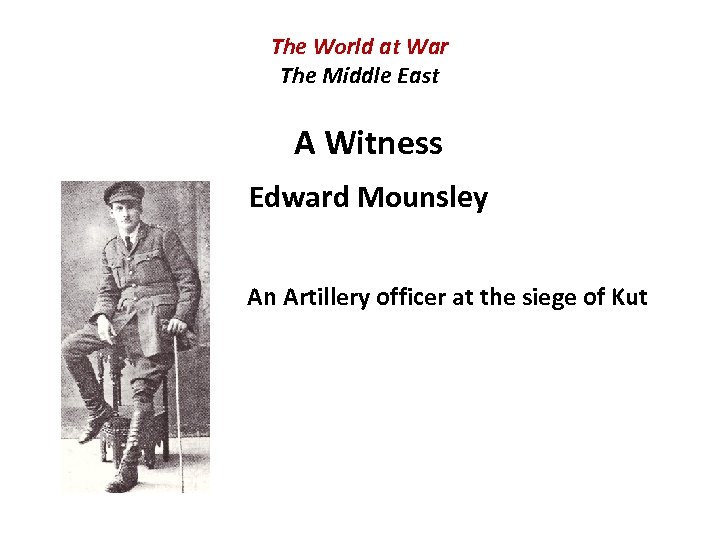 The World at War The Middle East A Witness Edward Mounsley An Artillery officer at the siege of Kut
 Not Just Trenches and Poems The Middle East Arab Supporters • Arabian peninsular had Kingdoms/Tribes, some under Ottoman authority • Saudi and Rashid tribes fought for control of Arabia in the 19 th century • Rashid tribe sided with the Ottomans, Saudis with Britain • British recognise Ibn Saud and Saudi kingdom (Treaty of Darin) and made it a British protectorate • As part of the treaty he promised not to attack other British protectorates in the Gulf BUT did not promise not to attack other British supporters (eg the leaders of the Pan Arab revolt)
 Not Just Trenches and Poems The Middle East Arab Supporters • Hussein ibn Ali al-Hashim, the Sharif of Mecca supported the British by declaring a Pan-Arab revolt • T. E. Lawrence was the British link with this group, fighting with them as a guerrilla army of a few thousand men • In the negotiations with the British leading up to the revolt Hussein was promised leadership of all Arabia • His sons Faisal and Abdullah were made kings of Iraq and Transjordan under the British mandates • In the early 1920 s the Saudis defeated Hussein and he was driven out of Arabia
 Not Just Trenches and Poems The Middle East Lawrence of Arabia • Archaeologist, soldier and diplomat who had travelled extensively in the Middle East • Foreign Office decides to encourage an Arab revolt to tie down Ottoman troops and assigns Lawrence • Role was to link actions of the Arab troops to the British military actions – so cutting railway lines etc. • Lots of diplomacy to keep the Arab factions of the group working together • Encouraged the idea of an independent Arab nation in opposition to the final result
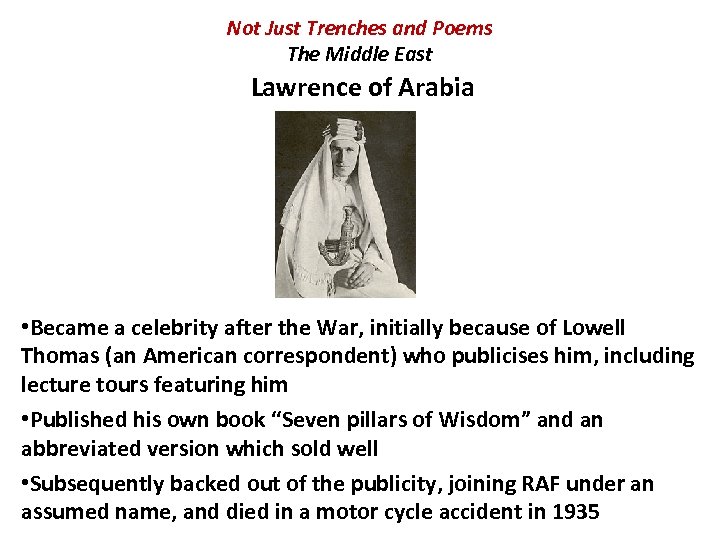 Not Just Trenches and Poems The Middle East Lawrence of Arabia • Became a celebrity after the War, initially because of Lowell Thomas (an American correspondent) who publicises him, including lecture tours featuring him • Published his own book “Seven pillars of Wisdom” and an abbreviated version which sold well • Subsequently backed out of the publicity, joining RAF under an assumed name, and died in a motor cycle accident in 1935
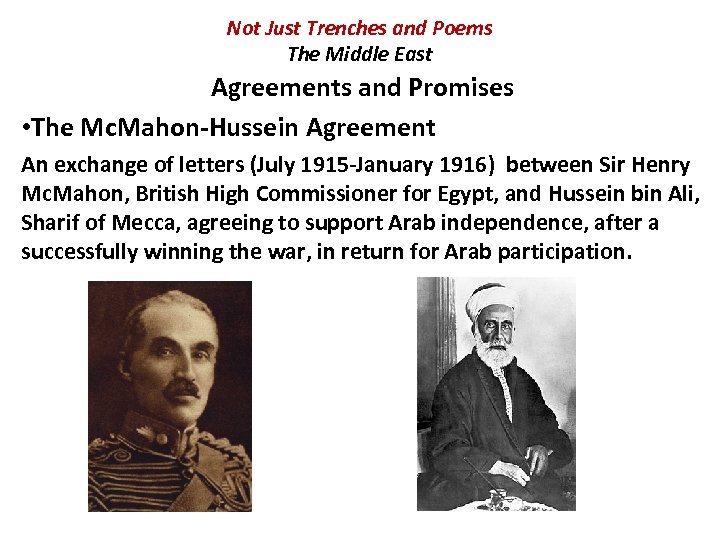 Not Just Trenches and Poems The Middle East Agreements and Promises • The Mc. Mahon-Hussein Agreement An exchange of letters (July 1915 -January 1916) between Sir Henry Mc. Mahon, British High Commissioner for Egypt, and Hussein bin Ali, Sharif of Mecca, agreeing to support Arab independence, after a successfully winning the war, in return for Arab participation.
 Not Just Trenches and Poems The Middle East Agreements and Promises • The final letter agreed to Hussein proposals with certain towns, including Damascus exempted, and a reference to not affecting French interests • The correspondence does not indicate Palestine being any different, or the issue of a Jewish Homeland • No reference to then secret Sykes-Picot agreement • Balfour Declaration comes 9 months after this, making public the aim for a Jewish Homeland in Palestine
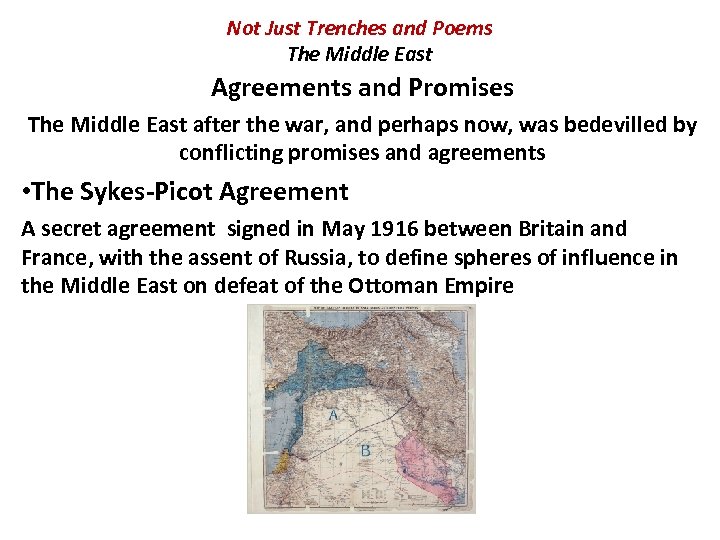 Not Just Trenches and Poems The Middle East Agreements and Promises The Middle East after the war, and perhaps now, was bedevilled by conflicting promises and agreements • The Sykes-Picot Agreement A secret agreement signed in May 1916 between Britain and France, with the assent of Russia, to define spheres of influence in the Middle East on defeat of the Ottoman Empire
 Not Just Trenches and Poems The Middle East Agreements and Promises • The agreement defined Spheres of Influence as Britain – River Jordan, Southern Iraq and Haifa/Acre France – South-East Turkey, Northern Iraq, Syria, Lebanon Russia - Istanbul, Turkish Straits, Ottoman Armenia “International control” - Palestine • Technically “spheres of influence” did not preclude honouring the commitment to Arab supporters for Kingdoms • Ironically Arabia did not seem worthy of being involved so Ibn Saud had a free hand (oil not discovered until 1930 s!) Following the Russian Revolution the Bolshevik Government exposed this and other secret agreements
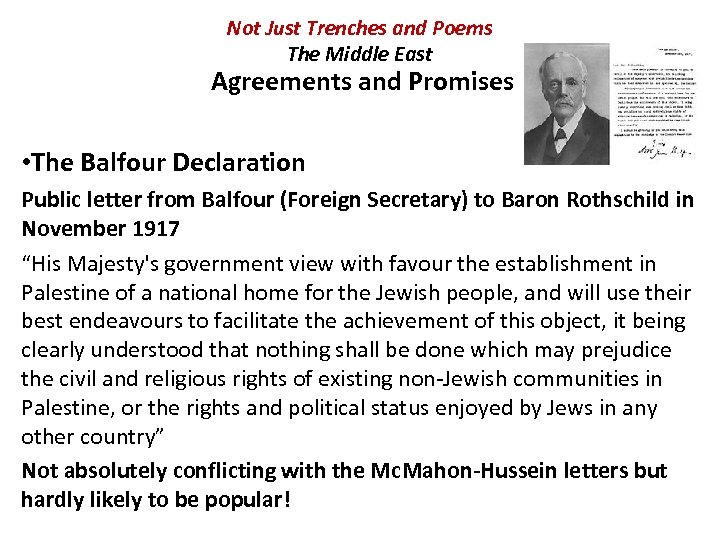 Not Just Trenches and Poems The Middle East Agreements and Promises • The Balfour Declaration Public letter from Balfour (Foreign Secretary) to Baron Rothschild in November 1917 “His Majesty's government view with favour the establishment in Palestine of a national home for the Jewish people, and will use their best endeavours to facilitate the achievement of this object, it being clearly understood that nothing shall be done which may prejudice the civil and religious rights of existing non-Jewish communities in Palestine, or the rights and political status enjoyed by Jews in any other country” Not absolutely conflicting with the Mc. Mahon-Hussein letters but hardly likely to be popular!
 Not Just Trenches and Poems The Middle East Agreements and Promises • The Treaty of Sevres 1920 This treaty was with the Ottoman Empire, leaving a Turkish portion as independent but splitting its territory up between the Allies (including parts of modern Turkey) • The Middle East was effectively split between Britain and France along the boundaries of the Sykes-Picot agreement but under a League of Nations Mandate system. • The Mandates were defined as “near” independent states: Palestine (eventually Jordan and Israel ) – Britain Syria and Lebanon – France Mesopotamia (becoming Iraq 1922, independent 1932) – Britain
 Not Just Trenches and Poems The Middle East So are we responsible for the 21 st century situation in the Middle East ? • Conflicting agreements cannot have helped long term trust from Arab leaders • Balfour declaration led to Jewish immigration to Palestine and ultimately Israel’s formation by force • Sykes- Picot division still quoted by ISIL as something they want to end BUT • Mandates did lead to the establishment of viable countries, although not necessarily Western style democracies