


 Скачать презентацию The Working Group on Coupled Models WGCM Report
b4ec6a9601cc1ea4b7b2575a6c26a1b7.ppt
- Количество слайдов: 32
 The Working Group on Coupled Models (WGCM) Report to JSC, 2010 Sandrine Bony & Jerry Meehl WGCM co-chairs Antalya, Feb 2010
 WGCM Mission Review and foster the development of coupled climate models (and now ESMs) Coordinate model experiments and inter-comparisons to: - better understand natural climate variability - predict the climate response to natural & anthropogenic perturbations Promote and facilitate model validation and diagnosis of shortcomings A balance between : Predicting – Evaluating - Understanding
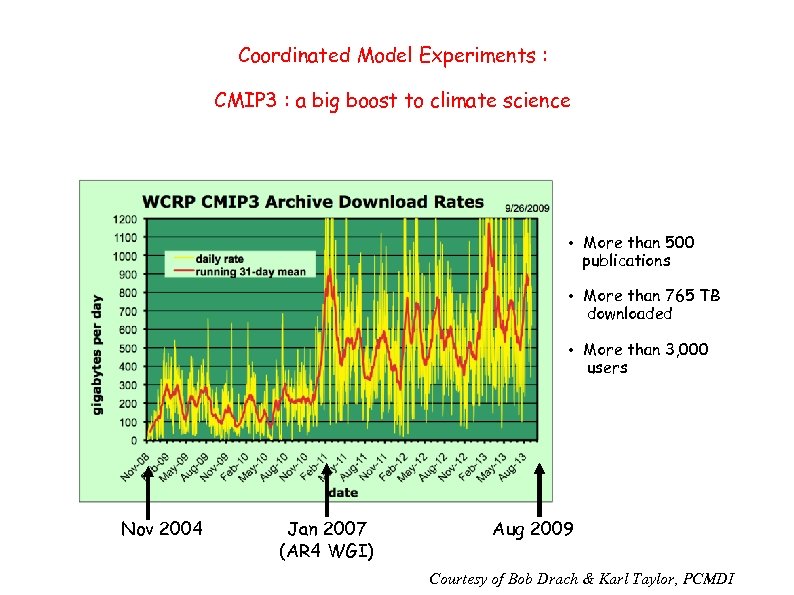 Coordinated Model Experiments : CMIP 3 : a big boost to climate science • More than 500 publications • More than 765 TB downloaded • More than 3, 000 users Nov 2004 Jan 2007 (AR 4 WGI) Aug 2009 Courtesy of Bob Drach & Karl Taylor, PCMDI
 From CMIP 3 to CMIP 5 : What should be improved ? Better inform decisions on climate change adaptation and mitigation Integrate Earth System Modelling Better assess robust and uncertain aspects of climate change Facilitate model evaluation and assess confidence in model projections + improvements on the infrastructure side … this led to CMIP 5
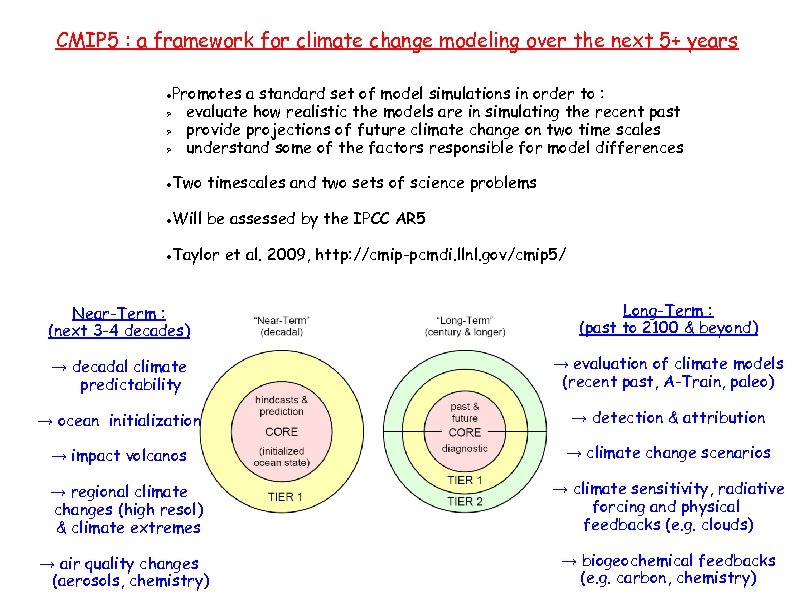 CMIP 5 : a framework for climate change modeling over the next 5+ years Promotes a standard set of model simulations in order to : evaluate how realistic the models are in simulating the recent past provide projections of future climate change on two time scales understand some of the factors responsible for model differences Two timescales and two sets of science problems Will be assessed by the IPCC AR 5 Taylor et al. 2009, http: //cmip-pcmdi. llnl. gov/cmip 5/ Near-Term : (next 3 -4 decades) Long-Term : (past to 2100 & beyond) → decadal climate predictability → evaluation of climate models (recent past, A-Train, paleo) → ocean initialization → detection & attribution → impact volcanos → climate change scenarios → regional climate changes (high resol) & climate extremes → climate sensitivity, radiative forcing and physical feedbacks (e. g. clouds) → air quality changes (aerosols, chemistry) → biogeochemical feedbacks (e. g. carbon, chemistry)
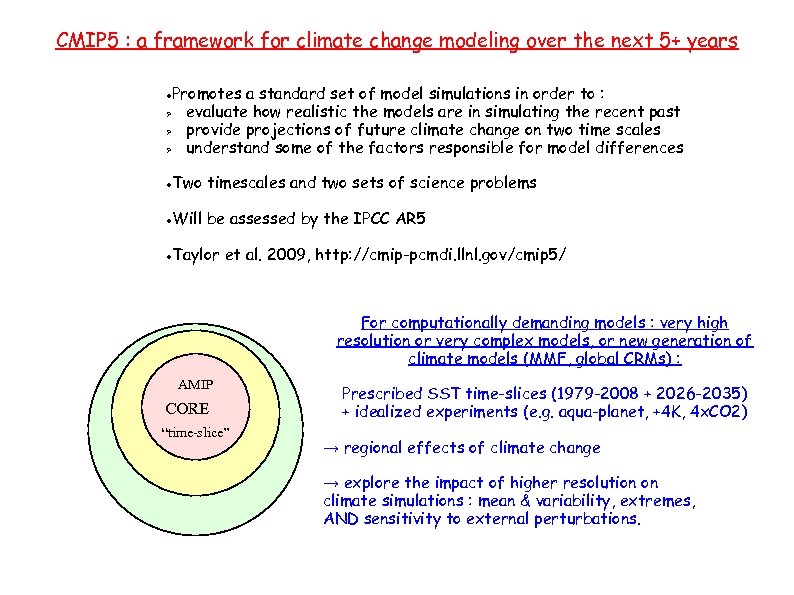 CMIP 5 : a framework for climate change modeling over the next 5+ years Promotes a standard set of model simulations in order to : evaluate how realistic the models are in simulating the recent past provide projections of future climate change on two time scales understand some of the factors responsible for model differences Two timescales and two sets of science problems Will be assessed by the IPCC AR 5 Taylor et al. 2009, http: //cmip-pcmdi. llnl. gov/cmip 5/ For computationally demanding models : very high resolution or very complex models, or new generation of climate models (MMF, global CRMs) : AMIP CORE “time-slice” Prescribed SST time-slices (1979 -2008 + 2026 -2035) + idealized experiments (e. g. aqua-planet, +4 K, 4 x. CO 2) → regional effects of climate change → explore the impact of higher resolution on climate simulations : mean & variability, extremes, AND sensitivity to external perturbations.
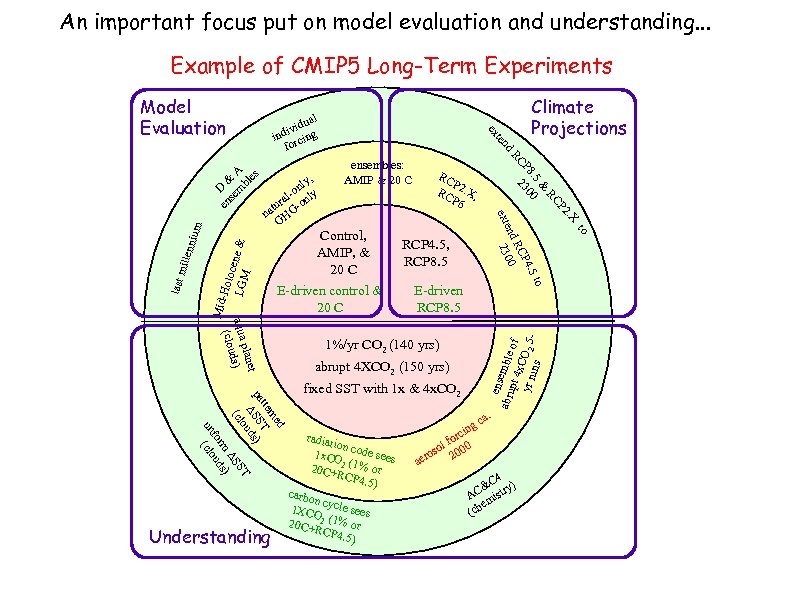 An important focus put on model evaluation and understanding. . . Example of CMIP 5 Long-Term Experiments Model en abru semble o pt 4 x. CO f yr r uns 2 5 - -Hol oc LGM ene & m nniu Mid to E-driven RCP 8. 5 abrupt 4 XCO 2 (150 yrs) fixed SST with 1 x & 4 x. CO 2 a. gc cin for sol 2000 o aer C 4 ) C& istry A m e (ch to mille . X RCP 4. 5, RCP 8. 5 1%/yr CO 2 (140 yrs) radiat ion 1 x. CO code sees 20 C+ 2 (1% or RCP 4. 5) carbo nc 1 XCO ycle sees 20 C+ 2 (1% or RCP 4. 5) P 2 5 P 4. RC nd 300 2 t plane aqua ds) (clou Understanding RC P RC 2. X, P 6 e ext Control, AMIP, & 20 C E-driven control & 20 C ed rn tte T pa S ) ΔS ds ou ST (cl ΔS rm s) fo ud un (clo Coupled carbon-cycle climate models only ensembles: AMIP & 20 C RC &. 5 0 P 8 30 RC 2 on al- only tur na HG G Climate Projections d ly, ten last ual ivid g ind rcin fo ex en D & se m A bl es All simulations are forced by Evaluation prescribed concentrations except those “E-driven” (i. e. , emission-driven).
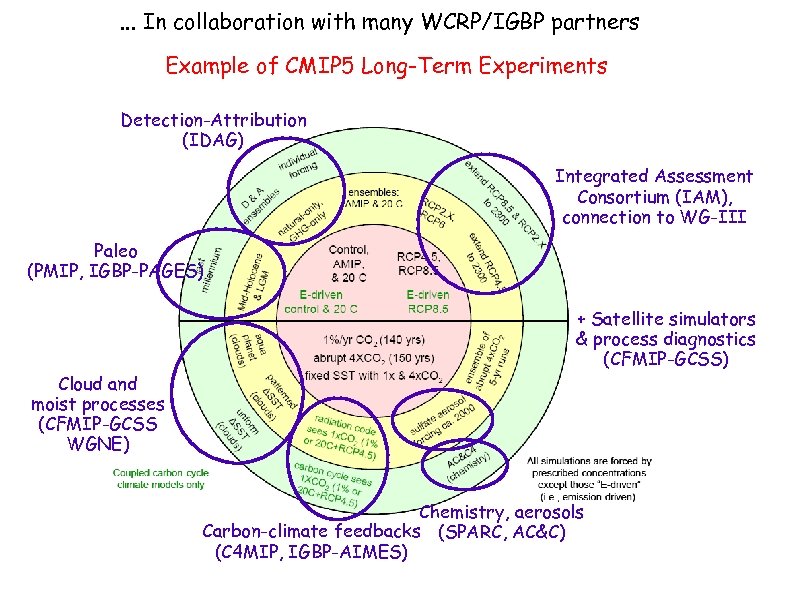 . . . In collaboration with many WCRP/IGBP partners Example of CMIP 5 Long-Term Experiments Detection-Attribution (IDAG) Integrated Assessment Consortium (IAM), connection to WG-III Paleo (PMIP, IGBP-PAGES) Cloud and moist processes (CFMIP-GCSS WGNE) + Satellite simulators & process diagnostics (CFMIP-GCSS) Chemistry, aerosols Carbon-climate feedbacks (SPARC, AC&C) (C 4 MIP, IGBP-AIMES)
 Status and Timeline : At least 21 global modeling groups will participate in CMIP 5. Likely that about 5 groups will have 50 km class AOGCMs for decadal prediction, at least 10 groups will have ESMs, several groups will have high-resolution AGCMs (<50 km). • The full sets of forcings and boundary conditions, and the list of model outputs, have been finalized. • Simulations have now started in many modeling groups. • Model outputs will be archived on the “Earth System Grid” (distributed grid technology) which is being deployed and tested now. • An extensive documentation of the models and of model experiments will be available for CMIP 5 through EU Metafor (standardized vocabulary and documentation), and US Earth System Curator projects (web-based tools for ingesting metadata). • PCMDI will require agreement to the “terms of use” as part of the registration procedure. CMIP data will be divided into two classes: unrestricted and restricted-use (no restriction: 7 out of 12). Analyses of model data will begin late 2010, and will be assessed by the IPCC AR 5. CMIP 5 model simulations and analyses will continue well beyond AR 5 deadlines.
 In parallel to CMIP 5, many other climate model coordinated experiments are being organized by the modelling community – WGCM (PMIP, CFMIP. . ): paleo, clouds – WGNE/WGCM (Transpose-AMIP): evaluation of climate models in NWP mode - CLIVAR WGSIP, WGOMD : seasonal to interannual prediction, ocean – TFRCD (CORDEX) : regional – GEWEX GCSS (GPCI) : processes – SPARC & IGBP/IGAC (CCMVal, Aero. Com. . ): chemistry & aerosols – IGBP/AIMES (C 4 MIP) : carbon feedbacks – … and much more! + WGNE/WGCM Metrics panel
 Proposal for coordinated geo-engineering experiments with stratospheric aerosols by Ben Kravitz, Alan Robock et al. Aim: explore the efficacy and risks of stratospheric geo-engineering with sulfate aerosols. Demonstration project to be conducted by a few modeling groups. Coordination with SPARC? Not part of CMIP 5. Received some feedback from WGCM last September. Issues of particular interest : - robustness of the model responses to geo-engineering - response of the hydrological cycle, temperature patterns and stratospheric ozone - response to the stoppage of geoengineering after a few decades Several experiments proposed for coupled ocean-atmosphere models including interactive aerosols and chemistry : - in combination of 1% increase CO 2 per year, progressively balance the CO 2 radiative forcing by a reduction of the solar constant - in combination of RCP 4. 5 scenario: progressively balance the CO 2 radiative forcing by injecting stratospheric aerosols (or SO 2) at the equator. - abrupt stoppage of geo-engineering after 50 years + simpler idealized experiments to better understand inter-model differences Interested modeling groups will perform these experiments this year. More groups might join after this demonstration project. How should this be coordinated across WCRP?
 BIG CHALLENGE : How to improve our confidence in climate models ? How to assess the credibility of model projections ?
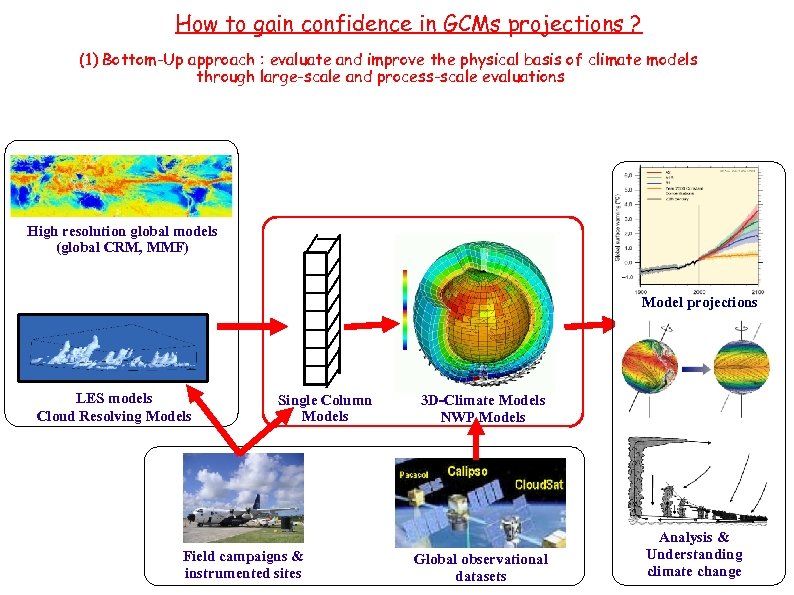 How to gain confidence in GCMs projections ? (1) Bottom-Up approach : evaluate and improve the physical basis of climate models through large-scale and process-scale evaluations High resolution global models (global CRM, MMF) Model projections LES models Cloud Resolving Models Single Column Models Field campaigns & instrumented sites 3 D-Climate Models NWP Models Global observational datasets Analysis & Understanding climate change
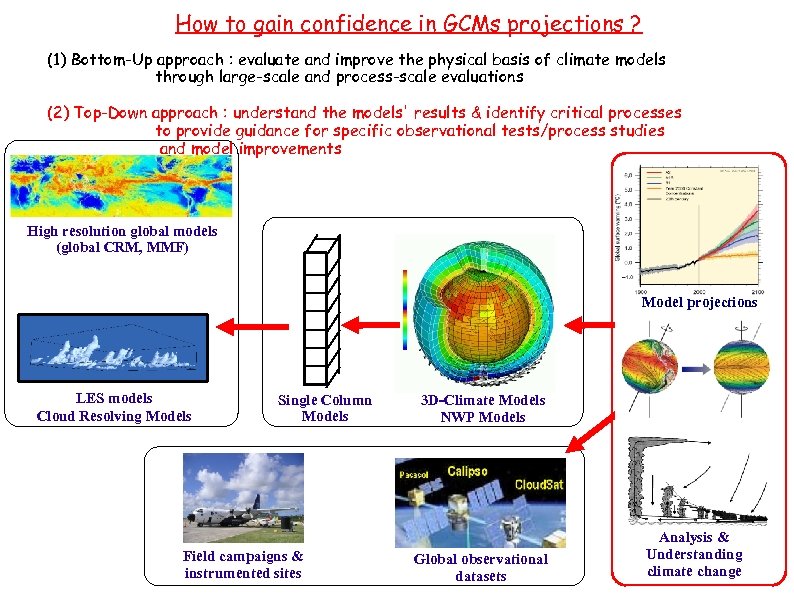 How to gain confidence in GCMs projections ? (1) Bottom-Up approach : evaluate and improve the physical basis of climate models through large-scale and process-scale evaluations (2) Top-Down approach : understand the models' results & identify critical processes to provide guidance for specific observational tests/process studies and model improvements High resolution global models (global CRM, MMF) Model projections LES models Cloud Resolving Models Single Column Models Field campaigns & instrumented sites 3 D-Climate Models NWP Models Global observational datasets Analysis & Understanding climate change
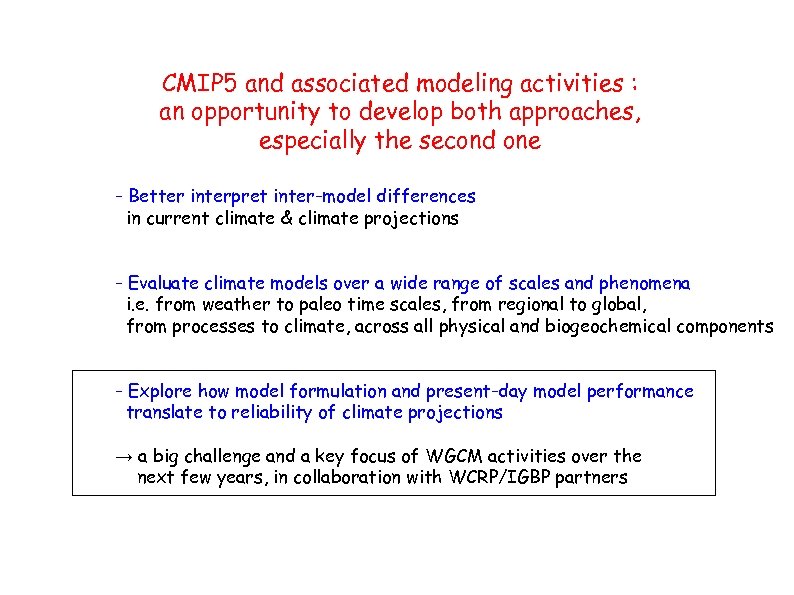 CMIP 5 and associated modeling activities : an opportunity to develop both approaches, especially the second one - Better interpret inter-model differences in current climate & climate projections - Evaluate climate models over a wide range of scales and phenomena i. e. from weather to paleo time scales, from regional to global, from processes to climate, across all physical and biogeochemical components - Explore how model formulation and present-day model performance translate to reliability of climate projections → a big challenge and a key focus of WGCM activities over the next few years, in collaboration with WCRP/IGBP partners
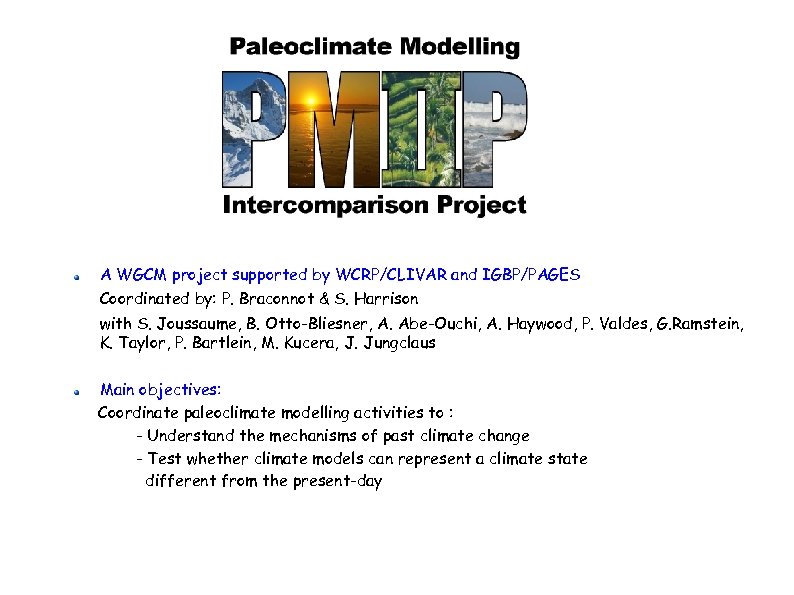 A WGCM project supported by WCRP/CLIVAR and IGBP/PAGES Coordinated by: P. Braconnot & S. Harrison with S. Joussaume, B. Otto-Bliesner, A. Abe-Ouchi, A. Haywood, P. Valdes, G. Ramstein, K. Taylor, P. Bartlein, M. Kucera, J. Jungclaus Main objectives: Coordinate paleoclimate modelling activities to : - Understand the mechanisms of past climate change - Test whether climate models can represent a climate state different from the present-day
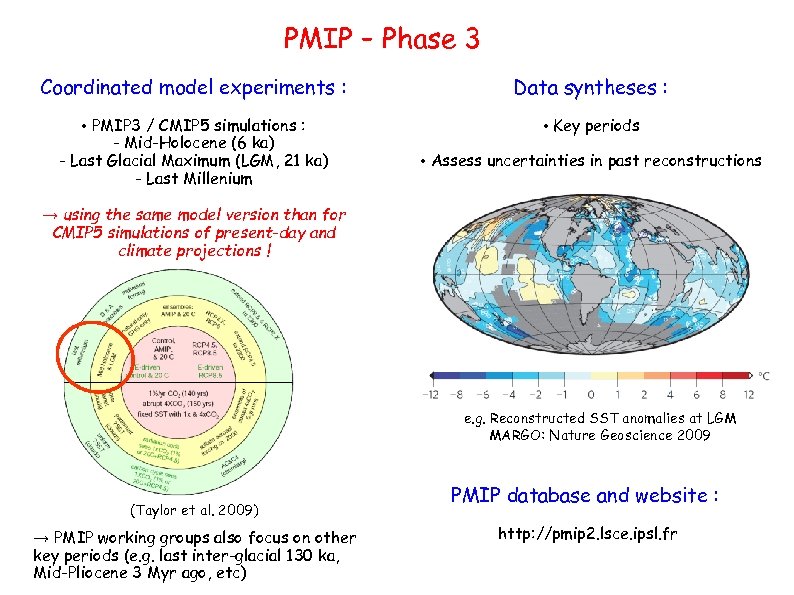 PMIP – Phase 3 Coordinated model experiments : Data syntheses : • PMIP 3 / CMIP 5 simulations : - Mid-Holocene (6 ka) - Last Glacial Maximum (LGM, 21 ka) - Last Millenium • Key periods • Assess uncertainties in past reconstructions → using the same model version than for CMIP 5 simulations of present-day and climate projections ! e. g. Reconstructed SST anomalies at LGM MARGO: Nature Geoscience 2009 (Taylor et al. 2009) → PMIP working groups also focus on other key periods (e. g. last inter-glacial 130 ka, Mid-Pliocene 3 Myr ago, etc) PMIP database and website : http: //pmip 2. lsce. ipsl. fr
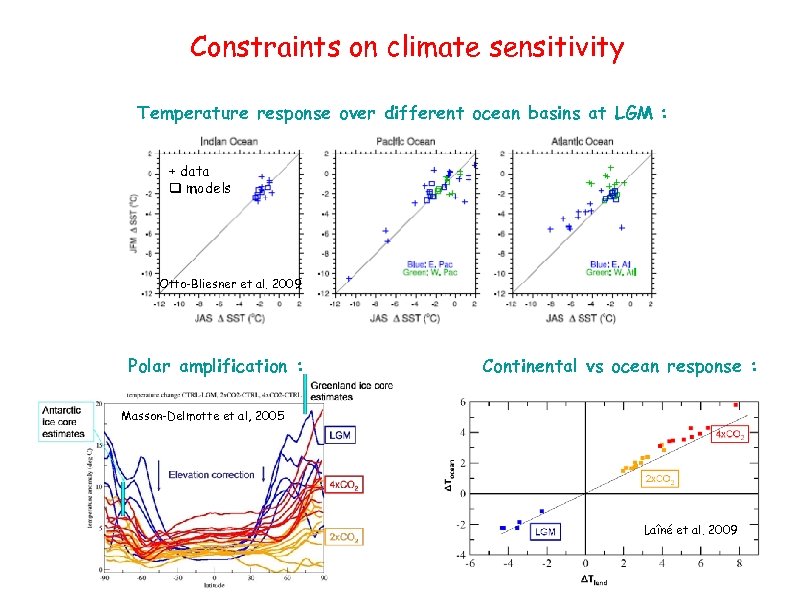 Constraints on climate sensitivity Temperature response over different ocean basins at LGM : + data models Otto-Bliesner et al. 2009 Polar amplification : Continental vs ocean response : Masson-Delmotte et al, 2005 Laîné et al. 2009
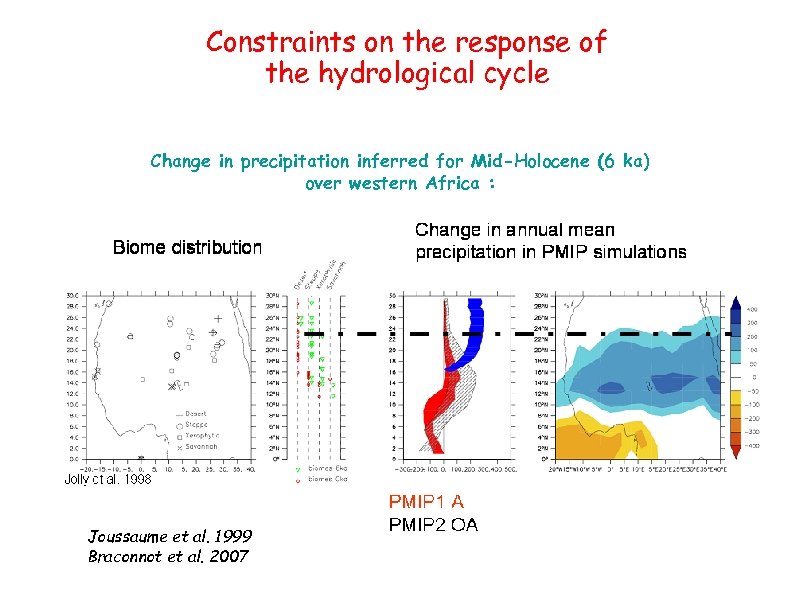 Constraints on the response of the hydrological cycle Change in precipitation inferred for Mid-Holocene (6 ka) over western Africa : Joussaume et al. 1999 Braconnot et al. 2007
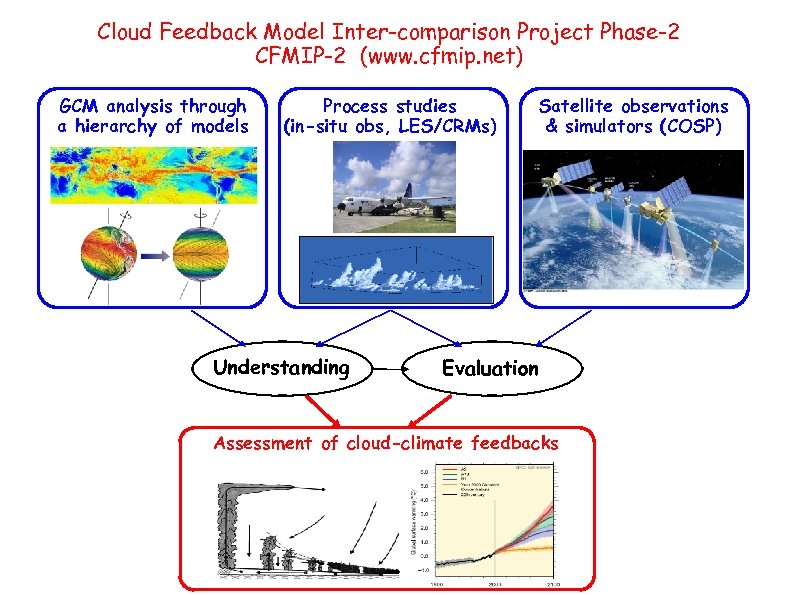
 Cloud Feedback Model Inter-comparison Project Phase-2 CFMIP-2 (www. cfmip. net) A WGCM project coordinated by : Mark Webb, Sandrine Bony, Christopher Bretherton, Steve Klein, George Tselioudis Aims : Encourage coordinated research in the area of cloud-climate feedbacks. Facilitate the evaluation of clouds simulated by climate models Strong interactions between climate/process/observation/NWP communities Building bridges through the cloud communities
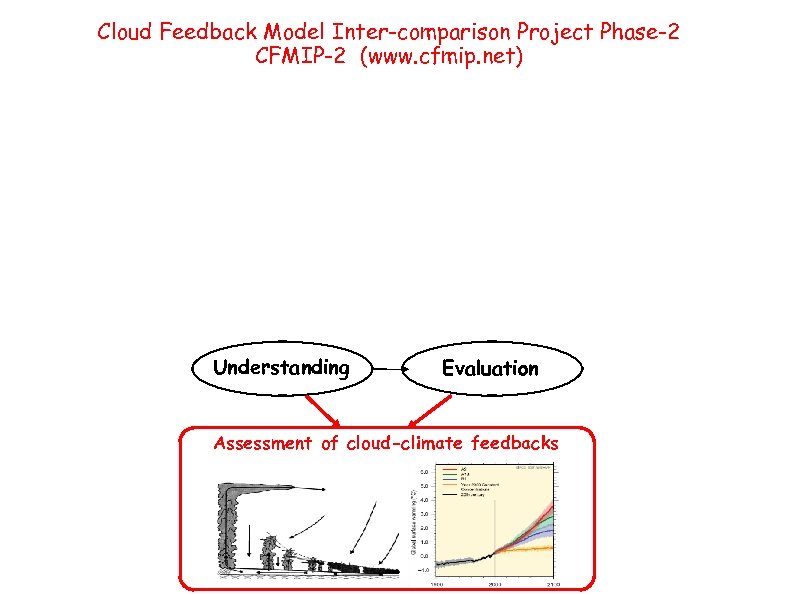 Cloud Feedback Model Inter-comparison Project Phase-2 CFMIP-2 (www. cfmip. net) Understanding Evaluation Assessment of cloud-climate feedbacks
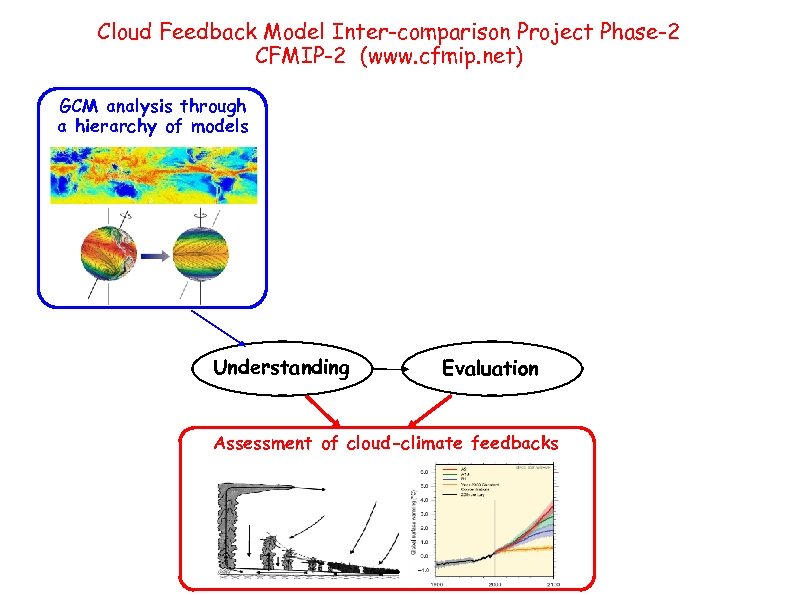 Cloud Feedback Model Inter-comparison Project Phase-2 CFMIP-2 (www. cfmip. net) GCM analysis through a hierarchy of models Understanding Evaluation Assessment of cloud-climate feedbacks
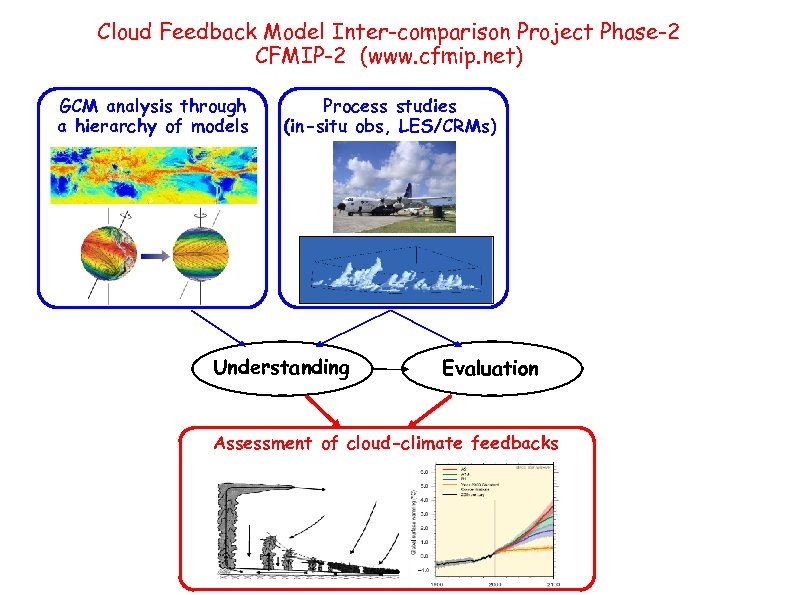 Cloud Feedback Model Inter-comparison Project Phase-2 CFMIP-2 (www. cfmip. net) GCM analysis through a hierarchy of models Process studies (in-situ obs, LES/CRMs) Understanding Evaluation Assessment of cloud-climate feedbacks
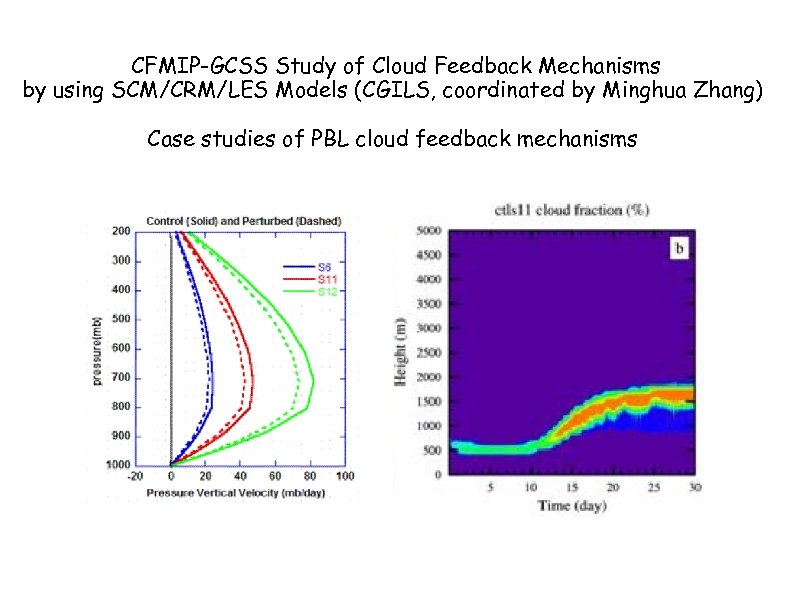
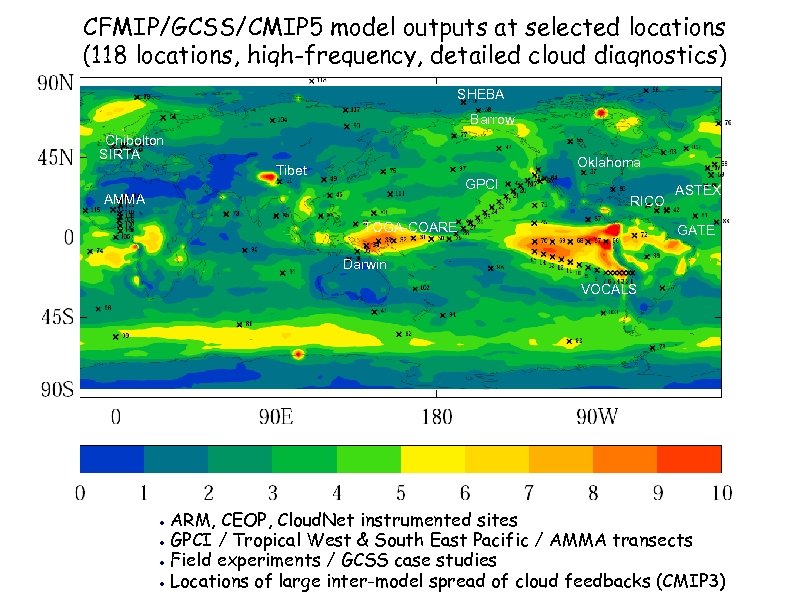 CFMIP/GCSS/CMIP 5 model outputs at selected locations (118 locations, high-frequency, detailed cloud diagnostics) SHEBA Barrow Chibolton SIRTA Oklahoma Tibet GPCI AMMA RICO TOGA-COARE ASTEX GATE Darwin VOCALS ● ● ARM, CEOP, Cloud. Net instrumented sites GPCI / Tropical West & South East Pacific / AMMA transects Field experiments / GCSS case studies Locations of large inter-model spread of cloud feedbacks (CMIP 3)
 CFMIP-GCSS Study of Cloud Feedback Mechanisms by using SCM/CRM/LES Models (CGILS, coordinated by Minghua Zhang) Case studies of PBL cloud feedback mechanisms
 Cloud Feedback Model Inter-comparison Project Phase-2 CFMIP-2 (www. cfmip. net) GCM analysis through a hierarchy of models Process studies (in-situ obs, LES/CRMs) Understanding Satellite observations & simulators (COSP) Evaluation Assessment of cloud-climate feedbacks
 Cloud Vertical Distribution CALIPSO-GOCCP OBS ECHAM 5 + SIM CCCMA + SIM LMDZ 4 + SIM CAM 3. 5 + SIM 0. 3 Overestimate: of high clouds Underestimate of: - Tropical low clouds - Congestus clouds - extratropical mid-level clouds 0 Chepfer et al. (Calipso-Cloudsat workshop, Jul 2009)
 Vertical distributions of radar reflectivities (CFADs) Cloud. Sat (Bodas-Salcedo et al. , in preparation)
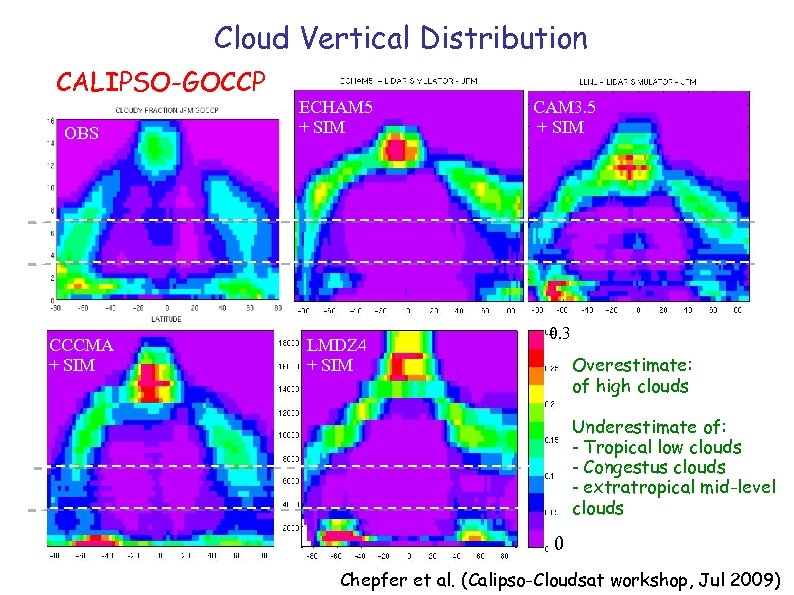
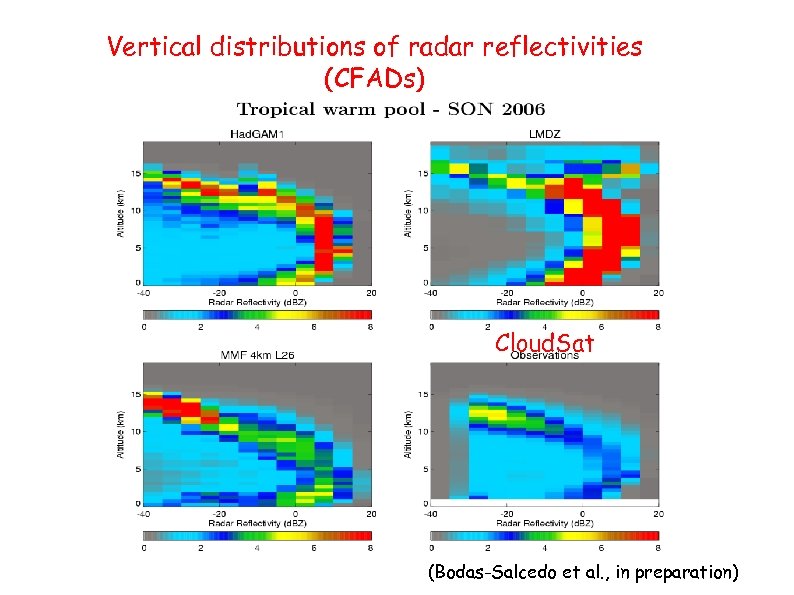
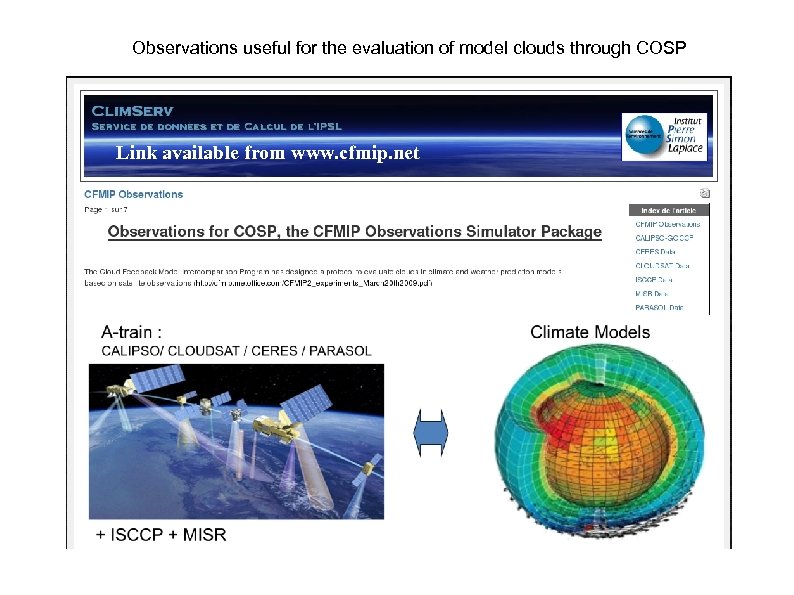 Observations useful for the evaluation of model clouds through COSP Link available from www. cfmip. net
 Observations for CMIP 5 Simulations • The climate modeling community would greatly benefit from an easier and more coordinated access to observations for model evaluation and analysis. • Many individual initiatives worldwide (different MIPs, ARM, etc) CMIP 5 might be an excellent opportunity to foster a coordinated access to observations that are most useful for model evaluation. • Recently, JPL (Joao Texeira, Duane Waliser, Jerry Potter, S Boland) launched such an initiative - To provide the community of researchers that will analyze CMIP 5 simulations access to analogous sets of observational data. - Analogous sets in terms of periods, variables, temporal/spatial frequency - This activity will be carried out in close coordination with CMIP 5 & modelling activities - It will directly engage the observational (e. g. mission and instrument) science teams to facilitate production of the corresponding data sets. Discussions already engaged with NASA. What about other providers of satellite and in-situ observations? To be discussed with WOAP and GCOS.
 Conclusion Trying to keep the balance between predicting, evaluating and understanding. . . CMIP 5 : - many new features : decadal, ESMs, high-resolution, satellite and process outputs. . - strong partnership with WCRP partners and IGBP (joint WGCM-AIMES meeting) - huge effort for modeling groups and many other communities Analysis of CMIP 5 simulations : an opportunity to - build connections among modeling communities and between modeling, processes and observation - address key science challenges e. g. assessing the reliability of model projections based on model evaluation at different time scales. cf IPCC expert meeting on multi-model simulations - help interpret model deficiencies and guide the model development process (motivation for the Survey on model evaluation and improvement at last CLIVAR SSG). Issues for JSC : - coordination of observations for model evaluation (modeling – WOAP – GCOS panels) - coordination & syntheses of different MIPs, evaluations and analyses across WCRP & IGBP - CMIP 5 analysis : recommendations? e. g. encourage coordinated analyses and syntheses about key topics cross-acronyms (strengthen connections + help AR 5 authors)
 WCRP-WWRP-THORPEX Consultation on Model Evaluation and Improvement Sandrine Bony, Jerry Meehl, Anna Pirani (WGCM) Christian Jakob, Martin Miller (WGNE) Ben Kirtman (WGSIP), Stephen Griffies (WGOMD), Tony Busalacchi (WCRP) Background and Goal : - Model errors and biases are key limitations of the skill of model predictions over a wide range of time and space scales ; - Not a new story. The increase of resolution and the addition of complexity in ESMs have not solved the problem. - How to tackle the problem ? What should we do? What can we do ? -> Bottom-up consultation of NWP/climate modeling groups, CLIVAR WGs/panels, WCRP/WWRP/IGBP projects - Restructuration of WCRP : an opportunity to put recommendations into action. More in a few minutes. .