


 Скачать презентацию The work of the OIE to improve veterinary
2bd9c5576dfd1c46c795dd805d685c6e.ppt
- Количество слайдов: 28
 The work of the OIE to improve veterinary education globally Vers une Union méditerranéenne de l'enseignement vétérinaire (TAIEX) 7 -8 October 2010, Maisons Alfort Dr Sarah Kahn Head, International Trade Department
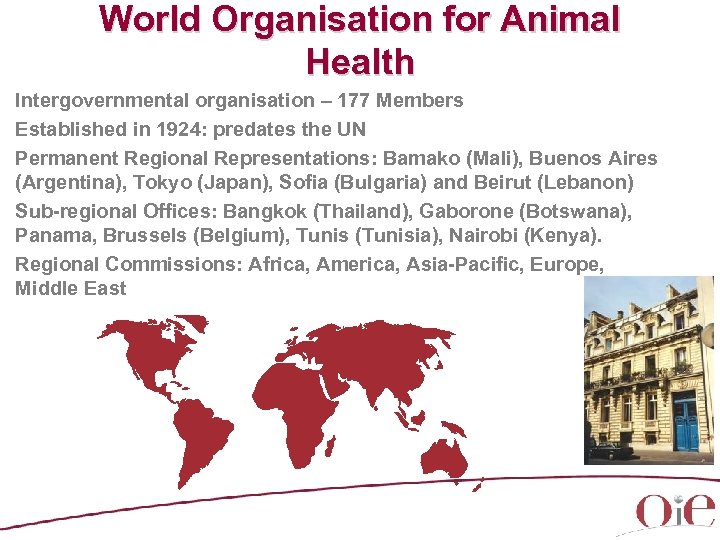 World Organisation for Animal Health Intergovernmental organisation – 177 Members Established in 1924: predates the UN Permanent Regional Representations: Bamako (Mali), Buenos Aires (Argentina), Tokyo (Japan), Sofia (Bulgaria) and Beirut (Lebanon) Sub-regional Offices: Bangkok (Thailand), Gaborone (Botswana), Panama, Brussels (Belgium), Tunis (Tunisia), Nairobi (Kenya). Regional Commissions: Africa, America, Asia-Pacific, Europe, Middle East
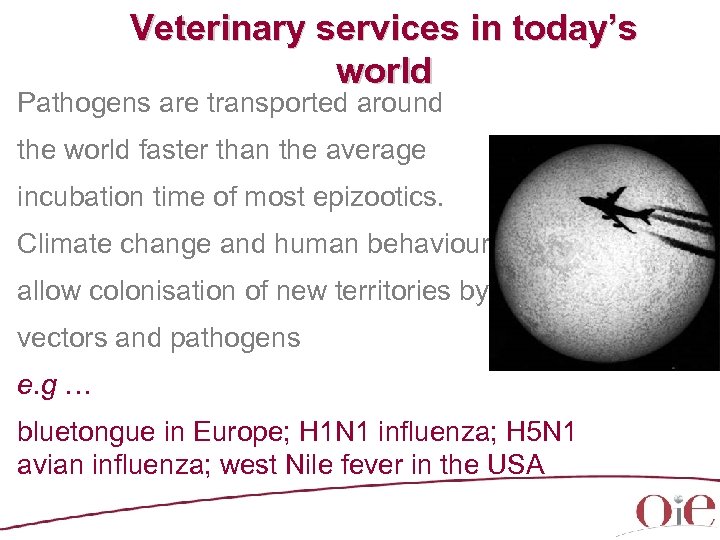 Veterinary services in today’s world Pathogens are transported around the world faster than the average incubation time of most epizootics. Climate change and human behaviour allow colonisation of new territories by vectors and pathogens e. g … bluetongue in Europe; H 1 N 1 influenza; H 5 N 1 avian influenza; west Nile fever in the USA
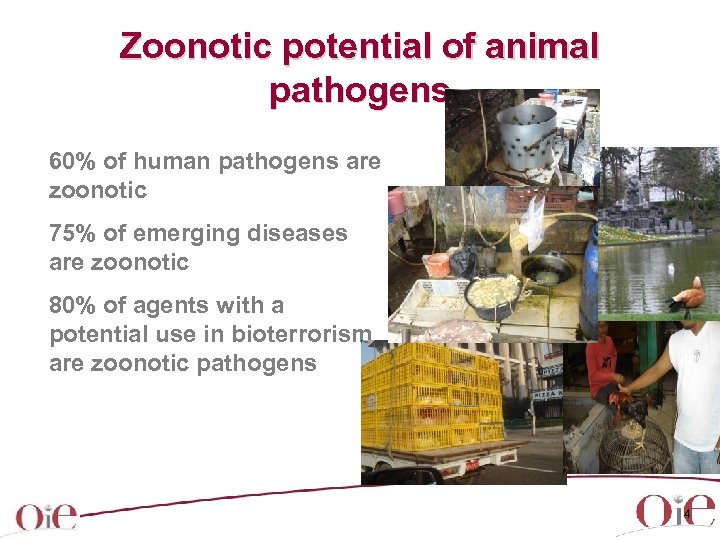 Zoonotic potential of animal pathogens 60% of human pathogens are zoonotic 75% of emerging diseases are zoonotic 80% of agents with a potential use in bioterrorism are zoonotic pathogens 4
 Food security, food safety and public health 1 billion poor people depend on livestock for survival Impact of animal diseases on animal production losses worldwide exceeds 20% Animal health, food security, public health are all linked Animal proteins are crucial for human health and welfare Given the rising demand for protein, animal production must be intensified globally The veterinary profession must be ready!
 Veterinary services: a Global Public Good Ø In relation to the control and eradication of infectious diseases, the benefits are international and inter generational in scope. Countries depend on each other Ø Animal health systems are not a commercial nor a strictly agricultural good. Investment of public resources nationally and globally is critical. Ø Failure of one country may endanger the entire planet
 Need to strengthen Veterinary Services Good Governance Building and maintaining effective epidemiosurveillance networks based on an efficient national chain of command; Public and private sector alliances (veterinarians, farmers); Quality standards democratically adopted by OIE Members; Veterinary education; Applied scientific research (new vaccines, diagnostics); Supported by the use of the OIE evaluation tool
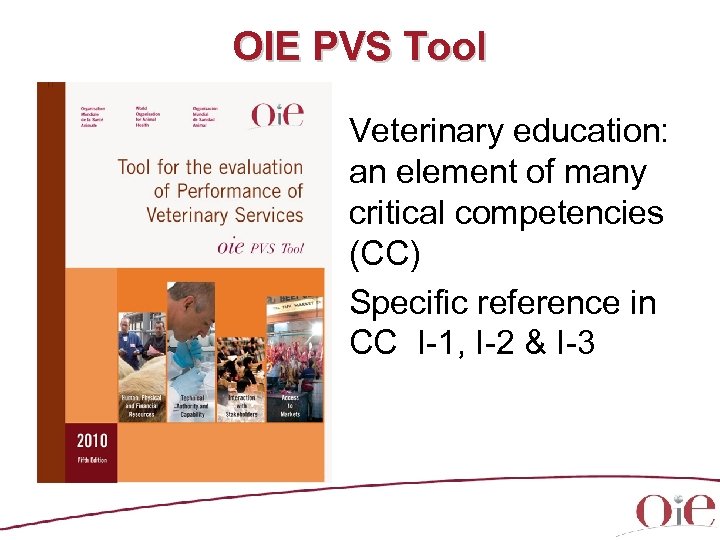 OIE PVS Tool Veterinary education: an element of many critical competencies (CC) Specific reference in CC I 1, I 2 & I 3
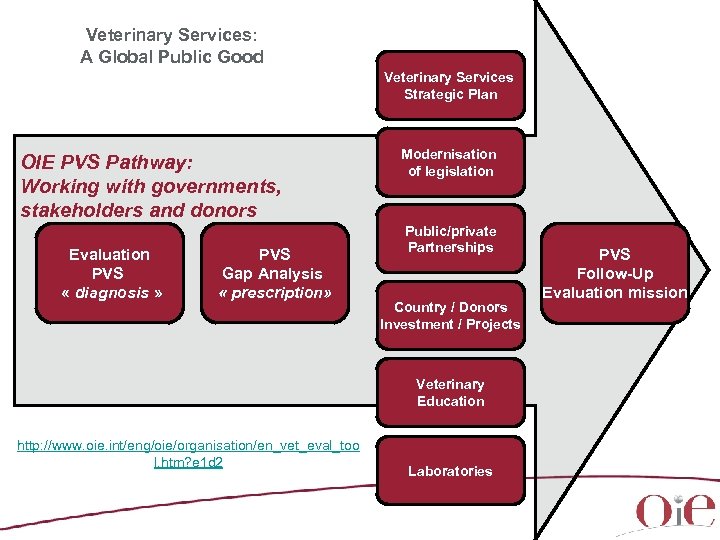 Veterinary Services: A Global Public Good Veterinary Services Strategic Plan OIE PVS Pathway: Working with governments, stakeholders and donors Evaluation PVS « diagnosis » PVS Gap Analysis « prescription» Modernisation of legislation Public/private Partnerships Country / Donors Investment / Projects Veterinary Education http: //www. oie. int/eng/oie/organisation/en_vet_eval_too l. htm? e 1 d 2 Laboratories PVS Follow-Up Evaluation mission
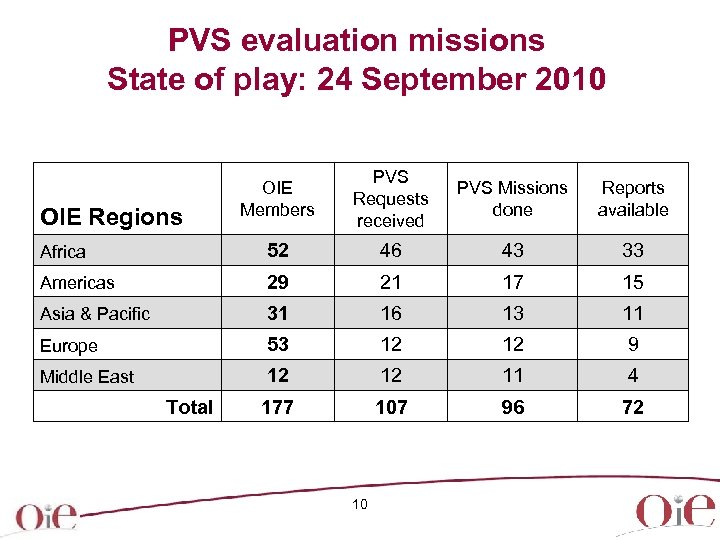 PVS evaluation missions State of play: 24 September 2010 OIE Members PVS Requests received PVS Missions done Reports available Africa 52 46 43 33 Americas 29 21 17 15 Asia & Pacific 31 16 13 11 Europe 53 12 12 9 Middle East 12 12 11 4 177 107 96 72 OIE Regions Total 10
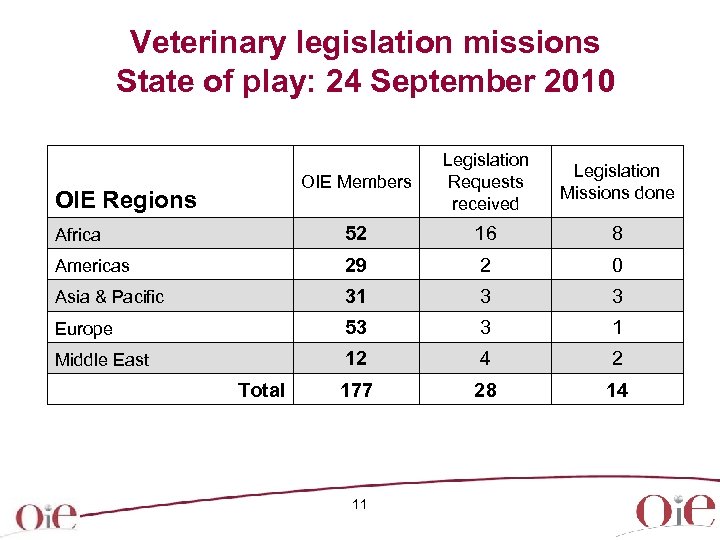 Veterinary legislation missions State of play: 24 September 2010 OIE Members Legislation Requests received Legislation Missions done Africa 52 16 8 Americas 29 2 0 Asia & Pacific 31 3 3 Europe 53 3 1 Middle East 12 4 2 177 28 14 OIE Regions Total 11
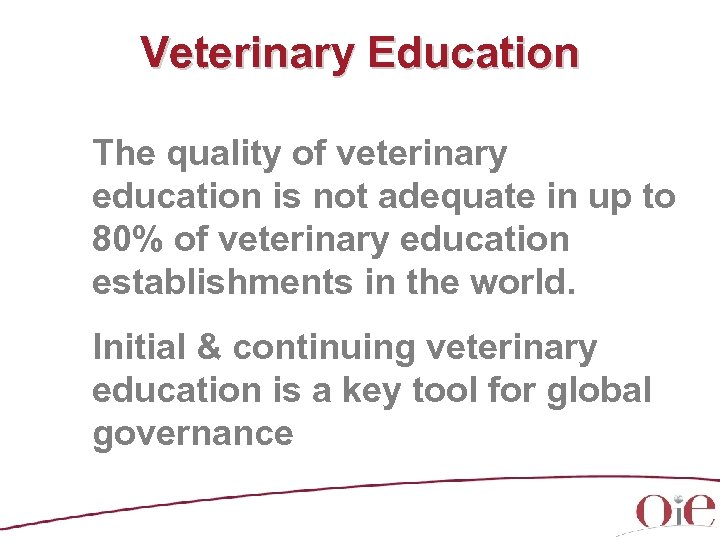 Veterinary Education The quality of veterinary education is not adequate in up to 80% of veterinary education establishments in the world. Initial & continuing veterinary education is a key tool for global governance
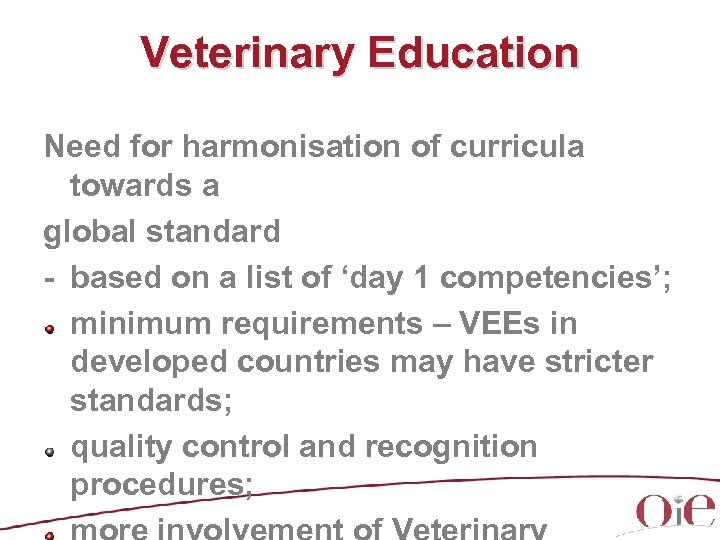 Veterinary Education Need for harmonisation of curricula towards a global standard - based on a list of ‘day 1 competencies’; minimum requirements – VEEs in developed countries may have stricter standards; quality control and recognition procedures;
 OIE Global Conference on Veterinary Education "Evolving veterinary education for a safer world" 2 -14 October 2009 Paris. More than 300 veterinary Deans from all around the world attended >> First global recommendations on veterinary education http: //www. oie. int/eng/press/en_091116. htm.
 Recommendations on veterinary education 1. Recognition of the OIE global leadership in veterinary education and veterinary legislation. 2. The concept of minimum standards to ensure that new veterinary graduates are capable of delivering their functions (in public and private sector), according to the OIE standards for quality of veterinary services. With the involvement of veterinary deans and teachers from all five OIE regions, an OIE expert ad hoc Group met in June 2010 to progress the Conference recommendations, including possible support and evaluation mechanisms. The next meeting will take place in December 2010.
 Recommendations on veterinary education Competencies Skills: psychomotor abilities, manual and physical; Knowledge: cognitive abilities meaning mental skills Attitude: affective abilities, meaning feelings and emotions; and Aptitude: a student’s natural ability, talent, or capacity for learning. 1. General competencies are not the subject of OIE recommendations (e. g. clinical veterinary sciences, animal production, etc). 2. Specific competencies must be taught in the professional curriculum. Topics include: zoonoses; transboundary animal diseases; emerging diseases; animal welfare; epidemiology; disease control and veterinary legislation.
 Recommendations on veterinary education 3. Advanced competencies should be taught in the professional curriculum but competence must be developed through postgraduate and on the job training. They are essential to veterinarians whose careers are in national Veterinary Services (VS) but also important to private veterinarians supporting the objectives of VS. Topics include: organisation of VS; risk analysis; research; international trade and management. Primary and secondary learning objectives are listed.
 Recommendations on veterinary education Example (1): Primary learning objectives for management include having a general awareness and appreciation of: • best practices in administration and management as those relate to delivery of quality national VS; • excellent interpersonal communication skills in the delivery of quality national VS, to include self knowledge and knowledge of others; • the understanding of communication as a critical discipline in the administration of veterinary services; • where to find up to date credible information should deeper knowledge be needed or desired; • at least one language other than the official language of the country.
 Recommendations on veterinary education Example (contd): Secondary learning objectives include the average entry level veterinarian understanding: • notions of the categorization of disease related risks as regards their socio/economic impacts and the impacts of their control measures, as well as prioritization of actions according to these categories and the situation of a territory, country, region.
 Recommendations on veterinary education Example (2): Primary learning objectives for this competency include the average entry level veterinarian having a general awareness and appreciation of: • how risk analysis can be applied to assessment of animal disease related risks and residues of veterinary drugs, including importation of animals and animal products and other related veterinary services activities; • how risk analysis can be used to ensure veterinary services adequately protect animal and human health; • where to find up to date credible information should deeper knowledge be needed or desired (e. g. the OIE Handbook on Import risk Analysis).
 Recommendations on veterinary education Example (contd): Secondary learning objectives include gaining an understanding, of the following definitions (in addition to those outlined above): • • • hazard identification; risk assessment; risk management; risk communication; and risk perceptions among risk assessors, risk managers, risk communicators, the general public, and other interested parties (e. g. , stakeholders).
 Important dates/next steps 2 nd World Conference on Veterinary Education at Lyon, 12 -16 May 2011. • The OIE may give an update on its work. At the 79 th General Session (23 -27 May 2011), OIE Members will be invited to endorse the ongoing work – although this is not proposed, at the moment, as a standard in the OIE Terrestrial Animal Health Code.
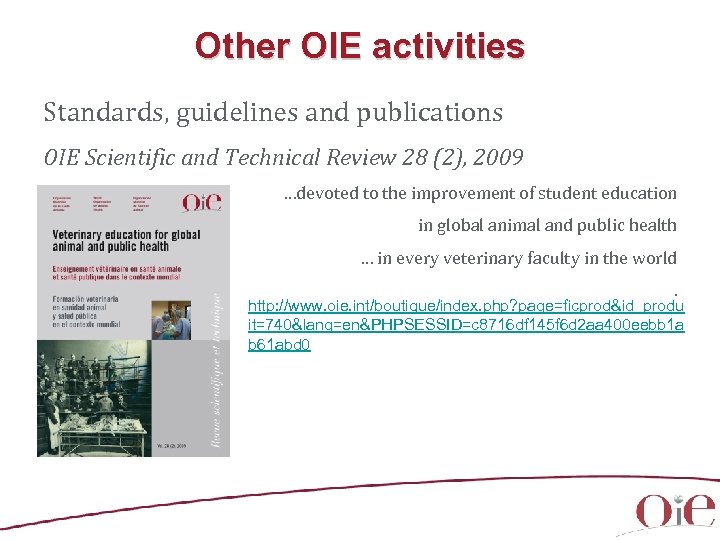 Other OIE activities Standards, guidelines and publications OIE Scientific and Technical Review 28 (2), 2009 …devoted to the improvement of student education in global animal and public health … in every veterinary faculty in the world. http: //www. oie. int/boutique/index. php? page=ficprod&id_produ it=740&lang=en&PHPSESSID=c 8716 df 145 f 6 d 2 aa 400 eebb 1 a b 61 abd 0
 Other OIE activities Standards, guidelines and publications Guidelines on Veterinary Legislation for OIE Members Veterinary legislation is an essential element of the national infrastructure that enables Veterinary Authorities to carry out their key functions…. . in the face of increasing global trade, climate change and the emergence of diseases that can rapidly spread across international borders, the Veterinary Services must be effectively supported by legislation to meet the OIE criteria for performance of essential functions. http: //www. oie. int/eng/oie/organisation/A_Guidelines_Vet%20 Leg. pdf A new standard will be proposed for adoption in 2011.
 Other OIE activities Global conference on Veterinary Legislation 7 -9 December 2010 Djerba, Tunisia. ‘Modernising Veterinary Legislation for Good Governance”. http: //www. oie. int/eng/A_LEG_VET 2010/Home_eng. htm
 “One World-One Health” A global strategy for preventing and managing risks at the human animal interface Prediction, prevention and response: cooperation is key Veterinarians have an important role to play.
 Conclusions Global veterinary education : a key component of the quality of veterinary services • both public & private sector. Veterinary education must evolve to meet societal demands and new sanitary risks in food security, food safety, animal and public health and animal welfare. The OIE is addressing the issue of veterinary education and legislation as part of its commitment to strengthening animal health and welfare and veterinary services globally.
 Thank you for your attention Organisation mondiale de la santé animale World Organisation for Animal Health Organización Mundial de Sanidad Animal 12 rue de Prony, 75017 Paris, France www. oie. int oie@oie. int