


 Скачать презентацию The Western Frontier and Industrialization The Western Frontier
6edf59ee08ed8244c496930c5519a001.ppt
- Количество слайдов: 31
 The Western Frontier and Industrialization The Western Frontier Industry and Railroads Big Business and Labor The Gilded Age Immigrants and Urbanization
 The Western Frontier Prairie Problems § Native American and White cultures greatly differed § Owning land § Whites believed west was unsettled, but lure of striking it rich too strong § US Gov’t grants and restricts land for NA often § Massacre at Sand Creek- Troops attack Indian reservation § Treaty of Fort Laramie settle problems temporarily § Whites encroach on Indian land searching for gold § Custer’s Last Stand: NA lay in wait and ambush US troops § Many Americans wanted to assimilate NA- integrate into white culture § The Dawes Act: Broke up reservations, “Americanize” Indians
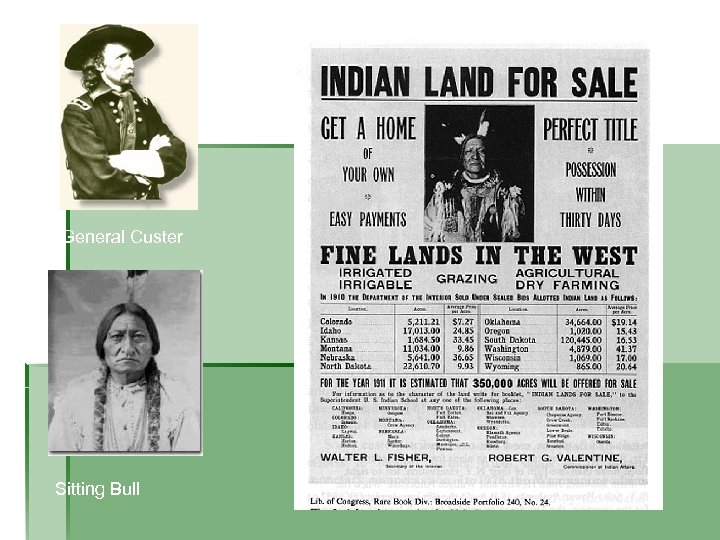 General Custer Sitting Bull
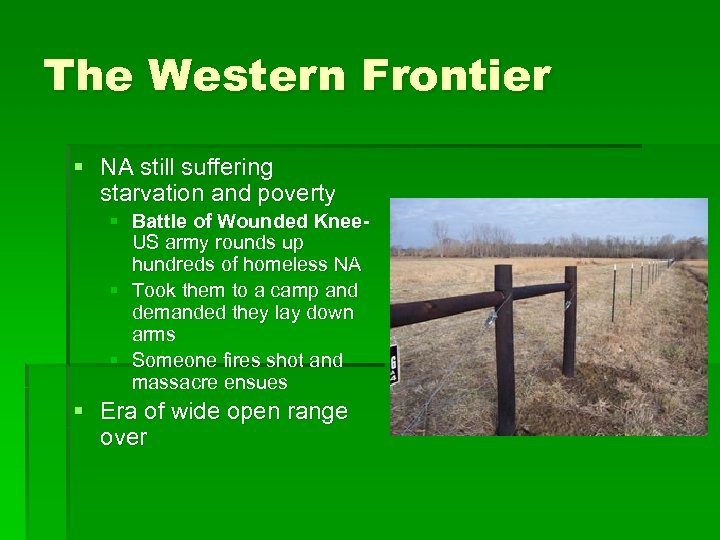 The Western Frontier § NA still suffering starvation and poverty § Battle of Wounded Knee. US army rounds up hundreds of homeless NA § Took them to a camp and demanded they lay down arms § Someone fires shot and massacre ensues § Era of wide open range over
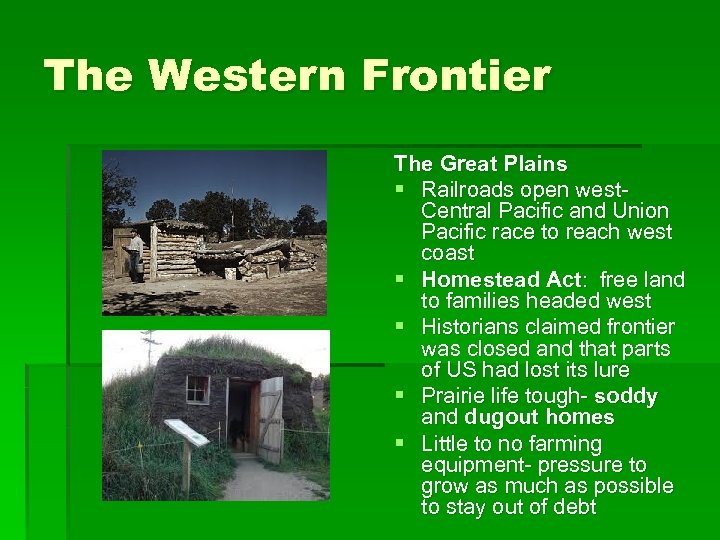 The Western Frontier The Great Plains § Railroads open west. Central Pacific and Union Pacific race to reach west coast § Homestead Act: free land to families headed west § Historians claimed frontier was closed and that parts of US had lost its lure § Prairie life tough- soddy and dugout homes § Little to no farming equipment- pressure to grow as much as possible to stay out of debt
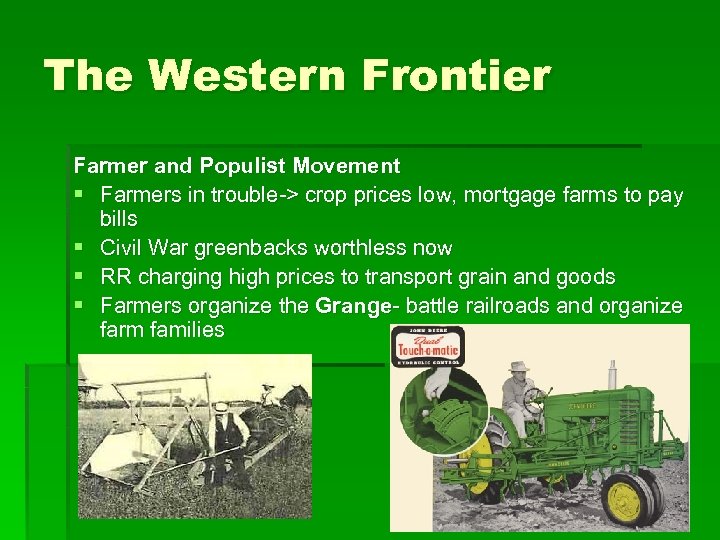 The Western Frontier Farmer and Populist Movement § Farmers in trouble-> crop prices low, mortgage farms to pay bills § Civil War greenbacks worthless now § RR charging high prices to transport grain and goods § Farmers organize the Grange- battle railroads and organize farm families
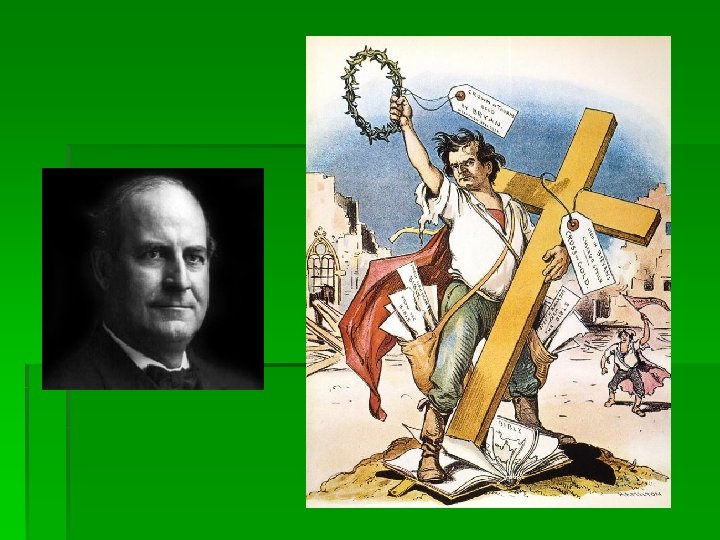
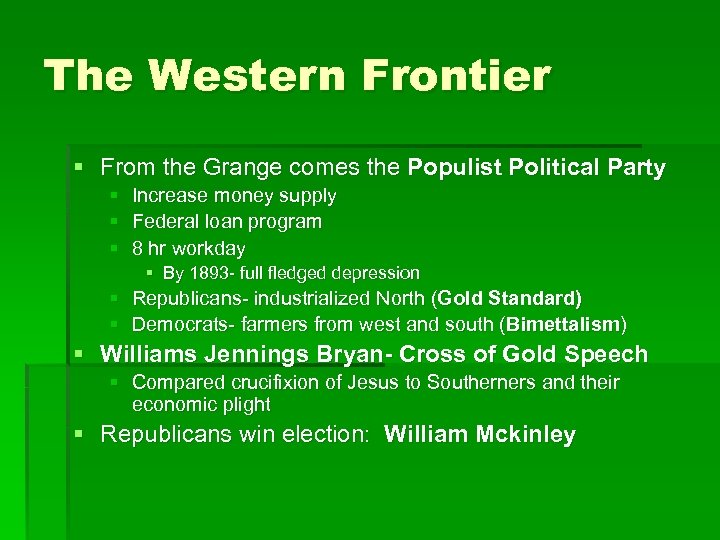 The Western Frontier § From the Grange comes the Populist Political Party § Increase money supply § Federal loan program § 8 hr workday § By 1893 - full fledged depression § Republicans- industrialized North (Gold Standard) § Democrats- farmers from west and south (Bimettalism) § Williams Jennings Bryan- Cross of Gold Speech § Compared crucifixion of Jesus to Southerners and their economic plight § Republicans win election: William Mckinley
 Industry and Railroads Expansion of Industry § Industrial Boom § Growing urban pop, natural resources, gov’t support of business § Oil Boom- Kerosene and eventually gasoline § Bessemer Steel- Turning iron into steel § Railroads, bridges, skyscrapers § Inventions § Edison: lightbulb-> need for electricity rises, allowed factories to choose any area, not just near rivers § Typewriter and telephone: growth of clerical jobs (women)
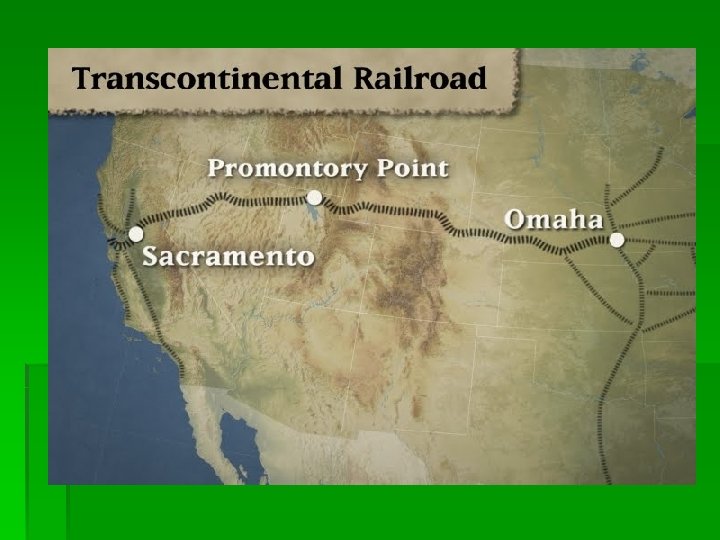
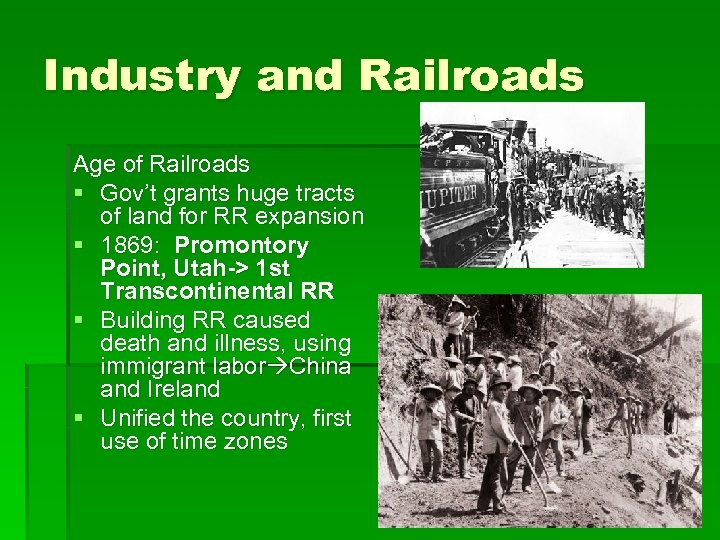 Industry and Railroads Age of Railroads § Gov’t grants huge tracts of land for RR expansion § 1869: Promontory Point, Utah-> 1 st Transcontinental RR § Building RR caused death and illness, using immigrant labor China and Ireland § Unified the country, first use of time zones
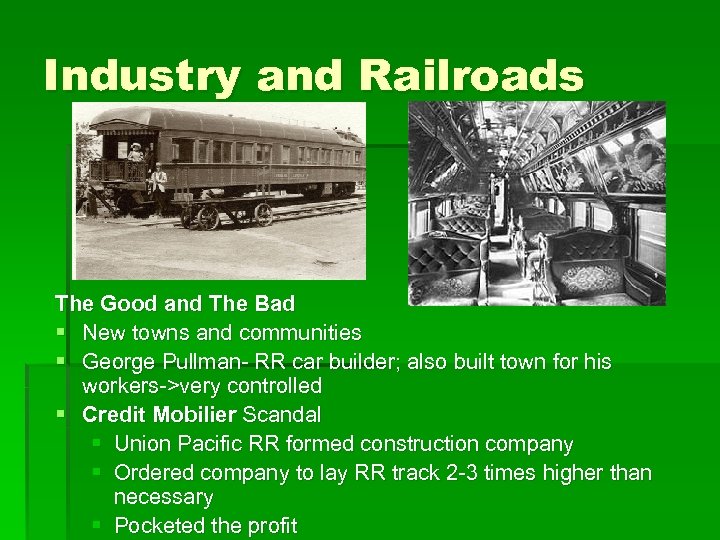 Industry and Railroads The Good and The Bad § New towns and communities § George Pullman- RR car builder; also built town for his workers->very controlled § Credit Mobilier Scandal § Union Pacific RR formed construction company § Ordered company to lay RR track 2 -3 times higher than necessary § Pocketed the profit
 Industry and Railroads Farmers vs. Railroads § Farmers mad: misuse land, fix prices, no consistent prices § Congress passes Interstate Commerce Act § Fed. Supervises inter-state activity (RR) § Corporate corruption, funds mismanagement, over building and competition lead to national financial probs
 Big Business and Labor Carnegie’s Innovations § Carnegie Steel Company § Make better products cheaper § Offered stock in his company § Vertical Integration- buy out his suppliers (coal fields, iron mines, RR lines) § Horizontal Integration- buy out competing companies § Carnegie adhered to Social Darwinism- laissez faire policy, strong win, weak go home
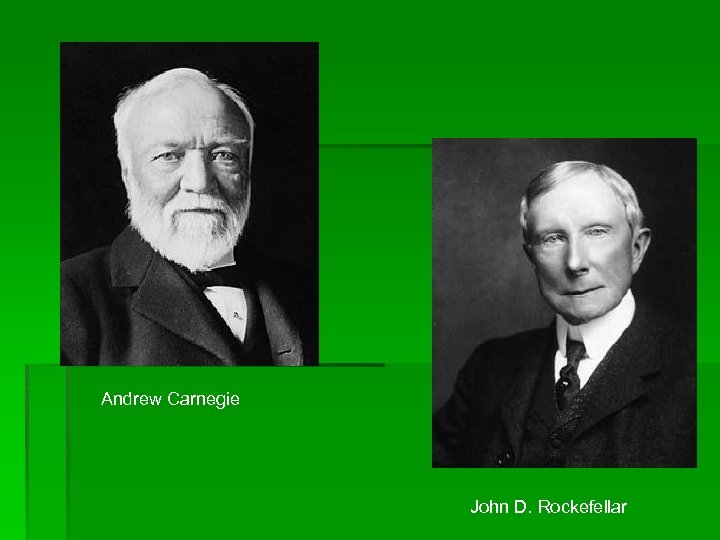 Andrew Carnegie John D. Rockefellar
 Big Business and Labor Fewer Control More § Mergers, stockholders, and trustees controlled wealth of nation § John D. Rockefeller- Standard Oil Company § Paid low wages, price gouging § Nicknames “Robber Baron” § Gov’t passes Sherman Antitrust Act: illegal to form a trust that interfered with free trade b/t states or countries § South lags- tobacco, furniture, and textile industries flourish
 Big Business and Labor Unions § Laborers join together to improve conditions § Injuries, poor ventilation, 7 day work weeks § Early Unions: National Labor Union, Knights of Labor § Activists turn to Socialism- gov’t controls business- equal distribution of wealth § Industrial Workers of the World – Wobblies
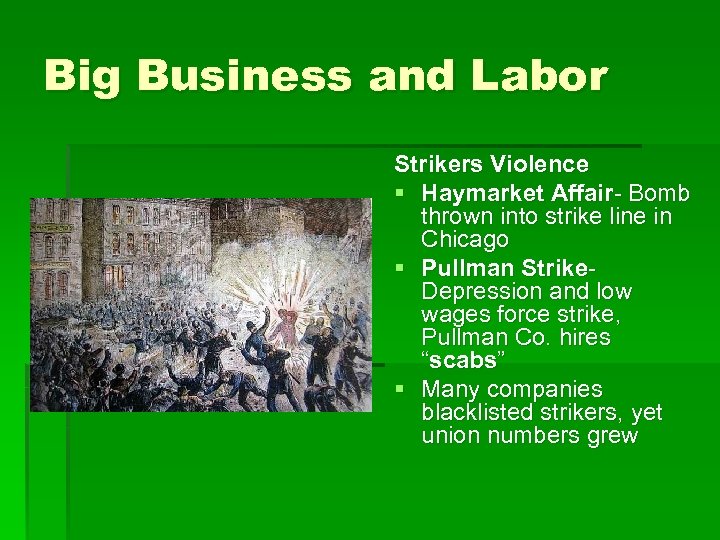 Big Business and Labor Strikers Violence § Haymarket Affair- Bomb thrown into strike line in Chicago § Pullman Strike. Depression and low wages force strike, Pullman Co. hires “scabs” § Many companies blacklisted strikers, yet union numbers grew
 The Gilded Age Political Machines § Weak city gov’t and ruthless Social Darwinist theory, cities receptive to new power structure: Political Machine § Organized group that controls activities of a political party § Offer services to voters and business in exchange for political or financial support § Political Boss: controlled city like a major
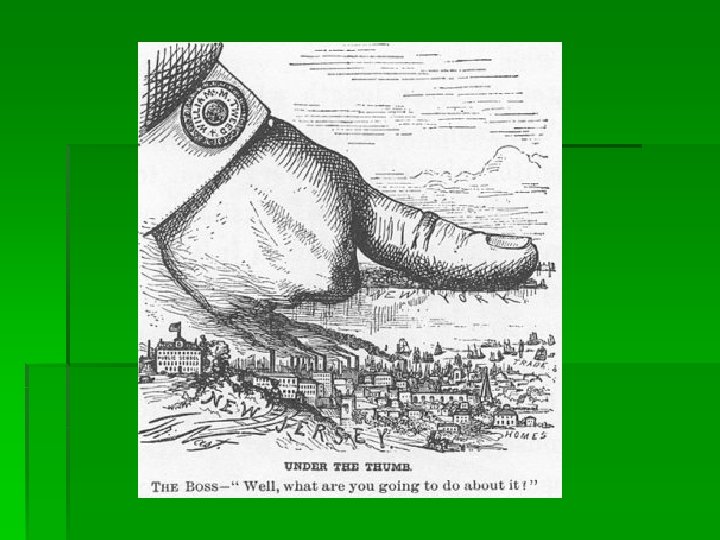
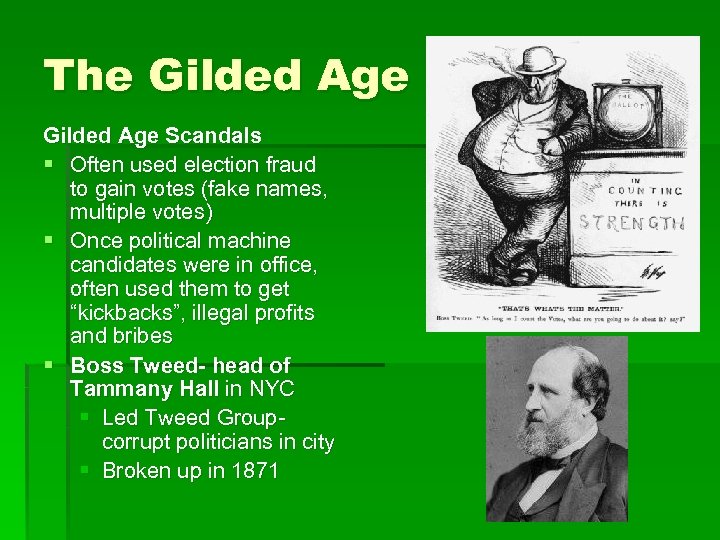 The Gilded Age Scandals § Often used election fraud to gain votes (fake names, multiple votes) § Once political machine candidates were in office, often used them to get “kickbacks”, illegal profits and bribes § Boss Tweed- head of Tammany Hall in NYC § Led Tweed Groupcorrupt politicians in city § Broken up in 1871
 The Gilded Age Civil Service Replaces Patronage § Complaints about patronage- giving gov’t jobs to people who helped a candidate get elected § Reformers press for adoption of merit system § Civil Service (gov’t jobs) go to those who are most qualified § Presidents Hayes, Garfield, and Arthur further reforms § Garfield assassinated § Pendleton Civil Service Act- enforced merit system § Big Business ensure that foreign tariffs would remain low by “buying” candidates in office
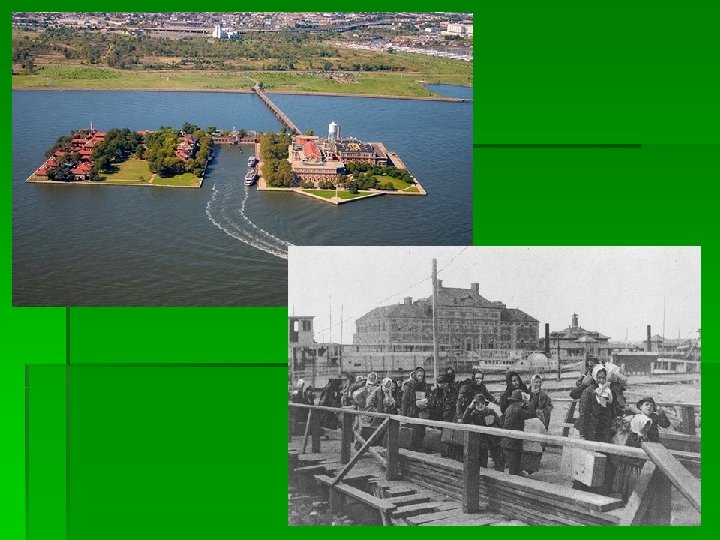
 Immigrants and Urbanization Life in a New Land § Seek better life- refuge from famine, religious/political persecution, rising population § In 50 yrs, ~20 million Europeans immigrate § Chinese and Japanese seek gold (1898 - US annex Hawaii) § Almost all immigrants travel by steamship- disease spreads § Pass inspection at Ellis Island- 5 hrs; Angel Island on West Coast § Ethnic communities grow-> friction increases
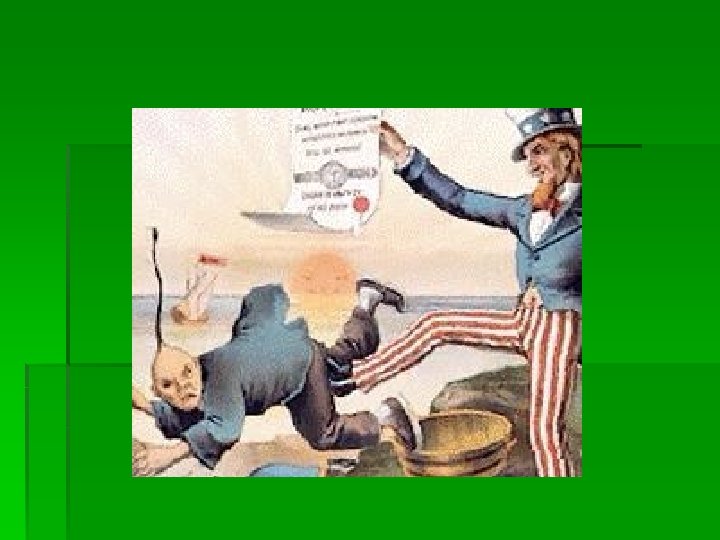
 Immigrants and Urbanization Immigrant Restrictions § America becomes melting pot § Anti-immigrant feelings emerge->Nativism (Favoritism to native born Americans) § Right immigrants VS Wrong Immigrants § Chinese Exclusion Act- stopped Chinese immigration for 10 yrs § 1907 - Japan agrees to “Gentlemen’s Agreement”Limit Japanese immigration to US, if US promises to stop segregating US schools
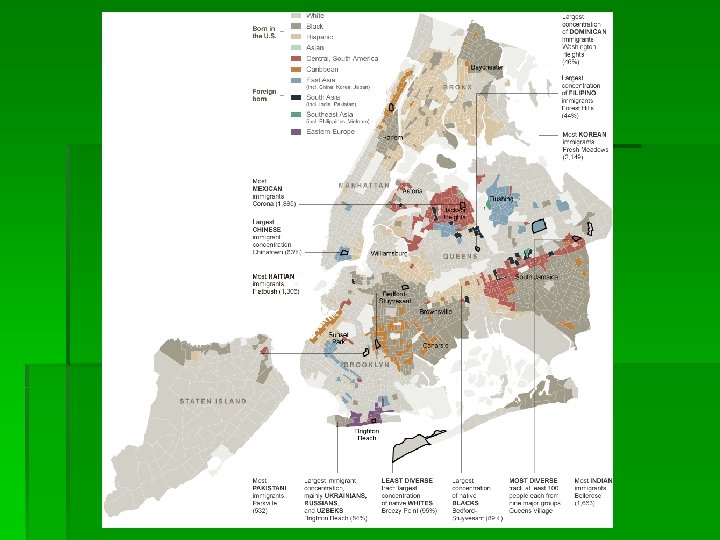
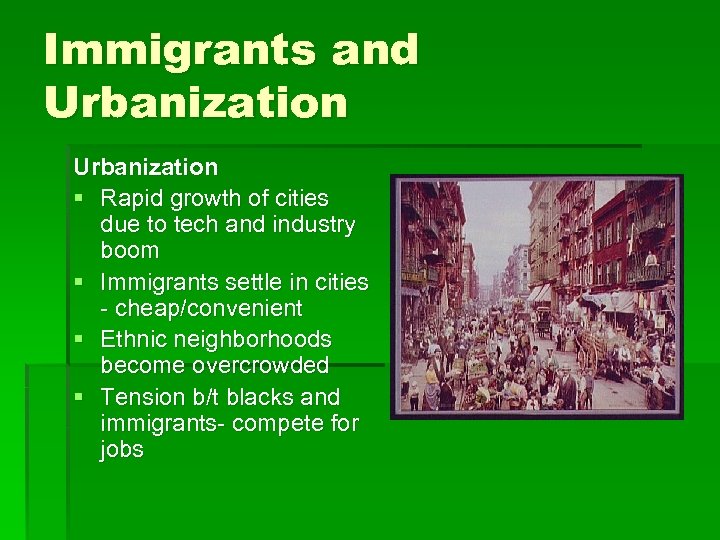 Immigrants and Urbanization § Rapid growth of cities due to tech and industry boom § Immigrants settle in cities - cheap/convenient § Ethnic neighborhoods become overcrowded § Tension b/t blacks and immigrants- compete for jobs
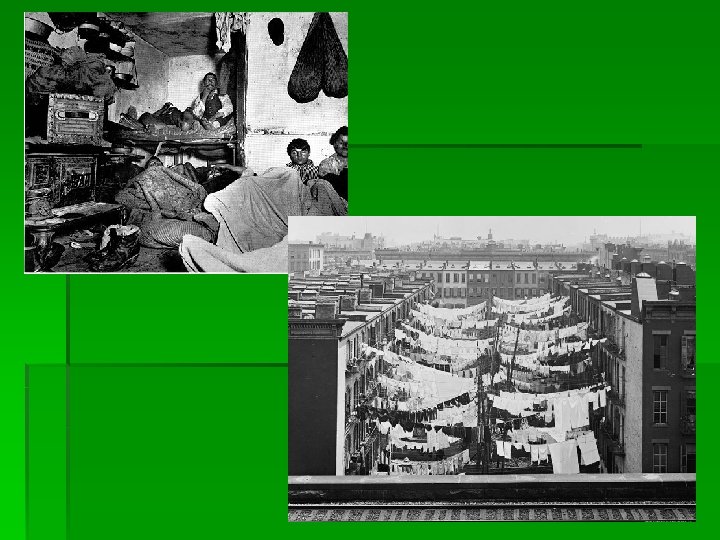
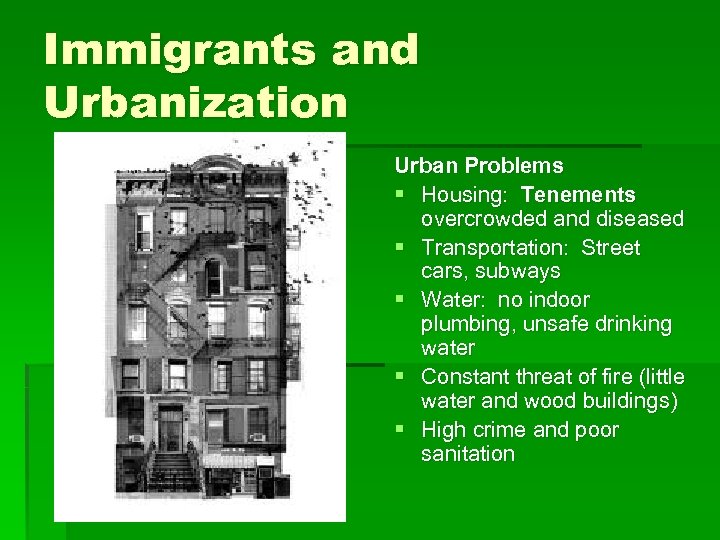 Immigrants and Urbanization Urban Problems § Housing: Tenements overcrowded and diseased § Transportation: Street cars, subways § Water: no indoor plumbing, unsafe drinking water § Constant threat of fire (little water and wood buildings) § High crime and poor sanitation
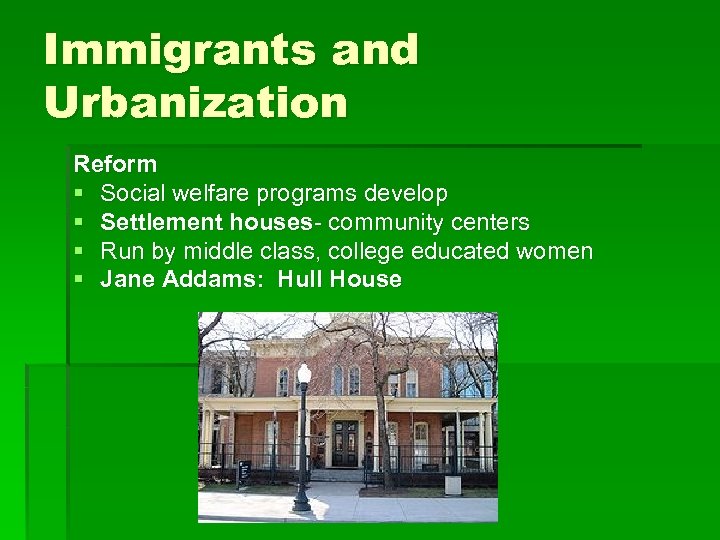 Immigrants and Urbanization Reform § Social welfare programs develop § Settlement houses- community centers § Run by middle class, college educated women § Jane Addams: Hull House