 Скачать презентацию The Web Operating System Towards Wide Area Ubiquitous
c2ecb5968837e0ce1a59b30368108544.ppt
- Количество слайдов: 35



The Web Operating System Towards Wide Area Ubiquitous Computing Joint work of P. Kropf, G. Babin, (University of Laval, Canada) J. Plaice (University of Sydney, Australia) H. Unger (University of Rostock, Germany) A. Mikler (University of North Texas, USA) S. Schubiger (University of Fribourg, Switzerland) O. Krone (Swisscom CT, Switzerland) 17. 08. 99 1
Overview • • • Motivation The WOS Approach – Resources – Warehouses – Eductive Engine – WOSNode, WOSpace Web Components (Web. Coms) Current Research Issues Related, and Future Work, Conclusion 17. 08. 99 2
Motivation • • Success of the WWW is tremendous Why not using WWW as platform for ubiquitous computing ? Today: resources found on the Web are information only; interaction is limited Tomorrow: use WEB as a Service Space: “The network is the computer” 17. 08. 99 3
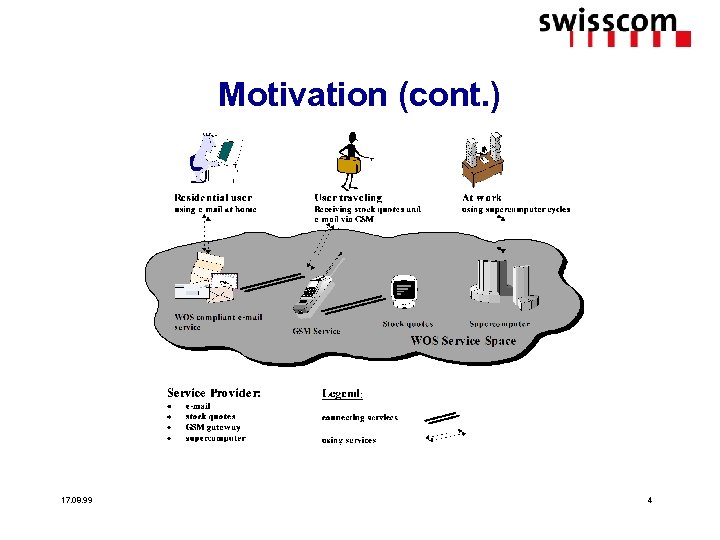
Motivation (cont. ) 17. 08. 99 4
Motivation (cont. ) • • • Network Applications – WWW, email, video Computational Applications – number crunching, distributed simulation Virtual Entities – classrooms, companies Knowledge based Applications – data mining, databases Real Time Applications – process control real-time multimedia 17. 08. 99 5
The WOS Approach • • • 5 Universities involved: Laval, Rostock, Texas, Sydney, Fribourg “Operating System” for the Web Runs on top of existing OS, Java Bringing the resource-richness of the Web to the user Bringing the computational potential of the Web to the user Distributed and versioned 17. 08. 99 6
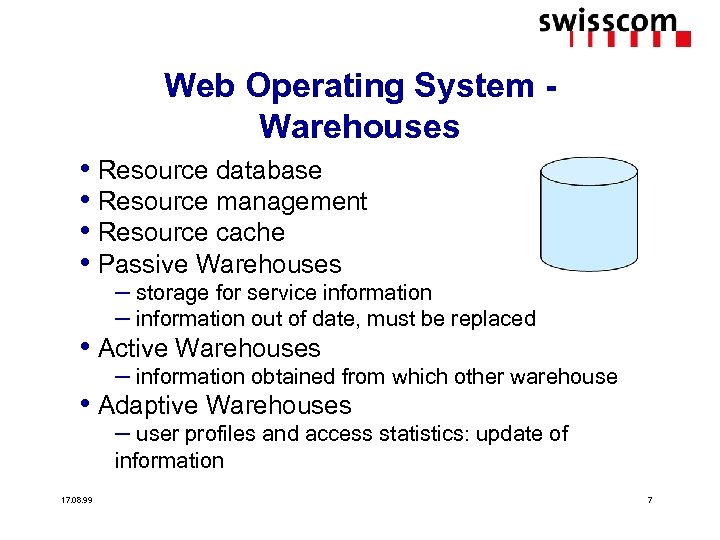
Web Operating System Warehouses • Resource database • Resource management • Resource cache • Passive Warehouses – storage for service information – information out of date, must be replaced • Active Warehouses – information obtained from which other warehouse • Adaptive Warehouses – user profiles and access statistics: update of information 17. 08. 99 7
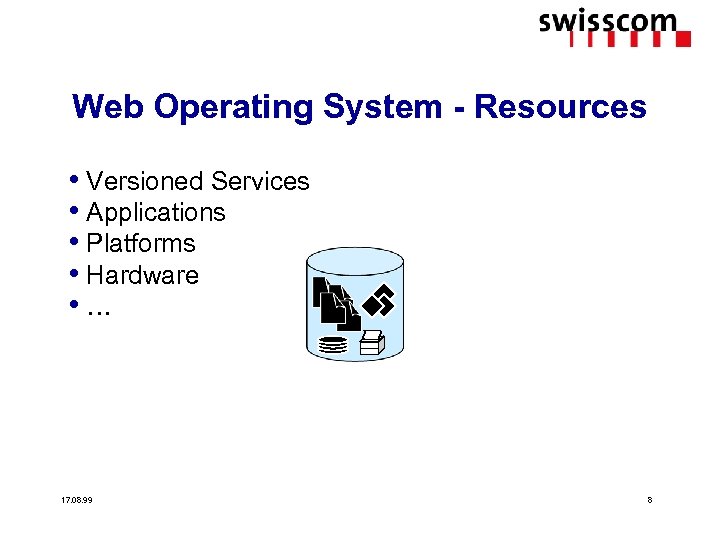
Web Operating System - Resources • Versioned Services • Applications • Platforms • Hardware • … 17. 08. 99 8
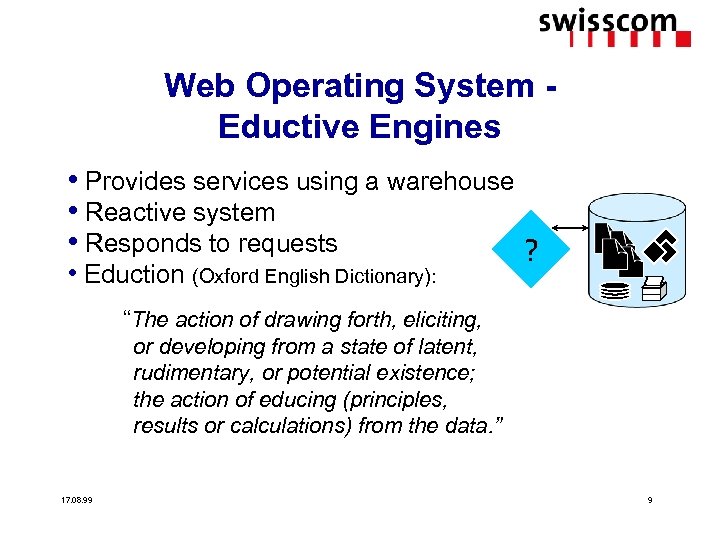
Web Operating System Eductive Engines • Provides services using a warehouse • Reactive system • Responds to requests ? • Eduction (Oxford English Dictionary): “The action of drawing forth, eliciting, or developing from a state of latent, rudimentary, or potential existence; the action of educing (principles, results or calculations) from the data. ” 17. 08. 99 9
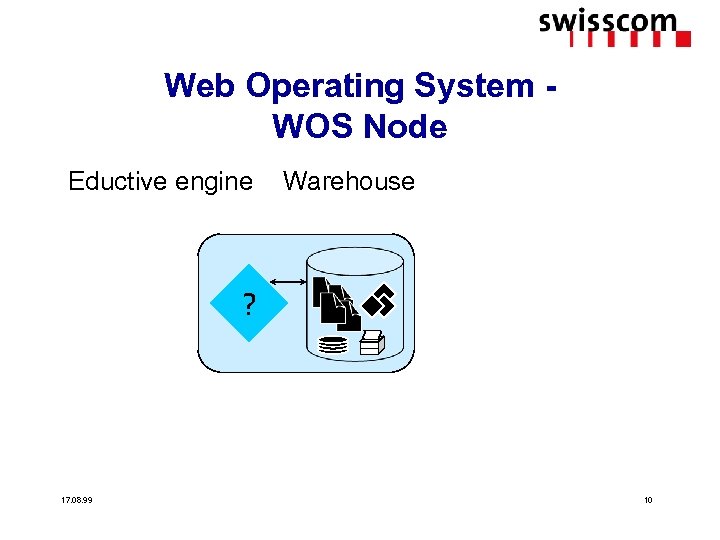
Web Operating System WOS Node Eductive engine + Warehouse ? 17. 08. 99 10
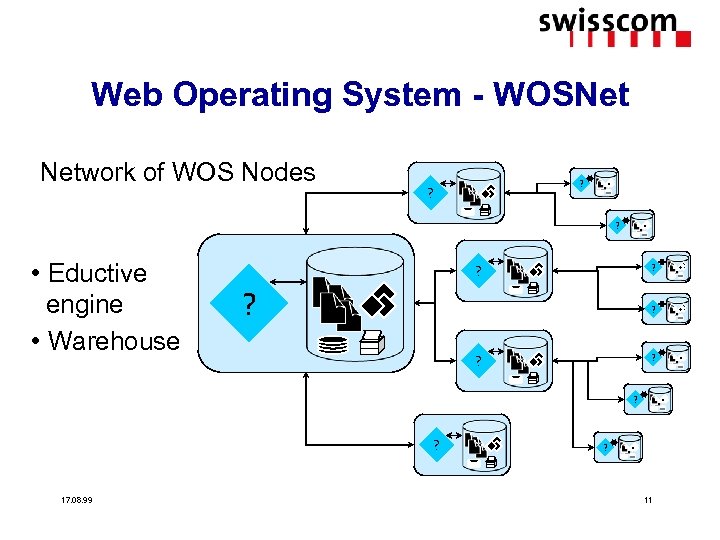
Web Operating System - WOSNet Network of WOS Nodes ? ? ? • Eductive engine • Warehouse ? ? ? 17. 08. 99 ? 11
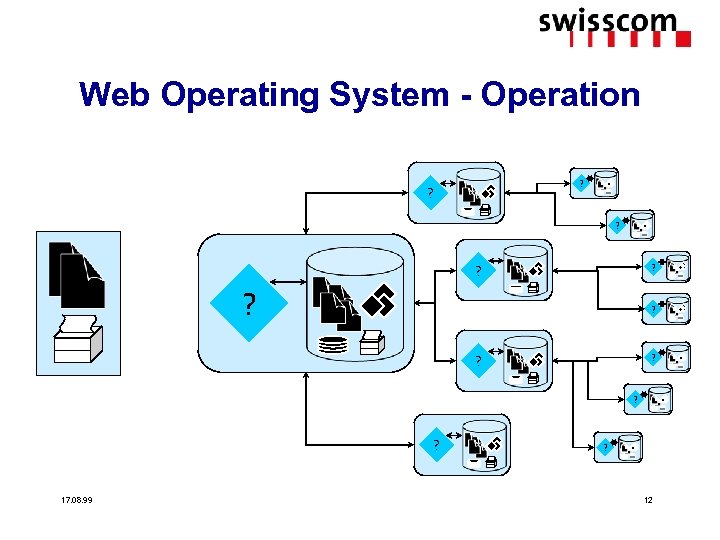
Web Operating System - Operation ? ? ? ? ? 17. 08. 99 ? 12
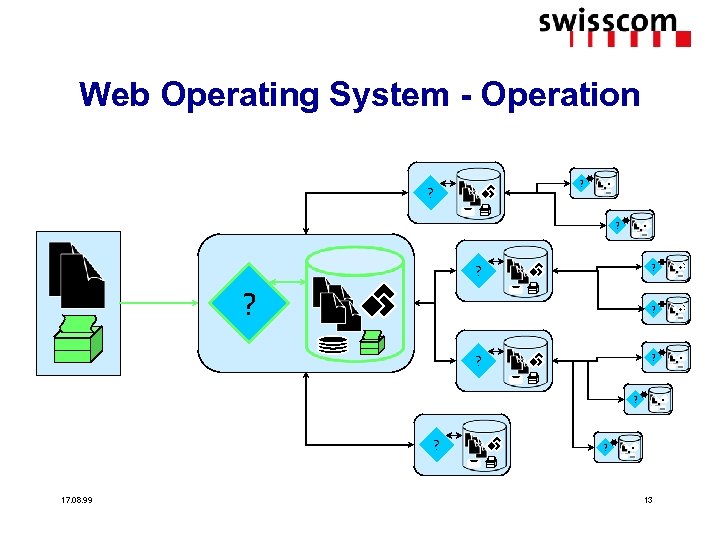
Web Operating System - Operation ? ? ? ? ? 17. 08. 99 ? 13
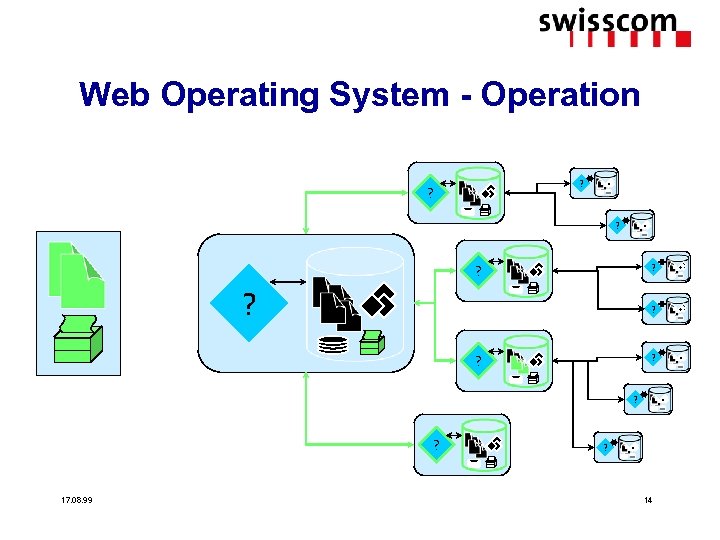
Web Operating System - Operation ? ? ? ? ? 17. 08. 99 ? 14
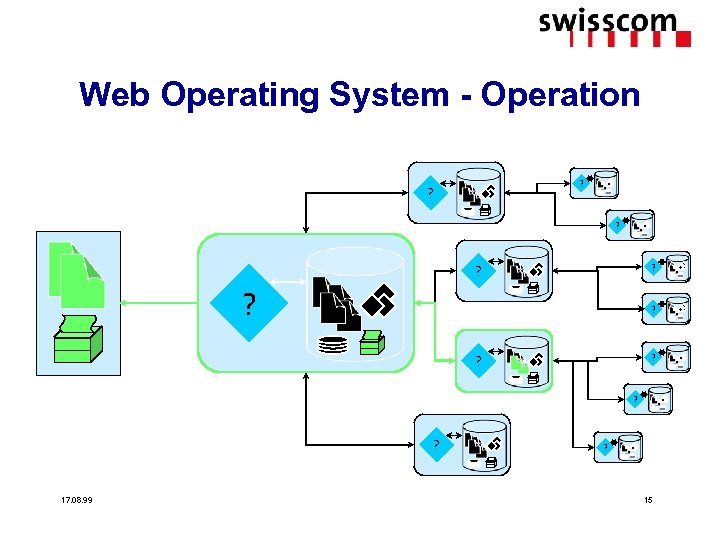
Web Operating System - Operation ? ? ? ? ? 17. 08. 99 ? 15
![Web. Components (Web. Coms) • Resource Representation Interaction [Schubiger, Krone] – Based on data](https://present5.com/presentation/c2ecb5968837e0ce1a59b30368108544/image-16.jpg "Web. Components (Web. Coms) • Resource Representation Interaction [Schubiger, Krone] – Based on data")
Web. Components (Web. Coms) • Resource Representation Interaction [Schubiger, Krone] – Based on data flow networks semantic hello. c ? = ? semantic hello. exe 17. 08. 99 hello. exe file name path content c-source file name path content os architecture 16
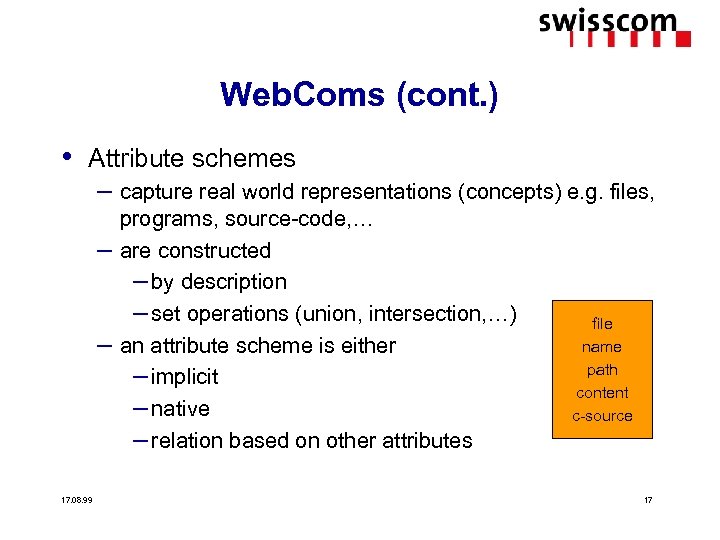
Web. Coms (cont. ) • Attribute schemes – capture real world representations (concepts) e. g. files, – – 17. 08. 99 programs, source-code, … are constructed – by description – set operations (union, intersection, …) an attribute scheme is either – implicit – native – relation based on other attributes file name path content c-source 17
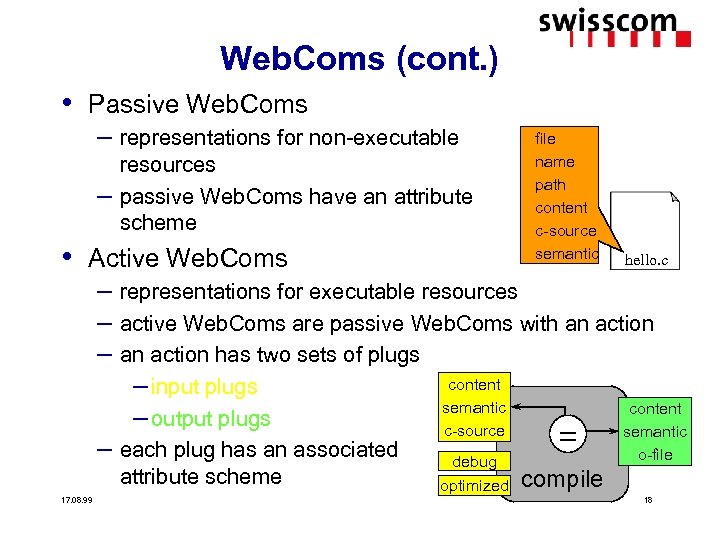
Web. Coms (cont. ) • Passive Web. Coms – representations for non-executable – • resources passive Web. Coms have an attribute scheme file name path content c-source semantic hello. c Active Web. Coms – representations for executable resources – active Web. Coms are passive Web. Coms with an action – an action has two sets of plugs content – input plugs semantic content – output plugs c-source = semantic – each plug has an associated o-file debug attribute scheme 17. 08. 99 optimized compile 18
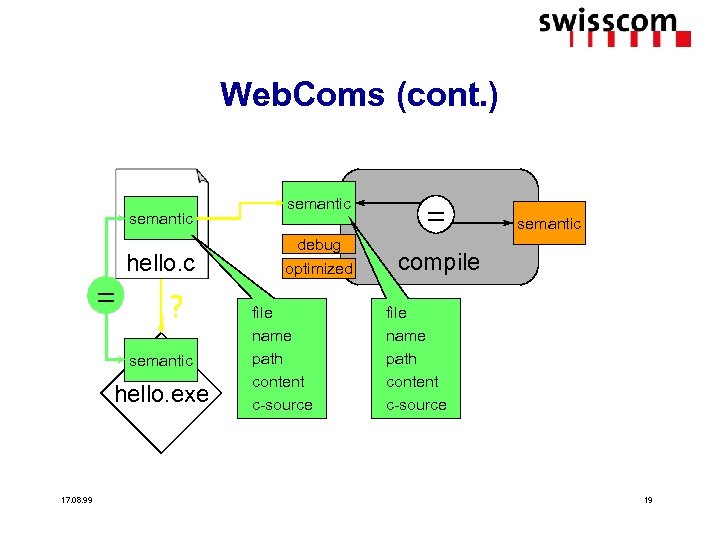
Web. Coms (cont. ) semantic hello. c = ? semantic hello. exe 17. 08. 99 semantic debug optimized file name path content c-source = semantic compile file name path content c-source 19
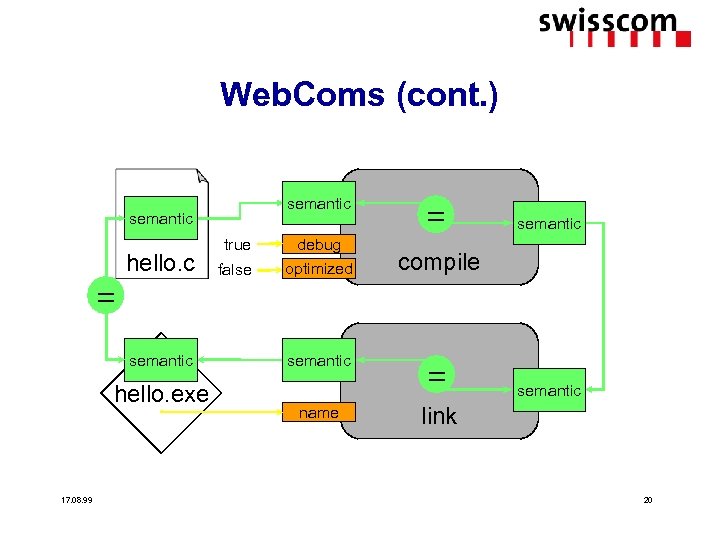
Web. Coms (cont. ) semantic hello. c = semantic hello. exe 17. 08. 99 true debug false optimized semantic name = semantic compile = semantic link 20
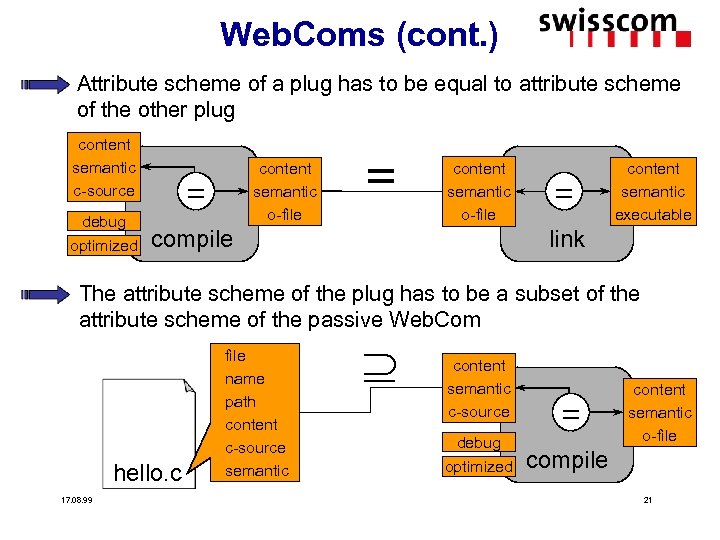
Web. Coms (cont. ) Attribute scheme of a plug has to be equal to attribute scheme of the other plug content semantic c-source debug optimized content semantic o-file = = content semantic o-file compile = content semantic executable link The attribute scheme of the plug has to be a subset of the attribute scheme of the passive Web. Com hello. c 17. 08. 99 file name path content c-source semantic Ê content semantic c-source debug optimized = content semantic o-file compile 21
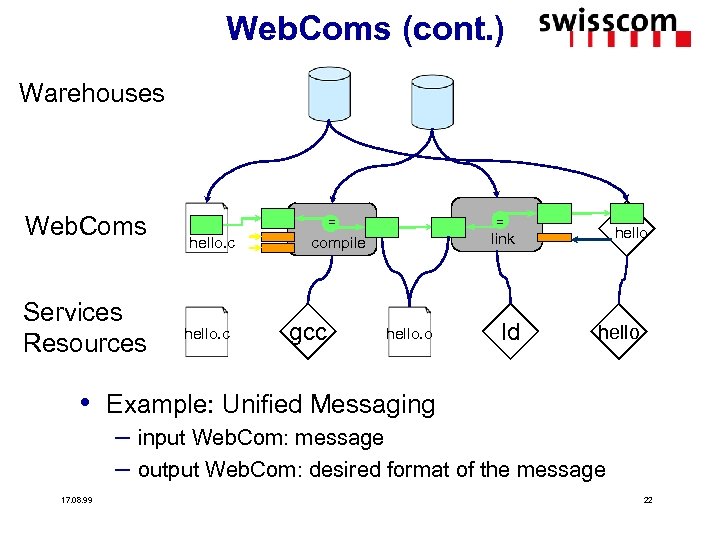
Web. Coms (cont. ) Warehouses Web. Coms Services Resources • 17. 08. 99 = hello. c = gcc hello link compile hello. o ld hello Example: Unified Messaging – input Web. Com: message – output Web. Com: desired format of the message 22
![Current Research Issues • WOS Node Architecture [Unger] – node is client – and](https://present5.com/presentation/c2ecb5968837e0ce1a59b30368108544/image-23.jpg "Current Research Issues • WOS Node Architecture [Unger] – node is client – and")
Current Research Issues • WOS Node Architecture [Unger] – node is client – and server 17. 08. 99 23
![Current Research Issues (cont. ) • Communication Protocols [Babin, Kropf, Unger] – Two level](https://present5.com/presentation/c2ecb5968837e0ce1a59b30368108544/image-24.jpg "Current Research Issues (cont. ) • Communication Protocols [Babin, Kropf, Unger] – Two level")
Current Research Issues (cont. ) • Communication Protocols [Babin, Kropf, Unger] – Two level communication protocol discovery/location protocol (WOSRP) location of specific WOS nodes t 2 generic Service Protocol (WOSP) * versioned protocol; bind node to appropriate instance of WOSP analyzer * setup, execution, query commands 17. 08. 99 Node t 1 24
![Current Research Issues (cont. ) • Service Search [Unger, Kropf, Babin, Boehme] – information](https://present5.com/presentation/c2ecb5968837e0ce1a59b30368108544/image-25.jpg "Current Research Issues (cont. ) • Service Search [Unger, Kropf, Babin, Boehme] – information")
Current Research Issues (cont. ) • Service Search [Unger, Kropf, Babin, Boehme] – information about local and remote services stored in – – 17. 08. 99 WOS node broadcast or serial chain mechanism, search trees combination of both theoretical research performed: 6 -10 chains in parallel result in good response time 25
![Research Issues (cont. ) • Fault Tolerance [Babin, Kropf, Unger] – WOS server cannot](https://present5.com/presentation/c2ecb5968837e0ce1a59b30368108544/image-26.jpg "Research Issues (cont. ) • Fault Tolerance [Babin, Kropf, Unger] – WOS server cannot")
Research Issues (cont. ) • Fault Tolerance [Babin, Kropf, Unger] – WOS server cannot serve the request after receiving it – Network brake downs – WOS nodes/machines crash MSG t MS G K RAC t 17. 08. 99 RACK MSG RACK TACK node i-1 t RACK ((n-i-2)+(n-i-2)2/n)*t Acknowledge protocol developed receive acknowledgment (RACK) termination acknowledgment (TACK) MSG node i node n-1 node n 26
![Current Research Issues (cont. ) • Load Management [Unger, Kropf, Plaice] – global online](https://present5.com/presentation/c2ecb5968837e0ce1a59b30368108544/image-27.jpg "Current Research Issues (cont. ) • Load Management [Unger, Kropf, Plaice] – global online")
Current Research Issues (cont. ) • Load Management [Unger, Kropf, Plaice] – global online resource prediction impossible – transmission time: data might be outdated upon arrival – reaction in case of failure of nodes – off line learning and adaptation techniques cannot be used user manager: statistical data of processes started by a specific user machine manager: arranging allocation of local resources 17. 08. 99 27
![Current Research Issues (cont. ) • Resource Representation & Interaction [Krone, Schubiger] – how](https://present5.com/presentation/c2ecb5968837e0ce1a59b30368108544/image-28.jpg "Current Research Issues (cont. ) • Resource Representation & Interaction [Krone, Schubiger] – how")
Current Research Issues (cont. ) • Resource Representation & Interaction [Krone, Schubiger] – how can resources be manipulated and shared use desktop metaphor for explicit manipulation: Web. Res * based on RMI; * introduced novel technique (dynamic linking) for runtime linking of objects implicit through (Web. Coms) data-flow driven 17. 08. 99 28
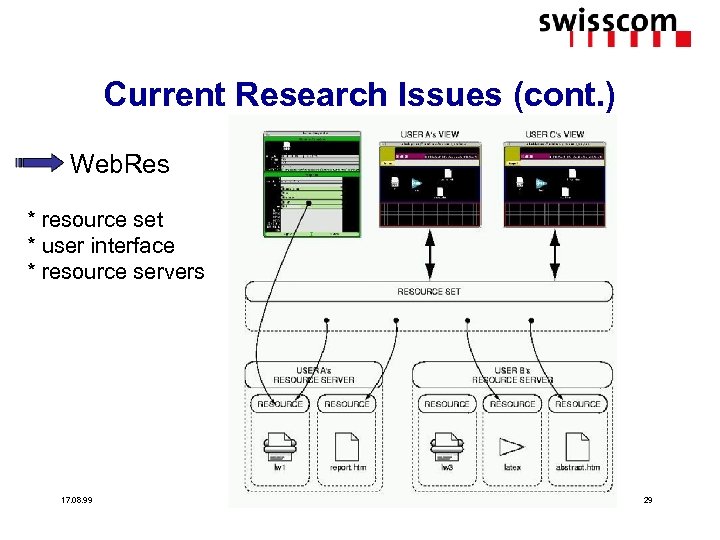
Current Research Issues (cont. ) Web. Res * resource set * user interface * resource servers 17. 08. 99 29
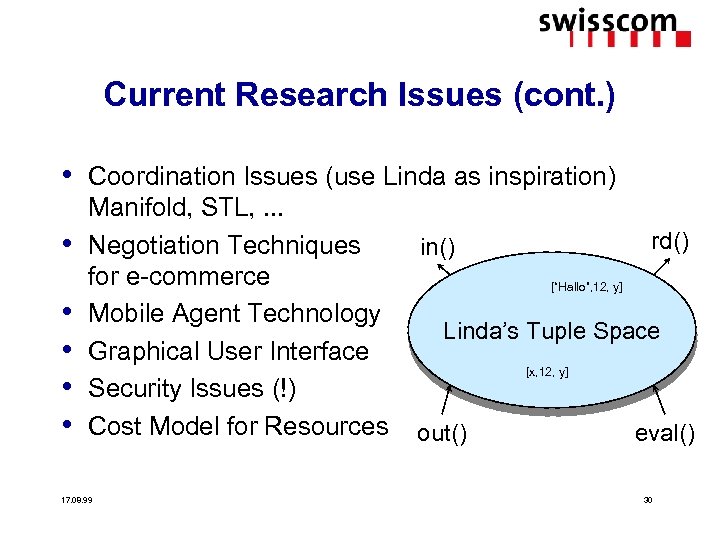
Current Research Issues (cont. ) • • • Coordination Issues (use Linda as inspiration) Manifold, STL, . . . rd() Negotiation Techniques in() for e-commerce [“Hallo”, 12, y] Mobile Agent Technology Linda’s Tuple Space Graphical User Interface [x, 12, y] Security Issues (!) Cost Model for Resources out() eval() 17. 08. 99 30
Related Work • • Inferno (Lucent Technologies) IBM’s T-Spaces Berkeley’s Web. OS (part of NOW) Super. Web and Charlotte Microsoft’s Millennium project and of course SUN’s Jini … 17. 08. 99 31
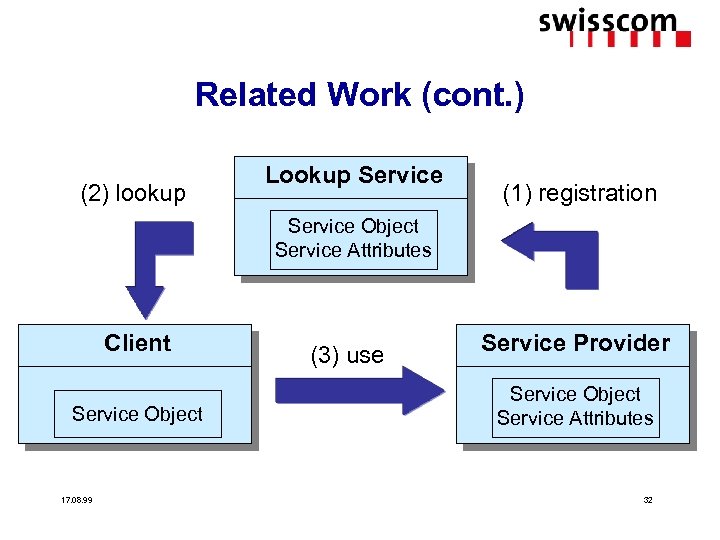
Related Work (cont. ) (2) lookup Lookup Service (1) registration Service Object Service Attributes Client Service Object 17. 08. 99 (3) use Service Provider Service Object Service Attributes 32
Related Work (cont. ) • • Jini – services as resource encapsulation – lookup service as resource directory – leasing for access control – events for notification – based on Java. Spaces (Linda variant) WOS – warehouses with versioned services – WOS’ “federations” are dynamically and autonomously – 17. 08. 99 created language independent (protocol) 33
Future Work • Extend Web. Res to be used with Web. Coms – Definition of the network language – Graphical network builder – Interactive/automated resource selection (Agents/Web robots) • • • Develop adapters for legacy software (CORBA) Validate Service Search Techniques Further investigate CORBA and Jini and her friends Look at Security Aspects Consolidation of already developed prototypes 17. 08. 99 34
Conclusion • • Presented the WOS effort, ongoing research project, 5 Universities Goals – develop methods, frameworks for future interconnected systems contribute to future global information infrastructure • • – Both industry and academia is interested Version 1. 0 is on its way Conference: Web Communities, June 2000, University of Laval Info: http: //paradis. ift. ulaval. ca/projects/wos 17. 08. 99 35
Скачать презентацию The Web Operating System Towards Wide Area Ubiquitous
c2ecb5968837e0ce1a59b30368108544.ppt