Скачать презентацию The Wars of Religion 1560 s-1648 Ms Susan
92c029c4b39ef0b0ea9cff90012ea102.ppt
- Количество слайдов: 63
 The Wars of Religion (1560 s-1648) Ms. Susan M. Pojer, Debra Solomon Horace Greeley H. S. Chappaqua, NY
 Civil War In France (1562 -1598)
 Religious Riots and Civil War in France 1559 -1598 • 1559: Power shift from France to Spain: Henry II, last powerful Valois King, dies at marriage tournament • Daughter Elizabeth of Valois married Phillip II of Spain • Connects two Catholic powers
 • Because of monarchial weakness, 2/5 -1/2 French nobles become Calvinist
 The Valois Family: The Beginning of the End After Henry II’s death, Three weak sons followed: § § § Francis II Charles IX Henri III v Catherine de Medici controlled the sons: § § § Was mother to the boys Played both sides in the civil war Developed a reputation for cruelty
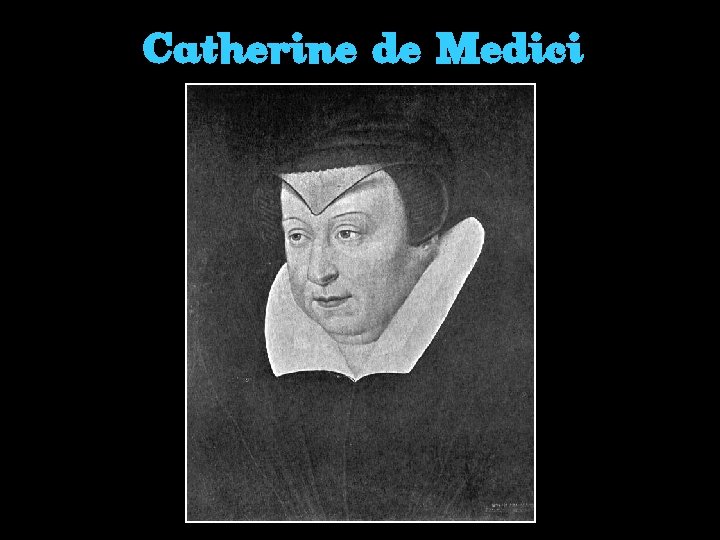 Catherine de Medici
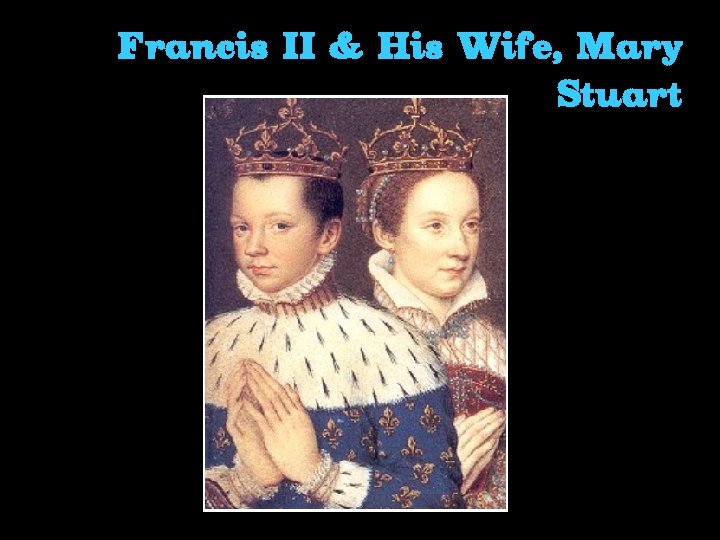 Francis II & His Wife, Mary Stuart
 First War of Religion 15621563 • Begun by Massacre at Vassy in 1562 • Duke of Guise stopped in a Calvinist worship service at Vassy • Catholic Servants argued with Huguenots
 • Guise factions fired on unarmed Huguenots –Burned the church –Killed much of the congregation –Series of small battles/sieges follow –Duke of Guise assassinated
 The French Civil War v There were two sides: § Guise family led Catholics in North § Bourbon family led Huguenots in South -Navarre, Coligny, Conde, Montmorency § Fighting for the royal inheritance v Catherine supported the Guises in the first phase. v St. Bartholomew’s Day Massacre § August 24, 1572 § 20, 000 Huguenots were killed § Henri of Navarre, a Bourbon, survived
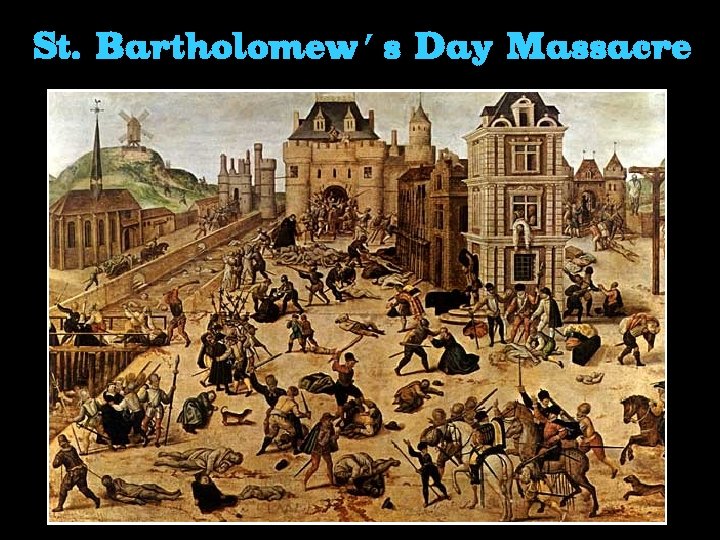 St. Bartholomew’s Day Massacre
 St. Bartholomew’s Day Massacre 1572 • To solve religious issues, Catherine de Medici arranged a wedding: Aug 17, 1572: Henri de Navarre married Margot de Valois • Festivities last until Aug. 23 • Aug 22: Admiral de Coligny shot by assassin--
 • Suffers broken arm, severely wounded • Suspected the Guises • Huguenots wanted justice from King; and they wanted Coligny to flee • The king holds a meeting at the Louvre
 At the Louvre • Charles IX, Catherine de Medici, Henri d’Anjou, encouraged by the Guises, decide to kill Coligny and Huguenots • Charles IX: “Well kill them all that no man be left to reproach me. ”
 • Charles’ soldiers go to Coligny’s door; shot guard; ran through the house; dragged Coligny from bed—stabbed him thru/ threw body from window • Duc de Guise mocked the body/kicked in face/said it was King’s will
 • Militia/general population went on rampage, sanctioned by church and king: • Wore white crosses on hats • Butchered their neighbors • Killing lasted 3 days in Paris, but much longer in the provinces.
 Henri de Navarre • Slept in bridal suite in Louvre • His entourage of 40 Huguenots killed • Henri de Navarre/Henri de Conde dragged before King Charles IX and threatened w/death unless they converted to Catholicism
 • Both converted; Navarre became prisoner of court for 4 years • In Provinces: massacres lasted for months
 1572 -1576 • Several more wars occur, and Henri of Navarre and his cousin escape the court. They are excommunicated
 5 th War (1576) • 1574 --Charles IX died “sweating blood and tormented w/guilt for Massacre” • Henri d’Anjou, Charles IX’s brother, becomes King Henri III • He has lots of problems
 • Henri III’s brother, Duc d’Alencon, began anti-royalist campaign that portrayed himself as an alternate king: more fair and tax-cutting • They formed a strong alliance: Catherine de Medici could not counter it— 20, 000 troops invade France under Jan Casimir
 • Casimir’s troops met up w/additional armies and Catherine forced to negotiate. • Edict of Beaulieu (Peace of Monsieur) signed in May –Great settlements for leaders: –Navarre made governor of Guyenne
 –Conde—governor of Picardy –Alencon—Duc d’Anjou and given many titles –Jan Casimir—crown paid for his mercenaries –Henry III angry; Parlament of Paris did not register the settlement; some towns ceded to Protestants did not let them in
 • Several more wars occur, but the culmination is the War of the Three Henries
 War of the 3 Henries (1584 -1589) • Crown was Catholic • Role of “Most Christian King” • Fundamental ideals for France
 • Henry III begs Henry de Navarre to convert to make throne legitimate • Navarre not ready: needed current base of support in the South • Duc de Guise revived Catholic League: To prevent a heretic from coming to the throne
 Dec 1584: Treaty of Joinville • Signed between Guises, Catholic League, and Philip II of Spain • Spain gives enormous sum to Catholic League and Guise pockets for 10 years.
 Treaty of Nemours 1585 • Revoked all previous edicts –Reformed religion banned –No Protestants in Royal offices –Evacuation of all garrisoned towns –All protestants abjure faith in 6 months or be exiled
 • Catholic League (Guises) hold N/E • Navarre & Conde hold S/W—they look for aid from Germans and Queen Elizabeth I • 1587—Jan Casimir leads German mercenaries to France; he is defeated by Guise armies
 • Navarre defeats Henry III’s army at Coutras • In Paris: growing dissatisfaction w/Henry III failure to suppress Protestants • 1588: Paris uprising: Barricades in streets • Henry III leaves Paris, but there is much fear of a Guise king
 • Dec. 24, 1588: Henry III invites the Duc de Guise to visit him in his quarters: archers lined stairs; 40 men in waiting room—Guise entered and doors bolted; Guise cut to pieces; body burnt; bones dissolved; ashes scattered; Cardinal de Guise suffered same fate
 Result of Guise murders • Duc de Mayenne (Guise) becomes Catholic League leader • revolutionary tracts printed • The Sorbonne—taught it was just and right to depose Henry III, or commit regicide
 • The Catholic League sent army against Henry III • Henry III turns to Henry de Navarre for help, and they reclaim Paris
 July 1589 • Jacques Clement, monk, begs audience w/King Henry III • Puts long knife into his spleen: wound festered • On his deathbed, he calls for Navarre and named him heir to the French throne
 Wars of the League 15891598 • Henry IV (Navarre) delicate position • Catholic League staged coups in principle cities; really it was a reign of terror: political correctness of citizens: moderate Catholics, Protestants, suspicious people hung
 • 9/1589: Henry IV and Catholic armies meet and Catholics defeated • Throughout winter, Henry IV takes town after town • 3/1590 League suffered crushing defeat at Ivry; Cardinal de Bourbon died
 • Spring/Summer 1590—Henry IV reduces Paris to severe hunger; Allows women and children to leave • Philip II of Spain alarmed –Sent Duke of Parma to relieve the siege of Paris –Parma re-supplied the City –Henry IV forced to withdraw.
 Startling turn of Events • Catholic League looks for an alternative Catholic King • Henry IV abjured his faith in July, 1593— “Paris is worth a mass. ” • Coronated in Chartres, not Reims, b/c it was still in the hands of the Catholic League
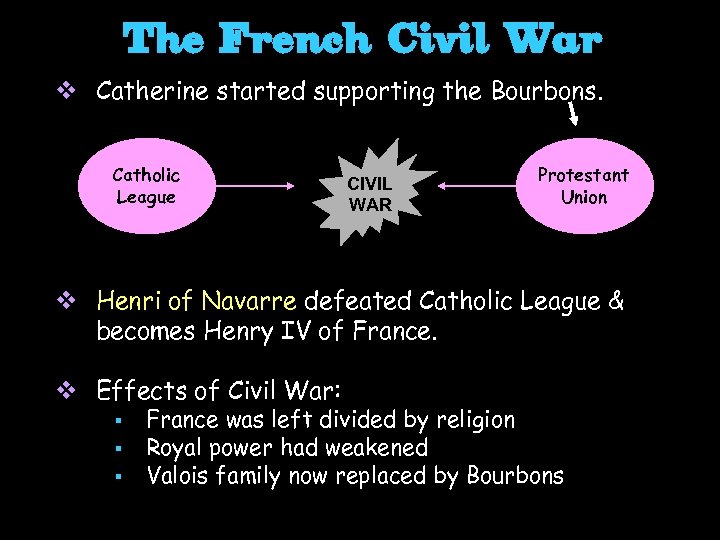 The French Civil War v Catherine started supporting the Bourbons. Catholic League CIVIL WAR Protestant Union v Henri of Navarre defeated Catholic League & becomes Henry IV of France. v Effects of Civil War: § § § France was left divided by religion Royal power had weakened Valois family now replaced by Bourbons
 Triumphal Entry of Henry IV Into Paris – Peter Paul Reubens
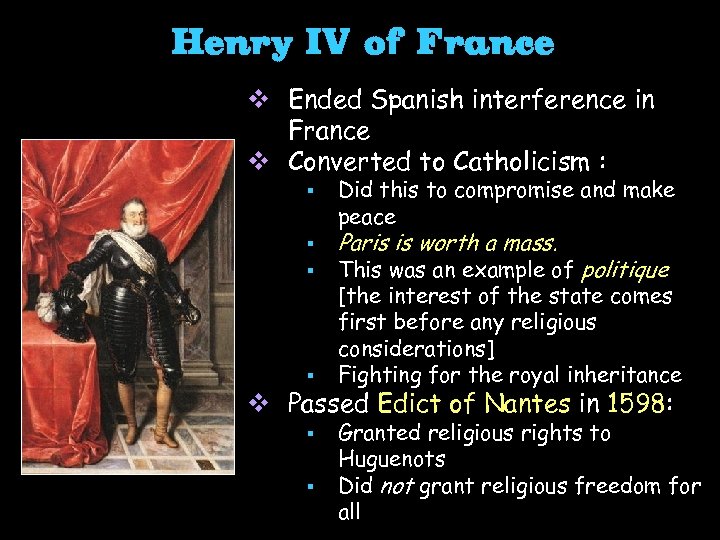 Henry IV of France v Ended Spanish interference in France v Converted to Catholicism : § § Did this to compromise and make peace Paris is worth a mass. This was an example of politique [the interest of the state comes first before any religious considerations] Fighting for the royal inheritance v Passed Edict of Nantes in 1598: § § Granted religious rights to Huguenots Did not grant religious freedom for all
 • 1598: Edict of Nantes: granted Huguenots liberty of conscience and public worship in 150 fortified towns; paved way for absolutism by restoring internal peace in France
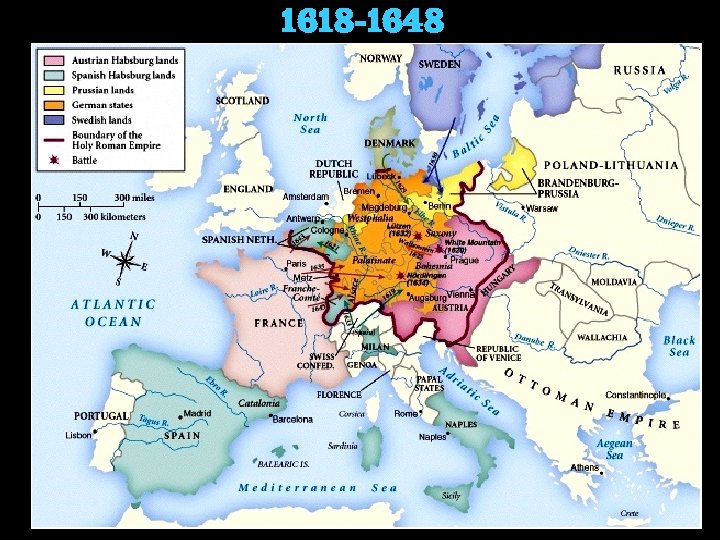
 The Thirty Years War (1618 -1648)
 1618 -1648
 Characteristics of the Thirty Years War v The Holy Roman Empire was the battleground. v At the beginning it was the Catholics vs. the Protestants. v At the end it was Habsburg power that was threatened. v Resolved by the Treaty of Westphalia in 1648.
 The Bohemian Phase: 1618 -1622 v Ferdinand II inherited Bohemia. § § The Bohemians hated him. Ferdinand refused to tolerate Protestants. Defenestration of Prague May, 1618 Bohemia named a new king, Frederick II. v Ferdinand II becomes Holy Roman Emperor. Frederick II borrowed an army from Bavaria. § Frederick lost his lands in the fighting. § v The rebellion in Bohemia inspired others.
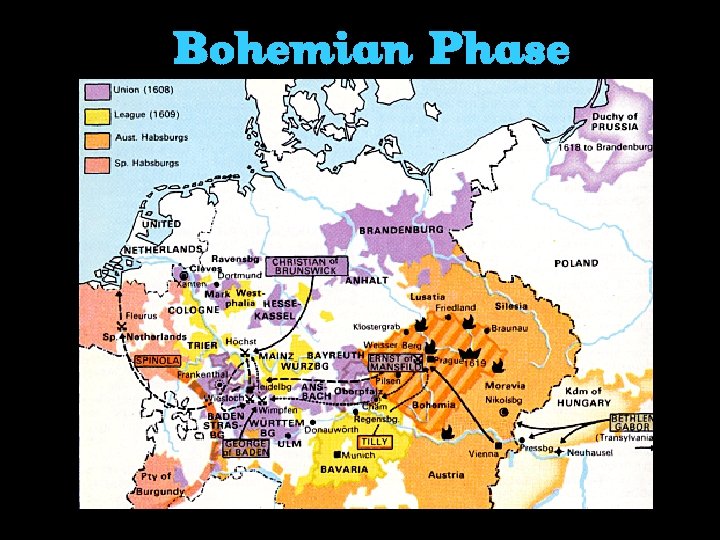 Bohemian Phase
 The Danish Phase: 1625 -1629 v Ferdinand II tried to end all resistance. Tried to crush Protestant northern Holy Roman Empire. § Ferdinand II used Albrecht von Wallenstein for the army. § Wallenstein defeated Protestants in north. § v Edict of Restitution (1629): § § Restored to Catholics all lands lost since 1552. Deprived all Protestants, except Lutherans, of their religious and political rights. v German princes feared Ferdinand he fired Wallenstein in effort to calm them.
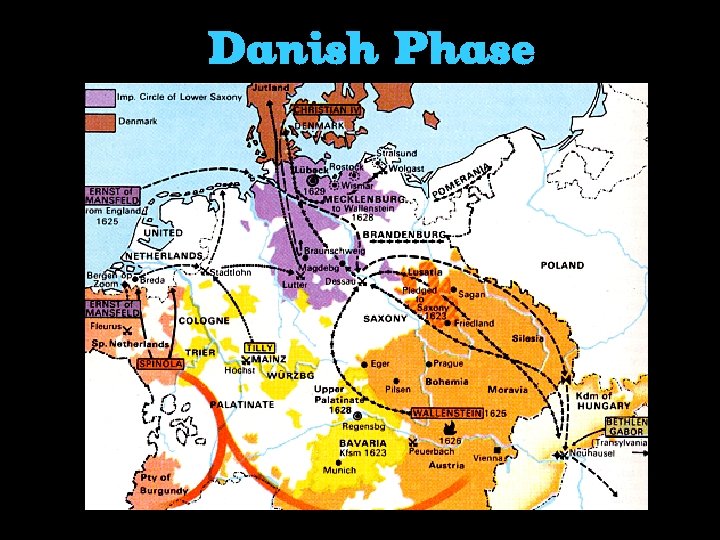 Danish Phase
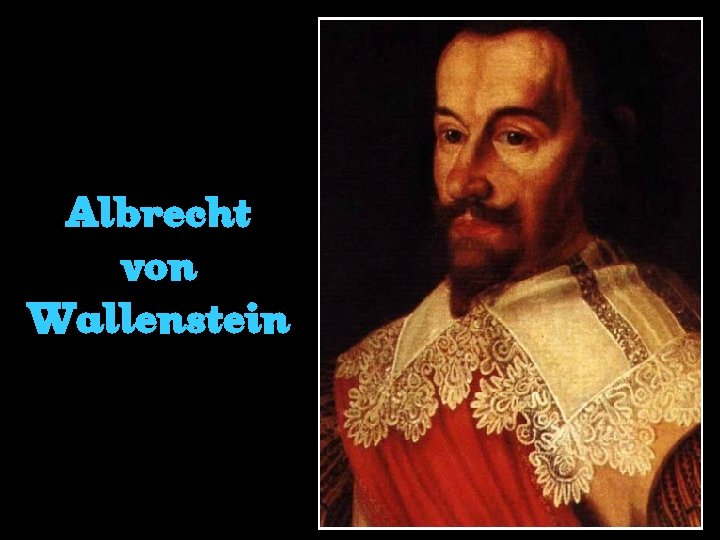 Albrecht von Wallenstein
 The Swedish Phase: 1630 -1635 v France & Sweden now get involved. § § § Both want to stop Habsburg power. Sweden led the charge. France provided support. v Gustavus Adolphus invaded the HR Empire. § § Ferdinand II brought back Wallenstein. Swedish advance was stopped. v German princes still feared Ferdinand II. v Wallenstein assassinated to appease them.
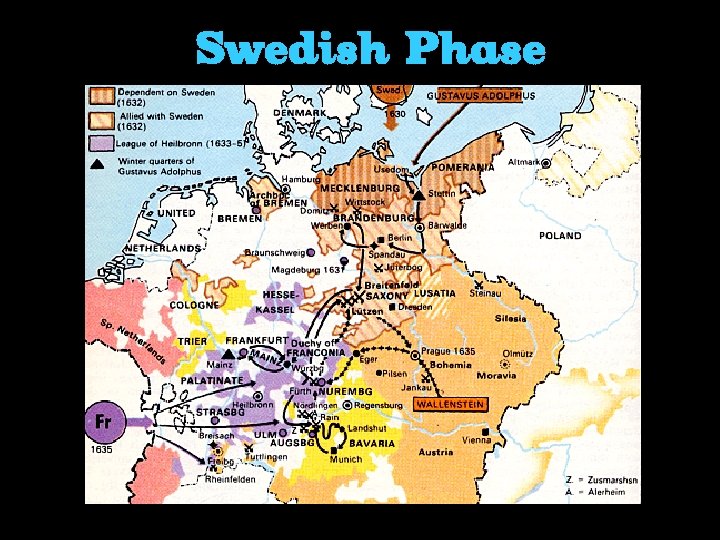 Swedish Phase
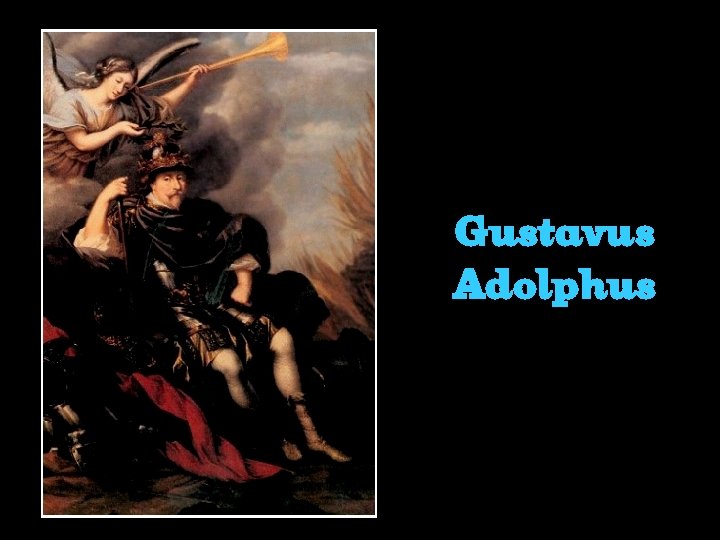 Gustavus Adolphus
 The French Phase: 1635 -1648 v France & Sweden switched roles. v All countries in Europe now participated. v This phase was most destructive! German towns decimated. Agriculture collapsed famine resulted. 8 million dead 1/3 of the population [from 21 million in 1618 to 13. 5 million in 1648] § Caused massive inflation. § Trade was crippled throughout Europe. § § §
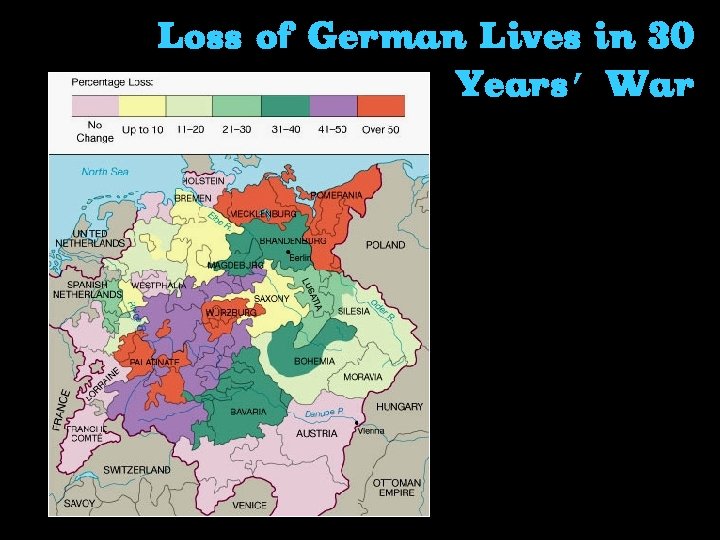 Loss of German Lives in 30 Years’ War
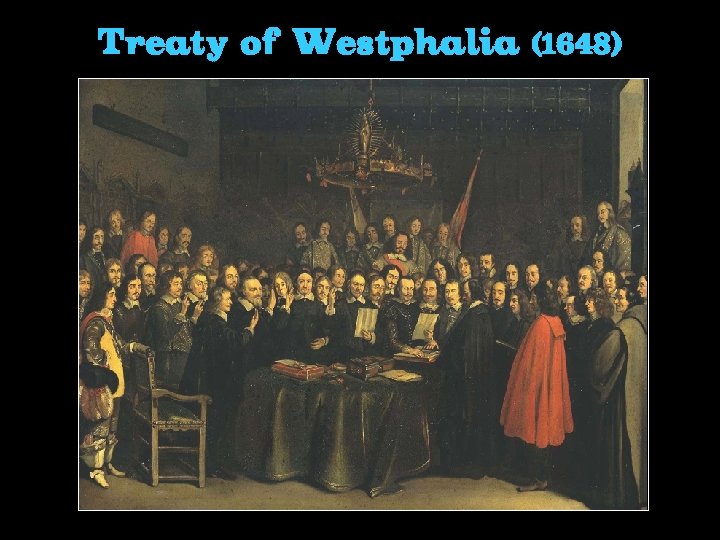
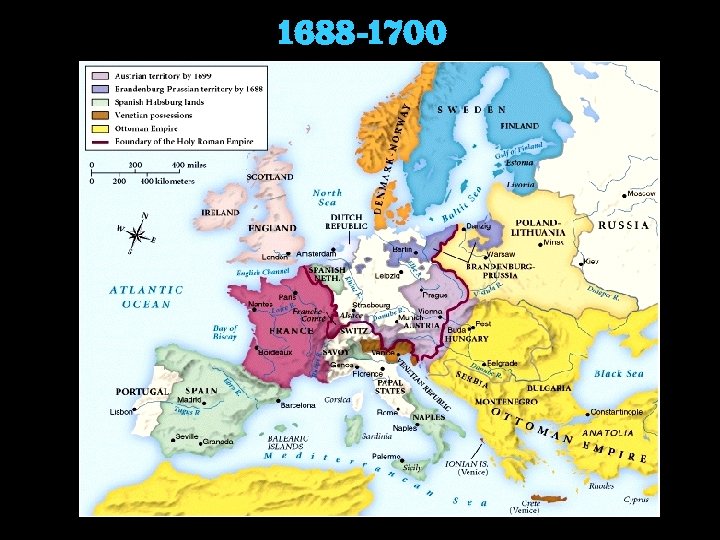
 The Peace of Westphalia v Political Provisions: § § § § (1648) Each Ger. prince became free from any kind of control by the HR Emperor. The United Provinces [Dutch Neths. ] became officially independent so. part remained a Sp. possession. Fr. rcvd. most of the Ger-speaking province of Alsace. Sweden got lands in No. Ger. on the Baltic & Black Sea coasts. Switzerland became totally independent of the HR Emperor Swiss Confederation. Sweden won a voice in the Diet of the HR Emp. Brandenburg got important terrs. on No. Sea & in central Germany.
 The Peace of Westphalia v Religious Provisions: (1648) Calvinists would have the same privileges as the Lutherans had in the Peace of Augsburg. § The ruler of each state could determine its official religion, BUT [except in the hereditary lands of the Habsburgs], he must permit freedom of private worship. §
 Treaty of Westphalia (1648)
 1688 -1700
 Nobody Was Happy! v Many Protestants felt betrayed. v The pope denounced it. v Only merit it ended the fighting in a war that became intolerable! v For the next few centuries, this war was blamed for everything that went wrong in Central Europe.
 What were the long-range effects of the Thirty Years’ War?