


 Скачать презентацию The voice of the European Service
24fd884c2c847da43355d9009580620e.ppt
- Количество слайдов: 17
 « The voice of the European Service Industries for the GATS negotiations » Club of Amsterdam The Summit for the Future Amsterdam, 27 th January 2005 Knowledge Stream: The future of trade/services industry « AN INEVITABLE INCREASE IN INTERNATIONAL TRADE IN SERVICES» Pascal Kerneis, Managing Director ESF (European Services Forum)
 « The voice of the European Service Industries for the GATS negotiations » ESF covers most services sectors, including: • Insurance • Banking • Business services: IT & Computer; consulting, advertising, after-sales services • Professional services: legal services, accountants, architects, engineers • Construction services • Distribution services • Publishing services (incl. Music) • Postal & Express Delivery services • Audio-visual services • Energy related services • Environmental services • Telecommunication services • Tourism • Air Transport • Maritime Transport But no members in Education or Health services For more information, see www. esf. be
 « The voice of the European Service Industries for the GATS negotiations » ESF MEMBERS INCLUDE: • • • AXA BARCLAYS BANK CLIFFORD CHANCE COMMERZBANK DHL FRANCE TELECOM IBM EUROPE LLOYD’S METRO AG • PRICEWATERHOUSECOOPERS • ROYAL AHOLD NV • SIEMENS AG • TELEFONICA • TNT • TUI • VEOLIA ENVIRONMENT • VODAFONE For more information, see www. esf. be
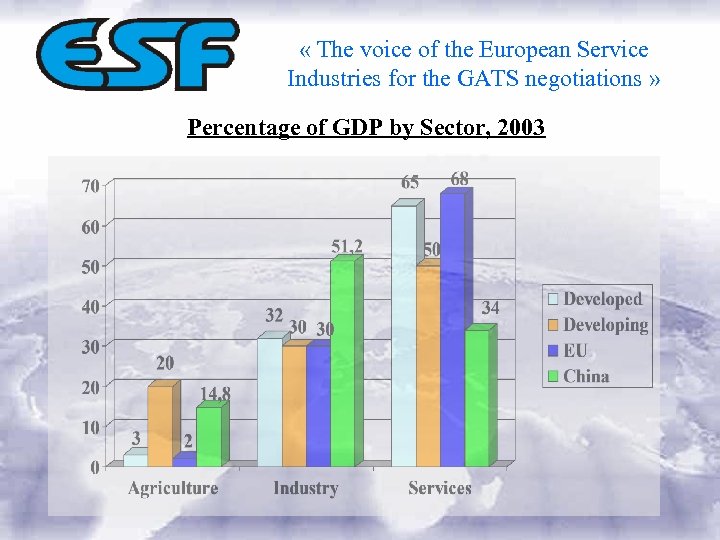 « The voice of the European Service Industries for the GATS negotiations » Percentage of GDP by Sector, 2003
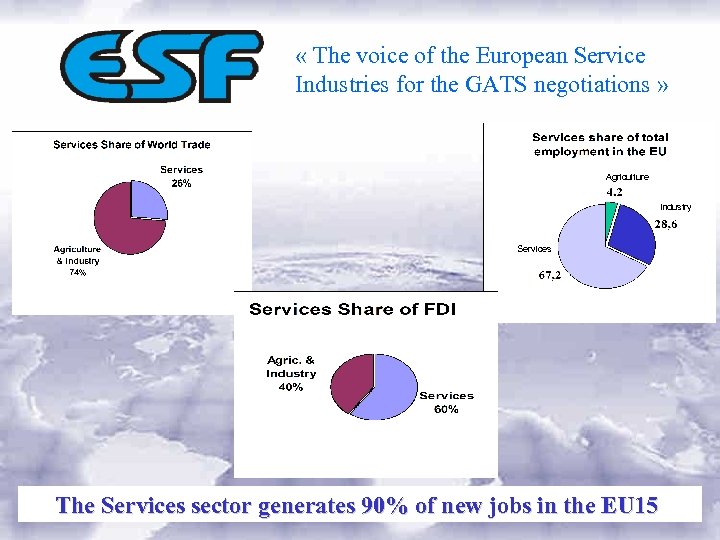 « The voice of the European Service Industries for the GATS negotiations » Agriculture Industry Services The Services sector generates 90% of new jobs in the EU 15
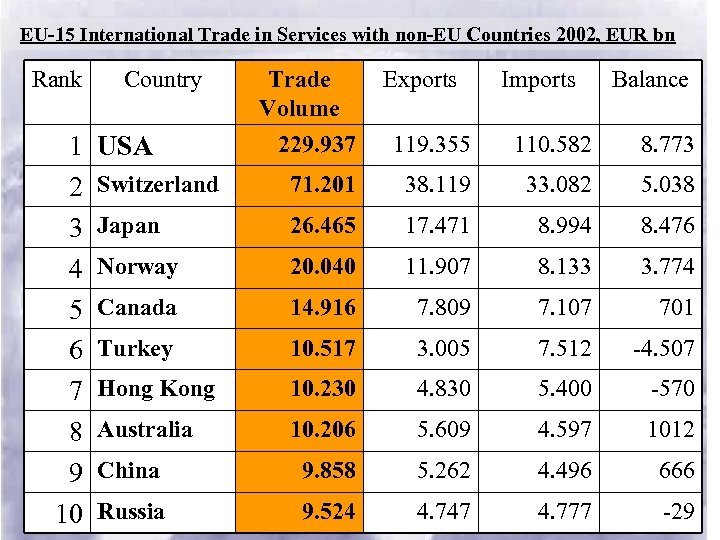 EU-15 International Trade in Services with non-EU Countries 2002, EUR bn Rank 1 2 3 4 5 6 7 8 9 10 Country USA Trade Volume 229. 937 Exports Imports Balance 119. 355 110. 582 8. 773 Switzerland 71. 201 38. 119 33. 082 5. 038 Japan 26. 465 17. 471 8. 994 8. 476 Norway 20. 040 11. 907 8. 133 3. 774 Canada 14. 916 7. 809 7. 107 701 Turkey 10. 517 3. 005 7. 512 -4. 507 Hong Kong 10. 230 4. 830 5. 400 -570 Australia 10. 206 5. 609 4. 597 1012 China 9. 858 5. 262 4. 496 666 Russia 9. 524 4. 747 4. 777 -29
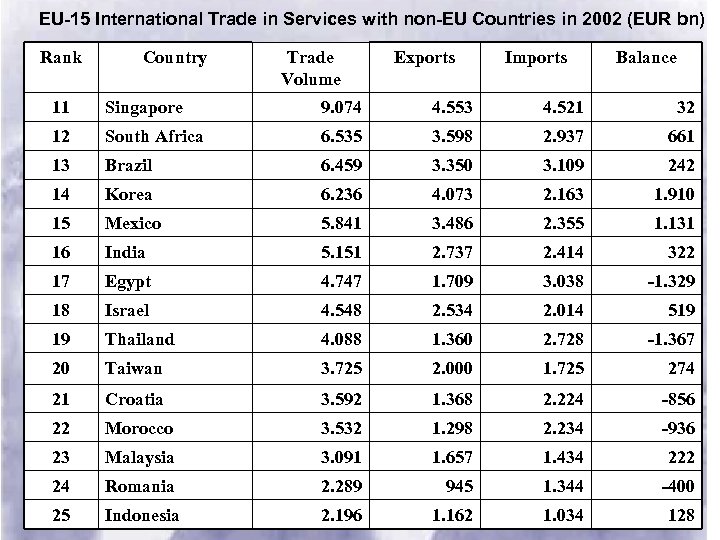 EU-15 International Trade in Services with non-EU Countries in 2002 (EUR bn) Rank Country Trade Volume Exports Imports Balance 11 Singapore 9. 074 4. 553 4. 521 32 12 South Africa 6. 535 3. 598 2. 937 661 13 Brazil 6. 459 3. 350 3. 109 242 14 Korea 6. 236 4. 073 2. 163 1. 910 15 Mexico 5. 841 3. 486 2. 355 1. 131 16 India 5. 151 2. 737 2. 414 322 17 Egypt 4. 747 1. 709 3. 038 -1. 329 18 Israel 4. 548 2. 534 2. 014 519 19 Thailand 4. 088 1. 360 2. 728 -1. 367 20 Taiwan 3. 725 2. 000 1. 725 274 21 Croatia 3. 592 1. 368 2. 224 -856 22 Morocco 3. 532 1. 298 2. 234 -936 23 Malaysia 3. 091 1. 657 1. 434 222 24 Romania 2. 289 945 1. 344 -400 25 Indonesia 2. 196 1. 162 1. 034 128
 « The voice of the European Service Industries for the GATS negotiations »
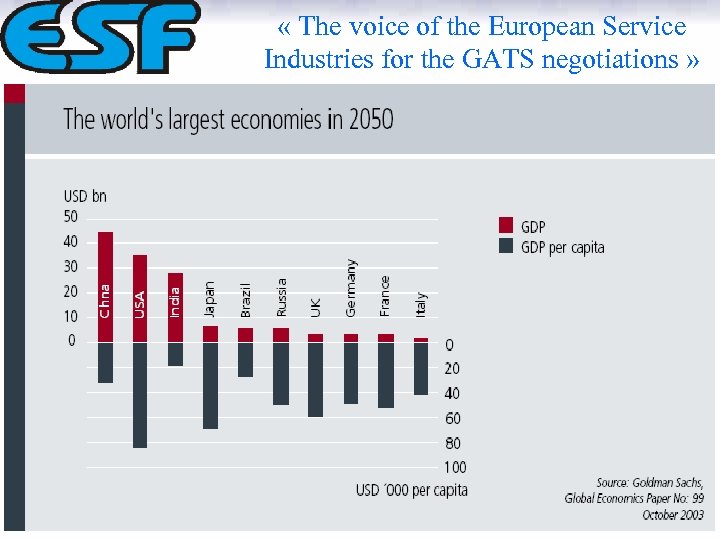 « The voice of the European Service Industries for the GATS negotiations »
 « The voice of the European Service Industries for the GATS negotiations » How can services liberalisation be beneficial to World Trade? By attracting FDI in infrastructure services: • Telecommunications • Logistics (transport, distribution, etc. ) • Energy network • Water and waste network • Financial services system, etc. Foreign service suppliers make long-term investments in their host countries By knowledge transfer and expertise from foreign services suppliers, which leads to: • Higher quality • Competitive pricing • Wider choice for consumers
 « The voice of the European Service Industries for the GATS negotiations » The main barriers to services liberalisation are: • Limitations on capital ownership • Limitations on licences allotted to foreign companies • Restrictions on real estate access • Local employment requirements • Lack of National Treatment in many services sectors • Long and burdensome administrative procedures • Lack of transparency in domestic regulation on: – Licensing requirements – Qualification requirements, etc.
 « The voice of the European Service Industries for the GATS negotiations » IMPROVING CROSS BORDER TRADE AND MOBILITY OF SKILLED PERSONNEL The current round of GATS Negotiations ought not only improve market access via Commercial Presence Abroad--Mode 3 of the GATS – i. e. joint ventures; subsidiaries; branching, but WTO Members ought to also expect and demand: 1)Commitments for Cross-Border Supply via Mode 1 of the GATS, i. e. selling services without a commercial presence in the consumer’s country—i. e. e-commerce, internet, sending electronic data to call center, fax, back offices, etc. 2)Movement of Natural Persons via Mode 4 of the GATS, i. e. quickly moving skilled business personnel within a company (intracorporate transferees) and to a company’s clients on a temporary basis
 « The voice of the European Service Industries for the GATS negotiations » State of play of the GATS Negotiations • + 400 Initial requests EU= 109 • 49 Initial offers as of December 2004 • Next steps: a) Improved offers by May 2005 b) Draft final offers • Final negotiations of the DDA: – December 2005 Hong Kong WTO Ministerial? Unlikely. – Mid 2006? End 2007? US TPA deadline?
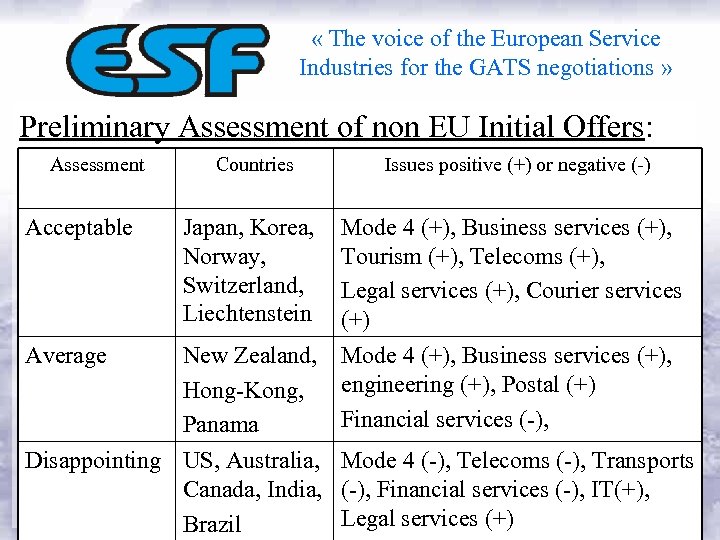 « The voice of the European Service Industries for the GATS negotiations » Preliminary Assessment of non EU Initial Offers: Assessment Acceptable Average Countries Issues positive (+) or negative (-) Japan, Korea, Norway, Switzerland, Liechtenstein Mode 4 (+), Business services (+), Tourism (+), Telecoms (+), Legal services (+), Courier services (+) New Zealand, Hong-Kong, Panama Disappointing US, Australia, Canada, India, Brazil Mode 4 (+), Business services (+), engineering (+), Postal (+) Financial services (-), Mode 4 (-), Telecoms (-), Transports (-), Financial services (-), IT(+), Legal services (+)
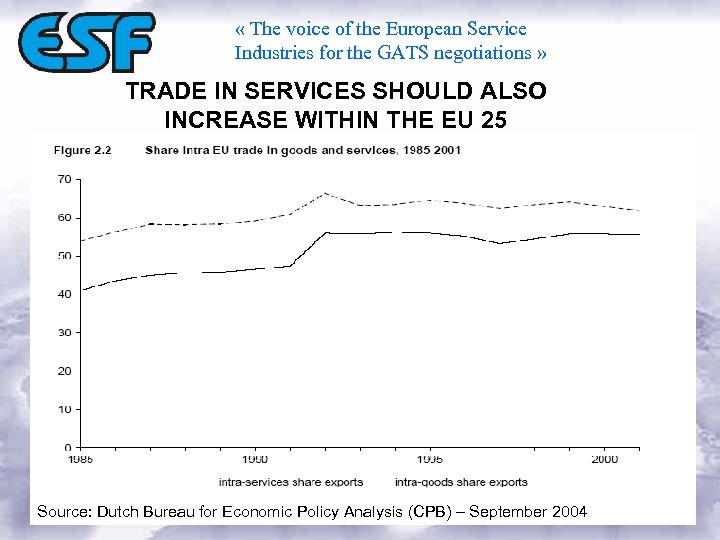 « The voice of the European Service Industries for the GATS negotiations » TRADE IN SERVICES SHOULD ALSO INCREASE WITHIN THE EU 25 Source: Dutch Bureau for Economic Policy Analysis (CPB) – September 2004
 « The voice of the European Service Industries for the GATS negotiations » TRADE IN SERVICES SHOULD ALSO INCREASE WITHIN THE EU 25 But EU Member States, companies and citizens (consumers and workers) must embrace the Internal “Single” Market to increase the cross-border supply of services between the 25 (27) countries: ØProposal for a Directive on Services in the Internal Market (country of origin principle, cut “red tape”), ØIncrease competition in the professional services (mutual recognition of diplomas and qualifications, elimination of corporatist rules, etc. ) ØImprove all aspects of business-related services (ICT, consulting, after-sale services, advertising, etc. )
 « The voice of the European Service Industries for the GATS negotiations » Pascal KERNEIS Managing Director European Services Forum – ESF 168, Avenue de Cortenbergh B – 1000 – BRUSSELS Tel: + 32 2 230 75 14 Fax: + 32 2 320 61 68 Email: esf@esf. be. Website: www. esf. be