 Скачать презентацию The Vogel Scheme Significant decision- as proposed by
9f26cc61a2b390fce02846d18bdaf619.ppt
- Количество слайдов: 14



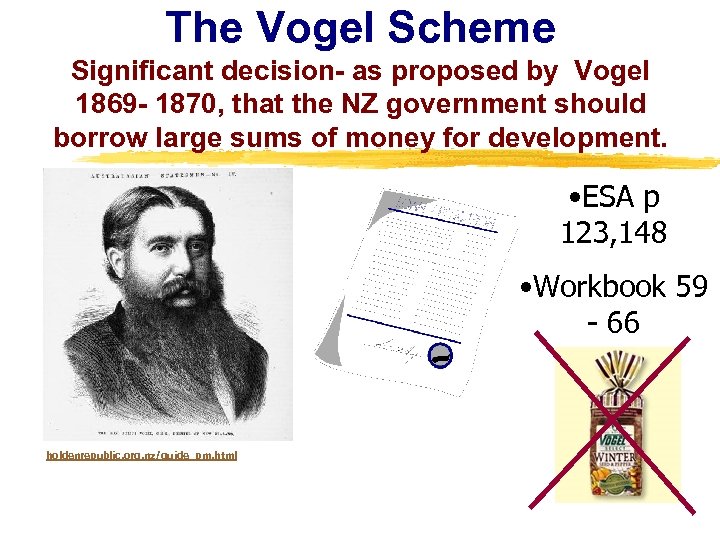
The Vogel Scheme Significant decision- as proposed by Vogel 1869 - 1870, that the NZ government should borrow large sums of money for development. • ESA p 123, 148 • Workbook 59 - 66 holdenrepublic. org. nz/guide_pm. html Copyright, 1996 © Dale Carnegie & Associates, Inc.
The Vogel Scheme When we talk about “Vogelism” we are talking about a scheme whereby massive amounts of money would be spent by central government to build roads, railways, bridges and bring immigrants into NZ. He wanted to create an infrastructure and other colonial politicians followed similar policies. The money would have to come from overseas. Controversial fellow – here is a positive web site.
z Born in London 1835. Parents Jewish, he was educated at various private school. z Became and assayer (person who tests metals, gold, coins etc). He then opened up stores in the Victorian (Aussie) gold rush- aged 17! z 1861 came to NZ and founded Otago Daily Times – NZ’s first daily paper z Elected to Otago Provincial Council 1863. Then entered national politics and in 1869 became Colonial Treasurer z Became notorious for his travels overseas. Spent £ 3000 compared to the Premier who spent £ 30. Drinker and gambler
Background: Attempts to Foster Economic Growth by the Provincial Councils z Read page 59 Workbook and briefly note the issues - Provincial Council aims z The Role of Central Government in Fostering Economic Development y. Pages 59 -60 What changed? y. P 123 ESA – What were things that motivated Vogelideas etc z Activity – Read 60 -61 and answer the questions
Details of the Vogel Scheme z Vogel proposed- page 62 top z His scheme was unique because never before had so much £ £ been borrowed for development, but also because it was borrowed by central government. z Vogel proposed that new railway lines should be main trunk routes between cities. Provinces would also have to give up some of the new land that was opened up. z 2000 miles of roads and bridges were built z In 1869 there were 50 miles of railway in NZ – by 1880 1200 miles
z Improved communication systems helped foster a sense of greater national unity. New postal services were established & 3000 miles of telegraph lines spanned NZ. A telegraph cable to Aust was laid. z During the 1870’s 100, 000 immigrants were assisted in coming to NZ by central Govt z Initially these people worked on public work schemes or in domestic service/ carpentry etc. z Many wanted to own land, to better their lives & some settled straight on to the land in remote forested areas that the govt hoped to open up. - e. g. 3500 Scandinavians in the Manawatu & Wairarapa regions
z The govt provided subsidies (payment) and bounties to encourage economic development- e. g. a bounty was paid for setting up early woollen mills in Otago. z There was an economic boom in the 1870’s with a period of great economic growth. Land values soared & many banks such as the city of Glasgow Bank invested heavily in NZ and accepted land as security z Many small towns were opened up and prospered. The railways helped link towns and markets
Views of Vogel z. Page 62 -65 – do all the activities! Impact of the Vogel Scheme. z. Page 148 ESA – Read – very important – note key ideas z. Historians- views – top of p 149 ESA
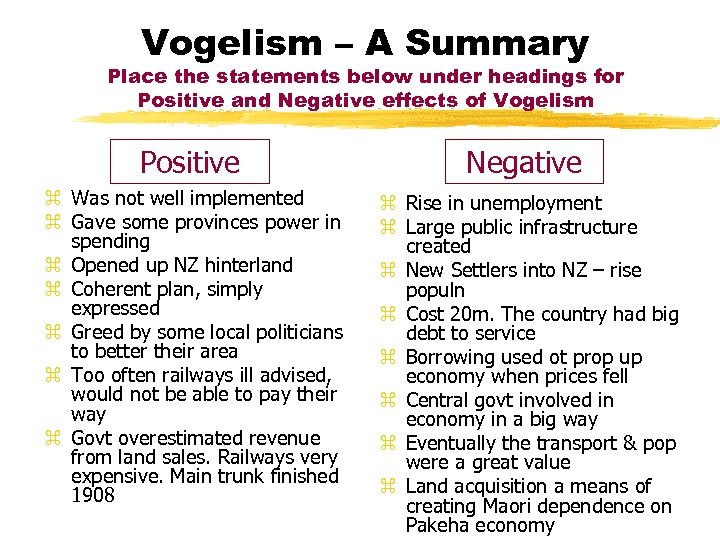
Vogelism – A Summary Place the statements below under headings for Positive and Negative effects of Vogelism Positive Negative z Was not well implemented z Gave some provinces power in spending z Opened up NZ hinterland z Coherent plan, simply expressed z Greed by some local politicians to better their area z Too often railways ill advised, would not be able to pay their way z Govt overestimated revenue from land sales. Railways very expensive. Main trunk finished 1908 z Rise in unemployment z Large public infrastructure created z New Settlers into NZ – rise populn z Cost 20 m. The country had big debt to service z Borrowing used ot prop up economy when prices fell z Central govt involved in economy in a big way z Eventually the transport & pop were a great value z Land acquisition a means of creating Maori dependence on Pakeha economy
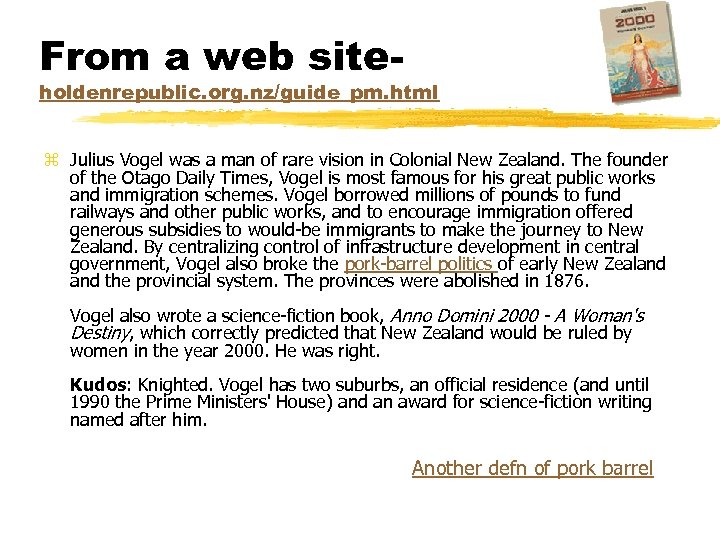
From a web site- holdenrepublic. org. nz/guide_pm. html z Julius Vogel was a man of rare vision in Colonial New Zealand. The founder of the Otago Daily Times, Vogel is most famous for his great public works and immigration schemes. Vogel borrowed millions of pounds to fund railways and other public works, and to encourage immigration offered generous subsidies to would-be immigrants to make the journey to New Zealand. By centralizing control of infrastructure development in central government, Vogel also broke the pork-barrel politics of early New Zealand the provincial system. The provinces were abolished in 1876. Vogel also wrote a science-fiction book, Anno Domini 2000 - A Woman's Destiny, which correctly predicted that New Zealand would be ruled by women in the year 2000. He was right. Kudos: Knighted. Vogel has two suburbs, an official residence (and until 1990 the Prime Ministers' House) and an award for science-fiction writing named after him. Another defn of pork barrel
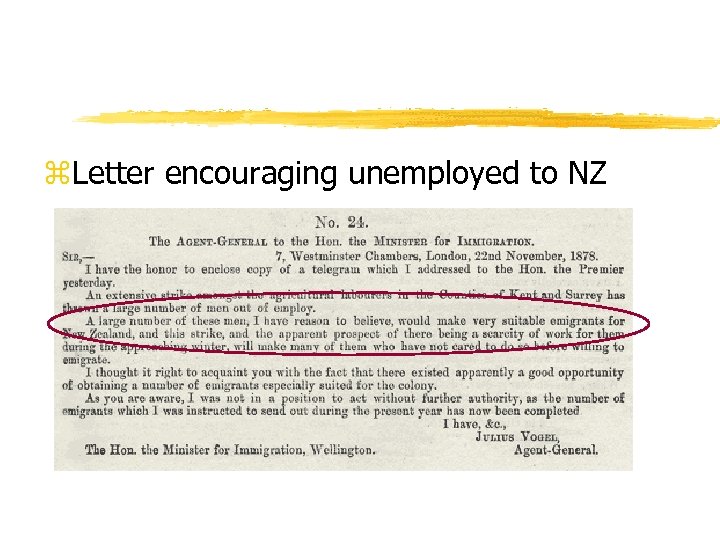
z. Letter encouraging unemployed to NZ
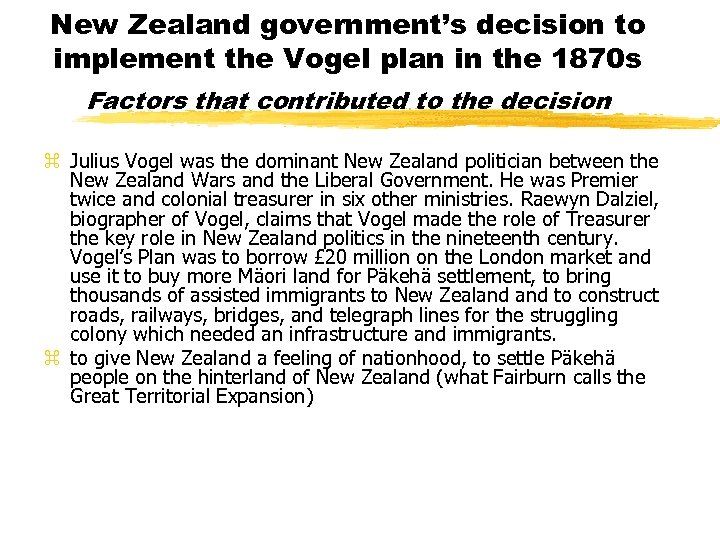
New Zealand government’s decision to implement the Vogel plan in the 1870 s Factors that contributed to the decision z Julius Vogel was the dominant New Zealand politician between the New Zealand Wars and the Liberal Government. He was Premier twice and colonial treasurer in six other ministries. Raewyn Dalziel, biographer of Vogel, claims that Vogel made the role of Treasurer the key role in New Zealand politics in the nineteenth century. Vogel’s Plan was to borrow £ 20 million on the London market and use it to buy more Mäori land for Päkehä settlement, to bring thousands of assisted immigrants to New Zealand to construct roads, railways, bridges, and telegraph lines for the struggling colony which needed an infrastructure and immigrants. z to give New Zealand a feeling of nationhood, to settle Päkehä people on the hinterland of New Zealand (what Fairburn calls the Great Territorial Expansion)
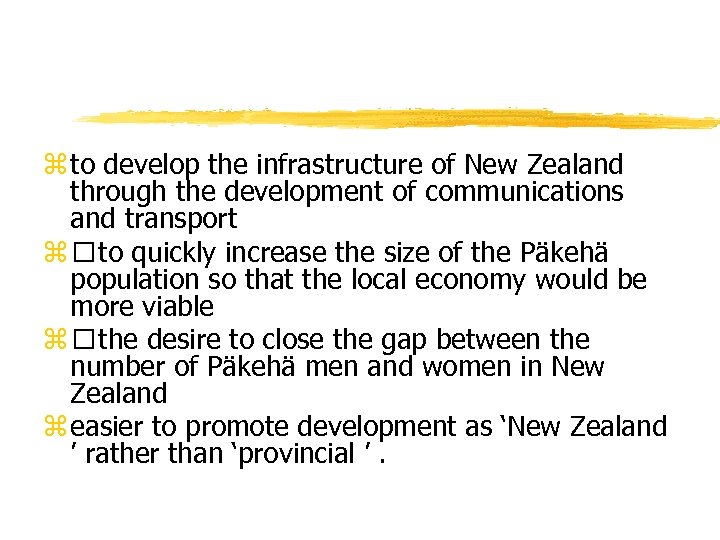
z to develop the infrastructure of New Zealand through the development of communications and transport z to quickly increase the size of the Päkehä population so that the local economy would be more viable z the desire to close the gap between the number of Päkehä men and women in New Zealand z easier to promote development as ‘New Zealand ’ rather than ‘provincial ’.
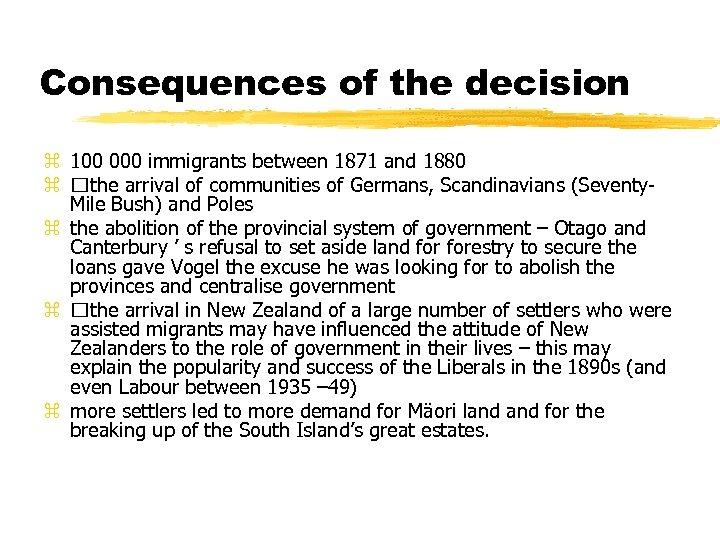
Consequences of the decision z 100 000 immigrants between 1871 and 1880 z the arrival of communities of Germans, Scandinavians (Seventy. Mile Bush) and Poles z the abolition of the provincial system of government – Otago and Canterbury ’ s refusal to set aside land forestry to secure the loans gave Vogel the excuse he was looking for to abolish the provinces and centralise government z the arrival in New Zealand of a large number of settlers who were assisted migrants may have influenced the attitude of New Zealanders to the role of government in their lives – this may explain the popularity and success of the Liberals in the 1890 s (and even Labour between 1935 – 49) z more settlers led to more demand for Mäori land for the breaking up of the South Island’s great estates.
Скачать презентацию The Vogel Scheme Significant decision- as proposed by
9f26cc61a2b390fce02846d18bdaf619.ppt