 Скачать презентацию The viterbi algorithm A J Han Vinck Lecture
9b41696fe7e55021908b89faa05c1755.ppt
- Количество слайдов: 18



The viterbi algorithm A. J. Han Vinck Lecture notes data communications Institute for Experimental Mathematics Ellernstrasse 29 45326 Essen - Germany
University Duisburg-Essen digital communications group content Viterbi decoding for convolutional codes Hidden Markov models With contributions taken from Dan Durafsky 2
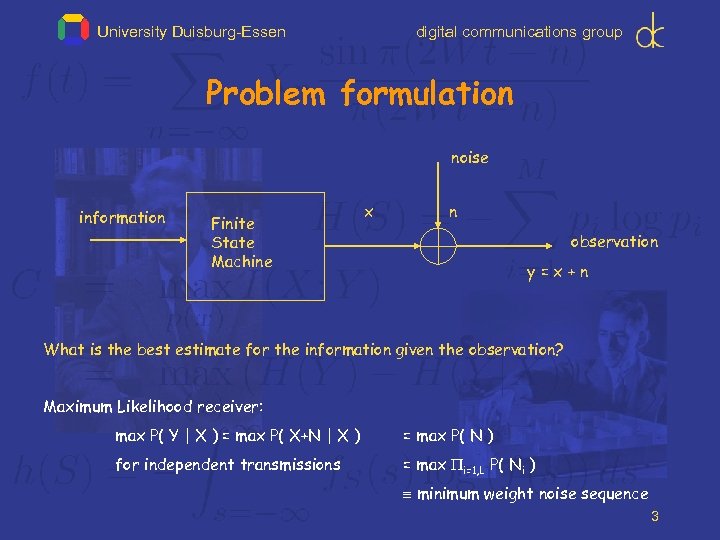
University Duisburg-Essen digital communications group Problem formulation noise information Finite State Machine x n observation y=x+n What is the best estimate for the information given the observation? Maximum Likelihood receiver: max P( Y | X ) = max P( X+N | X ) = max P( N ) for independent transmissions = max i=1, L P( Ni ) minimum weight noise sequence 3
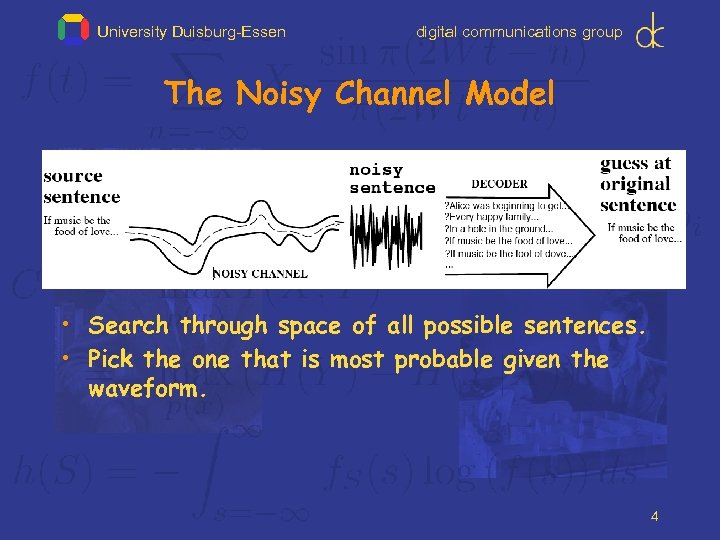
University Duisburg-Essen digital communications group The Noisy Channel Model • Search through space of all possible sentences. • Pick the one that is most probable given the waveform. 4
University Duisburg-Essen digital communications group characteristics the Viterbi algorithm is a standard component of tens of millions of high-speed modems. It is a key building block of modern information infrastructure The symbol "VA" is ubiquitous in the block diagrams of modern receivers. Essentially: the VA finds a path through any Markov graph, which is a sequence of states governed by a Markov chain. many practical applications: convolutional decoding and channel trellis decoding. fading communication channels, partial response channels in recording systems, optical character recognition, voice recognition. DNA sequence analysis etc. 5
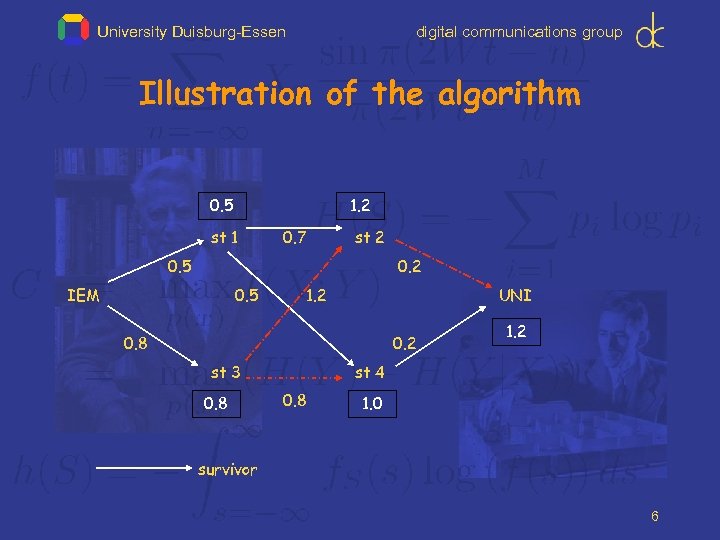
University Duisburg-Essen digital communications group Illustration of the algorithm 0. 5 1. 2 st 1 0. 7 st 2 0. 5 0. 2 IEM 0. 5 1. 2 UNI 0. 8 0. 2 st 3 0. 8 1. 2 st 4 0. 8 1. 0 survivor 6
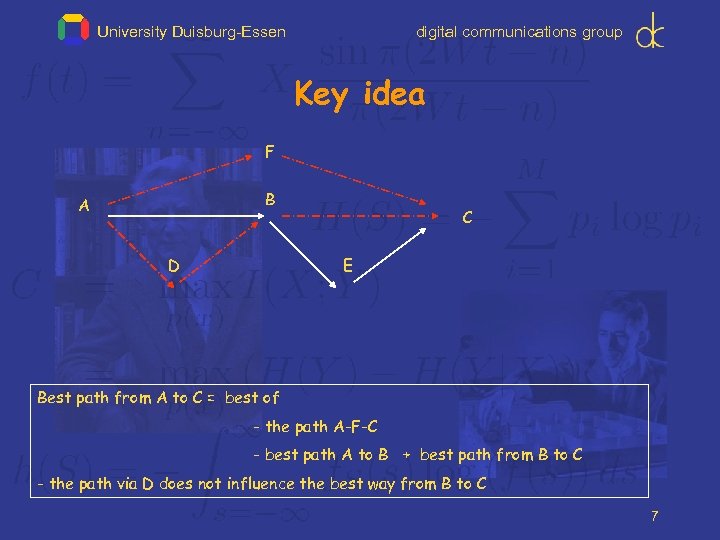
University Duisburg-Essen digital communications group Key idea F B A D C E Best path from A to C = best of - the path A-F-C - best path A to B + best path from B to C - the path via D does not influence the best way from B to C 7
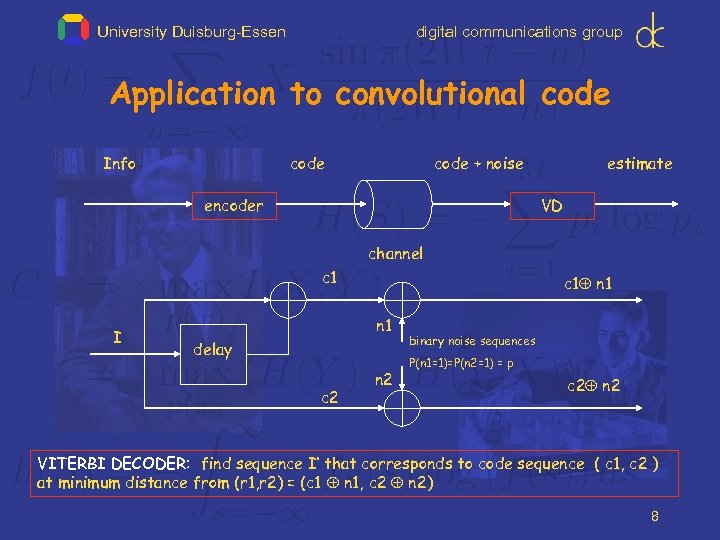
University Duisburg-Essen digital communications group Application to convolutional code Info code + noise encoder estimate VD channel c 1 I c 1 n 1 delay c 2 n 2 binary noise sequences P(n 1=1)=P(n 2=1) = p c 2 n 2 VITERBI DECODER: find sequence I‘ that corresponds to code sequence ( c 1, c 2 ) at minimum distance from (r 1, r 2) = (c 1 n 1, c 2 n 2) 8
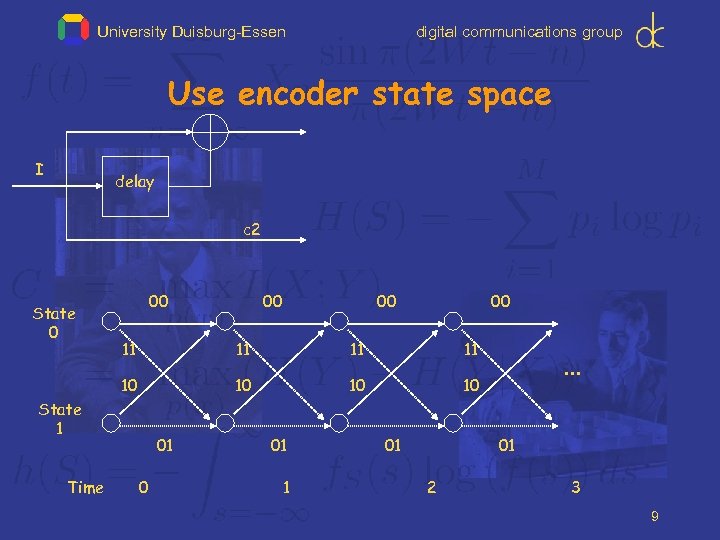
University Duisburg-Essen digital communications group Use encoder state space I delay c 2 State 0 00 00 11 11 10 10 State 1 Time 01 0 01 1 01 • • • 01 2 3 9
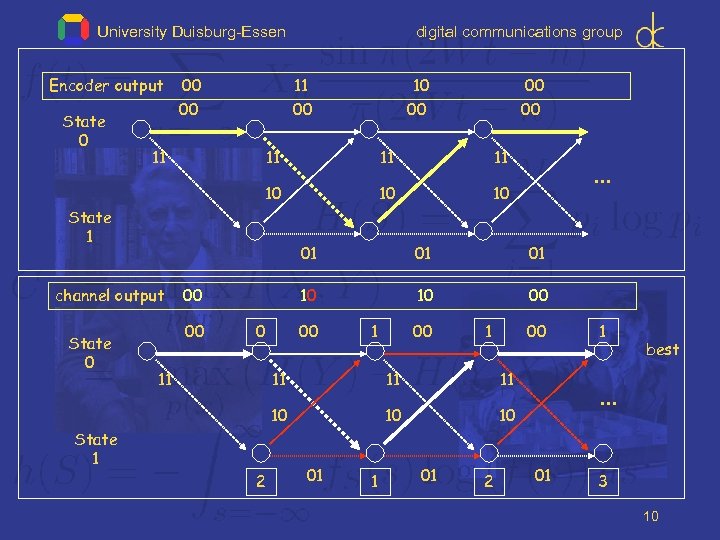
University Duisburg-Essen Encoder output State 0 00 00 11 digital communications group 11 00 10 00 00 00 11 11 11 10 10 10 State 1 01 channel output State 0 • • • 00 0 11 01 10 00 00 11 2 10 10 best 11 10 State 1 11 1 01 2 • • • 01 3 10
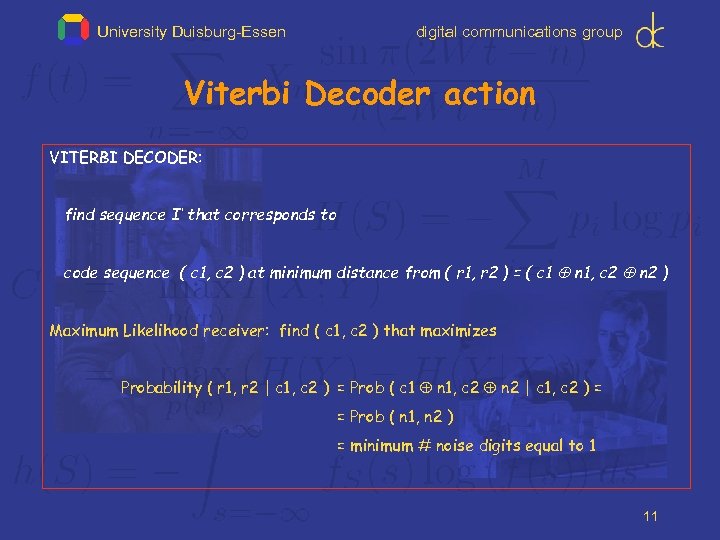
University Duisburg-Essen digital communications group Viterbi Decoder action VITERBI DECODER: find sequence I‘ that corresponds to code sequence ( c 1, c 2 ) at minimum distance from ( r 1, r 2 ) = ( c 1 n 1, c 2 n 2 ) Maximum Likelihood receiver: find ( c 1, c 2 ) that maximizes Probability ( r 1, r 2 | c 1, c 2 ) = Prob ( c 1 n 1, c 2 n 2 | c 1, c 2 ) = = Prob ( n 1, n 2 ) = minimum # noise digits equal to 1 11
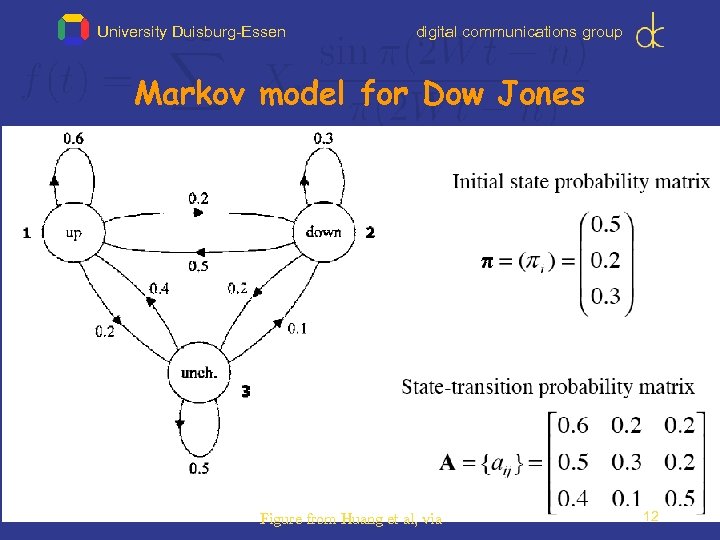
University Duisburg-Essen digital communications group Markov model for Dow Jones Figure from Huang et al, via 12
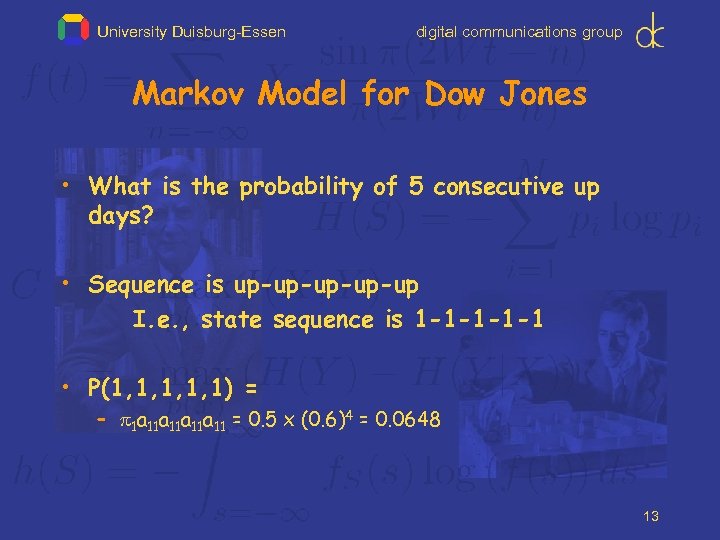
University Duisburg-Essen digital communications group Markov Model for Dow Jones • What is the probability of 5 consecutive up days? • Sequence is up-up-up I. e. , state sequence is 1 -1 -1 • P(1, 1, 1) = – 1 a 11 a 11 = 0. 5 x (0. 6)4 = 0. 0648 13
University Duisburg-Essen digital communications group Application to Hidden Markov Models Definition: The HMM is a finite set of states, each of which is associated with a probability distribution. transitions among the states are governed by a set of probabilities called transition probabilities. In a particular state an outcome or observation can be generated, according to the associated probability distribution. It is only the outcome, not the state visible to an external observer and therefore states are ``hidden'' to the outside; hence the name Hidden Markov Model. EXAMPLE APPLICATION: speech recognition and synthesis 14
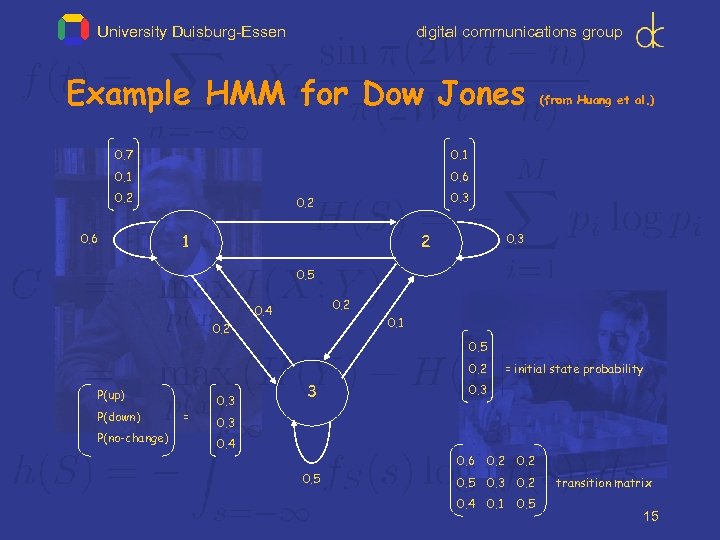
University Duisburg-Essen digital communications group Example HMM for Dow Jones 0. 7 0. 1 (from Huang et al. ) 0. 6 0. 2 0. 6 0. 3 0. 2 1 2 0. 3 0. 5 0. 2 0. 4 0. 1 0. 2 0. 5 0. 2 P(up) P(down) P(no-change) = 0. 3 3 = initial state probability 0. 3 0. 4 0. 6 0. 5 0. 2 0. 5 0. 3 0. 2 0. 4 0. 1 0. 5 transition matrix 15
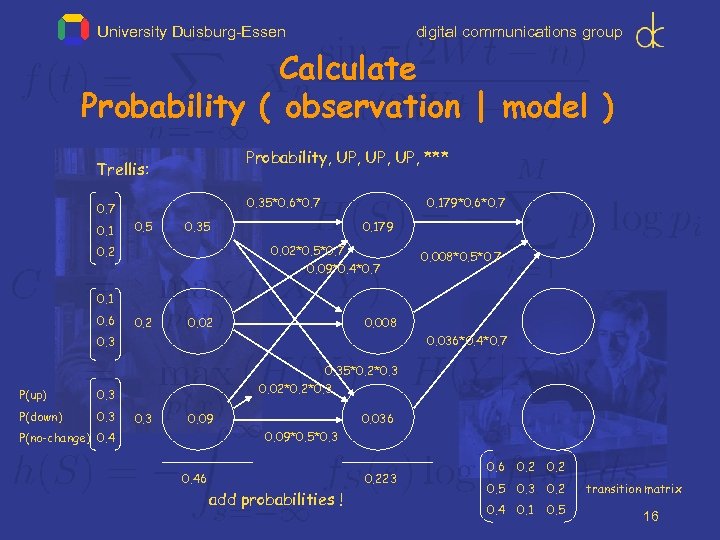
University Duisburg-Essen digital communications group Calculate Probability ( observation | model ) Probability, UP, UP, *** Trellis: 0. 35*0. 6*0. 7 0. 1 0. 5 0. 35 0. 179*0. 6*0. 7 0. 179 0. 02*0. 5*0. 7 0. 09*0. 4*0. 7 0. 2 0. 008*0. 5*0. 7 0. 1 0. 6 0. 2 0. 008 0. 036*0. 4*0. 7 0. 3 P(up) 0. 3 P(down) 0. 35*0. 2*0. 3 0. 02*0. 3 0. 09 0. 036 0. 09*0. 5*0. 3 P(no-change) 0. 46 0. 223 add probabilities ! 0. 6 0. 2 0. 5 0. 3 0. 2 0. 4 0. 1 0. 5 transition matrix 16
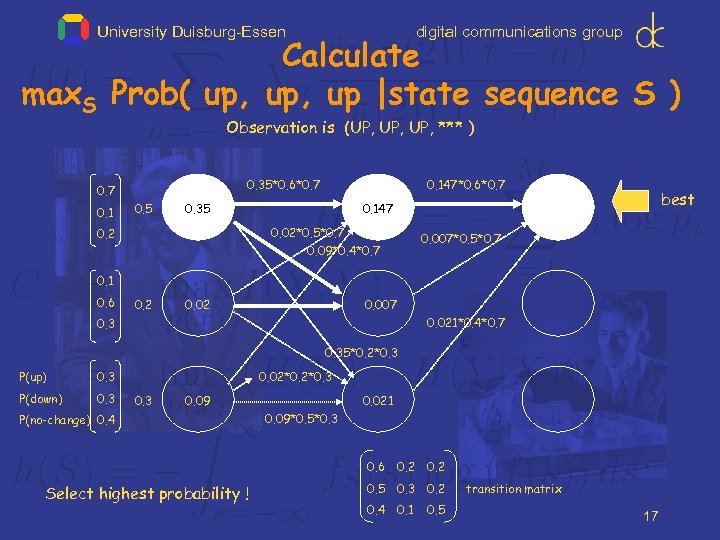
University Duisburg-Essen digital communications group Calculate max. S Prob( up, up |state sequence S ) Observation is (UP, UP, *** ) 0. 35*0. 6*0. 7 0. 1 0. 5 0. 147*0. 6*0. 7 0. 35 0. 02*0. 5*0. 7 0. 09*0. 4*0. 7 0. 2 best 0. 147 0. 007*0. 5*0. 7 0. 1 0. 6 0. 2 0. 007 0. 021*0. 4*0. 7 0. 35*0. 2*0. 3 P(up) 0. 3 P(down) 0. 3 0. 02*0. 3 0. 09 P(no-change) 0. 4 0. 021 0. 09*0. 5*0. 3 0. 6 Select highest probability ! 0. 2 0. 5 0. 3 0. 2 0. 4 0. 1 0. 5 transition matrix 17
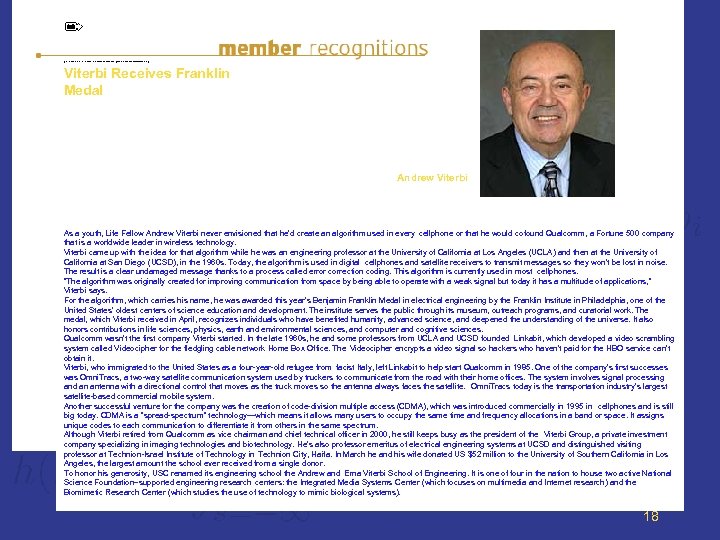
University Duisburg-Essen digital communications group 06 June 2005 08: 00 AM (GMT -05: 00) (From The Institute print edition) Viterbi Receives Franklin Medal Send Link Print Andrew Viterbi er Friendly As a youth, Life Fellow Andrew Viterbi never envisioned that he’d create an algorithm used in every cellphone or that he would cofound Qualcomm, a Fortune 500 company that is a worldwide leader in wireless technology. Viterbi came up with the idea for that algorithm while he was an engineering professor at the University of California at Los Angeles (UCLA) and then at the University of California at San Diego (UCSD), in the 1960 s. Today, the algorithm is used in digital cellphones and satellite receivers to transmit messages so they won’t be lost in noise. The result is a clear undamaged message thanks to a process called error correction coding. This algorithm is currently used in most cellphones. “The algorithm was originally created for improving communication from space by being able to operate with a weak signal but today it has a multitude of applications, ” Viterbi says. For the algorithm, which carries his name, he was awarded this year’s Benjamin Franklin Medal in electrical engineering by the Franklin Institute in Philadelphia, one of the United States’ oldest centers of science education and development. The institute serves the public through its museum, outreach programs, and curatorial work. The medal, which Viterbi received in April, recognizes individuals who have benefited humanity, advanced science, and deepened the understanding of the universe. It also honors contributions in life sciences, physics, earth and environmental sciences, and computer and cognitive sciences. Qualcomm wasn’t the first company Viterbi started. In the late 1960 s, he and some professors from UCLA and UCSD founded Linkabit, which developed a video scrambling system called Videocipher for the fledgling cable network Home Box Office. The Videocipher encrypts a video signal so hackers who haven’t paid for the HBO service can’t obtain it. Viterbi, who immigrated to the United States as a four-year-old refugee from facist Italy, left Linkabit to help start Qualcomm in 1985. One of the company’s first successes was Omni. Tracs, a two-way satellite communication system used by truckers to communicate from the road with their home offices. The system involves signal processing and an antenna with a directional control that moves as the truck moves so the antenna always faces the satellite. Omni. Tracs today is the transportation industry’s largest satellite-based commercial mobile system. Another successful venture for the company was the creation of code-division multiple access (CDMA), which was introduced commercially in 1995 in cellphones and is still big today. CDMA is a “spread-spectrum” technology—which means it allows many users to occupy the same time and frequency allocations in a band or space. It assigns unique codes to each communication to differentiate it from others in the same spectrum. Although Viterbi retired from Qualcomm as vice chairman and chief technical officer in 2000, he still keeps busy as the president of the Viterbi Group, a private investment company specializing in imaging technologies and biotechnology. He’s also professor emeritus of electrical engineering systems at UCSD and distinguished visiting professor at Technion-Israel Institute of Technology in Technion City, Haifa. In March he and his wife donated US $52 million to the University of Southern California in Los Angeles, the largest amount the school ever received from a single donor. To honor his generosity, USC renamed its engineering school the Andrew and Erna Viterbi School of Engineering. It is one of four in the nation to house two active National Science Foundation–supported engineering research centers: the Integrated Media Systems Center (which focuses on multimedia and Internet research) and the Biomimetic Research Center (which studies the use of technology to mimic biological systems). 18
Скачать презентацию The viterbi algorithm A J Han Vinck Lecture
9b41696fe7e55021908b89faa05c1755.ppt