 Скачать презентацию The visible hand of China in Latin America
e2794ca00efc2d997a48eb273c57e911.ppt
- Количество слайдов: 35



The visible hand of China in Latin America Opportunities, Challenges and Risks Javier Santiso Chief Economist & Deputy Director OECD Development Centre Central Bank of Chile Santiago de Chile April 27 th 2007
1 The cognitive effect: new emerging capitalisms. 2 The trade effect: the dark side of the boom. 3 China and India as a wake up call. 2
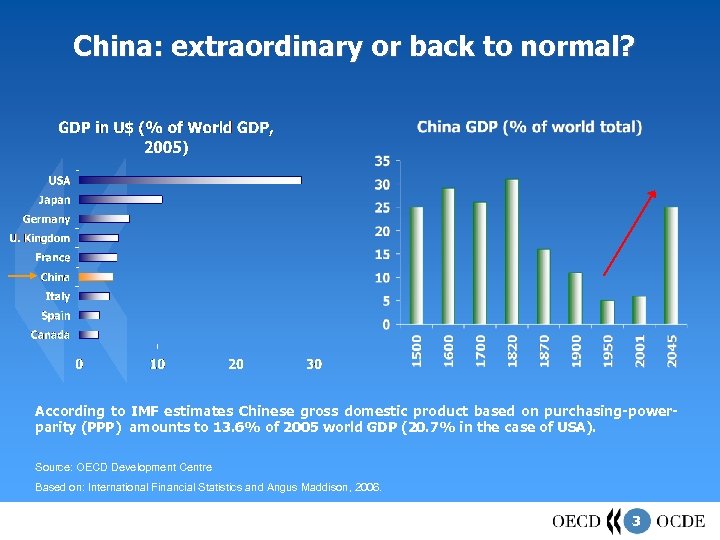
China: extraordinary or back to normal? According to IMF estimates Chinese gross domestic product based on purchasing-powerparity (PPP) amounts to 13. 6% of 2005 world GDP (20. 7% in the case of USA). Source: OECD Development Centre Based on: International Financial Statistics and Angus Maddison, 2006. 3
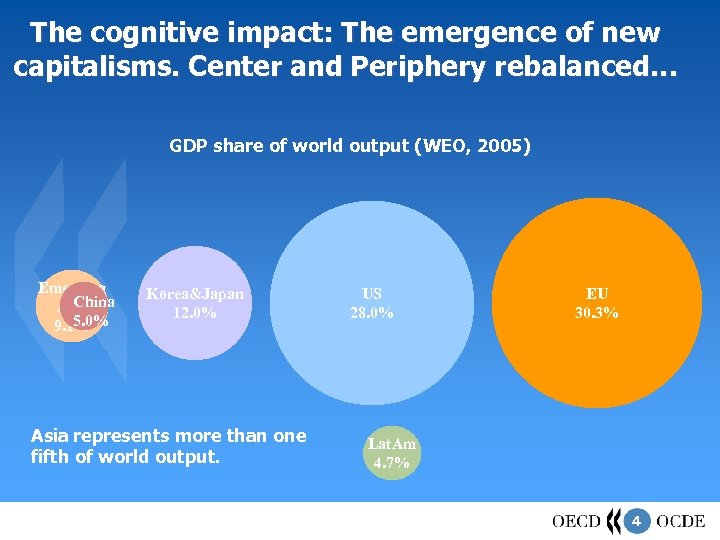
The cognitive impact: The emergence of new capitalisms. Center and Periphery rebalanced… GDP share of world output (WEO, 2005) Emerging China Asia 5. 0% 9. 1% Korea&Japan 12. 0% Asia represents more than one fifth of world output. US 28. 0% EU 30. 3% Lat. Am 4. 7% 4
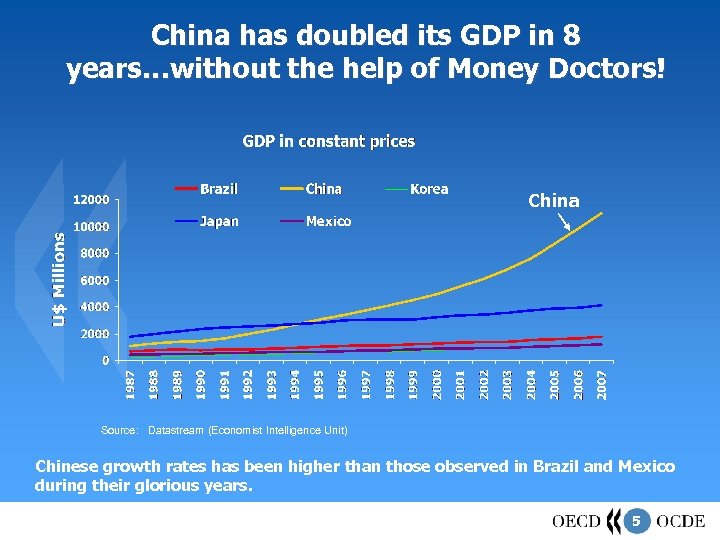
China has doubled its GDP in 8 years…without the help of Money Doctors! China Source: Datastream (Economist Intelligence Unit) Chinese growth rates has been higher than those observed in Brazil and Mexico during their glorious years. 5
1 The cognitive effect: new emerging capitalisms. 2 The trade effect: the dark side of the boom. 3 China and India as a wake up call. 6
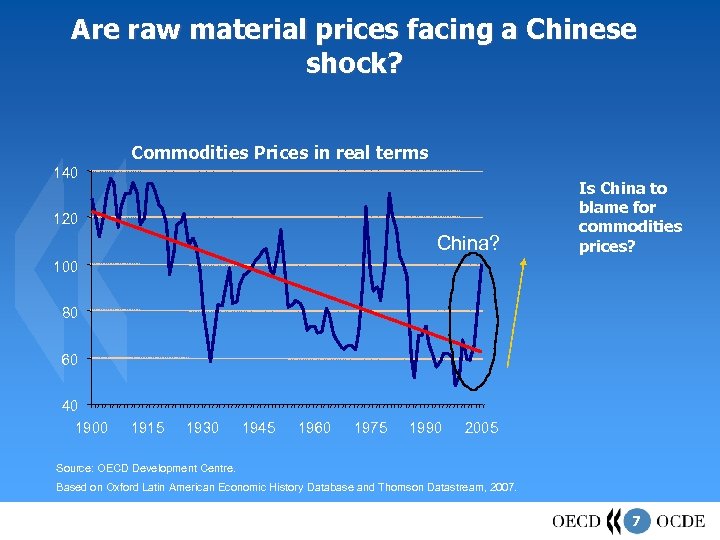
Are raw material prices facing a Chinese shock? Commodities Prices in real terms 140 120 China? Is China to blame for commodities prices? 100 80 60 40 1900 1915 1930 1945 1960 1975 1990 2005 Source: OECD Development Centre. Based on Oxford Latin American Economic History Database and Thomson Datastream, 2007. 7
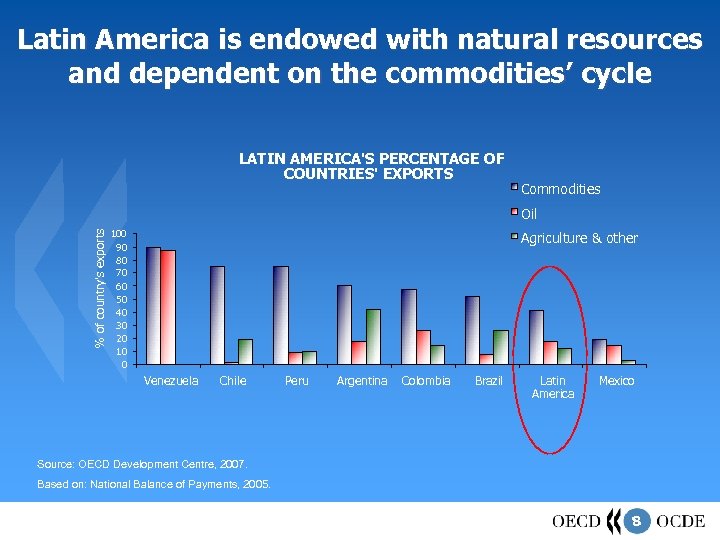
Latin America is endowed with natural resources and dependent on the commodities’ cycle LATIN AMERICA'S PERCENTAGE OF COUNTRIES' EXPORTS Commodities % of country's exports Oil 100 90 80 70 60 50 40 30 20 10 0 Agriculture & other Venezuela Chile Peru Argentina Colombia Brazil Latin America Mexico Source: OECD Development Centre, 2007. Based on: National Balance of Payments, 2005. 8
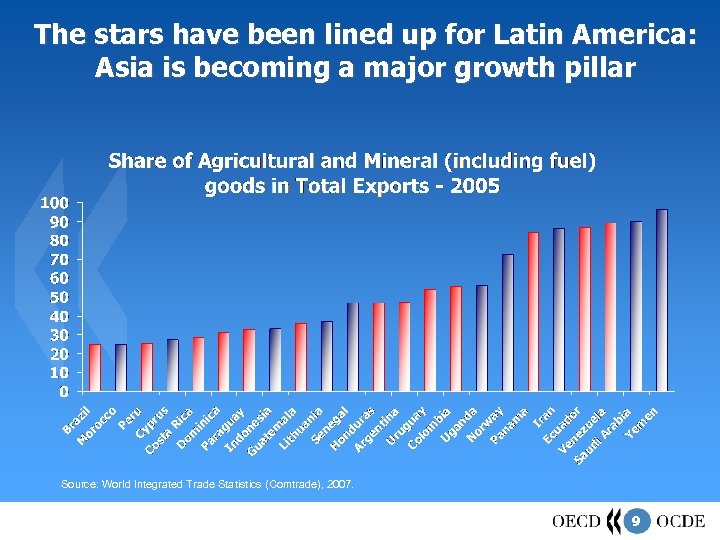
The stars have been lined up for Latin America: Asia is becoming a major growth pillar Source: World Integrated Trade Statistics (Comtrade), 2007. 9
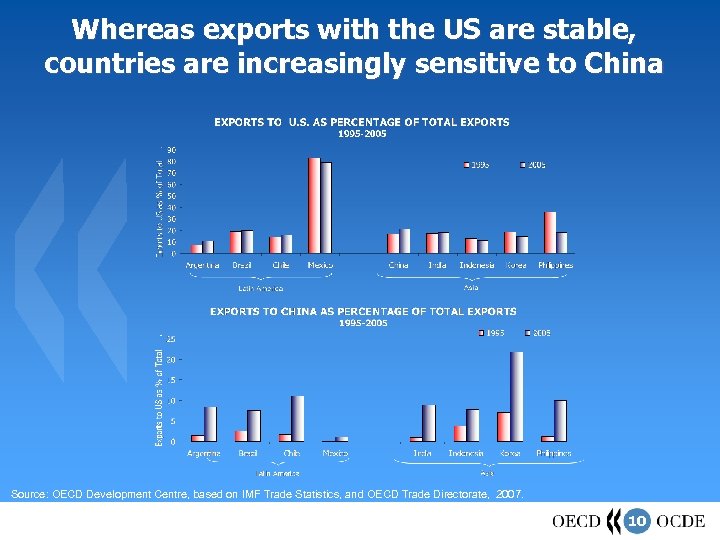
Whereas exports with the US are stable, countries are increasingly sensitive to China Source: OECD Development Centre, based on IMF Trade Statistics, and OECD Trade Directorate, 2007. 10
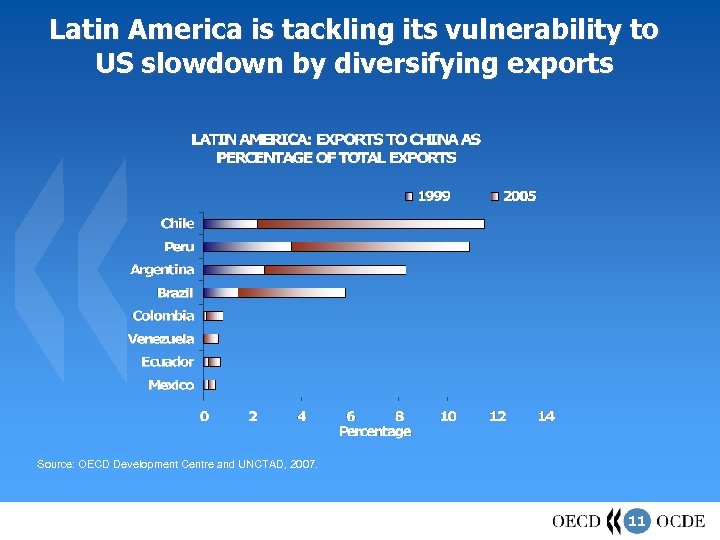
Latin America is tackling its vulnerability to US slowdown by diversifying exports Source: OECD Development Centre and UNCTAD, 2007. 11
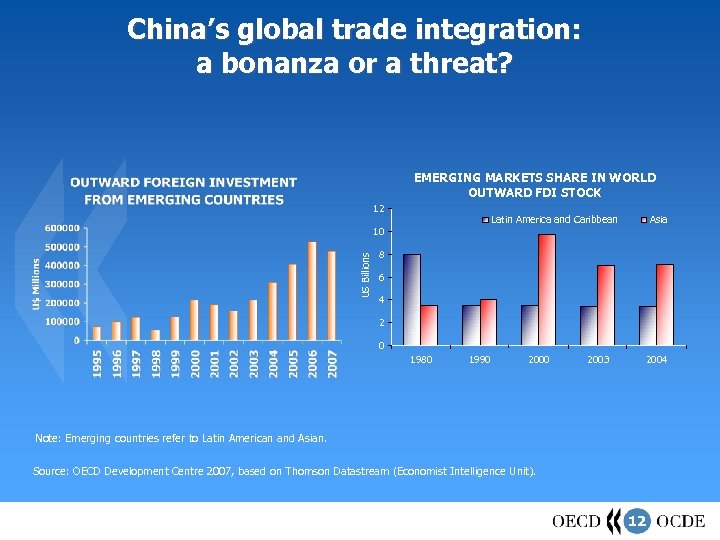
China’s global trade integration: a bonanza or a threat? EMERGING MARKETS SHARE IN WORLD OUTWARD FDI STOCK 12 Latin America and Caribbean US Billions 10 Asia 8 6 4 2 0 1980 1990 2003 2004 Note: Emerging countries refer to Latin American and Asian. Source: OECD Development Centre 2007, based on Thomson Datastream (Economist Intelligence Unit). 12
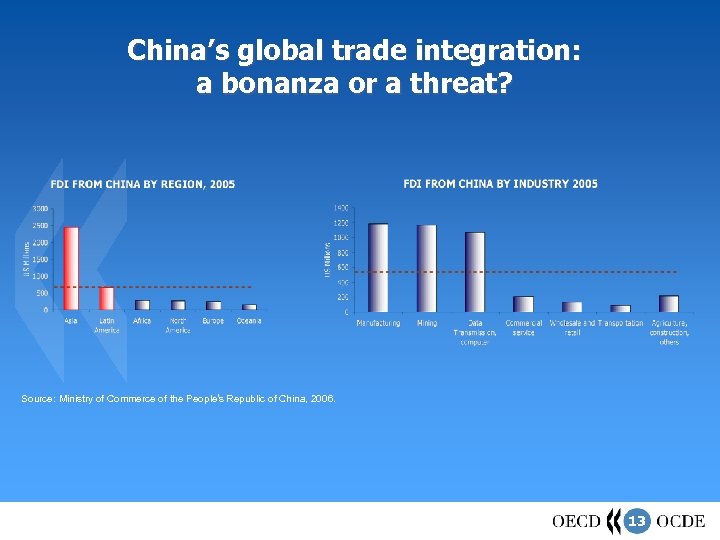
China’s global trade integration: a bonanza or a threat? Source: Ministry of Commerce of the People’s Republic of China, 2006. 13
1 The cognitive effect: new emerging capitalisms. 2 The trade effect: the dark side of the boom. 3 China and India as a wake up call. 14
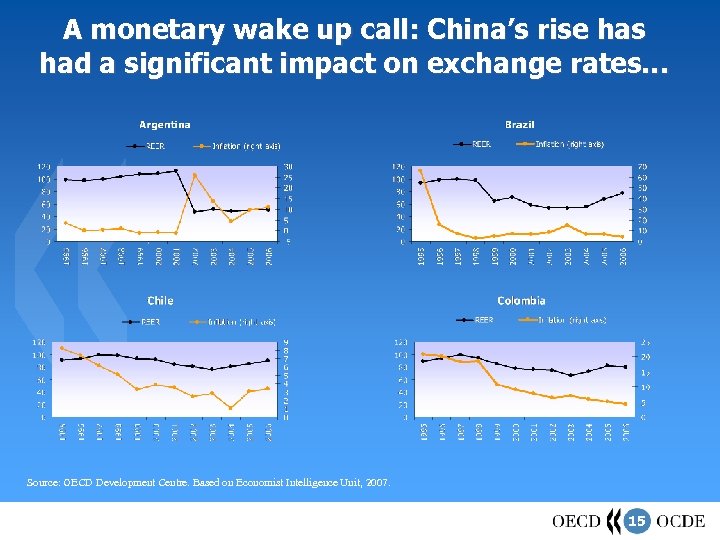
A monetary wake up call: China’s rise has had a significant impact on exchange rates… Source: OECD Development Centre. Based on Economist Intelligence Unit, 2007. 15
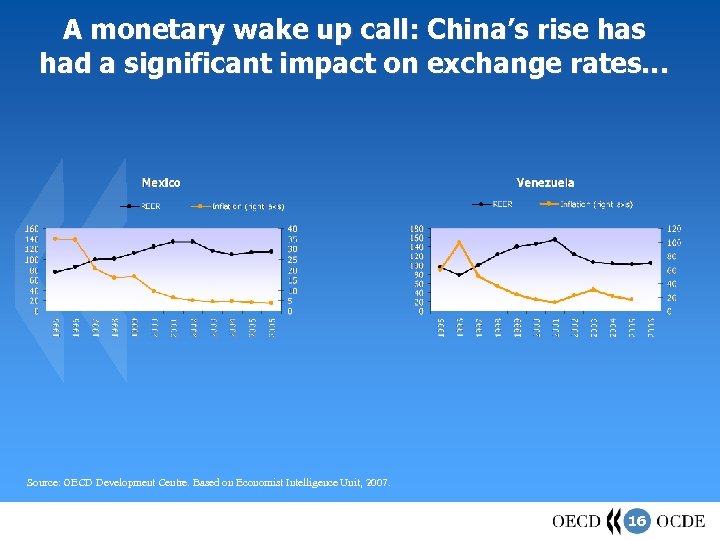
A monetary wake up call: China’s rise has had a significant impact on exchange rates… Source: OECD Development Centre. Based on Economist Intelligence Unit, 2007. 16
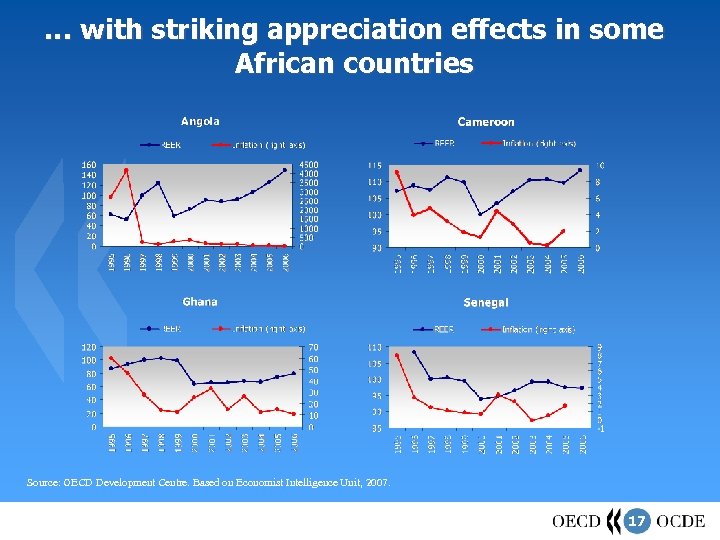
… with striking appreciation effects in some African countries Source: OECD Development Centre. Based on Economist Intelligence Unit, 2007. 17
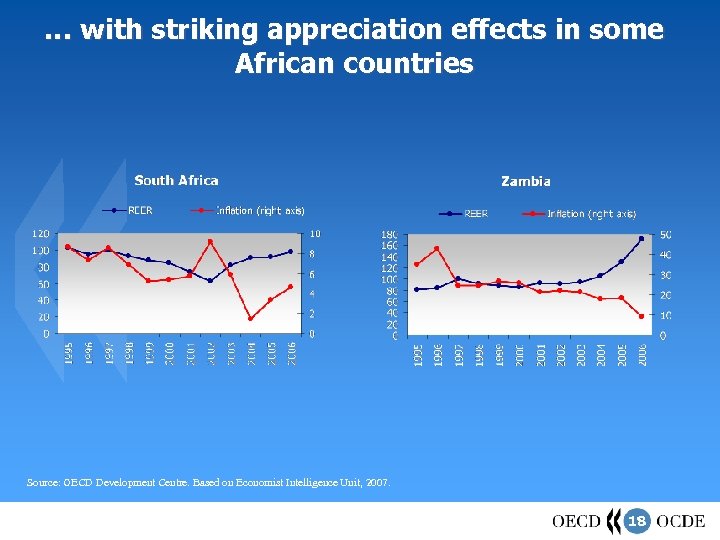
… with striking appreciation effects in some African countries Source: OECD Development Centre. Based on Economist Intelligence Unit, 2007. 18
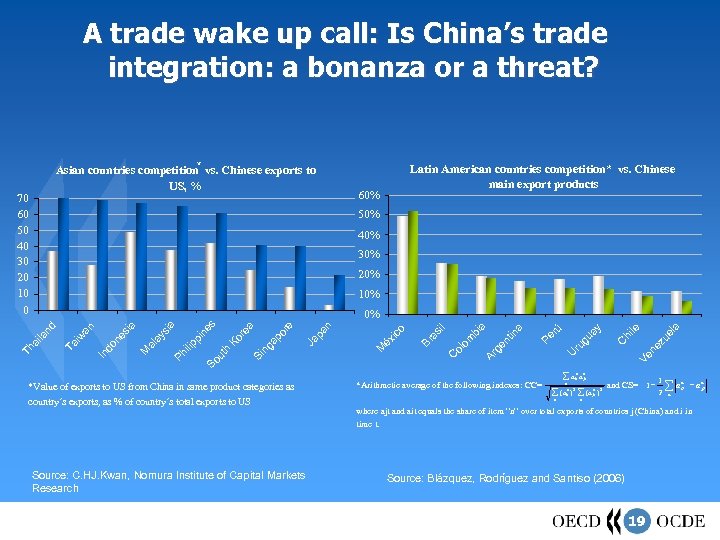
A trade wake up call: Is China’s trade integration: a bonanza or a threat? * Asian countries competition vs. Chinese exports to US, % 70 60 50 40 30 20 10 0 Latin American countries competition* vs. Chinese main export products 60% 50% 40% 30% 20% 10% *Value of exports to US from China in same product categories as country´s exports, as % of country´s total exports to US Source: C. HJ. Kwan, Nomura Institute of Capital Markets Research åa el a hi le Ve ne zu ru g U C ua y rú Pe tin ge n Ar C ol o m bi a a l as i Br ic éx M Ja pa o n re ap o ng Si Ko h ut So ilip pi re a ne s a Ph ay al M do In si ia ne s an iw Ta Th ai la nd 0% n it an jt 1 2 n 1 - å a it - a jt *Arithmetic average of the following indexes: CC= and CS= n n 2 n å (a n it ) å (a jt ) n n where ajt and ait equals the share of item “n” over total exports of countries j (China) and i in time t. Source: Blázquez, Rodríguez and Santiso (2006) 19
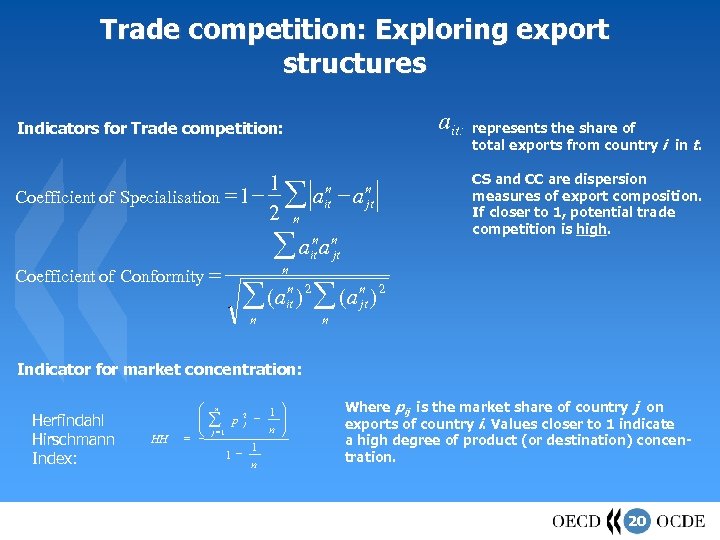
Trade competition: Exploring export structures ait: Indicators for Trade competition: 1 n n Coefficient of Specialisation = 1 - å ait - a jt 2 n n ait a n å jt Coefficient of Conformity = represents the share of total exports from country i in t. CS and CC are dispersion measures of export composition. If closer to 1, potential trade competition is high. n å (aitn )2 å (a njt )2 n n Indicator for market concentration: Herfindahl Hirschmann Index: HH æ ç ç = è n å p j =1 1 - 2 j 1 n ö ÷ ÷ ø Where pij is the market share of country j on exports of country i. Values closer to 1 indicate a high degree of product (or destination) concentration. 20
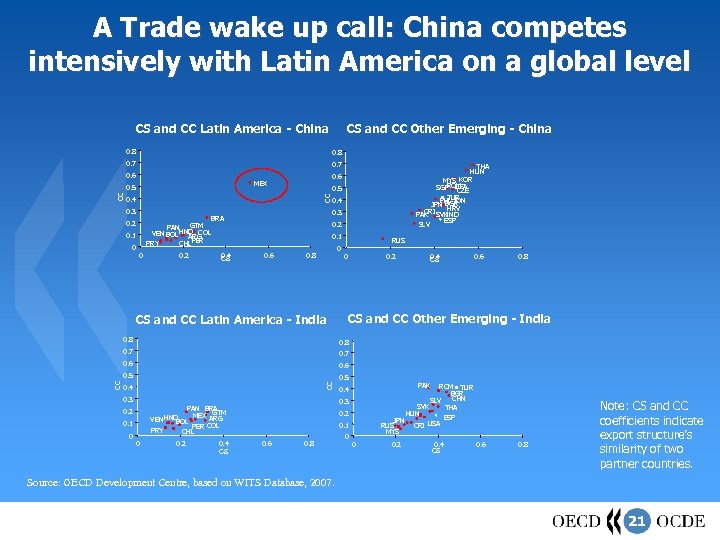
A Trade wake up call: China competes intensively with Latin America on a global level CS and CC Latin America - China CS and CC Other Emerging - China 0. 8 0. 7 0. 6 MEX 0. 5 CC CC 0. 5 0. 4 0. 3 0. 2 PAN GTM VEN BOL HND COL ARG CHLPER PRY 0. 1 0 0 0. 2 THA HUN MYS KOR ROM SGP USA CZE TUR PHL IDN JPN BGR HRV CRI PAK SVK IND ESP SLV 0. 4 0. 3 BRA 0. 2 0. 1 0. 4 CS 0. 6 0 0. 8 CS and CC Latin America - India RUS 0 0. 4 CS 0. 6 0. 8 CS and CC Other Emerging - India 0. 8 0. 7 0. 6 0. 5 CC 0. 8 CC 0. 2 0. 4 0. 3 0. 2 0 PRY 0 PAN BRA GTM MEX ARG PER COL CHL 0. 2 0. 4 CS ROM TUR BGR CHN SVK THA HUN ESP JPN CRI USA RUS MYS SLV 0. 3 0. 2 VEN HND BOL 0. 1 PAK 0. 4 0. 1 0. 6 0. 8 0 0 0. 2 0. 4 CS 0. 6 0. 8 Note: CS and CC coefficients indicate export structure’s similarity of two partner countries. Source: OECD Development Centre, based on WITS Database, 2007. 21
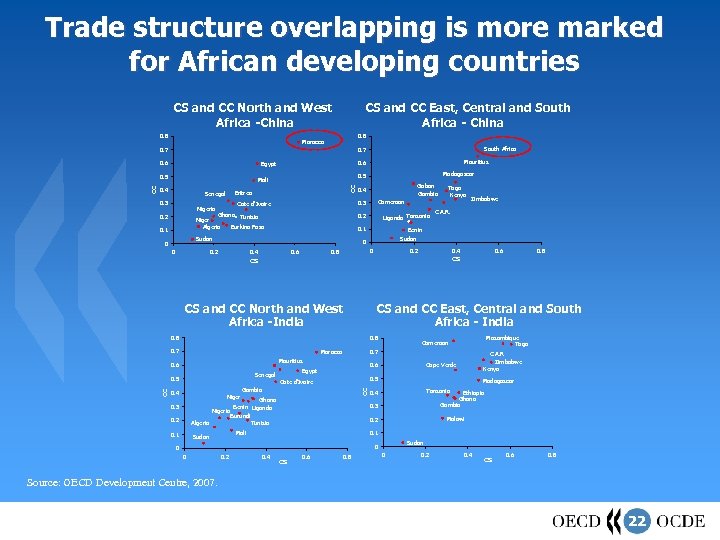
Trade structure overlapping is more marked for African developing countries CS and CC North and West Africa -China 0. 8 CS and CC East, Central and South Africa - China 0. 8 Morocco 0. 7 0. 6 0. 3 CC CC Eritrea Senegal Ghana Tunisia Niger Algeria Burkina Faso 0. 2 0. 1 0 Uganda Tanzania 0. 1 0. 4 CS 0. 6 0 0. 8 CS and CC North and West Africa -India 0. 2 0. 8 Nigeria 0. 2 Algeria 0. 1 Gambia CC Niger 0. 3 Ghana Benin Uganda Burundi Tunisia Madagascar Tanzania 0. 4 Ethiopia Ghana Gambia 0. 3 Malawi 0. 2 0. 1 Mali Sudan 0 0. 2 C. A. R Zimbabwe Kenya Cape Verde 0. 5 Cote d'Ivoire 0. 4 0. 8 Mozambique Togo Cameroon 0. 6 Egypt Senegal 0. 5 0. 6 0. 7 Morocco Mauritius 0. 6 0. 4 CS CS and CC East, Central and South Africa - India 0. 8 0. 7 Zimbabwe C. A. R. Benin Sudan 0 0. 2 Togo Kenya Cameroon 0. 2 Sudan 0 Gabon Gambia 0. 4 0. 3 Cote d'Ivoire Nigeria Madagascar 0. 5 Mali 0. 4 Mauritius 0. 6 Egypt 0. 5 CC South Africa 0. 7 0. 4 CS 0. 6 0. 8 0 0. 2 0. 4 CS 0. 6 0. 8 Source: OECD Development Centre, 2007. 22
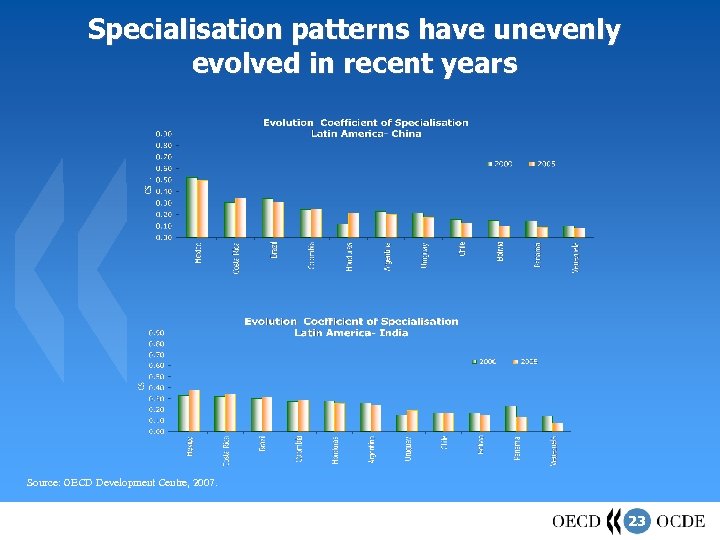
Specialisation patterns have unevenly evolved in recent years Source: OECD Development Centre, 2007. 23
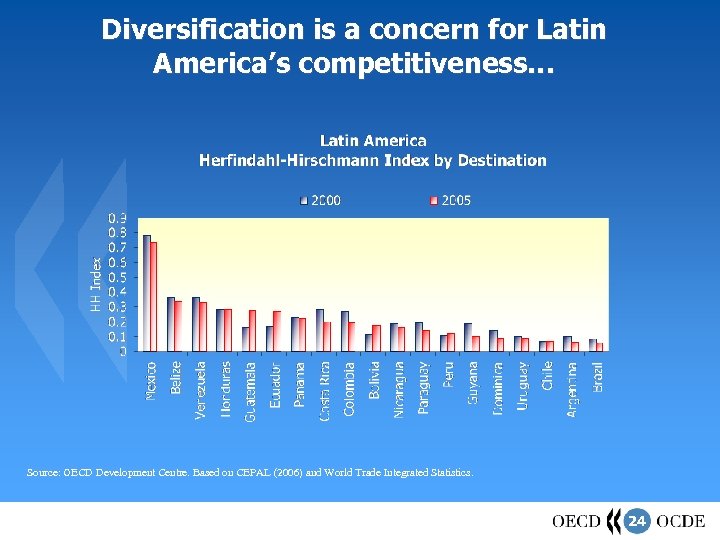
Diversification is a concern for Latin America’s competitiveness… Source: OECD Development Centre. Based on CEPAL (2006) and World Trade Integrated Statistics. 24
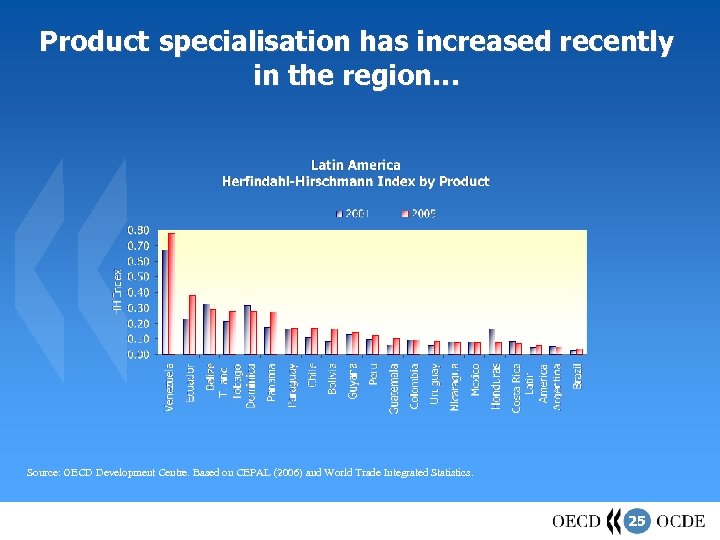
Product specialisation has increased recently in the region… Source: OECD Development Centre. Based on CEPAL (2006) and World Trade Integrated Statistics. 25
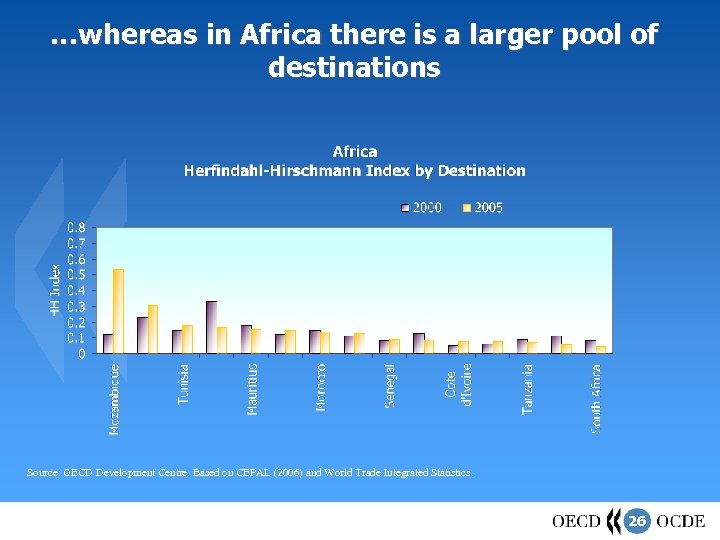
…whereas in Africa there is a larger pool of destinations Source: OECD Development Centre. Based on CEPAL (2006) and World Trade Integrated Statistics. 26
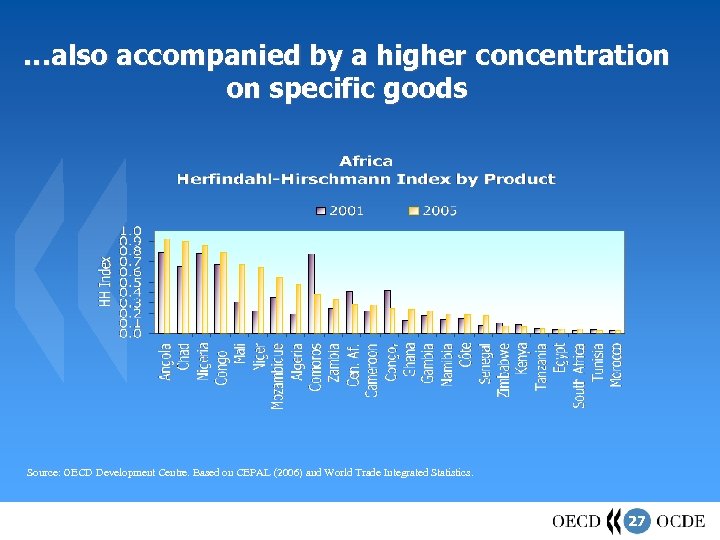
…also accompanied by a higher concentration on specific goods Source: OECD Development Centre. Based on CEPAL (2006) and World Trade Integrated Statistics. 27
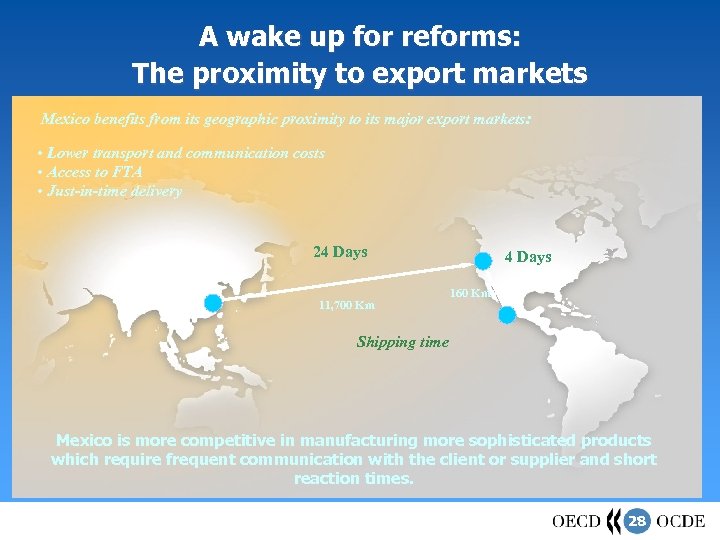
A wake up for reforms: The proximity to export markets Mexico benefits from its geographic proximity to its major export markets: • Lower transport and communication costs • Access to FTA • Just-in-time delivery 24 Days 11, 700 Km 4 Days 160 Km Shipping time Mexico is more competitive in manufacturing more sophisticated products which require frequent communication with the client or supplier and short reaction times. 28
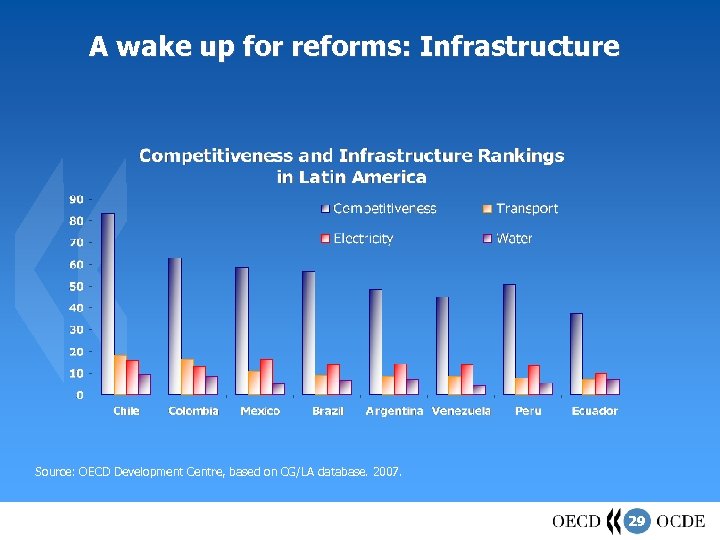
A wake up for reforms: Infrastructure Source: OECD Development Centre, based on CG/LA database. 2007. 29
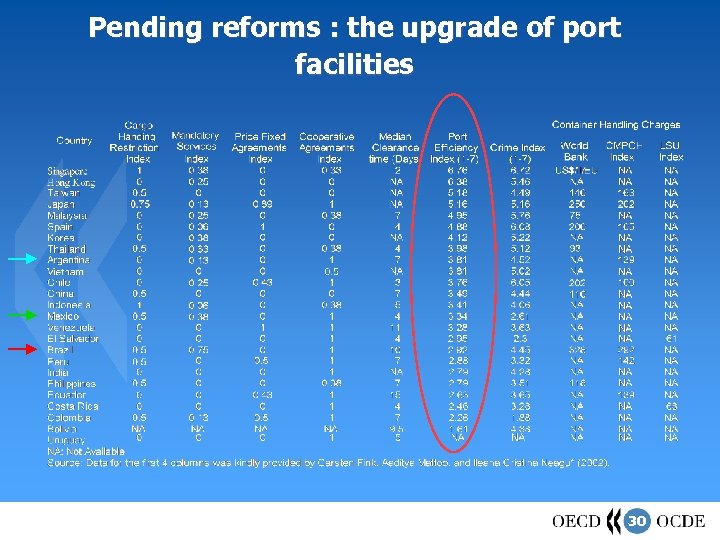
Pending reforms : the upgrade of port facilities 30
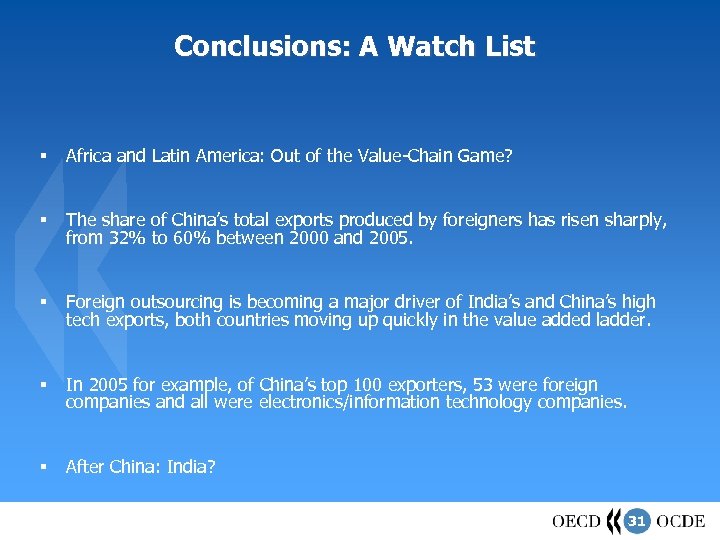
Conclusions: A Watch List § Africa and Latin America: Out of the Value-Chain Game? § The share of China’s total exports produced by foreigners has risen sharply, from 32% to 60% between 2000 and 2005. § Foreign outsourcing is becoming a major driver of India’s and China’s high tech exports, both countries moving up quickly in the value added ladder. § In 2005 for example, of China’s top 100 exporters, 53 were foreign companies and all were electronics/information technology companies. § After China: India? 31
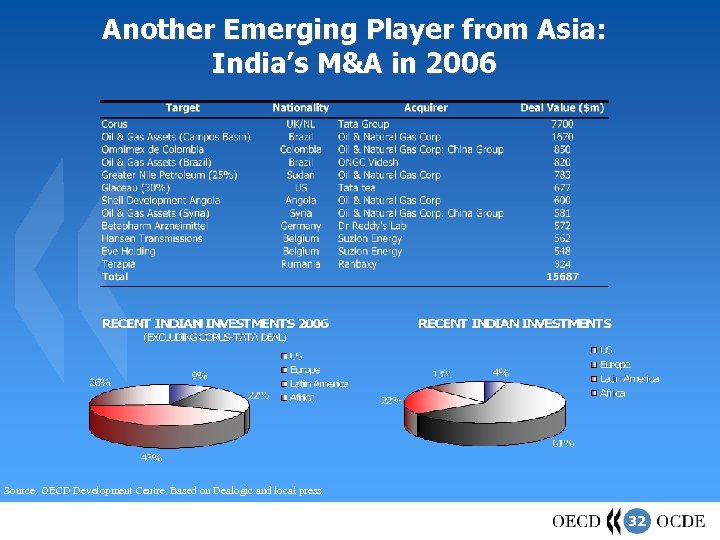
Another Emerging Player from Asia: India’s M&A in 2006 Source: OECD Development Centre. Based on Dealogic and local press. 32
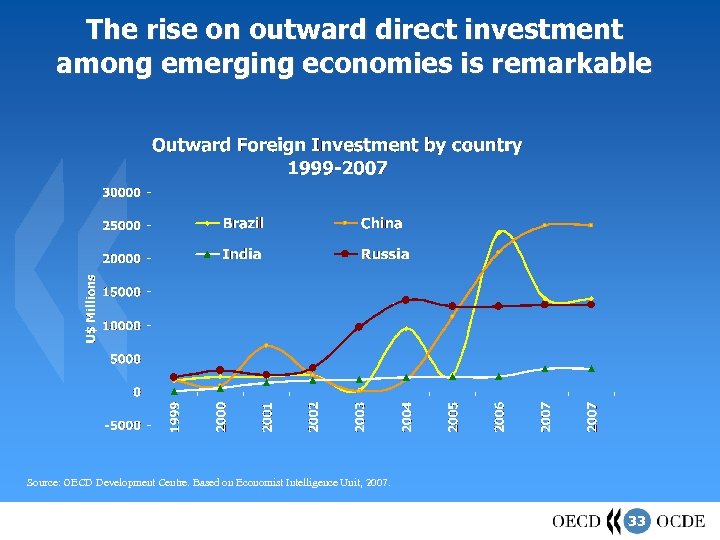
The rise on outward direct investment among emerging economies is remarkable Source: OECD Development Centre. Based on Economist Intelligence Unit, 2007. 33
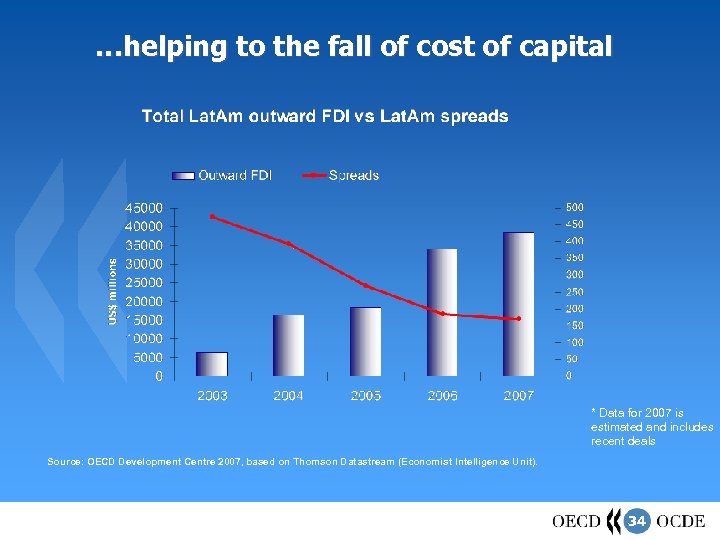
…helping to the fall of cost of capital * Data for 2007 is estimated and includes recent deals Source: OECD Development Centre 2007, based on Thomson Datastream (Economist Intelligence Unit). 34
Thank you Based on: Javier Santiso (ed. ). “The Visible Hand of China in Latin America”. OECD Development Centre Studies, 2007. Javier. santiso@oecd. org
Скачать презентацию The visible hand of China in Latin America
e2794ca00efc2d997a48eb273c57e911.ppt