


 Скачать презентацию The Victorians 1837 -1901 Historical tendencies which
The_Victorians_(1837-1901).ppt
- Количество слайдов: 26
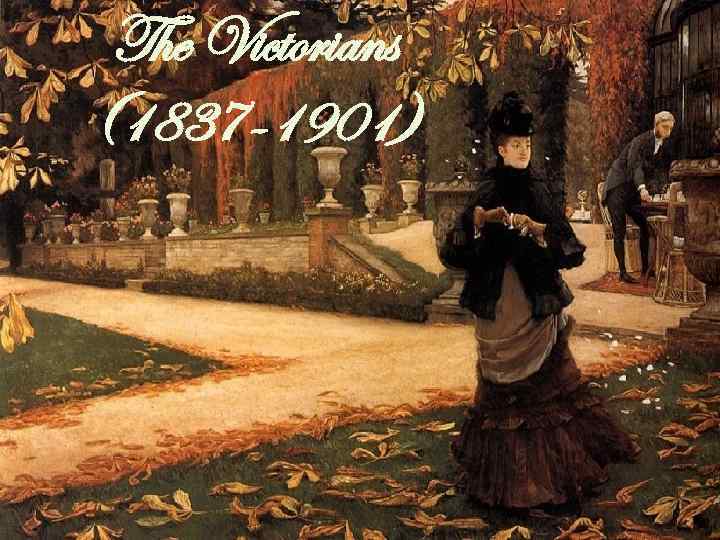 The Victorians (1837 -1901)
 Historical tendencies which have affected life and literature. Political and economical tendencies Tendency of imperialism: 1. This period ruled by Queen Victoria (1837 -1901), Victorian qualities: The United Kingdom expanded its borders into America, Africa, Asia, earnestness, moral responsibility, domestic propriety and Oceania and became the first economic and political world power 2. the Reform Bill of 1832 – Common people by their representatives in the House of Commons are (Somerset Maugham’s “The Moon and Sixpence”, Rudyard Kipling’s the real rulers of England, the privileges of royalty and nobility are “Soldiers Three”) diminished – English government, society and literature have all become more democratic. The masses of men begin to be educated. Writers created works that appeared in answer to the demand for reading matter. 3. London becomes most important city in Europe 4. The Industrial Revolution. – Shift from ownership of land to modern urban economy – Unemployment, poverty, rebellions, working conditions for women and children were terrible
 Main periods • The Early Victorian period (1830 -1848) is described as romantic and sentimental, the youth, courtship and marriage of the queen Victoria reflected literature of that time. Early Victorian works were highly descriptive and emotionally expressive and strove to be earnest and wholesome showing the impact of the British industrial prosperity on the working class life. • The Mid-Victorian period (1848 -1870) is characterized by prosperity, stability and optimism that reflected in the literary works • The Late Victorian period (1870 -1901) A great impact on the works of this period made the decay of social values, economic instability, the British imperialism, international conflicts and socialism.
 The main literary tendencies 1. In the early Victorian period the Victorian social humanitarianism is merely the developed form of the eighteenth century romantic democratic impulse. 2. Beginning with the Mid-Victorian period writer’s realism tried to show "life as it was": - a reaction to Romanticism - stress on reason and positivism - features of scientific scepticism 3. The most important literature of the whole period are literature for children and popular literature 4. Prose: The beginning of the lyric prose that communicates ideas expressing it beautifully. Genres: novels, essays, short stories, prose fiction, tales 5. Women wrote and published their works in which the major characters were women struggling to survive and adopting to the situation (the Brontes, Jane Austin). 6. Children became the main characters of the novels (Charles Dickens)
 Novel • Novels are the most important literary form of the period • Novels represent a large social world with a variety of classes and were read by an educated middle class Major themes 1. The place of the individual in society (Subthemes: middle class, children, poverty family, position of women, business) 2. The British imperialism • The protagonist’s search for fulfillment is symbolical of the human condition. • Characters are idealized portraits of difficult lives in which hard work, perseverance, love and luck win out in the end. Virtue would be rewarded and wrongdoers are suitably punished. • Writers told about the time they lived in (Charles Dickens, the Brontes) • Novel was also a form of entertainment • Novels: “The Great Expectations” by Charles Dickens, “Jane Eyre” by Charlotte Bronte)
 Poetry 1. Some features of Romanticism remain in poetry of the early Victorian period – – The use of archaic language and the revision of many old forms (the mixture of lyric and elegy which influenced the development of epigram) Experimentation with genres. Some poets continued the movement of colloquial diction into poetry (Robert Browning) 2. Poets tried new ways of telling stories in verse 3. Dramatic monologue (Alfred Tennyson) 4. Poets use detail to construct visual images that represent the emotion or situation the poem concerns. ( Thomas Hardy)
 Theatre • The theater was a flourishing and popular institution during the Victorian period. • Comedy became popular (Bernard Shaw and Oscar Wilde) • The popularity of theater influenced other genres.
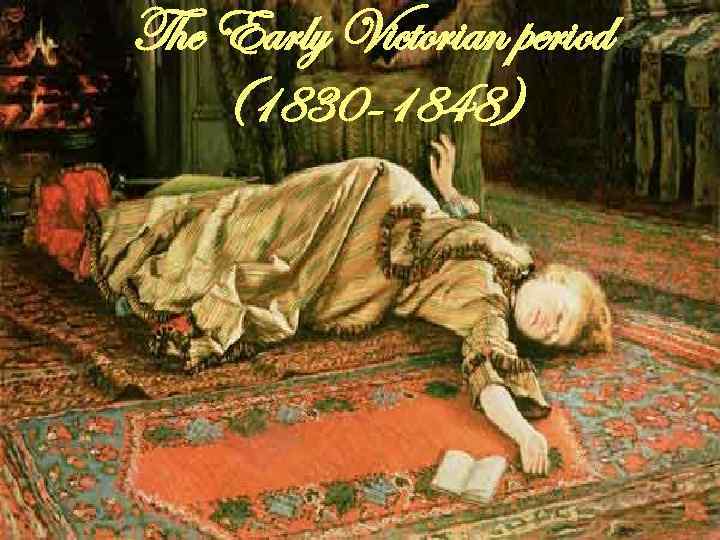 The Early Victorian period (1830 -1848)
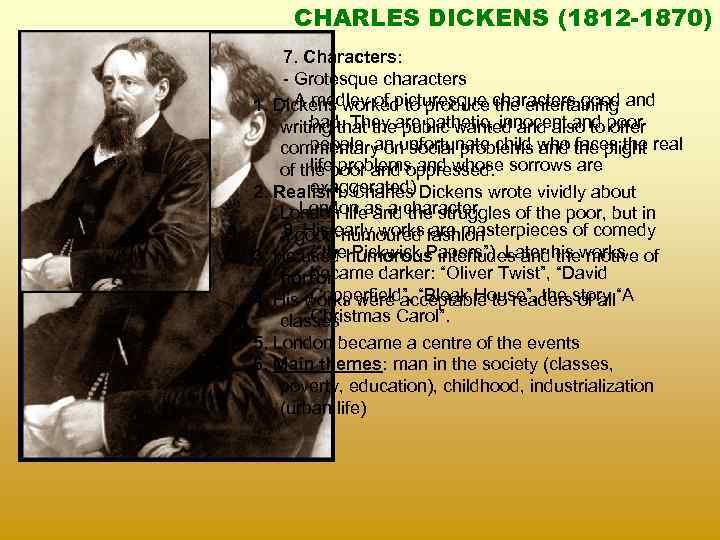 CHARLES DICKENS (1812 -1870) 7. Characters: - Grotesque characters - A medley of picturesque characters good and 1. Dickens worked to produce the entertaining bad. They are pathetic, innocent and poor writing that the public wanted and also to offer people, an unfortunate child who faces the real commentary on social problems and the plight life problems and whose sorrows are of the poor and oppressed. exaggerated) 2. Realism: Charles Dickens wrote vividly about - London as a character London life and the struggles of the poor, but in 8. His early works are masterpieces of comedy a good-humoured fashion (“the Pickwick Papers”). Later his works 3. He used humorous interludes and the motive of became darker: “Oliver Twist”, “David horror Copperfield”, “Bleak House”, the story “A 4. His works were acceptable to readers of all Christmas Carol”. classes 5. London became a centre of the events 6. Main themes: man in the society (classes, poverty, education), childhood, industrialization (urban life)
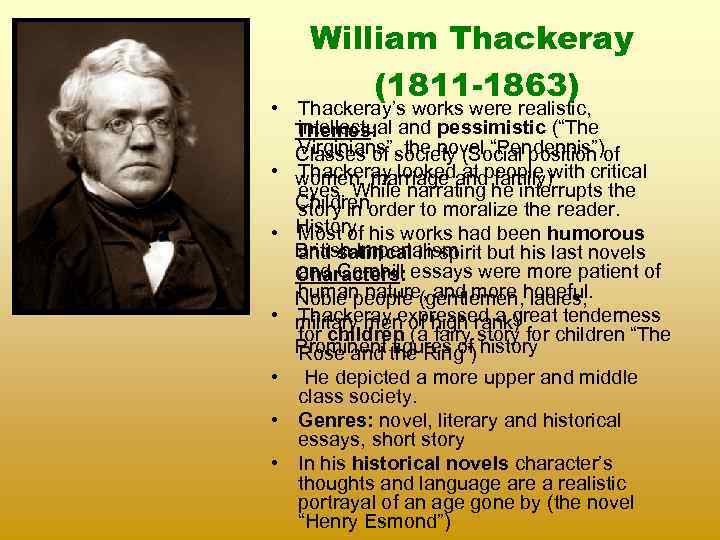 William Thackeray (1811 -1863) • Thackeray’s works were realistic, intellectual and pessimistic (“The Themes: Virginians”, the novel “Pendennis”) Classes of society (Social position of • women, marriage and family) Thackeray looked at people with critical eyes. While narrating he interrupts the Children story in order to moralize the reader. • History Most of his works had been humorous British Imperialism and satirical in spirit but his last novels and Cornhill essays were more patient of Characters: human nature, and more hopeful. Noble people (gentlemen, ladies, • military men of high rank) Thackeray expressed a great tenderness for children (a fairy story for children “The Prominent figures of history Rose and the Ring”) • He depicted a more upper and middle class society. • Genres: novel, literary and historical essays, short story • In historical novels character’s thoughts and language are a realistic portrayal of an age gone by (the novel “Henry Esmond”)
 “The Vanity Fair, A Novel without a Hero” (1848) • “Vanity Fair” was Thackeray’s first notable satire and the foundation of reputation as a writer for the upper classes. • Thackeray makes his novel a moralizing exposition of the shams of society. Thackeray explains in his preface that characters are “mere puppets, ” which must move when he pulls the strings. • By contrasting lives of the two characters, the unprincipled Becky Sharp and the spineless Amelia, Thackeray shows a variety of fools and snobs, mostly well-drawn, all carefully analyzed to point on the weakness or villainy
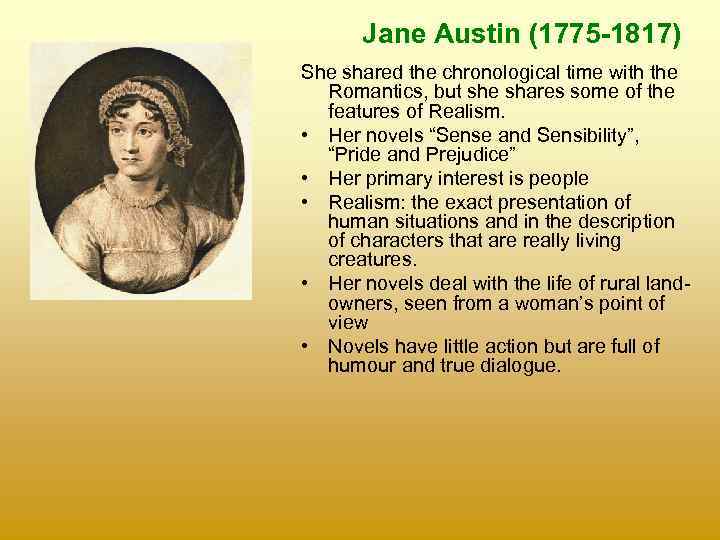 Jane Austin (1775 -1817) She shared the chronological time with the Romantics, but she shares some of the features of Realism. • Her novels “Sense and Sensibility”, “Pride and Prejudice” • Her primary interest is people • Realism: the exact presentation of human situations and in the description of characters that are really living creatures. • Her novels deal with the life of rural landowners, seen from a woman’s point of view • Novels have little action but are full of humour and true dialogue.
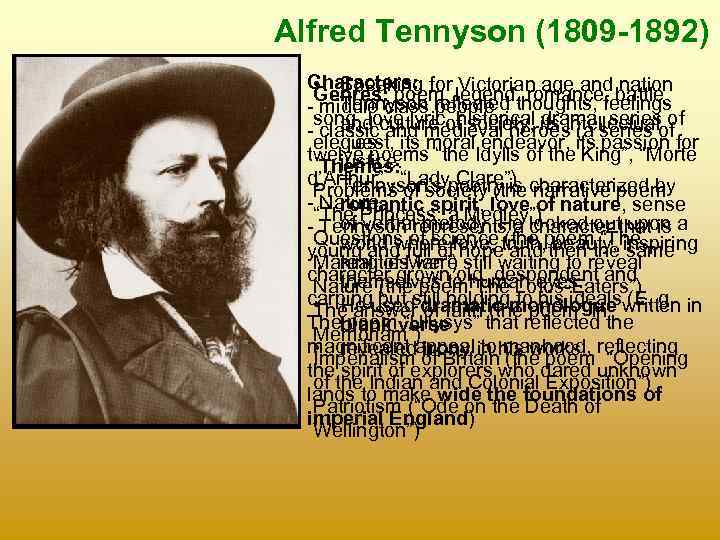 Alfred Tennyson (1809 -1892) Characters: • Speaking for Victorian age and nation Genres: poem, legend, romance, battle Tennyson reflected thoughts, feelings - middle class people song, love lyric, historical drama, series of and culture of society, its intellectual - classic and medieval heroes (a series of quest, its moral endeavor, its passion for elegies twelve poems “the Idylls of the King”, “Morte justice. Themes: d’Arthur” , “Lady Clare”) • Tennyson’s poetry is characterized by Problems of society (the narrative poem - Nature romantic spirit, love of nature, sense “The Princess: a Medley”) of verbal melody. He looked out upon a - Tennyson represents a character that is Questions of science (the poem “The world where love, truth, beauty, inspiring young and full of hope and then the same realities were still waiting to reveal Making of Man”) character grown old, despondent and themselves to human eyes. Nature (the poem“The Lotos-Eaters”) carping but still holding to his ideals (E. g. • He used dramatic monologue written in The answer of faith (the poem“ In The poem “Ullysys” that reflected the blank verse Memoriam”) magnificent appeal to manhood, reflecting • revealed irony in his works Imperialism of Britain (the poem “Opening the spirit of explorers who dared unknown of the Indian and Colonial Exposition”) lands to make wide the foundations of Patriotism (“Ode on the Death of imperial England) Wellington”)
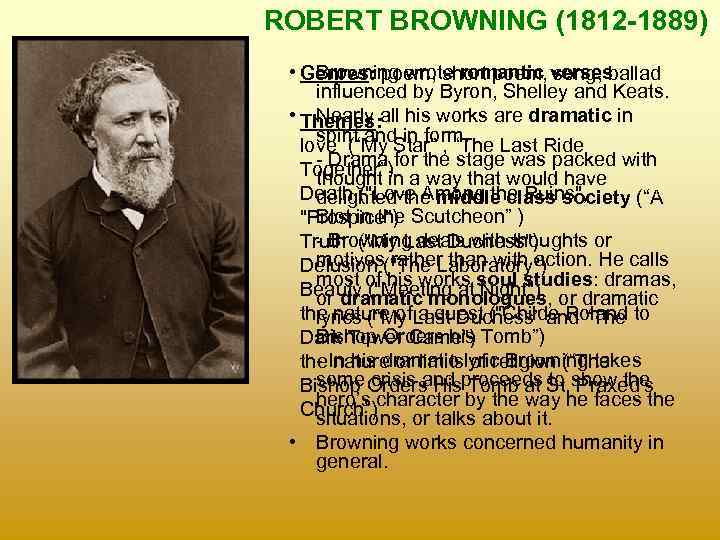 ROBERT BROWNING (1812 -1889) • Genres: poem, short poem, song, ballad Browning wrote romantic verses influenced by Byron, Shelley and Keats. • Themes: Nearly all his works are dramatic in spirit and in form. love (“My Star” , “The Last Ride - Drama for the stage was packed with Together”) thought in a way that would have Death ("Love Among the Ruins", delighted the middle class society (“A Blot in the Scutcheon” ) "Prospice") - Browning deals with thoughts or Truth ("My Last Duchess") motives rather than with action. He calls Delusion ("The Laboratory") most of his works soul studies: dramas, Beauty ("Meeting at Night") or dramatic monologues, or dramatic the nature of a quest ("Childe Roland to lyrics (“My Last Duchess” and “The Bishop Orders his Tomb”) Dark Tower Came") - In his dramatic lyric Browning takes the nature or limits of religion (“The some crisis and proceeds to show the Bishop Orders His Tomb at St. Praxed's hero’s character by the way he faces the Church”) situations, or talks about it. • Browning works concerned humanity in general.
 The Mid-Victorian period 1848 -1870
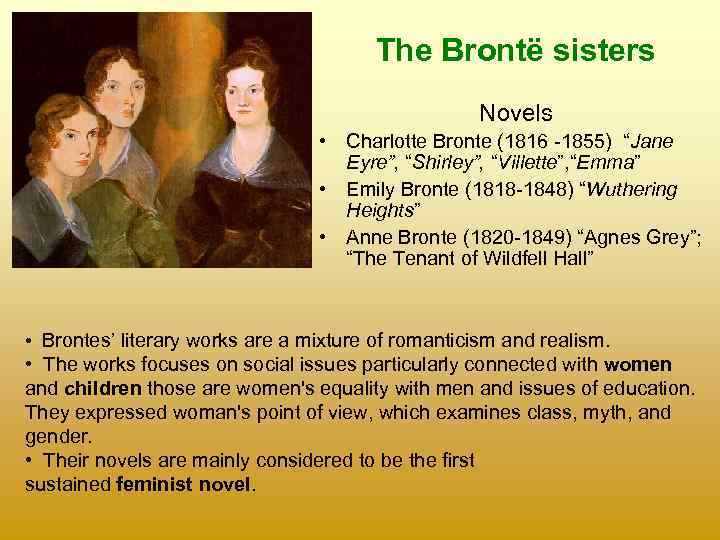 The Brontë sisters Novels • Charlotte Bronte (1816 -1855) “Jane Eyre”, “Shirley”, “Villette”, “Emma” • Emily Bronte (1818 -1848) “Wuthering Heights” • Anne Bronte (1820 -1849) “Agnes Grey”; “The Tenant of Wildfell Hall” • Brontes’ literary works are a mixture of romanticism and realism. • The works focuses on social issues particularly connected with women and children those are women's equality with men and issues of education. They expressed woman's point of view, which examines class, myth, and gender. • Their novels are mainly considered to be the first sustained feminist novel.
 The Brontë sisters • Spirituality of the landscape and the strength of religious feeling are reflected in their novels • Gothic Romanticism ( “Jane Eyre”) a romantic novel with the supernatural elements of the "horrors" of the mysterious adventure and mysticism (family curse and ghosts). The action of the novels are often set in the old Gothic castle. • Themes: women in society(working women, women’s rights, education, love) • Characters are endowed with strong emotions, courage, solid moral principles, the ability to make independent decisions.
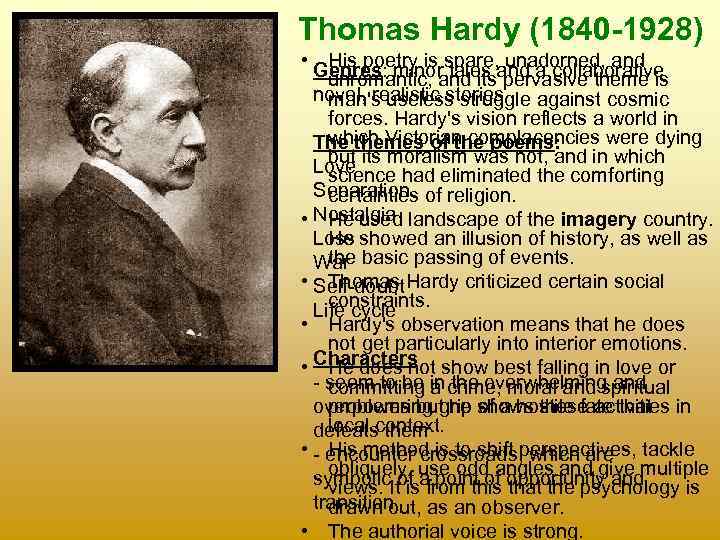 Thomas Hardy (1840 -1928) • Genres: minor tales and a collaborative His poetry is spare, unadorned, and unromantic, and its pervasive theme is novel, realistic stories man's useless struggle against cosmic forces. Hardy's vision reflects a world in which Victorian complacencies were dying The themes of the poems: but its moralism was not, and in which Love science had eliminated the comforting Separation certainties of religion. • Nostalgia He used landscape of the imagery country. He showed an illusion of history, as well as Loss the basic passing of events. War • Self-doubt Thomas Hardy criticized certain social constraints. Life cycle • Hardy's observation means that he does not get particularly into interior emotions. • Characters He does not show best falling in love or - seem to be in the overwhelming and committing a crime, moral and spiritual problems but he shows these activities in overpowering grip of a hostile fate that local context. defeats them • - encounter crossroads, which are His method is to shift perspectives, tackle obliquely, use odd angles and give multiple symbolic of a point of opportunity and views. It is from this that the psychology is transition. drawn out, as an observer. • The authorial voice is strong.
 The Late Victorian period 1870 -1901
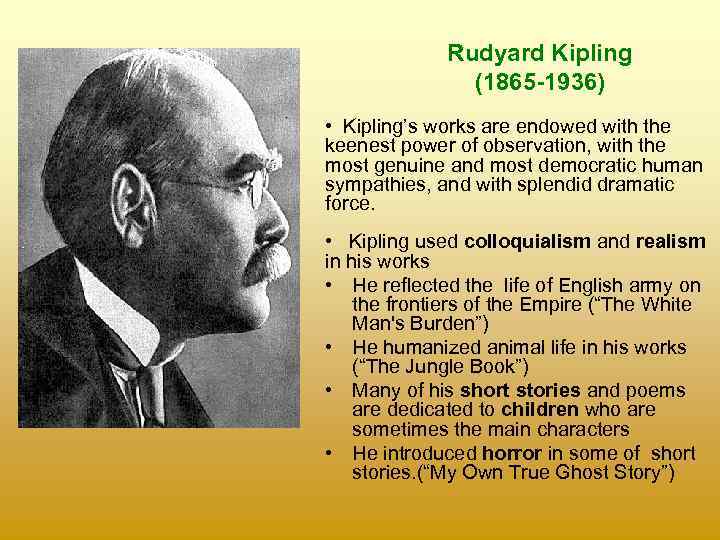 Rudyard Kipling (1865 -1936) • Kipling’s works are endowed with the keenest power of observation, with the most genuine and most democratic human sympathies, and with splendid dramatic force. • Kipling used colloquialism and realism in his works • He reflected the life of English army on the frontiers of the Empire (“The White Man's Burden”) • He humanized animal life in his works (“The Jungle Book”) • Many of his short stories and poems are dedicated to children who are sometimes the main characters • He introduced horror in some of short stories. (“My Own True Ghost Story”)
 “Danny Deever” “…What makes the rear-rank breathe so 'ard? " said Files-on-Parade. "It's bitter cold, it's bitter cold, " the Colour-Sergeant said. "What makes that front-rank man fall down? " said Files-on-Parade. "A touch o' sun, a touch o' sun, " the Colour-Sergeant said. They are hangin' Danny Deever, they are marchin' of 'im round, They 'ave 'alted Danny Deever by 'is coffin on the ground; An' e'll swing in 'arf a minute for a sneakin' shootin' hound they're hangin' Danny Deever in the mornin'!. . . ”
 Rudyard Kipling (1865 -1936) Genres: short-story, novel, tales and poems. Themes: The British imperialism(India, racism) Religion Society (work, childhood, education) Nature History Death Characters: the English common soldier Children Humanized animals Ihnabitants of the colonized countries middle class people Stories: "Rikki-Tavi", “Kim” Poems: “If-”, “When earth's last picture is painted”, “Dane-geld”, “the King’s Job”, “A Death-Bed”
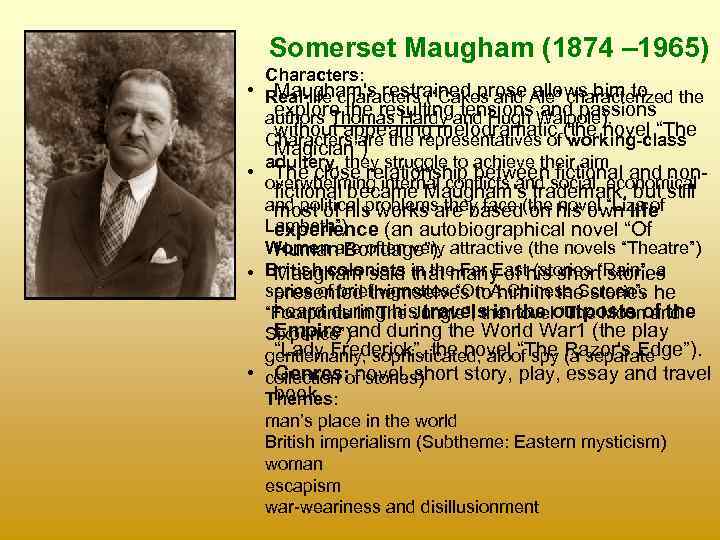 Somerset Maugham (1874 – 1965) • • Characters: Maugham's restrained prose allows him to Real-life characters (“Cakes and Ale” characterized the explore the resulting tensions and passions authors Thomas Hardy and Hugh Walpole). without appearing melodramatic (the novel “The Characters are the representatives of working-class Magician”) adultery, they struggle to achieve their aim The close relationship between fictional and nonoverwhelming internal conflicts and social, economical fictional became Maugham's trademark, but still and political problems they face (the novel “Liza of most of his works are based on his own life Lambeth”) experience (an autobiographical novel “Of Women are often very attractive (the novels “Theatre”) Human Bondage”). British colonists in the Far East (stories “Rain”, a Maugham said that many of his short stories series of brief vignettes “On A Chinese Screen”, presented themselves to him in the stories he heard during his travels in the outposts of the “Footprints In The Jungle”, the novel “The Moon and Empire and during the World War 1 (the play Sixpence”) “Lady Frederick”, the novel “The Razor's Edge”). gentlemanly, sophisticated, aloof spy (a separate Genres: novel, short story, play, essay and travel collection of stories) book Themes: man’s place in the world British imperialism (Subtheme: Eastern mysticism) woman escapism war-weariness and disillusionment
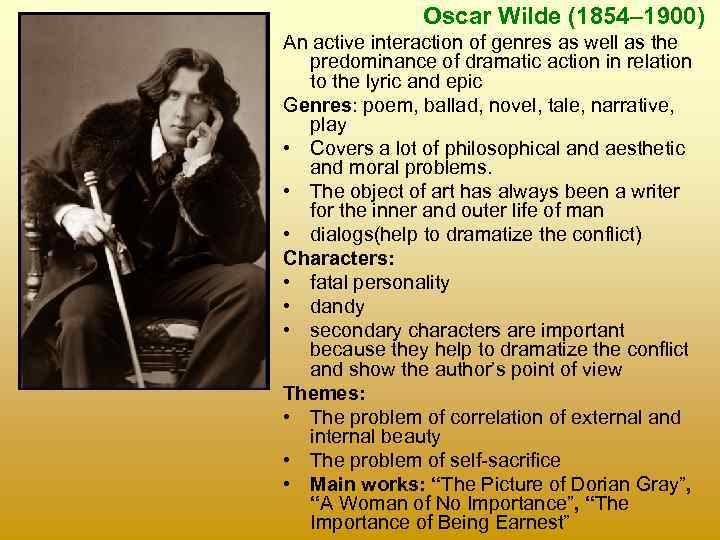 Oscar Wilde (1854– 1900) An active interaction of genres as well as the predominance of dramatic action in relation to the lyric and epic Genres: poem, ballad, novel, tale, narrative, play • Covers a lot of philosophical and aesthetic and moral problems. • The object of art has always been a writer for the inner and outer life of man • dialogs(help to dramatize the conflict) Characters: • fatal personality • dandy • secondary characters are important because they help to dramatize the conflict and show the author’s point of view Themes: • The problem of correlation of external and internal beauty • The problem of self-sacrifice • Main works: “The Picture of Dorian Gray”, “A Woman of No Importance”, “The Importance of Being Earnest”
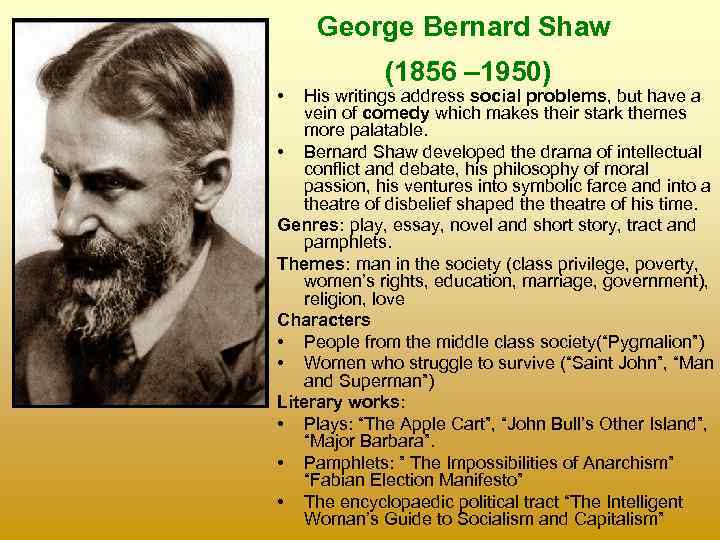 George Bernard Shaw • (1856 – 1950) His writings address social problems, but have a vein of comedy which makes their stark themes more palatable. • Bernard Shaw developed the drama of intellectual conflict and debate, his philosophy of moral passion, his ventures into symbolic farce and into a theatre of disbelief shaped theatre of his time. Genres: play, essay, novel and short story, tract and pamphlets. Themes: man in the society (class privilege, poverty, women’s rights, education, marriage, government), religion, love Characters • People from the middle class society(“Pygmalion”) • Women who struggle to survive (“Saint John”, “Man and Superman”) Literary works: • Plays: “The Apple Cart”, “John Bull’s Other Island”, “Major Barbara”. • Pamphlets: ” The Impossibilities of Anarchism” “Fabian Election Manifesto” • The encyclopaedic political tract “The Intelligent Woman’s Guide to Socialism and Capitalism”
 Thank you for attention