 Скачать презентацию The Victorian Ombudsman s investigation into ICTenabled projects Erin
c8e85a5d7d222ba645a2fcdc06960d66.ppt
- Количество слайдов: 24



The Victorian Ombudsman’s investigation into ICTenabled projects Erin Barlow, Manager of Investigations
Session overview Background • Ombudsman’s role • Annual report 2010 -11 • Ombudsman’s powers ICT report • Background • Scope • Objectives and methodology • Conclusion • Recommendations Questions 1

Background
Ombudsman’s role • Independent • Takes complaints • 25, 569 approaches between 2010 -11 • Makes recommendations • Reports to Parliament 3
Ombudsman Act 1973 The principal function of the Ombudsman is to enquire into and/or investigate any administrative action taken by public authorities (government departments, public statutory body, member or staff of a municipal council) 4
Annual Report 2010
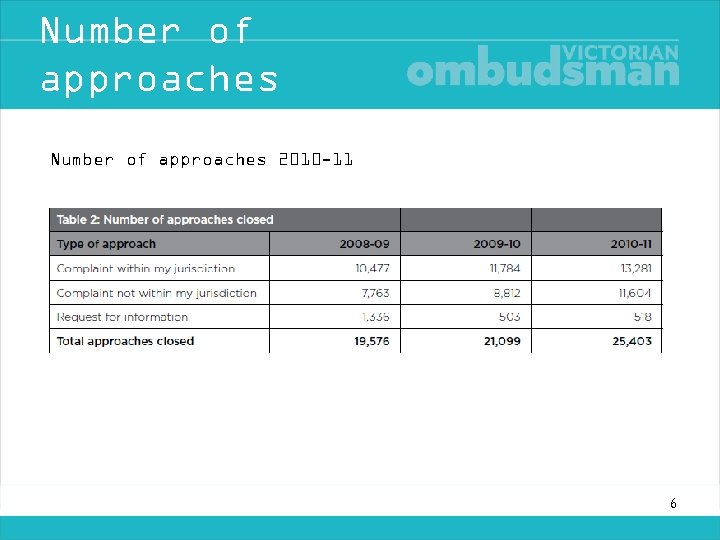
Number of approaches 2010 -11 6
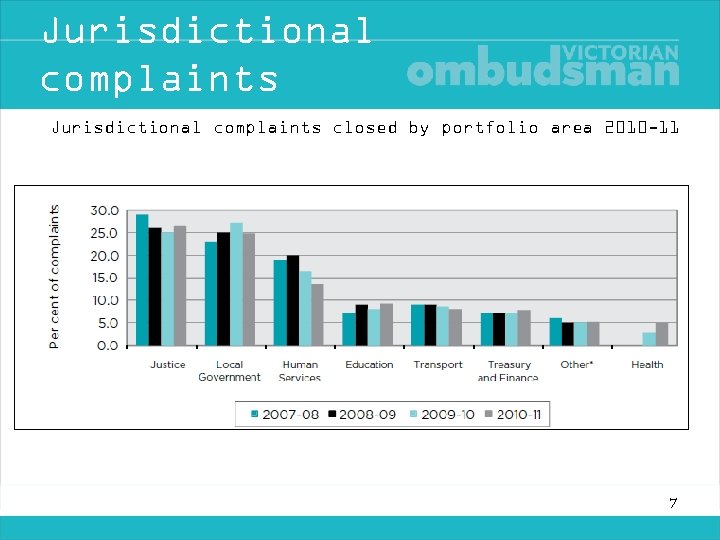
Jurisdictional complaints closed by portfolio area 2010 -11 7

Powers
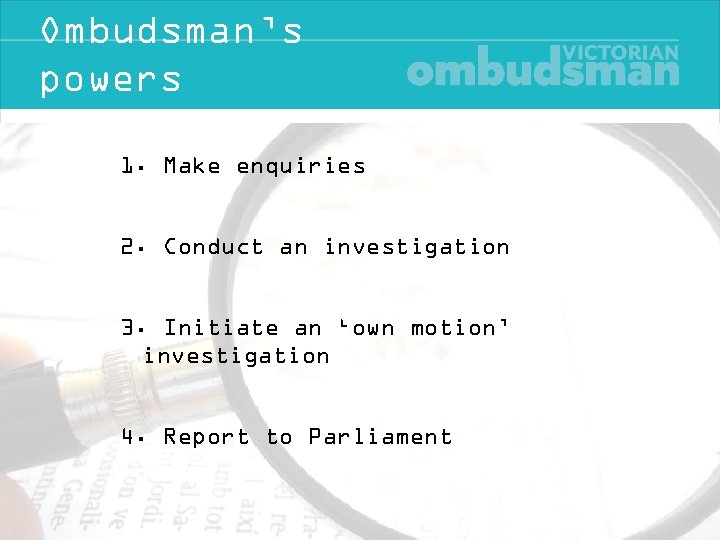
Ombudsman’s powers 1. Make enquiries 2. Conduct an investigation 3. Initiate an ‘own motion’ investigation 4. Report to Parliament 9
Parliamentary reports November 2011 Investigation into the Foodbowl Modernisation Project and related matter November 2011 Own-motion investigation into ICT enabled projects October 2011 Investigation into how universities deal with international students October 2011 Investigation regarding the Department of Human Services Child Protection program (Loddon Mallee) October 2011 Investigation into the Office of Police Integrity’s handling of a complaint September 2011 Safe. Streets Documents- Investigation into Victoria Police’s handling of a Freedom of Information request 10
Own motion investigation into ICT-enabled projects
Background • What is ICT? Information and communications technology • History of ICT failures: state, national and international level • Ombudsman and Auditor-General reports on ICT • Little signs of lessons learnt • Ombudsman and Auditor-General agreed to investigate • April 2011: Ombudsman commenced own motion investigation under section 14 of the Ombudsman Act 1973 • Conducted in consultation with the Victorian Auditor-General’s Office (VAGO) 12
Scope • Examined 10 ICT-enabled projects: – Link (Victoria Police) – Health. SMART (Department of Health) – myki (Transport Ticketing Authority) – Registration and Licensing – Rand. L (Vic. Roads) – Client Relationship Information System – CRIS (Department of Human Services) – Ultranet (Department of Education and Early Childhood Development) – Integrated Courts Management System – ICMS (Department of Justice) – Property and Laboratory Management – PALM (Victoria Police) – HRAssist (Victoria Police) – Housing Integrated Information Program – HIIP (Office of Housing). 13
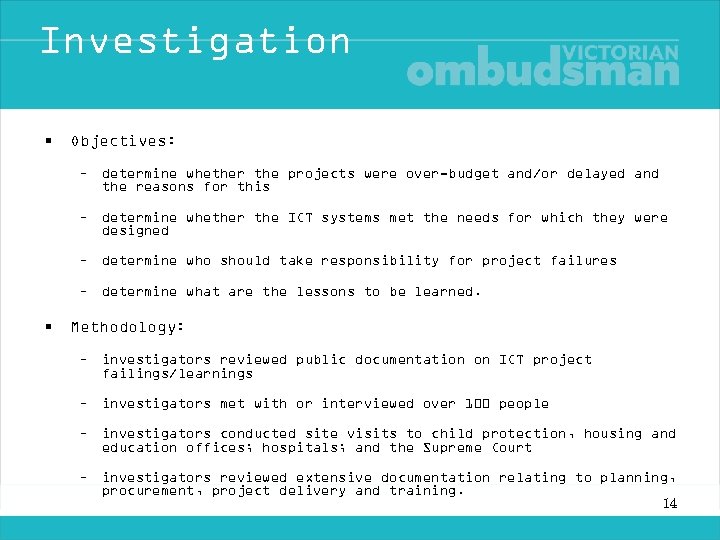
Investigation • Objectives: – determine whether the projects were over-budget and/or delayed and the reasons for this – determine whether the ICT systems met the needs for which they were designed – determine who should take responsibility for project failures – determine what are the lessons to be learned. • Methodology: – investigators reviewed public documentation on ICT project failings/learnings – investigators met with or interviewed over 100 people – investigators conducted site visits to child protection, housing and education offices; hospitals; and the Supreme Court – investigators reviewed extensive documentation relating to planning, procurement, project delivery and training. 14
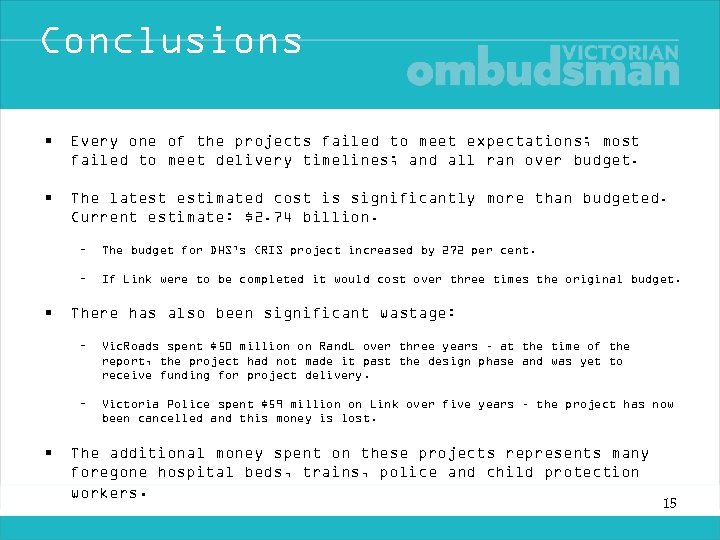
Conclusions • Every one of the projects failed to meet expectations; most failed to meet delivery timelines; and all ran over budget. • The latest estimated cost is significantly more than budgeted. Current estimate: $2. 74 billion. – – • The budget for DHS’s CRIS project increased by 272 per cent. If Link were to be completed it would cost over three times the original budget. There has also been significant wastage: – – • Vic. Roads spent $50 million on Rand. L over three years – at the time of the report, the project had not made it past the design phase and was yet to receive funding for project delivery. Victoria Police spent $59 million on Link over five years – the project has now been cancelled and this money is lost. The additional money spent on these projects represents many foregone hospital beds, trains, police and child protection workers. 15
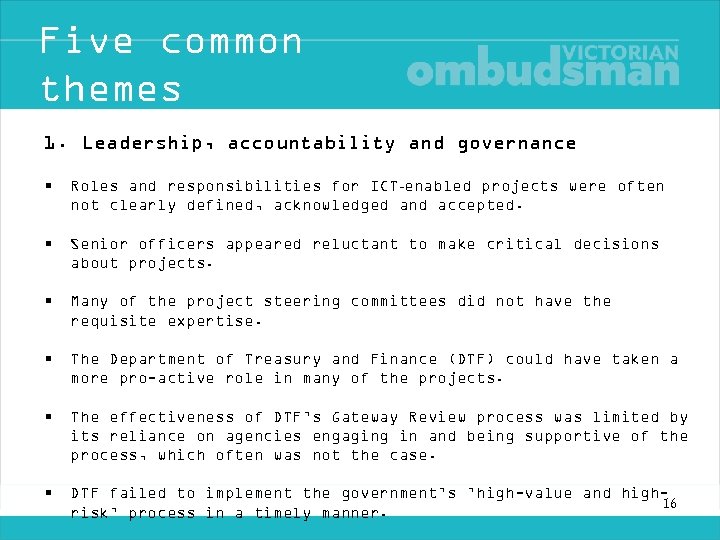
Five common themes 1. Leadership, accountability and governance • Roles and responsibilities for ICT‑enabled projects were often not clearly defined, acknowledged and accepted. • Senior officers appeared reluctant to make critical decisions about projects. • Many of the project steering committees did not have the requisite expertise. • The Department of Treasury and Finance (DTF) could have taken a more pro-active role in many of the projects. • The effectiveness of DTF’s Gateway Review process was limited by its reliance on agencies engaging in and being supportive of the process, which often was not the case. • DTF failed to implement the government’s ’high-value and high 16 risk’ process in a timely manner.
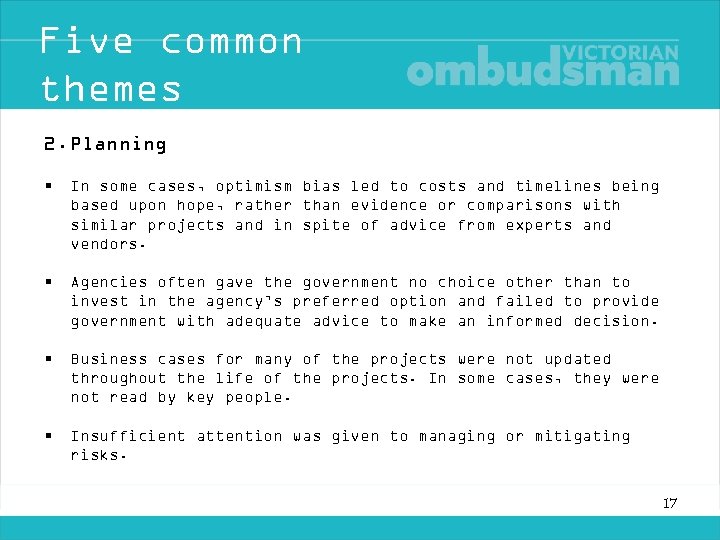
Five common themes 2. Planning • In some cases, optimism bias led to costs and timelines being based upon hope, rather than evidence or comparisons with similar projects and in spite of advice from experts and vendors. • Agencies often gave the government no choice other than to invest in the agency’s preferred option and failed to provide government with adequate advice to make an informed decision. • Business cases for many of the projects were not updated throughout the life of the projects. In some cases, they were not read by key people. • Insufficient attention was given to managing or mitigating risks. 17
Five common themes 3. Funding • Agencies felt the need to create ‘big vision’ projects to capture the government’s attention, which increased complexity and risk. • In some cases the Budget and Expenditure Review Committee (BERC) only partially funded projects, but agencies failed to revise the scope of the project to fit within the allocated budget. • Public announcement of major project funding decisions prior to business case development resulted in business cases being rushed and projects being ‘shoe-horned’ into the published funding ceiling. • The costs and timelines of comparative projects were sometimes ignored. • Projects funded internally have not been subject to the same level of scrutiny as BERC-funded projects. • Agencies were unable to identify the cost of significant projects 18 with any accuracy.
Five common themes 4. Probity and procurement • Agencies appeared to pay limited regard and expended minimal funds on probity advice and audit. • Agency and probity practitioner responses to conflict of interest sometimes failed to recognise the importance of the perception of a conflict of interest. • Agencies tended to purchase off-the-shelf systems and customise them to such a degree that the benefits were lost to government. • The evidence suggests government should explore new procurement methods for ICT-enabled projects. • Large vendors are well-versed and experienced in contract negotiations, putting relatively inexperienced government staff at a disadvantage. 19
Five common themes 5. Project management • Several agencies failed to act with enough urgency to address potential problems and in doing so allowed the issue to escalate. • There is a shortage of skilled senior project managers with relevant ICT experience in government. To compensate, agencies often appoint expensive contractors or inexperienced public sector staff. • Managing vendor and user relationships can be a complex exercise and agencies have adopted differing approaches to this problem with different degrees of success. • Approaches to training staff were varied and not always effective. 20
Recommendations • The framework within which agencies seek funds, manage and review projects needs to be improved. • The scale of the problem suggests that significant ICT‑enabled projects should be treated as a special case at least until the bureaucracy is sufficiently experienced to handle these projects well. • The Ombudsman developed a framework that builds on current guidance and advice from the Auditor‑General and the Department of Treasury and Finance and provides a practical solution to many of the problems commonly encountered. The framework contains 42 recommendations based around the five common themes. • The Ombudsman also made recommendations that suggest a away forward for each of the 10 projects. 21
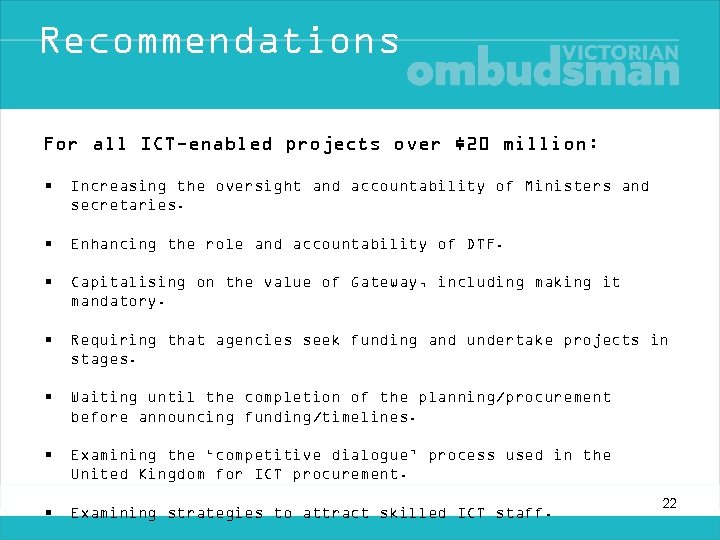
Recommendations For all ICT-enabled projects over $20 million: • Increasing the oversight and accountability of Ministers and secretaries. • Enhancing the role and accountability of DTF. • Capitalising on the value of Gateway, including making it mandatory. • Requiring that agencies seek funding and undertake projects in stages. • Waiting until the completion of the planning/procurement before announcing funding/timelines. • Examining the ‘competitive dialogue’ process used in the United Kingdom for ICT procurement. • Examining strategies to attract skilled ICT staff. 22

Questions? 23
Скачать презентацию The Victorian Ombudsman s investigation into ICTenabled projects Erin
c8e85a5d7d222ba645a2fcdc06960d66.ppt