


 Скачать презентацию The very forward region Tel-Aviv meeting summary 18
bbfa14b0b5355ef6488af1236ec1d404.ppt
- Количество слайдов: 35
 The very forward region Tel-Aviv meeting summary 18 - 19 September, Tel-Aviv, ISRAEL Collaboration High precision design Ronen Ingbir ECFA 2005
 FCAL Collaboration Luminosity detector Goals : design and construction of Beam monitor University of Colorado AGH University, Cracow Photons calorimeter Institute of Nuclear Physics, Cracow Jagellonian University, Cracow DESY Joint Institute Nuclear Research Dubna Institute HEP Protvino National Center of Particle & HEP Minsk Prague Acad. of Science Tel Aviv University Cooperation with: SLAC Iowa State University Wayne State University Collaboration High precision design 2 ECFA 2005
 Photo. Cal Beam diagnostics from beamstrahlung photons Collaboration High precision design 3 ECFA 2005
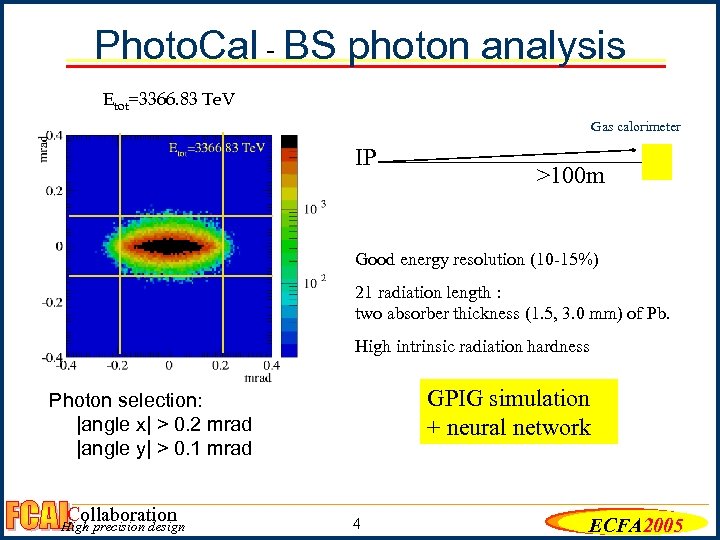 Photo. Cal - BS photon analysis Etot=3366. 83 Te. V Gas calorimeter IP >100 m Good energy resolution (10 -15%) 21 radiation length : two absorber thickness (1. 5, 3. 0 mm) of Pb. High intrinsic radiation hardness GPIG simulation + neural network Photon selection: |angle x| > 0. 2 mrad |angle y| > 0. 1 mrad Collaboration High precision design 4 ECFA 2005
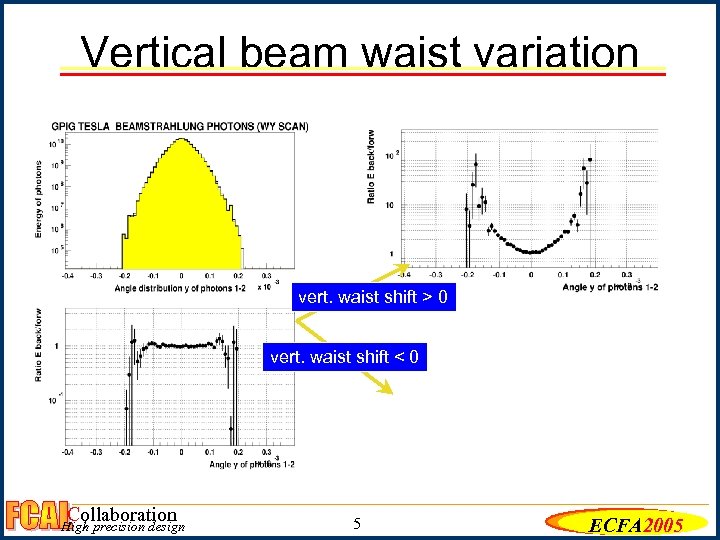 Vertical beam waist variation vert. waist shift > 0 vert. waist shift < 0 Collaboration High precision design 5 ECFA 2005
 Beam. Cal Detection of electrons/photons at low angle Shielding the inner detector Beam diagnostics from beamstrahlung electrons/positron pairs. Collaboration High precision design 6 ECFA 2005
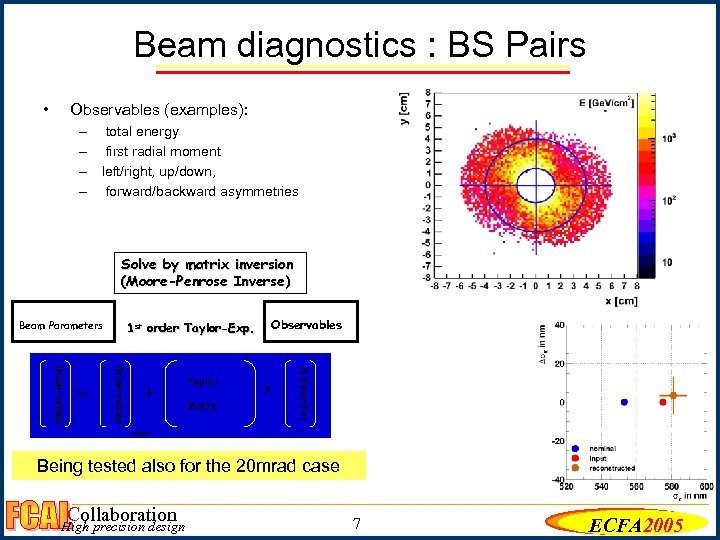 Beam diagnostics : BS Pairs • Observables (examples): – total energy – first radial moment – left/right, up/down, – forward/backward asymmetries Solve by matrix inversion (Moore-Penrose Inverse) Beam Parameters + Taylor Matrix * Δ Beam. Par Observables = Observables 1 st order Taylor-Exp. nom Being tested also for the 20 mrad case Collaboration High precision design 7 ECFA 2005
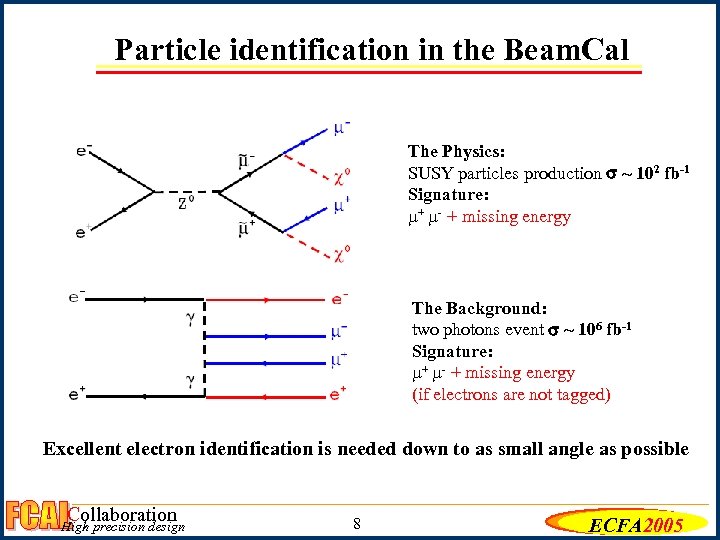 Particle identification in the Beam. Cal The Physics: SUSY particles production ~ 102 fb-1 Signature: + - + missing energy The Background: two photons event ~ 106 fb-1 Signature: + - + missing energy (if electrons are not tagged) Excellent electron identification is needed down to as small angle as possible Collaboration High precision design 8 ECFA 2005
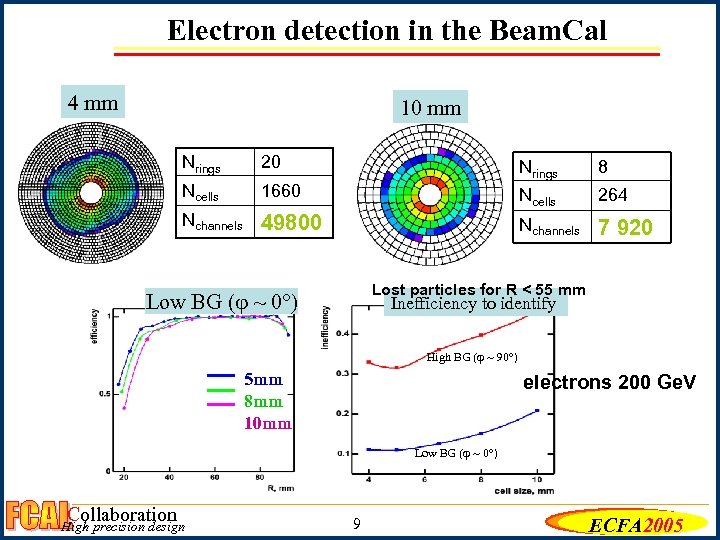 Electron detection in the Beam. Cal 4 mm 10 mm Nrings 20 Nrings 8 Ncells 1660 Ncells 264 Nchannels 49800 Nchannels 7 920 Lost particles for R < 55 mm Low BG ( ~ 0°) High BG ( ~ 90°) Inefficiency to identify High BG ( ~ 90°) 5 mm electrons 200 Ge. V 8 mm 10 mm 5 mm 8 mm 10 mm Low BG ( ~ 0°) Collaboration High precision design 9 ECFA 2005
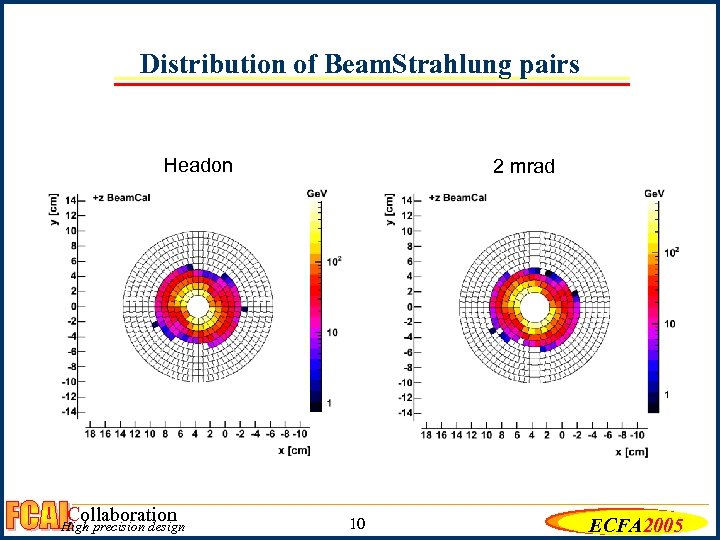 Distribution of Beam. Strahlung pairs Headon Collaboration High precision design 2 mrad 10 ECFA 2005
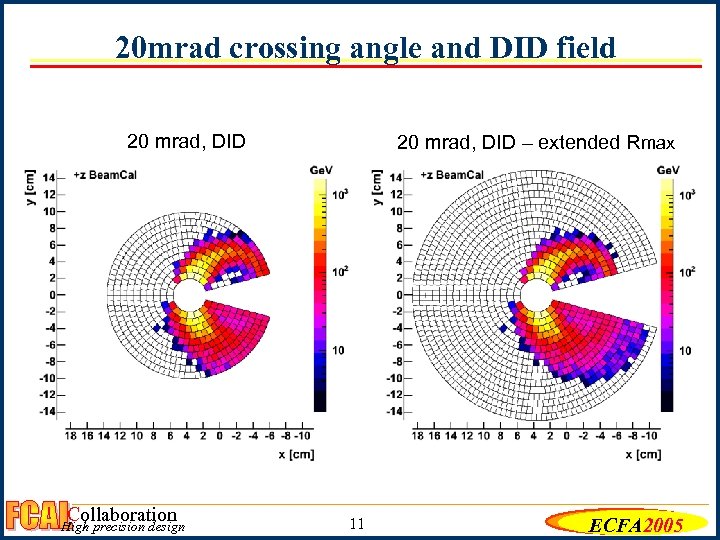 20 mrad crossing angle and DID field 20 mrad, DID Collaboration High precision design 20 mrad, DID – extended Rmax 11 ECFA 2005
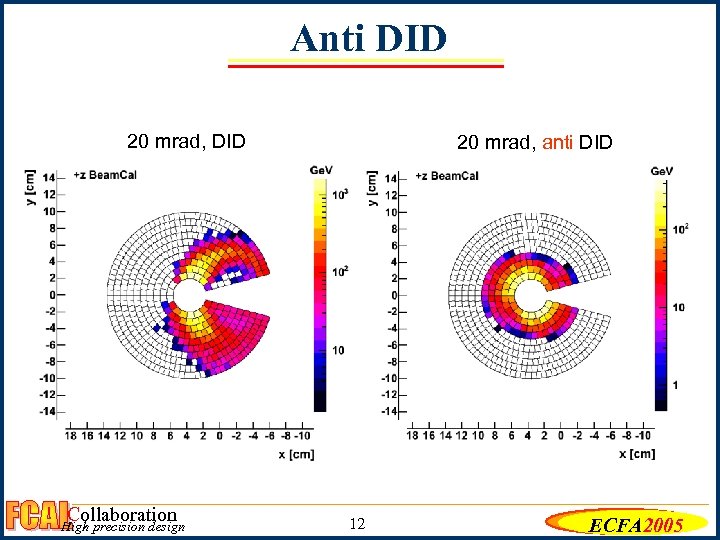 Anti DID 20 mrad, DID Collaboration High precision design 20 mrad, anti DID 12 ECFA 2005
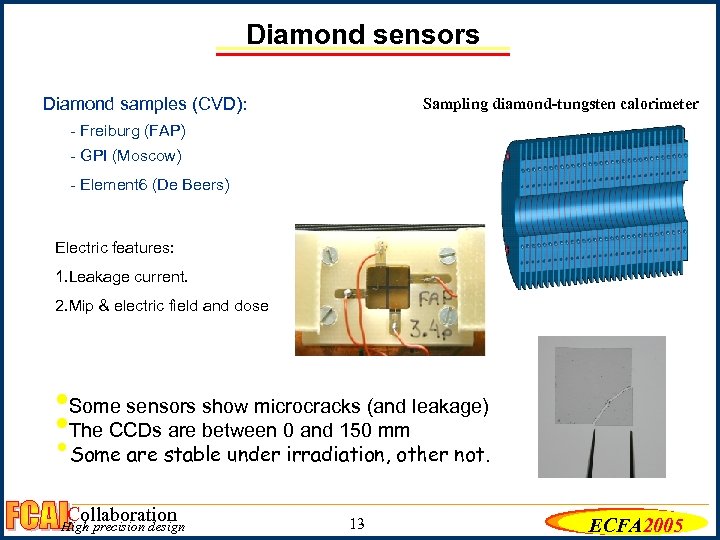 Diamond sensors Diamond samples (CVD): Sampling diamond-tungsten calorimeter - Freiburg (FAP) - GPI (Moscow) - Element 6 (De Beers) Electric features: 1. Leakage current. 2. Mip & electric field and dose • Some sensors show microcracks (and leakage) • The CCDs are between 0 and 150 mm • Some are stable under irradiation, other not. Collaboration High precision design 13 ECFA 2005
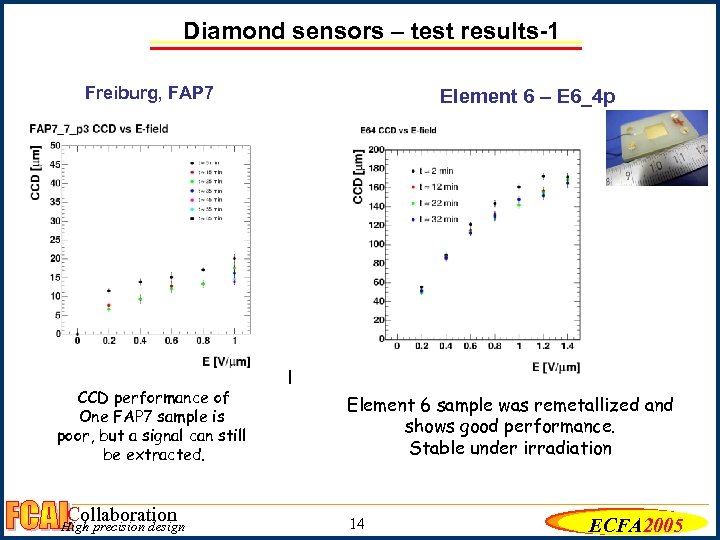 Diamond sensors – test results-1 Freiburg, FAP 7 CCD performance of One FAP 7 sample is poor, but a signal can still be extracted. Collaboration High precision design Element 6 – E 6_4 p l Element 6 sample was remetallized and shows good performance. Stable under irradiation 14 ECFA 2005
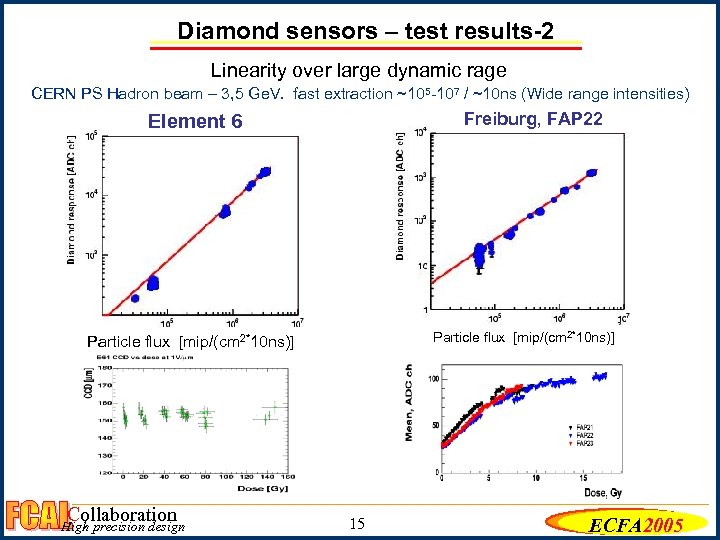 Diamond sensors – test results-2 Linearity over large dynamic rage CERN PS Hadron beam – 3, 5 Ge. V. fast extraction ~105 -107 / ~10 ns (Wide range intensities) Freiburg, FAP 22 Element 6 Particle flux [mip/(cm 2*10 ns)] Collaboration High precision design 15 ECFA 2005
 Lumi. Cal Precise measurement of the luminosity by using Bhabha events Extend coverage of the ILC detector Collaboration High precision design 16 ECFA 2005
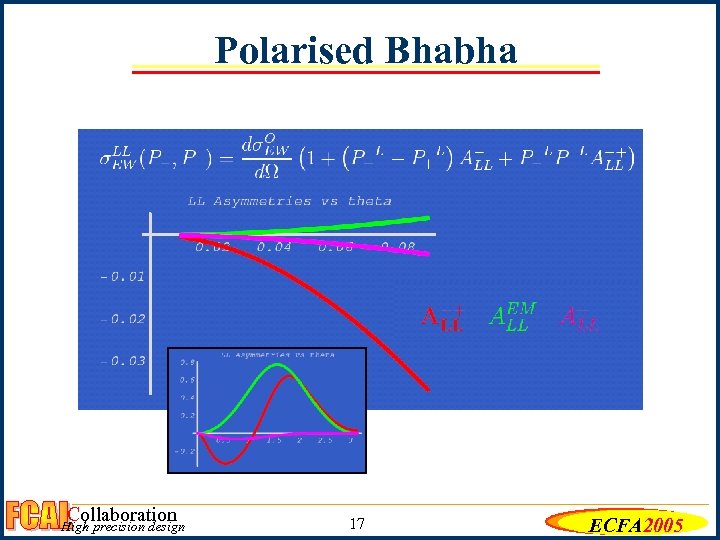 Polarised Bhabha Collaboration High precision design 17 ECFA 2005
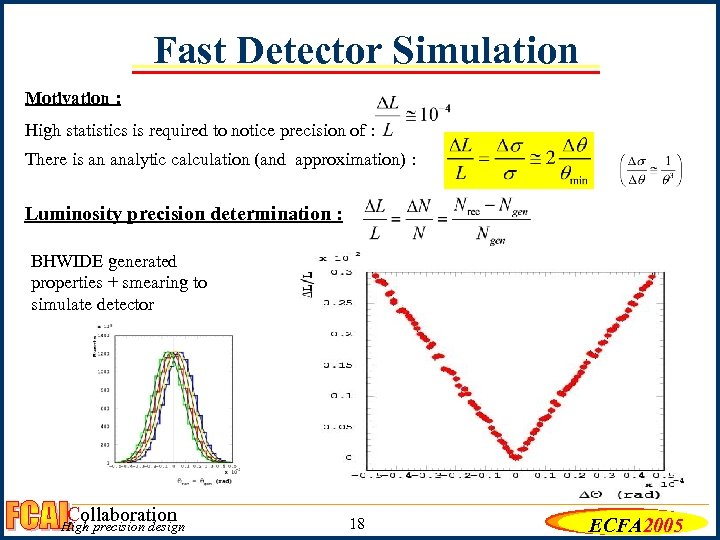 Fast Detector Simulation Motivation : High statistics is required to notice precision of : There is an analytic calculation (and approximation) : Luminosity precision determination : BHWIDE generated properties + smearing to simulate detector Collaboration High precision design 18 ECFA 2005
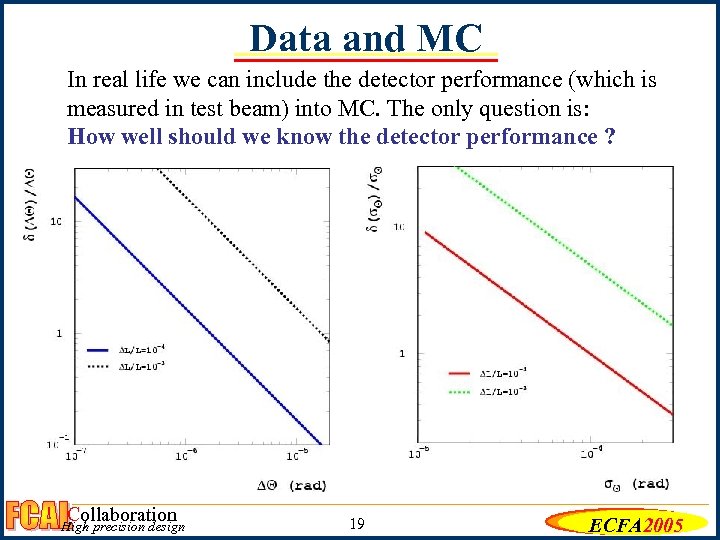 Data and MC In real life we can include the detector performance (which is measured in test beam) into MC. The only question is: How well should we know the detector performance ? Collaboration High precision design 19 ECFA 2005
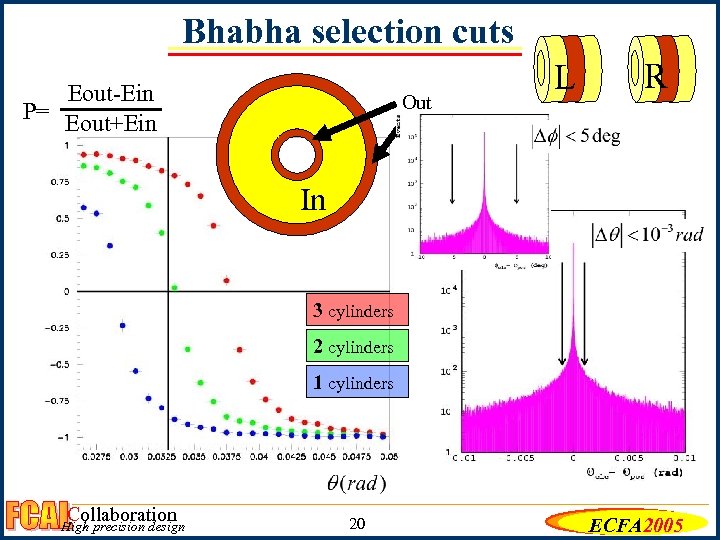 Bhabha selection cuts Eout-Ein P= Eout+Ein Out L R In 3 cylinders 2 cylinders 1 cylinders Collaboration High precision design 20 ECFA 2005
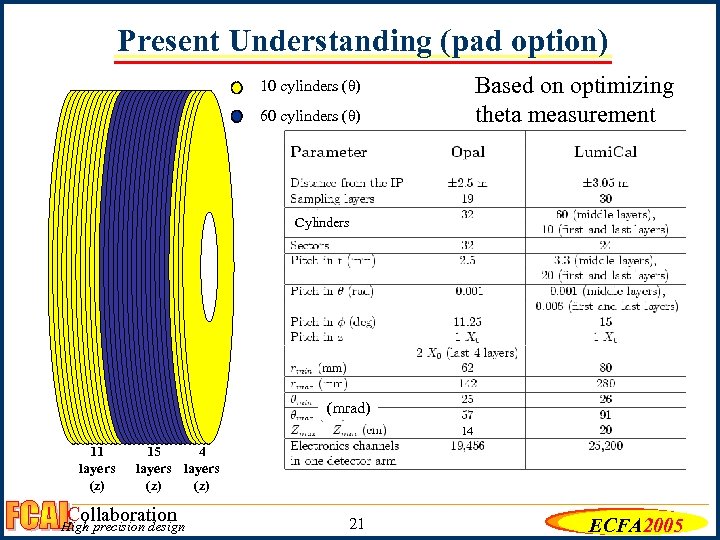 Present Understanding (pad option) Based on optimizing theta measurement 10 cylinders (θ) 60 cylinders (θ) Cylinders (mrad) 14 11 layers (z) 15 4 layers (z) Collaboration High precision design 21 ECFA 2005
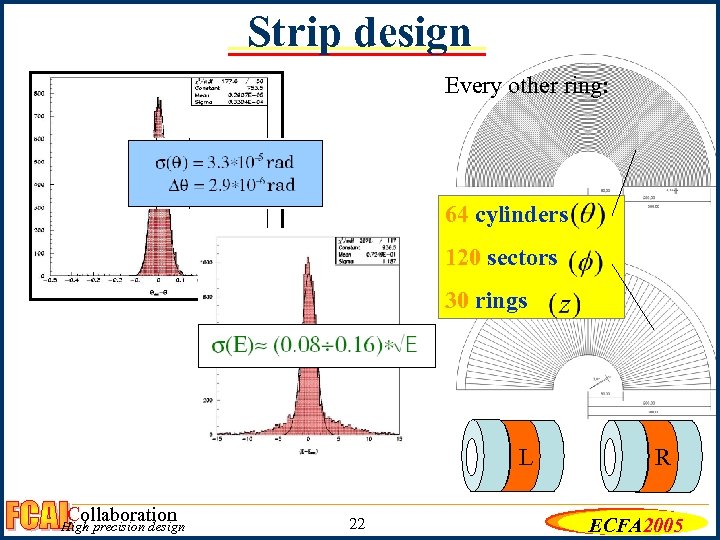 Strip design Every other ring: 64 cylinders 120 sectors 30 rings L Collaboration High precision design 22 R ECFA 2005
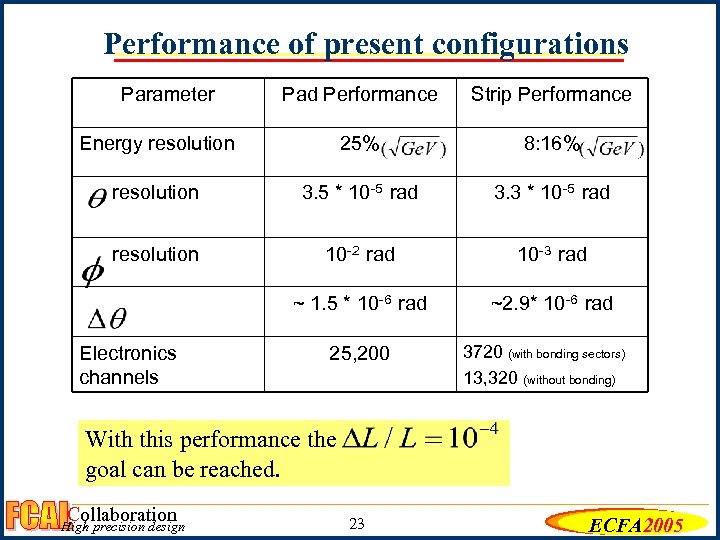 Performance of present configurations Parameter Pad Performance Strip Performance Energy resolution 25% 8: 16% resolution 3. 5 * 10 -5 rad 3. 3 * 10 -5 rad resolution 10 -2 rad 10 -3 rad ~ 1. 5 * 10 -6 rad ~2. 9* 10 -6 rad Electronics channels 25, 200 3720 (with bonding sectors) 13, 320 (without bonding) With this performance the goal can be reached. Collaboration High precision design 23 ECFA 2005
![Two photon events LUMICAL BEAMCAL Energy [Ge. V] Polar angle [deg. ] Independent generator](https://present5.com/presentation/bbfa14b0b5355ef6488af1236ec1d404/image-24.jpg "Two photon events LUMICAL BEAMCAL Energy [Ge. V] Polar angle [deg. ] Independent generator") Two photon events LUMICAL BEAMCAL Energy [Ge. V] Polar angle [deg. ] Independent generator studies (WHIZARD, Vermasseren) have shown that physics Vermasseren background from the four-lepton processes is present in the Luminosity Calorimeter with an average rate of 10 -3 tracks per bunch crossing for head-on collisions. Further studies for crossing angles is under way. Collaboration High precision design 24 ECFA 2005
Two photon events LUMICAL BEAMCAL Energy [Ge. V] Polar angle [deg. ] Independent generator studies (WHIZARD, Vermasseren) have shown that physics Vermasseren background from the four-lepton processes is present in the Luminosity Calorimeter with an average rate of 10 -3 tracks per bunch crossing for head-on collisions. Further studies for crossing angles is under way. Collaboration High precision design 24 ECFA 2005
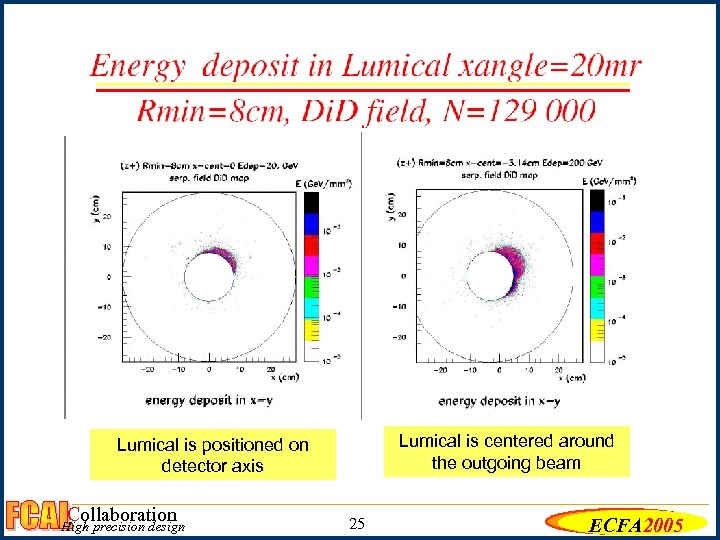 Lumical is centered around the outgoing beam Lumical is positioned on detector axis Collaboration High precision design 25 ECFA 2005
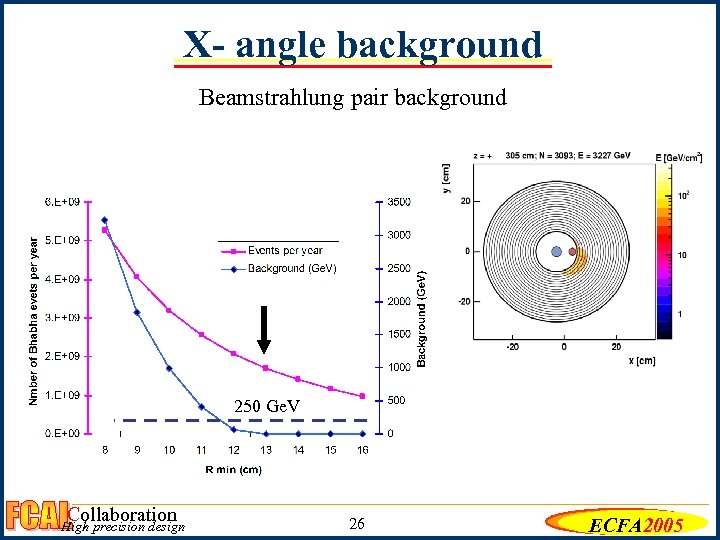 X- angle background Beamstrahlung pair background 250 Ge. V Collaboration High precision design 26 ECFA 2005
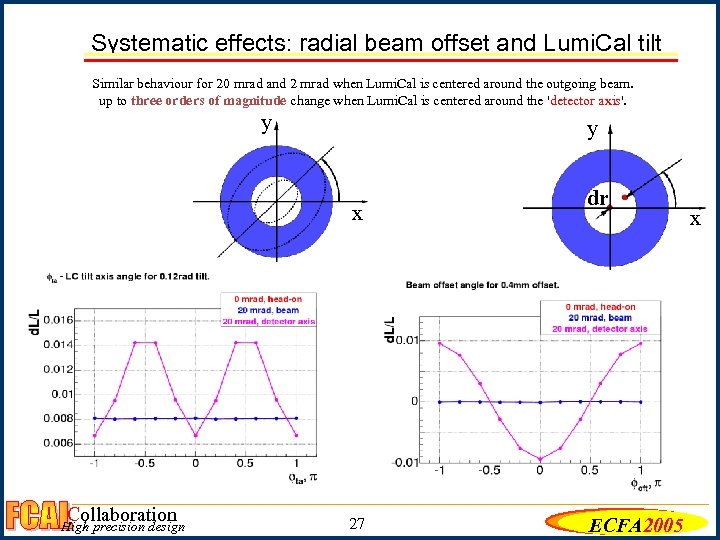 Systematic effects: radial beam offset and Lumi. Cal tilt Similar behaviour for 20 mrad and 2 mrad when Lumi. Cal is centered around the outgoing beam. up to three orders of magnitude change when Lumi. Cal is centered around the 'detector axis'. y y x Collaboration High precision design 27 dr ECFA 2005 x
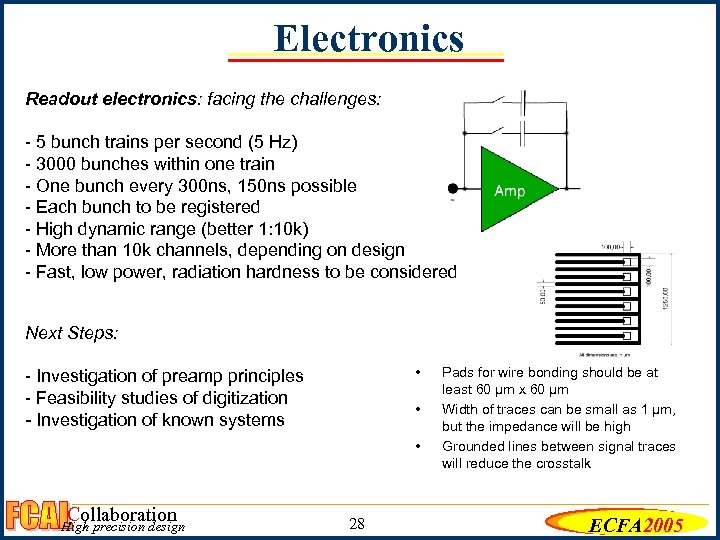 Electronics Readout electronics: facing the challenges: - 5 bunch trains per second (5 Hz) - 3000 bunches within one train - One bunch every 300 ns, 150 ns possible - Each bunch to be registered - High dynamic range (better 1: 10 k) - More than 10 k channels, depending on design - Fast, low power, radiation hardness to be considered Next Steps: • - Investigation of preamp principles - Feasibility studies of digitization - Investigation of known systems • • Collaboration High precision design 28 Pads for wire bonding should be at least 60 µm x 60 µm Width of traces can be small as 1 µm, but the impedance will be high Grounded lines between signal traces will reduce the crosstalk ECFA 2005
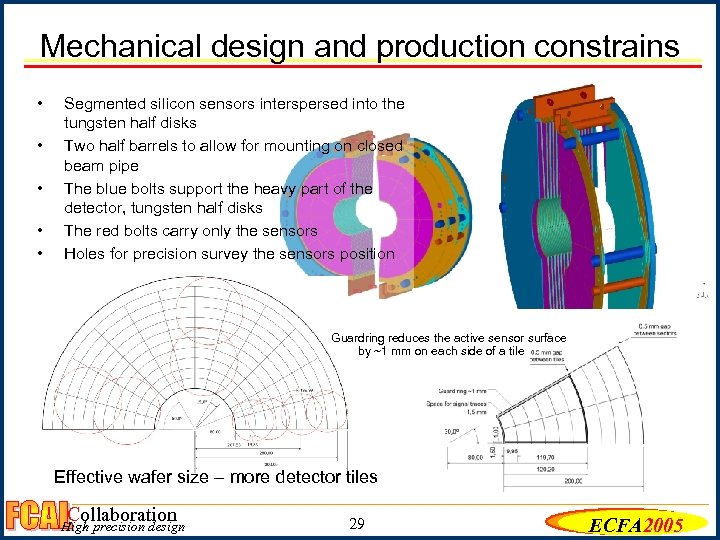 Mechanical design and production constrains • • • Segmented silicon sensors interspersed into the tungsten half disks Two half barrels to allow for mounting on closed beam pipe The blue bolts support the heavy part of the detector, tungsten half disks The red bolts carry only the sensors Holes for precision survey the sensors position Guardring reduces the active sensor surface by ~1 mm on each side of a tile Effective wafer size – more detector tiles Collaboration High precision design 29 ECFA 2005
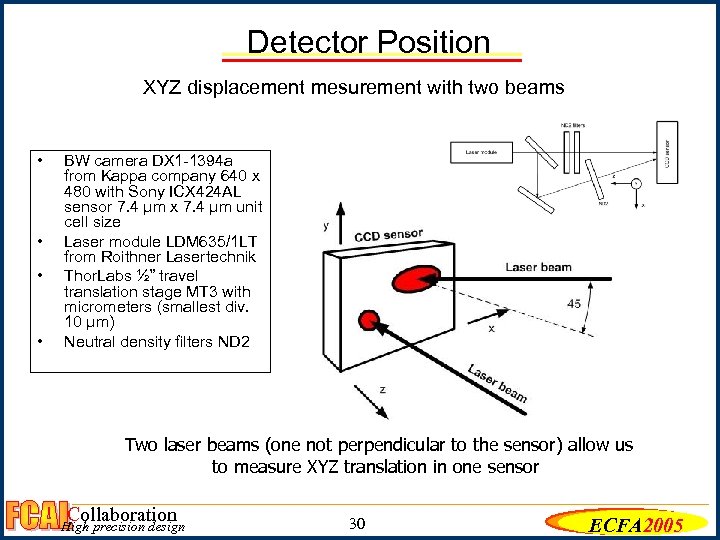 Detector Position XYZ displacement mesurement with two beams • • BW camera DX 1 -1394 a from Kappa company 640 x 480 with Sony ICX 424 AL sensor 7. 4 μm x 7. 4 μm unit cell size Laser module LDM 635/1 LT from Roithner Lasertechnik Thor. Labs ½” travel translation stage MT 3 with micrometers (smallest div. 10 μm) Neutral density filters ND 2 Two laser beams (one not perpendicular to the sensor) allow us to measure XYZ translation in one sensor Collaboration High precision design 30 ECFA 2005
 Summary Collaboration High precision design 31 ECFA 2005
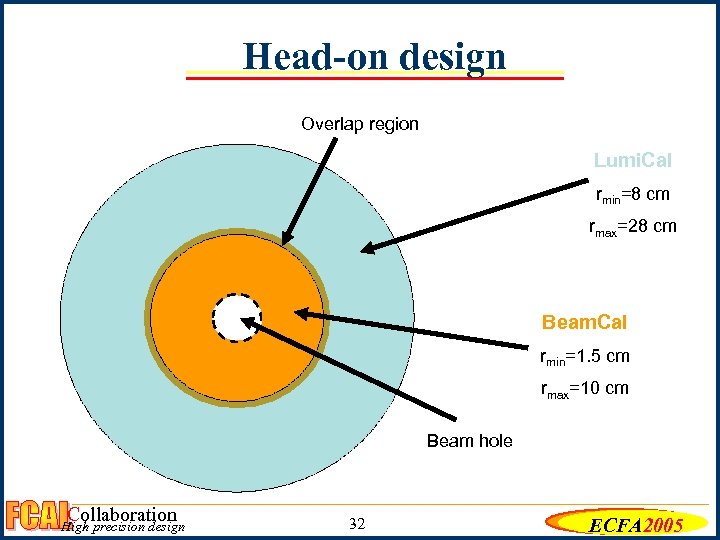 Head-on design Overlap region Lumi. Cal rmin=8 cm rmax=28 cm Beam. Cal rmin=1. 5 cm rmax=10 cm Beam hole Collaboration High precision design 32 ECFA 2005
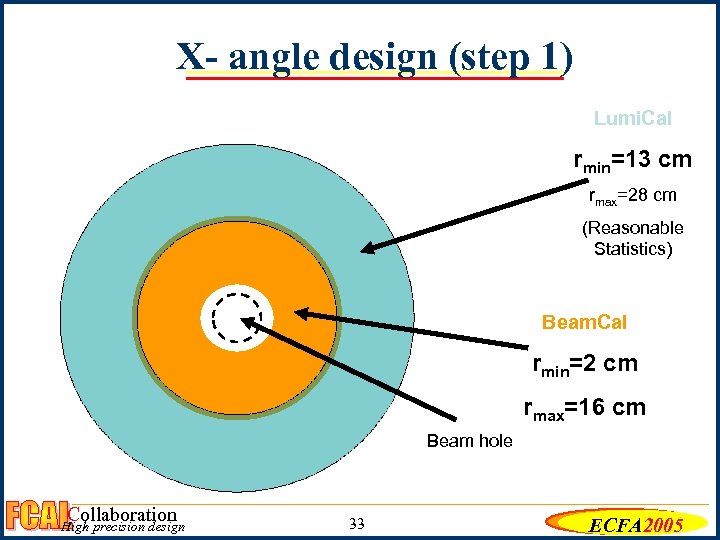 X- angle design (step 1) Lumi. Cal rmin=13 cm rmax=28 cm (Reasonable Statistics) Beam. Cal rmin=2 cm rmax=16 cm Beam hole Collaboration High precision design 33 ECFA 2005
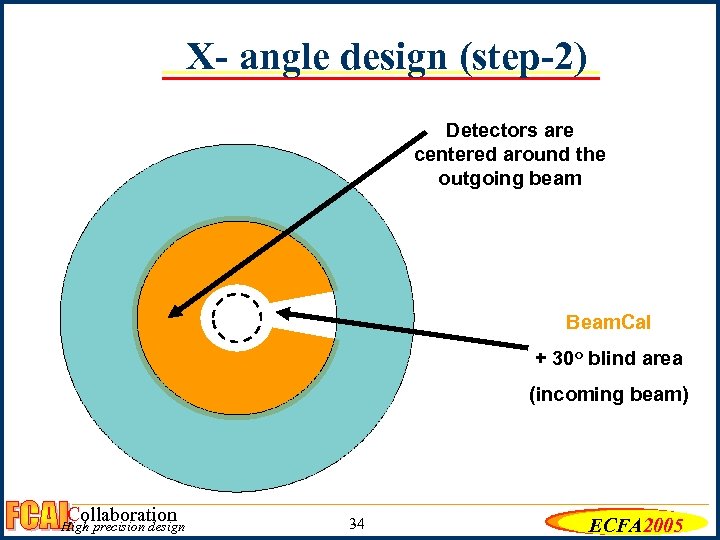 X- angle design (step-2) Detectors are centered around the outgoing beam Beam. Cal + 30 o blind area (incoming beam) Collaboration High precision design 34 ECFA 2005
 Collaboration High precision design Thank you ! You are invited to the more focused talks given by our collaboration in this meeting More detailed information can be found at the collaboration web page : http: //www. ifh. de/ILC/fcal Collaboration High precision design 35 ECFA 2005