


THE VERB. PART I 1. The Verb: Morphological Characteristics, Lexical and Grammatical Classification. 2. The Category of Tense. 3. The Category of Aspect.
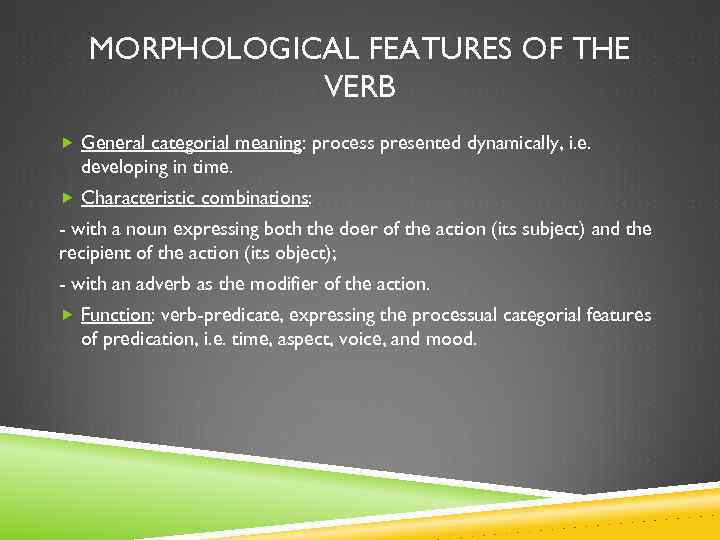
MORPHOLOGICAL FEATURES OF THE VERB General categorial meaning: process presented dynamically, i. e. developing in time. Characteristic combinations: - with a noun expressing both the doer of the action (its subject) and the recipient of the action (its object); - with an adverb as the modifier of the action. Function: verb-predicate, expressing the processual categorial features of predication, i. e. time, aspect, voice, and mood.
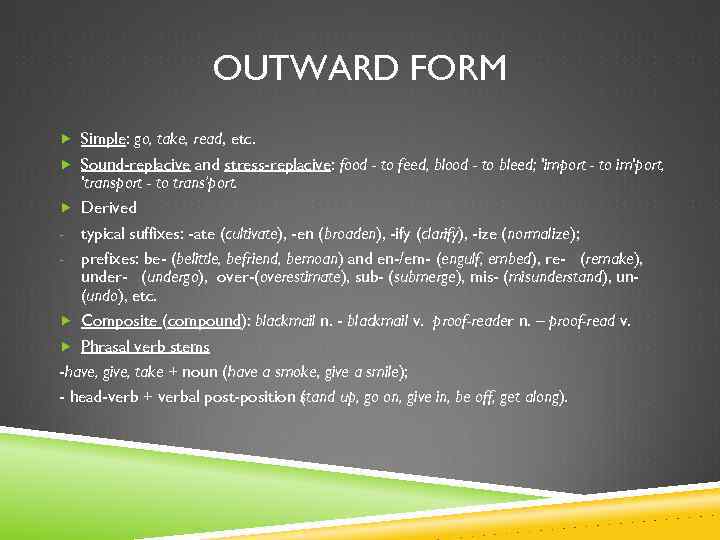
OUTWARD FORM Simple: go, take, read, etc. Sound-replacive and stress-replacive: food - to feed, blood - to bleed; 'import - to im'port, 'transport - to trans’port. Derived - typical suffixes: -ate (cultivate), -en (broaden), -ify (clarify), -ize (normalize); - prefixes: be- (belittle, befriend, bemoan) and en-/em- (engulf, embed), re- (remake), under- (undergo), over-(overestimate), sub- (submerge), mis- (misunderstand), un(undo), etc. Composite (compound): blackmail n. - blackmail v. proof-reader n. – proof-read v. Phrasal verb stems -have, give, take + noun (have a smoke, give a smile); - head-verb + verbal post position ( tand up, go on, give in, be off, get along). s
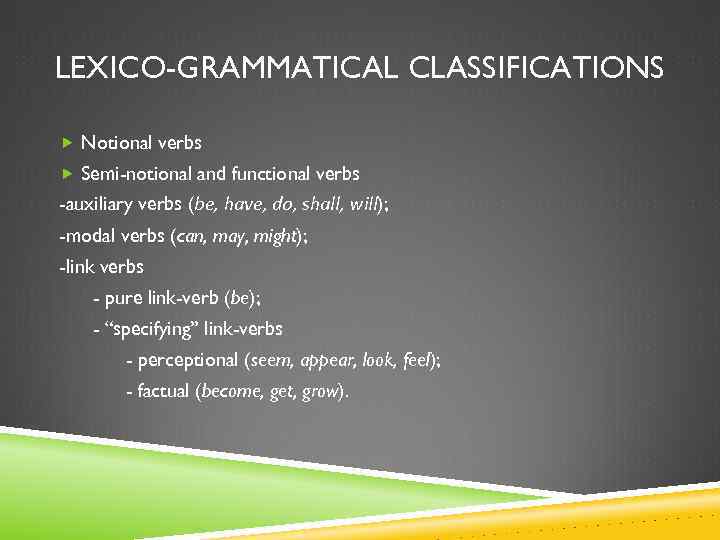
LEXICO-GRAMMATICAL CLASSIFICATIONS Notional verbs Semi-notional and functional verbs -auxiliary verbs (be, have, do, shall, will); -modal verbs (can, may, might); -link verbs - pure link-verb (be); - “specifying” link-verbs - perceptional (seem, appear, look, feel); - factual (become, get, grow).
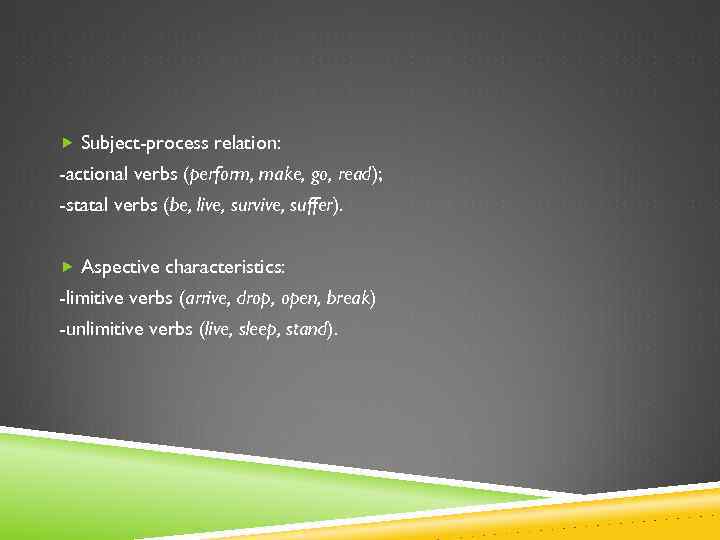
Subject-process relation: -actional verbs (perform, make, go, read); -statal verbs (be, live, survive, suffer). Aspective characteristics: -limitive verbs (arrive, drop, open, break) -unlimitive verbs (live, sleep, stand).
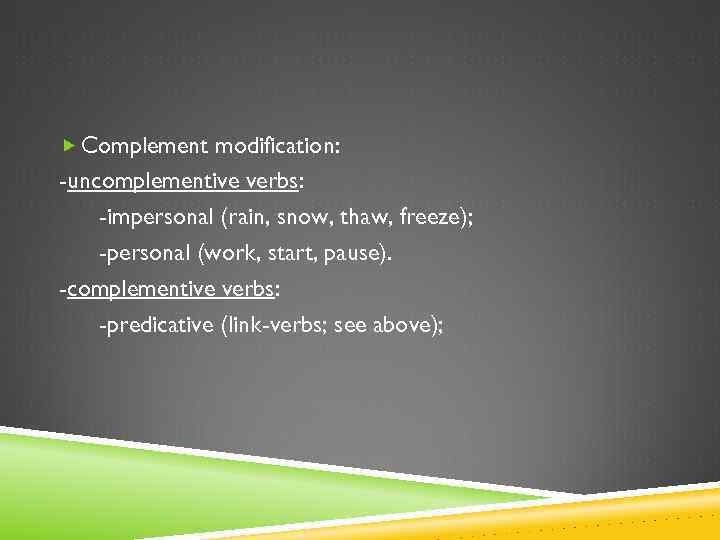
Complement modification: -uncomplementive verbs: -impersonal (rain, snow, thaw, freeze); -personal (work, start, pause). -complementive verbs: -predicative (link-verbs; see above);
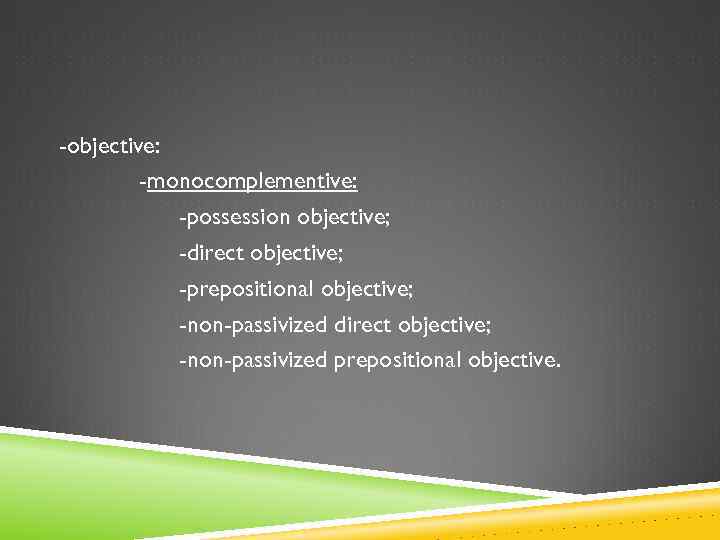
-objective: -monocomplementive: -possession objective; -direct objective; -prepositional objective; -non-passivized direct objective; -non-passivized prepositional objective.
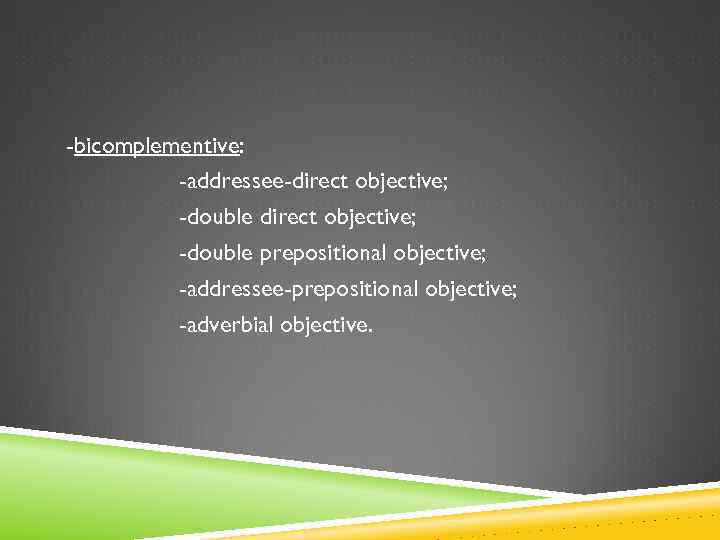
-bicomplementive: -addressee-direct objective; -double prepositional objective; -addressee-prepositional objective; -adverbial objective.
-adverbial: -adverbials of place and time; -adverbials of manner.

2. THE CATEGORY OF TENSE Traditional Linguistics: present, past and future forms (tertiary opposition); J. Lyons: present and past forms; M. Y. Blokh: 2 temporal categories -primary time (-(e)d vs __); -prospective time (shall / will… to vs __).
CATEGORIAL FEATURES OF VERB FORMS 1. was making; 2. would be marvelling; 3. would happen; 4. had given up; 5. would have settled; 6. was being watched; 7. *would be being looked after.
3. THE CATEGORY OF ASPECT The aspective category of development 1. Tense view (H. Sweet, O. Jespersen). 2. Tense-aspect blend view (I. P. Ivanova). 3. Aspect view (A. I. Smirnitsky, V. N. Yartseva, B. A. Ilyish, B. S. Khaimovich and B. I. Rogovskaya, L. S. Barkhudarov). 4. Double aspect view (M. Y. Blokh).
The aspective category of retrospective coordination Tense view (H. Sweet, G. Curme, M. Bryant , J. R. Aiken, N. F. Irtenyeva). 1. 2. Aspect view (M. Deutschbein, E. A. Sonnenschein, A. S. West, G. N. Vorontsova).
3. Tense-aspect blend view (I. P. Ivanova). 4. Time correlation view (A. I. Smirnitsky). 5. Retrospective coordination view (M. Y. Blokh).
