



The verb.
1) The verb. 2) Grammatical categories of the finite verb. 3) Grammatical categories of the Verbals. 4) Morphological classification of Verbs. 5) Strong verbs. 6) Weak verbs. 7) Minor groups of verbs.
1) The verb. Word and phrase that expresses an action, an event or a state.
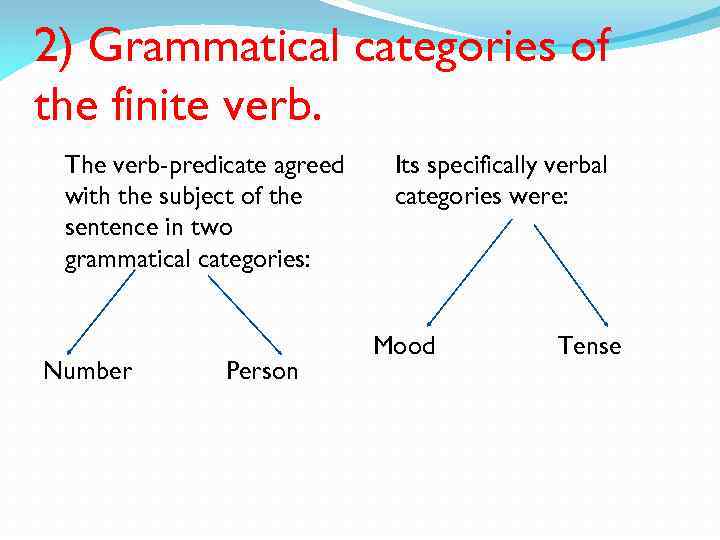
2) Grammatical categories of the finite verb. The verb-predicate agreed with the subject of the sentence in two grammatical categories: Number Person Its specifically verbal categories were: Mood Tense
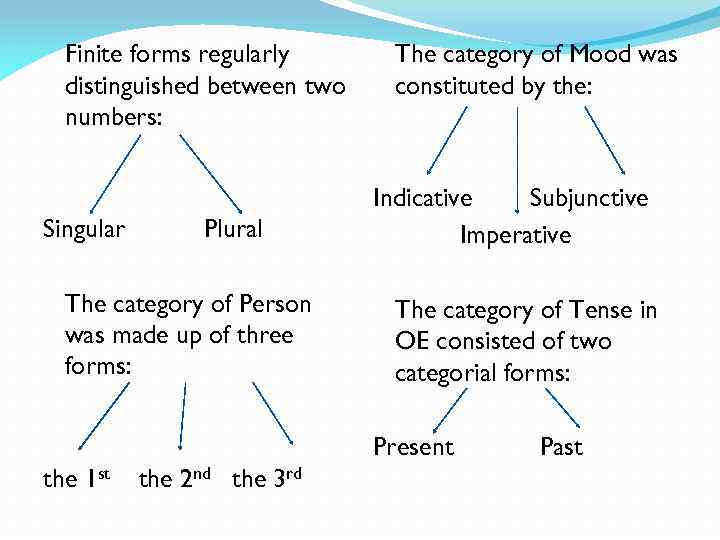
Finite forms regularly distinguished between two numbers: Singular Plural The category of Person was made up of three forms: The category of Mood was constituted by the: Indicative Subjunctive Imperative The category of Tense in OE consisted of two categorial forms: Present the 1 st the 2 nd the 3 rd Past
In order to understand the structure of the verb system one should get acquainted with the meanings and use of moods and tenses in OE. The use of the Subj. Mood in OE was in many respects different from its use in later ages. Subj. forms conveyed a very general meaning of unreality or supposition. In addition to its use in conditional sentences and other volitional, conjectural and hypothetical contexts Subj. Was common in other types of construction: in clauses of time, clauses of result and in clauses presenting reported speech.
The meanings of the tense forms were also very general, as compared with later ages and with present-day English. The forms of the Pres. were used to indicate present and future actions. With verbs of perfective meaning or with adverbs of future time the Pres. acquired the meaning of futurity. The Past tense was used in a most general sense to indicate various events in the past (including those which are nowadays expressed by the forms of the Past Continuous, Past Perfect, Present Perfect and other analytical forms). Additional shades of meaning could be attached to it in different contexts.
The existence of the four grammatical categories described above is confirmed by consistent opposition of form and meaning. In addition to these categories we must mention two debatable categories: Aspect Voice
Until recently it was believed that in OE — as well as in other OG languages — the category of aspect was expressed by the regular contrast of verbs with and without the prefix Зe-; verbs with the prefix had a perfective meaning while the same verbs without the prefix in dicated a non-completed action, e. g. OE feohtan — зefeohtan 'fight'- — 'gain by fighting', līcian — зelīcian 'like' — 'come to like' (R: нравится — понравится).
It is important to note that in OE texts there were also other means of expressing aspective meanings: — verb phrases made up of the verbs habban, bēon, weor an (NE have, be, 'become') and the Past or Present Participle. The phrases with Participle I were used to describe a pro longed state or action, the phrases with Participle II indicated a state resulting from a previous, completed action.
The category of voice in OE is another debatable issue. In OE texts we find a few isolated relics of synthetic Mediopassive forms (which may have existed in PG and were well developed in Gothic), Cf. the old Mediopassive in рйёа ре hatte Araxis 'the river that is called Arax' with the active use of the same verb: pa deor hie ha tap hranas 'those deer they called reindeer'. The passive meaning was frequently indicated with the help of Participle II of transitive verbs used as pre dicativeswith the verbs Ьёоп (NE be) and weor. San 'become. During the OE period these constructions were gradually transformed into the analytical forms of the Passive voice.
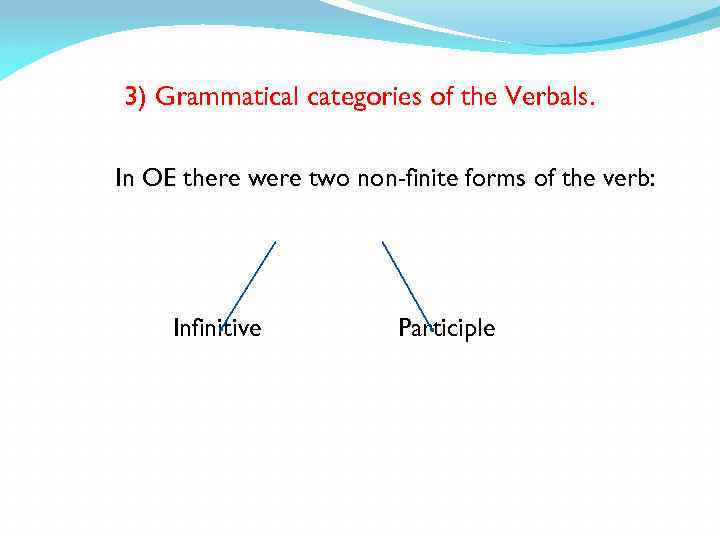
3) Grammatical categories of the Verbals. In OE there were two non-finite forms of the verb: Infinitive Participle
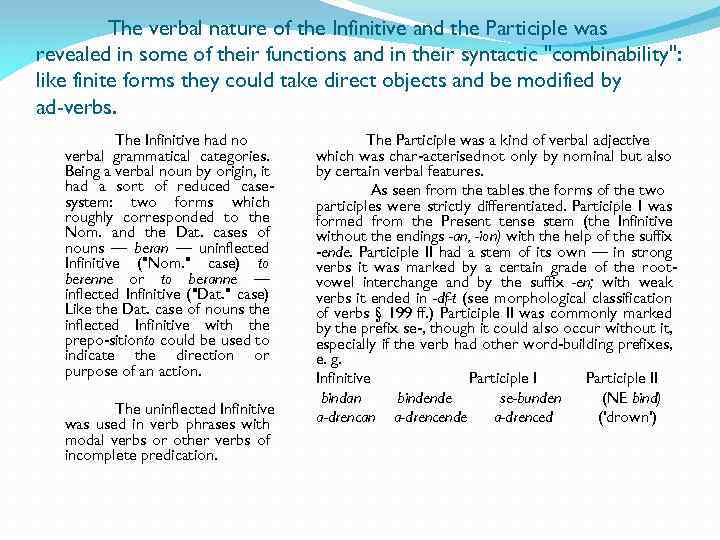
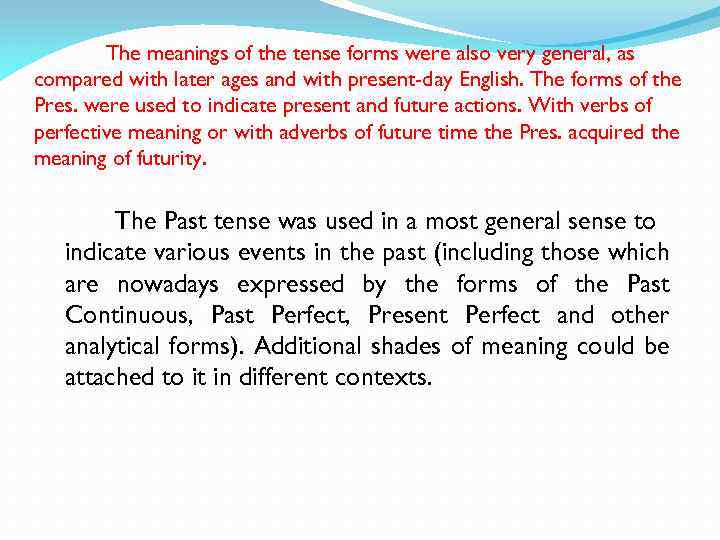
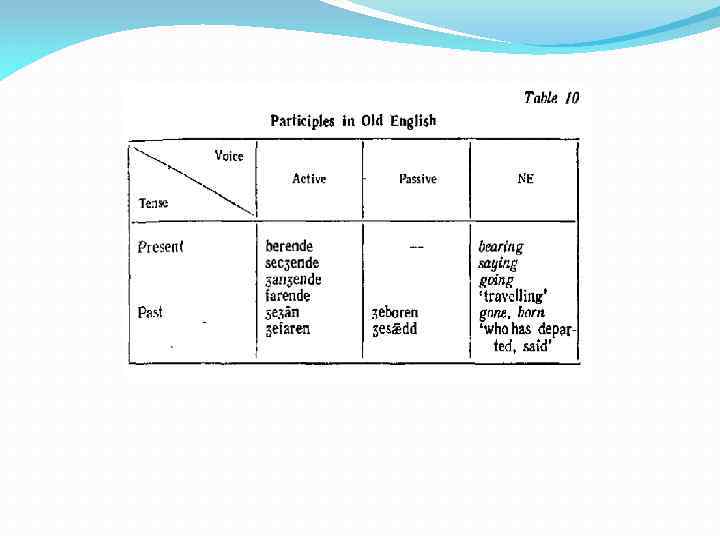
The verbal nature of the Infinitive and the Participle was revealed in some of their functions and in their syntactic "combinability": like finite forms they could take direct objects and be modified by ad verbs. The Infinitive had no verbal grammatical categories. Being a verbal noun by origin, it had a sort of reduced casesystem: two forms which roughly corresponded to the Nom. and the Dat. cases of nouns — beran — uninflected Infinitive ("Nom. " case) to berenne or to beranne — inflected Infinitive ("Dat. " case) Like the Dat. case of nouns the inflected Infinitive with the prepo sitionto could be used to indicate the direction or purpose of an action. The uninflected Infinitive was used in verb phrases with modal verbs or other verbs of incomplete predication. The Participle was a kind of verbal adjective which was char acterised not only by nominal but also by certain verbal features. As seen from the tables the forms of the two participles were strictly differentiated. Participle I was formed from the Present tense stem (the Infinitive without the endings -an, -ion) with the help of the suffix -ende. Participle II had a stem of its own — in strong verbs it was marked by a certain grade of the rootvowel interchange and by the suffix -en; with weak verbs it ended in -df-t (see morphological classification of verbs § 199 ff. ) Participle II was commonly marked by the prefix se-, though it could also occur without it, especially if the verb had other word-building prefixes, e. g. Infinitive Participle II bindan bindende se-bunden (NE bind) a-drencan a-drencende a-drenced ('drown')
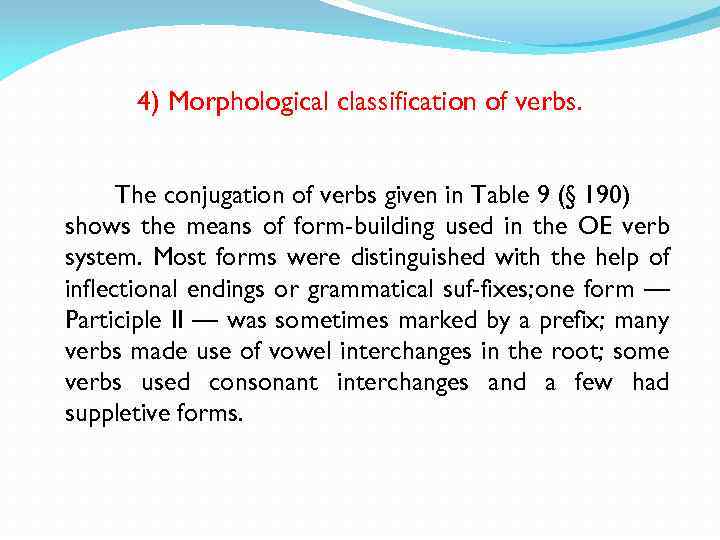
4) Morphological classification of verbs. The conjugation of verbs given in Table 9 (§ 190) shows the means of form-building used in the OE verb system. Most forms were distinguished with the help of inflectional endings or grammatical suf fixes; one form — Participle II — was sometimes marked by a prefix; many verbs made use of vowel interchanges in the root; some verbs used consonant interchanges and a few had suppletive forms.
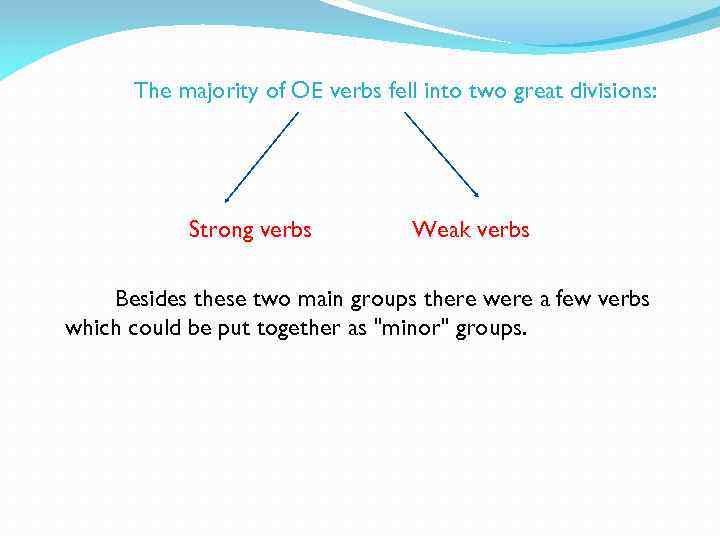
The majority of OE verbs fell into two great divisions: Strong verbs Weak verbs Besides these two main groups there were a few verbs which could be put together as "minor" groups.
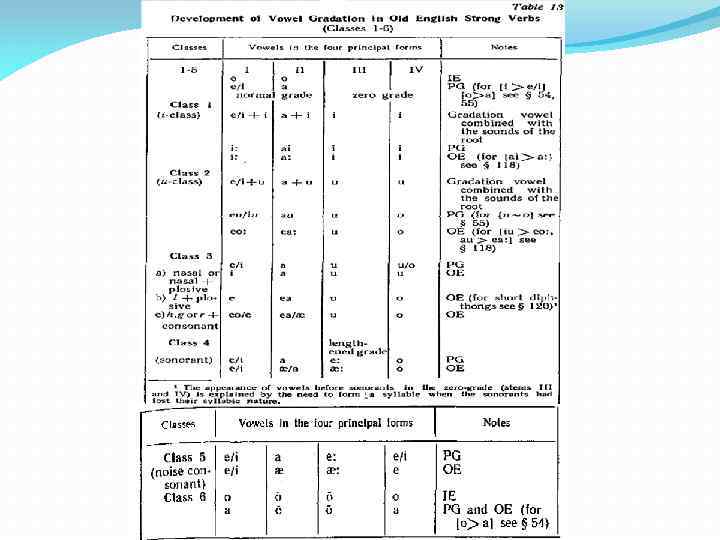
The strong verbs formed their stems by means of vowel gradation (ablaut, see § 63, 64) and by adding certain suffixes; in some verbs vowel gradation was accompanied by consonant interchanges. The strong verbs had four stems, as they distinguished two stems in the Past Tense — one for the 1 st and 3 rd p. sg Ind. Mood, the other — for the other Past tense forms, Ind. and Subj. The weak verbs derived their Past tense stem and the stem of Parti ciple II from the Present tense stem with the help of the dental suffix -d- or -t~; normally they did not change their root vowel, but in some verbs suffixation was accompanied by a vowel interchange. The main differences between the strong and the weak verbs can be seen in the following examples (see also Table 9, § 190)'
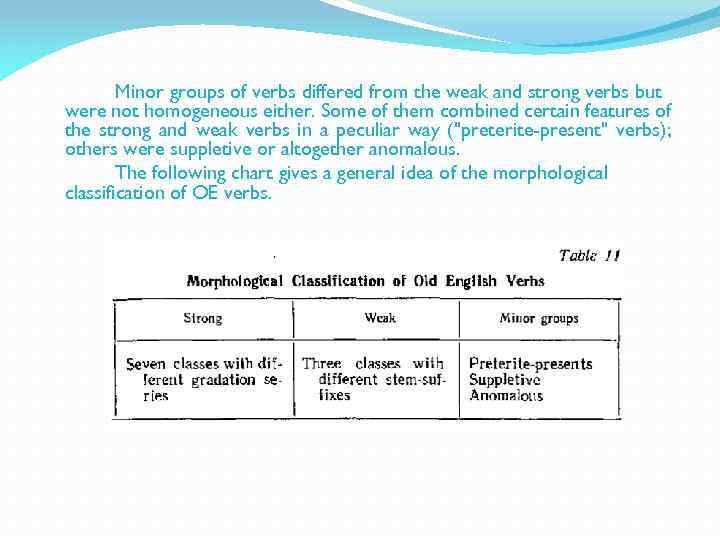
Minor groups of verbs differed from the weak and strong verbs but were not homogeneous either. Some of them combined certain features of the strong and weak verbs in a peculiar way ("preterite-present" verbs); others were suppletive or altogether anomalous. The following chart gives a general idea of the morphological classification of OE verbs.
5) Strong verbs. There were about three hundred strong verbs in OE. The strong verbs in OE (as well as in other OG languages) are usually divided into seven classes. Classes from I to 6 use vowei gradation which goes back to the IE ablaut-series modified in different phonetic conditions in accordance with PG and Early OE sound changes. Class 7 includes reduplicating verbs, which originally built their past forms by means of repeating the root-morpheme; this doubled root gave rise to a specific kind of root- vowel interchange.
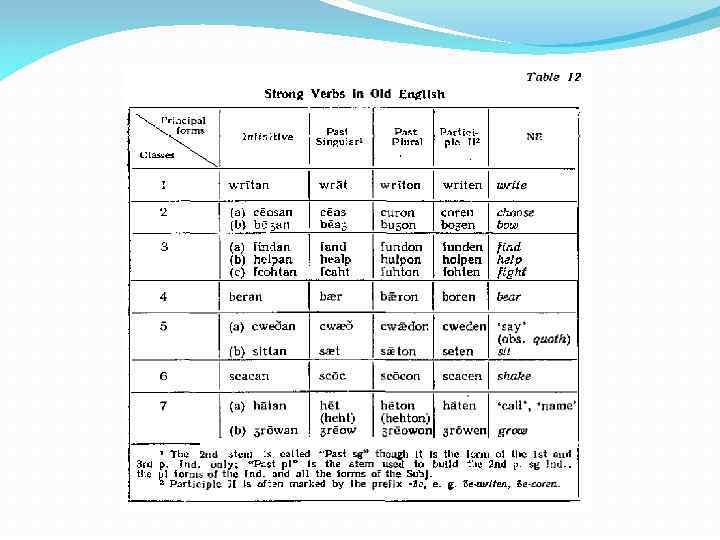
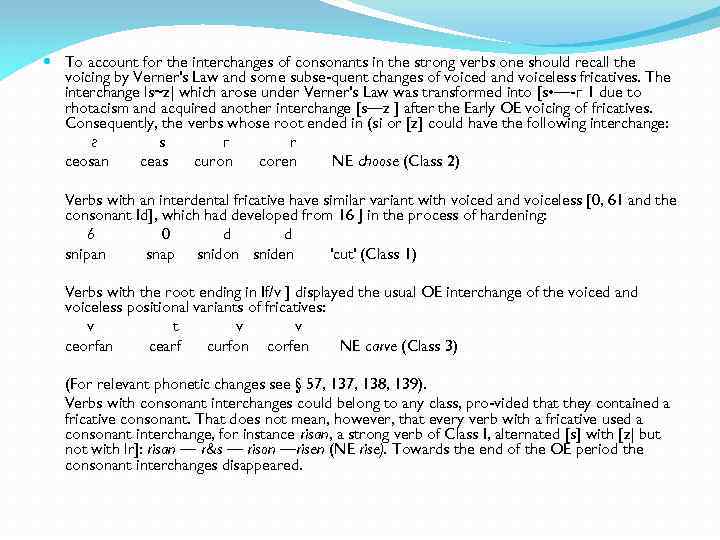
To account for the interchanges of consonants in the strong verbs one should recall the voicing by Verner's Law and some subse quent changes of voiced and voiceless fricatives. The interchange ls~z| which arose under Verner's Law was transformed into [s • —-г 1 due to rhotacism and acquired another interchange [s—z ] after the Early OE voicing of fricatives. Consequently, the verbs whose root ended in (si or [z] could have the following interchange: г s г r ceosan ceas curon coren NE choose (Class 2) Verbs with an interdental fricative have similar variant with voiced and voiceless [0, 61 and the consonant Id], which had developed from 16 J in the process of hardening: 6 0 d d snipan snap snidon sniden 'cut' (Class 1) Verbs with the root ending in If/v ] displayed the usual OE interchange of the voiced and voiceless positional variants of fricatives: v t v v ceorfan cearf curfon corfen NE carve (Class 3) (For relevant phonetic changes see § 57, 138, 139). Verbs with consonant interchanges could belong to any class, pro vided that they contained a fricative consonant. That does not mean, however, that every verb with a fricative used a consonant interchange, for instance risan, a strong verb of Class I, alternated [s] with [z| but not with lr]: risan — r&s — rison —risen (NE rise). Towards the end of the OE period the consonant interchanges disappeared.
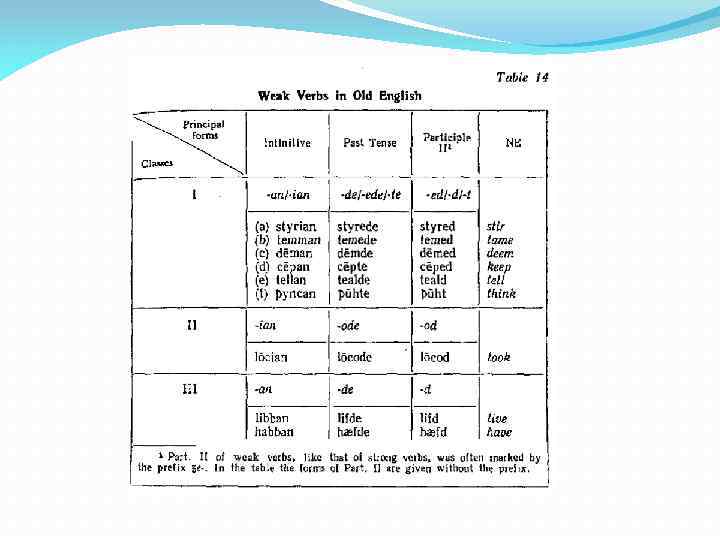
6) Weak verbs. The number of weak verbs in OE by far exceeded that of strong verbs. In fact, all the verbs, with the exception of the strong verbs and the minor groups (which make a total of about 315 -320 units) were weak. Their number was constantly growing since all new verbs derived from other stems were conjugated weak (except derivatives of strong verbs with prefixes). Among the weak verbs there were many de rivativesof OE noun and adjective stems and also derivatives of strong verbs built from one of their stems (usually the second stem — Past sg), e. g. OE talu n tellan v (NE tale, tell) OE full adj fyllan v (NE full, fill) OE findan, v str. fandian v (NE find, find out)(Past sg fand) Weak verbs formed their Past and Participle II by means of the dental suffix d- or -t- (a specifically Germanic trait — see § 69). In OE the weak verbs are subdivided into three classes differing in the ending of the Infinitive, the sonority of the suffix, and the sounds pre cedingthe suffix. The principal forms of the verbs in the three classes are given in Table 14, with several- subclasses in Class I.
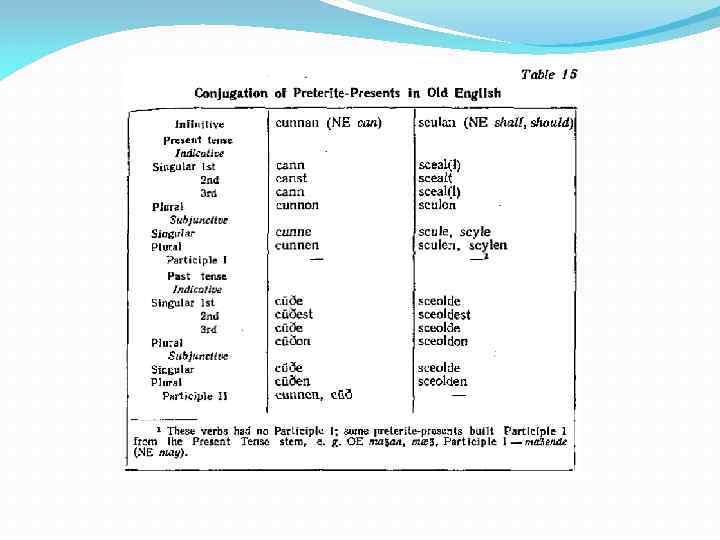
7) Minor groups of verbs. Several minor groups of verbs can be referred neither to strong nor to weak verbs. The most important group of these verbs were the so-called "pret- erite-presents" or "past-present" verbs. Some of them also acquired the forms of the verbals: Participles and Infinitives; most verbs did not have a full paradigm and were in this sense "defective". The conjugation of OE preterite-presents is shown in Table 15.
In OE there were twelve preterite-present verbs. Six of them have survived in Mod E: OE аз; cunnan, cann; dear(r), sculan, sceal; ma^an, тт$; mot (NE owe, ought; can; dare; shall; may; must). Most of the pret erite-presentsdid not indicate actions, but expressed a kind of attitude to an action denoted by another verb, an Infinitive which followed the preterite-present. In other words, they were used like modal verbs, and eventually developed into modem modal verbs. (In OE some of them could also be used as notional verbs.

Thanks for your attention!!!
