 Скачать презентацию The Variations 2 Digital Music Library Project Jon
82006d544a3afa6dfd8110155f85698f.ppt
- Количество слайдов: 38



The Variations 2 Digital Music Library Project Jon Dunn Digital Library Program Indiana University January 16, 2004
Presentation Outline n n n Overview/Background Features Technical Details Data Model / Metadata Demonstration Future
Variations 2 n Four-year research project n n n Started October 1, 2000 Funding from NSF and NEH through Digital Libraries Phase 2 (DLI 2) program Large interdisciplinary team of investigators Faculty: Music, SLIS, Law Librarians and technologists: Libraries, University Information Technology Services Many participants from Bloomington and IUPUI
Variations 2 Project Goals n n n Establish a digital music library testbed system Develop multiple interfaces for specific user applications in the music library and the classroom Conduct research in metadata, usability, copyright, and networking
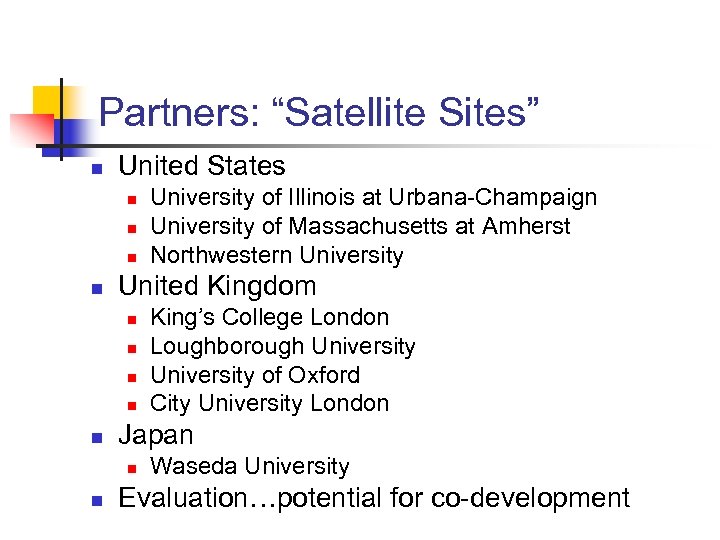
Partners: “Satellite Sites” n United States n n United Kingdom n n n King’s College London Loughborough University of Oxford City University London Japan n n University of Illinois at Urbana-Champaign University of Massachusetts at Amherst Northwestern University Waseda University Evaluation…potential for co-development
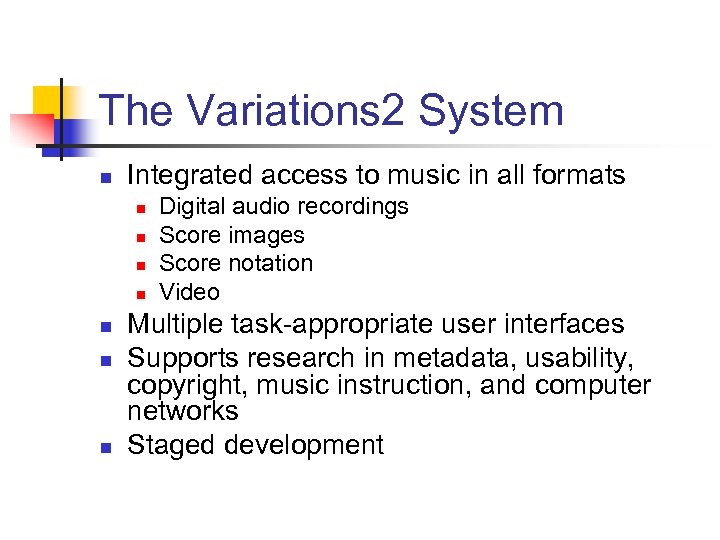
The Variations 2 System n Integrated access to music in all formats n n n n Digital audio recordings Score images Score notation Video Multiple task-appropriate user interfaces Supports research in metadata, usability, copyright, music instruction, and computer networks Staged development
Variations n n n Existing DL of sound recordings (~8000 titles) and scores (~200 titles) in IU Cook Music Library Developed in 1996 Used thousands of times per day for access to course reserves and the general collection
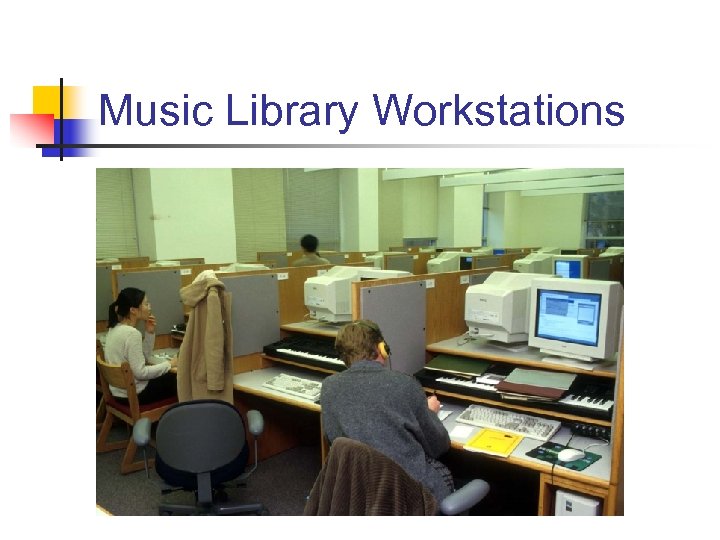
Music Library Workstations
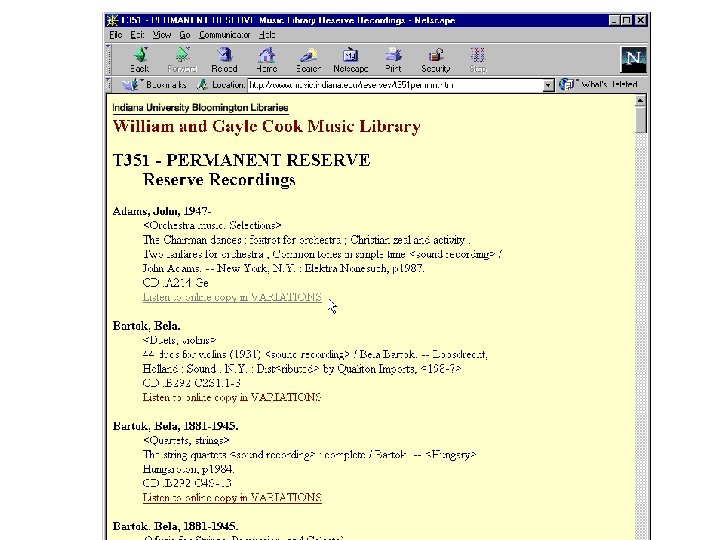
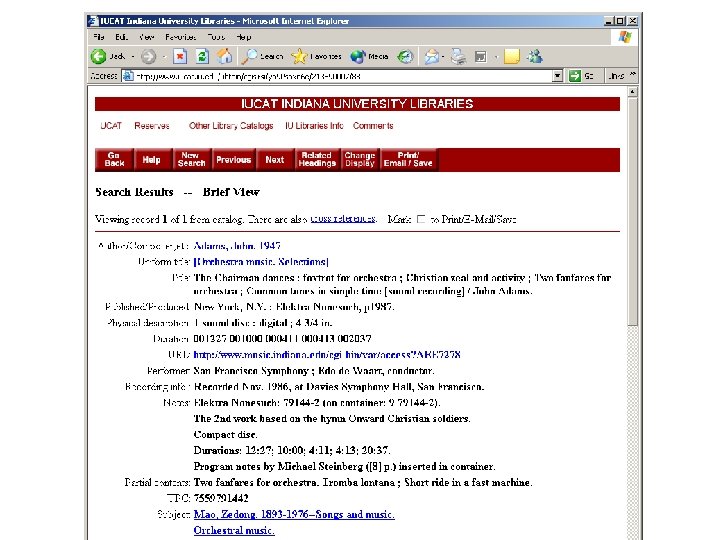
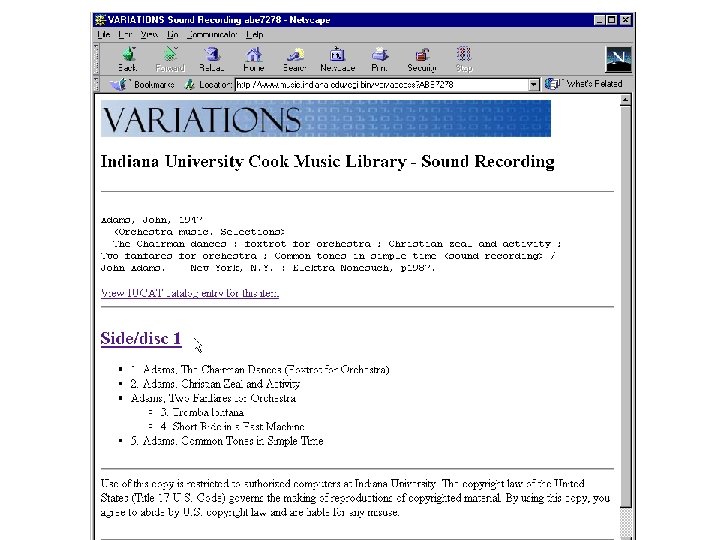
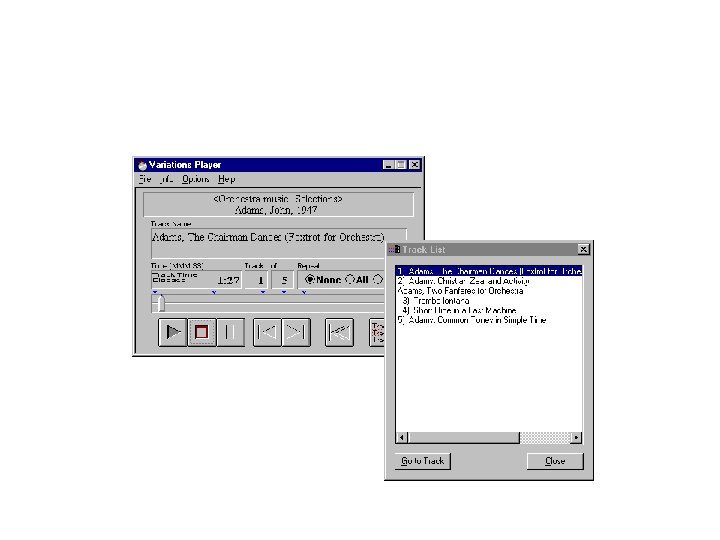
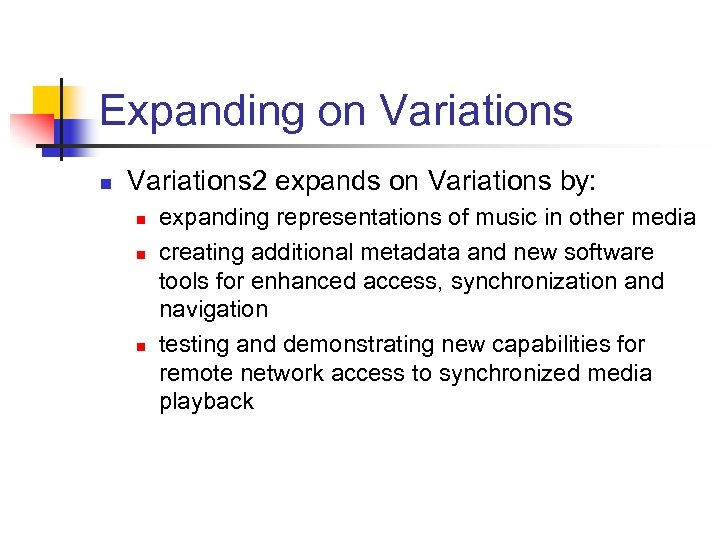
Expanding on Variations 2 expands on Variations by: n n n expanding representations of music in other media creating additional metadata and new software tools for enhanced access, synchronization and navigation testing and demonstrating new capabilities for remote network access to synchronized media playback
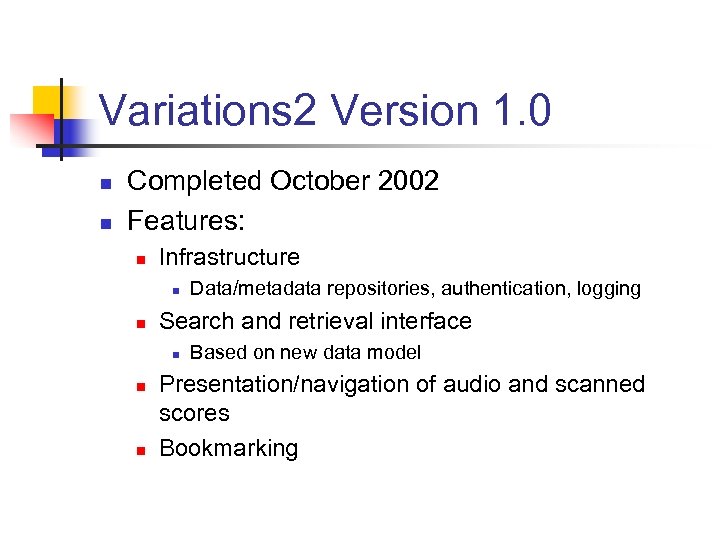
Variations 2 Version 1. 0 n n Completed October 2002 Features: n Infrastructure n n Search and retrieval interface n n n Data/metadata repositories, authentication, logging Based on new data model Presentation/navigation of audio and scanned scores Bookmarking
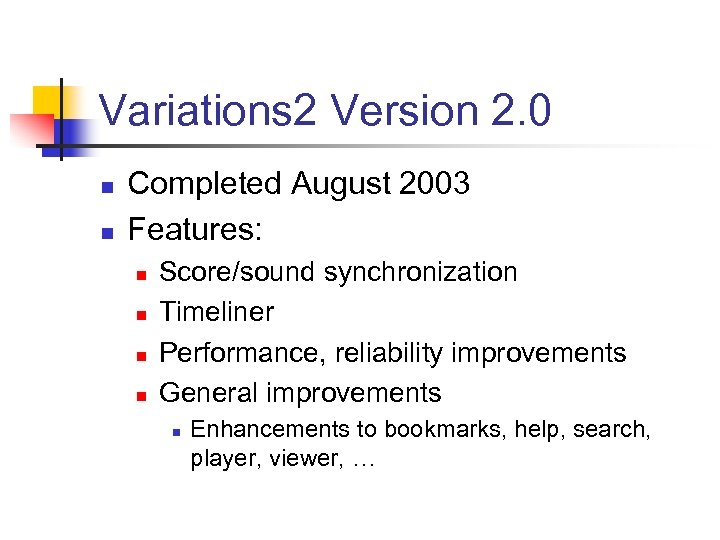
Variations 2 Version 2. 0 n n Completed August 2003 Features: n n Score/sound synchronization Timeliner Performance, reliability improvements General improvements n Enhancements to bookmarks, help, search, player, viewer, …
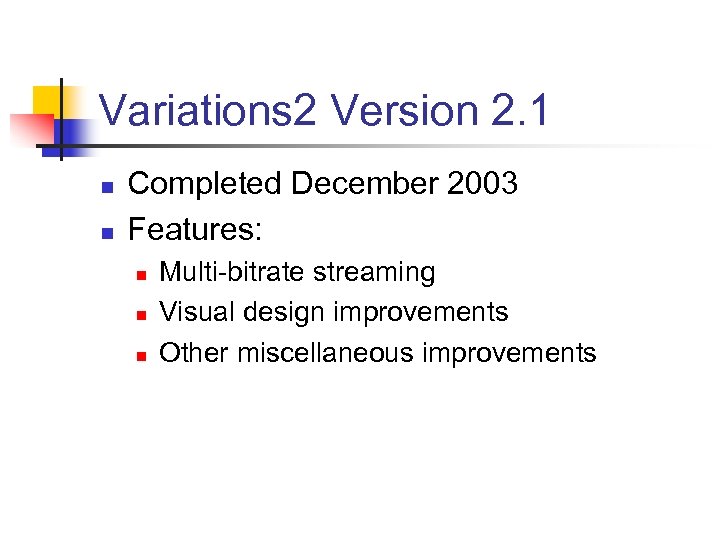
Variations 2 Version 2. 1 n n Completed December 2003 Features: n n n Multi-bitrate streaming Visual design improvements Other miscellaneous improvements
Variations 2 Technical Environment n n n Client and server developed in Java Windows and Mac OS X client platforms, Unix (AIX/Linux) server Audio streaming: Quick. Time for Java, Apple’s Darwin Streaming Server Database: IBM DB 2, DB 2 Net Search Extender Image compresssion: Dj. Vu from AT&T Labs and Lizardtech
Conceptual Architecture
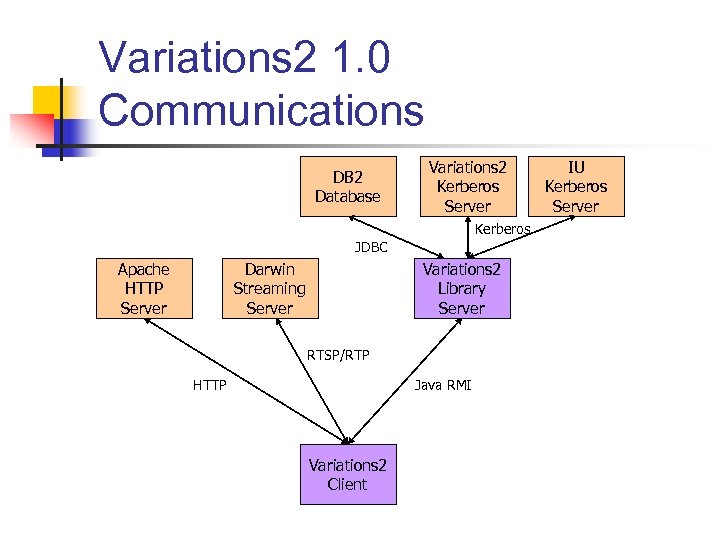
Variations 2 1. 0 Communications DB 2 Database Variations 2 Kerberos Server Kerberos JDBC Apache HTTP Server Darwin Streaming Server Variations 2 Library Server RTSP/RTP HTTP Java RMI Variations 2 Client IU Kerberos Server
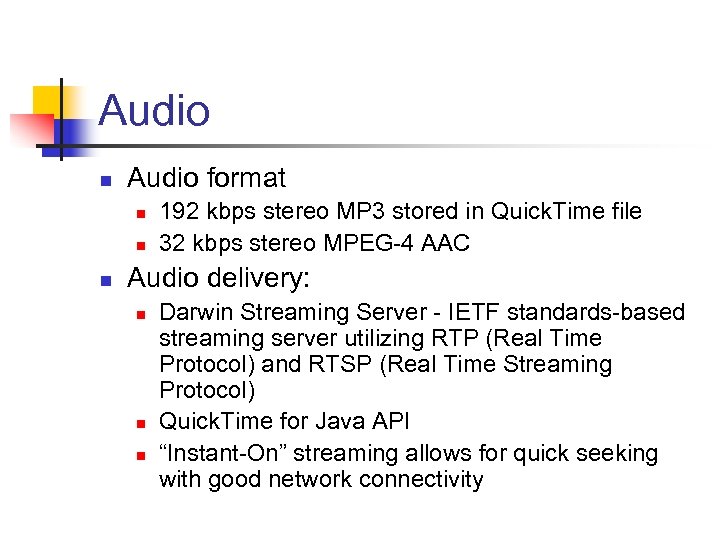
Audio n Audio format n n n 192 kbps stereo MP 3 stored in Quick. Time file 32 kbps stereo MPEG-4 AAC Audio delivery: n n n Darwin Streaming Server - IETF standards-based streaming server utilizing RTP (Real Time Protocol) and RTSP (Real Time Streaming Protocol) Quick. Time for Java API “Instant-On” streaming allows for quick seeking with good network connectivity
Images n Djvu format n n AT&T Labs / Lizard. Tech Supports a number of compression options, including proprietary “JB 2” for bitonal documents Advantages over PDF: smaller file size, better zooming/scaling algorithm Dj. Vu client implementation n Free Dj. Vu open-source package with locally-written JNI wrapper
Some Problems with MARCbased catalogs n Traditional MARC-based online catalogs not ideal for music n n Large number of works by single author Multiple works in single container n n n Multiple roles of “authors” Importance of work: uniform titles n n n Not always possible to easily get one version of a work to others Many variant forms of titles Problems with LC subject headings n n Relationships of performers and other fields to works e. g. “Songs (High voice) with orchestra, Arranged” Isolating / sorting by format
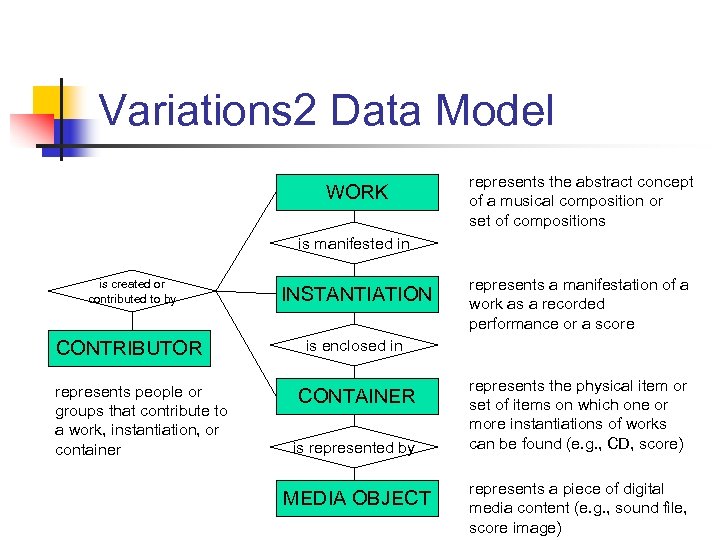
Variations 2 Data Model WORK represents the abstract concept of a musical composition or set of compositions is manifested in is created or contributed to by INSTANTIATION CONTRIBUTOR represents a manifestation of a work as a recorded performance or a score is enclosed in represents people or groups that contribute to a work, instantiation, or container CONTAINER is represented by MEDIA OBJECT represents the physical item or set of items on which one or more instantiations of works can be found (e. g. , CD, score) represents a piece of digital media content (e. g. , sound file, score image)
Variations 2 Data Model n n n Appropriate metadata elements attached to each entity Can import and map MARC records Closely related to FRBR n International Federation of Library Associations Report on the Functional Requirements of Bibliographic Records, 1997
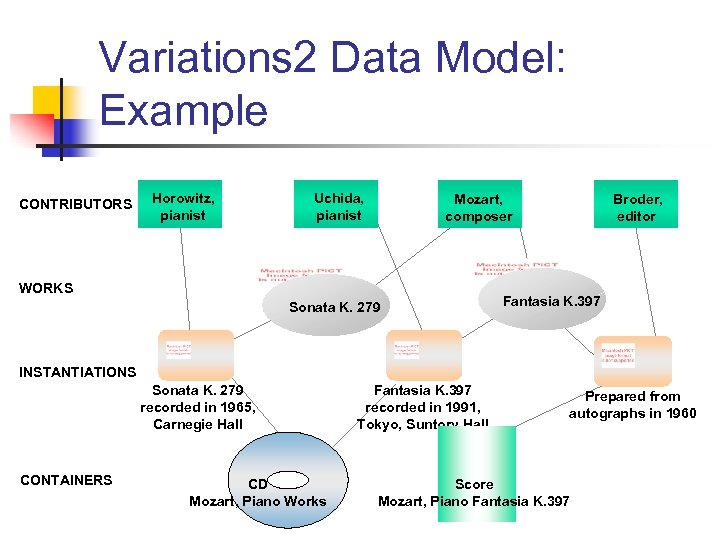
Variations 2 Data Model: Example CONTRIBUTORS Horowitz, pianist Uchida, pianist Mozart, composer WORKS Sonata K. 279 Broder, editor Fantasia K. 397 INSTANTIATIONS Sonata K. 279 recorded in 1965, Carnegie Hall CONTAINERS CD Mozart, Piano Works Fantasia K. 397 recorded in 1991, Tokyo, Suntory Hall Prepared from autographs in 1960 Score Mozart, Piano Fantasia K. 397
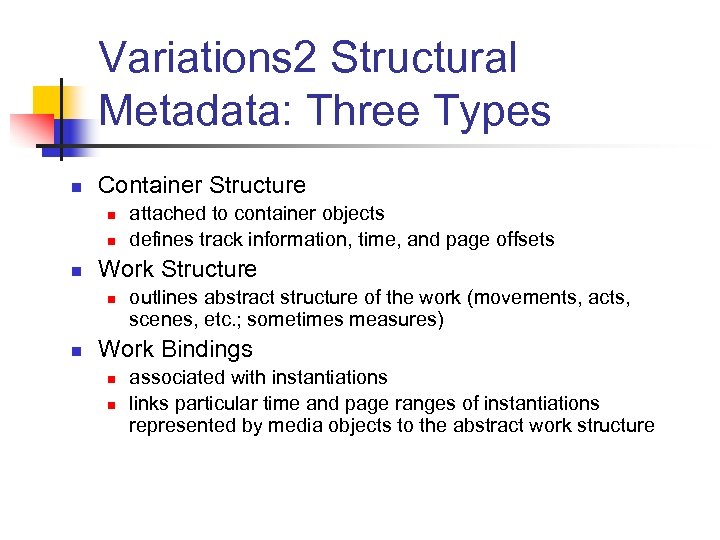
Variations 2 Structural Metadata: Three Types n Container Structure n n n Work Structure n n attached to container objects defines track information, time, and page offsets outlines abstract structure of the work (movements, acts, scenes, etc. ; sometimes measures) Work Bindings n n associated with instantiations links particular time and page ranges of instantiations represented by media objects to the abstract work structure
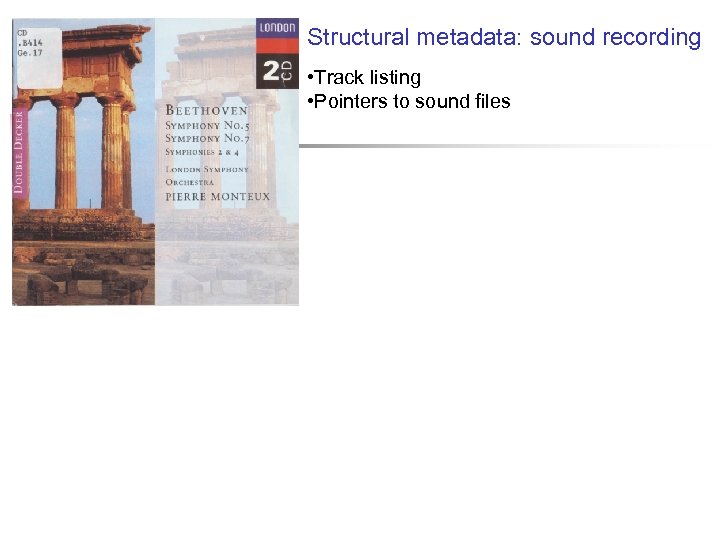
Structural metadata: sound recording • Track listing • Pointers to sound files
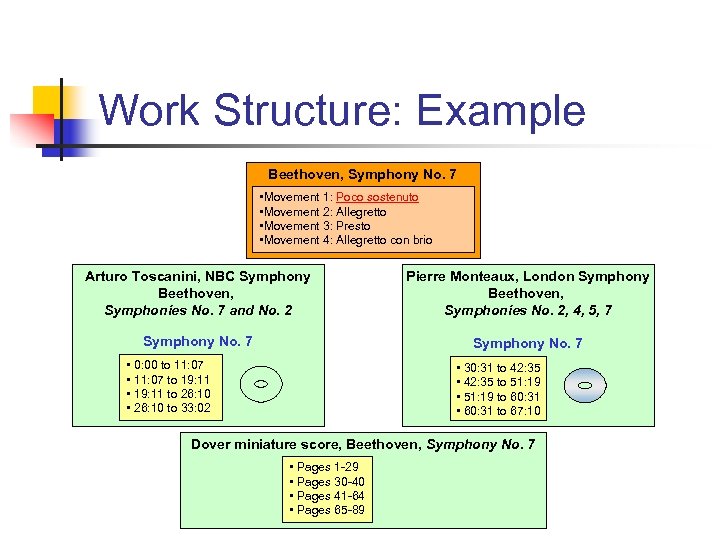
Work Structure: Example Beethoven, Symphony No. 7 • Movement 1: Poco sostenuto • Movement 2: Allegretto • Movement 3: Presto • Movement 4: Allegretto con brio Arturo Toscanini, NBC Symphony Beethoven, Symphonies No. 7 and No. 2 Pierre Monteaux, London Symphony Beethoven, Symphonies No. 2, 4, 5, 7 Symphony No. 7 • 0: 00 to 11: 07 • 11: 07 to 19: 11 • 19: 11 to 26: 10 • 26: 10 to 33: 02 • 30: 31 to 42: 35 • 42: 35 to 51: 19 • 51: 19 to 60: 31 • 60: 31 to 67: 10 Dover miniature score, Beethoven, Symphony No. 7 • Pages 1 -29 • Pages 30 -40 • Pages 41 -64 • Pages 65 -89
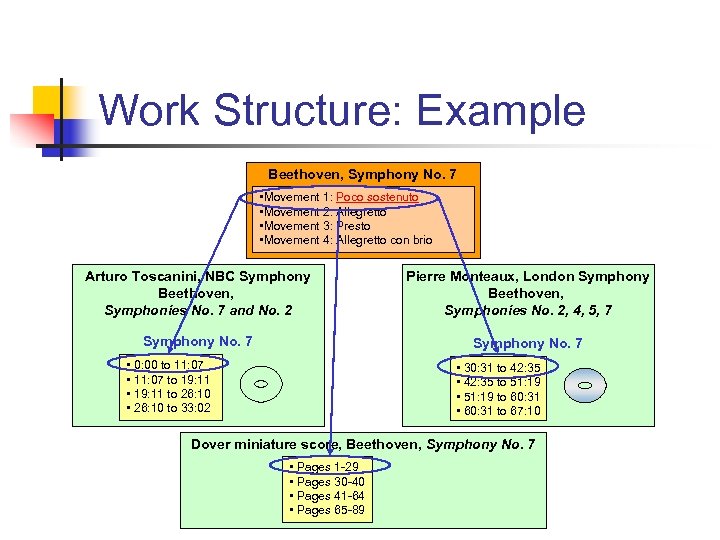
Work Structure: Example Beethoven, Symphony No. 7 • Movement 1: Poco sostenuto • Movement 2: Allegretto • Movement 3: Presto • Movement 4: Allegretto con brio Arturo Toscanini, NBC Symphony Beethoven, Symphonies No. 7 and No. 2 Pierre Monteaux, London Symphony Beethoven, Symphonies No. 2, 4, 5, 7 Symphony No. 7 • 0: 00 to 11: 07 • 11: 07 to 19: 11 • 19: 11 to 26: 10 • 26: 10 to 33: 02 • 30: 31 to 42: 35 • 42: 35 to 51: 19 • 51: 19 to 60: 31 • 60: 31 to 67: 10 Dover miniature score, Beethoven, Symphony No. 7 • Pages 1 -29 • Pages 30 -40 • Pages 41 -64 • Pages 65 -89
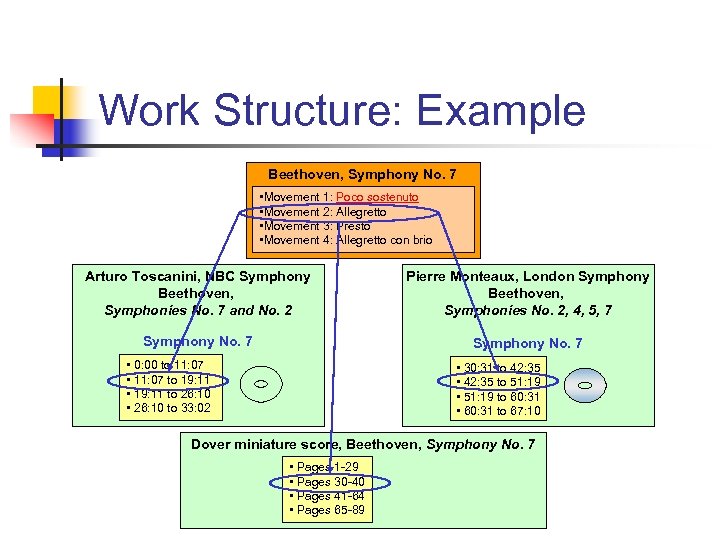
Work Structure: Example Beethoven, Symphony No. 7 • Movement 1: Poco sostenuto • Movement 2: Allegretto • Movement 3: Presto • Movement 4: Allegretto con brio Arturo Toscanini, NBC Symphony Beethoven, Symphonies No. 7 and No. 2 Pierre Monteaux, London Symphony Beethoven, Symphonies No. 2, 4, 5, 7 Symphony No. 7 • 0: 00 to 11: 07 • 11: 07 to 19: 11 • 19: 11 to 26: 10 • 26: 10 to 33: 02 • 30: 31 to 42: 35 • 42: 35 to 51: 19 • 51: 19 to 60: 31 • 60: 31 to 67: 10 Dover miniature score, Beethoven, Symphony No. 7 • Pages 1 -29 • Pages 30 -40 • Pages 41 -64 • Pages 65 -89
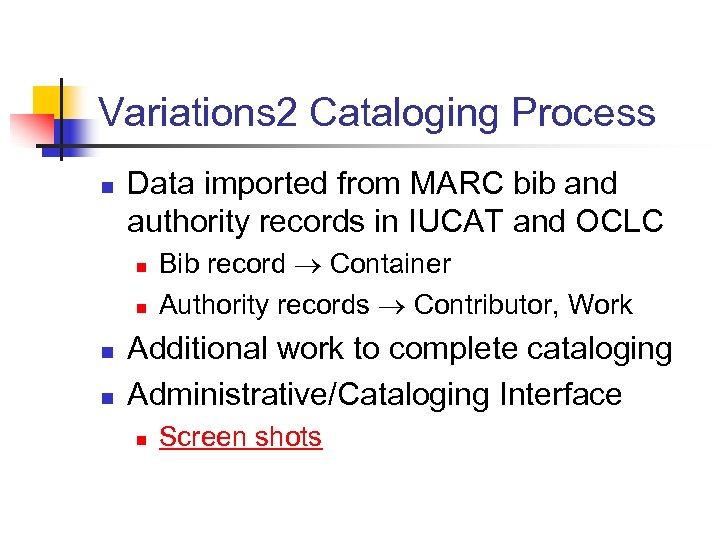
Variations 2 Cataloging Process n Data imported from MARC bib and authority records in IUCAT and OCLC n n Bib record Container Authority records Contributor, Work Additional work to complete cataloging Administrative/Cataloging Interface n Screen shots
Demonstration
Variations 2 Version 3. 0 n n n Currently in planning Target: September 2004 Possible features n Enhancements for distance ed n n n n Better integration with On. Course Quiz, self-test tools Playlists Themes and incipits Encoded scores (music notation) Score annotation tools Ongoing data model, cataloging, performance improvements Client-server communication using SOAP (web services)
Variations 2 Possible Future Plans n n n Extend media access to additional formats, delivery methods Storage, indexing improvements for larger data set Support for multiple sites: record sharing, cross-repository references n n n Necessary for sustainability Improved cataloging/administrative interface Better MARC record import Continued work on metadata -standards? Replace Variations[1]? Web interface Further work on instructional authoring, classroom presentation, and instructional delivery interfaces: MMTT Support for supplemental recording materials (e. g. , liner notes, booklets) Integration with content-based search Support for video Repository integration: e. g. Fedora. . .
Usability n n Usability = ease of use + usefulness Established baseline n n Usability test of existing Variations system Satisfaction study of Variations users Contextual inquiry Evaluation of usability of Variations 2 n n n Prototype interviews Usability tests of preliminary versions Pilot studies n Data gathering through satisfaction survey and automated usage logging
Intellectual Property n Issues n Complexity of music copyright n n n Multiple rights and rights holders Fair use and other exceptions Technologies for access control and rights management Content licensing options for research and educational use Affect of legal requirements and licensing terms on technical design, management, and ability to meet educational objectives
Disclaimer This material is based upon work supported by the National Science Foundation under Grant No. 9909068. Any opinions, findings, and conclusions or recommendations expressed in this material are those of the author(s) and do not necessarily reflect the views of the National Science Foundation.
More information. . . n Research: n n User Guide: n n http: //variations 2. indiana. edu/use/ E-mail: n jwd@indiana. edu
Скачать презентацию The Variations 2 Digital Music Library Project Jon
82006d544a3afa6dfd8110155f85698f.ppt