


 Скачать презентацию The Use of Legal Aid to Realize Other
d531113cf7bdc75d6b9132bec9672d1c.ppt
- Количество слайдов: 32
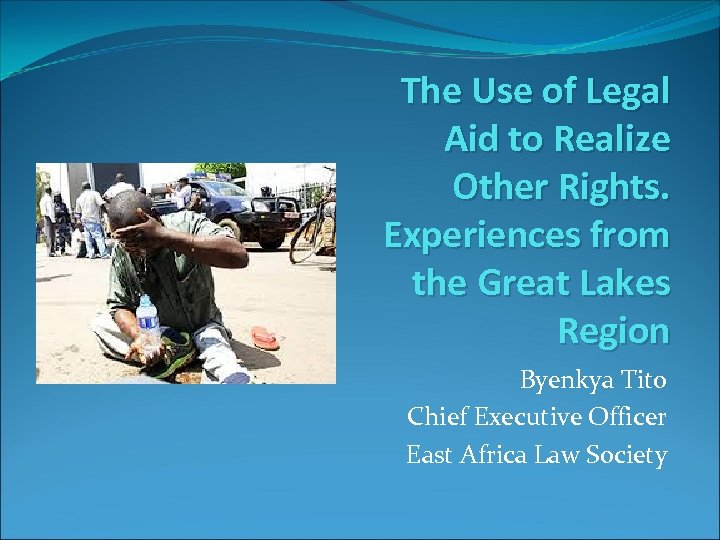 The Use of Legal Aid to Realize Other Rights. Experiences from the Great Lakes Region Byenkya Tito Chief Executive Officer East Africa Law Society
 Charting the Course…. This Presentation aims to illustrate the linkage between Legal Aid, Legal Empowerment and human rights. It will also address the question as to whether legal Aid has facilitated the realization of adequate standards of living – as a driver of economic empowerment.
 Human Rights – Definition …. Human Rights are universal legal guarantees protecting individuals and groups against actions and omissions that interfere with fundamental freedoms, entitlements and human dignity. Human rights are inherent in all human beings and are founded on the respect for the dignity and worth of each person. Human Rights have been enshrined in the Universal Declaration of Human Rights, and codified in a series of international, regional and sub-regional instruments.
 Human Rights – Definition Cont’d. These include: 1. The 1966 International Covenant on Civil and Political rights. 2. The 1966 International Covenant on Economic, social and Cultural Rights. 3. The 1981 African Charter on Human and Peoples Rights. 4. The 1999 Treaty for the Establishment of the East African Community.
 Human Rights – Definition Cont’d. The Human rights standards and norms in these Treaties and Instruments; as well as other instruments such as Declarations, Guidelines and Principles as adopted at international level, have been domesticated in municipal constitutional and legal frameworks by the signatory states. Despite their categorization as first, second and third generation rights, it should be noted that human rights are universal, inalienable, interrelated, interdependent, and indivisible.
 The link between Legal Aid and Human Rights. . The centrality of Legal Aid to the Realization of Human rights was established by the European Court of Human Rights in the 1979 case of Airey v Ireland (32 Eur Ct Ser A (1979); (1979) 2 E. H. R. R. 305). The case maintained that legal aid is an integral part of human rights, in order to make remedies effective and not merely illusory where necessary. It also serves as a precedent for demonstrating that there are economic and social rights dimensions within civil and political rights.
 The link between Legal Aid and Human Rights Cont’d… And the principle has been reiterated in a number of Declarations, Guidelines and Principles adopted by States and intergovernmental organizations, such as the 1999 Dakar Declaration on the Right to a Fair Trial; Principles and Guidelines on the Right to a fair Trial and Legal Assistance in Africa; as well as the 2007 Kyiv Declaration on the Right to Legal Aid.
 Poverty – and Legal Empowerment Cont’d… The need for legal aid as a vehicle for realization of rights and enhancing access to justice is occasioned by: ü Poverty ü Ignorance of legal rights and obligations. ü Inordinately complex judicial systems and processes ü A largely profit oriented urban based legal profession ü Exclusion of poor and marginalized groups from social and political processes that define their lives. ü Ambiguous, cumbersome and costly laws, polices and administrative processes that don’t benefit the poor.
 Poverty – and Legal Empowerment Cont’d… Communities living in poverty are also characterized by: ü Inequitable access to state institutions that promote and protect human rights, where these exist in the first place. ü Inability to adequately voice their needs. ü Inability to seek redress against injustice. ü Traditional cultures that discriminate and disempower women and the youth (Patriarchy). ü Default preference for informal systems and customary practices to protect, and where possible, enhance their incomes.
 The link between Legal Aid and Human Rights Cont’d. So, one can conclude that legal aid, through enhancing access to justice, results into the realization of human rights for the poor and the marginalized; It empowers them to claim rights and live in respect and dignity. But what exactly is legal empowerment, and how does it result into poverty alleviation and economic empowerment – which is the thrust of this paper.
 Poverty – and Legal Empowerment The 2009 United Nations Secretary General’s Report on Legal Empowerment of the Poor and Eradication of Poverty (A/64/133 – UNGA) describes poverty as ‘… simply not the lack of material goods and opportunities such as employment, ownership of productive assets and savings. It is also the lack of intangible assets and social goods, such as legal identity, good health, physical integrity, freedom from fear and violence, organizational capacity, the ability to exert political influence and the ability to claim rights and live in respect and dignity. (Paragraph 7, on page 4)
 Poverty – and Legal Empowerment Cont’d… Legal empowerment of the poor can then be understood as the process of systematic change through which the poor are protected and enabled to use the law to advance their rights and interests as citizens and economic actors. It recognizes that poverty results from disempowerment, exclusion and discrimination. So Legal empowerment fosters development through empowering and strengthening voices of individuals and communities. It recognizes that every individual must have access to justice, including due process and remedies, and that action must be taken to eliminate discrimination. (Paragraphs 3 and 4, page 3)
 Poverty – and Legal Empowerment Cont’d… Legal empowerment of the poor seeks to establish the rule of law and ensure equal and equitable access to justice and to tackle the roots of exclusion, vulnerability and poverty. Security of livelihoods, of shelter, of tenure, and of contracts can enable and empower the poor against the possible violation of their rights. In that respect, legal empowerment goes beyond the provision of legal remedies and leads to better economic opportunities for the poor. Thus, by focusing in livelihood security, legal empowerment can effectively deliver both ‘freedom from want’ and ‘freedom from fear’. (Paragraph 5, page 3).
 Poverty – and Legal Empowerment Cont’d… The ‘livelihood security’ focus of legal empowerment is evident in three of its four constitutive pillars. These are: (i) Property Rights. (ii) Labour Rights. (iii)Rights to self employment and business. Access to Justice, as the fourth pillar, underpins the first three as a component of the rule of law – the fundamental and enabling framework without which none of the other rights can be realized. (Paragraph 23, page 7). Pillar four is a process pillar.
 Poverty – and Legal Empowerment Cont’d… It should be noted that the first three pillars are consistent with ‘economic rights’ as we understand them today, to wit: ü Right to work ü Right to enjoyment of just and favorable working conditions. ü The right to form and join trade unions. ü Protection of property. But a cursory observation of most of the legal aid service providers within the region will reveal a disproportionate focus on pillar 4 of the Legal Empowerment framework.
 Legal Aid and Economic empowerment…. So, based on the above, it is clear that Legal aid can serve as a driver for economic empowerment if it integrates the first three pillars of the legal empowerment framework. But does this principle hold true across the five countries of Uganda, Kenya, Tanzania, Rwanda and Burundi? My assessment and evaluation in this regard will be done at the structural (commitment) level; the process (efforts) level; and finally at the outcome (results) level.
 Legal Aid and economic empowerment – commitment stage At the commitment stage, all the countries mentioned have committed to and domesticated the international and regional conventions on human rights; as well as identifying themselves with the various Legal Aid instruments mentioned above. They also subscribe to the ILO’s Decent Work Agenda, which focusses on the following four inseparable, interrelated and mutually supportive objectives:
 Legal Aid and economic empowerment – commitment stage Promoting Employment as the Principal route out of poverty. 2. Respecting, promoting and realizing fundamental principles and rights at work. 3. Developing sustainable social protection. 4. Promoting social dialogue. 1. (Decent Work and the MDGs. The Millennium Declaration, the MDGs and the ILOs Decent Work Agenda. ILO).
 Legal Aid and economic empowerment – commitment stage In December 2008, the Danish Institute of Human Rights, together with the Rwanda Legal Aid Forum and the East Africa Law Society convened a regional Legal Aid Meeting in Kigali, Rwanda, at which the Legal Aid sector stakeholders across the region upheld and committed to actuating the Kyiv Declaration on the Right to Legal Aid within their respective constituents.
 Legal Aid and economic empowerment – process stage At the process / efforts stage, legal aid service providers and Bar Associations across East Africa are actively engaged in: 1. Community and legal literacy campaigns on the broad array of rights, including economic rights. 2. Impact litigation on specific rights issues. 3. Legal and policy advocacy for pro-poor reforms. 4. Legal representation of indigent clients in land, breach of contract , labour and gender equality cases. 5. Creating local bases of knowledge to address community rights violations through paralegal training and dispatch. 6. Creating and consolidation of legal aid networks and forums for improved coordination and service delivery.
 Legal Aid and economic empowerment – process stage Local Success stories include: 1. Economic, gender and land rights focused legal aid services by FHRI, LAP, FIDA, etc. 2. Advocacy towards better labour standards, social security reform and a realistic minimum wage by Platform for Labour Action. 3. Advocacy towards increasing women’s control of productive resources by the Uganda Land Alliance. 4. Impact litigation by FIDA and UWONET to purge gender discriminatory provisions from the Divorce Act. 5. Coalition building and networking by LASPNET / HURINET. 6. Labour Union action for better work conditions and remuneration for their constituents.
 Legal Aid and economic empowerment – process stage There are equally impressive initiatives at the regional level by institutions like NALEAP, FIDA – Kenya Chapter and Kituo cha Sheria in Kenya; Legal and Human Rights Centre as well as Women Legal Aid Centre in Tanzania; FORSC in Burundi and the Women Legal Rights Initiative in Rwanda: but the limited time will not permit me to expound on each of them. Suffice it to mention that the EALS has, in the aspect of economic empowerment and livelihoods of communities and individuals, filed two cases at the East African Court of Justice. (EACJ References No. 1 of 2014, and No. 7 of 2014).
 Legal Aid and economic empowerment – results stage However, despite initial gains at the structural and process levels, legal aid is yet to fully translate into economic empowerment at the outcome or results stage. This is manifested by: 1. Absence or lack of meaningful minimum wages within the mentioned countries, which may also be eroded by inflation. According to the 2009/2010 labour market survey, 2. 7 million Ugandans were classified as ‘working poor’. Their remuneration cannot lift them out of poverty, because their monthly income added up to less than 1 US$ per day.
 Legal Aid and economic empowerment – results stage Uganda, Kenya and Tanzania have all been rocked by strikes initiated by teachers, medical workers, as well as academic teaching and administrative staff at public universities; decrying the high costs of living and comparatively low salary scales. Consider that in 2012, 40% of Tanzanian adults, up from 25% in 2008, felt that the economic situation there was very bad. In Uganda, the figure was 62% in 2012, up from 42% two years earlier. For Kenya, the figure jumped to 84% in 2011, up from 54% six years earlier.
 Legal Aid and economic empowerment – results stage 2. According to State of East Africa Report 2013, just 1. 6% of Uganda’s, 4% of Burundi’s, 5% of Tanzania’s, and 6% of Kenya’s working populations are formally employed. The bulk of the working population is engaged in the informal economy, characterized by income insecurity and a wide range of decent work deficits. However, the social security platforms across the five states mentioned are designed to largely cater for the formal sector workers, leaving the vast majority of the labour force in the informal economy uninsulated from economic related uncertainties.
 Legal Aid and economic empowerment – results stage 3. While gender gains have been made in trying to achieve gender equity in ownership of productive resources and decision making, attitudinal change at policy level is still a challenge. Recently, His Excellency the President of Kenya signed into law a controversial Marriage Bill that recognizes polygamous civil unions; while in Rwanda, the statutory duration of maternity leave has been reduced from twelve to six weeks, ‘to attract foreign investment’. This means that women are not accorded equal treatment and opportunity in economic affairs, despite the excellent constitutional provisions on gender equity in these two countries.
 Legal Aid and economic empowerment – results stage 4. In 2011, the richest 10% of East Africans or about 14 million people, commanded US$ 29 Billion of the regions total income. (Averaging US$ 2, 100 each). In comparison, the poorest 40% of the population or about 56 million people, shared US$12. 7 Billion over the same period. (Averaging US$ 225 each). So legal empowerment of the poor, in its present form, appears unable to guarantee a more balanced, inclusive and harmonious development process within East Africa; amidst high levels of economic inequality, social exclusion and disempowerment.
 Way Forward Legal Aid service providers should try and balance their focus between Civil and Political rights; as well as economic rights. The latter set of rights, or generally second and third generation rights, are usually sacrificed at the altar of the former. 2. There should be a closer working relationship between Legal Aid service providers, and the partners in the ILO Social Dialogue. (Workers, employers and the Government) for better, more inclusive labour standards. 1.
 Way Forward cont’d. 3. Social security platforms should be expanded to cater for economic activities and employment within the informal economy, to mitigate income and other shocks. Examples can be drawn from Kenya that has introduced a voluntary social security arrangement for the informal sector, with payments as low as KES. 20 per day. 4. Legal Aid Actors should liaise with regional actors like the East Africa Women in Business Platform, to present a concerted voice against gender biased attitudes that economically disadvantage women.
 Way Forward cont’d. 5. According to the state of East Africa Report 2013, the strong economic growth performance unleashed by the EAC Integration process has done little to close the gap between the rich and the poor; and it may not even be moving the region in such a direction. So increase trade, investment, competiveness and value addition can only be one side of the story. Addressing the social dimensions of improved welfare by achieving a greater degree of equity enhancing inclusiveness must be the second and equally important side of East Africa’s regional integration narrative – a task for legal aid service providers.
 Way Forward cont’d. 6. Legal Aid service providers should endeavor to strengthen the link between the process and results stages of their interventions, from an economic development perspective. Inclusiveness of growth and the degree of equity. Must underlie their interventions.
 END We can carry on the discussion at ceo@ealawsociety. org