 Скачать презентацию The use of IT in food distribution and
9ce6fa0ff693adfa21b8ba8dfeb9df9c.ppt
- Количество слайдов: 35




The use of IT in food distribution and food traceability (in Ireland) Jonnyboy, Wheat? , July 27 th 2008, CC
Food traceability is defined by the EU commission as: “the ability to trace and follow a food, feed, food producing animal or substance intended to be, or expected to be incorporated into a food or feed, through all stages of production, processing and distribution”(Kelepouris, 2007; Regattieri et al. , 2007).

With Ireland’s meat and fish exports growing at a steady rate, such systems needed to be introduced to meet the EU standards.
There are 3 mains technologies being used:
There are 3 mains technologies being used: • RFID
There are 3 mains technologies being used: • RFID • Retinal Imaging
There are 3 mains technologies being used: • RFID • Retinal Imaging • Wireless Sensors
RFID or Radio-frequency identification
RFID or Radio-frequency identification “allows automated identification of products by embedding chips with wireless antennas on objects. ” (Indranil, Ngai, Teo, & Spiekermann, 2009).
RFID or Radio-frequency identification “allows automated identification of products by embedding chips with wireless antennas on objects. ” (Indranil, Ngai, Teo, & Spiekermann, 2009). So how do they work ?
RFID’s comprise of 3 main parts:
RFID’s comprise of 3 main parts: • A chip
RFID’s comprise of 3 main parts: • A chip • A reader
RFID’s comprise of 3 main parts: • A chip • A reader • A receiver
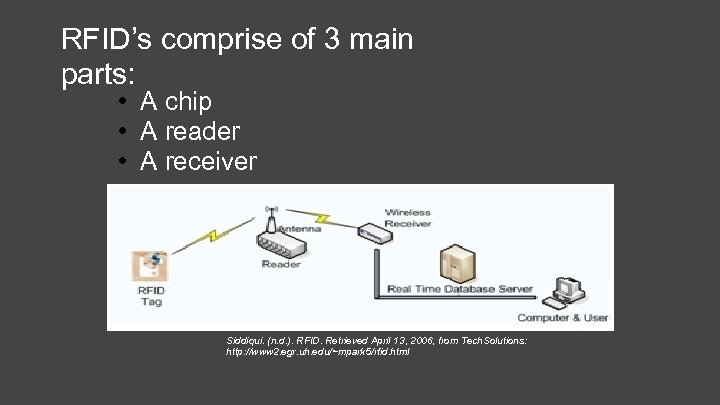
RFID’s comprise of 3 main parts: • A chip • A reader • A receiver Siddiqui. (n. d. ). RFID. Retrieved April 13, 2006, from Tech. Solutions: http: //www 2. egr. uh. edu/~mpark 5/rfid. html
RFID’s: • Cheap to implement • Over 50 years old • being surpassed
RFID’s: • Cheap to implement • Over 50 years old • being surpassed. . . Retinal Imaging
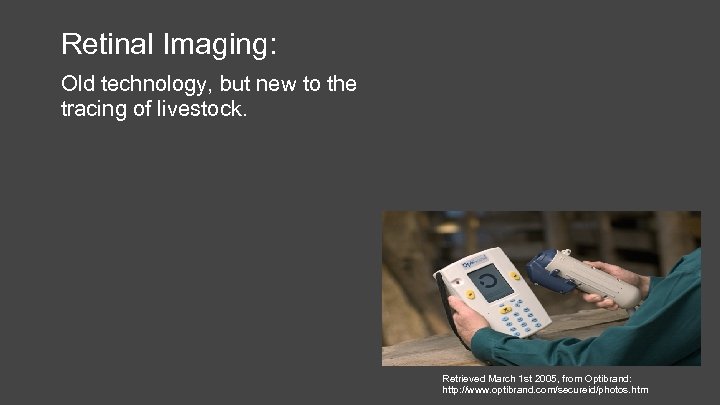
Retinal Imaging: Old technology, but new to the tracing of livestock. Retrieved March 1 st 2005, from Optibrand: http: //www. optibrand. com/secureid/photos. htm
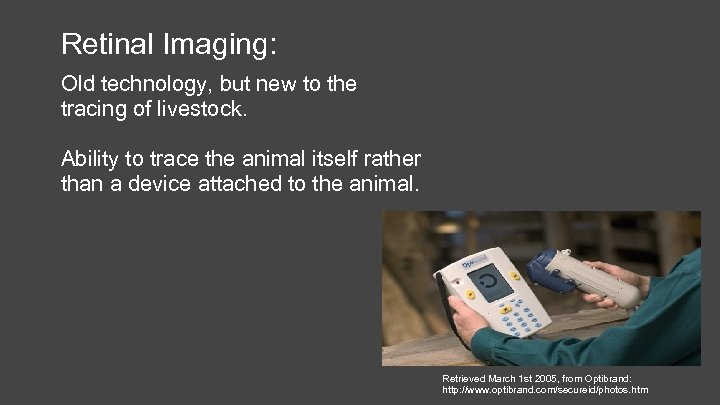
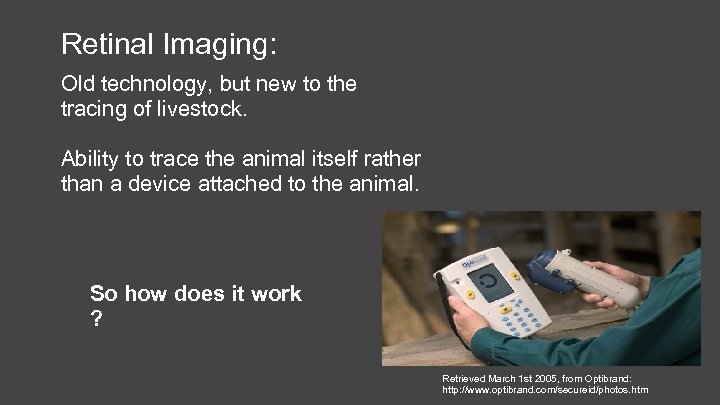
Retinal Imaging: Old technology, but new to the tracing of livestock. Ability to trace the animal itself rather than a device attached to the animal. Retrieved March 1 st 2005, from Optibrand: http: //www. optibrand. com/secureid/photos. htm
Retinal Imaging: Old technology, but new to the tracing of livestock. Ability to trace the animal itself rather than a device attached to the animal. So how does it work ? Retrieved March 1 st 2005, from Optibrand: http: //www. optibrand. com/secureid/photos. htm
Retinal Imaging: Retrieved March 1 st 2005, from Optibrand: http: //www. optibrand. com/secureid/photos. htm
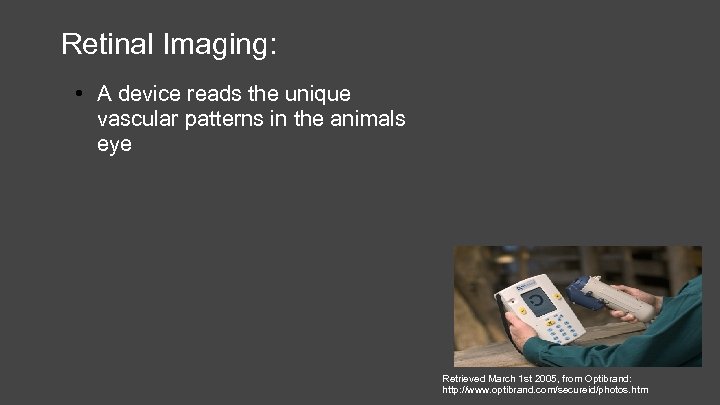
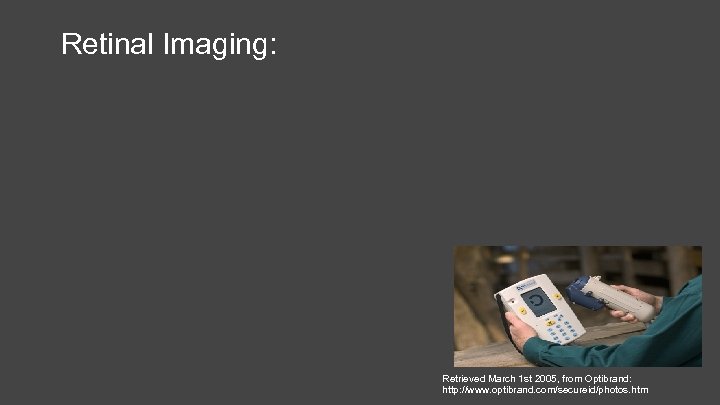
Retinal Imaging: • A device reads the unique vascular patterns in the animals eye Retrieved March 1 st 2005, from Optibrand: http: //www. optibrand. com/secureid/photos. htm
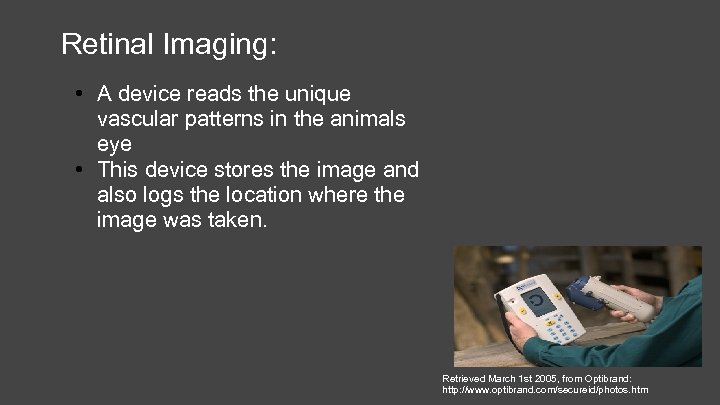
Retinal Imaging: • A device reads the unique vascular patterns in the animals eye • This device stores the image and also logs the location where the image was taken. Retrieved March 1 st 2005, from Optibrand: http: //www. optibrand. com/secureid/photos. htm
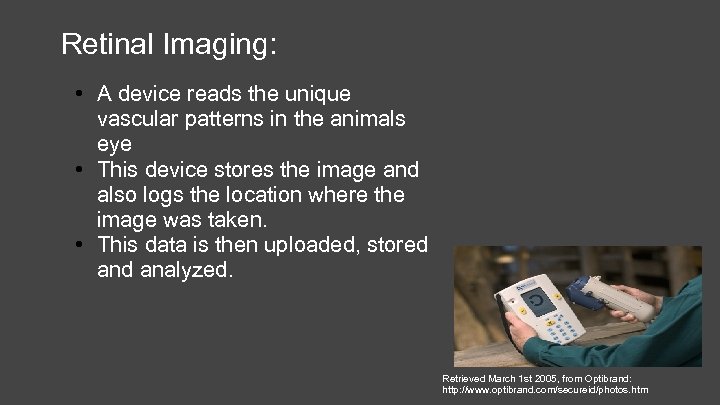
Retinal Imaging: • A device reads the unique vascular patterns in the animals eye • This device stores the image and also logs the location where the image was taken. • This data is then uploaded, stored analyzed. Retrieved March 1 st 2005, from Optibrand: http: //www. optibrand. com/secureid/photos. htm

Wireless sensors:
Wireless sensors: Log water temperatures ( Vital to maintain fish supplies )
Wireless sensors: Log water temperatures ( Vital to maintain fish supplies ) How the work can be explained best if broken down into 2 levels.

Wireless sensors: Level 1:
Wireless sensors: Level 1: • Loggers o thermostat o RF transmitter • Base station ( receives transmitted data )
Wireless sensors: Level 1: Level 2: • Loggers o thermostat o RF transmitter • Base station ( receives transmitted data )
Wireless sensors: Level 1: Level 2: • Loggers • GSM modem o thermostat • Server o RF transmitter • Base station ( receives transmitted data )
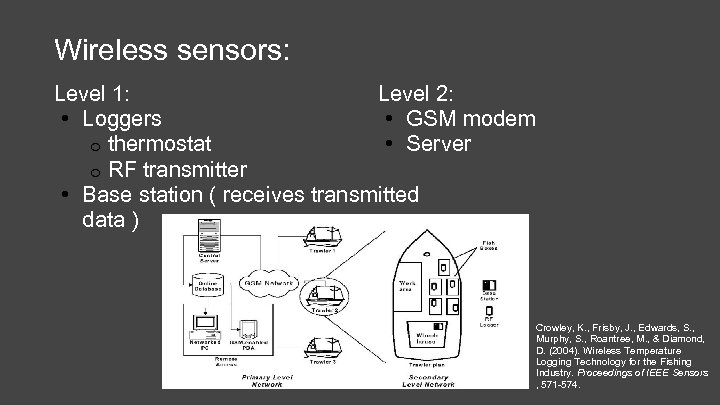
Wireless sensors: Level 1: Level 2: • Loggers • GSM modem o thermostat • Server o RF transmitter • Base station ( receives transmitted data ) Crowley, K. , Frisby, J. , Edwards, S. , Murphy, S. , Roantree, M. , & Diamond, D. (2004). Wireless Temperature Logging Technology for the Fishing Industry. Proceedings of IEEE Sensors , 571 -574.
Wireless sensors: This design is only in its early stages, and will improve in the future.

Thank You!
References: • Buhr, B. (2003). Traceability and Information Technology in the Meat Supply Chain: Implications for Firm Organization and Market Structure. Journal of Food Distribution Research. • Cree, L. M. , & Reid, M. H. (2009). Development of the UK food samples surveillance system. Public Health , 89– 94. • Crowley, K. , Frisby, J. , Edwards, S. , Murphy, S. , Roantree, M. , & Diamond, D. (2004). Wireless Temperature Logging Technology for the Fishing Industry. Proceedings of IEEE Sensors , 571 -574. • Golden, B. , Allen, A. , Taylor, M. , Patterson, D. , & Skuce, R. (2008). Evaluation of retinal imaging technology for the biometric identification of bovine animals in Northern Ireland. Livestock Science , 42 -52. • Indranil, B. , Ngai, W. , Teo, S. , & Spiekermann, S. (2009). Managing RFID projects in organizations. European Journal of Information Systems , 534– 540. • Siddiqui. (n. d. ). RFID. Retrieved April 13, 2006, from Tech. Solutions: http: //www 2. egr. uh. edu/~mpark 5/rfid. html
Скачать презентацию The use of IT in food distribution and
9ce6fa0ff693adfa21b8ba8dfeb9df9c.ppt