


 Скачать презентацию The use of FM systems with Cochlear Implants-
f8a8d465bbc121fdb6e9320e8784d3bb.ppt
- Количество слайдов: 24
 The use of FM systems with Cochlear Implants- How has research had an impact on practice? Sarah Flynn and Elizabeth Wood South of England Cochlear Implant Centre University of Southampton
 Co - workers • • • Julie Eyles Catherine Sammons Mark Lutman Paula Greenham Margie Harriott
 Why use assistive listening devices? • Listening conditions outside the clinic • Proven benefit of FM radio aids with hearing aids in classroom situations • Direct rehabilitation at hearing deficit rather than overcoming poor listening environment
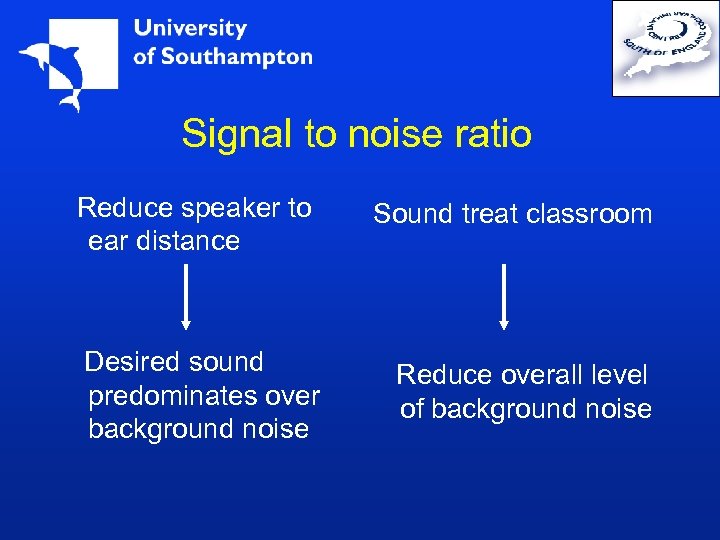 Signal to noise ratio Reduce speaker to ear distance Sound treat classroom Desired sound predominates over background noise Reduce overall level of background noise
 Research rationale • Older children and adults for sound quality rating • Word discrimination testing in pink noise simulates classroom conditions • Testing at distances up to 10 metres to simulate teacher’s distance from child • Standard conditions to compare different processor and radio aid combinations • No change to processor sensitivity setting
 Mc. Cormick Automated Toy Test (ATT) • Word discrimination task for young children • Adaptive technique allows comparison without doing many word lists • 71% words correct in d. B (A)
 Results of earlier studies In noise • All subjects benefited from using an FM system • Mean FM improvement in quiet = 7 d. B • Mean FM improvement in noise = 15 d. B Over distance • Sound quality reported as good at 1 m, 3 m and 10 m • Mean FM improvement at 1 m and 3 m = 14 d. B • Mean FM improvement at >10 m = 10 d. B
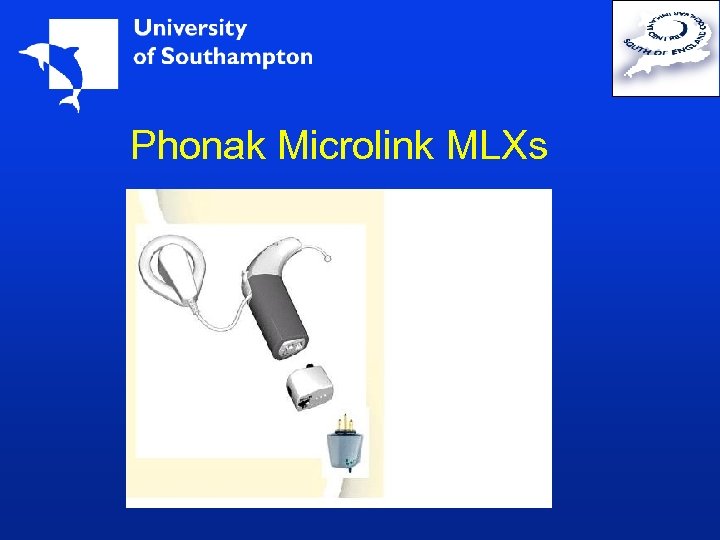 Phonak Microlink MLXs
 Initial results with ESPrit 3 G • 4/11 subjects reported problems with the clarity of the FM signal with Micro. Link MLx • Large variability between subjects • Identified a need for change in programming parameters of processors - monitor earphone setting should not be enabled for the map suitable for FM / accessories
 Follow-up study of FM radio aids with ESPrit 3 G • • • 3 radio aids Micro. Link MLx, Genie and Solaris 10 subjects Each subject used the MLx and one other system 2 m in noise with and without FM Distance – • 3 m in quiet no FM • 3 m and 10 m in quiet with FM
 Results of FM radio aids with 3 G • • In noise All 3 FM systems performed well Solaris 7. 3 d. B improvement Genie 11. 0 d. B improvement Microlink 8. 3 d. B improvement • • Over distance Sound quality was >83% for all 3 systems 3/10 preferred the Microlink MLx for its ease of wearing 5/7 preferred the Genie due to louder sound ATT results were better with the Genie, than MLx
 Further research questions • Does the microphone option for the handy mic of the MLx system influence the results? • Would the MLx be more acceptable to users if there was a higher gain option?
 Microphone options Handy mic with MLx Better performance with the omni microphone setting in noise Omni gave slightly better results than zoom and much better results than superzoom over distance Campus S with MLx. S Slightly better performance with the omni microphone setting in noise and over distance
 Campus S and MLx. S with the 3 G • MLx. S receivers with gains of 10, 16 and 20 gave a significant improvement in noise • At 10 metres, a gain of 16 was significantly better than 10, but 20 was not better than 16 • 4/7 subjects said the 10 gain MLx. S was too quiet although sound quality was rated as good • 3/7 subjects said the 20 db gain MLx. S was too loud to listen to for a long time
 Research conclusions • All the FM radio aids tested can be used with cochlear implants • Micro. Link MLx – less gain for 9/10 subjects at 3 m and 10 m • Microlink MLx. S – – Gain of between 10 and 16 d. B appropriate for most users but one level is unlikely to suit all users – Probable saturation at >16 • Need for patient feedback • Need for good communication between clinic and education professionals
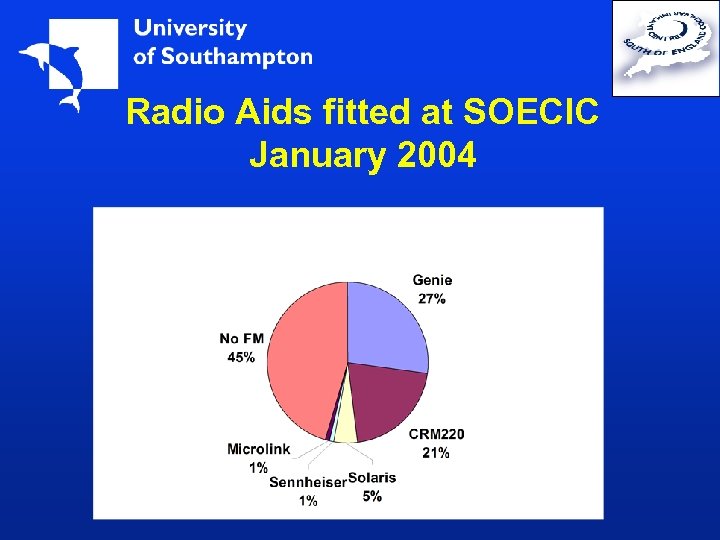 Radio Aids fitted at SOECIC January 2004
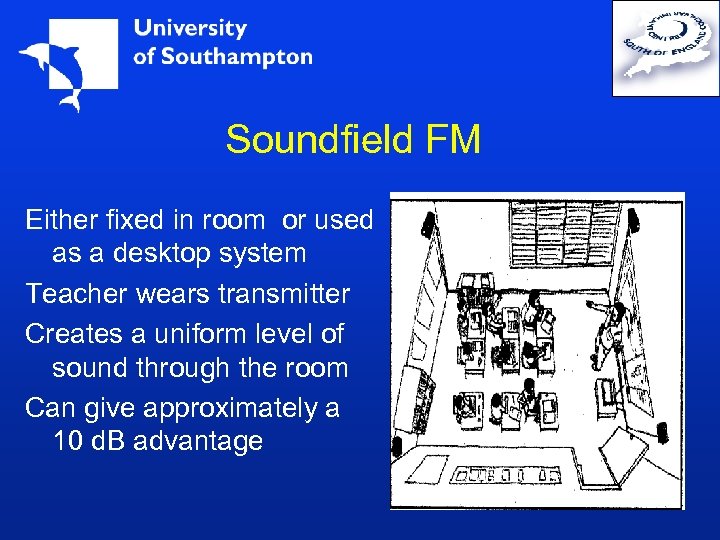 Soundfield FM Either fixed in room or used as a desktop system Teacher wears transmitter Creates a uniform level of sound through the room Can give approximately a 10 d. B advantage
 Soundfield FM Conclusions • Soundfield does give benefit to children and teachers • Users preferred the personal FM over personal FM and fixed soundfield • Need to improve room acoustics before using fixed soundfield FM • Ensure that the soundfield is optimally functioning
 Fitting guidance • • Implant user able to indicate sound quality Willingness to use radio aid with implant Stable map Use map with monitor earphones not enabled Correct FM lead Recommended transmission frequency Wearing position Communication with local professionals
 Fitting the FM system • Listening check of FM radio aid • Set output of radio aid to be compatible with that from the cochlear implant on its own • Validation of settings (Mc. Cormick ATT) • FM booklet
 Interference • Any unwanted non-signal noise • Can be caused by – Interaction between cochlear implant RF signal and radio aid RF signal – Monitor earphones enabled – Processor and radio aid worn too close together – Distance from transmitter – Receiver searching for signal when transmitter turned off – Furniture eg metal objects – Smoke alarms, taxis, mobile phone masts
 Simple checks • Having monitor earphones to check processor on its own (use monitor earphones enabled map on 3 G) • With Sprint listen through monitor earphones to radio aid system and processor together • Check radio aid system with processor on 0 sensitivity • Check accessory adaptor is used with ESPrit 3 G processor • All connections fully engaged • Microphone of Campus S switched on
 Helpful Hints for long term radio aid use • Good communication between implant centre and local services • Patient card with programme locations • Seating position in room • Processor + FM signal must be consistent over time
 References 1 Benefit of FM study : Speech Discrimination in Noise (January 2000) 2 Speech Discrimination Ability and Sound Quality with FM over distance (April 2000) 3 FM survey (June 1999/ May 2000) 4 Soundfield Systems used with Personal FM and CI (2002) 5 Benefit of FM with 3 G - distance/noise (2003) 6 Benefit of FM with 3 G - 3 FM systems (2003)