 Скачать презентацию The Use of Ensemble Model Data to Generate
0a9fb76000714b37c5ca0caeb3dfb48f.ppt
- Количество слайдов: 23



The Use of Ensemble Model Data to Generate Probabilistic Hazard Forecasts for Aviation Piers Buchanan and Philip G Gill EMS - ECAM 2013, Reading, 12 th September 2013 © Crown copyright Met Office
Contents This presentation covers the following areas • 1. Introduction: • Turbulence and ensembles • 2. Ensemble turbulence trial • 3. Summary and future work © Crown copyright Met Office
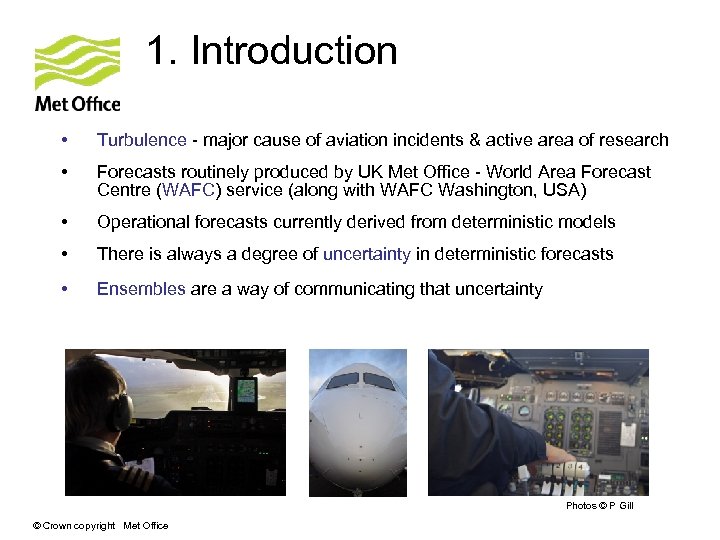
1. Introduction • Turbulence - major cause of aviation incidents & active area of research • Forecasts routinely produced by UK Met Office - World Area Forecast Centre (WAFC) service (along with WAFC Washington, USA) • Operational forecasts currently derived from deterministic models • There is always a degree of uncertainty in deterministic forecasts • Ensembles are a way of communicating that uncertainty Photos © P Gill © Crown copyright Met Office
MOGREPS-G Met Office Global and Regional Ensemble Prediction System Operational from Sep 2008 after 3 years of trials At the time of the trial (Nov 2010 – Oct 2011), MOGREPS-G: Ø Ø Approx. 60 km, 70 Levels T+72 h Run at 00 Z, 12 Z with 24 members ETKF for initial condition perturbations Stochastic physics (SKEB 2) MOGREPS-G Upgrade (January 2013) Ø Same as above but at a resolution of approx. 33 km in mid latitudes and keeping 70 levels Ø 12 member forecasts run every 6 hours i. e. 00 Z, 06 Z, 12 Z and 18 Z. © Crown copyright Met Office
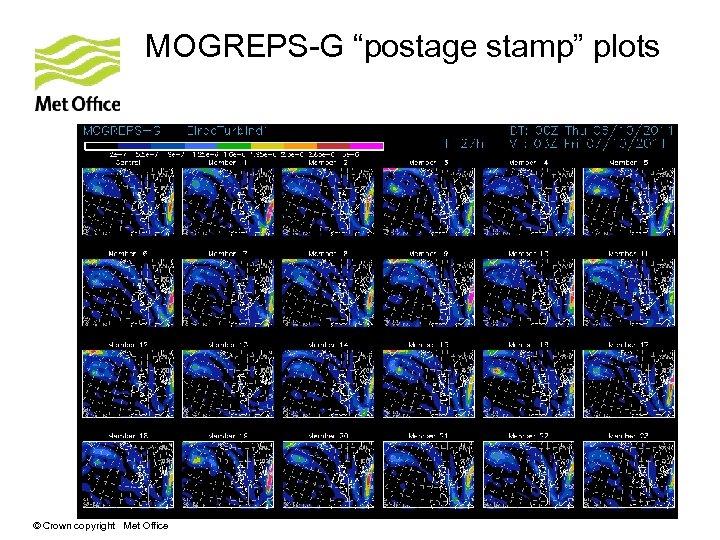
MOGREPS-G “postage stamp” plots © Crown copyright Met Office
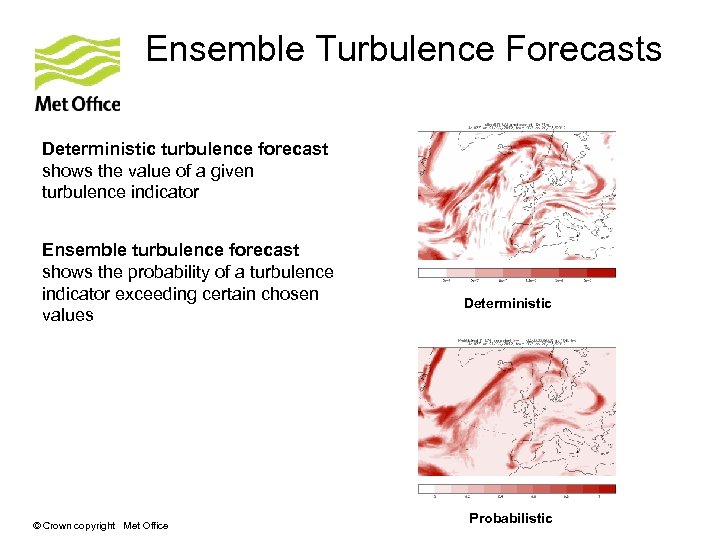
Ensemble Turbulence Forecasts Deterministic turbulence forecast shows the value of a given turbulence indicator Ensemble turbulence forecast shows the probability of a turbulence indicator exceeding certain chosen values © Crown copyright Met Office Deterministic Probabilistic

Degrees of turbulence (broadly speaking) • Light Turbulence • Ripples in your inflight coffee • Moderate Turbulence • Coffee splashes out of cups and cup itself may be upset • Severe Turbulence • Objects and even people thrown around the cabin • (Source: Daily Mirror website, 4 th June 2013)
Turbulence predictors Turbulence can come from different sources – wind shear, convection, (mountain-wave) • Windshear related: • Ellrod TI 1, Ellrod TI 2 • Brown • Dutton • Lunnon • Convection related: • Convective rainfall rate • Convective rainfall accumulation • Both windshear and convection: Richardson number • Turbulence climatology • Gridded field of observed turbulence frequency produced from aircraft observations from previous year • Light or greater and moderate or greater turbulence climatology produced © Crown copyright Met Office
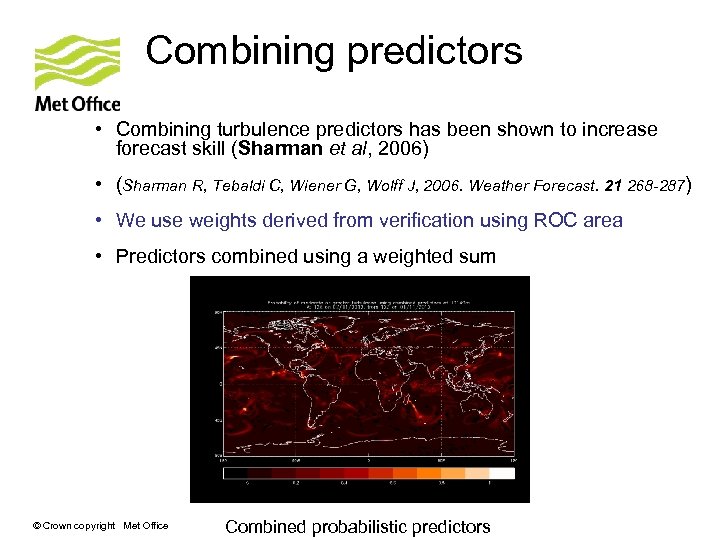
Combining predictors • Combining turbulence predictors has been shown to increase forecast skill (Sharman et al, 2006) • (Sharman R, Tebaldi C, Wiener G, Wolff J, 2006. Weather Forecast. 21 268 -287) • We use weights derived from verification using ROC area • Predictors combined using a weighted sum © Crown copyright Met Office Combined probabilistic predictors
2. Ensemble turbulence trial © Crown copyright Met Office
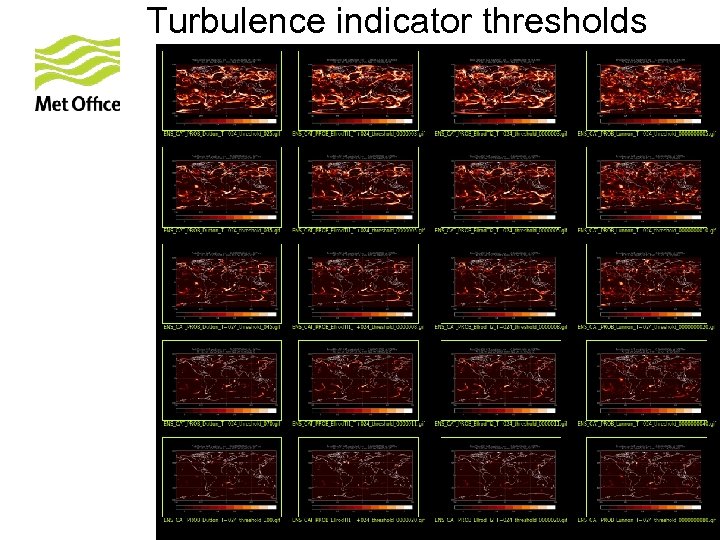
Ensemble turbulence trial • Objective verification of deterministic and probabilistic model forecasts • Global verification to assess T+24 h MOGREPS-G forecasts of turbulence • (T+24 chosen because this is a typical product time range) • Verification against automated aircraft observations from the Global Aircraft Data Set (GADS) • 12 -month trial from November 2010 -October 2011 • Eight numerical predictors and climatology verified • Five thresholds used on each predictor to generate probability forecasts • Thresholds designed to cover light to moderate to severe turbulence © Crown copyright Met Office
Turbulence indicator thresholds
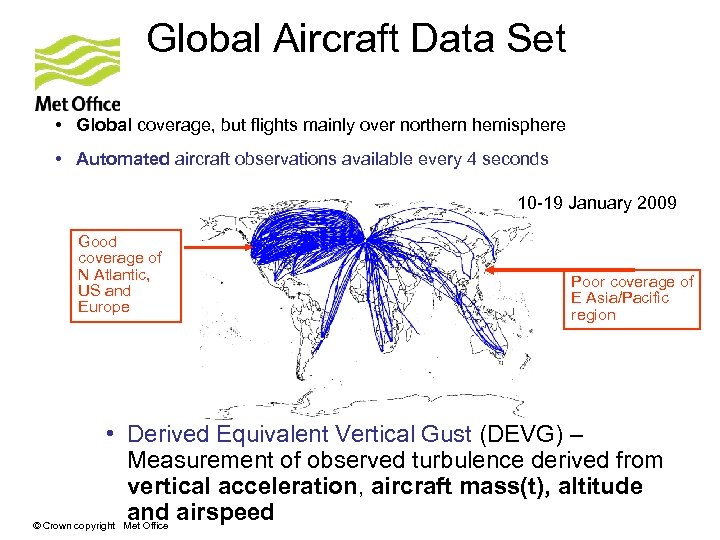
Global Aircraft Data Set • Global coverage, but flights mainly over northern hemisphere • Automated aircraft observations available every 4 seconds 10 -19 January 2009 Good coverage of N Atlantic, US and Europe Poor coverage of E Asia/Pacific region • Derived Equivalent Vertical Gust (DEVG) – Measurement of observed turbulence derived from vertical acceleration, aircraft mass(t), altitude and airspeed © Crown copyright Met Office
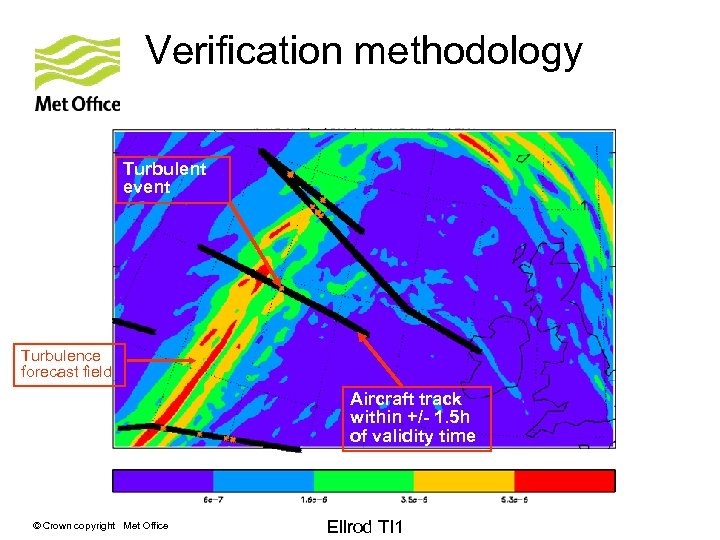
Verification methodology Turbulent event Turbulence forecast field Aircraft track within +/- 1. 5 h of validity time © Crown copyright Met Office Ellrod TI 1
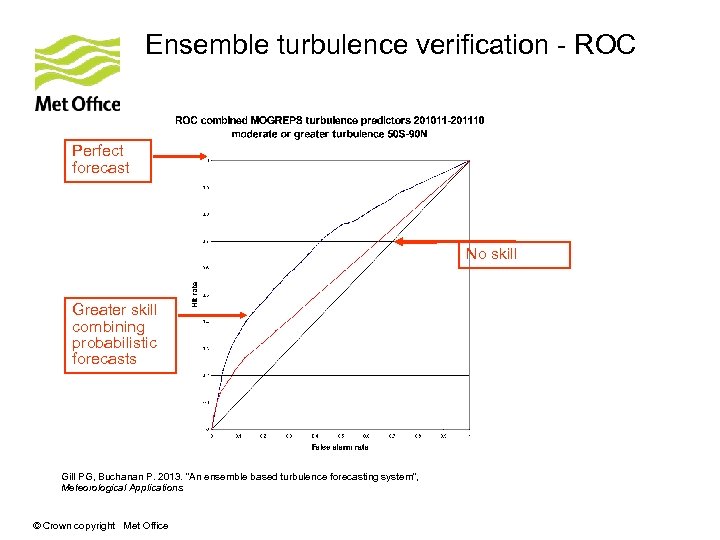
Ensemble turbulence verification - ROC Perfect forecast No skill Greater skill combining probabilistic forecasts Gill PG, Buchanan P. 2013. “An ensemble based turbulence forecasting system”, Meteorological Applications © Crown copyright Met Office
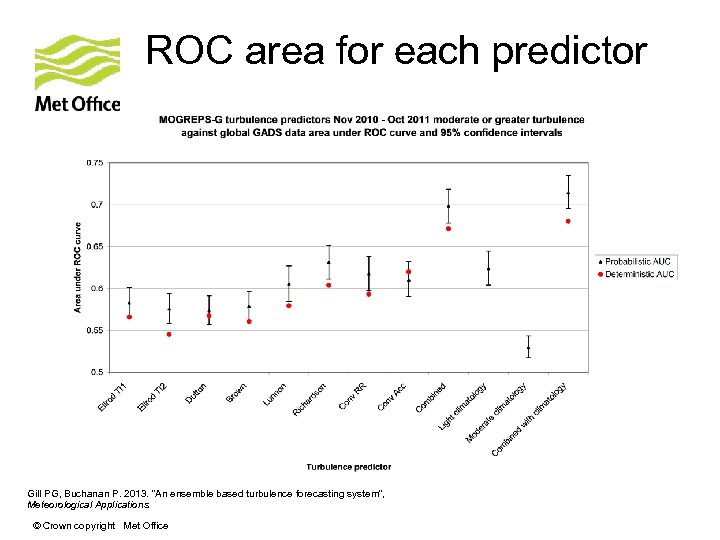
ROC area for each predictor Gill PG, Buchanan P. 2013. “An ensemble based turbulence forecasting system”, Meteorological Applications © Crown copyright Met Office
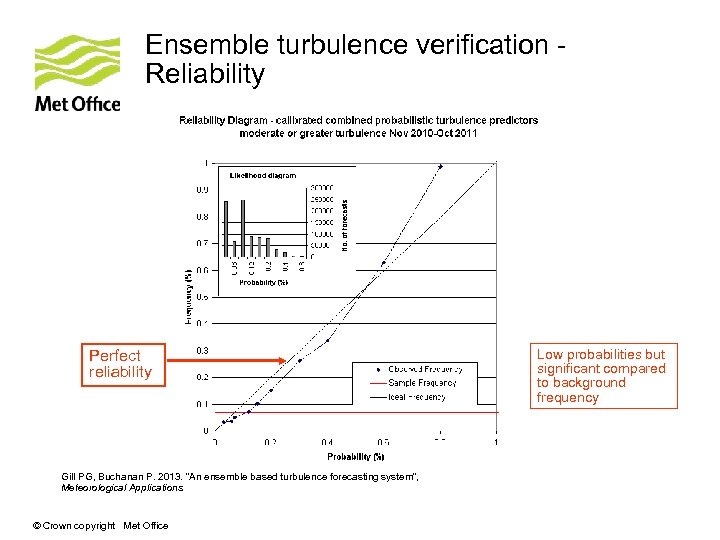
Ensemble turbulence verification Reliability Perfect reliability Gill PG, Buchanan P. 2013. “An ensemble based turbulence forecasting system”, Meteorological Applications © Crown copyright Met Office Low probabilities but significant compared to background frequency
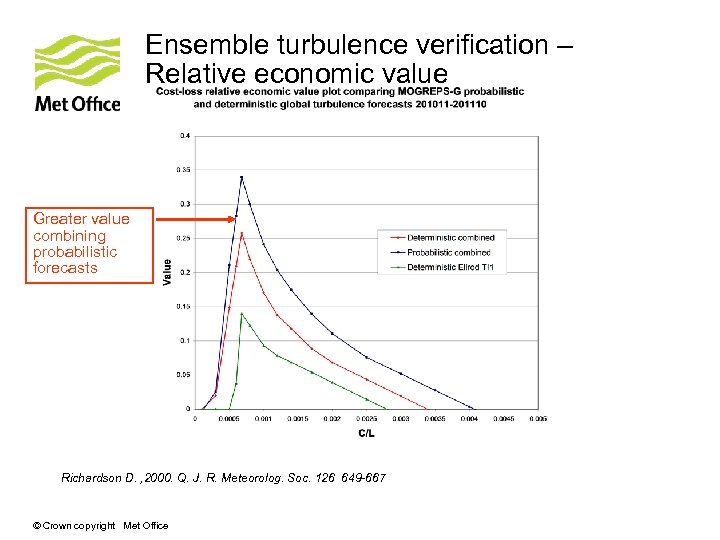
Ensemble turbulence verification – Relative economic value Greater value combining probabilistic forecasts Richardson D. , 2000. Q. J. R. Meteorolog. Soc. 126 649 -667 © Crown copyright Met Office

3. Summary and future work © Crown copyright Met Office
Summary Benefits of using Ensemble turbulence forecasts • Significant increase in skill • Increased economic value of forecast • Confidence can be communicated with every forecast © Crown copyright Met Office
Current status • Project underway to produce probabilistic forecasts within an operational setting ready for implementation – completion in Mar 2014 • Verification complete for November 2010 to Feb 2013 – analysis ongoing. • Studies into using logistic regression (thanks to Lisa Murray) to combine predictors using regional and seasonal weightings © Crown copyright Met Office
Future plans and challenges • Create operational probabilistic aviation hazard forecasts for Turbulence, Cb, Icing and Severe Convection e. g. Lightning • Investigate using a multi-model ensemble for WAFC turbulence forecasts (in collaboration with USA) • Work on sourcing additional observations continues. • Educating users in interpretation of probabilistic forecasts and verification © Crown copyright Met Office Photo © P Gill
Acknowledgements • Thanks to the UK Civil Aviation Authority for funding this project • The content of this presentation is available as a paper • Gill PG, Buchanan P. 2013. “An ensemble based turbulence forecasting system”, Meteorological Applications Any questions? piers. buchanan@metoffice. gov. uk © Crown copyright Met Office
Скачать презентацию The Use of Ensemble Model Data to Generate
0a9fb76000714b37c5ca0caeb3dfb48f.ppt