


 Скачать презентацию THE USE OF ECO-EXERGY IN OCEANOLOGY APPLICATION TO
e0b492041278bf13defc15d18b514349.ppt
- Количество слайдов: 28
 THE USE OF ECO-EXERGY IN OCEANOLOGY: APPLICATION TO POSIDONIA OCEANICA MEADOWS Dorothée Pête, Branko Velimirov & Sylvie Gobert Ph. D student, University of Liège
 Introduction § Exergy = « Useful work a system can perform when brought into equilibrium with its environment » (Szargut et al. , 1988) = distance from thermodynamic equlibrium Applying this theory to understand ecosystems and to detect environmental perturbations What a mystification! It’s metaphysics! Are you crazy?
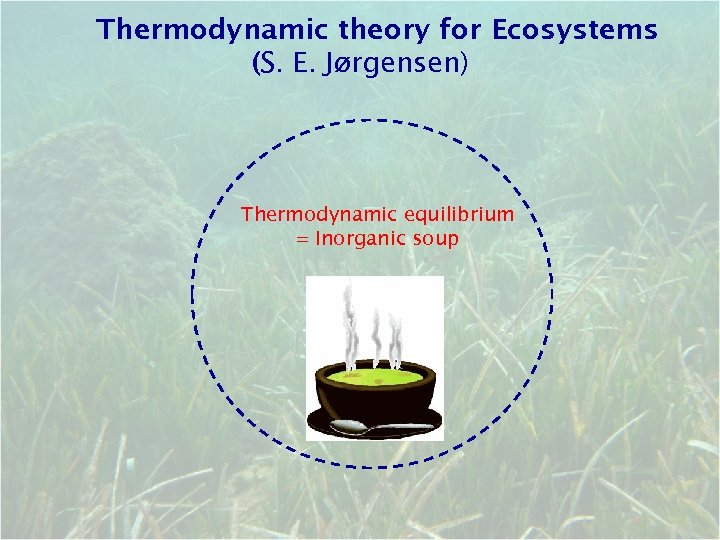 Thermodynamic theory for Ecosystems (S. E. Jørgensen) Thermodynamic equilibrium = Inorganic soup
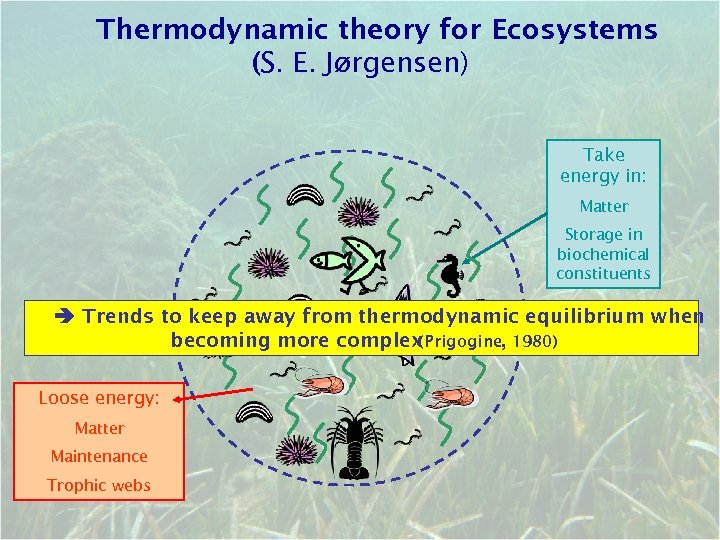 Thermodynamic theory for Ecosystems (S. E. Jørgensen) Take energy in: Matter Storage in biochemical constituents Trends to keep away from thermodynamic equilibrium when becoming more complex (Prigogine, 1980) Loose energy: Matter Maintenance Trophic webs
 Exergy index or eco-exergy: a practical way to apply the exergy theory to ecosystems • Ex (k. J/volume or surface) = distance between the system and thermodynamic equilibrium when the ecosystem is moving away from thermodynamic equilibrium when the ecosystem is getting closer from its climax, its ecological optimum = « work capacity possessed by organisms and ecological networks of organisms due to biomass and information embodied in their genome and the amino acid sequence of proteins » (Jørgensen et al. , 2010)
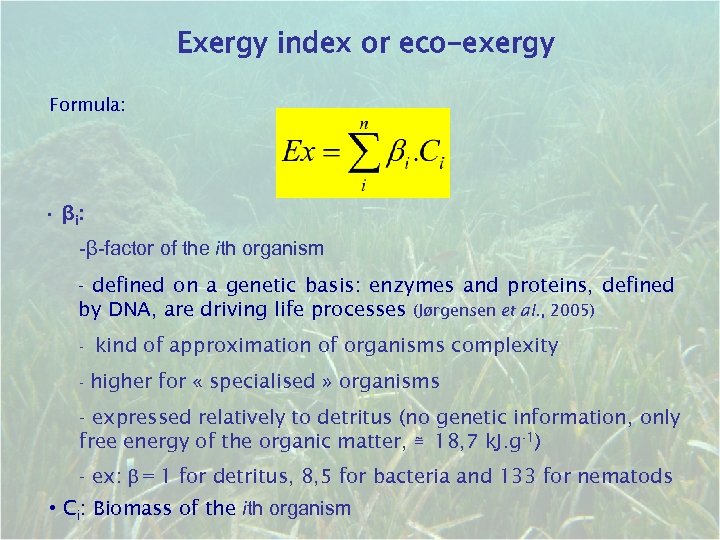 Exergy index or eco-exergy Formula: • βi: -β-factor of the ith organism - defined on a genetic basis: enzymes and proteins, defined by DNA, are driving life processes (Jørgensen et al. , 2005) - kind of approximation of organisms complexity higher for « specialised » organisms - expressed relatively to detritus (no genetic information, only free energy of the organic matter, ≅ 18, 7 k. J. g-1) - ex: β = 1 for detritus, 8, 5 for bacteria and 133 for nematods • Ci: Biomass of the ith organism
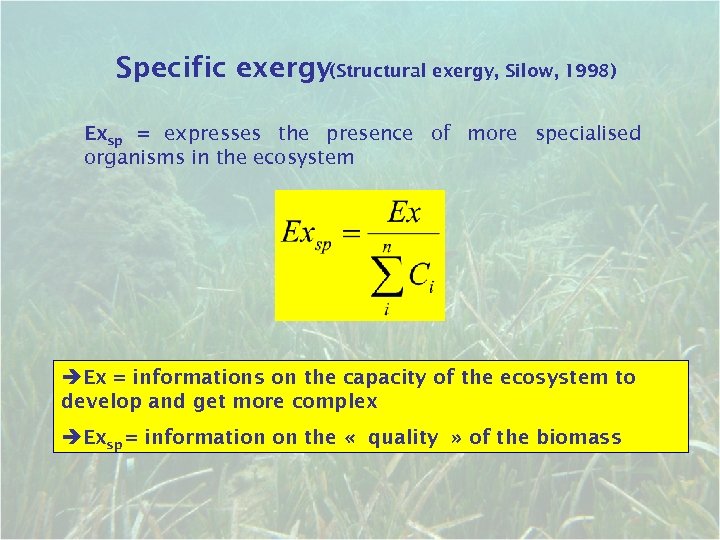 Specific exergy(Structural exergy, Silow, 1998) Exsp = expresses the presence of more specialised organisms in the ecosystem Ex = informations on the capacity of the ecosystem to develop and get more complex Exsp = information on the « quality » of the biomass
 Use of Ex and Exsp in Oceanology • 2 main uses: - Modeling of ecosystems development (plankton dynamics) - Indicators of environmental quality
 Use of Ex and Exsp in Oceanology • 2 main uses: - Modeling of ecosystems development (e. g. plankton dynamics) - Indicators of environmental quality • Interest as indicators: - Complete part of an ecosystem Global More sensitive ? - Reflect ecosystem development and complexity.
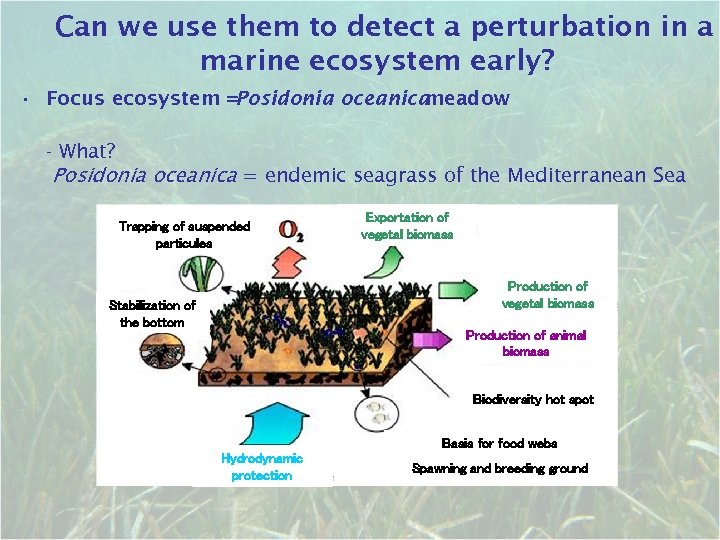 Can we use them to detect a perturbation in a marine ecosystem early? • Focus ecosystem =Posidonia oceanica meadow - What? Posidonia oceanica = endemic seagrass of the Mediterranean Sea Trapping of suspended particules Exportation of vegetal biomass Production of vegetal biomass Stabilization of the bottom Production of animal biomass Biodiversity hot spot Basis for food webs Hydrodynamic protection Spawning and breeding ground
 Can we use them to detect a perturbation in a marine ecosystem early? • Focus ecosystem = Posidonia oceanica meadow - Why? P. oceanica = descriptor of the quality of the Mediterranean coastal zone In Calvi Bay, pristine and perturbated meadows are well known. University of Liege: Good zone to test the use of Ex and Ex - Tradition of marine research (Biology, chemistry, physics, sp modeling) - Research station in Calvi Bay, Corsica: STARESO (STAtion de REcherche Sous-marine et Océanographique) - Years of experience in the Mediterranean Sea with a special focus on the Posidonia oceanica ecosystem
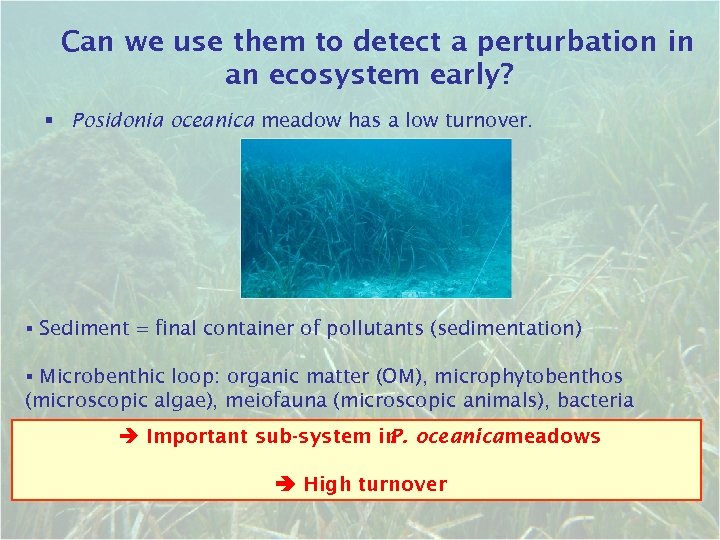 Can we use them to detect a perturbation in an ecosystem early? § Posidonia oceanica meadow has a low turnover. § Sediment = final container of pollutants (sedimentation) § Microbenthic loop: organic matter (OM), microphytobenthos (microscopic algae), meiofauna (microscopic animals), bacteria Important sub-system in oceanicameadows P. High turnover
 Goals § Clarification and validation of the use of Ex and Exsp as descriptors of anthropogenic perturbations in P. oceanica beds § Effects of nutrients and organic matter inputs which are the main perturbations in the Mediterranean coastal zone New method to measure and detect perturbations affecting P. oceanica meadows Precise, early and global method
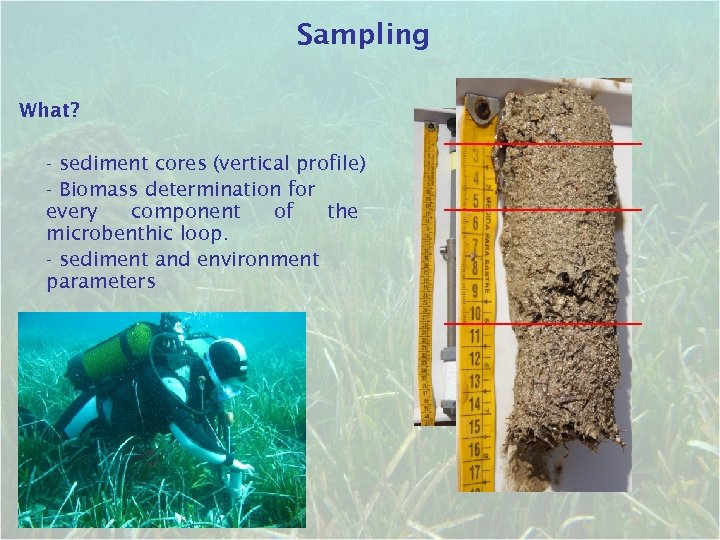 Sampling What? - sediment cores (vertical profile) - Biomass determination for every component of the microbenthic loop. - sediment and environment parameters
 How to validate an index and a method? • Spatial heterogeneity at small scale • Comparison between a pristine and a perturbated site • In situ experiments
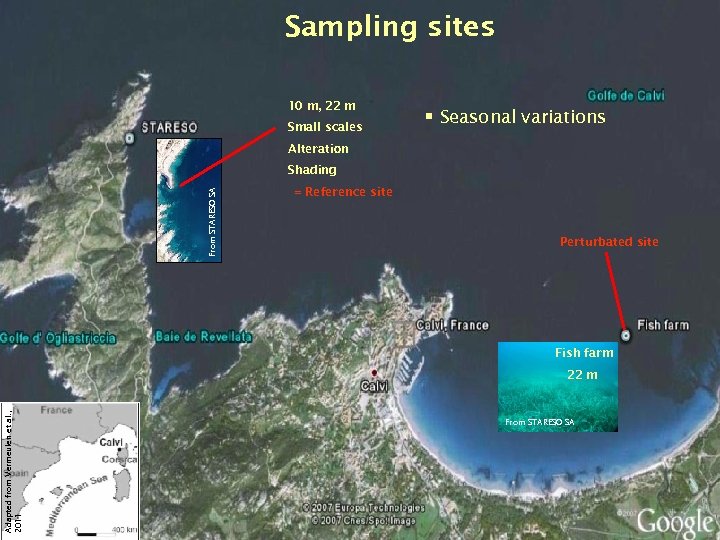 Sampling sites 10 m, 22 m Small scales § Seasonal variations Alteration From STARESO SA Shading = Reference site Perturbated site Fish farm Adapted from Vermeulen et al. , 2011 22 m From STARESO SA
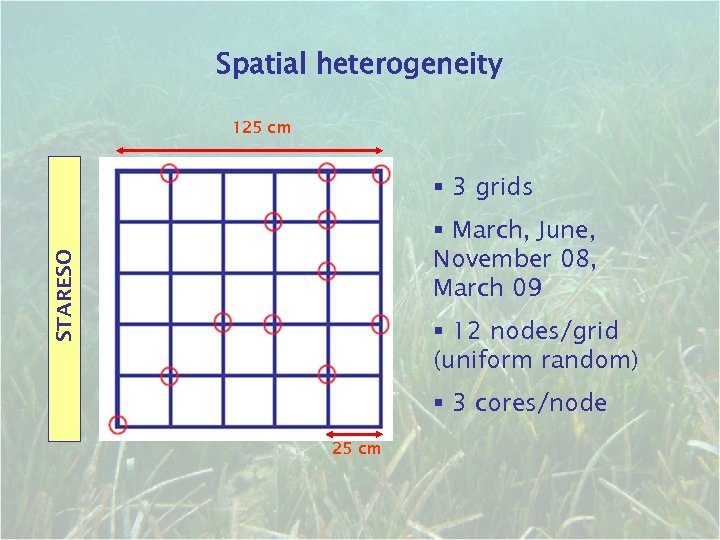 Spatial heterogeneity 125 cm § 3 grids STARESO § March, June, November 08, March 09 § 12 nodes/grid (uniform random) § 3 cores/node 25 cm
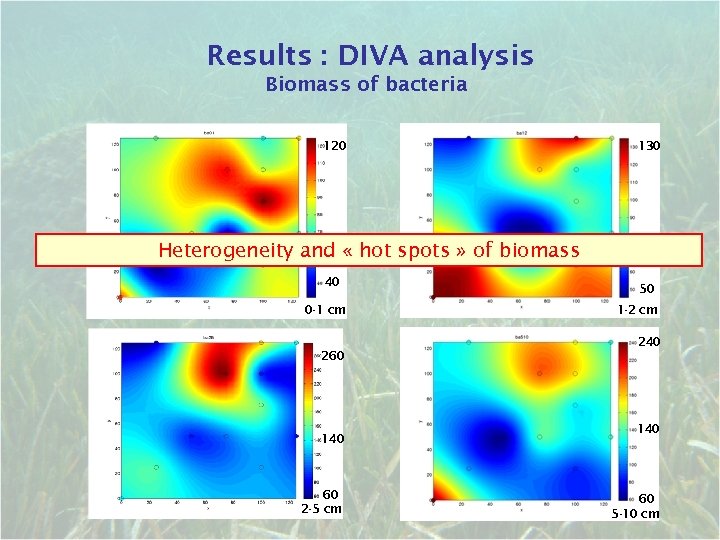 Results : DIVA analysis Biomass of bacteria 120 130 Heterogeneity and « hot spots » of biomass 40 0 -1 cm 50 1 -2 cm 240 260 140 60 2 -5 cm 140 60 5 -10 cm
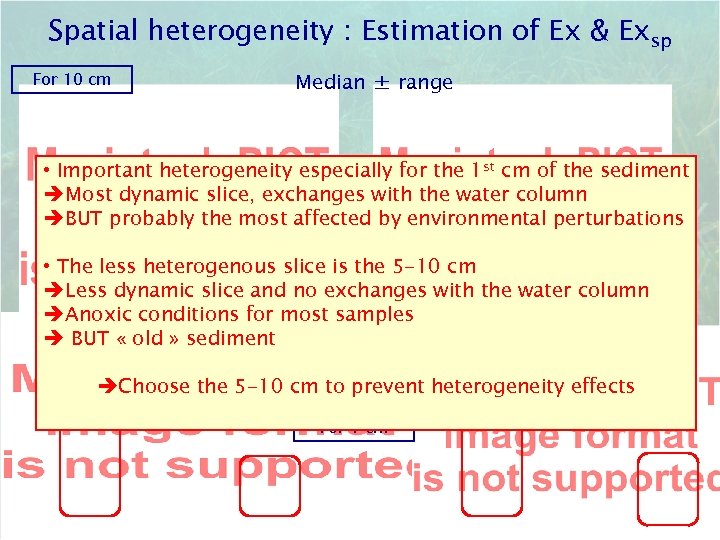 Spatial heterogeneity : Estimation of Ex & Exsp For 10 cm Median ± range • Important heterogeneity especially for the 1 st cm of the sediment Most dynamic slice, exchanges with the water column BUT probably the most affected by environmental perturbations • The less heterogenous slice is the 5 -10 cm Less dynamic slice and no exchanges with the water column Anoxic conditions for most samples BUT « old » sediment Choose the 5 -10 cm to prevent heterogeneity effects For 1 cm
 Spatial heterogeneity : Ex & Exsp 5 -10 cm Median ± range • Important heterogeneity in spite of the choice • No real seasonal variability Seems stable along the year
 STARESO vs. Fish farm: 5 -10 cm Median ± range • This estimation is not able to catch the difference in EX between • Awaited results for November 2008 sites. only Not an estimation… • In November 2008, Ex STARESO>Ex Fish farm STARESO is closer from the ecosystem climax than the fish farm. • No difference in Exsp. No difference in the « complexity » of organisms living in the ecosystem. • No The ecosystem is able to adapt itself to this perturbation (Silow, difference in Exsp 1998)difference in biomass No. « quality » between sites
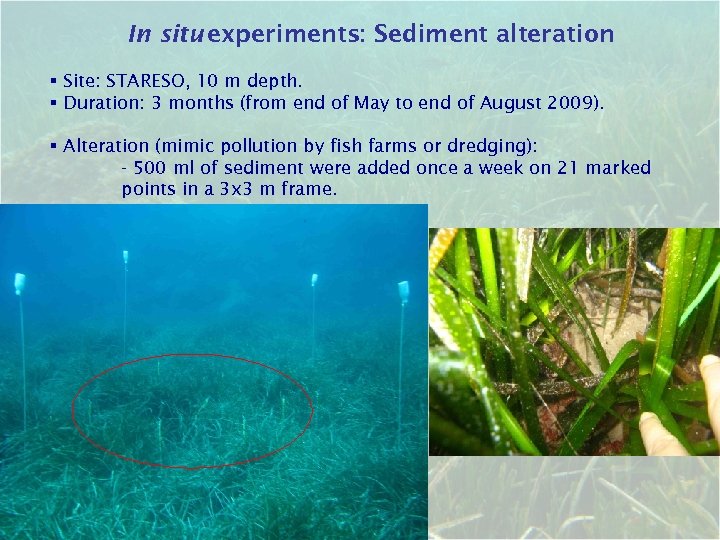 In situ experiments: Sediment alteration § Site: STARESO, 10 m depth. § Duration: 3 months (from end of May to end of August 2009). § Alteration (mimic pollution by fish farms or dredging): - 500 ml of sediment were added once a week on 21 marked points in a 3 x 3 m frame.
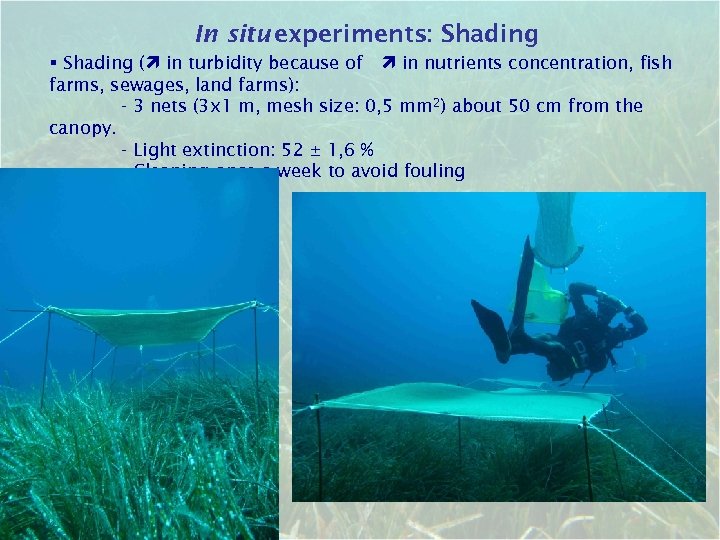 In situ experiments: Shading § Shading ( in turbidity because of in nutrients concentration, fish farms, sewages, land farms): - 3 nets (3 x 1 m, mesh size: 0, 5 mm 2) about 50 cm from the canopy. - Light extinction: 52 ± 1, 6 % - Cleaning once a week to avoid fouling
 In situ experiment : Ex 5 -10 cm • No difference between periods Estimation? Too short experiment? Median ± range
 In situ experiment : Exsp 5 -10 cm • No real difference between periods Estimation? Too short experiment? Median ± range
 Conclusions § Spatial variability • Important heterogeneity BUT less important in the 5 -10 cm sediment depth zone Choice of the 5 -10 cm sediment horizon to compare samples even if it is maybe less precise § Fish farm vs. STARESO • Ex STARESO>Ex Fish farm in November 2008 for the 510 cm horizon Ex seems able to dicriminate both sites § In situ experiment • No difference along the experiment. Too short experiment to see an impact…
 Conclusions • Use of Ex and Exsp as a tool to detect perturbations in the Mediterranean coastal zone is not easy to validate in this part of P. oceanica ecosystem. • Important to link the results with environmental parameters to understant why it works or not. • Work in progress…
 Thank you! Tanks to Loïc Michel, Renzo Biondo, Gilles Lepoint, Sylvie Gobert, Branko Velimirov, people of the STARESO, students, cleaning team, spreading team, repairing team, …