


 Скачать презентацию The use of Domestic Sludge from Septic Tanks
a126e70ac7cb9c24e4a30973be89f0d5.ppt
- Количество слайдов: 1
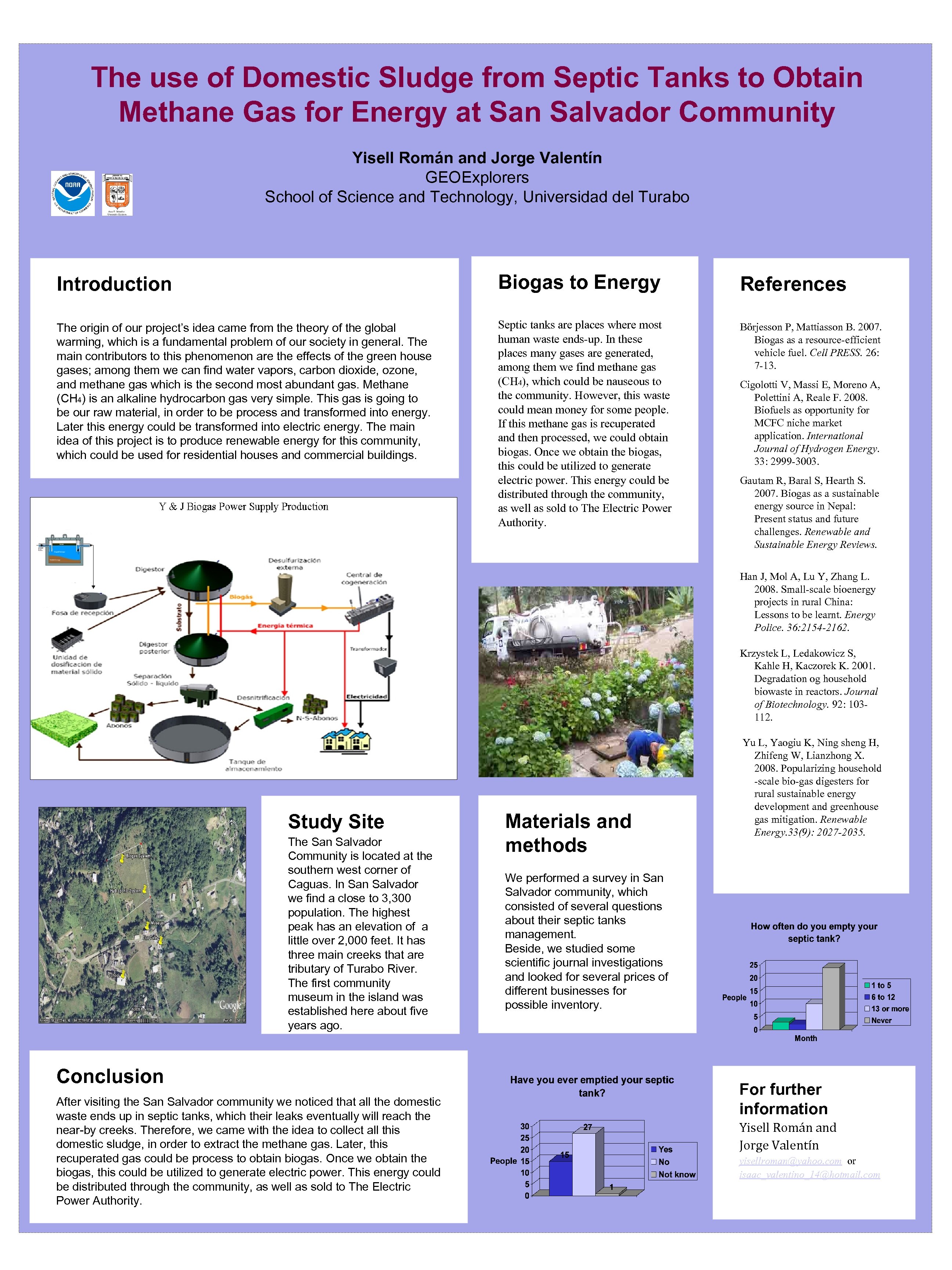 The use of Domestic Sludge from Septic Tanks to Obtain Methane Gas for Energy at San Salvador Community Yisell Román and Jorge Valentín GEOExplorers School of Science and Technology, Universidad del Turabo Introduction Biogas to Energy References The origin of our project’s idea came from theory of the global warming, which is a fundamental problem of our society in general. The main contributors to this phenomenon are the effects of the green house gases; among them we can find water vapors, carbon dioxide, ozone, and methane gas which is the second most abundant gas. Methane (CH 4) is an alkaline hydrocarbon gas very simple. This gas is going to be our raw material, in order to be process and transformed into energy. Later this energy could be transformed into electric energy. The main idea of this project is to produce renewable energy for this community, which could be used for residential houses and commercial buildings. Septic tanks are places where most human waste ends-up. In these places many gases are generated, among them we find methane gas (CH 4), which could be nauseous to the community. However, this waste could mean money for some people. If this methane gas is recuperated and then processed, we could obtain biogas. Once we obtain the biogas, this could be utilized to generate electric power. This energy could be distributed through the community, as well as sold to The Electric Power Authority. Börjesson P, Mattiasson B. 2007. Biogas as a resource-efficient vehicle fuel. Cell PRESS. 26: 7 -13. Cigolotti V, Massi E, Moreno A, Polettini A, Reale F. 2008. Biofuels as opportunity for MCFC niche market application. International Journal of Hydrogen Energy. 33: 2999 -3003. Gautam R, Baral S, Hearth S. 2007. Biogas as a sustainable energy source in Nepal: Present status and future challenges. Renewable and Sustainable Energy Reviews. Han J, Mol A, Lu Y, Zhang L. 2008. Small-scale bioenergy projects in rural China: Lessons to be learnt. Energy Police. 36: 2154 -2162. Krzystek L, Ledakowicz S, Kahle H, Kaczorek K. 2001. Degradation og household biowaste in reactors. Journal of Biotechnology. 92: 103112. Study Site The San Salvador Community is located at the southern west corner of Caguas. In Salvador we find a close to 3, 300 population. The highest peak has an elevation of a little over 2, 000 feet. It has three main creeks that are tributary of Turabo River. The first community museum in the island was established here about five years ago. Conclusion After visiting the San Salvador community we noticed that all the domestic waste ends up in septic tanks, which their leaks eventually will reach the near-by creeks. Therefore, we came with the idea to collect all this domestic sludge, in order to extract the methane gas. Later, this recuperated gas could be process to obtain biogas. Once we obtain the biogas, this could be utilized to generate electric power. This energy could be distributed through the community, as well as sold to The Electric Power Authority. Materials and methods Yu L, Yaogiu K, Ning sheng H, Zhifeng W, Lianzhong X. 2008. Popularizing household -scale bio-gas digesters for rural sustainable energy development and greenhouse gas mitigation. Renewable Energy. 33(9): 2027 -2035. We performed a survey in Salvador community, which consisted of several questions about their septic tanks management. Beside, we studied some scientific journal investigations and looked for several prices of different businesses for possible inventory. For further information Yisell Román and Jorge Valentín yisellroman@yahoo. com or isaac_valentino_14@hotmail. com