


 Скачать презентацию The US FTA with Central America and the
53d29d93298cbe10531dcd95c454b50f.ppt
- Количество слайдов: 16
 The US FTA with Central America and the Dominican Republic (DR-CAFTA): What Relevance for Asia? Carl A. Cira, J. D. Director, Summit of the Americas Center Latin American and Caribbean Center Florida International University Miami, Florida ~~~~~~~~~ APEC OFFICIAL SYMPOSIUM: IMPACT OF REGIONAL ECONOMIC INTEGRATION IN EAST ASIA ON APEC TRADE LIBERALIZATION Tokyo, 27 -28 September 2006 SUMMIT OF THE AMERICAS CENTER, FIU.
 US and Central America –Recent History l l l 25 years of US focus CA – often intense on 1980’s - leftist insurgencies and military governments ending - Peace Accords - Nicaragua, El Salvador, Guatemala, Honduras – Extensive US military and economic development assistance. 1984 – Caribbean Basin Initiative (CBI) - Unilateral trade preferences to CA and US Caribbean to promote economic growth, political stability and democratic development. (By 2003, 77% of CA exports to US were duty free) 1990’s - democratic elections, gradual economic recovery. Maquila (assembly) industries and nontraditional agriculture expanded steadily. All 6 CAFTA countries now have over 50%of their two way commerce with the United States. SUMMIT OF THE AMERICAS CENTER, FIU.
 Western Hemisphere Trade Negotiations -1990’s l l l 1994 - European Union and Mercosur begin FTA talks. 1994 – Summit of the Americas Miami – 34 – leaders agreed to talks for a Free Trade Area of the Americas (FTAA). 1995 – GATT Uruguay Round ends – World Trade Organization (WTO) begins 1995 – NAFTA takes effect (US, Mexico, Canada) – CBI benefits diluted, CA trade + investment diverted to Mexico. CA begins to lobby US for “NAFTA parity. ” 1998 – FTAA negotiations formally begin. SUMMIT OF THE AMERICAS CENTER, FIU.
 Free Trade Area of the Americas Negotiations 1998 - 2003 l l l 1998 -2003 – FTAA ambition was a hemisphere–wide “WTO – plus” agreementby January 2005 Hundreds of working group and. committee meetings held. Eight Trade Ministerial meetings an Four Summits. “Single Undertaking” partial agreements. Nothing agreed unt - No all is agreed. Nine Chapters and nine negotiating groups. Very broad consensus needed. New disciplines Services, Gov. procurement, investment : protections, competition policy, trade facilitation, “TRIPS – and plus” for IPR (Resistance on most of these. ). Reduction of US agricultural subsidies– focus of Brazil, Argentina etc. US unwilling outside WTO Doha context. (Publication of Bracketed Draft Negotiating Text – July 2001. F time ever to blunt “secret negotiation” criticisms. ) SUMMIT OF THE AMERICAS CENTER, FIU.
 “PLAN B” – 2001 to date l l l Before 2000– US preferred multilateral trade pacts – GATT/WTO. – only 3 bilateral US FTA’s Canada, Mexico (NAFTA), and Israel. Jordan signed in 2000 absent Fast Track - Congress ratified 2001 2000 – Failure of Seattle WTO Ministerial; FTAA stalled, no Fast Track, Clinton administration opened FTA talks with Singapore and CHILE. Chile and US had BIT and Chile had sought to join NAFTA since ‘ 92. Even so, 3 years of negotiations. July 2002 - US TPA law (a. k. a. , “Fast Track”) passed and Congress got back into the FTA game. July 2003 - US – Chile FTA signed and ratified under new TPA. Effective January 2004 SUMMIT OF THE AMERICAS CENTER, FIU.
 Why start with Chile? l l l l Chile’s “Open Regionalism”fastest, broadest liberalization of any Latin American nation in ’ 90 s. Chile FTA’s with 2/3 of NAFTA. [CANADA (1997) and MEXICO (1998)] FTA with Costa Rica + Central America (2001) In 2002, Chile signs Association Agreement (FTA) with European Union- (commercial, political pacts plus technical and cultural cooperation) Chile an Associate MERCOSUR member since ‘ 96, but Chile-EU negotiated apart from MERCOSUREU talks, also stalled in 2002 (and to date…. . ) Strategically, a US FTA with Chile easiest to overcome US Congressional ratification hurdles. Solid trade partner, stable market economy, dynamic trade leadership in Latin America. (And no illegal immigration problems………. . . ) SUMMIT OF THE AMERICAS CENTER, FIU.
 Why Central America Next in US Line? l l l l 2001 - FTA’s. Chile - Costa Rica + Central America April 2001 - Costa Rica – Canada FTA July 2001 Costa Rica. president gives Bush draft proposal for a US - Costa Rica or US Central America FTA. Latin American leaders rush to join US bilateral queue…. After 2002 TPA passage, USTR pressured heavily FTAA progress for and delayed on more bilaterals, moving only on Chile. USTR used the implicit openness to other eventual bilaterals to try to move FTAA ahead. Ultimately unsuccessful……… Brazil - main resisting counterpart Other policy imperatives, . regional leadership ambitions, limited dependence on US trade. Early 2003: Clear that FTAA not moving. USTR accelerated “Pla - “multiple bilaterals opening “discussions” with Central Americ , ” as next priority after completing Chile. End 2003: FTAA stalls – “Single Undertaking” abandoned – Two structure decided, but February 2004 Vice Ministers meeting un to progress. Moribund since then. SUMMIT OF THE AMERICAS CENTER, FIU.
 Brazil and Mercosur – “China Ex Machina”? l l l Brazil “Plan B” After FTAA stall, pushed revival of EU– Mercosur FTA Still not moving today. EU has other. internal priorities. EU Agriculture - main obstacle. MERCOSUR crisis- Argentina collapse further slowed integration; Uruguay and Paraguay seek US FTA’s; New member Venezuelamainly political – minimal trade. South American Community? – non-substantive. MERCOSUR–Andean Community FTA – hollow so far. 2004 - China to the Rescue! China factor in LA highlighted by Presidential visits. Huge China S. A. commodity sales boost Brazil, Argentina, Chile, and Peru. (agricultural, mining, petroleum) Investments? Andes and Central America. Rest of region benefiting less - low priced China manufactured imports in home markets + strong competition for US import market. SUMMIT OF THE AMERICAS CENTER, FIU.
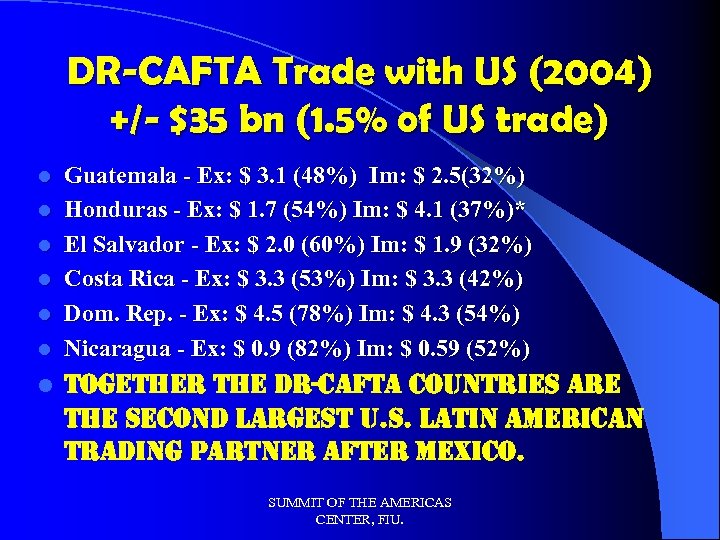 DR-CAFTA Trade with US (2004) +/- $35 bn (1. 5% of US trade) l l l l Guatemala - Ex: $ 3. 1 (48%) Im: $ 2. 5(32%) Honduras - Ex: $ 1. 7 (54%) Im: $ 4. 1 (37%)* El Salvador - Ex: $ 2. 0 (60%) Im: $ 1. 9 (32%) Costa Rica - Ex: $ 3. 3 (53%) Im: $ 3. 3 (42%) Dom. Rep. - Ex: $ 4. 5 (78%) Im: $ 4. 3 (54%) Nicaragua - Ex: $ 0. 9 (82%) Im: $ 0. 59 (52%) together the dr-cafta countries are the second Largest u. s. Latin american trading partner after mexico. SUMMIT OF THE AMERICAS CENTER, FIU.
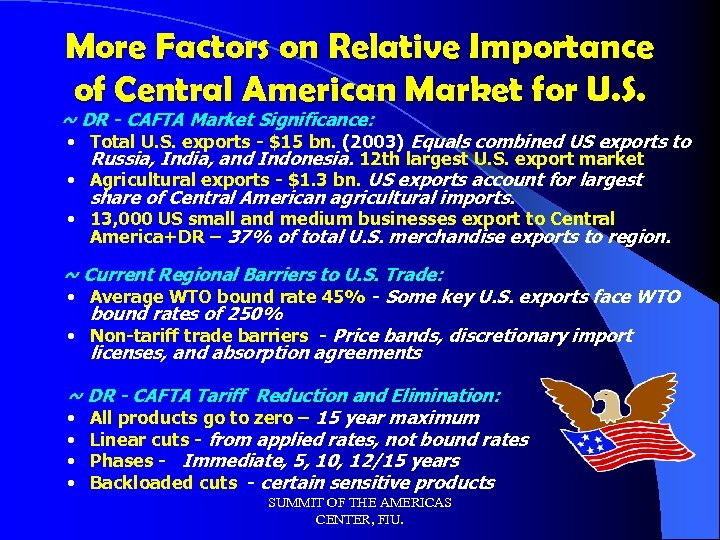 More Factors on Relative Importance of Central American Market for U. S. ~ DR - CAFTA Market Significance: Significance • Total U. S. exports - $15 bn. (2003) Equals combined US exports to Russia, India, and Indonesia. 12 th largest U. S. export market • Agricultural exports - $1. 3 bn. US exports account for largest share of Central American agricultural imports. • 13, 000 US small and medium businesses export to Central America+DR – 37% of total U. S. merchandise exports to region. ~ Current Regional Barriers to U. S. Trade: • Average WTO bound rate 45% - Some key U. S. exports face WTO bound rates of 250% • Non-tariff trade barriers - Price bands, discretionary import licenses, and absorption agreements ~ DR - CAFTA Tariff Reduction and Elimination: • All products go to zero – 15 year maximum • Linear cuts - from applied rates, not bound rates • Phases - Immediate, 5, 10, 12/15 years • Backloaded cuts - certain sensitive products SUMMIT OF THE AMERICAS CENTER, FIU.
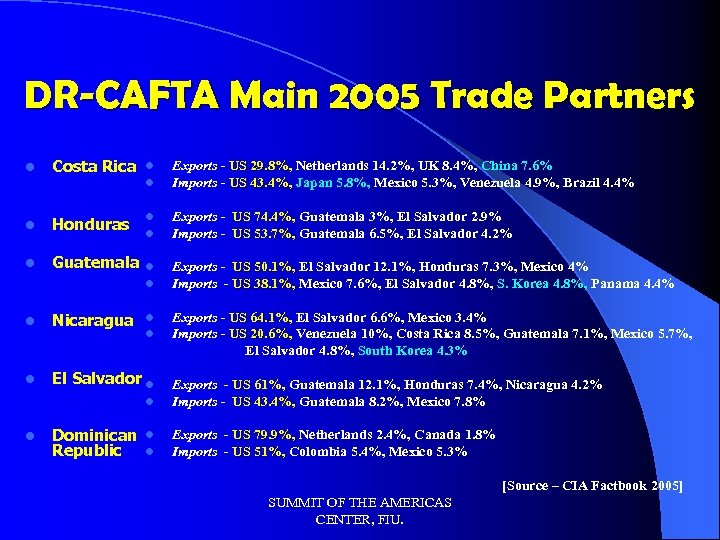 DR-CAFTA Main 2005 Trade Partners l Costa Rica l l Exports - US 29. 8%, Netherlands 14. 2%, UK 8. 4%, China 7. 6% Imports - US 43. 4%, Japan 5. 8%, Mexico 5. 3%, Venezuela 4. 9%, Brazil 4. 4% l Honduras l l Exports - US 74. 4%, Guatemala 3%, El Salvador 2. 9% Imports - US 53. 7%, Guatemala 6. 5%, El Salvador 4. 2% l Guatemala l l Exports - US 50. 1%, El Salvador 12. 1%, Honduras 7. 3%, Mexico 4% Imports - US 38. 1%, Mexico 7. 6%, El Salvador 4. 8%, S. Korea 4. 8%, Panama 4. 4% l Nicaragua l l Exports - US 64. 1%, El Salvador 6. 6%, Mexico 3. 4% Imports - US 20. 6%, Venezuela 10%, Costa Rica 8. 5%, Guatemala 7. 1%, Mexico 5. 7%, El Salvador 4. 8%, South Korea 4. 3% l El Salvador l l l Dominican Republic Exports - US 61%, Guatemala 12. 1%, Honduras 7. 4%, Nicaragua 4. 2% Imports - US 43. 4%, Guatemala 8. 2%, Mexico 7. 8% l l Exports - US 79. 9%, Netherlands 2. 4%, Canada 1. 8% Imports - US 51%, Colombia 5. 4%, Mexico 5. 3% [Source – CIA Factbook 2005] SUMMIT OF THE AMERICAS CENTER, FIU.
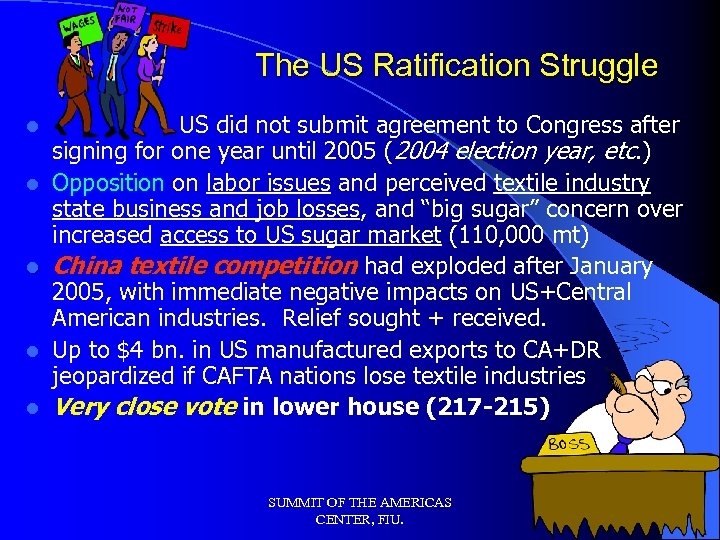 The US Ratification Struggle l l l US did not submit agreement to Congress after signing for one year until 2005 (2004 election year, etc. ) Opposition on labor issues and perceived textile industry state business and job losses, and “big sugar” concern over increased access to US sugar market (110, 000 mt) China textile competition had exploded after January 2005, with immediate negative impacts on US+Central American industries. Relief sought + received. Up to $4 bn. in US manufactured exports to CA+DR jeopardized if CAFTA nations lose textile industries Very close vote in lower house (217 -215) SUMMIT OF THE AMERICAS CENTER, FIU.
 Current Dr - Ca. Fta status Costa Ricahas not ratifiedyet. (was. CA’s lead CAFTA negotiator). Dominican Republicunresolved issues– USTR not yet satisfied with DR legislative and administrative compliance. l Fully effective Nicaragua (3/06), El Salvador (3/06), Honduras for (3/06), and Guatemala (6/06) (US removes signatory country from. GSP, CBI, and CBTPA benefits date DR-CAFTA enters into on force for that country). l Former Unilateral US Preferences now converted into permanent and reciprocal benefits and obligations. l Textiles in limbo. CAFTA pushed as response to expected Chinese textile deluge. Incentives to regional industries using U cloth, yarn, and thread and “cumulation. ” US ratification delay and slow CA + DR compliance with US requirements have blunted effects and delayed investments. l l SUMMIT OF THE AMERICAS CENTER, FIU.
 Gains for Asian Trade? Improved investment opportunities for direct access to US market via CA + DR l Investment opportunities for indirect US duty free access (Mexico – Japan FTA Mexico mfrs = qualified inputs for DRCAFTA Origin cumulation) l Some uncertainty over CBTPA investments in Costa Rica if CR ratification is delayed into 2007 l SUMMIT OF THE AMERICAS CENTER, FIU.
 DR- CAFTA - Summing Up l Consolidation of US trade relations in CA + DR l Building block for potential revival of FTAA Potential effective regional integration of US and NAFTA-DR-CAFTA textile industries Implementation lab for TRIPS–plus IPR, other “Singapore issues. ” Piracy criminalized New and strengthened regional dispute settlement mechanism (SIECA) New and stronger mutual obligations among all 7 signatory countries l l l Clear benefits for Central American integration SUMMIT OF THE AMERICAS CENTER, FIU.
 Thank you for your attention…. www. Americas. Net. net SUMMIT OF THE AMERICAS CENTER, FIU.