 Скачать презентацию THE URBAN INSTITUTE Insuring America s Children Findings from
3fc57d1551d665c837ffb562cda29c3c.ppt
- Количество слайдов: 15



THE URBAN INSTITUTE Insuring America’s Children: Findings from Site Visits to Six Grantee States Prepared by: Ian Hill, Debra Draper, Allison Liebhaber, Sara Hogan Presented at: Finish Line Grantee Annual Meeting Funded by: The David and Lucile Packard Foundation 15 July 2009
Outline of Presentation • • Background on Insuring America’s Children Overview of evaluation and case study methods Results from 6 site visits Next Steps/looking forward THE URBAN INSTITUTE 2
Insuring America’s Children: States Leading the Way • Provides financial and technical support to statebased advocacy organizations working to advance universal children’s coverage • 8 states awarded Narrative Communications grants • 8 states awarded Finish Line grants • Technical assistance provided by Spitfire Communications and Georgetown University’s Center for Children and Families THE URBAN INSTITUTE 3
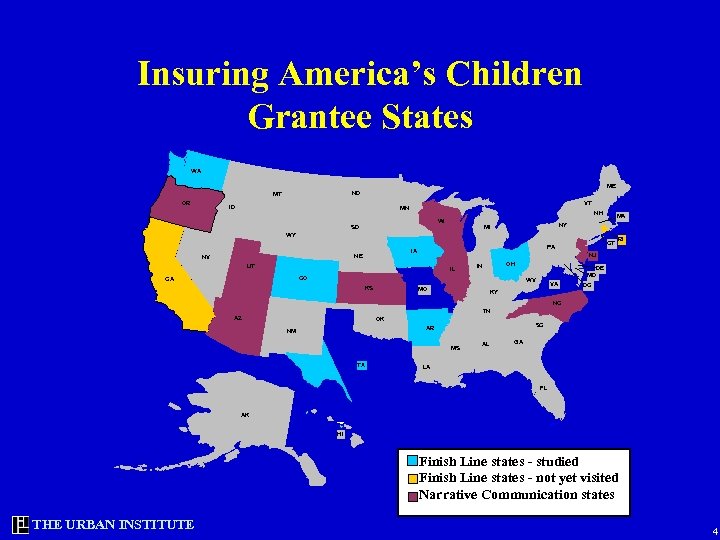
Insuring America’s Children Grantee States WA ME ND MT OR ID VT MN NH WI SD MA NY MI WY NE NV IL OH IN CO DE MD WV KS RI NJ UT CA CT PA IA MO VA DC KY NC TN AZ OK SC AR NM MS TX AL GA LA FL AK HI Finish Line states - studied Finish Line states - not yet visited Narrative Communication states THE URBAN INSTITUTE 4
Insuring America’s Children Evaluation • Three-year partnership of Mathematica Policy Research, Inc. , the Urban Institute, and the Center for Studying Health System Change • Goals of evaluation: – Monitor children’s coverage and access nationally – Analyze salience of/progress toward universal coverage in selected states – Assess the impact of selected innovative expansions/policies THE URBAN INSTITUTE 5
In-Depth Case Studies of Finish Line Grantees/States • Establish “baseline” understanding of state initiatives • Learn about process of implementation • Develop early “lessons” for Foundation and states • Two interview teams: – Policy/program: Urban Institute – Advocacy/stakeholder: Health Systems Change THE URBAN INSTITUTE 6
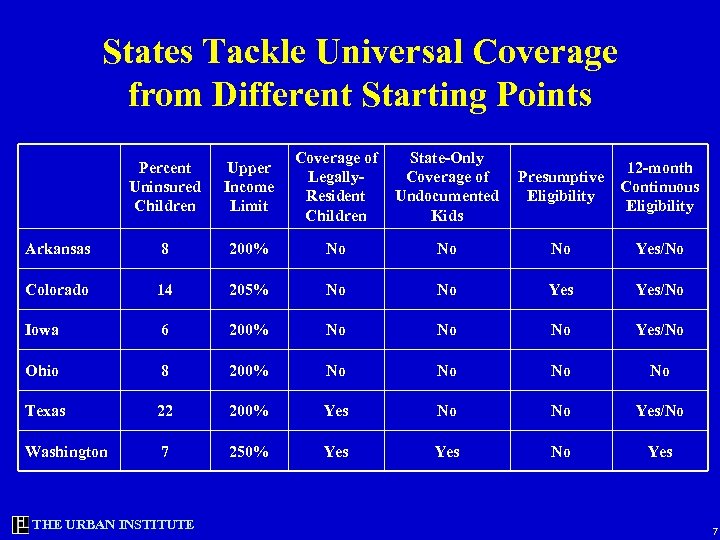
States Tackle Universal Coverage from Different Starting Points Percent Uninsured Children Upper Income Limit Coverage of Legally. Resident Children State-Only Coverage of Undocumented Kids Presumptive Eligibility 12 -month Continuous Eligibility Arkansas 8 200% No No No Yes/No Colorado 14 205% No No Yes/No Iowa 6 200% No No No Yes/No Ohio 8 200% No No Texas 22 200% Yes No No Yes/No Washington 7 250% Yes No Yes THE URBAN INSTITUTE 7
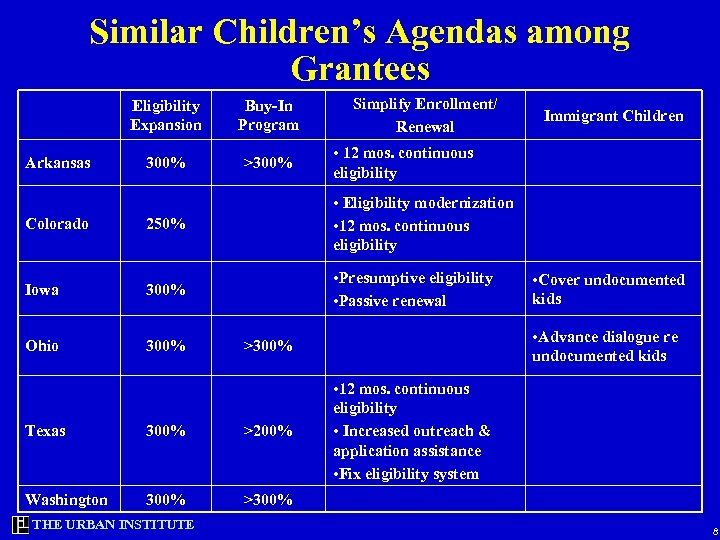
Similar Children’s Agendas among Grantees Eligibility Expansion Arkansas Buy-In Program 300% >300% Simplify Enrollment/ Renewal Immigrant Children • 12 mos. continuous eligibility Colorado 250% • Eligibility modernization • 12 mos. continuous eligibility Iowa 300% • Presumptive eligibility • Passive renewal Ohio 300% • Advance dialogue re undocumented kids >300% Texas 300% >200% Washington 300% • Cover undocumented kids • 12 mos. continuous eligibility • Increased outreach & application assistance • Fix eligibility system >300% THE URBAN INSTITUTE 8
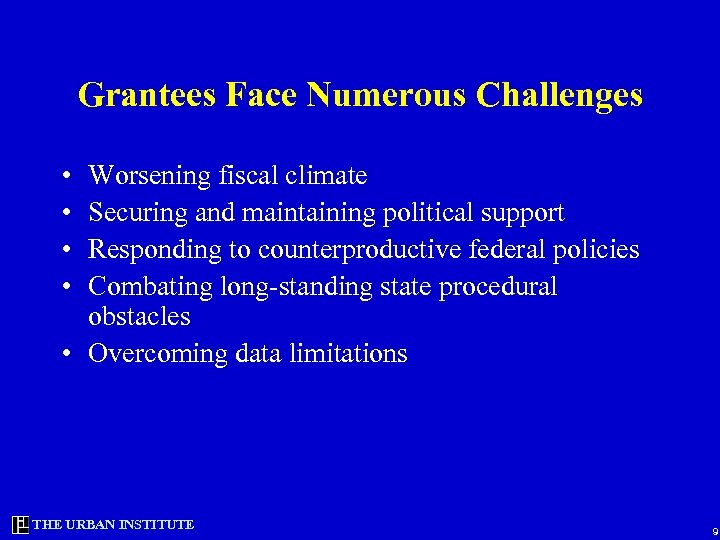
Grantees Face Numerous Challenges • • Worsening fiscal climate Securing and maintaining political support Responding to counterproductive federal policies Combating long-standing state procedural obstacles • Overcoming data limitations THE URBAN INSTITUTE 9
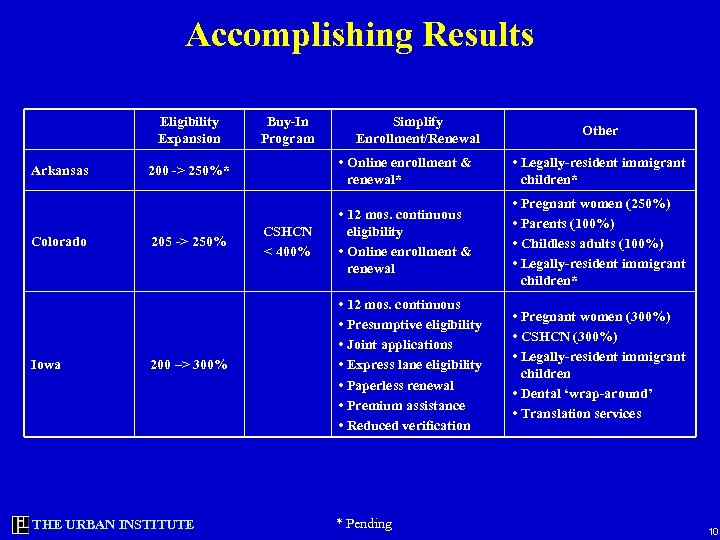
Accomplishing Results Eligibility Expansion Arkansas Colorado Iowa Buy-In Program Simplify Enrollment/Renewal Other 200 -> 250%* • Online enrollment & renewal* • Legally-resident immigrant children* 205 -> 250% • 12 mos. continuous eligibility • Online enrollment & renewal • Pregnant women (250%) • Parents (100%) • Childless adults (100%) • Legally-resident immigrant children* • 12 mos. continuous • Presumptive eligibility • Joint applications • Express lane eligibility • Paperless renewal • Premium assistance • Reduced verification • Pregnant women (300%) • CSHCN (300%) • Legally-resident immigrant children • Dental ‘wrap-around’ • Translation services 200 –> 300% THE URBAN INSTITUTE CSHCN < 400% * Pending 10
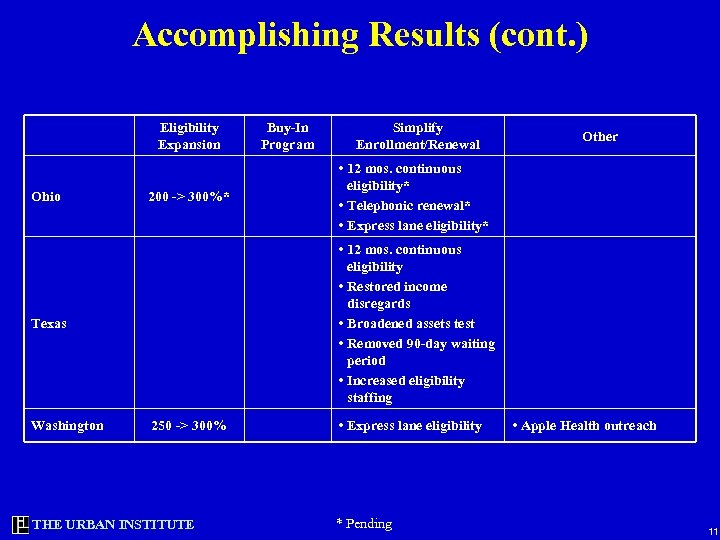
Accomplishing Results (cont. ) Eligibility Expansion Ohio 200 -> 300%* Simplify Enrollment/Renewal Other • 12 mos. continuous eligibility* • Telephonic renewal* • Express lane eligibility* • 12 mos. continuous eligibility • Restored income disregards • Broadened assets test • Removed 90 -day waiting period • Increased eligibility staffing Texas Washington Buy-In Program 250 -> 300% THE URBAN INSTITUTE • Express lane eligibility * Pending • Apple Health outreach 11
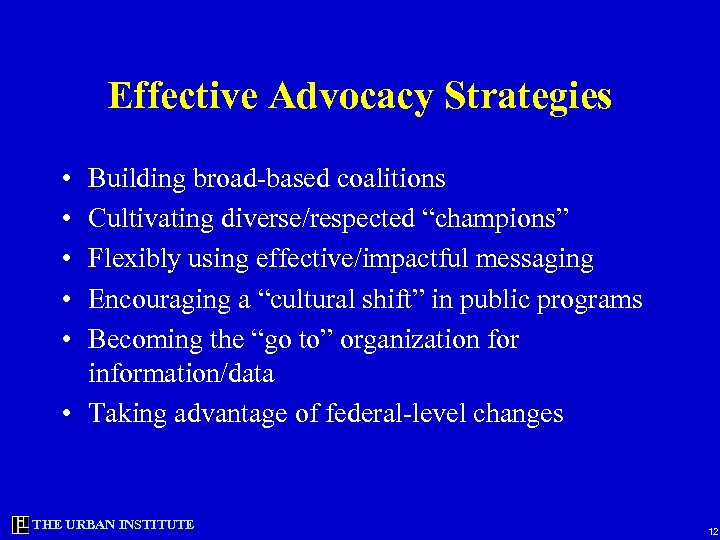
Effective Advocacy Strategies • • • Building broad-based coalitions Cultivating diverse/respected “champions” Flexibly using effective/impactful messaging Encouraging a “cultural shift” in public programs Becoming the “go to” organization for information/data • Taking advantage of federal-level changes THE URBAN INSTITUTE 12
Lessons Learned • Achieving reform requires persistence/long-term commitment • Coalitions must involve grass roots, as well as state-level, stakeholders • Advocates must have unified “voice” • Creativity/flexibility required in changing environment THE URBAN INSTITUTE 13
Lessons Learned • Strong data are critical to supporting objectives • Passing legislation is just a first step • Advancing the dialogue on immigrant children is an important first step THE URBAN INSTITUTE 14
Next Steps in the Evaluation • Gathering and monitoring coverage/access data • Conducting “bellwether” interviews • Identifying targeted impact studies THE URBAN INSTITUTE 15
Скачать презентацию THE URBAN INSTITUTE Insuring America s Children Findings from
3fc57d1551d665c837ffb562cda29c3c.ppt