


 Скачать презентацию The University of Waterloo Live Fire Research
af54c551ecfe01bbf09c33ccc4784046.ppt
- Количество слайдов: 1
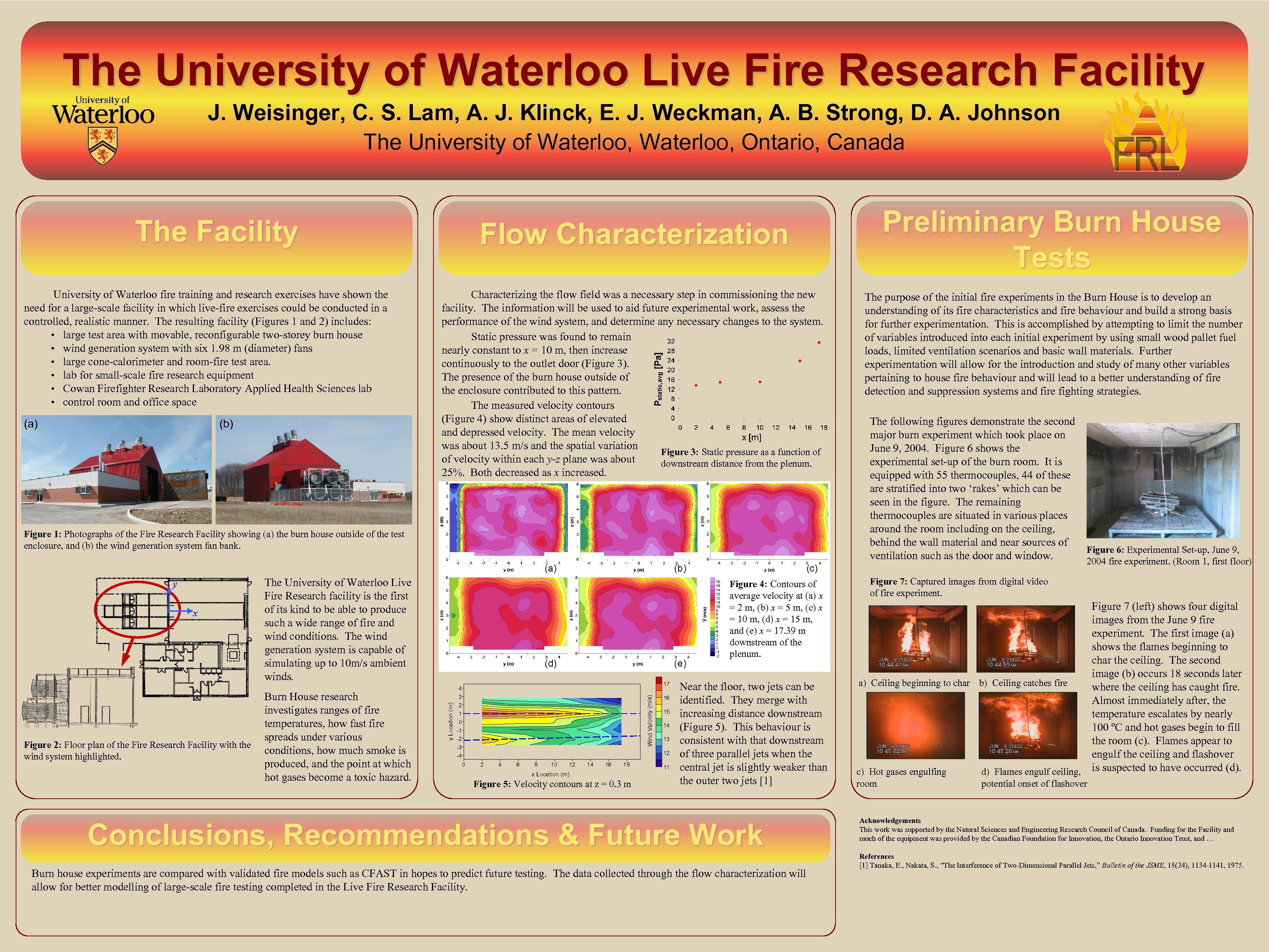 The University of Waterloo Live Fire Research Facility J. Weisinger, C. S. Lam, A. J. Klinck, E. J. Weckman, A. B. Strong, D. A. Johnson The University of Waterloo, Ontario, Canada The Facility University of Waterloo fire training and research exercises have shown the need for a large-scale facility in which live-fire exercises could be conducted in a controlled, realistic manner. The resulting facility (Figures 1 and 2) includes: • large test area with movable, reconfigurable two-storey burn house • wind generation system with six 1. 98 m (diameter) fans • large cone-calorimeter and room-fire test area. • lab for small-scale fire research equipment • Cowan Firefighter Research Laboratory Applied Health Sciences lab • control room and office space (a) (b) Preliminary Burn House Tests Flow Characterization Characterizing the flow field was a necessary step in commissioning the new facility. The information will be used to aid future experimental work, assess the performance of the wind system, and determine any necessary changes to the system. Static pressure was found to remain nearly constant to x = 10 m, then increase continuously to the outlet door (Figure 3). The presence of the burn house outside of the enclosure contributed to this pattern. The measured velocity contours (Figure 4) show distinct areas of elevated and depressed velocity. The mean velocity was about 13. 5 m/s and the spatial variation Figure 3: Static pressure as a function of of velocity within each y-z plane was about downstream distance from the plenum. 25%. Both decreased as x increased. Figure 1: Photographs of the Fire Research Facility showing (a) the burn house outside of the test enclosure, and (b) the wind generation system fan bank. (a) x Figure 2: Floor plan of the Fire Research Facility with the wind system highlighted. The University of Waterloo Live Fire Research facility is the first of its kind to be able to produce such a wide range of fire and wind conditions. The wind generation system is capable of simulating up to 10 m/s ambient winds. Burn House research investigates ranges of fire temperatures, how fast fire spreads under various conditions, how much smoke is produced, and the point at which hot gases become a toxic hazard. (b) (d) (e) 17 4 3 2 Wind Velocity (m/s) y y Location (m) 1 0 -1 -2 -3 -4 16 15 14 13 12 0 2 4 6 8 10 12 14 16 18 x Location (m) Figure 5: Velocity contours at z = 0. 3 m 11 The purpose of the initial fire experiments in the Burn House is to develop an understanding of its fire characteristics and fire behaviour and build a strong basis for further experimentation. This is accomplished by attempting to limit the number of variables introduced into each initial experiment by using small wood pallet fuel loads, limited ventilation scenarios and basic wall materials. Further experimentation will allow for the introduction and study of many other variables pertaining to house fire behaviour and will lead to a better understanding of fire detection and suppression systems and fire fighting strategies. The following figures demonstrate the second major burn experiment which took place on June 9, 2004. Figure 6 shows the experimental set-up of the burn room. It is equipped with 55 thermocouples, 44 of these are stratified into two ‘rakes’ which can be seen in the figure. The remaining thermocouples are situated in various places around the room including on the ceiling, behind the wall material and near sources of ventilation such as the door and window. (c) Figure 4: Contours of average velocity at (a) x = 2 m, (b) x = 5 m, (c) x = 10 m, (d) x = 15 m, and (e) x = 17. 39 m downstream of the plenum. Near the floor, two jets can be identified. They merge with increasing distance downstream (Figure 5). This behaviour is consistent with that downstream of three parallel jets when the central jet is slightly weaker than the outer two jets [1] Conclusions, Recommendations & Future Work Burn house experiments are compared with validated fire models such as CFAST in hopes to predict future testing. The data collected through the flow characterization will allow for better modelling of large-scale fire testing completed in the Live Fire Research Facility. Figure 6: Experimental Set-up, June 9, 2004 fire experiment. (Room 1, first floor) Figure 7: Captured images from digital video of fire experiment. Figure 7 (left) shows four digital images from the June 9 fire experiment. The first image (a) shows the flames beginning to char the ceiling. The second image (b) occurs 18 seconds later a) Ceiling beginning to char b) Ceiling catches fire where the ceiling has caught fire. Almost immediately after, the temperature escalates by nearly 100 ºC and hot gases begin to fill the room (c). Flames appear to engulf the ceiling and flashover c) Hot gases engulfing d) Flames engulf ceiling, is suspected to have occurred (d). room potential onset of flashover Acknowledgements This work was supported by the Natural Sciences and Engineering Research Council of Canada. Funding for the Facility and much of the equipment was provided by the Canadian Foundation for Innovation, the Ontario Innovation Trust, and … References [1] Tanaka, E. , Nakata, S. , “The Interference of Two-Dimensional Parallel Jets, ” Bulletin of the JSME, 18(24), 1134 -1141, 1975.