 Скачать презентацию The University of Birmingham MSc International Business International
d9fc22e8fd809805f89b8e0eb07d5422.ppt
- Количество слайдов: 63



The University of Birmingham MSc International Business International e-business 2014 Lecture 2: How the Internet and WWW Work (briefly) Strategy Framework, Markets and Value Creation 1 -
Learning Objectives • • • The University of Birmingham Basic Underlying Technology and Related Jargon Discuss the meaning of strategy What determines and drives business strategy? Understand the necessity to align IS and business strategy Determine what is meant by “business model” Identify various types of business model and revenue model (especially “new” models for conducting e-business) What determines competitive advantage and its sustainability? How is competitive advantage eroded? What can we learn from successful (and unsuccessful) e-business organizations? What guidelines are there for developing successful business strategies? 1 -2
Reading and Online Activity • • The University of Birmingham Schneider Chapters 2 & 3 Chaffey, Chapter 2 Jelassi & Enders, Chapter 2 Farhoomand, Chapters 2 and 3 Laudon & Traver, Chapter 2 Papazoglou & Ribbers, Chapters 2 and 3 Mohamed et al, Chapters 1 - 3 • http: //www. research. ibm. com/strategy/pub/ebbb. pdf • http: //www. economywatch. com/business/e-business-strategy. html • (Very useful site) http: //www. tutor 2 u. net/ebusiness/index. html • http: //www. hec. unil. ch/yp/Pub/01 -thunderbird. pdf • • http: //www. cardellmedia. co. uk/marketing 15. html http: //www. Knowledge. Storm. com 1 -3
Basic Ideas The University of Birmingham • Origin, growth, and current structure of the Internet • How packet-switched networks are combined to form the • • Internet How Internet, e-mail, and Web protocols work About Internet addressing and how Web domain names are constructed history and use of markup languages on the Web How HTML tags and links work About technologies people and businesses use to connect to the Internet About Internet 2 and the Semantic Web Basic XML concepts 1 -4
The Internet and World Wide Web The University of Birmingham • Computer network Around since 1970 s (ARPANET) • Technology allowing people to connect computers • Internet • Interconnected global computer networks (capital “I”) • internet (small “i”): group of interconnected computer networks • Basic technology structure • Supports networks, the Internet, and e-commerce • World Wide Web (Web): Invented 1992 • Subset of Internet computers • Includes easy-to-use interfaces • Multiple Platform Interoperability (Excellent Concept) 1 -5
Growth of the Internet and Web The University of Birmingham • Up to 1990 s: Largely an Academic Network • 1993: Sir Tim Berners-Lee developed www • 1995: Commercial Activities Permitted • Network Access Points / Access Providers • Sold Access Rights to larger Customers, and ISP (Internet Service Providers) – SMEs, etc. • Internet Hosts: Directly Connected Computers • One of the most significant Technological and Social Developments of the last Millennium • Massive Growth since 1995, and expected to continue ever faster. 1 -6
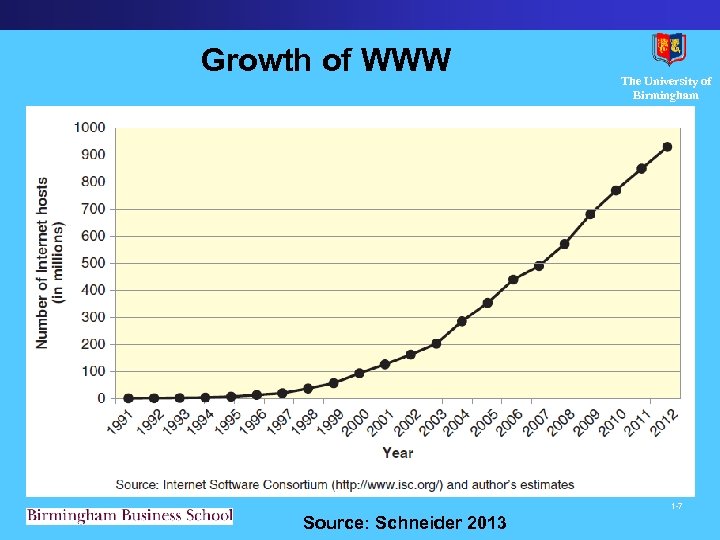
Growth of WWW The University of Birmingham 1 -7 Source: Schneider 2013
Packet-Switched Networks The University of Birmingham • Local area network (LAN) • Network of computers located close together • Wide area networks (WANs) • Networks of computers connected over greater distances • Circuit • Combination of telephone lines and closed switches connecting them to each other • Circuit switching • Centrally controlled, single-connection model • Single electrical path between caller and receiver • Good for Phone Systems; Poor for LANs and WANs • Solution: Packet-Switching – moving data between 2 points 1 -8
Packet-Switched Networks (2) The University of Birmingham • Packet-switched network • Packets • Small pieces labelled electronically • (origin, sequence, and destination address) • Travel along interconnected networks • Can take different paths • May arrive out of order • Destination computer • Collects packets • Reassembles original file or e-mail message 1 -9
Routing Packets The University of Birmingham • Routing computers • Decide how best to forward each packet • Also known as: • Router computers, routers, gateway computers, border routers • Gateway from LAN or WAN to Internet • Border routers between organization and the Internet • Routing algorithms • Programs on routing computers • Determine best path for packet 1 -10
Routing Packets The University of Birmingham • Routing algorithms applied to routing table (configuration table) information • Routing table (configuration table) information • Includes lists of connections • Includes rules for: • Specifying connection to use first • Handling heavy packet traffic and network congestion • Variety of rules and standards for creating packets • Hubs, switches, and bridges • Devices that move packets 1 -11
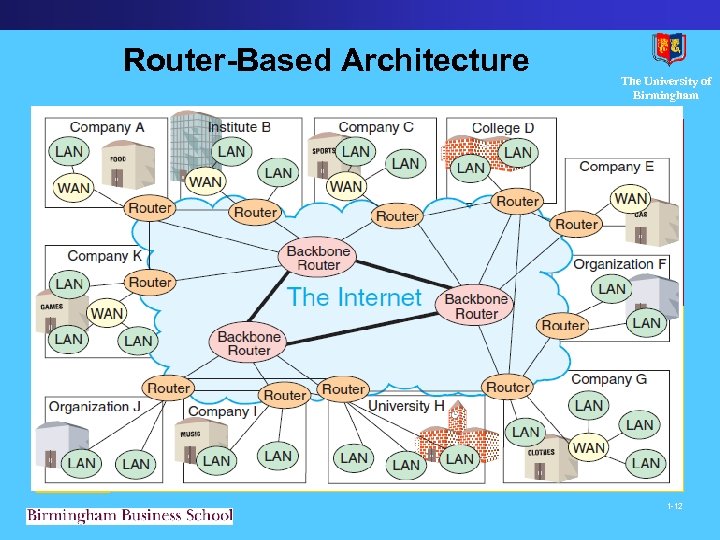
Router-Based Architecture The University of Birmingham 1 -12
Public and Private Networks The University of Birmingham • Public network • Public availability • Private network • Private, leased-line connection • Physically connects intranets to one another • Leased line • Permanent telephone connection between two points • Advantage: security • Drawback: costs (EXTREMELY Expensive) • Scaling problem: adding companies 1 -13
Virtual Private Network (VPN) The University of Birmingham • Connection via public networks and protocols • Sends sensitive data • Uses IP tunneling (encapsulation) system • Private passageway through public Internet • Secure transmission • Encapsulation • Encrypts packet content, places inside another packet • IP wrapper: outer packet • VPN software installed on both computers • “Virtual” since connection seems permanent • Actually a temporary connection • Easy to set up (one click on a Mac) 1 -14
Intranets and Extranets The University of Birmingham • Intranet • An internet within the boundaries of the organization • Interconnected private networks • Extranet • An internet that extends beyond the organization and incorporates networks of outside entities • Technologies (public networks, private networks, or VPNs) • Independent of organizational boundaries 1 -15
Internet Protocols The University of Birmingham • Protocol: collection of network data rules • Includes transmission rules • Computers must use same protocol • Open architecture (Internet core) • Uses common protocol • Four key message-handling rules • Contributed to the Internet’s success • Internet protocols • Transmission Control Protocol (TCP) • Controls message or file disassembly into packets before • Internet transmission • Controls packet reassembly into original formats at destinations • Internet Protocol (IP) • Specifies addressing details for each packet • Labels packet with origination and destination addresses TCP/IP: Drives the Internet / Web (EXTREMELY IMPORTANT) 1 -16
IP Addressing The University of Birmingham • Internet Protocol version 4 (IPv 4) • Used for past 20 years • IP address • 32 -bit number identifying computers • Base 2 (binary) number system • Computers use binary for internal calculations • Digit: 0 or a 1 (on or off condition) • Four billion different addresses (232 = 4, 294, 967, 296) • Router breaks message into packets • Contains source and destination IP address 1 -17
IP Addressing (2) The University of Birmingham • Dotted decimal notation • Four numbers separated by periods • IP addresses range: 0. 0 to 255 • Unwieldy; difficult to remember (Use URL instead; DNS) • Internet Protocol version 6 (IPv 6) • Replaces IPv 4 (future) • IPv 4 and IPv 6 not directly compatible • Advantages • 128 -bit number for addresses • 228 addresses: 34 followed by 37 zeros • Packet format change eliminates unnecessary fields • Adds fields for security, other optional information • Shorthand notation system for expressing addresses 1 -18
Web Page Request and Delivery Protocols The University of Birmingham • Hypertext Transfer Protocol (HTTP) • Internet Web page file delivery rules • Web page request using Web browser • User types protocol name • Followed by “//: ” characters before the domain name • Uniform Resource Locator (URL) • Combination: protocol name, domain name • Locates resources (Web page) on another computer (Web server) 1 -19
The Development of Hypertext The University of Birmingham • HTML • Set of codes (tags) attached to text • Describes relationships among text elements • Web markup language • Most commonly used now in Version HTML 5 • (Audio and Video Support; Better than Flash) • Hypertext link (hyperlink) • Points to another location • Same or another HTML document • Extensible Markup Language (XML) • Describes properties of DATA: Benefits – virtually costless Electronic Data Interchange (EDI) • Allows for real-time Data Updating (e. g. Inventories) 1 -20
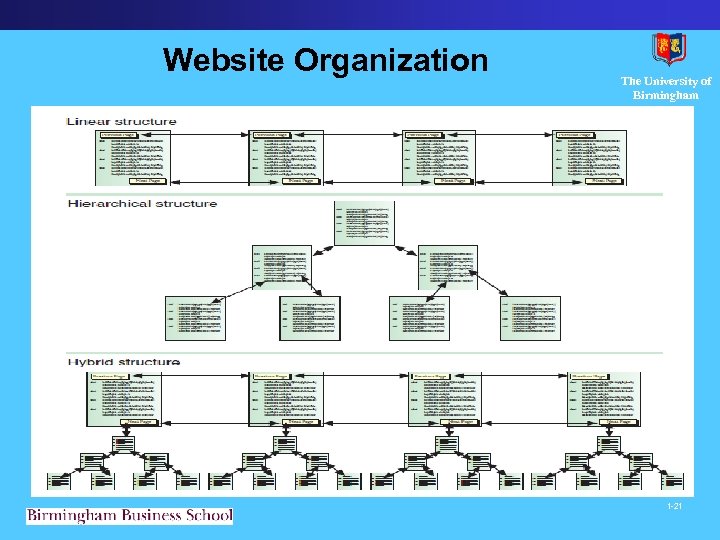
Website Organization The University of Birmingham 1 -21
Wireless Web Connection The University of Birmingham • Becoming Increasingly Important • Mobile telephone networks • Broadcast signals to/receive signals from antennas • Three miles apart in grid • Short message service (SMS) protocol • Send and receive short text messages • Also used for netbooks and tablet devices • Third-generation (3 G) wireless technology • 2 Mbps download/800 Kbps upload speeds • Fourth-generation (4 G) technology • Long Term Evolution (LTE) and Worldwide Interoperability for Microwave Access (Wi. MAX) • Significance in Mobile commerce or m-commerce • Smartphones, Tablets and Wearable Devices (Google) 1 -22
Internet 2 & Semantic Web The University of Birmingham • Internet 2 • Replacement for original ARPANET laboratory • Experimental networking technologies test bed • High end of the bandwidth spectrum (10 Gbps) • Used by universities, medical schools, CERN • Focus • Mainly technology development • See www. internet 2. edu (University Consortium) • Semantic Web project (next-generation Web) • Goal: blending technologies and information into a next-generation Web • Have words on Web pages tagged (using XML) with their meanings • Uses software agents (intelligent programs) • Read XML tags, determine meaning of words in their contexts • Essentially provides an “Intelligent Web” • Search for www. semanticweb. org 1 -23
Management Issues The University of Birmingham What are the implications of changes in marketplace structures for how we trade with customers and other partners? Which Business Models and revenue models should we consider in order to exploit the Internet? What will be the importance of online intermediaries and marketplace hubs to our business and what actions should we take to partner these intermediaries? What are the implications of recent developments, such as Social Networking Sites, Web 2. 0 and rapid rate of penetration of mobile PDAs and Tablet computers (e. g. i. Pad, Android) for e-business? [e. g. How can we monetize SNS sites? ] 1 -24
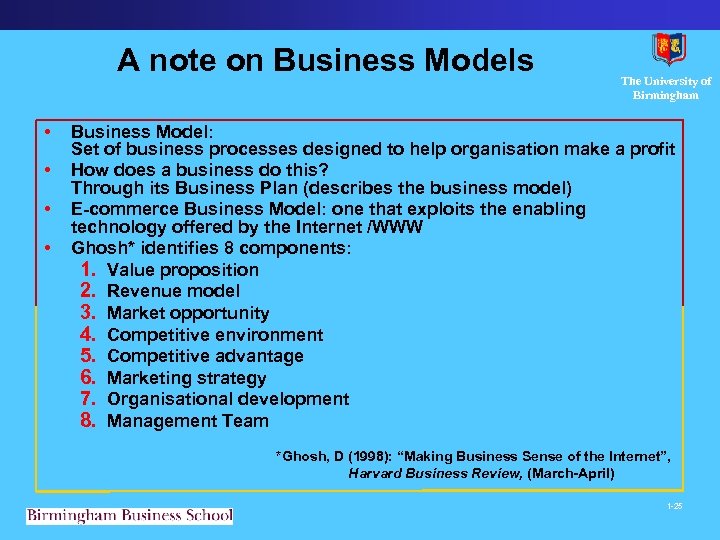
A note on Business Models The University of Birmingham • Business Model: • • • Set of business processes designed to help organisation make a profit How does a business do this? Through its Business Plan (describes the business model) E-commerce Business Model: one that exploits the enabling technology offered by the Internet /WWW Ghosh* identifies 8 components: 1. Value proposition 2. Revenue model 3. Market opportunity 4. Competitive environment 5. Competitive advantage 6. Marketing strategy 7. Organisational development 8. Management Team *Ghosh, D (1998): “Making Business Sense of the Internet”, Harvard Business Review, (March-April) 1 -25
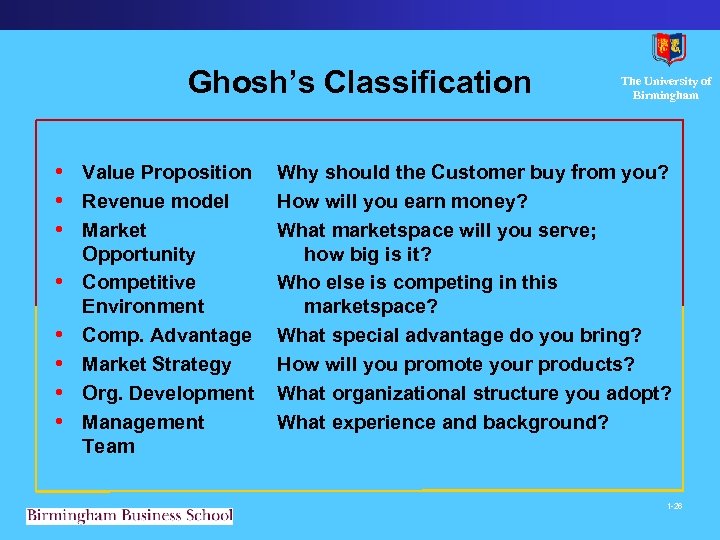
Ghosh’s Classification • Value Proposition • Revenue model • Market • • • Opportunity Competitive Environment Comp. Advantage Market Strategy Org. Development Management Team The University of Birmingham Why should the Customer buy from you? How will you earn money? What marketspace will you serve; how big is it? Who else is competing in this marketspace? What special advantage do you bring? How will you promote your products? What organizational structure you adopt? What experience and background? 1 -26
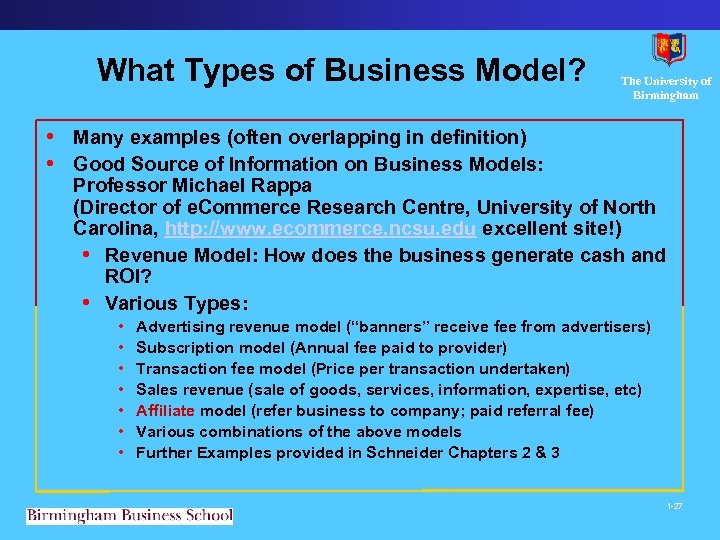
What Types of Business Model? The University of Birmingham • Many examples (often overlapping in definition) • Good Source of Information on Business Models: Professor Michael Rappa (Director of e. Commerce Research Centre, University of North Carolina, http: //www. ecommerce. ncsu. edu excellent site!) • Revenue Model: How does the business generate cash and ROI? • Various Types: • • Advertising revenue model (“banners” receive fee from advertisers) Subscription model (Annual fee paid to provider) Transaction fee model (Price per transaction undertaken) Sales revenue (sale of goods, services, information, expertise, etc) Affiliate model (refer business to company; paid referral fee) Various combinations of the above models Further Examples provided in Schneider Chapters 2 & 3 1 -27
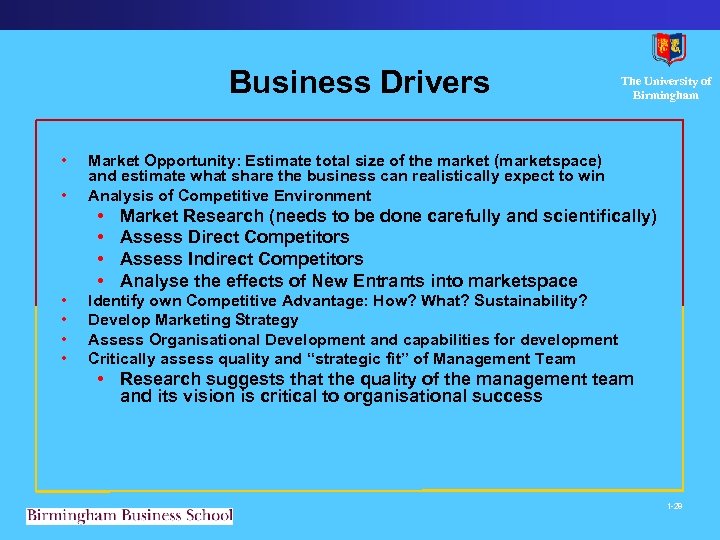
Business Drivers • • • The University of Birmingham Market Opportunity: Estimate total size of the market (marketspace) and estimate what share the business can realistically expect to win Analysis of Competitive Environment • • Market Research (needs to be done carefully and scientifically) Assess Direct Competitors Assess Indirect Competitors Analyse the effects of New Entrants into marketspace Identify own Competitive Advantage: How? What? Sustainability? Develop Marketing Strategy Assess Organisational Development and capabilities for development Critically assess quality and “strategic fit” of Management Team • Research suggests that the quality of the management team and its vision is critical to organisational success 1 -28
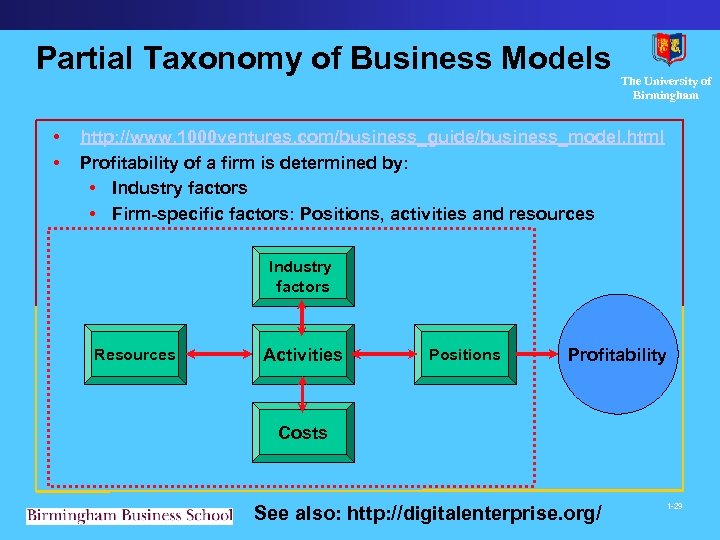
Partial Taxonomy of Business Models The University of Birmingham • http: //www. 1000 ventures. com/business_guide/business_model. html • Profitability of a firm is determined by: • Industry factors • Firm-specific factors: Positions, activities and resources Industry factors Resources Activities Positions Profitability Costs See also: http: //digitalenterprise. org/ 1 -29
Business Model and Strategy The University of Birmingham • Business Model: • Set of Which activities a firm performs • How it performs these activities • When it performs them as it uses its resources • Resources depend on the industry it operates in • Objective: to create superior customer value • Either low-cost • Or differentiated products • To allow it to attract value (money) to itself • So, PROFITABILTY is a function of all the above 1 -30
What sort of Business Model? The University of Birmingham • In e-commerce Wave 1 it was common to describe firms as having a particular type of business model: • Advertising model • Subscription model • Production model • Various types of revenue model (more than 100 at time of “dot-com bust” [“dot-bomb”] • Gave and Kaletsky (2005) identify the “platform company” - see next couple of slides. 1 -31
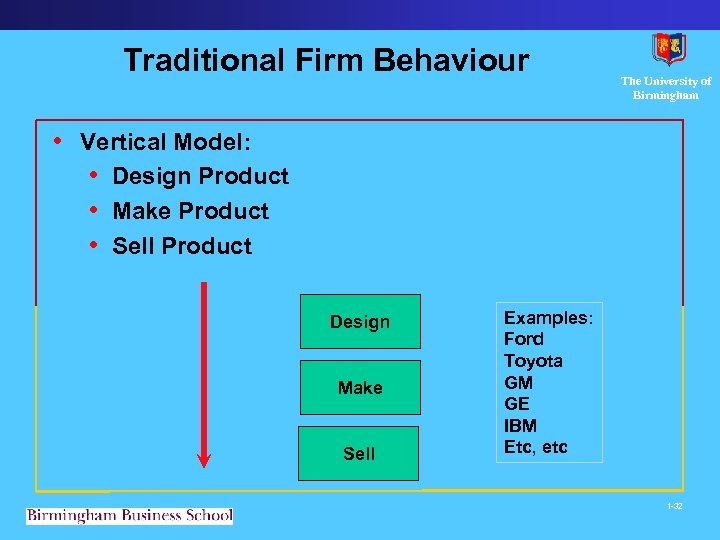
Traditional Firm Behaviour The University of Birmingham • Vertical Model: • Design Product • Make Product • Sell Product Design Make Sell Examples: Ford Toyota GM GE IBM Etc, etc 1 -32
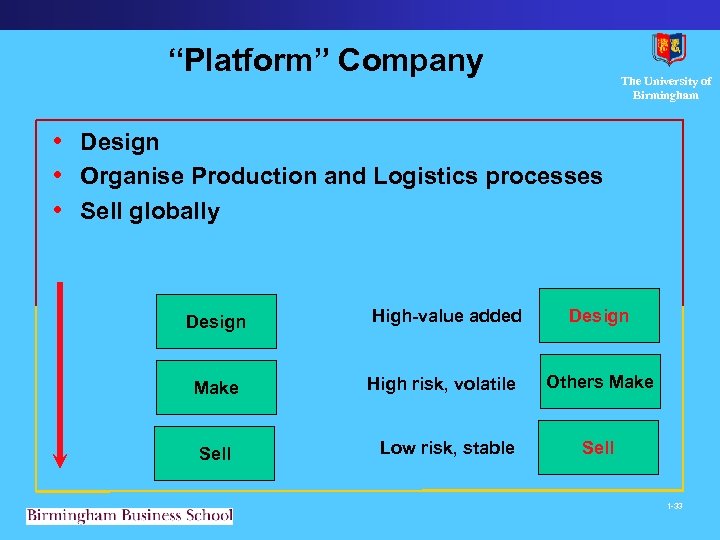
“Platform” Company The University of Birmingham • Design • Organise Production and Logistics processes • Sell globally Design High-value added Design Make High risk, volatile Others Make Sell Low risk, stable Sell 1 -33
Who are the “platform” firms? • • • The University of Birmingham Dell. com Apple Cisco IKEA Li & Fung Wal-Mart Hennes & Mauritz Hilton Hotel Group - manage not own hotels Marriott Others? 1 -34
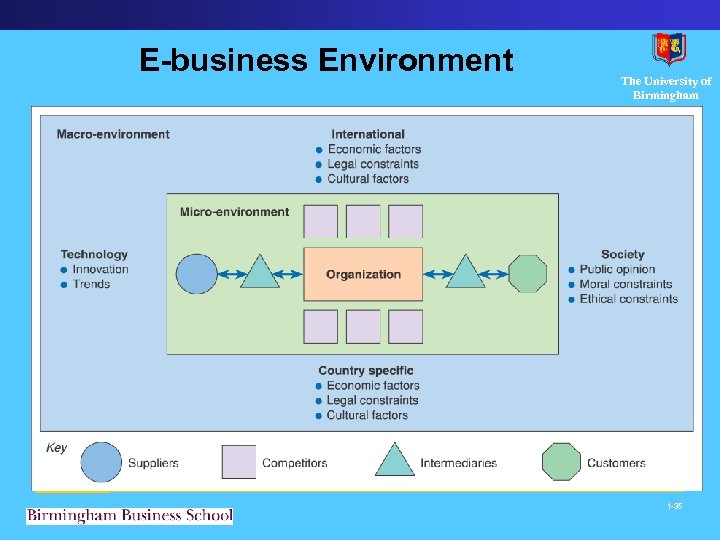
E-business Environment The University of Birmingham 1 -35
Environment: Constraints & Opportunities • • • The University of Birmingham Customers – which services are they offering via their web site that your organization could support them in? Competitors – need to be benchmarked in order to review the online services they are offering – do they have a competitive advantage? Intermediaries – are new or existing intermediaries offering products or services from your competitors while you are not represented? Suppliers – are suppliers offering different methods of procurement to competitors that give them a competitive advantage? Macro-environment Society – what is the ethical and moral consensus on holding personal information? Country specific, international legal – what are the local and global legal constraints for example on holding personal information, or taxation rules on sale of goods? Country specific, international economic – what are the economic constraints of operating within a country or global constraints? Technology – what new technologies are emerging by which to deliver online services such as interactive digital TV and mobile phone-based access? 1 -36
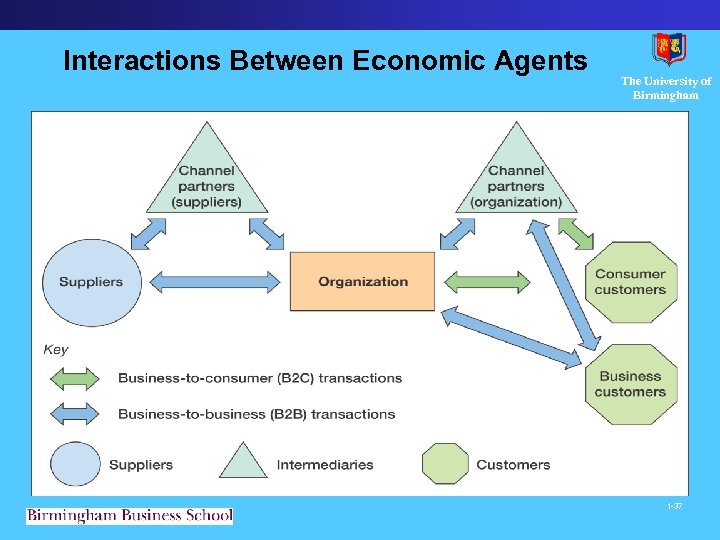
Interactions Between Economic Agents The University of Birmingham 1 -37
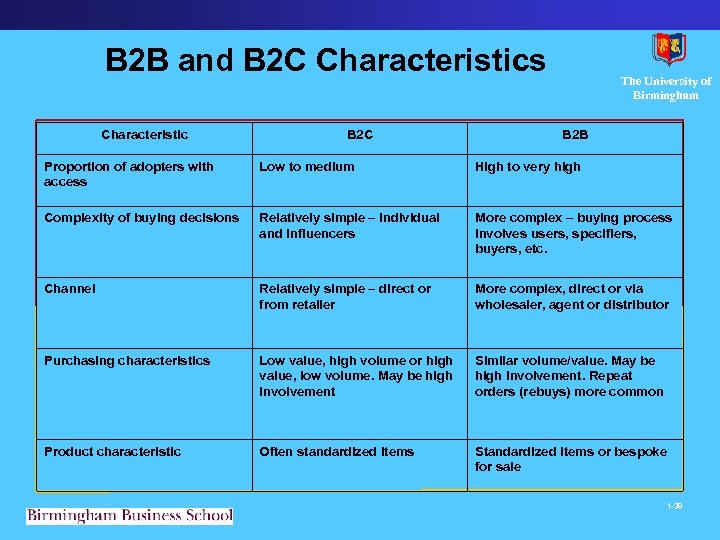
B 2 B and B 2 C Characteristics Characteristic B 2 C The University of Birmingham B 2 B Proportion of adopters with access Low to medium High to very high Complexity of buying decisions Relatively simple – individual and influencers More complex – buying process involves users, specifiers, buyers, etc. Channel Relatively simple – direct or from retailer More complex, direct or via wholesaler, agent or distributor Purchasing characteristics Low value, high volume or high value, low volume. May be high involvement Similar volume/value. May be high Involvement. Repeat orders (rebuys) more common Product characteristic Often standardized items Standardized items or bespoke for sale 1 -38
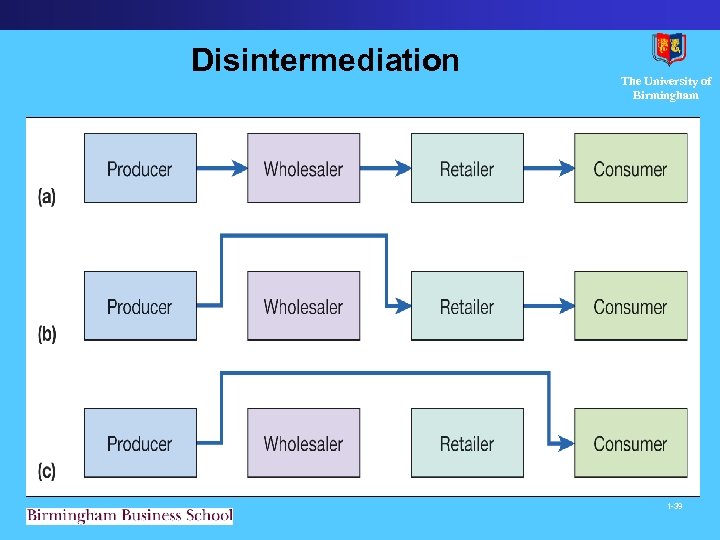
Disintermediation The University of Birmingham 1 -39
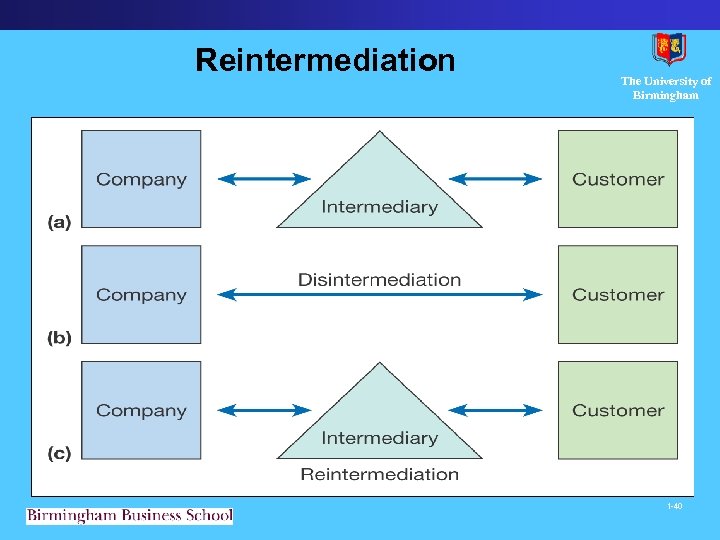
Reintermediation The University of Birmingham 1 -40
Countermediation The University of Birmingham • Creation of a new intermediary • Example: • B&Q www. diy. com • Opodo www. opodo. com • Boots www. wellbeing. com ; www. handbag. com • Partnering with existing intermediary – Mortgage broker Charcol and Freeserve • Expect new entrants in mobile e-commerce marketspace 1 -41
Decision to Go Online The University of Birmingham 1. Requires Careful Planning 1. What type of business do we want to be? 2. B 2 C (simple), or B 2 B (complex)? 3. What service(s) do we want to offer? 4. What is our market? Local or Global? 2. How will we attract Customers? 1. Where are they? 2. Who are they? 3. What is their profile/demographic? 3. What do we NEED? …. An e-Strategy 1 -42
What is Strategy? The University of Birmingham • “A firm’s theory about how to compete successfully. ” [Barney] • “A firm’s theory of how it can gain superior performance in the • • • markets in which it operates. ” [Drucker] The overall plan for deploying resources to establish a favourable position. ” [Grant] “A commitment to undertake one set of activities rather than another. ” [Oster] “The creation of a unique and valuable position, involving a different set of activities. ” [Porter] • Obviously, many definitions; most academics emphasise the (relatively) long-term nature of Strategy - as opposed to Tactics, Campaigns and Projects [I. e. “What do we do on Monday morning? ”] 1 -43
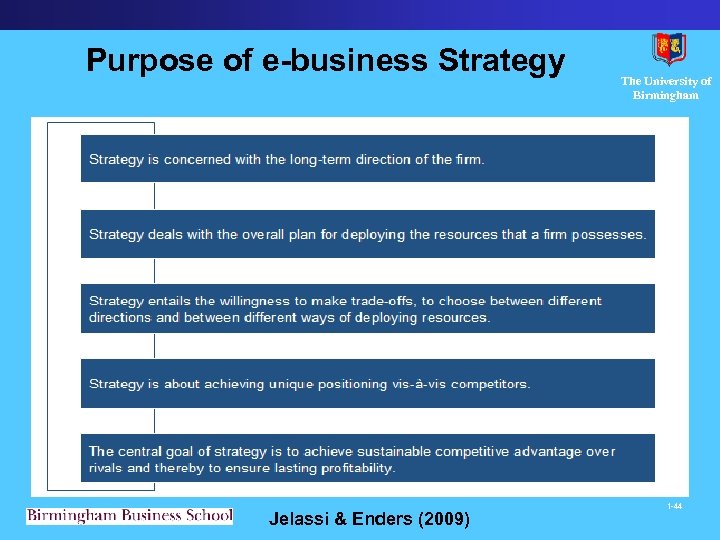
Purpose of e-business Strategy Jelassi & Enders (2009) The University of Birmingham 1 -44
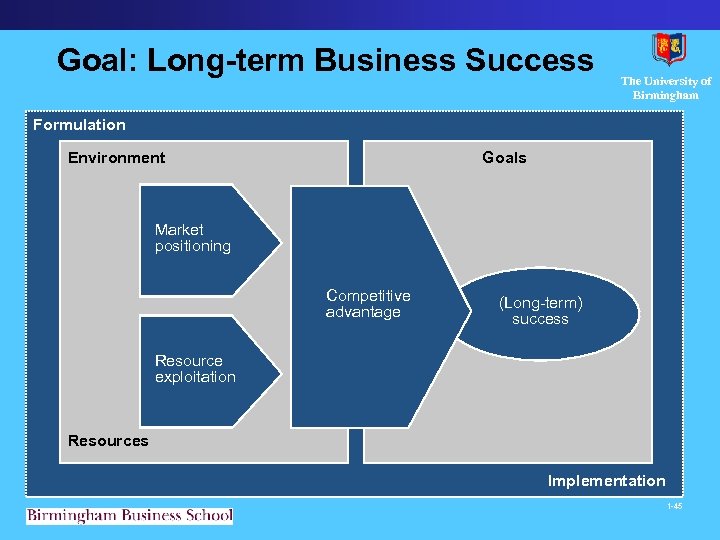
Goal: Long-term Business Success The University of Birmingham Formulation Environment Goals Market positioning Competitive advantage (Long-term) success Resource exploitation Resources Implementation 1 -45
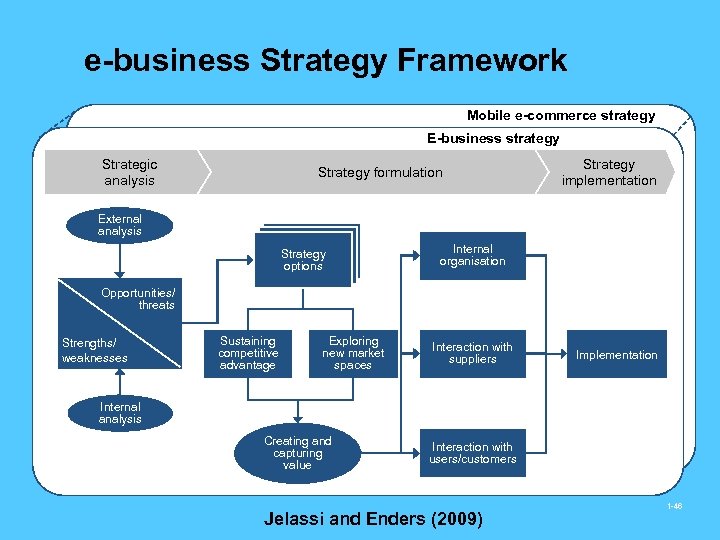
e-business Strategy Framework Mobile e-commerce strategy E-business strategy Strategic analysis Strategy formulation Strategy implementation External analysis Strategy options Internal organisation Opportunities/ threats Strengths/ weaknesses Sustaining competitive advantage Exploring new market spaces Interaction with suppliers Implementation Internal analysis Creating and capturing value Interaction with users/customers Jelassi and Enders (2009) 1 -46
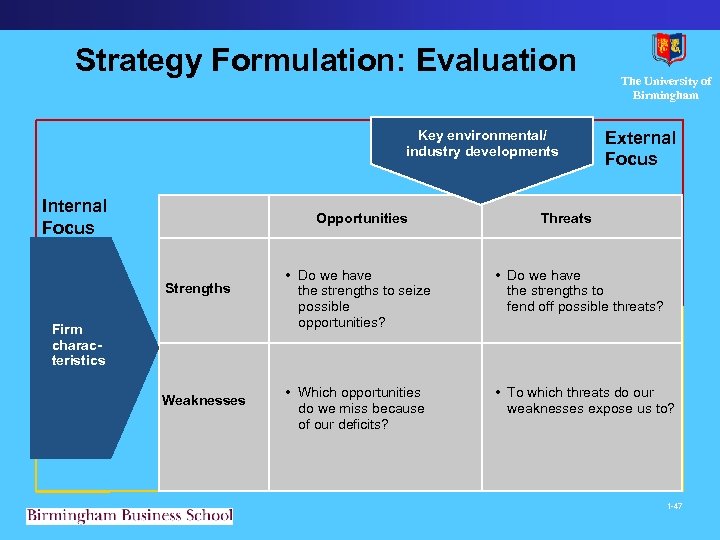
Strategy Formulation: Evaluation Key environmental/ industry developments Internal Focus Opportunities Strengths Firm characteristics Weaknesses The University of Birmingham External Focus Threats • Do we have the strengths to seize possible opportunities? • Do we have the strengths to fend off possible threats? • Which opportunities do we miss because of our deficits? • To which threats do our weaknesses expose us to? 1 -47
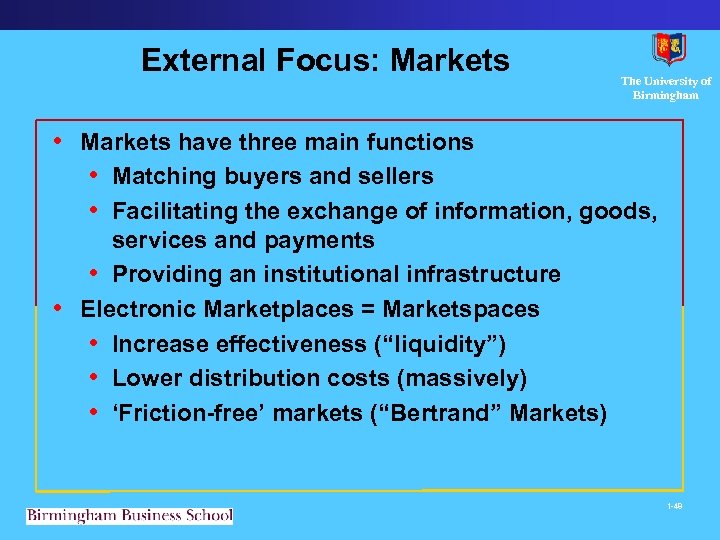
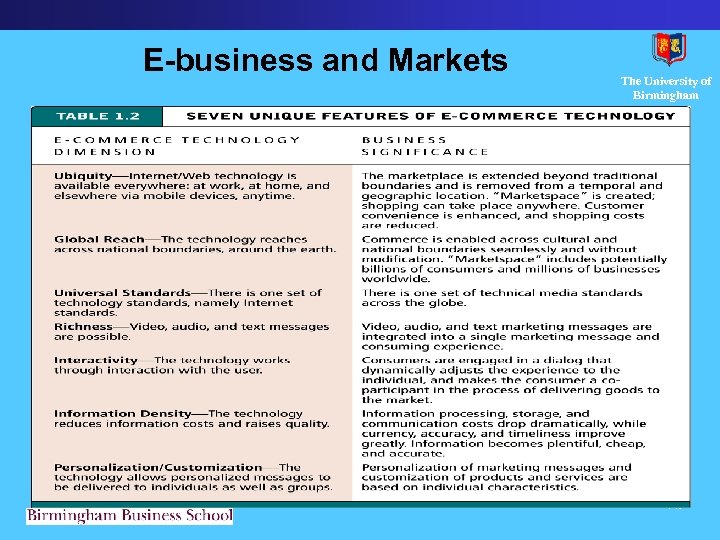
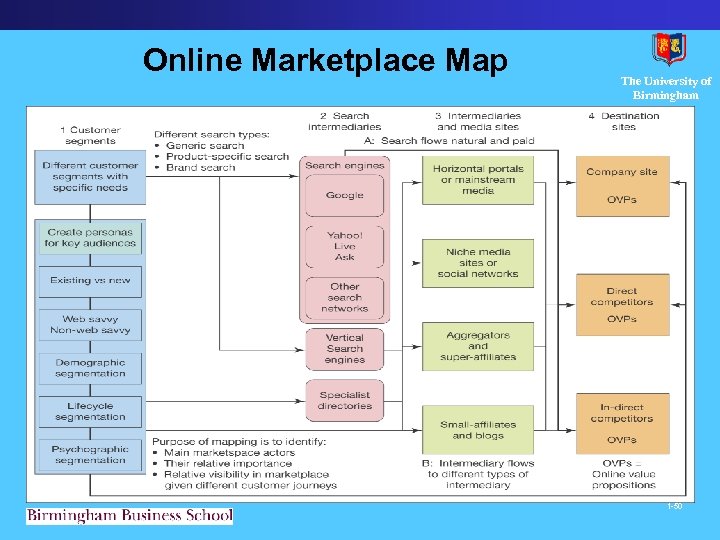
External Focus: Markets The University of Birmingham • Markets have three main functions • Matching buyers and sellers • Facilitating the exchange of information, goods, services and payments • Providing an institutional infrastructure • Electronic Marketplaces = Marketspaces • Increase effectiveness (“liquidity”) • Lower distribution costs (massively) • ‘Friction-free’ markets (“Bertrand” Markets) 1 -48
E-business and Markets The University of Birmingham 1 -49
Online Marketplace Map The University of Birmingham 1 -50
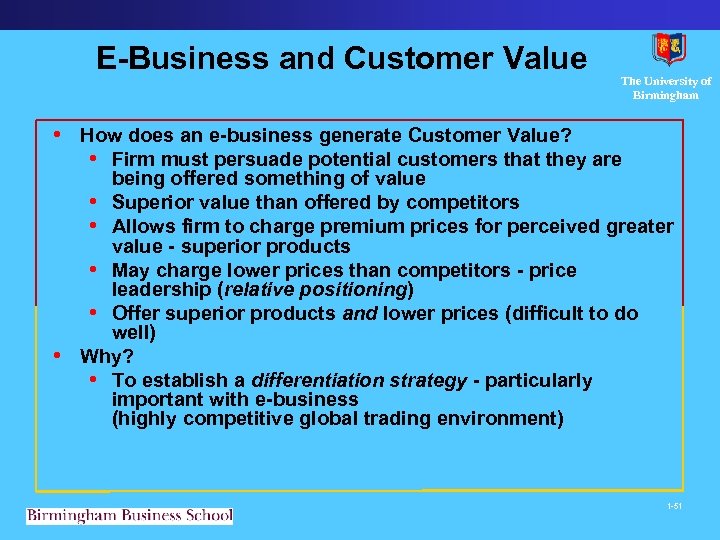
E-Business and Customer Value The University of Birmingham • How does an e-business generate Customer Value? • Firm must persuade potential customers that they are being offered something of value • Superior value than offered by competitors • Allows firm to charge premium prices for perceived greater value - superior products • May charge lower prices than competitors - price leadership (relative positioning) • Offer superior products and lower prices (difficult to do well) • Why? • To establish a differentiation strategy - particularly important with e-business (highly competitive global trading environment) 1 -51
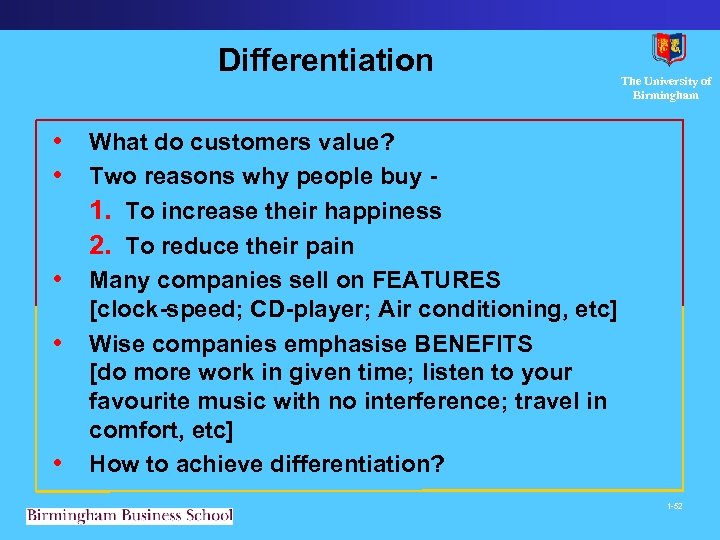
Differentiation The University of Birmingham • What do customers value? • Two reasons why people buy 1. To increase their happiness 2. To reduce their pain • Many companies sell on FEATURES • • [clock-speed; CD-player; Air conditioning, etc] Wise companies emphasise BENEFITS [do more work in given time; listen to your favourite music with no interference; travel in comfort, etc] How to achieve differentiation? 1 -52
Achieving Differentiation • • The University of Birmingham Features (low on list of priorities for good firms) Brand (reputation): MUCH more important Network Effects [Network externalities: e. g. Wintel] Timing (‘first-mover advantage”) Location (location, location) Service [Customer Service and CRM - see later] Product Mix (and marketing mix) 1 -53
Demand for Differentiated Products The University of Birmingham • Multidimensional Scaling • Benefits Mapping • Hedonics • Technological Progress • Sources of Differentiation • Economies of Scale • Economies of Scope • Factor Costs • Industry-specific Cost Drivers • Innovation • Learning by Doing • Agency Costs 1 -54
Profiting from Customer Value The University of Birmingham • Cooperation (Integration along supply chain) • Competition (Online / Offline /Both) • “Coopetition” (“cooperate and compete at the • • same time”, Ray Noorda, Novell) Streamlining Procurement Processes Bargaining Power Impact of Porter’s 5 -forces Analysis • Porter, M E (1998): “Competitive Strategy”, Boston, Harvard Business School Press See also, Besanko et al (2011): “Economics of Strategy”, 5 th Edition 1 -55
Business Strategy Development The University of Birmingham • Business Models important in strategy choice (options) and development • Strategic options determined by attitudes toward change, business risk and psychological factors • Mintzberg (1973) identifies 3 fundamental “modes” • Entrepreneurial mode • Adaptive mode • Planning mode • Modern Strategic Analysis recognises these and combined modes for strategy development 1 -56
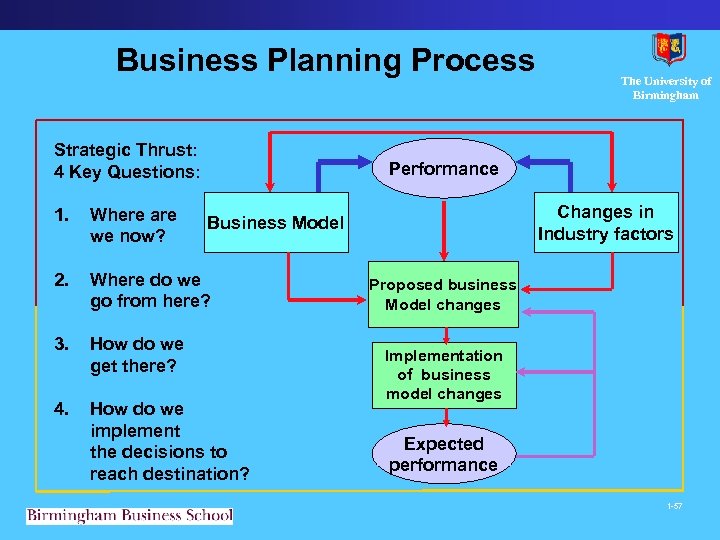
Business Planning Process Strategic Thrust: 4 Key Questions: The University of Birmingham Performance 1. Where are we now? 2. Where do we go from here? 3. How do we get there? 4. How do we implement the decisions to reach destination? Changes in Industry factors Business Model Proposed business Model changes Implementation of business model changes Expected performance 1 -57
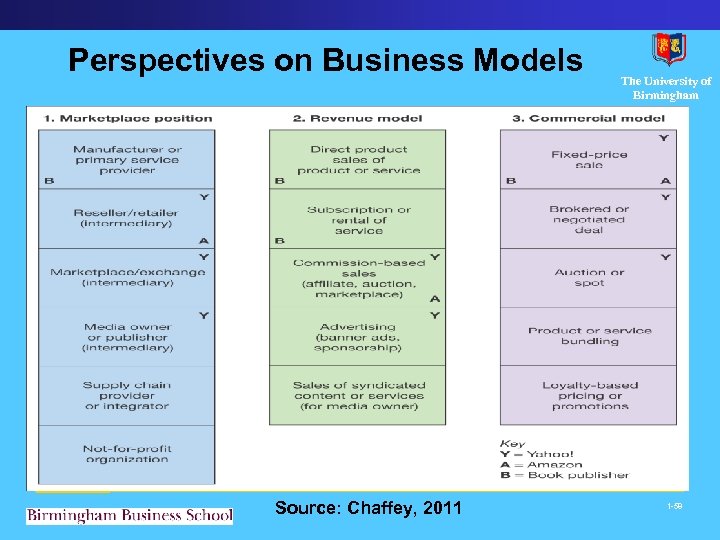
Perspectives on Business Models Source: Chaffey, 2011 The University of Birmingham 1 -58
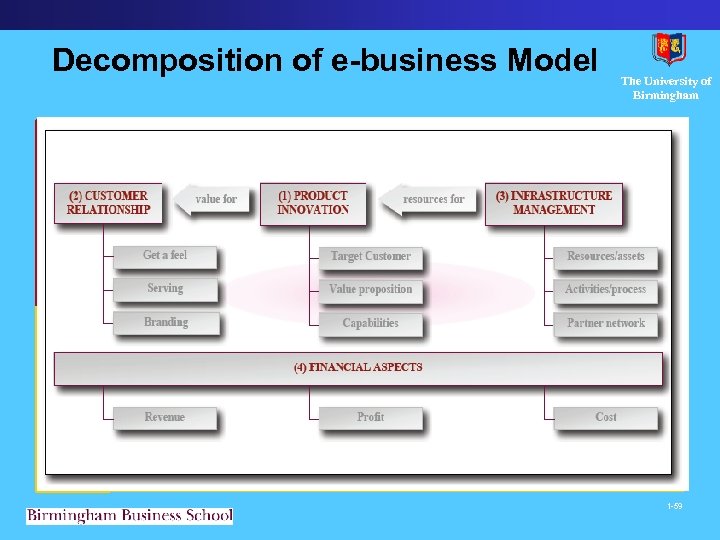
Decomposition of e-business Model The University of Birmingham 1 -59
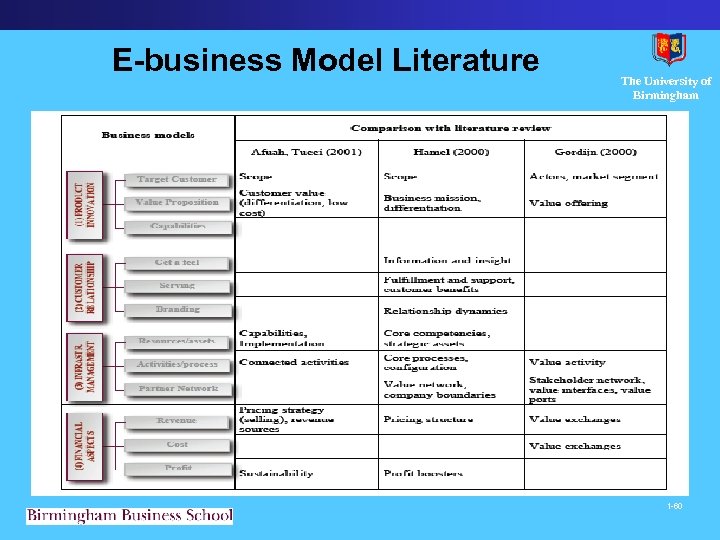
E-business Model Literature The University of Birmingham 1 -60
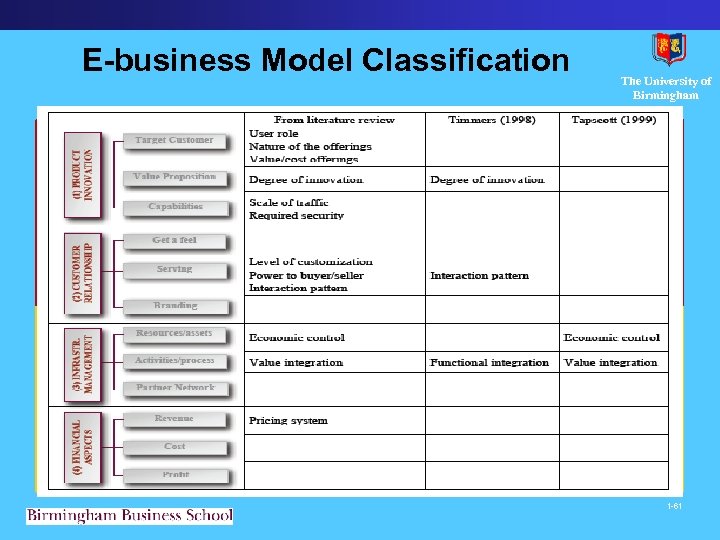
E-business Model Classification The University of Birmingham 1 -61
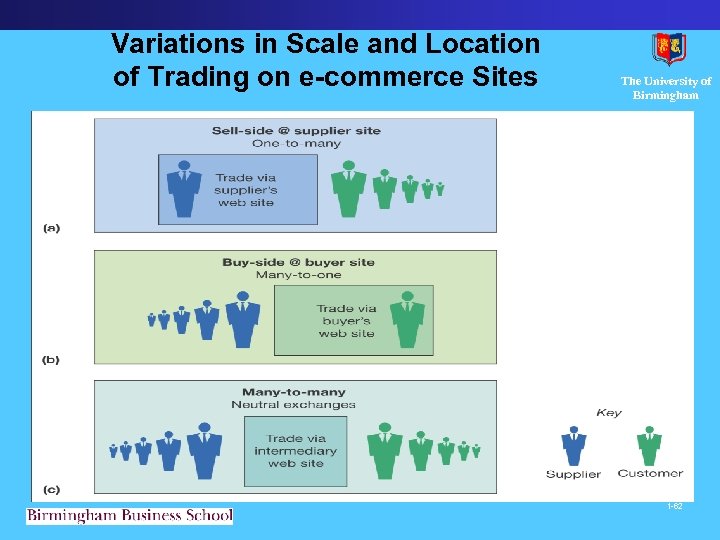
Variations in Scale and Location of Trading on e-commerce Sites The University of Birmingham 1 -62
Summary • • • The University of Birmingham How the Internet / Web works Importance of Protocols Examined concept of Business and Revenue Models Looked at e-business models (Rappa’s Website) Considered environments within which e-commerce/ e-business takes place Opportunities and constraints for e-business Interactions within and between e-businesses (see also later – Inter-Organisational Systems (IOS) Characteristics of B 2 C and B 2 B Business Planning and Strategy ACTIVITY: Visit Rappa’s site and analyse Google’s strategy. We’ll discuss it on Canvas. Dave Chaffey’s Website: Spreadsheets for Download 1 -63
Скачать презентацию The University of Birmingham MSc International Business International
d9fc22e8fd809805f89b8e0eb07d5422.ppt