 Скачать презентацию The University for business and the professions What
f8a5f2a46fcecb3b129146b6e8ef8341.ppt
- Количество слайдов: 31



The University for business and the professions What is a developmental language disorder? Victoria Joffe Department of Language and Communication Science City University Joffe, V. L. ESRC Festival of Social Science, City University, London, Saturday 15 th March, 2008.
The University for business and the professions Do you know anyone who has a developmental speech, language or communication disorder – a student, a neighbour, a son, daughter, niece or grandchild, a friend…. ? Joffe, V. L. ESRC Festival of Social Science, City University, London, Saturday 15 th March, 2008.
The University for business and the professions And if so, what do these children look like? Joffe, V. L. ESRC Festival of Social Science, City University, London, Saturday 15 th March, 2008.
The University for business and the professions Let’s go back a little to early development…. And ask, what is language? Joffe, V. L. ESRC Festival of Social Science, City University, London, Saturday 15 th March, 2008.
The University for business and the professions The mystery of language mastery q Most children typically acquire and develop language effortlessly without any formal instruction q Before they can add up 2 + 2 children are combining sentences, making statements, asking questions, and using linguistic rules appropriately q A child of around 3 -4 years produces conversation at a similar level to that of an adult Joffe, V. L. ESRC Festival of Social Science, City University, London, Saturday 15 th March, 2008.

The University for business and the professions What is language? q Rule governed organised system using a set of arbitrary symbols which are combined to form words q The symbols can take the form of sounds (speech), written symbols (text), hand movements (sign language) or raised dots (Braille) q These words can be combined to form an infinite set of utterances to convey meaning q The most important purpose of language is communication Joffe, V. L. ESRC Festival of Social Science, City University, London, Saturday 15 th March, 2008.
The University for business and the professions Languages have four main components: q syntax and morphology (rules) - grammar q phonology (form) – sounds q semantics - meaning q pragmatics - use Joffe, V. L. ESRC Festival of Social Science, City University, London, Saturday 15 th March, 2008.
The University for business and the professions Comprehension and Expression We also make a distinction between the comprehension (understanding) and expression (production) of language. Children usually understand words and sentences before they produce them. If you observe a young infant of around 6 months of age, you might not observe any expressive language (besides babbling), but the child may appear to understand a lot; for example, ‘Do you want some juice? ’ Joffe, V. L. ESRC Festival of Social Science, City University, London, Saturday 15 th March, 2008.
The University for business and the professions THE COMMUNICATION CHAIN: q Input q Processing q Output Joffe, V. L. ESRC Festival of Social Science, City University, London, Saturday 15 th March, 2008.
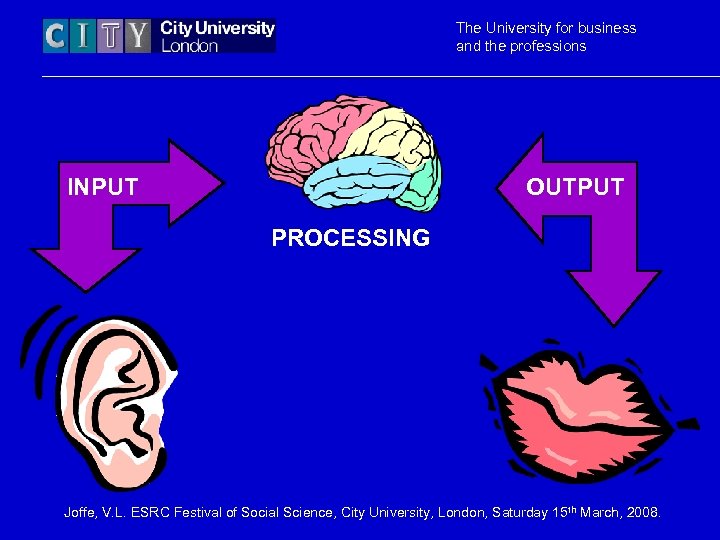
The University for business and the professions INPUT OUTPUT PROCESSING Joffe, V. L. ESRC Festival of Social Science, City University, London, Saturday 15 th March, 2008.
The University for business and the professions q Any difficulty along the communication chain, input, representation, output, can impact on learning q It can impact adversely on the understanding of all subjects across the National Curriculum, as well as on participation in the classroom and general school behaviour q A speech, language and communication difficulty will also affect a child’s behaviour, and social and emotional functioning Joffe, V. L. ESRC Festival of Social Science, City University, London, Saturday 15 th March, 2008.
The University for business and the professions So what are speech, language and communication impairments? Despite the ease of language acquisition for most children, some experience significant difficulties in acquiring and developing speech, language and communication. Language disorder occurs when a person has difficulties in using and/or understanding language. The term language disorder covers difficulties with phonology, syntax, semantics and/or pragmatics. Joffe, V. L. ESRC Festival of Social Science, City University, London, Saturday 15 th March, 2008.
The University for business and the professions q Children with language disorder can have problems with the sounds of the language. They may fail to discriminate correctly between speech sounds (for e. g. /t/ versus /s/), and mispronounce sounds (for e. g. /tat for /cat/). Children make the following speech errors: q Substitution q Omission q Distortion q Addition Joffe, V. L. ESRC Festival of Social Science, City University, London, Saturday 15 th March, 2008.
The University for business and the professions q Problems can be seen in grammar, with difficulties with past tense, for example, ‘caught’ ‘catched’ We also may see problems in putting words together to form sentences ‘The boy hits the ball’ ‘Boy hit ball’ They may also experience difficulties in using conjunctions like ‘but’, ‘if’, ‘however’. Joffe, V. L. ESRC Festival of Social Science, City University, London, Saturday 15 th March, 2008.
The University for business and the professions q Problems in semantics manifest in word finding difficulties struggling to find the target word and overusing general words like ‘thing’ and ‘stuff’ and ‘uhm’ and ‘er’ Students with semantic difficulties show a reduced vocabulary and their understanding of words is very literal and limited to specific items. For e. g. the word ‘sweet’ will be used for a snack from the newsagent, but won’t be extended to the chocolate mousse dessert. There will also be less understanding of this word in a more figurative sense, i. e. the sweet-natured man. Joffe, V. L. ESRC Festival of Social Science, City University, London, Saturday 15 th March, 2008.
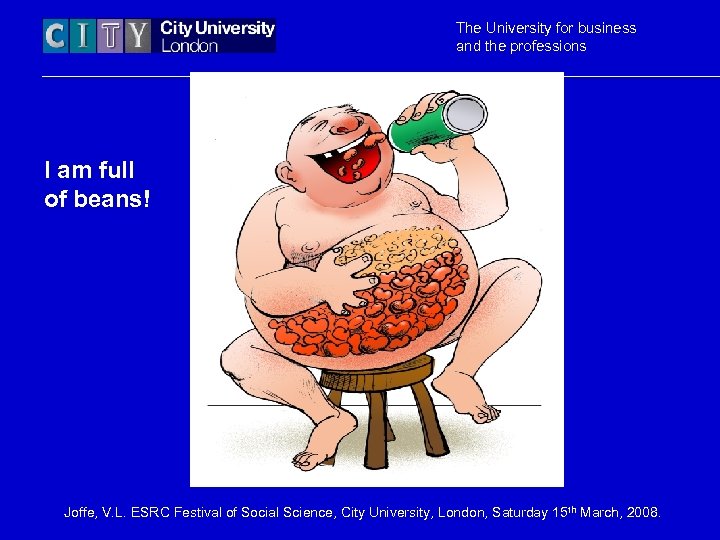
The University for business and the professions I am full of beans! Joffe, V. L. ESRC Festival of Social Science, City University, London, Saturday 15 th March, 2008.
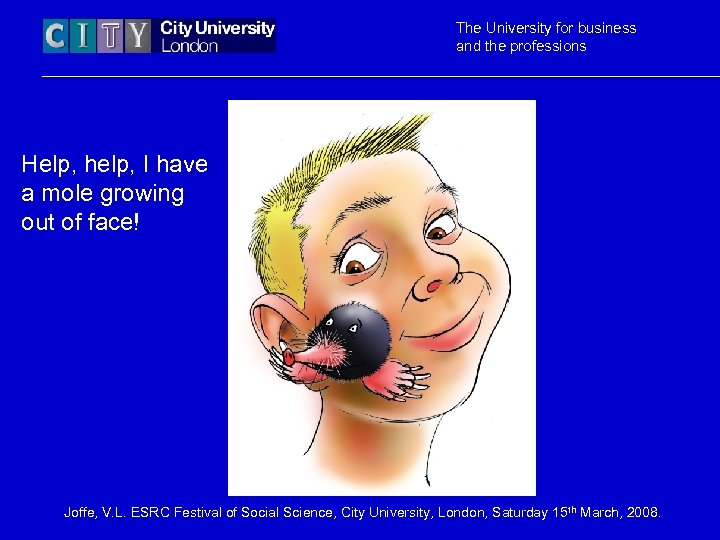
The University for business and the professions Help, help, I have a mole growing out of face! Joffe, V. L. ESRC Festival of Social Science, City University, London, Saturday 15 th March, 2008.
The University for business and the professions q Problems with pragmatics involve the way children use language. Pragmatic difficulties can be seen when students use language inappropriately, for e. g. using the same language when talking to their peers and head teacher. Pragmatics also includes the use and interpretation of appropriate non-verbal language (facial expression and body language) to communicate effectively. Joffe, V. L. ESRC Festival of Social Science, City University, London, Saturday 15 th March, 2008.
The University for business and the professions q All these difficulties can involve the understanding (reception) and expression of language q Children with language problems may also have difficulties with: v attention v concentration v organisation v listening v memory Joffe, V. L. ESRC Festival of Social Science, City University, London, Saturday 15 th March, 2008.
The University for business and the professions Punishment given to secondary school-aged children for the following misdemeanours: q coming in late for class q leaving equipment at home, for e. g. a ruler in maths class q not paying attention in class q getting lost on the way to the classroom q not finishing work on time q being disruptive in the classroom Bad behaviour or possibly understandable as part of the presenting picture of the language impairment? ? Joffe, V. L. ESRC Festival of Social Science, City University, London, Saturday 15 th March, 2008.
The University for business and the professions The Problem of Terminology We have many different terms and labels to refer to such children. These include: q Developmental disorders of language q Developmental dysphasia q Specific language impairment q Language delay q Language disorder q Language learning disability q Specific Learning Difficulties q General Learning Difficulties and more……. . Joffe, V. L. ESRC Festival of Social Science, City University, London, Saturday 15 th March, 2008.
The University for business and the professions 'It is generally the case that the less well we understand a condition, the more varied and inconsistent is the terminology that we use to refer to it. ' (Bishop, 1997, p. 21) q It is important to remember that children with language disorder are a heterogeneous group and present with different strengths and areas of need – they will not all look the same q The prevalence of language impairment is estimated at around 7 -10% Joffe, V. L. ESRC Festival of Social Science, City University, London, Saturday 15 th March, 2008.
The University for business and the professions Some linguistic examples from students with language impairment… Joffe, V. L. ESRC Festival of Social Science, City University, London, Saturday 15 th March, 2008.
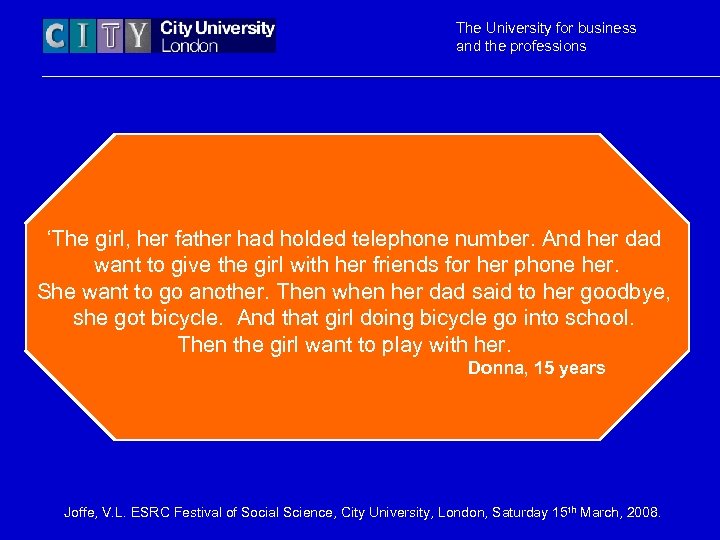
The University for business and the professions ‘The girl, her father had holded telephone number. And her dad want to give the girl with her friends for her phone her. She want to go another. Then when her dad said to her goodbye, she got bicycle. And that girl doing bicycle go into school. Then the girl want to play with her. Donna, 15 years Joffe, V. L. ESRC Festival of Social Science, City University, London, Saturday 15 th March, 2008.
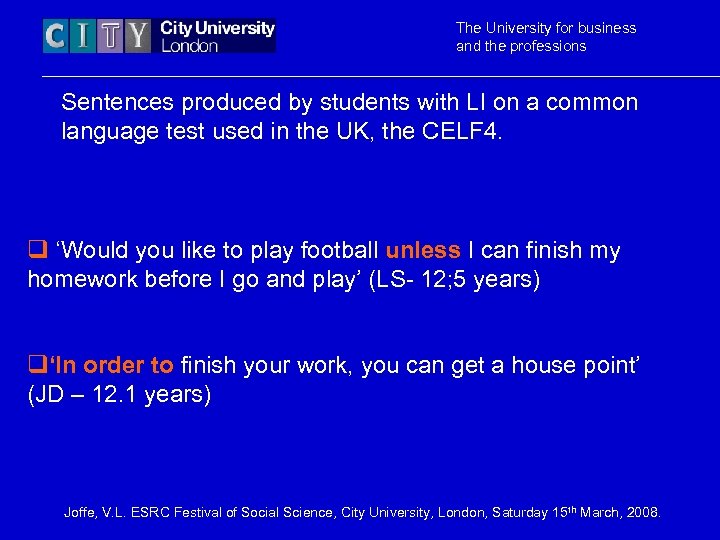
The University for business and the professions Sentences produced by students with LI on a common language test used in the UK, the CELF 4. q ‘Would you like to play football unless I can finish my homework before I go and play’ (LS- 12; 5 years) q‘In order to finish your work, you can get a house point’ (JD – 12. 1 years) Joffe, V. L. ESRC Festival of Social Science, City University, London, Saturday 15 th March, 2008.
The University for business and the professions Responses given by students with LI to an idiomatic understanding task: Can you tell me in your own words what this saying means: q to see red: ‘bleeding’ (CG – 11; 8 years ) qto be in the red: ‘to be in trouble’ (NG – 11; 7 years) q to be in the black: ‘to be in even more trouble’ (NG) q to be in the black: ‘to be in the dark’ (ZS – 11; 11 years) q to feel blue: , nice and calm’ (SF – 11; 7 years) Joffe, V. L. ESRC Festival of Social Science, City University, London, Saturday 15 th March, 2008.
The University for business and the professions Definitions: Can you tell me in your own words what these words mean: q Employer: ‘someone who, saying to other people what to do’ (HY – 11; 10 years) q Occupation: ‘if you are bored, you can occupation yourself’ (CG – 11; 8 years) q conservation: ‘conversation’ (NG – 11; 7 years) q conservation: ‘conversation between two important people’ (LS – 12; 5 years) Joffe, V. L. ESRC Festival of Social Science, City University, London, Saturday 15 th March, 2008.
The University for business and the professions q Language problems can be pervasive and persist into adolescence and adulthood q So what happens to adults with developmental language impairments? Joffe, V. L. ESRC Festival of Social Science, City University, London, Saturday 15 th March, 2008.
The University for business and the professions Speech, language and communication impairments impact on ALL aspects of the education curriculum AND the individual’s overall development: academic, physical, social, psychological, emotional, vocational Joffe, V. L. ESRC Festival of Social Science, City University, London, Saturday 15 th March, 2008.
The University for business and the professions And So…… Do you know anyone who has a developmental speech, language or communication disorder – a student, a neighbour, a son, daughter, niece or grandchild, a friend…. ? Joffe, V. L. ESRC Festival of Social Science, City University, London, Saturday 15 th March, 2008.
The University for business and the professions K AN S! Victoria Joffe Department of Language and Communication Science City University Northampton Square London EC 1 V 0 HB v. joffe@city. ac. uk www. elciss. com TH For further details, please contact: Joffe, V. L. ESRC Festival of Social Science, City University, London, Saturday 15 th March, 2008.
Скачать презентацию The University for business and the professions What
f8a5f2a46fcecb3b129146b6e8ef8341.ppt