



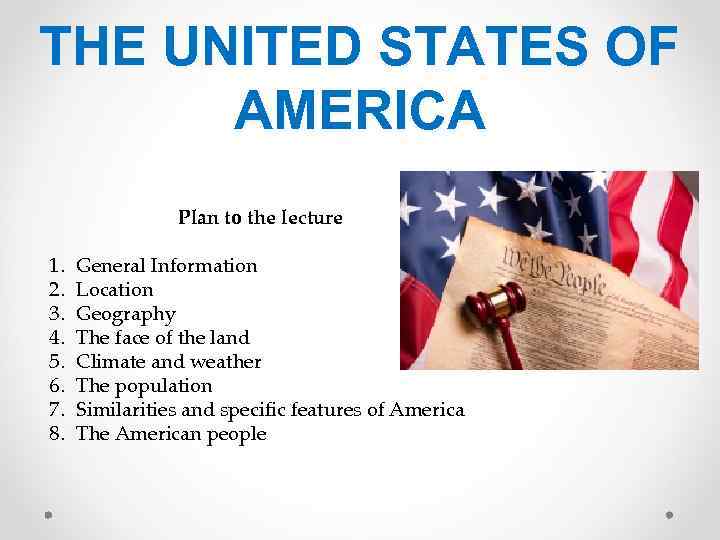
 THE UNITED STATES OF AMERICA Plan to the lecture 1. 2. 3. 4. 5. 6. 7. 8. General Information Location Geography The face of the land Climate and weather The population Similarities and specific features of America The American people
 Dictionary established by the Constitution - образована на основании Конституции “the Stars and Stripes and Old Glory” - «звезды, полоски и древняя слава» (описание флага США) stripe - полоска alternately - чередуясь, через одну proclaim - провозглашать courage - храбрость liberty - свобода loyalty - верность, преданность coat-of-arms - герб eagle - орел wings outspread - распростертые крылья bundle of rods - пучок розог administering - управление claw - клюв olive twig - оливковая ветвь motto - надпись (на гербе)
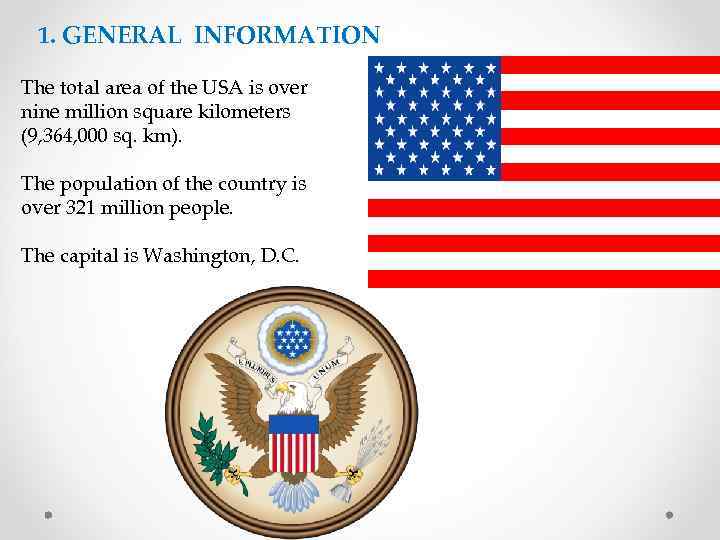 1. GENERAL INFORMATION The total area of the USA is over nine million square kilometers (9, 364, 000 sq. km). The population of the country is over 321 million people. The capital is Washington, D. C.
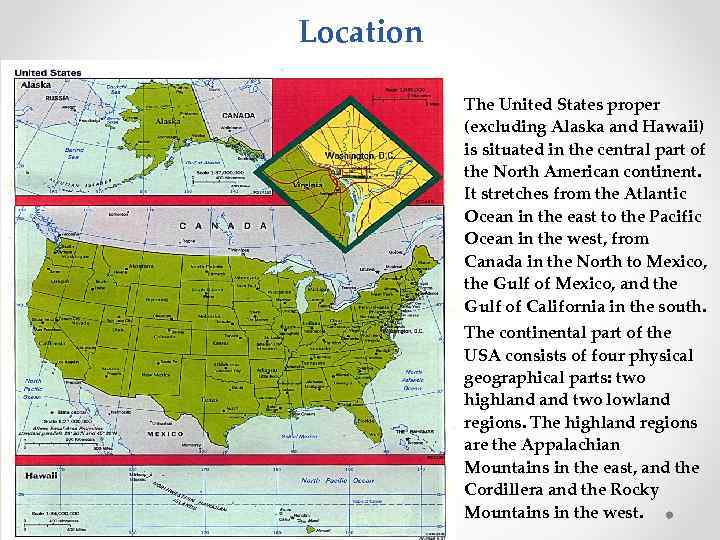 Location The United States proper (excluding Alaska and Hawaii) is situated in the central part of the North American continent. It stretches from the Atlantic Ocean in the east to the Pacific Ocean in the west, from Canada in the North to Mexico, the Gulf of Mexico, and the Gulf of California in the south. The continental part of the USA consists of four physical geographical parts: two highland two lowland regions. The highland regions are the Appalachian Mountains in the east, and the Cordillera and the Rocky Mountains in the west.
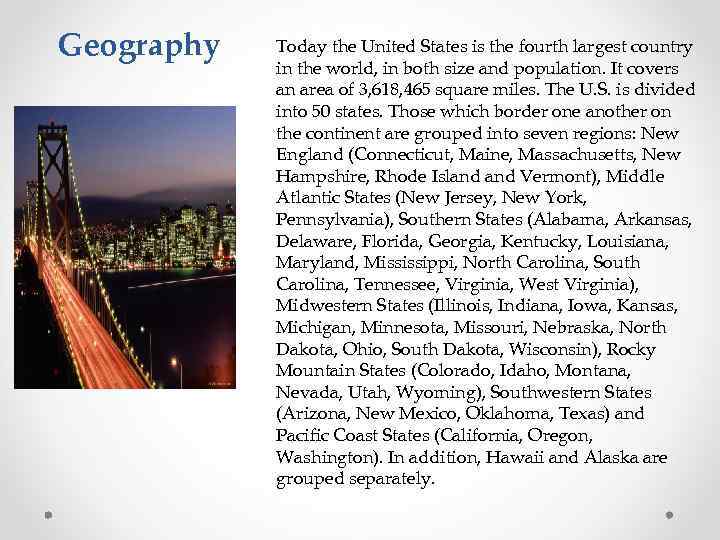 Geography Today the United States is the fourth largest country in the world, in both size and population. It covers an area of 3, 618, 465 square miles. The U. S. is divided into 50 states. Those which border one another on the continent are grouped into seven regions: New England (Connecticut, Maine, Massachusetts, New Hampshire, Rhode Island Vermont), Middle Atlantic States (New Jersey, New York, Pennsylvania), Southern States (Alabama, Arkansas, Delaware, Florida, Georgia, Kentucky, Louisiana, Maryland, Mississippi, North Carolina, South Carolina, Tennessee, Virginia, West Virginia), Midwestern States (Illinois, Indiana, Iowa, Kansas, Michigan, Minnesota, Missouri, Nebraska, North Dakota, Ohio, South Dakota, Wisconsin), Rocky Mountain States (Colorado, Idaho, Montana, Nevada, Utah, Wyoming), Southwestern States (Arizona, New Mexico, Oklahoma, Texas) and Pacific Coast States (California, Oregon, Washington). In addition, Hawaii and Alaska are grouped separately.
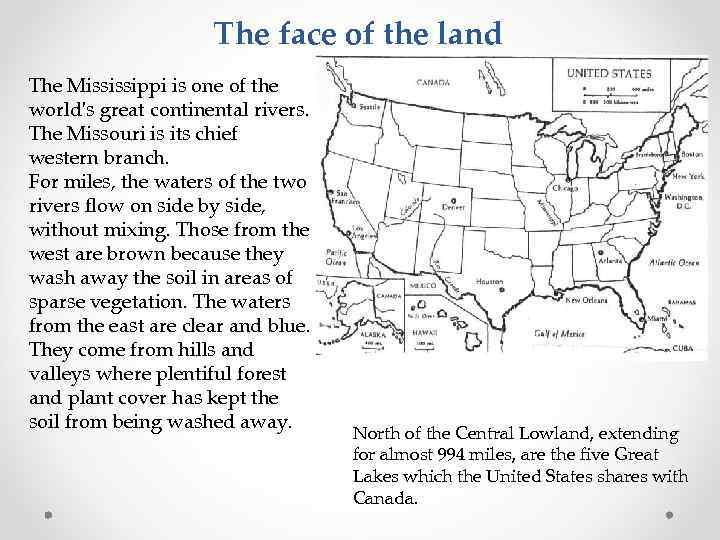 The face of the land The Mississippi is one of the world's great continental rivers. The Missouri is its chief western branch. For miles, the waters of the two rivers flow on side by side, without mixing. Those from the west are brown because they wash away the soil in areas of sparse vegetation. The waters from the east are clear and blue. They come from hills and valleys where plentiful forest and plant cover has kept the soil from being washed away. North of the Central Lowland, extending for almost 994 miles, are the five Great Lakes which the United States shares with Canada.
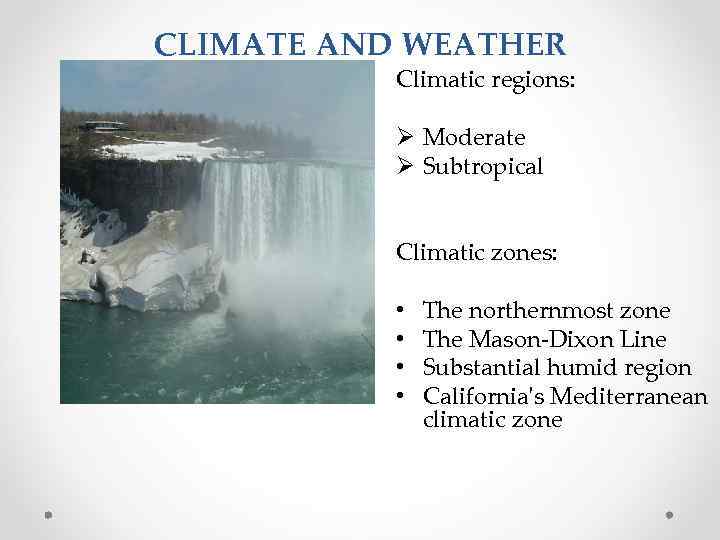 CLIMATE AND WEATHER Climatic regions: Ø Moderate Ø Subtropical Climatic zones: • • The northernmost zone The Mason-Dixon Line Substantial humid region California's Mediterranean climatic zone
 POPULATION At first, the settlers pushed westward in thin lines along the rivers; then they began to fill the intervening spaces throughout the middle of the country. And there, dramatically, the movement of the population jumped to the Pacific. As of the census taken in the year 2000 the population of the United States was 281, 421, 906. Native Americans comprise less than one half of one percent of the total population.
 SIMILARITIES AND SPECIFIC FEATURES OF AMERICA 1. 2. 3. 4. 5. 6. 7. 8. 9. Like other countries the United States changes quickly. The number of senior citizens increases. Americans are moving across the country. There are homeless people, hungry children, and crime in the country. Unemployment is a problem. American women work more now, but still do not have the same opportunities for equal salaries and career as men. Americans try to be independent. Young people get married later. Racial discrimination is illegal.
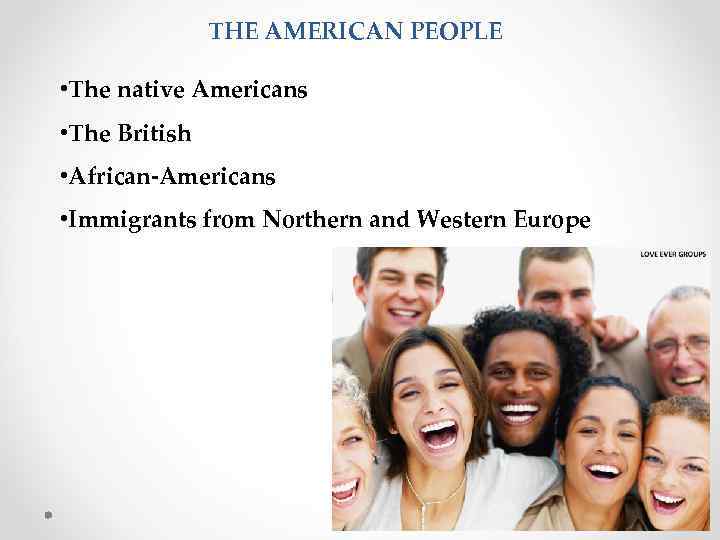 THE AMERICAN PEOPLE • The native Americans • The British • African-Americans • Immigrants from Northern and Western Europe
 LECTURE 2 AMERICAN HISTORY Plan to the lecture 1. 2. 3. 4. 5. The discovery of America The colonial period American Indians Two formative events in American history The American revolution
 COMMENTARY 1. Henry VIII (1491– 1547) – King of England. 2. the Church of England – the state protestant church of England (16 century). 3. accession to the throne – an act of becoming king (or queen). 4. Elizabeth (1533– 1603) – Elizabeth I (Tudor), Queen of Britain, daughter of Henry VIII, supported absolute monarchy and reconstructed the Church of England. 5. New Spain – a general term applying to the territories in the New World that were under Spanish rule or control. 6. James I (1566– 1625) – King of England who was also King James VI of Scotland was the first Stewart monarch to rule England. 7. a joint stock company – a corporate entity in which the corporate stock is owned by a number of individuals or other corporate entities. Can be privately or publicly held.
 COMMENTARY 8. The Scots & Irish. . . fled economic distress and religious discrimination – people took flight from some parts of England Ireland in an attempt to improve their economic situation and profess their religious creed. 9. to codify laws – the method of indexing laws and regulations by numerical and alphabetical reference; here: to make, to adopt laws. 10. American enlistments – generally referring to voluntary enrollment into the armed forces of the United States; here: enrollment into the British army from the American population. 11. the redcoats – a name given to the British Army or their sympathizers. 12. “Sons of Liberty” – a pre-constitutional organization, founded by Samuel Adams to organize resistance against the English rule. Any member of colonial activists in the pursuit of democracy.
 COMMENTARY 13. Samuel Adams (1722– 1803) – an American patriot, one of the leaders of the Independent Movement, against the English colonization. The leader of the “Sons of Liberty” organization. 14. “committee of correspondence” – established in Boston Mass, by Samuel Adams – the image of local revolutionary authority. 15. The East India Company – a group of European trading companies operating in the 17 th and 18 th centuries to enhance political and economic power. 16. Concord & Lexington – two towns on the outskirts of Boston, where the major battles were fought between the English (redcoats) and the American (tories), in which the American patriots won against the dominating English. 17. John Hancock (1737– 1793) – one of the original architects of, and signatories to the Constitution of the United States. A leader of the liberation movement against the British colonization.
 COMMENTARY 18. Paul Revere (1735— 1818) – a noted silversmith and patriot who was best known for his midnight ride through the suburbs of Boston, warning the local residents of a pending British invasion. 19. George Washington (1732– 1799) – commander-in-chief of the first American Army who defeated the British Army at Potomac (Va). Was elected the first president of the United States. 20. Thomas Jefferson (1743– 1826) – President of the United States (1801– 1809). The author of the Declaration of Independence. 21. John Adams (1735– 1826) – the second President of the United States (1797– 1801); participant in the war for independence in North America 1775– 1783.
 COMMENTARY 22. Benjamin Franklin (1706– 1790) – a noted inventor, author, and scientist. One of the authors of the Declaration of Independence (of the U. S. A. ) (1776) and U. S. Constitution (1787). Established in Philadelphia the first public library (1731), University of Pennsylvania (1740), American Philosophical Society (1743). 23. The Seven Years’ War (1756– 1763) – war between Austria, France, Russia, Spain, Sweden on the one side and Great Britain and Portugal on the other. The main result was the victory of Great Britain over France in the fight for colonial and trade superiority. 24. King Louis XVI (1754– 1793) – King of France, the last Bourbon king to govern France as an absolute ruler. 25. guerilla warfare – a method of military tactics utilizing ambush methods of “hit and run” technique.
 Word Combinations to establish a settlement to levy a tax to found a colony to suspend legislature a key occurrence to repeal duties to assume a mature form to state the rights and grievances a rapid population growth to set up a committee a distressed area to grant a monopoly indentured servitude to execute a design to squat on land to pass punitive measures rove one’s circumstances dramatically to bring somebody into line
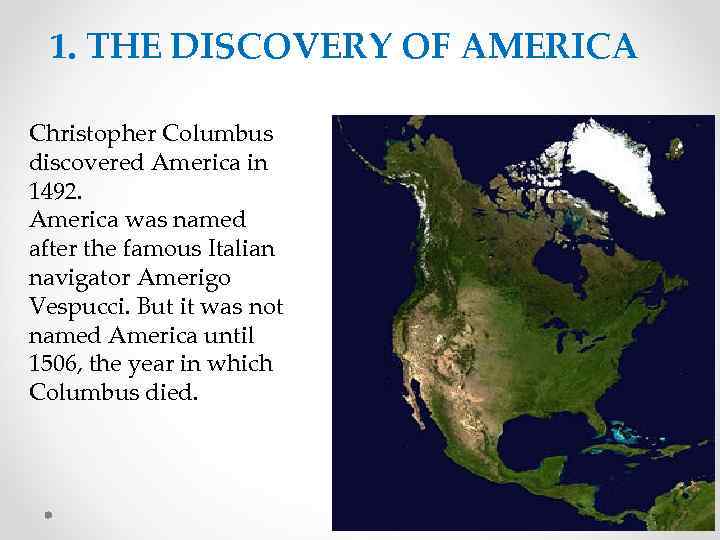 1. THE DISCOVERY OF AMERICA Christopher Columbus discovered America in 1492. America was named after the famous Italian navigator Amerigo Vespucci. But it was not named America until 1506, the year in which Columbus died.
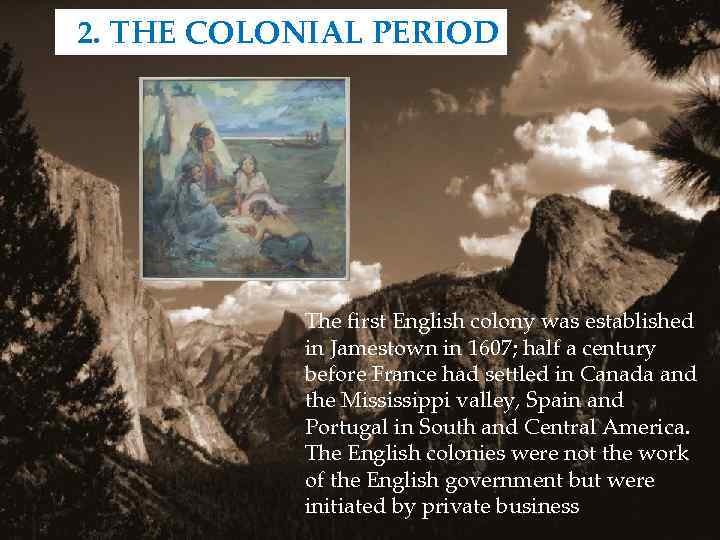 2. THE COLONIAL PERIOD The first English colony was established in Jamestown in 1607; half a century before France had settled in Canada and the Mississippi valley, Spain and Portugal in South and Central America. The English colonies were not the work of the English government but were initiated by private business
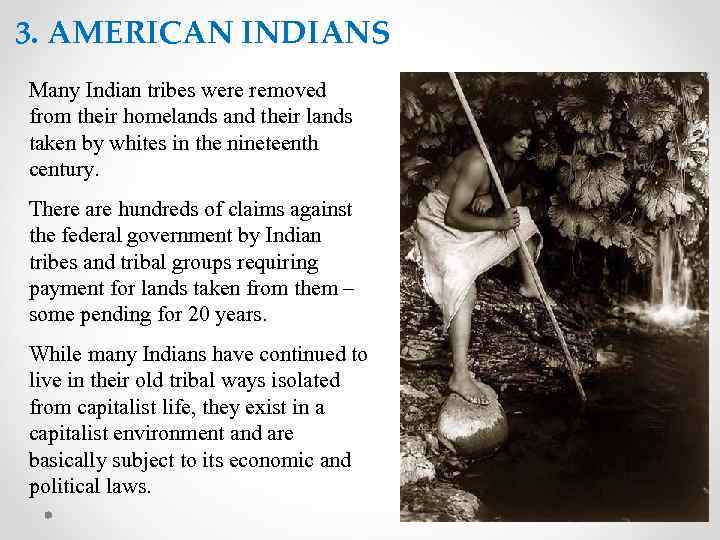 3. AMERICAN INDIANS Many Indian tribes were removed from their homelands and their lands taken by whites in the nineteenth century. There are hundreds of claims against the federal government by Indian tribes and tribal groups requiring payment for lands taken from them – some pending for 20 years. While many Indians have continued to live in their old tribal ways isolated from capitalist life, they exist in a capitalist environment and are basically subject to its economic and political laws.
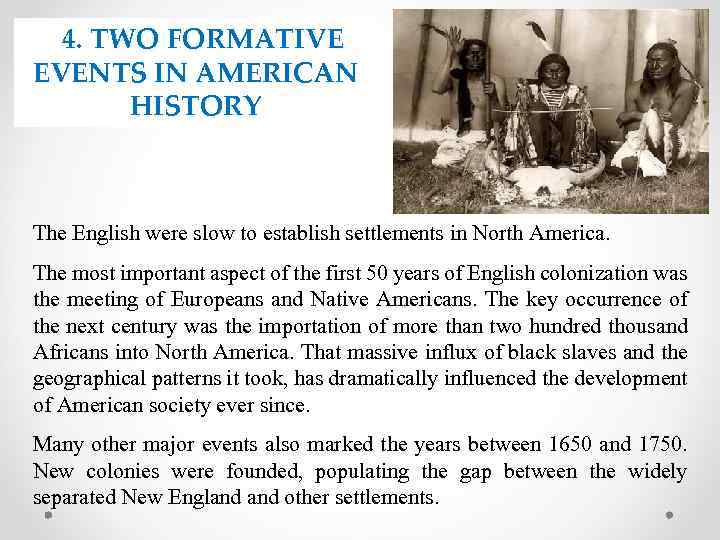 4. TWO FORMATIVE EVENTS IN AMERICAN HISTORY The English were slow to establish settlements in North America. The most important aspect of the first 50 years of English colonization was the meeting of Europeans and Native Americans. The key occurrence of the next century was the importation of more than two hundred thousand Africans into North America. That massive influx of black slaves and the geographical patterns it took, has dramatically influenced the development of American society ever since. Many other major events also marked the years between 1650 and 1750. New colonies were founded, populating the gap between the widely separated New England other settlements.
 5. THE AMERICAN REVOLUTION The Native Americans were also angry with the British, as after the British won the victory in 1760 they refused to pay the rent for the forts in the tribal territory. They also permitted white settlers to move farther west. At the beginning of 1760, England was seeking new sources of money for covering the immense war debt, and so they decided to tax the colonies. The new taxes were to be levied on goods like sugar, paper, glass, and tea. The British also introduced some posts of British officials in America and suspended the New York legislature for not providing firewood and candles to British troops stationed permanently in America. These measures drew a quick response. The revolution took place in July 1772/