Скачать презентацию The United States of America Chapter 10 Government
4622b0db0e9e6ffa1a1b247ff6be61c5.ppt
- Количество слайдов: 64
 The United States of America Chapter 10 Government
 CONTENTS 1 US Constitution 2 Federal System & Government 3 Political Parties 4 Election 5 Foreign Policy
 1. US Constitution—basic instrument law, drawn up in 1787, came into effect in 1789. Two characters: separation of powers, check and balances; specified exactly what power the central government had and which power was reserved for the states.
 1. US Constitution Significance of the Constitution Taking precedence over all state constitutions and laws, and over laws made by the congress; First of its kind in the world, it has inspired dozens of other countries to seek political reform. Basic law of the land Nation’s political stability Economic growth Social progress
 2. Federal System & Government What is federalism? What is the separation of powers? What are the qualifications for a US President? How do you understand the power of American President?
 2. Federal System & Government 2. 1 The Federal Government 2. 2 The Executive Branch 2. 3 The Legislative Branch 2. 4 The Judicial Branch
 2. 1 The Federal Government—the central government. Three equal and separate branches: The Executive branch The Legislative branch The Judicial branch They are checked and balanced by one another.
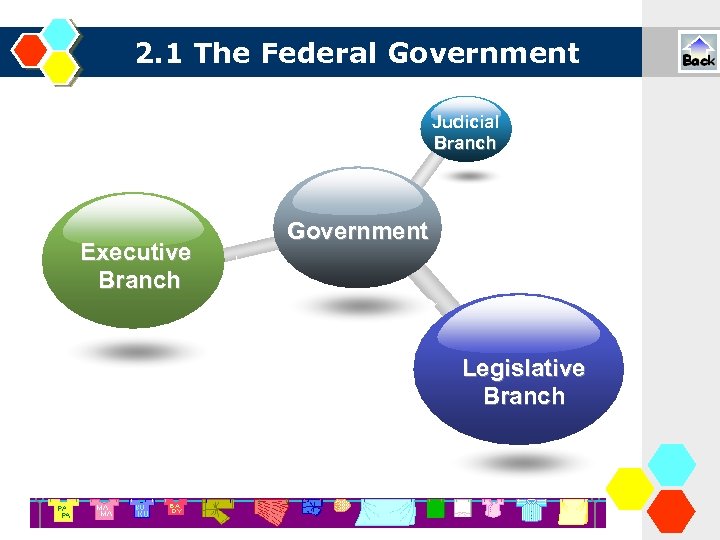 2. 1 The Federal Government Judicial Branch Executive Branch Government Legislative Branch
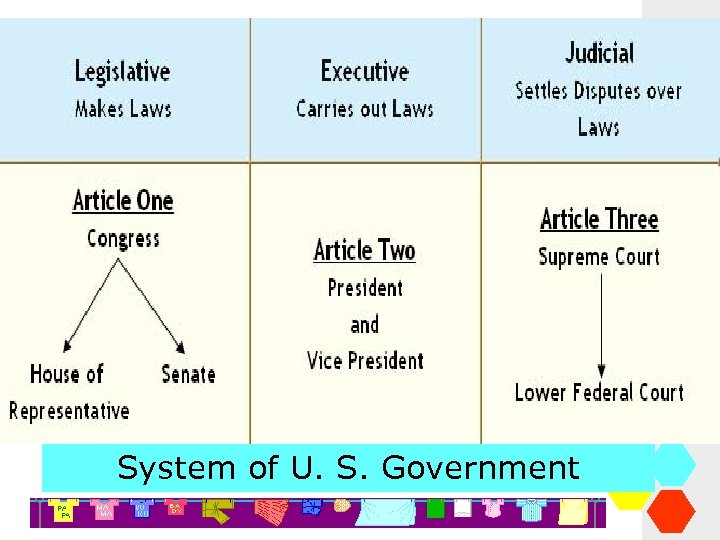 System of U. S. Government
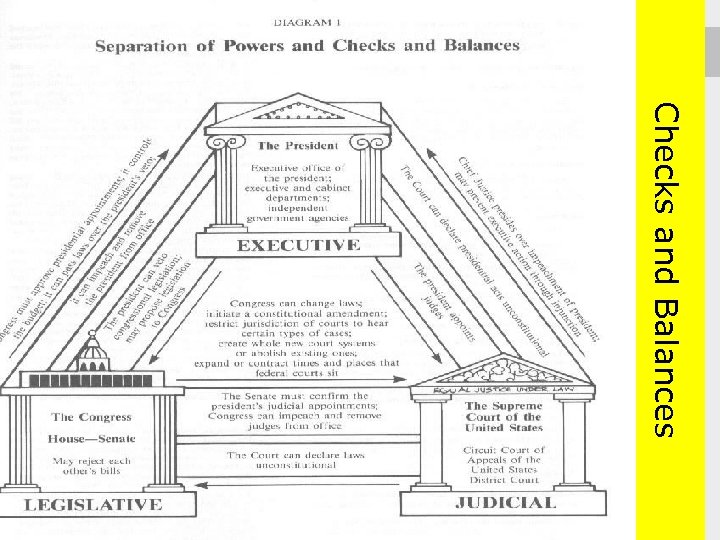 Checks and Balances
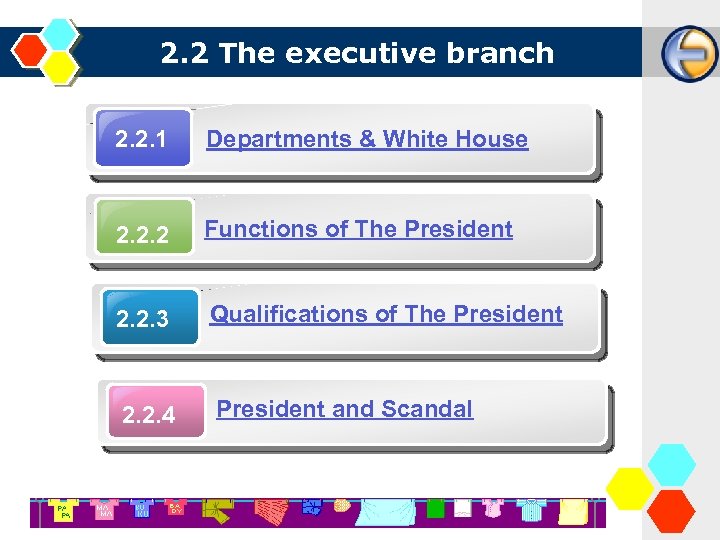 2. 2 The executive branch 2. 2. 1 Departments & White House 2. 2. 2 Functions of The President 2. 2. 3 Qualifications of The President 2. 2. 4 President and Scandal
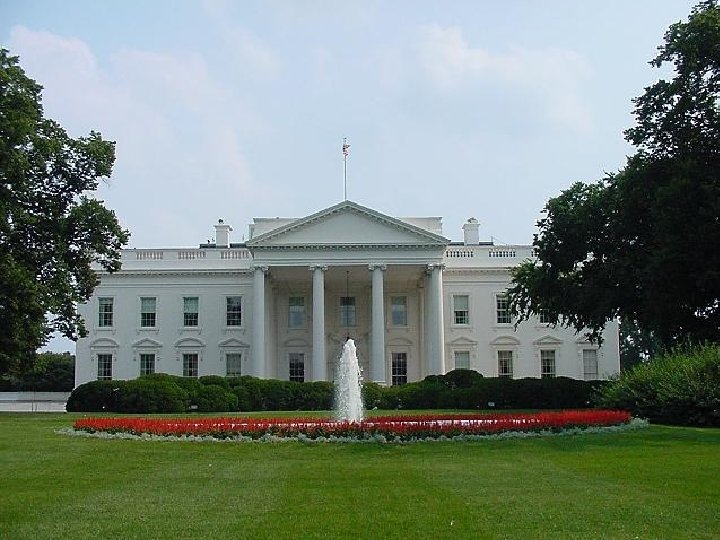
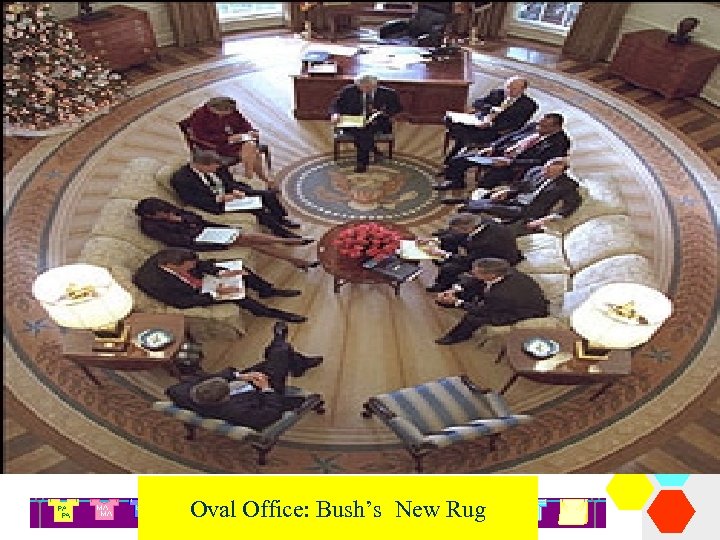
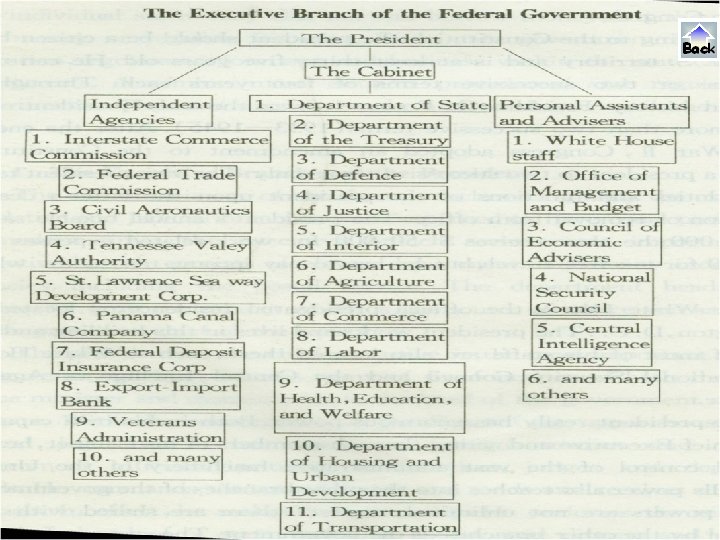
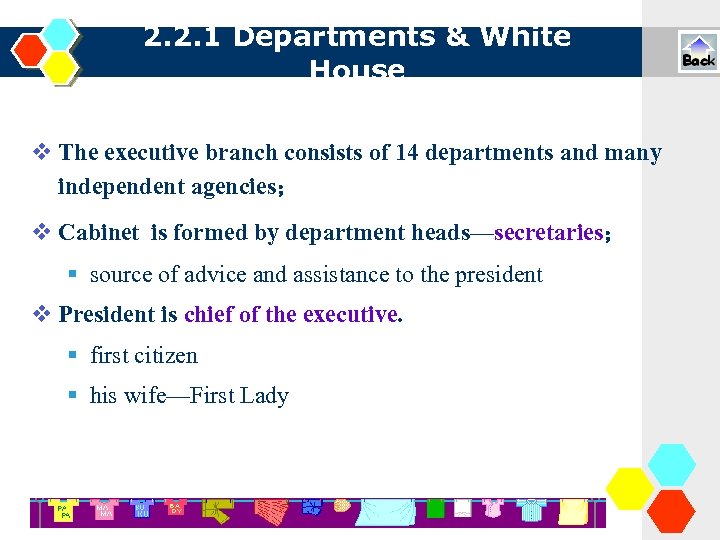 2. 2. 1 Departments & White House The executive branch consists of 14 departments and many independent agencies; Cabinet is formed by department heads—secretaries; source of advice and assistance to the president President is chief of the executive. first citizen his wife—First Lady
 Oval Office: Bush’s New Rug
 www. themegallery. com
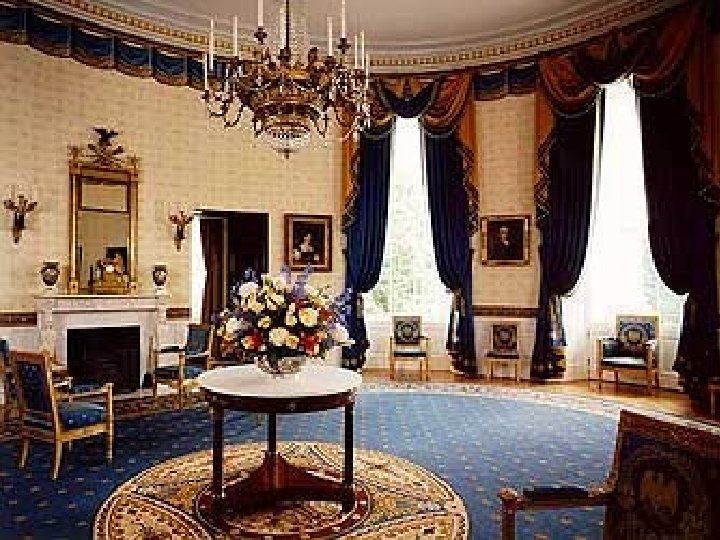
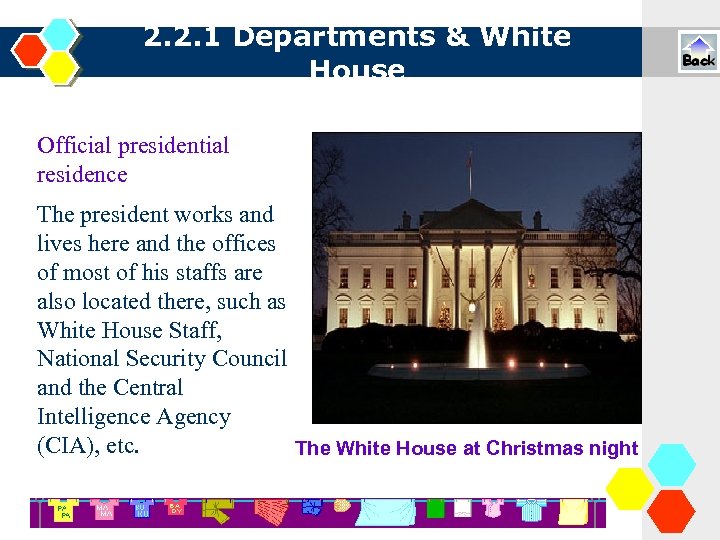 2. 2. 1 Departments & White House Official presidential residence The president works and lives here and the offices of most of his staffs are also located there, such as White House Staff, National Security Council and the Central Intelligence Agency (CIA), etc. The White House at Christmas night
 2. 2. 2 Functions of The President As Chief Executive, he is given the authority or duty: to command the armed forces and grant pardons; to make appointments to certain offices; to conclude treaties; to send and receive diplomatic and consular officials; to inform Congress on the “state of the Union”; to recommend legislation, approve or veto bills passed by Congress, and ensure the execution of laws.
 2. 2. 2 Functions of The President The president’s limits: major appointments with approval of the Senate; veto overridden by Congress with two-thirds consent of the Senators; all appropriations legislated by Congress; can be impeached by Congress if abusing power or committing crimes; no power to dismiss Congress; his policy can be vetoed and abolished by The Supreme Court.
 2. 2. 3 Qualifications of The President Natural-born American citizen of and over 35 years-old; Being resident within the US for at least 14 years; Serve one or two successive terms of four years. Franklin D. Roosevelt—the only president who served more than two successive terms. After World War II, Congress adopted an amendment limiting a president to two successive terms only.
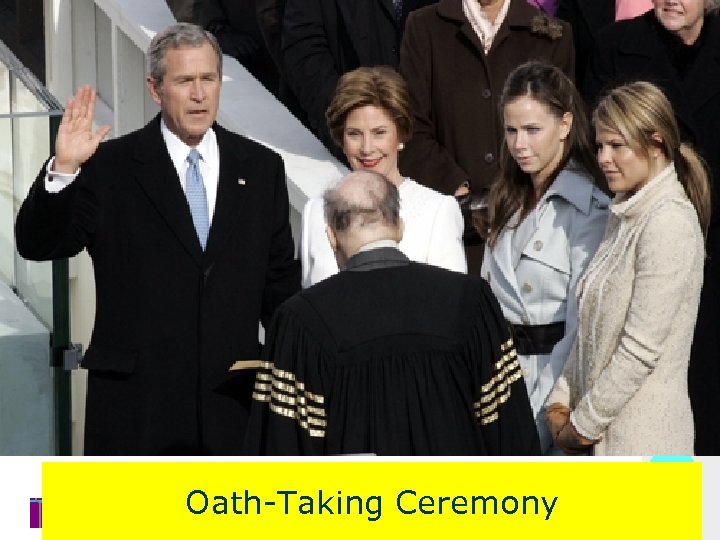 Oath-Taking Ceremony
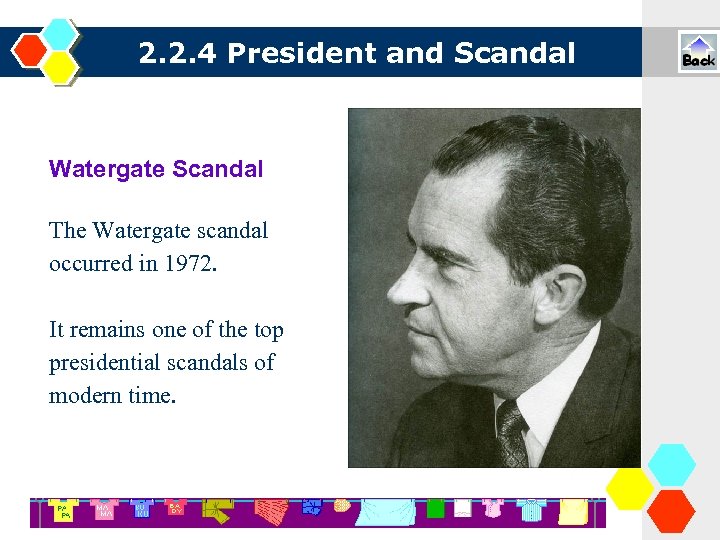 2. 2. 4 President and Scandal Watergate Scandal The Watergate scandal occurred in 1972. It remains one of the top presidential scandals of modern time.
 Chinese poems quotoed by American Presidents Obama: (Town Hall) Chinese proverb:Consider the past you shall know the future. Nixon Chairman has written: So many deeds cry out to be done, and always urgently; the world rolls on, time presses. Ten thousand years are too long; seize the day, seize the hour! This is the hour. This is the day for our two people (现在就是我们两国人民只 争朝夕的时候了) Cliton (1998) in Xi’an City Let us give new meaning to the words written in the ancient Book of Rites, what you call the Li Shi: When the great way is followed, all under heaven will be equal(让我们给《礼记》这本 历史古书的文字赋予新的意义:当大家走伟大的道路时,世界所有的 人都将是平等的)。
 Reagan: Many centuries ago, Wang Po, a famous Chinese poetphilosopher, wrote, "Although we reside in far corners of the world, having a good friend is akin to having a good neighbor. " Senior Bush (1989) There's a Chinese proverb that says: "One generation plants a tree; the next sits in its shade. " :… where we relished the history of the Three Kingdoms and could almost hear the poet Li Bo's description of "the monkeys who screamed from the two sides without stopping. "
 Junior Bush: (2005) Thousands of years before Thomas Jefferson or Abraham Lincoln, a Chinese poet wrote that, “the people should be cherished, the people are the root of a country;the root firm, the country is tranquil. ” (在托马斯·杰斐逊或亚伯拉罕·林肯诞生的几 千年前,就有一位中国诗人写道:“人民应该被珍视,人民是国家的根基。根 基牢固,国家就安宁)。这句话出自《尚书·夏书》中的“五子之歌”,原文 是“民可近,不可下。民惟邦本,本固邦宁”。 Obama: Thousands of years ago, the great philosopher Mencius said:'A trail through the mountains, if used, becomes a path in a short time, but, if unused, becomes blocked by grass in an equally short time. ’" (山径之蹊间,介然用之而成路;为间不用,则茅塞之矣。今茅塞子之 心矣 —《孟子·尽心下》)。
 2. 2. 4 President and Scandal n To defeat his adversary, Nixon hired five burglars to set up wiretaps to get confidential information in the Democratic National Committee offices; n It was exposed and became the biggest political scandal in the history of America; n Because of the pressure of public, Nixon was impeached and resigned in 1974. Listen to the Audio: Watergate
 2. 3 The Legislative Branch What qualifications are prescribed for a Representative and a Senator? What are the functions of the Congress? Briefly state the legislative process—how does a bill become law? What do you know about the Judicial Branch and the Jury System?
 2. 3 The Legislative Branch 2. 3. 1 Congress 2. 3. 2 The Senate 2. 3. 3 The House of Representatives 2. 3. 4 The Function of Congress
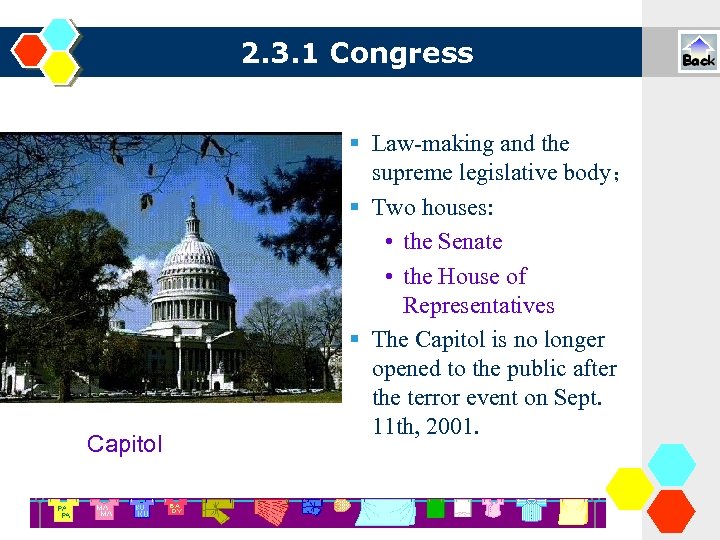 2. 3. 1 Congress Capitol Law-making and the supreme legislative body; Two houses: • the Senate • the House of Representatives The Capitol is no longer opened to the public after the terror event on Sept. 11 th, 2001.
 2. 3. 2 The Senate 100 voting members, two from each state; They may be reelected for an unlimited number of six-year terms, chosen by a direct election; Qualifications for being a senator: over 30 years old; a US citizen for at least 9 years; resident in the state from which he is elected.
 2. 3. 3 The House of Representatives 435 voting members plus a non-voting representative from Puerto Rico, Guma and the District of Columbia; State legislature divides each state into congressional districts, each district electing one Representative; Qualifications for being a representative: at least 25 years old; a US citizen for no less than 7 years; serve for a term of two years.
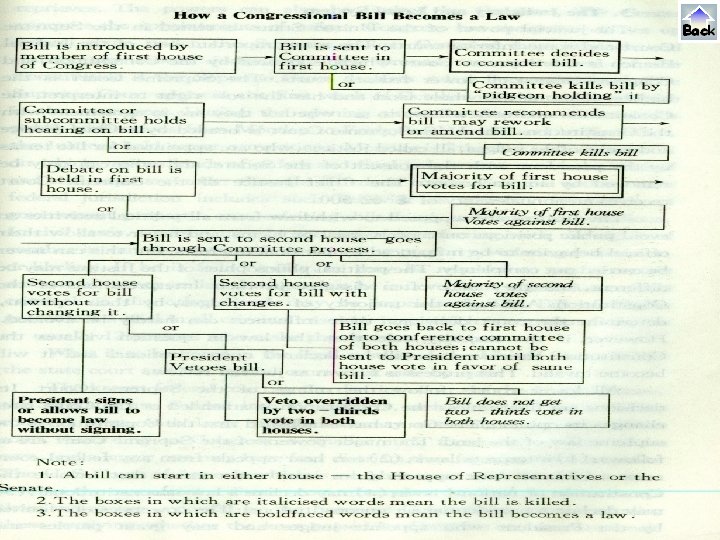
 2. 3. 4 The Function of Congress—passing laws for the Union; Either house may introduce legislation on any subject except the revenue bills which must originate in the House of Representatives.
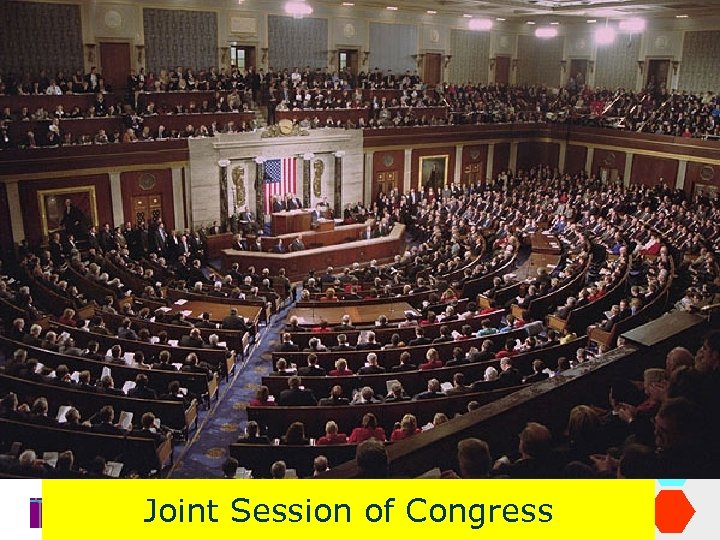 Joint Session of Congress
 www. themegallery. com
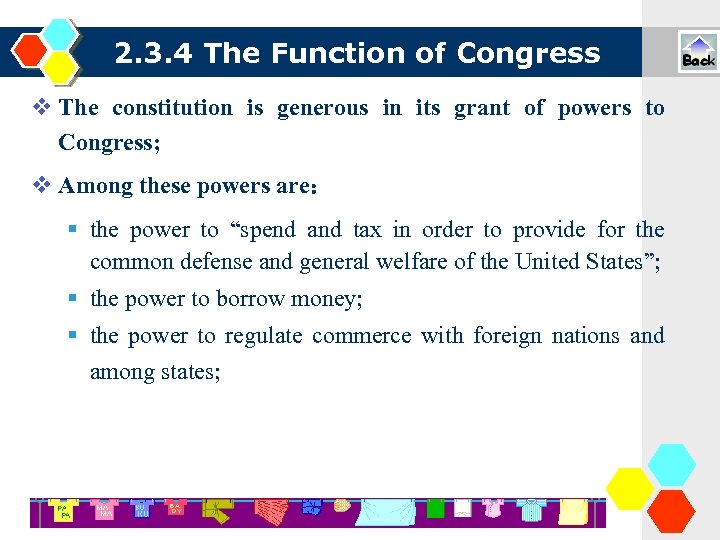 2. 3. 4 The Function of Congress The constitution is generous in its grant of powers to Congress; Among these powers are: the power to “spend and tax in order to provide for the common defense and general welfare of the United States”; the power to borrow money; the power to regulate commerce with foreign nations and among states;
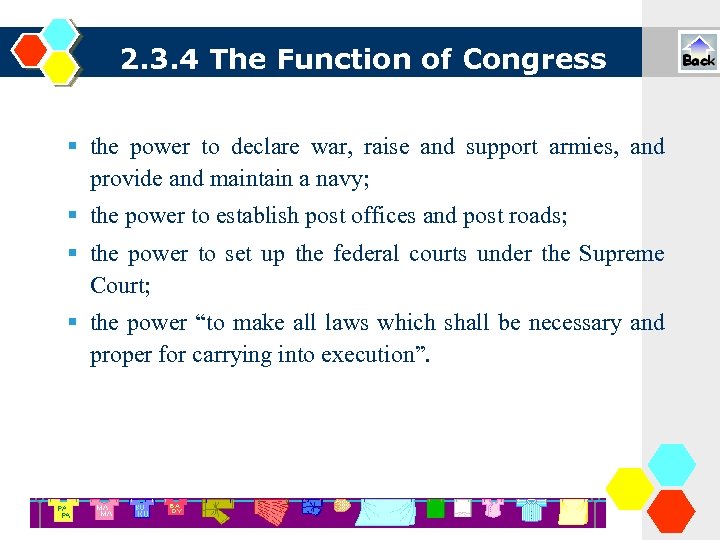 2. 3. 4 The Function of Congress the power to declare war, raise and support armies, and provide and maintain a navy; the power to establish post offices and post roads; the power to set up the federal courts under the Supreme Court; the power “to make all laws which shall be necessary and proper for carrying into execution”.
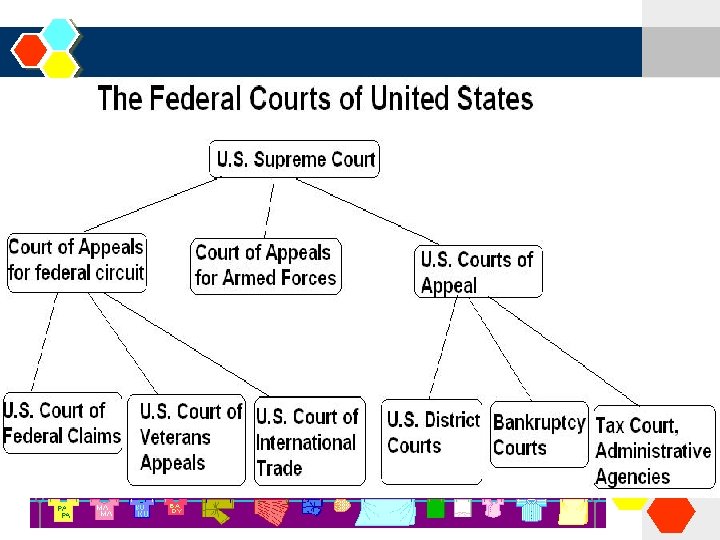
 2. 4 The Judicial Branch The judicial branch consists of a series of courts: the Supreme Court the courts of appeals— 12 the district courts— 94 The Supreme Court—highest court; One Chief Justice and eight Associate Justices; decisions are made by the majority. appointed by the President with the Senate’s approval; only removed from office by Congress through difficult impeachment.
 Jury System In most criminal justice systems and some civil cases, panels are initially selected at random from the adult population of the district. A person who is serving on (is a member of) a jury is known as a juror. The number of jurors is usually twelve, though smaller cases may require only six. Some alternate jurors are nominated to follow the trial when jurors do not complete the trial for health or other reasons (but they do not take part in deciding the verdict).
 Jury System The role of the jury is the “finder of fact”, while the Judge has the sole responsibility of interpreting the appropriate law and instructing the jury accordingly. Occasionally, a jury may find the defendant "not guilty" even though he violated the law if the jury thinks that the law is invalid or unjust.
 3. Political Parties What are the differences between the two major parties? What are the functions of the major parties when the general election comes? How the president is voted in the US? What is the “winner-take-all” system?
 3. Political Parties 3. 1 Symbols of the parties 3. 2 The Democratic Party 3. 3 The Republican Party 3. 4 Function of Parties
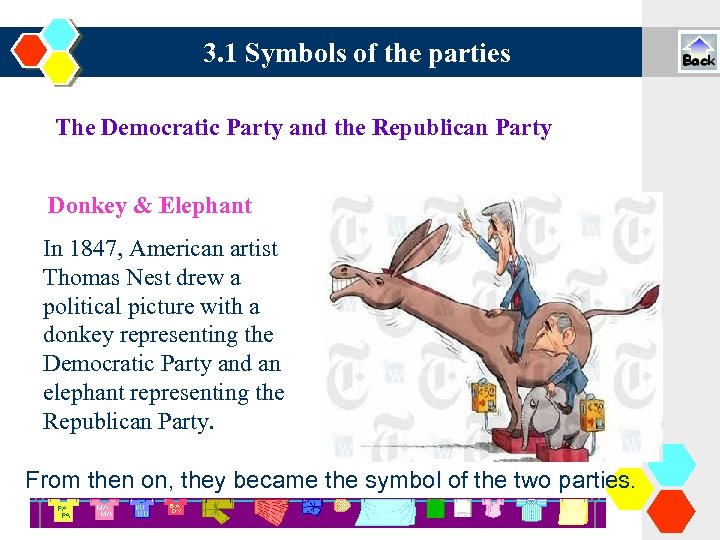 3. 1 Symbols of the parties The Democratic Party and the Republican Party Donkey & Elephant In 1847, American artist Thomas Nest drew a political picture with a donkey representing the Democratic Party and an elephant representing the Republican Party. From then on, they became the symbol of the two parties.
 3. 2 The Democratic Party—liberal; Government—playing an important role in the economy and emphasizing full employment; Favor civil rights laws, a strong social security system and less restrictive abortion laws, etc. ; More disposed to search out a method of living with Russia and China and to look for reduction in arms spending.
 3. 3 The Republican Party—conservative; Favor an economic system—giving enterprises a greater freedom and demand the government to control inflation; Stress the need for law and order; Oppose complete governmental social programs and free choice of abortion; Favor a strong military posture and assertive stands in international relations.
 3. 4 Function of Parties To nominate candidates for office and help them in their election campaigns. find the most suitable candidates; help candidates to collect the money needed, mobilize the party activists or hire people to help them with the propaganda; urge the public to vote for them and undermine the rivals by exposing their personal flaws or attacking their policies.
 4. Election There are many kinds of elections in the United States. When an American votes in November in the presidential election each leap year, he is voting in several other elections as well; He also votes for a Representative or a Senator; At regular intervals he votes to choose the governor of his state, the mayor of his city and the holders of several local public offices.
 Presidential Election Only the candidates nominated by the two major parties have the chance to win a Presidential election; The election process is complex; The Presidential election (four stages): The first stage: the major parties hold conventions to choose candidates for President and Vice-President and to determine the party's platform. Listen to the audio: American youth supports Democratic Party
 Presidential Election The second stage is the campaigning stage. • By early fall the presidential race is on. From that time until the election day, voters are bombarded from all sides—by radio, television, newspapers, and personal communications with political material. • There are whistle stop tours by train, by plane, and by car. The candidate delivers countless speeches and shakes countless hands. This is a very important stage in the general election.
 Presidential Election The third stage is the time for voters to choose the list of presidential electors for the state. • The number of electors of each state is equal to that of its senators and representatives in Congress. • There altogether 538 presidential electors, 535 from the states and 3 from the District of Columbia (without seats in Congress).
 Presidential Election All the candidates of Presidential electors are party nominees. People will vote their party candidate for the presidency. As a result, a voter is actually choosing a President when he casts his vote for an elector. “Winner-take-all” principle If the candidates of a party for “electors” in a given state receive a majority of the total vote, then the party is entitled to have all the electoral votes for that state.
 Presidential Election When the presidential electors are chosen out in the presidential election year, people have already known who is going to be the US president in the next four years. Although the result is already known, the electors still meet in their state capitals and cast their votes for President and vice-President on the first Monday after the second Wednesday in December. That is the fourth stage.
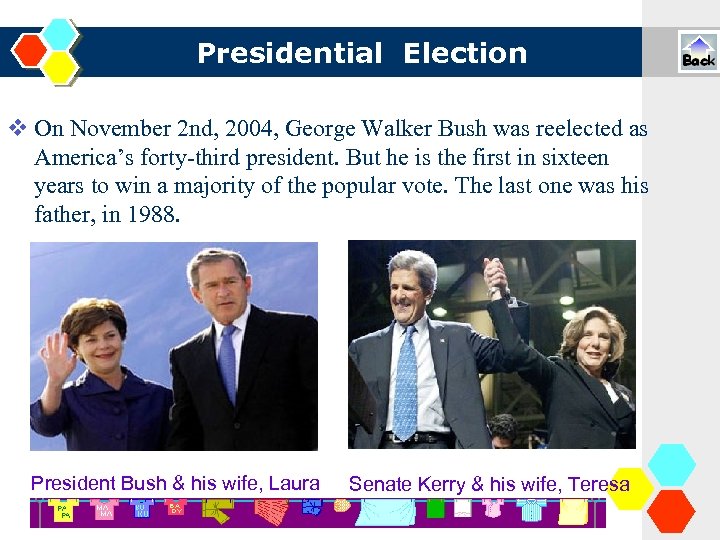 Presidential Election On November 2 nd, 2004, George Walker Bush was reelected as America’s forty-third president. But he is the first in sixteen years to win a majority of the popular vote. The last one was his father, in 1988. President Bush & his wife, Laura Senate Kerry & his wife, Teresa
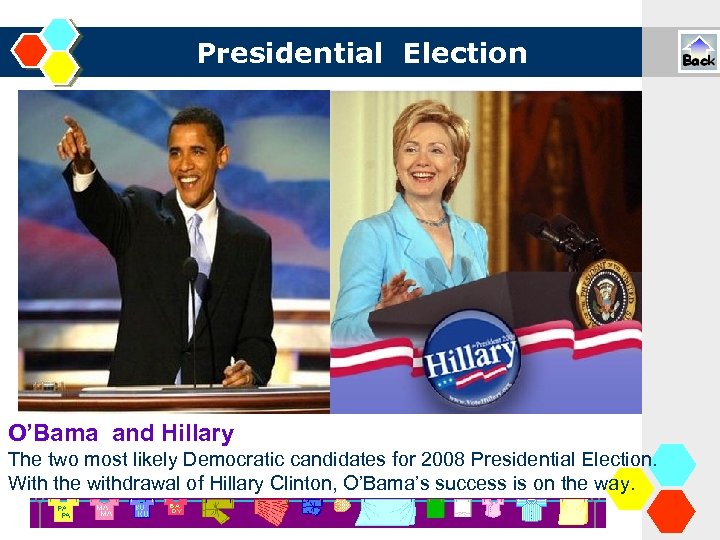 Presidential Election O’Bama and Hillary The two most likely Democratic candidates for 2008 Presidential Election. With the withdrawal of Hillary Clinton, O’Bama’s success is on the way.
 5. Foreign policy 5. 1 Neutrality 5. 2 Containment and Intervention
 5. 1 Neutrality “Declaration of Neutrality”; America entered the war—German government resumed unrestricted submarine warfare in 1917; Wilson submitted Fourteen Points in 1918;
 5. 1 Neutrality Ø Fourteen Points abandonment of secret international agreements; freedom of the seas; free trade between nations; reductions in national armaments (军备、武器); adjustment of colonial claims in the interests of the inhabitants affected; self-rule for subjugated (使屈服、征服) European nationalities; the establishment of an association of nations to afford “mutual guarantees to great and small states alike”.
 5. 1 Neutrality With the outbreak of World War II, isolationist sentiment increased; Neutrality legislation—prevent the involvement of the war; prohibited trade in arms with any warring nations; required cash for all other commodities; forbade American merchant ships from carrying those goods.
 5. 1 Neutrality Japanese attack at Pearl Harbor on December 7, 1941; America declared war with the Axis powers—Germany, Italy and Japan. The nation rapidly readied itself for mobilization of its people and its entire industrial capacity; Wartime objectives—total destruction of the Axis powers and the establishment of a world order.
 5. 2 Containment and Intervention The US dominated global affairs after World War II; “American Century”: confident of its mission at home and abroad; to maintain the democratic structure and to share the benefits of prosperity. Containment—postwar policy affirmed by President Truman: Communism was a threat to the United States; His statements inspired a wave of hysterical anti. Communism throughout the country.
 Cold War Cold War—waged by Eisenhower placed new emphasis on nuclear strength to prevent the outbreak of war; authorized the CIA to undertake covert actions to overthrow unfriendly governments or protect reliable anti-Communist leaders whose power was threatened; the CIA helped topple the governments of Iran in 1953 and Guatemala (危地马拉) in 1954; Eisenhower helped to create a non-Communist government in South Vietnam.
 Historic Step Nixon administration’s historic step—closer ties with Communist countries: New relationship with China—the most dramatic move; Nixon— first US President to visit Beijing; The “Shanghai Communiqué”: • There was one China,Taiwan was part of China; • A peaceful settlement of the dispute by the Chinese themselves was American interest.
 US Domination Berlin Wall fell in 1989, former Soviet Union broke up in 1991; The US remained the most powerful country; Europe, Russia and probably China can attain comparable status in the future international affairs.