


 Скачать презентацию The United States Constitution Introduction to the
bd40b109dd3f32a8ea87e32868105a82.ppt
- Количество слайдов: 107
 The United States Constitution
 Introduction to the U. S. Constitution
 Article I---Legislative Branch • Legislative Branch = Congress 1. Bicameral Legislature---Two houses, a Senate and House of Representatives. • The structure of Congress is based on British Parliament. REMEMBER: • The House of Burgesses and colonial assemblies were similar in form. • The Great Compromise of the Virginia and New Jersey plans followed a similar design.
 2. Clause Two---What are the Qualifications for a member of the U. S. House of Representatives? • 25 years old • 7 year citizen of the United States • Resident of the state one is elected in. EXTRA Ø A Representative serves a two year term ØNumber of terms are not limited (no term limits)
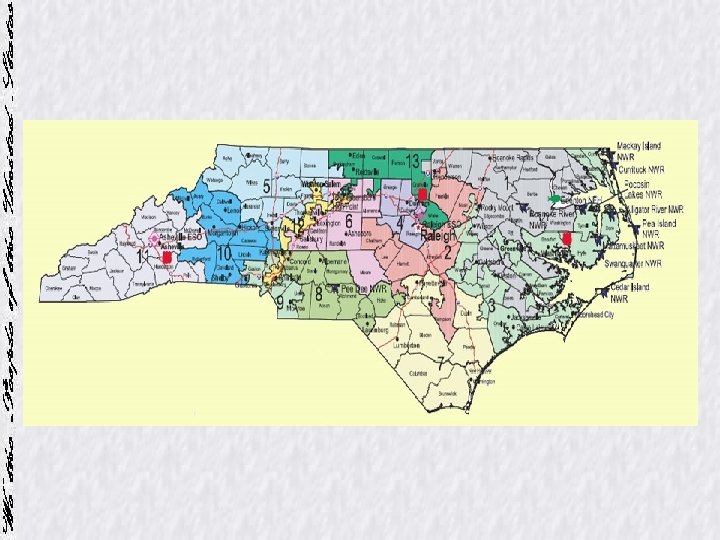
 3. Clause Three– How is the number of Representatives determined that each state will receive? (based on population) Population is determined by the Census! Ø Census - an official count of a population carried out every ten years to determine how many representatives each state will have in the U. S. House. Why does California have more members in the House of Representatives than North Carolina? What if half of North Carolina’s population moved to Minnesota? New districts would need to be created. ØReapportionment---Creating new districts every ten years to adjust for population changes
 Reapportionment---How it Works 1. Take a census every ten years 2. Congress totals the number of Reps. each state will get (that total must equal 435) 3. Congress will notify the state legislatures of any changes 4. State legislatures will determine new district boundaries 5. New districts will allow for new elections for the House of Reps 6. - ALSO known as REDISTRICTING! How many people per Representative? About 650, 000
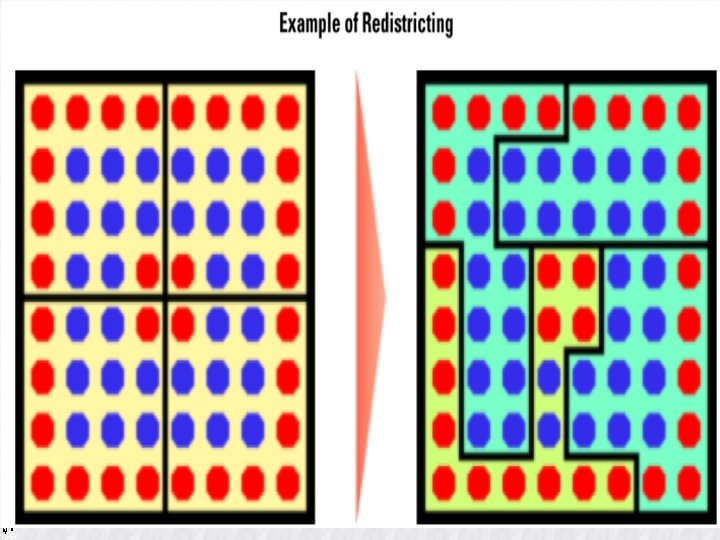
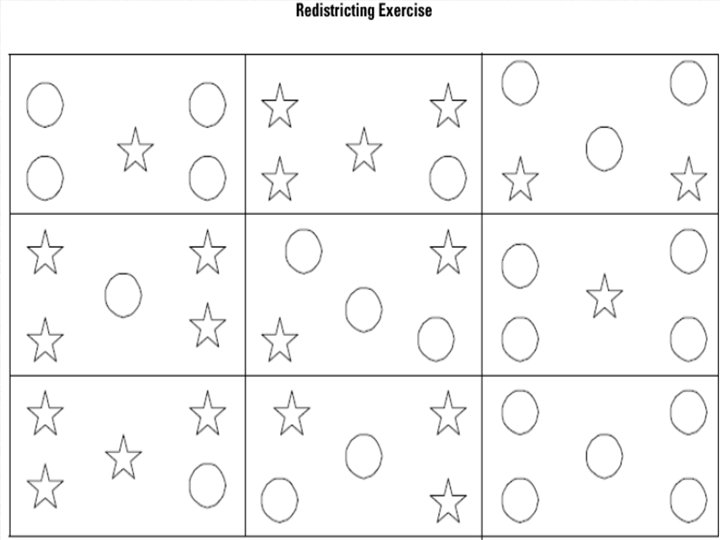
 Gerrymandering--Redrawing district lines to favor a political party Ø Each district has to have about the same number of people. Each Rep. represents a District, not the State. ØHOWEVER – Each state is promised at least 1 Representative regardless of size. Ø Seven states with one U. S. Representative: (North Dakota, Montana, Wyoming, Vermont, Alaska, Delaware, South Dakota)
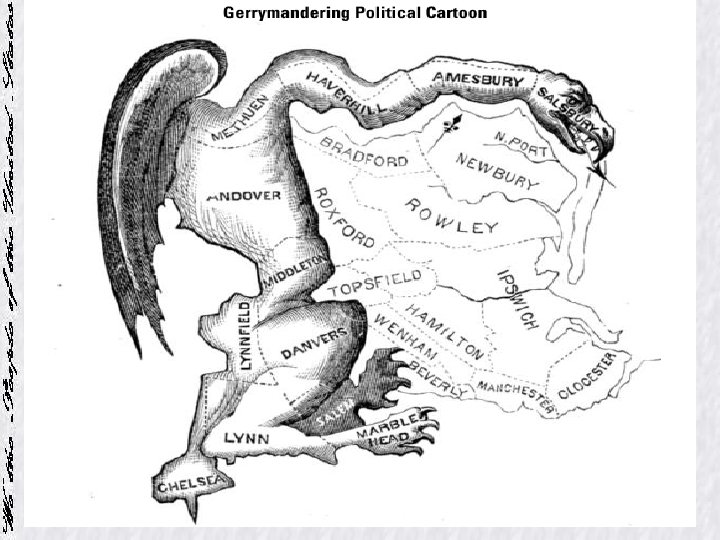
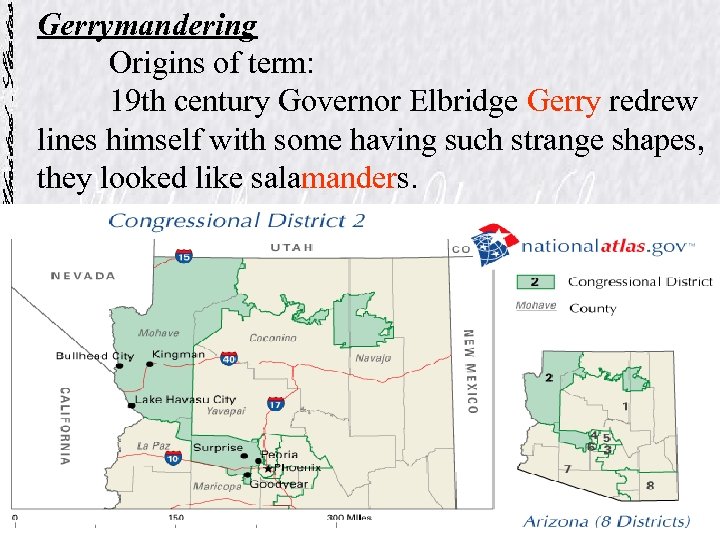 Gerrymandering Origins of term: 19 th century Governor Elbridge Gerry redrew lines himself with some having such strange shapes, they looked like salamanders.
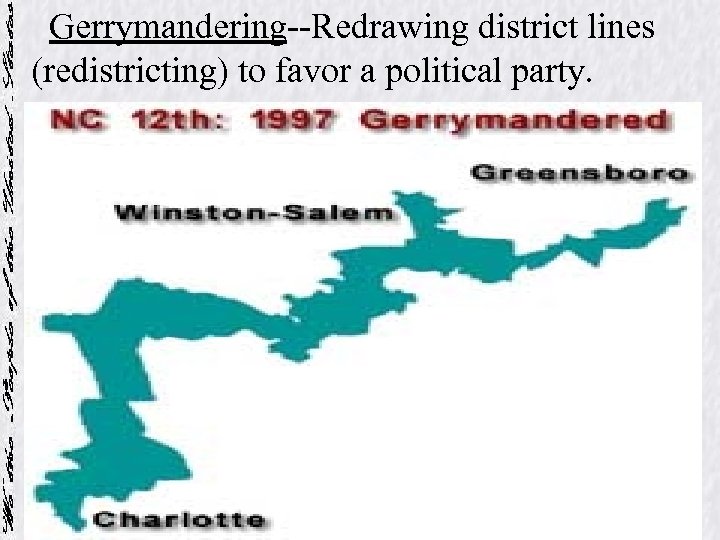 Gerrymandering--Redrawing district lines (redistricting) to favor a political party.
 4. Clause Four-- What happens if a Representative dies in office or cannot serve? • Vacancies – to fill a vacancy the state issue writs of election (new election is held) Usually a governor will issue an election to fill the vacancy
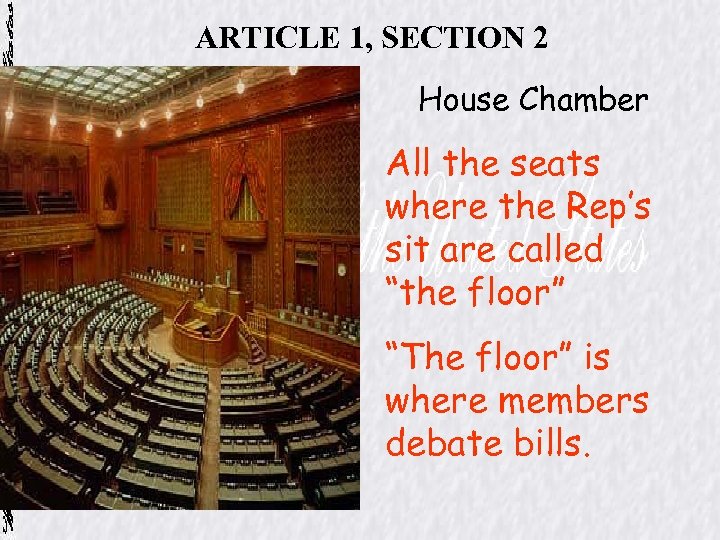 ARTICLE 1, SECTION 2 House Chamber All the seats where the Rep’s sit are called “the floor” “The floor” is where members debate bills.
 5. Clause Five---Where does the impeachment process start? Ø The House of Reps. will start the impeachment process. Impeachment means to bring charges against! It does not remove a person from office. It is an indictment. Ø Andrew Johnson---First U. S. President to be impeached, but fell one vote shy of the Senate’s conviction Ø Richard Nixon---Resigned before official impeachment could take place Ø Bill Clinton---Impeachment articles were passed by the U. S. House of Reps, but the Senate found him NOT guilty of those articles
 House Officers - 110 th Congress ØSpeaker of the House (John Boehner) - second (after the vice president) in the line to succeed a president who resigns, dies in office, or is impeached. Most powerful position in the House: Ø A. Controls the debate on the floor Ø B. Helps make committee assignments; Ø C. Helps appoint the party leadership (leader, whip) Ø D. Decides order in which bills are debated and go to which committees. ØMajority Leader (Eric Cantor) – Assists the speaker – organizes votes on party legislation. ØMajority Whip (Kevin Mc. Carthy) –Get votes on critical bills ØMinority Leader (Nancy Pelosi) - Serves as a watchdog over the majority party. ØMinority Whip (Steny Hoyer)—Get votes on critical bills
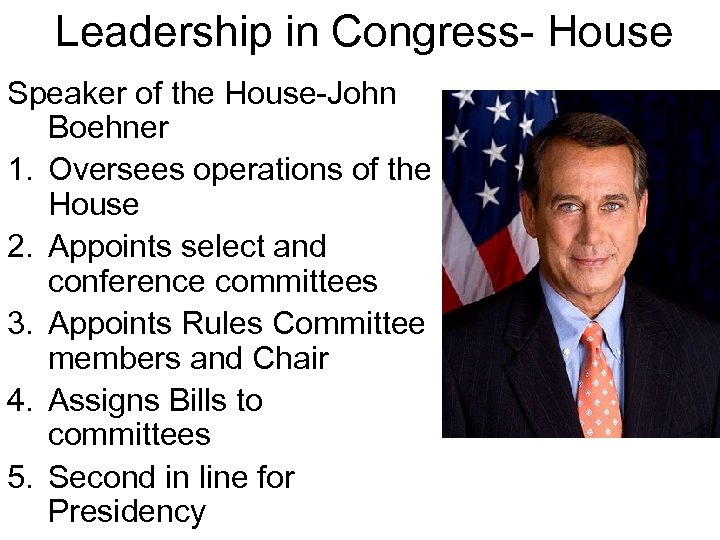 Leadership in Congress- House Speaker of the House-John Boehner 1. Oversees operations of the House 2. Appoints select and conference committees 3. Appoints Rules Committee members and Chair 4. Assigns Bills to committees 5. Second in line for Presidency
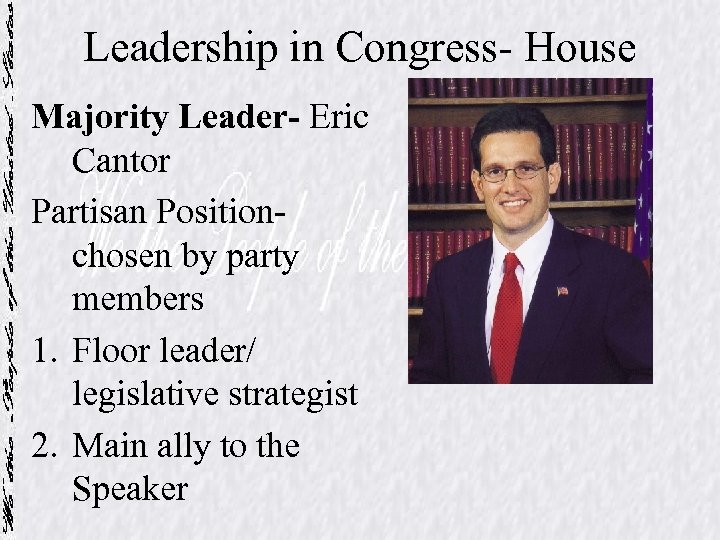 Leadership in Congress- House Majority Leader- Eric Cantor Partisan Positionchosen by party members 1. Floor leader/ legislative strategist 2. Main ally to the Speaker
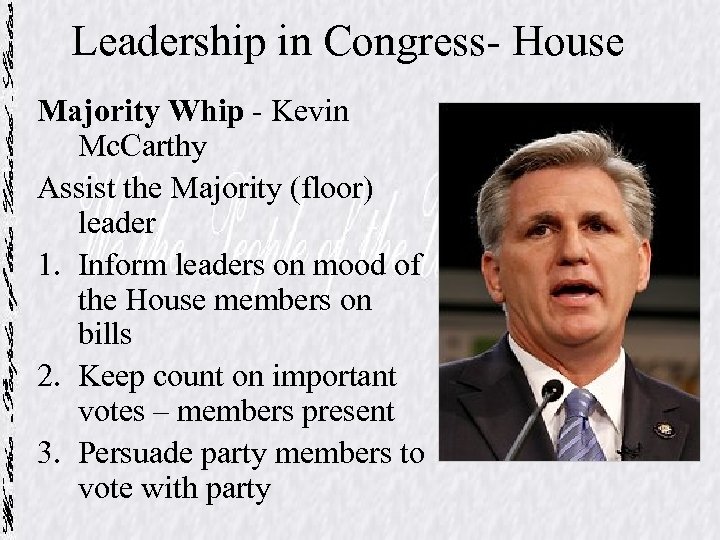 Leadership in Congress- House Majority Whip - Kevin Mc. Carthy Assist the Majority (floor) leader 1. Inform leaders on mood of the House members on bills 2. Keep count on important votes – members present 3. Persuade party members to vote with party
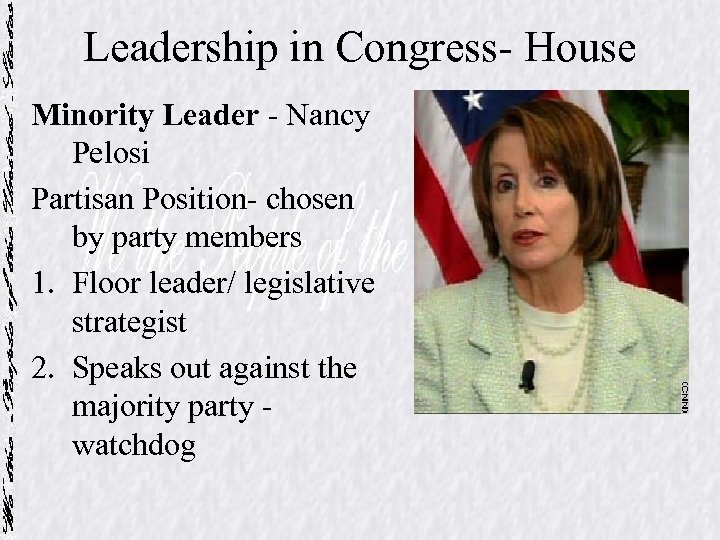 Leadership in Congress- House Minority Leader - Nancy Pelosi Partisan Position- chosen by party members 1. Floor leader/ legislative strategist 2. Speaks out against the majority party watchdog
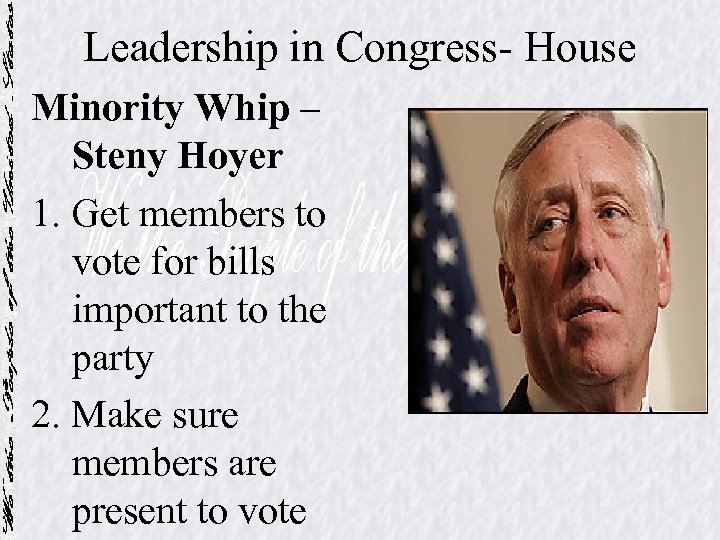 Leadership in Congress- House Minority Whip – Steny Hoyer 1. Get members to vote for bills important to the party 2. Make sure members are present to vote
 House of Representatives • Special Powers of the House of Representatives – All money (appropriations) bills start here – Create taxes – Select the President in an Electoral College tie – Write the article of impeachment against high ranking officials
 Section Three---The Senate 1. Clause One - Qualifications – 30 years old – 9 year citizen of the United States – Resident of the state one is elected in. EXTRA - • Senators term is 6 years • Terms are unlimited (no term limits) • 2 Senators per state (all states get the same amount – NJ Plan) • 2 x 50 = 100 Senators (today)
 2. Clause Two--Is it possible for both Senators from one state to be up for re-election at the same time? (No) All of the members from the first Senate did not get a 6 year term. The Framers wanted the Senate to have experienced members so they created a staggered election. Ø First class = 2 year term Ø Second class = 4 year term Ø Third class = 6 year term Ø Never will the Senators term from one state be up for reelection at the same time Ø Never will all Senators be up for reelection at same time. Ø 1/3 of the Senate runs for election or reelection at one time
 Senate Leadership Ø The Vice-President (Joe Biden) of the U. S. is the President of the Senate – Oversees daily operations - Very little power Ø As President of the Senate - VP only votes if there is a tie. VP – position has become more powerful over the last twenty years. Only reason for accepting position is you are one heartbeat from becoming President.
 5. Clause Five -Officers of the Senate Ø President of the Pro Tempore (Daniel Inouye) presides temporarily when vice-president is not available (very little power) Ø Majority Leader (Harry Reid) - controls the agenda of the majority party (Most powerful position in the Senate) Ø Majority Whip (Richard Durbin) - helps the majority leader Ø Minority Leader (Mitch Mc. Connell) - A watchdog function over the majority party Ø Minority Whip (Jon Kyl) - helps the minority leader
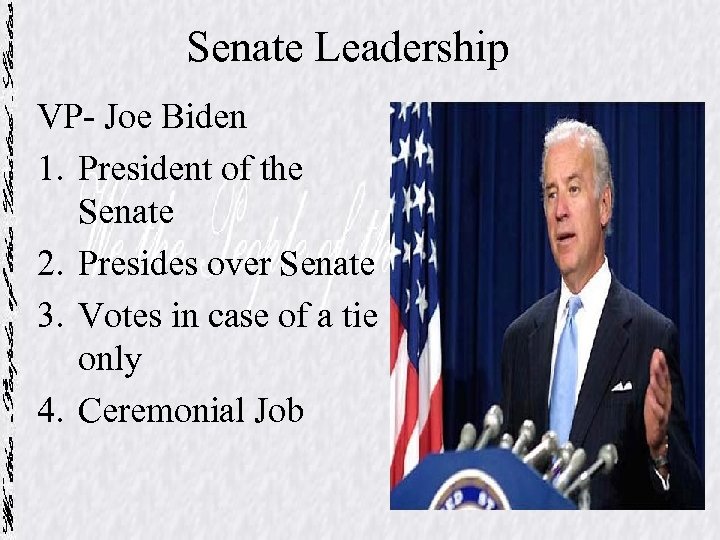 Senate Leadership VP- Joe Biden 1. President of the Senate 2. Presides over Senate 3. Votes in case of a tie only 4. Ceremonial Job
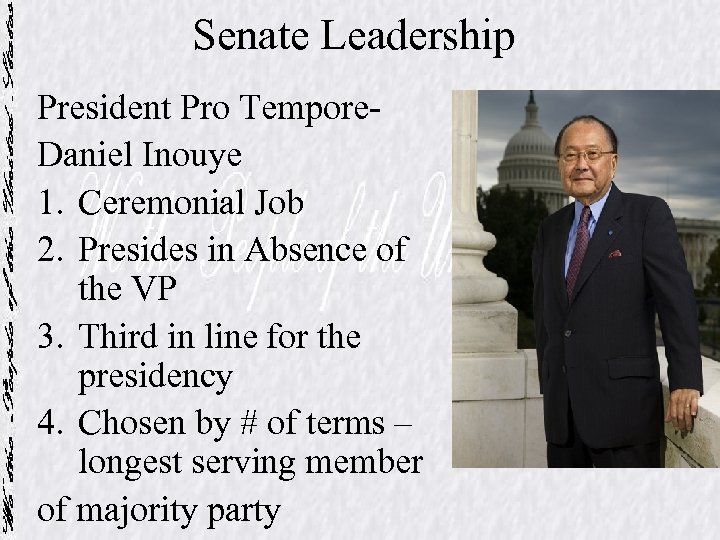 Senate Leadership President Pro Tempore. Daniel Inouye 1. Ceremonial Job 2. Presides in Absence of the VP 3. Third in line for the presidency 4. Chosen by # of terms – longest serving member of majority party
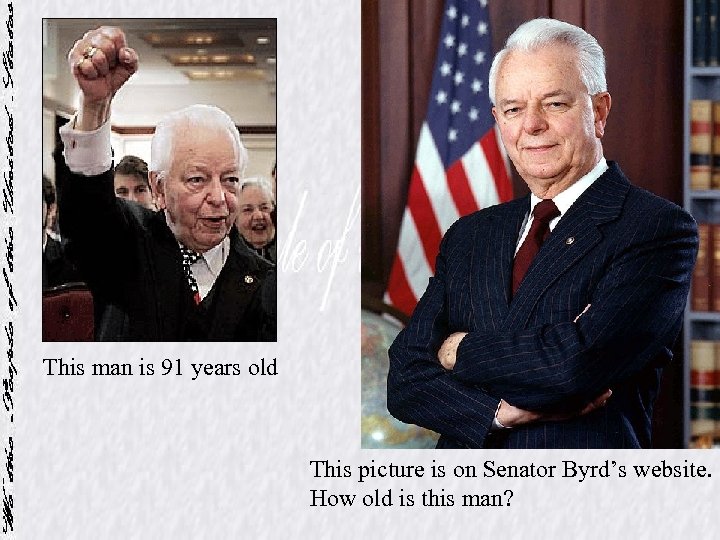 This man is 91 years old This picture is on Senator Byrd’s website. How old is this man?
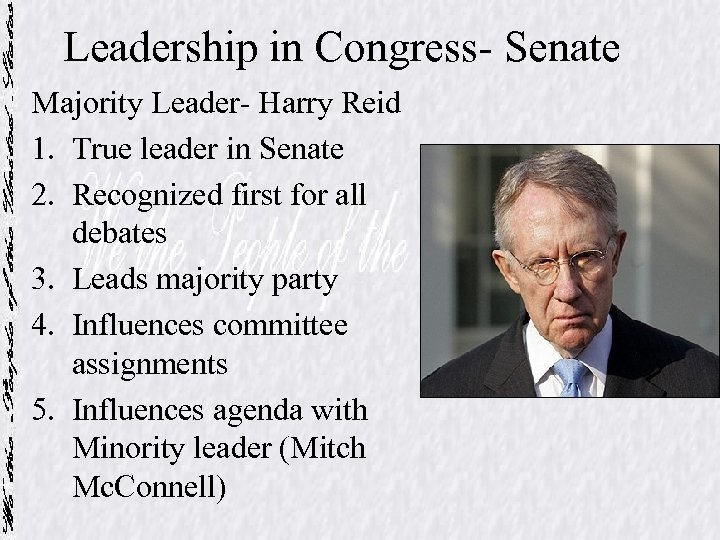 Leadership in Congress- Senate Majority Leader- Harry Reid 1. True leader in Senate 2. Recognized first for all debates 3. Leads majority party 4. Influences committee assignments 5. Influences agenda with Minority leader (Mitch Mc. Connell)
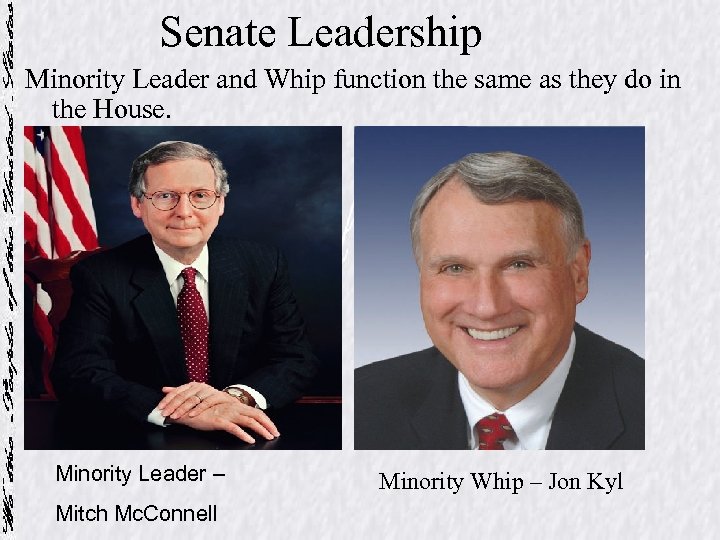 Senate Leadership Minority Leader and Whip function the same as they do in the House. Minority Leader – Mitch Mc. Connell Minority Whip – Jon Kyl
 Senate Special Powers – Approves all treaties – Approves all appointments – Chooses the Vice President in an Electoral College tie – Acts as the jury in all trials of impeachment
 Filibuster—Delaying a vote on a bill through the use of discussion. “talking a bill to death. ” ONLY the Senate has Filibusters. Commonly used by the minority party Strom Thurmond—longest filibuster, 24 hours 18 minutes Cloture rule—ends a filibuster if 60 Senators agree to vote for the closing of debate
 6. Trial of Impeachments - the Senate serves as the Jury in impeachment proceedings Ø House of Reps. introduces the Articles of Impeachment Ø Senate tries impeachments (acts as a jury) Ø House needs a majority (218) vote to bring charges Ø Senate needs 2/3 s majority (67) to convict
 7. Clause Seven—What happens if someone is impeached? Ø A guilty conviction on the Articles of Impeachment is removal from office Ø A U. S. President cannot be pardoned if found guilty by 2/3 s of the Senate (part of the checks and balance system)
 Section Five—Rules of Procedures 1. Clause One - Can an elected official be punished BUT not removed from office? Censure. 2. Censure - official expression of disapproval. Take away some of their power or seniority like committee assignment or leadership position BUT… 3. Expulsion: members with gross misconduct may be thrown out of office for violating rules. 4. Each house shall determine their own elections & qualifications. Ex. Brigham Roberts— 1901, polygamist from Utah, The Senate refused to seat him
 The seniority system - the practice of granting privileges to members of Congress who have served the longest. Committee chairmanships, the most powerful position on a committee are usually based on seniority. Privileges: • choice of office location in the Capitol • choice of committee assignments, - Seniority is more important in the Senate than in the House of Representatives. While leadership positions are elected positions – ex. Speaker, Majority Leader and Minority Leader in the Senate – Seniority will usually determine who is elected!!
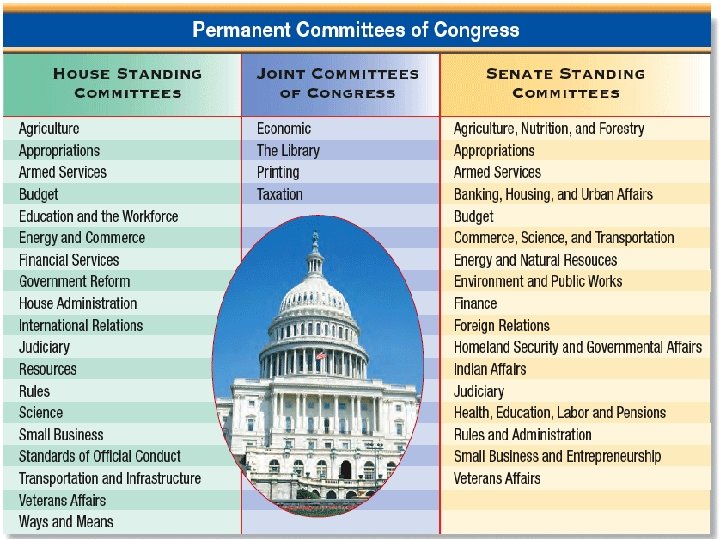
 The Committee System • Most work of Congress takes place in the committees • There are (at least) 35 standing committees and more subcommittees • Each is headed by a committee chair • Chairs are chosen by the majority party and have the most seniority • These members use earmarks to fund special projects.
 Congressional Earmarks Should We Bring Home the Bacon?
 Who Likes Bacon? « Who likes bacon? « Is bacon always good for you? « What are some alternatives for bacon? « What would happen if you ate bacon all day, everyday? « What recommendations would you make to people who are considering adding bacon to their diets?
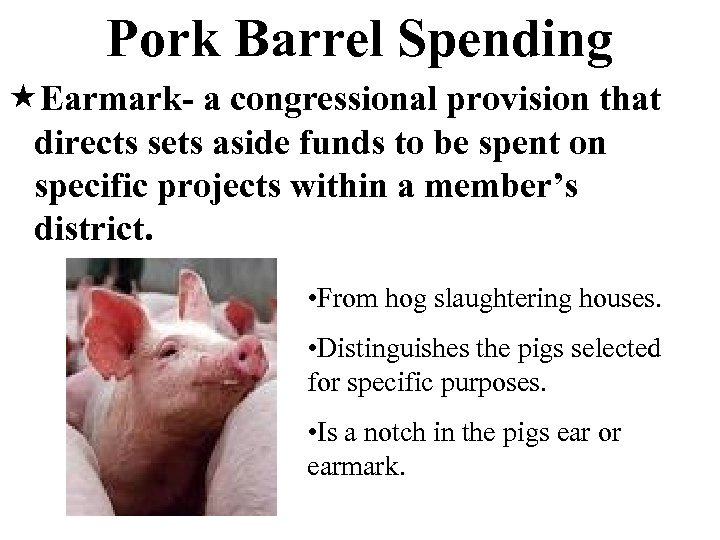 Pork Barrel Spending «Earmark- a congressional provision that directs sets aside funds to be spent on specific projects within a member’s district. • From hog slaughtering houses. • Distinguishes the pigs selected for specific purposes. • Is a notch in the pigs ear or earmark.
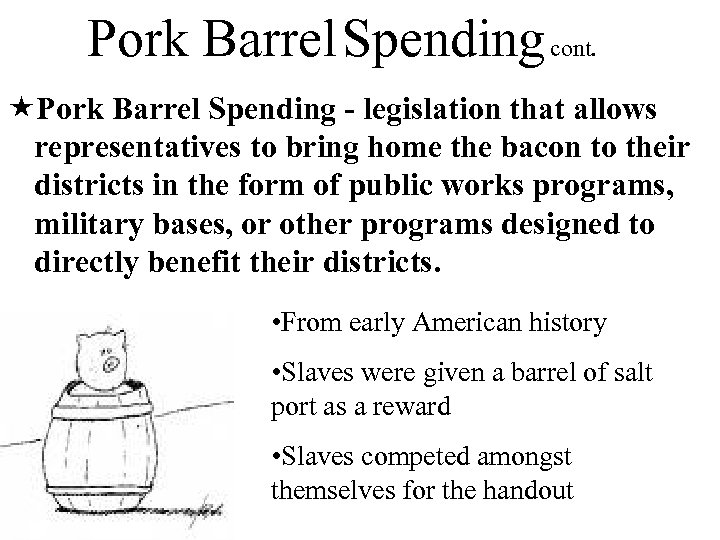 Pork Barrel Spending cont. «Pork Barrel Spending - legislation that allows representatives to bring home the bacon to their districts in the form of public works programs, military bases, or other programs designed to directly benefit their districts. • From early American history • Slaves were given a barrel of salt port as a reward • Slaves competed amongst themselves for the handout
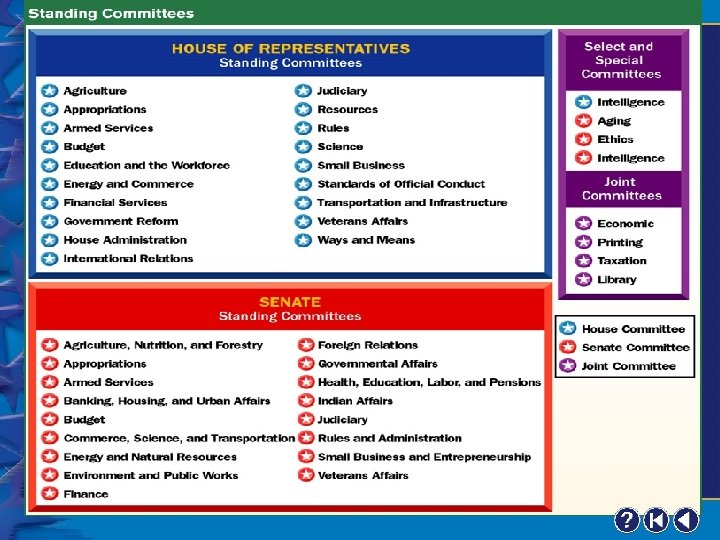
 Standing Committees • the most important. + Permanent: exist from session to session + Receive all legislation (bills) + Responsible for specific subject matter Ex: specializing in agriculture, commerce, foreign policy, budget
 Oversight +They have legislative, investigative, and oversight powers (the responsibility of supervising something) • Oversight is the effort by Congress, through hearings, investigations, and other techniques, to exercise control over the activities of the executive agencies. Hearings - a session held by a committee whereby witnesses are questioned and heard. The information is gathered to inform the committee what decisions should be made.
 Types of Committees • Subcommittees: help ease workload of the committee b/c of large # of bills, a lot of power • Handle particular areas. part of standing • Ex: Under Ways & Means- Health, Human Resources, Social Security, Trade http: //www. contactingthecongress. org/cgibin/committee_list. cgi? site=ctc
 Select Committee: temporary comm. to study one specific issue & report findings Tend to look at problems of great concern to public -ex. Watergate Cm, assassination of President Kennedy, Committee on Aging.
 Types of Committees • Joint Committees: composed of members of both houses formed to study particular issues • Ex: Conference Committees: formed temporarily to work out differences in H & S versions of bill • created to reach compromise on legislation passed by both chambers
 Maps/Charts 2
 Why are committees important? • • The real work of Congress is done Most bills are “killed” here – pigeonholed! Getting on right committee is crucial! Ex: to serve constituents, wield power, increase re-election chances • For House: Rules, Ways and Means • For Senate: Finance, Appropriations, Judiciary
 What is the Problem with the Committee System? • Is it an Oligarchy or Democracy? • 1995: House Republicans gave committee chairs more power and more control over legislation (oligarchic) • Actually less democratic.
 Caucus in Congress • Caucuses are groups of senators or representatives who share certain opinions, interests or social characteristics. Examples +Democratic Caucus +Black Caucus +Hispanic Caucus +Women’s Caucus
 Other Items of Interest – Random Information Quorum – A majority of both houses needed to do business (1 more than half) • 51 Senators • 218 Reps ØCongressional Record —Published daily, includes word for word what people had to say - All meetings must be open to the public and all records about the session are open to the public as well. WHY?
 Ø Session – meeting time to conduct business Ø Adjourn—to stop meeting Ø Special Session— a meeting to deal with an emergency situation.
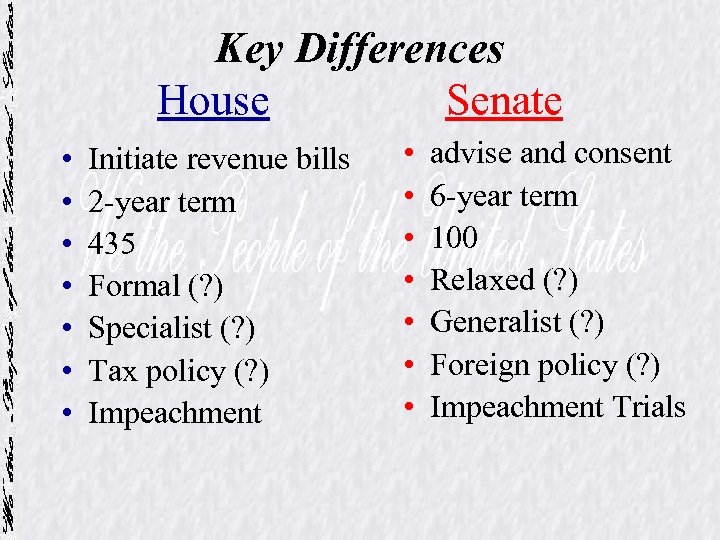 Key Differences House Senate • • Initiate revenue bills 2 -year term 435 Formal (? ) Specialist (? ) Tax policy (? ) Impeachment • • advise and consent 6 -year term 100 Relaxed (? ) Generalist (? ) Foreign policy (? ) Impeachment Trials
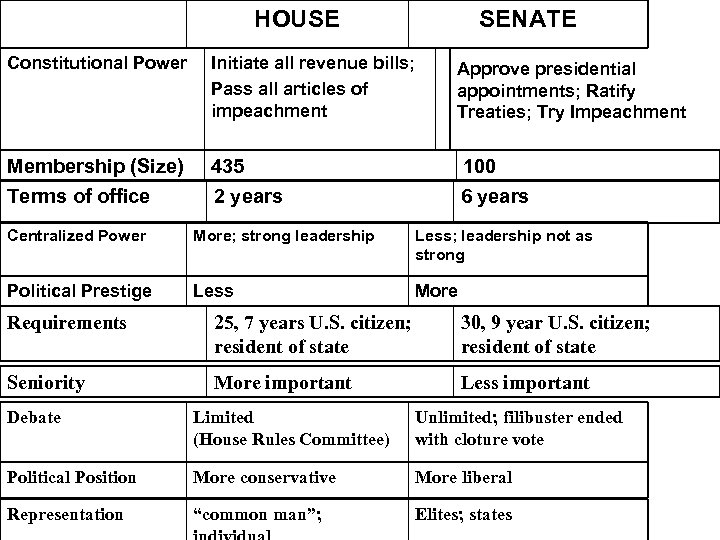 HOUSE SENATE Constitutional Power Initiate all revenue bills; Pass all articles of impeachment Approve presidential appointments; Ratify Treaties; Try Impeachment Membership (Size) Terms of office 435 2 years 100 6 years Centralized Power More; strong leadership Less; leadership not as strong Political Prestige Less More Requirements 25, 7 years U. S. citizen; resident of state 30, 9 year U. S. citizen; resident of state Seniority More important Less important Debate Limited (House Rules Committee) Unlimited; filibuster ended with cloture vote Political Position More conservative More liberal Representation “common man”; Elites; states
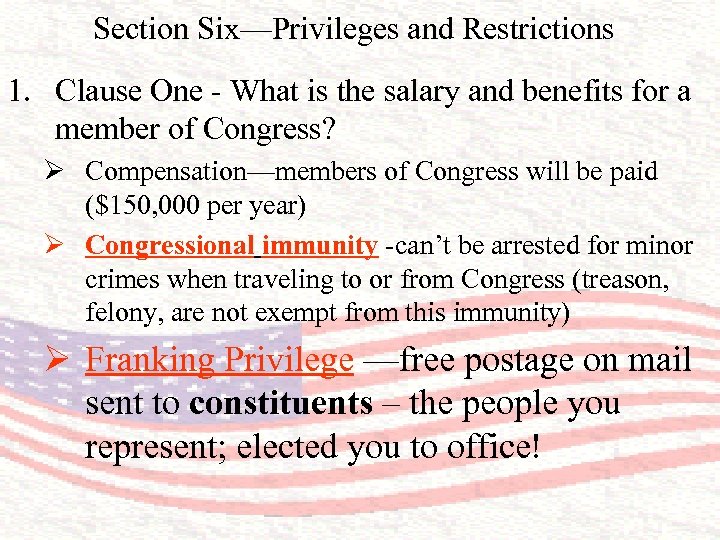 Section Six—Privileges and Restrictions 1. Clause One - What is the salary and benefits for a member of Congress? Ø Compensation—members of Congress will be paid ($150, 000 per year) Ø Congressional immunity -can’t be arrested for minor crimes when traveling to or from Congress (treason, felony, are not exempt from this immunity) Ø Franking Privilege —free postage on mail sent to constituents – the people you represent; elected you to office!
 Other Privileges Ø Free Travel - trips to home state and abroad Ø Free Office in D. C. and their state – Free parking Ø Staff budget - allowance for hiring assistants and office supplies as well as phone calls, faxes Ø Pension for life Ø Some tax breaks – ex. second home Ø 15% of salary for speaking engagements Ø Unlimited income from book royalties ØMedical and dental benefits
 2. Clause Two - Can a member of Congress also be a federal judge? (No) Ø Separation of Powers—can’t hold two offices at once from different branches of government
 Section 7 Method of Passing Bills 1. Clause One - Where do tax bills start? 2. All tax bills start in the House.
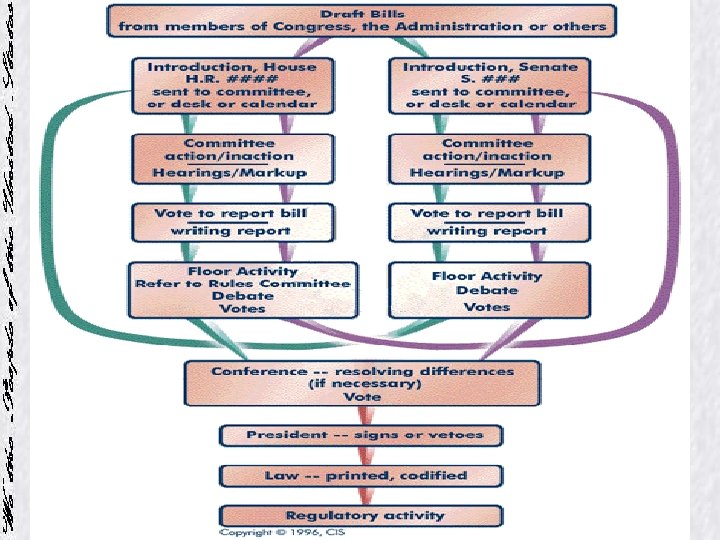
 2. Clause Two - How does a bill become a law? Procedures vary in each house and all bills must go through committee work before they get to the floor. Here is a simple overview: Ø First method—passes one house by majority vote, passes second house by majority vote, goes to president, president signs it into law Ø Second method—passes one house by majority vote, passes second house by majority vote, goes to president, president vetoes, goes back to house it originated in and must pass by 2/3 vote, then goes to next house and must pass by 2/3 vote to become a law Ø Third method-- passes one house by majority vote, passes second house by majority vote, goes to president, president delays action for ten days excluding Sundays, becomes law
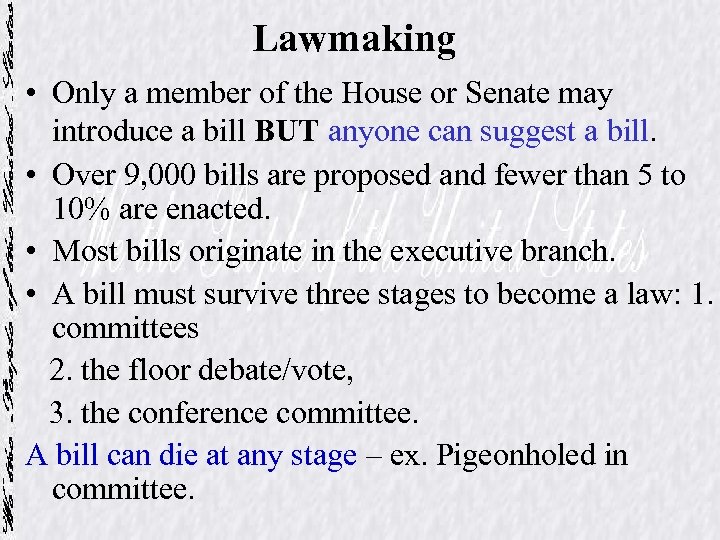 Lawmaking • Only a member of the House or Senate may introduce a bill BUT anyone can suggest a bill. • Over 9, 000 bills are proposed and fewer than 5 to 10% are enacted. • Most bills originate in the executive branch. • A bill must survive three stages to become a law: 1. committees 2. the floor debate/vote, 3. the conference committee. A bill can die at any stage – ex. Pigeonholed in committee.
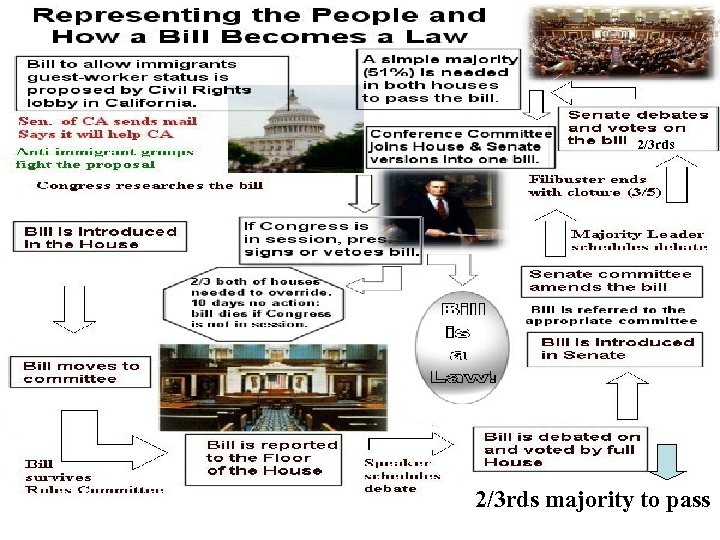 2/3 rds majority to pass
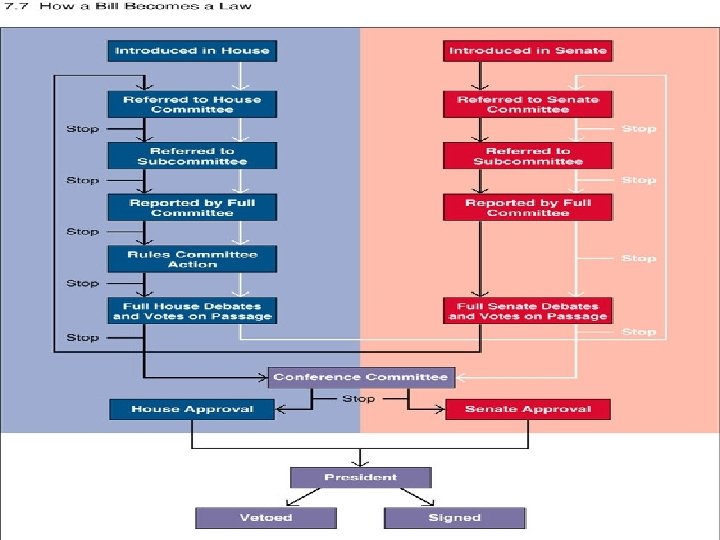
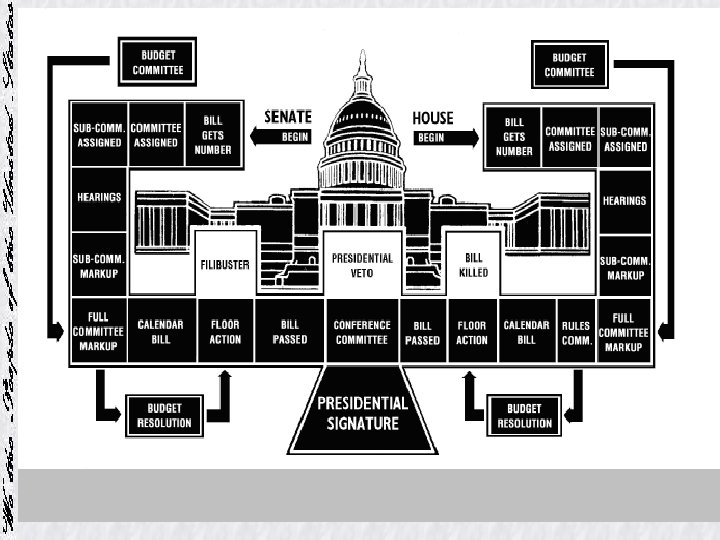
 Presidential Action • The president may: + sign the bill into law; + veto (reject) the bill with a formal veto message BUT Congress may override by twothirds vote of both chambers
 Powers Delegated, Expressed or Enumerated to Congress
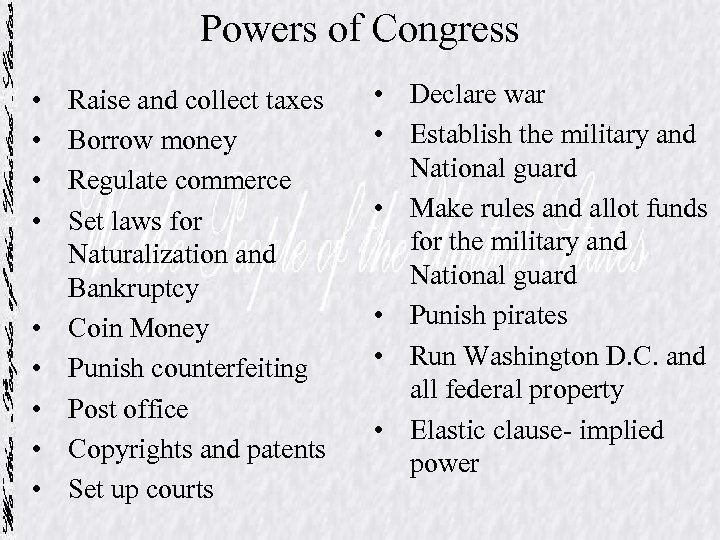 Powers of Congress • • • Raise and collect taxes Borrow money Regulate commerce Set laws for Naturalization and Bankruptcy Coin Money Punish counterfeiting Post office Copyrights and patents Set up courts • Declare war • Establish the military and National guard • Make rules and allot funds for the military and National guard • Punish pirates • Run Washington D. C. and all federal property • Elastic clause- implied power
 2. Clause Two - Can Congress Borrow Money? Ø They can borrow money on the credit of the United States. 3. Clause Three - Can Congress regulate trade? REVIEW Ø Interstate—Trade between two or more states Ø Intrastate—Trade within a state Ø Congress can only regulate interstate trade – Commerce clause!!!!
 5. Clause Five - Can a federal bank make money? (No) Ø Congress will make money Ø Congress will set up our weights and measures Ø 1831—English system (foot-pound-mile) Ø 1866—if states wanted to, they could go on the metric system Ø We are the only large country not on the metric system 6. Clause Six Ø Congress will punish counterfeiters Ø Minting edge - lip on penny and nickel
 7. Clause Seven - Mail Service Ø Federal government will establish a mail service 8. Clause Eight Ø Congress promotes inventions Ø Copyrights—Secures rights of ownership for the life of the owner (publications and literature) Ø Patents—Secures the rights of inventors generally for 20 years
 9. Clause Nine Ø Congress establishes and abolishes courts 10. Clause Ten Ø Congress can punish for crimes committed on the water 11. Clause Eleven Ø Only Congress can declare war—power to many people as opposed to one
 18. Clause Eighteen—Necessary and Proper Clause Ø Congress has the power to establish any rules they deem necessary and proper Ø Elastic Clause—expands the powers of Congress
 Non-legislative Powers • Propose constitutional amendments. • Impeachment. • Role of oversight.
 Powers denied Congress • Congress cannot make laws concerning slave trade after 1808 • Cannot suspend the writ of Habeas Corpusmust show cause for holding a suspect except when in “Cases of Rebellion or Invasion the public Safety may require it. ” • Congress cannot pass an ex post facto law “after the fact” (a new law does not apply to crimes committed before the new law was adopted. )
 Powers denied Congress • No tax on exports • All states must be treated the same • No titles of nobility – Lord, King, Duke: Any gifts from foreign countries must approved by Congress • Congress cannot pass a bill of attainder (legislative act declaring a person guilty of a crime w/o a trial)
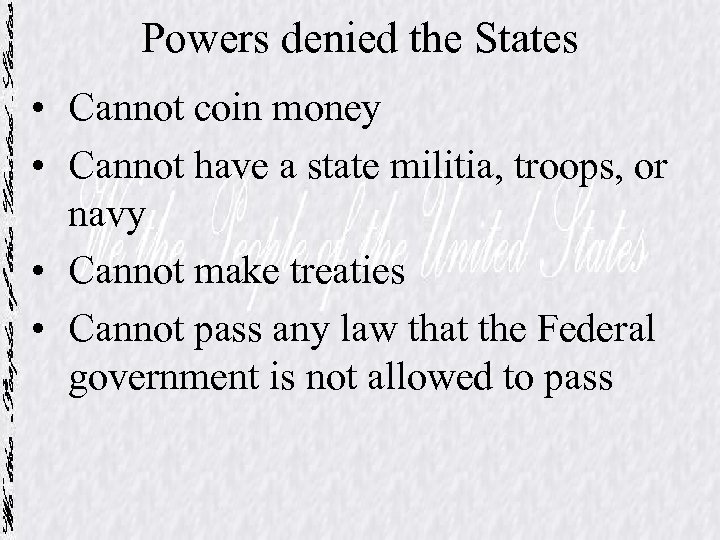 Powers denied the States • Cannot coin money • Cannot have a state militia, troops, or navy • Cannot make treaties • Cannot pass any law that the Federal government is not allowed to pass
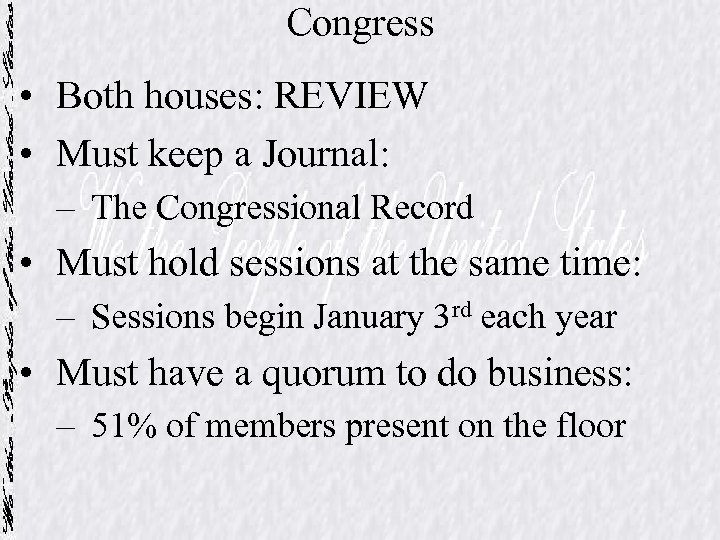 Congress • Both houses: REVIEW • Must keep a Journal: – The Congressional Record • Must hold sessions at the same time: – Sessions begin January 3 rd each year • Must have a quorum to do business: – 51% of members present on the floor
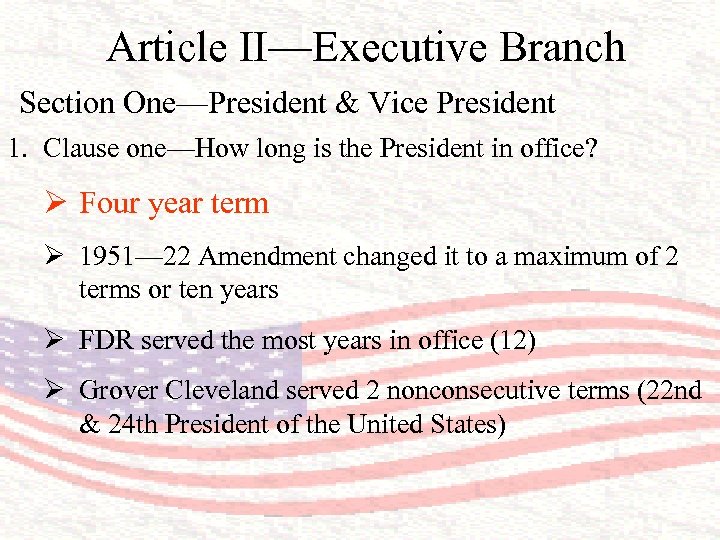 Article II—Executive Branch Section One—President & Vice President 1. Clause one—How long is the President in office? Ø Four year term Ø 1951— 22 Amendment changed it to a maximum of 2 terms or ten years Ø FDR served the most years in office (12) Ø Grover Cleveland served 2 nonconsecutive terms (22 nd & 24 th President of the United States)
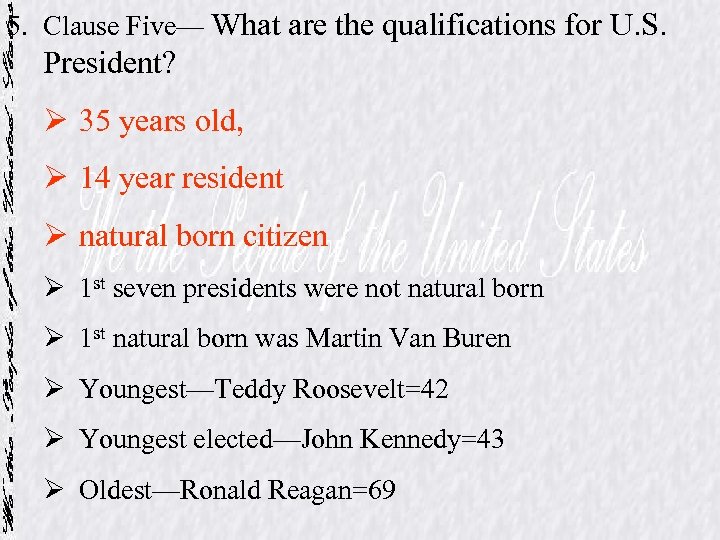 5. Clause Five— What are the qualifications for U. S. President? Ø 35 years old, Ø 14 year resident Ø natural born citizen Ø 1 st seven presidents were not natural born Ø 1 st natural born was Martin Van Buren Ø Youngest—Teddy Roosevelt=42 Ø Youngest elected—John Kennedy=43 Ø Oldest—Ronald Reagan=69
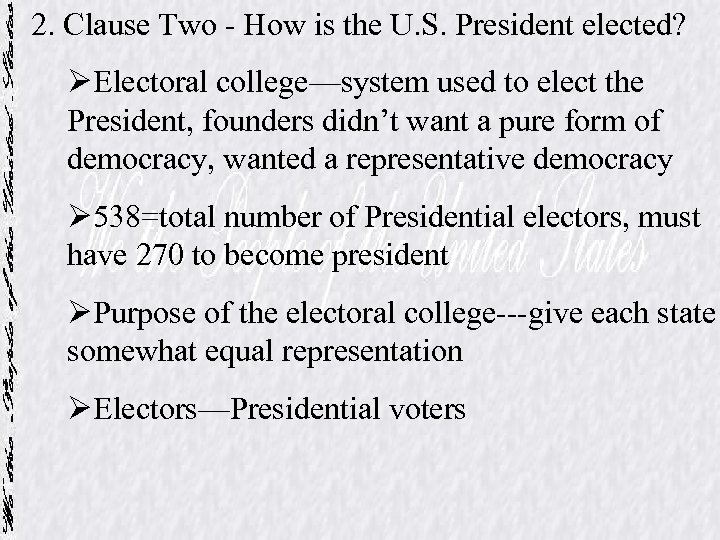 2. Clause Two - How is the U. S. President elected? ØElectoral college—system used to elect the President, founders didn’t want a pure form of democracy, wanted a representative democracy Ø 538=total number of Presidential electors, must have 270 to become president ØPurpose of the electoral college---give each state somewhat equal representation ØElectors—Presidential voters
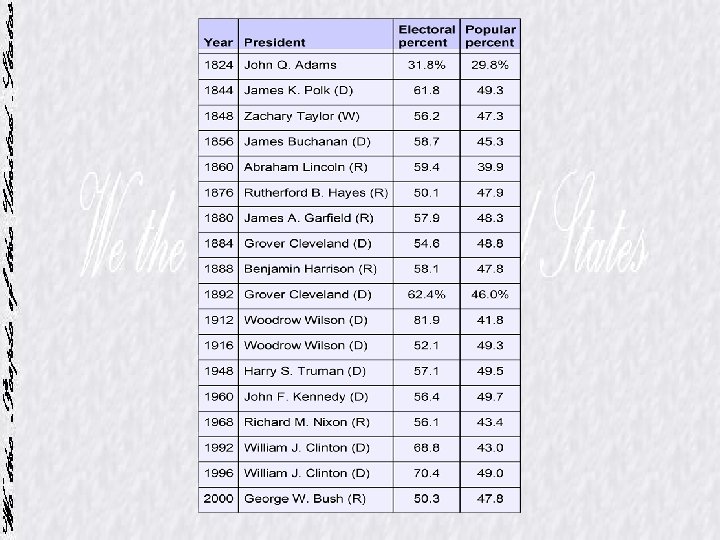
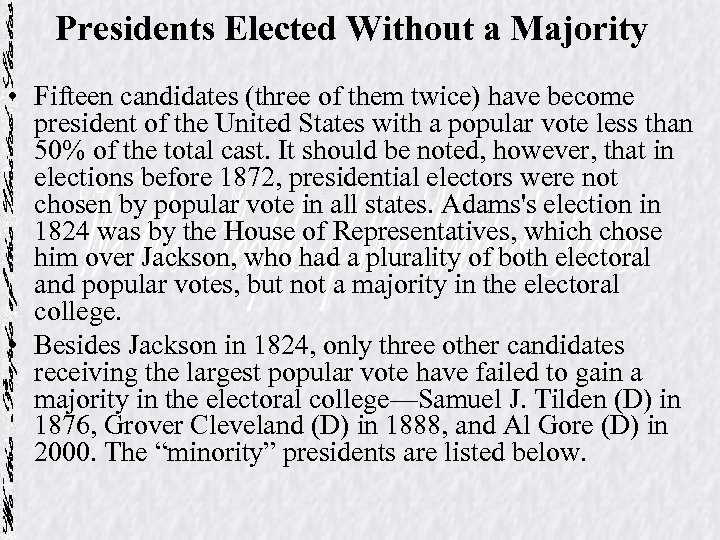 Presidents Elected Without a Majority • Fifteen candidates (three of them twice) have become president of the United States with a popular vote less than 50% of the total cast. It should be noted, however, that in elections before 1872, presidential electors were not chosen by popular vote in all states. Adams's election in 1824 was by the House of Representatives, which chose him over Jackson, who had a plurality of both electoral and popular votes, but not a majority in the electoral college. • Besides Jackson in 1824, only three other candidates receiving the largest popular vote have failed to gain a majority in the electoral college—Samuel J. Tilden (D) in 1876, Grover Cleveland (D) in 1888, and Al Gore (D) in 2000. The “minority” presidents are listed below.
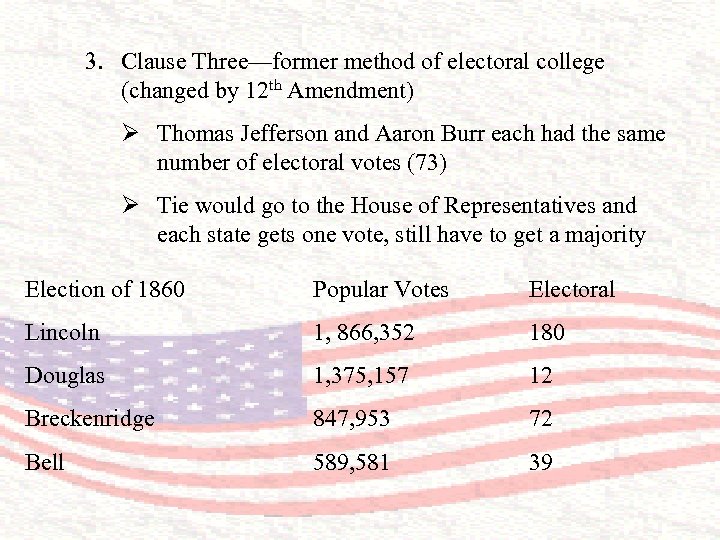 3. Clause Three—former method of electoral college (changed by 12 th Amendment) Ø Thomas Jefferson and Aaron Burr each had the same number of electoral votes (73) Ø Tie would go to the House of Representatives and each state gets one vote, still have to get a majority Election of 1860 Popular Votes Electoral Lincoln 1, 866, 352 180 Douglas 1, 375, 157 12 Breckenridge 847, 953 72 Bell 589, 581 39
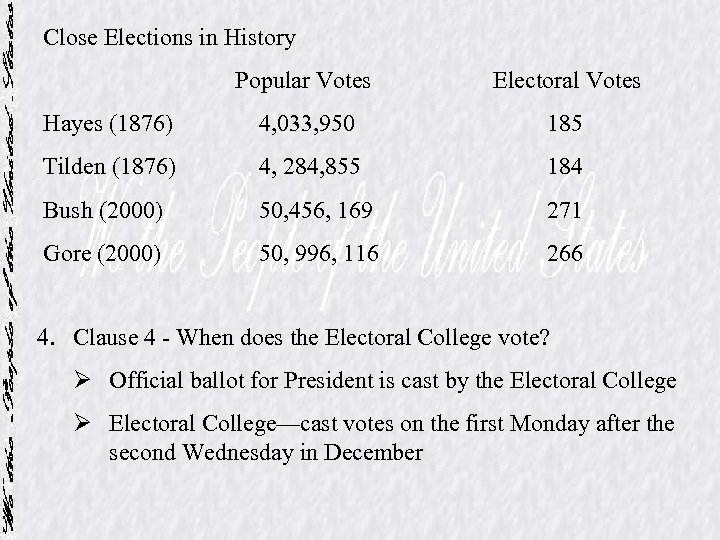 Close Elections in History Popular Votes Electoral Votes Hayes (1876) 4, 033, 950 185 Tilden (1876) 4, 284, 855 184 Bush (2000) 50, 456, 169 271 Gore (2000) 50, 996, 116 266 4. Clause 4 - When does the Electoral College vote? Ø Official ballot for President is cast by the Electoral College Ø Electoral College—cast votes on the first Monday after the second Wednesday in December
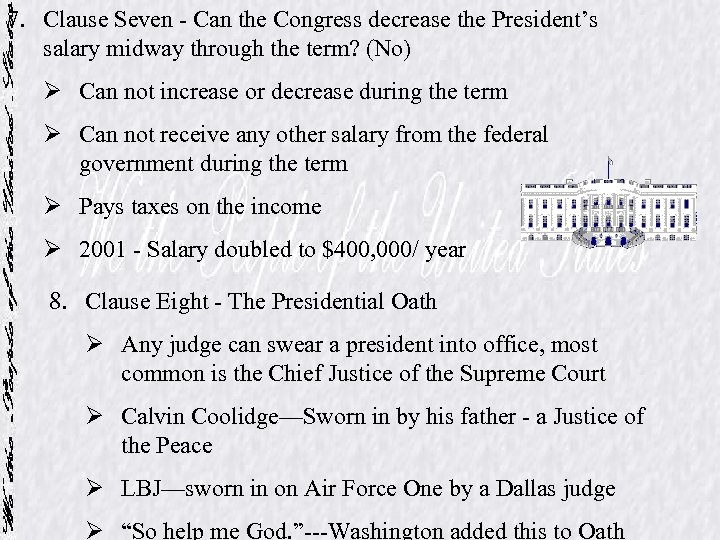 7. Clause Seven - Can the Congress decrease the President’s salary midway through the term? (No) Ø Can not increase or decrease during the term Ø Can not receive any other salary from the federal government during the term Ø Pays taxes on the income Ø 2001 - Salary doubled to $400, 000/ year 8. Clause Eight - The Presidential Oath Ø Any judge can swear a president into office, most common is the Chief Justice of the Supreme Court Ø Calvin Coolidge—Sworn in by his father - a Justice of the Peace Ø LBJ—sworn in on Air Force One by a Dallas judge Ø “So help me God. ”---Washington added this to Oath
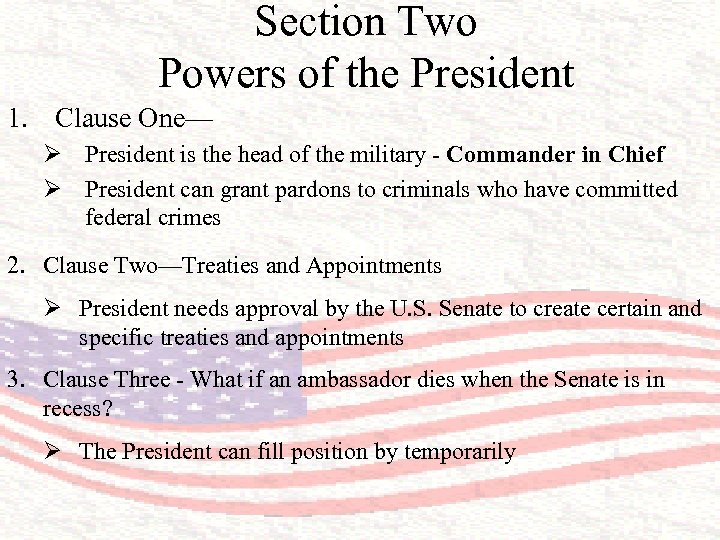 Section Two Powers of the President 1. Clause One— Ø President is the head of the military - Commander in Chief Ø President can grant pardons to criminals who have committed federal crimes 2. Clause Two—Treaties and Appointments Ø President needs approval by the U. S. Senate to create certain and specific treaties and appointments 3. Clause Three - What if an ambassador dies when the Senate is in recess? Ø The President can fill position by temporarily
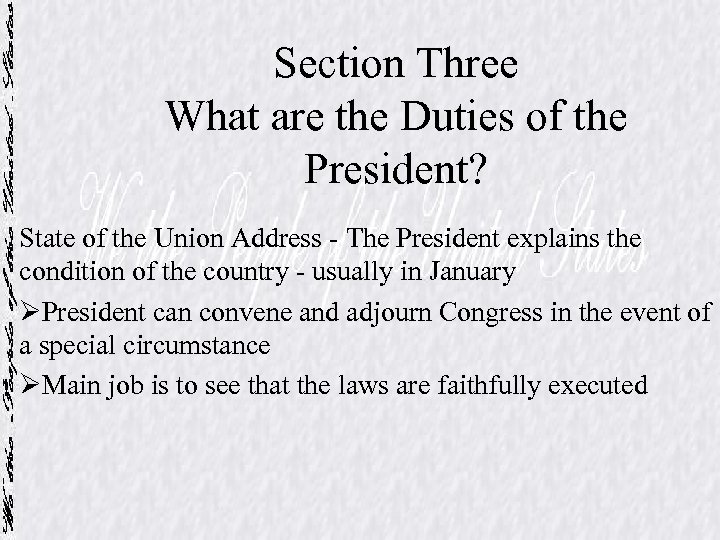 Section Three What are the Duties of the President? State of the Union Address - The President explains the condition of the country - usually in January ØPresident can convene and adjourn Congress in the event of a special circumstance ØMain job is to see that the laws are faithfully executed
 Section Four--Impeachment Ø President, Vice President, and all civil officers can be impeached Ø Can only be impeached for three things: treason, bribery, or other high crimes and misdemeanors. Ø Judges are civil officers that are the most often convicted of impeachment Ø Members of the Congress are expelled by their own house, they do not go through the formal impeachment process
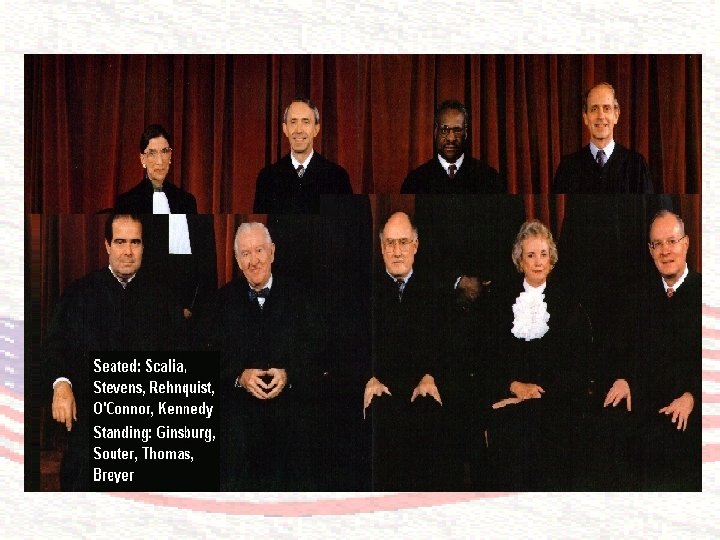
 Article III—Judicial Branch Section One—Federal Courts 1. Clause One - Who interprets the law? Ø Judicial branch interprets the law (Courts) Ø Legislative makes the law (Congress) Ø Executive enforces the law (President) Ø Judicial powers—the power to hear cases Ø Federal Judges are appointed by the President and approved by the Senate
 Section Two—Jurisdiction of the Federal Courts 1. Clause One—Jurisdiction Ø Jurisdiction—power and right to apply law Ø Plaintiff—one who brings charges Ø Defendant—one being charged Ø Criminal case—when government is plaintiff (California vs. O. J. Simpson) Ø Civil case—between two or more people (O. J. Simpson vs. Goldman family)
 2. Clause Two - How does a case reach the Supreme Court? Ø SC has two kinds of jurisdiction: a. Original—a case is first heard by the SC b. Appellate—cases that are appealed by a lower court (Most cases come to the SC through appellate jurisdiction) Ø Thousands of cases are brought to the SC each year Ø About 75 are heard each year Ø Writ of Certiorari—an order from a higher court to a lower court to see the records and proceedings of a previous case
 3. Clause Three—Conduct of Trials Ø Guarantees a trial by jury in federal courts Ø Extradition—returning a fugitive to the state in which the crime was committed
 Section Three--Treason 1. Clause One - What is treason? Ø Only crime defined in the Constitution (helping a nation’s enemies or carrying out war against your country) Ø 2 ways of being convicted: 1. Confession in court room 2. Having two witnesses testify against you 2. Clause Two - What is the penalty for treason? Ø Treason can only happen during time of war Ø Maximum penalty is death Ø Espionage, Sabotage, conspiracy to overthrow the government are all similar to treason but happen during times of peace
 Article IV—Relations Among the States Section One—Official Acts 1. Clause One - I live in Minnesota do I have to follow the rules of North Dakota? (Yes - full faith and credit) Ø Each state shall respect legal action of another state (marriage licenses, speed limits, fines, drivers license)
 Section Two—Privileges of Citizens 1. Clause One - Can I buy a lake home in Minnesota if I live in Illinois? (Yes) Ø State cannot discriminate against you because you are a citizen of another state 2. Clause Two—Extradition Ø Bringing back a fugitive (interstate rendition) Ø “shall”—tradition, custom, and the courts have interpreted this to mean “may” Ø Governors can refuse to return a fugitive
 3. Clause Three—Fugitive slaves (nonexistent) - Changed by amendment after the Civil War. Ø “persons” refer to slaves Ø If a slave escapes from a slave state to a free state, the slave is not free
 Section Three—New States 1. Clause One - How does a state become admitted to the Union? Ø Only Congress can admit states 2. Clause Two Ø Congress will make all laws for all U. S. territories
 Section Four Guarantees of the State Ø The federal government guarantees each state a republic ØRepublic—Representative democracy where we elect officials to represent our concerns ØThe government will protect us from invasions
 Article V Methods of Amendments 1 st Method - need 2/3 of Congress to PROPOSE an Amendment 2 nd Method - need 2/3 of the state legislatures to ask Congress for a national convention to propose an Amendment (this method has never been used) Ø Need 3/4 of all states to actually ratify or APPROVE an Amendment. This is done by state legislatures or a special ratifying convention. Ø Over 4000 proposed Amendments since the early 1800 s Ø Only 27 have been ratified Ø 1 st Ten Amendments were a package deal, 18 and 21 cancel each other out, leaves 15 separate Amendments that went through the process
 Article VI—General Provisions Section One - Could the new government evade debts owed as a result of the Revolutionary War? Ø New government can’t evade old debts Section Two - Is the federal law the supreme law of the land? Ø Yes - State law cannot override a federal law Ø “Supremacy Clause” Section Three—all officers, state and federal, must take an oath to support the U. S. Constitution Ø Can’t have a religious requirement has part of the Oath
 Article Seven--Ratification Section One— Ø Convention—calling of delegates from each state to ratify the Constitution Ø Must have nine states to approve the Constitution
 CLOSURE Constitution was finished September 17, 1787 55 total delegates during the convention 42 were present on the final day but only 39 people signed the Constitution The following two years provided debate for ratification The United States Constitution took effect April 30 , 1789 when George Washington was sworn in as President