 Скачать презентацию THE UNITED REPUBLIC OF TANZANIA MINISTRY OF WORKS
c3ed0111ca00e32176952ba7dbf508a5.ppt
- Количество слайдов: 38



THE UNITED REPUBLIC OF TANZANIA MINISTRY OF WORKS, TRANSPORT AND COMMUNICATION AED - 2016 ‘Infrastructure Development and its Contribution to Transformation of Tanzania Towards Becoming a Middle Income Country by 2025’ Prof. Makame M. Mbarawa (MP) Minister for Works, Transport and Communication Prepared by:
OVERVIEW: Role of Infrastructure in Economic Development Status of Infrastructure in Tanzania Infrastructure Development Programmes for Vision 2025 Financing Approaches for Infrastructure Technical Capacity Building Infrastructure Protection and Safety Conclusion and Way Forward ERB 2016 2
1. Role of Infrastructure in Economic Development • Middle Income Countries (MICs) o Per-capita Gross National Income (GNI) in 2016 is between $1, 046 and $12, 735. Tanzania GDP in $910 o GNI is one of the income categories that the World Bank uses to classify economies. • The Tanzania transport sector plays a crucial role in the economic growth. o It facilitates domestic and international trade, o Contributes to national and regional integration, o Provides access to jobs, health, education and other ERB 2016 essential facilities. 3
2. STATUS OF INFRASTRUCTURE IN TANZANIA Roads o Railways o Ports o Aerodromes and o Communication Service Infrastructure ERB 2016 4
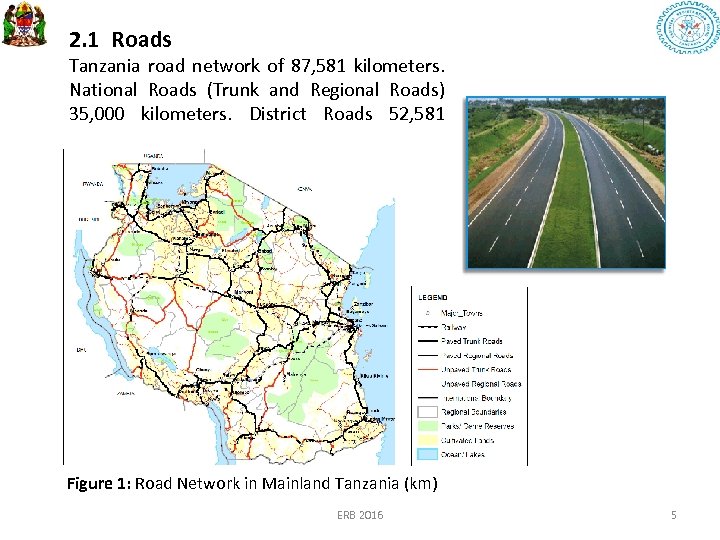
2. 1 Roads Tanzania road network of 87, 581 kilometers. National Roads (Trunk and Regional Roads) 35, 000 kilometers. District Roads 52, 581 kilometers. Figure 1: Road Network in Mainland Tanzania (km) ERB 2016 5
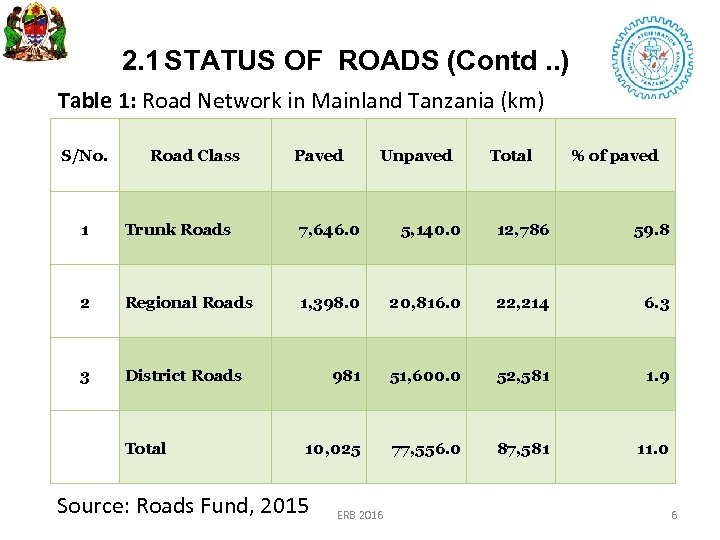
2. 1 STATUS OF ROADS (Contd. . ) Table 1: Road Network in Mainland Tanzania (km) S/No. Road Class Paved Unpaved Total % of paved 1 Trunk Roads 7, 646. 0 5, 140. 0 12, 786 59. 8 2 Regional Roads 1, 398. 0 20, 816. 0 22, 214 6. 3 3 District Roads 981 51, 600. 0 52, 581 1. 9 10, 025 77, 556. 0 87, 581 11. 0 Total Source: Roads Fund, 2015 ERB 2016 6
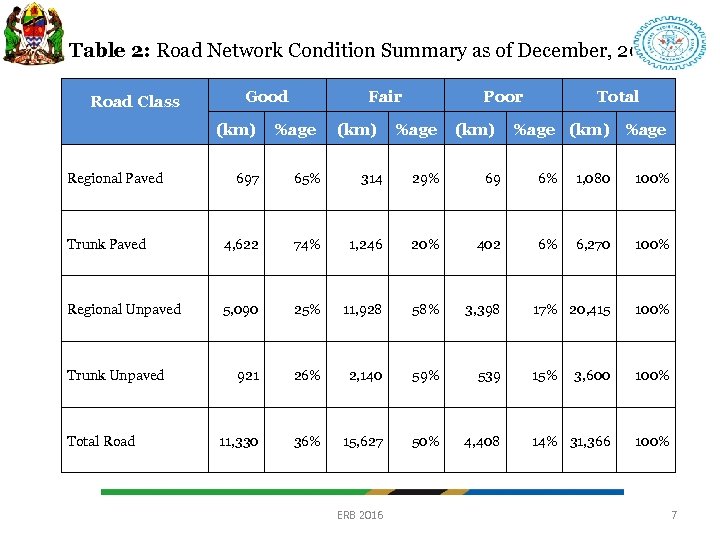
Table 2: Road Network Condition Summary as of December, 2015 Road Class Regional Paved Good (km) Fair %age (km) Poor %age (km) Total %age (km) %age 697 65% 314 29% 69 6% 1, 080 100% Trunk Paved 4, 622 74% 1, 246 20% 402 6% 6, 270 100% Regional Unpaved 5, 090 25% 11, 928 58% 3, 398 17% 20, 415 100% 921 26% 2, 140 59% 539 15% 3, 600 100% 11, 330 36% 15, 627 50% 4, 408 14% 31, 366 100% Trunk Unpaved Total Road ERB 2016 7
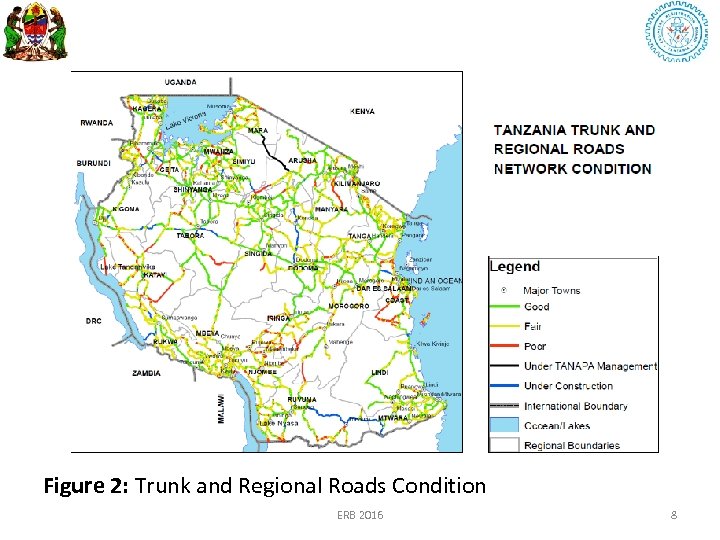
Figure 2: Trunk and Regional Roads Condition ERB 2016 8
Road Density Is one of the WB indicator measured as km of road per sq km of land of a country. • Tanzania road network is 87, 581 kilometers. National Roads 35, 000 kms and District Roads 52, 581 kms. • The road density for Tanzania is 9. 1 km/100 sq km. Average for Sub Sahara is 20. 4 km/100 sq km, and Malaysia is 20. 1 km/100 sq km) ERB 2016 9
2. 2 RAIL INFRASTRUCTURE The railway infrastructure managing bodies are: • Tanzania Railways Limited (TRL) manages the Central Line (1, 840 km). • Tanzania – Zambia Railway Limited (TAZARA) manages the Zambia bound line (1860 km). • 970 km of the TAZARA line is in Tanzania and the rest is in Zambia. * 10
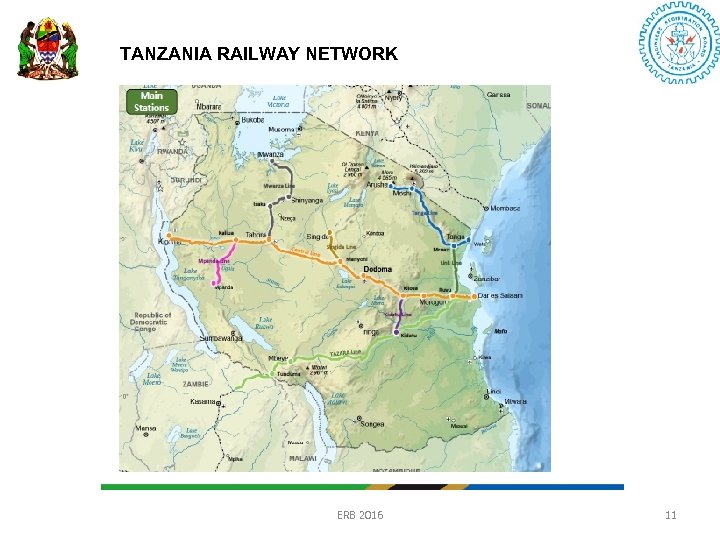
TANZANIA RAILWAY NETWORK ERB 2016 11
2. 3 PORTS INFRASTRUCTURE • There are three main ports of DSM, Tanga and Mtwara on the Indian Ocean coast • Inland Ports of Mwanza South and Kemondo on Lake Victoria, Kigoma on Lake Tanganyika and Itungi Port on Like Nyasa serve on inland waterbodies. * 12
2. 4 AERODROMES • Air Transport is carried out through Airports and Airstrips. • There about 300 Airports and Airstrips in the Country. • Out of these 58 are managed by Tanzania Airports Authority (TAA). • There are 18 most active airports of which three are the International Airports of JNIA, KIA and Zanzibar. * 13
2. 5 INFORMATION AND COMMUNICATION TECHNOLOGY INFRASTRUCTURE • NICTBB is considered as the ICT roadmap for Tanzania • Phase I and II of the project which has a 7, 560 km network has been completed and is operational. • The NICTBB connects all regions and districts to national and regional broadband infrastructure as well as undersea (Seacom and Eassy) landing on its shores. • NICTBB has been delivered across borders connecting to neighbouring countries * 14
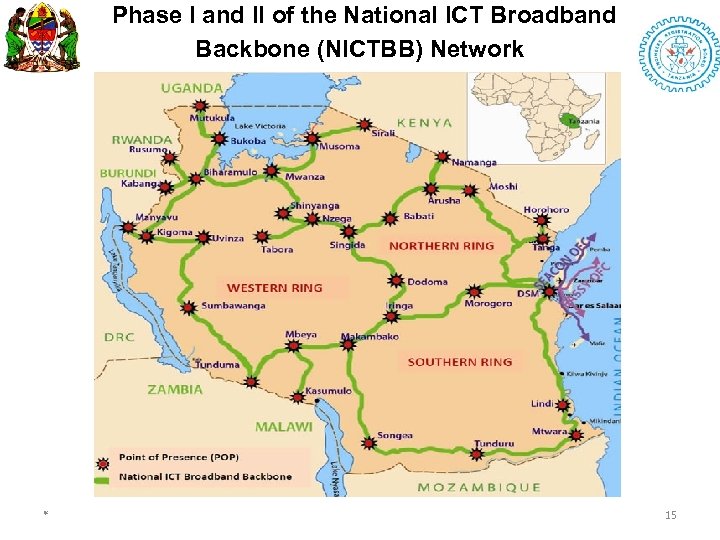
Phase I and II of the National ICT Broadband Backbone (NICTBB) Network * 15
WHERE ARE WE (ROADS) • 17, 762 km of roads are under various stages implementation by June 2015 • 3, 873 km are undergoing upgrading • 5, 228 km designs completed • 4, 965 km design in progress • 70% of the transport corridor is already paved • 11% of corridor network under construction * 16
3: Infrastructure Development Programme for Vision 2025: Strategies have been drawn to address Infrastructure demand in order to meet 2025 Infrastructure needs as follows: 3. 1 Roads infrastructure strategic interventions being taken: Direct investment through constructing roads leading to areas with highest economic potential (e. g. TANZAM Highway) * 17
Roads infrastructure strategic interventions (2) • Develop Major Transport Corridors (9 major corridors identified) with plan to pave all Trunk Roads by 2018) • Investment in Roads That Have High Potential in Regional Integration (Arusha Namanga/Holili, Dar –Isaka-Rusumo/Kobero, Mutukula-Mwanza-Sirari etc. ) • Connecting All Regional Headquarters With Paved Roads. ERB 2016 18
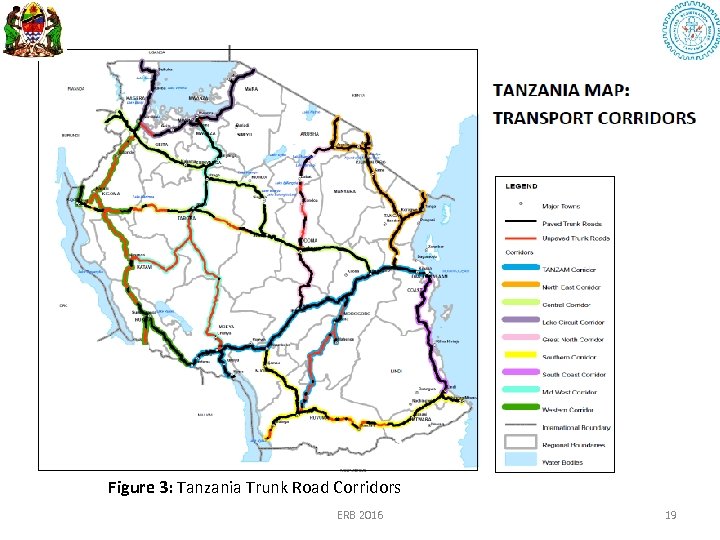
Figure 3: Tanzania Trunk Road Corridors ERB 2016 19
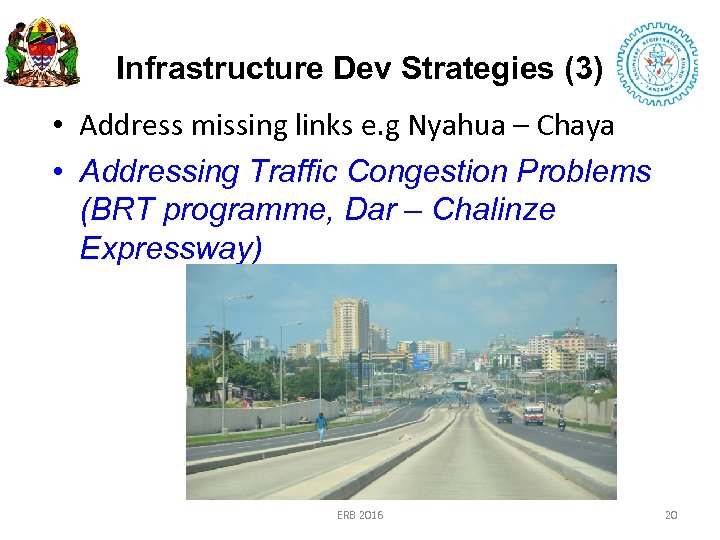
Infrastructure Dev Strategies (3) • Address missing links e. g Nyahua – Chaya • Addressing Traffic Congestion Problems (BRT programme, Dar – Chalinze Expressway) ERB 2016 20
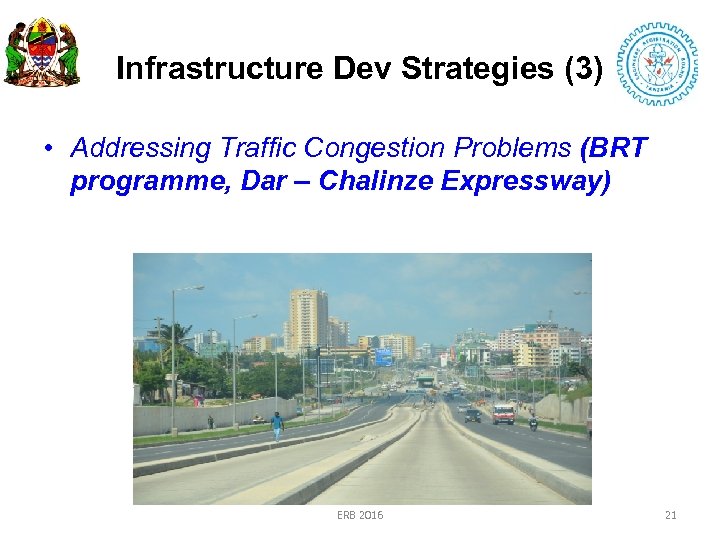
Infrastructure Dev Strategies (3) • Addressing Traffic Congestion Problems (BRT programme, Dar – Chalinze Expressway) ERB 2016 21
3. 2 Railways Infrastructure Strategic Interventions • Rehabilitation of the existing central railway line (2, 707 km) including drainage improvement of Kilosa-Gulwe Section (83 km). • Rehabilitation of the TAZARA line 1860 km. • Upgrade and construct strategic line to make Tanzania a hub of Transport – Construction of the DSM–Isaka–Mwanza(1, 219 km), Isaka–Rusumo (371 km) and Keza-Ruvubu (36 km) to Standard Gauge * 22
Railways Infrastructure Strategic Interventions (2) • Construction of Railway Lines to Strategic Economic Areas: – Mtwara-Songea-Mbamba Bay with spurs to Liganga and Mchuchuma (1, 000 km). – Construction of Tanga-Arusha- Musoma line (1, 028 km) with a siding at Maweni for Mwambani Port * 23
3. 3 Infrastructure Strategic Interventions: Marine -1 • Expand Cargo Volume Handling Capacities at Sea and Lake Ports from the current 10. 0 million tonners to 20. 0 million by 2020. • Develop effective modal interfaces at sea and inland water ports and inland cargo and passenger terminals. • US $ 690 million projects aimed at improving capacity of Dar es Salaam Port. – These include deepening and widening on berths 1 – 7, 14; deepening and widening of entrance channel and turning basin etc. A total of 8 projects will be implemented • Development of a new port at Mwambani in Tanga. – Plan is to construct three (3) berths 815 m long * 24
Infrastructure Strategic Interventions: Marine -2 • Modernization of Mwanza South Port. – So far cargo handled as general cargo in rail wagons. Plan is to containerise cargo as this would improve port operations. • Expansion of Kigoma Port – Plan is to increase quay length from 300 m to 1130 m • Expansion and Modernization of Mtwara Port. – Important for Mtwara corridor development which include Mozambique, Zambia, Malawi & Tanzania. – Plan is to add 4 more berths * 25
Infrastructure Strategic Interventions: Marine -3 • Construction of Bagamoyo Port and the Special Economic Zone – Port Construction at Mbegani – Support Infrastructure: • Roads ( about 87 km) • Railway line from Dar to Bagamoyo * 26
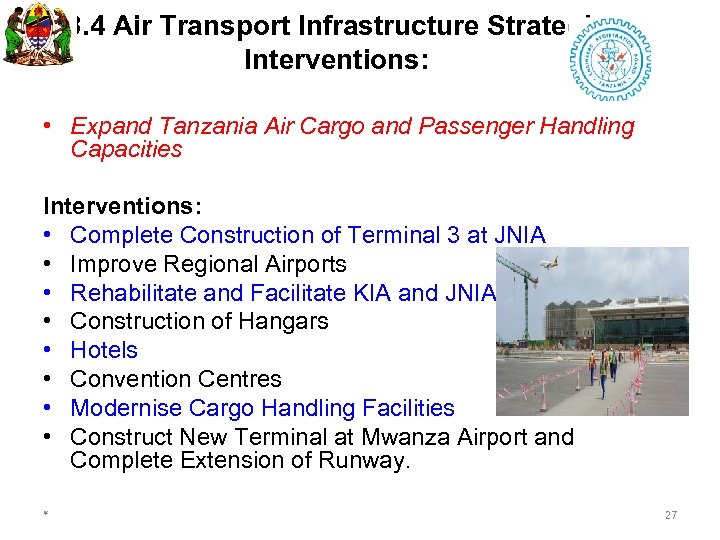
3. 4 Air Transport Infrastructure Strategic Interventions: • Expand Tanzania Air Cargo and Passenger Handling Capacities Interventions: • Complete Construction of Terminal 3 at JNIA • Improve Regional Airports • Rehabilitate and Facilitate KIA and JNIA • Construction of Hangars • Hotels • Convention Centres • Modernise Cargo Handling Facilities • Construct New Terminal at Mwanza Airport and Complete Extension of Runway. * 27
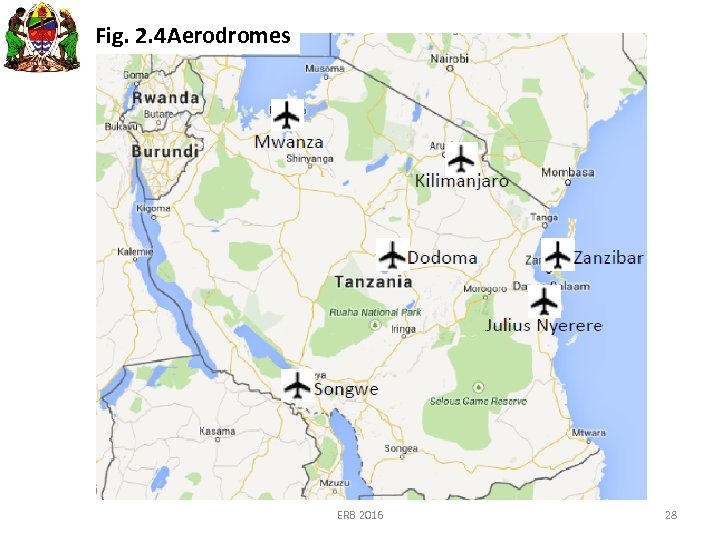
Fig. 2. 4 Aerodromes ERB 2016 28
3. 5 ICT Infrastructure Strategic Interventionn Investing in National ICT Broadband Backbone, Broadband Access Connectivity and ICT Equipment and Skills Development. Specific Interventions: o Building of the internet data centres (IDC) as a platform for hosting internet based applications and contents o Rolling out the Optic Fiber Cable (OFC) Metro Ring Networks in urban areas and building missing links to complement the NICTBB networks. o Extending NICTBB to have a footprint and a service point at each District headquarter o Implementation of additional Internet based applications systems for the government to extend the on-going e-Government project to local governments : ERNET, e-schools network, e-Health Net, Community Information Centres (CICs), and Public Key Infrastructure. * 29
4. 0 FINANCING OPTIONS Financing of Projects has Been Dependent on Ø Government consolidated budget; Ø grants, credits, Ø loans from Development Partners, and Ø User Charges (Toll, Levies and Fees). More recently a focus has been on private financing through Public Private Partnership (PPP). . The Public Private Partnership Act of 2010 was made with the objective of promoting private sector participation in financing of public services. . * 30
4: Financing (Contd…) q The Roads Fund Board is able to fund about 61% of road maintenance needs. q. Revenue by RF has increased from Tshs. 75 billion in FY 2005/06 to TShs. 866 billion in FY 2015/2016. q. In Financial Year 2016/17 the Parliament approved the budget of over TShs 4. 4 trilion for Infrastructure. q. DP include Af. DB, JICA, Abu Dhabi, IDA etc * 31
5. Technical Capacity Building Current Policies support: • private sector to invest in education, • number of higher learning institutions offering technical education have been established • MOWTC (Works) supports practical training of graduate engineers through SEAP Programme. • The challenge, however remains the off balance ratio of engineers, technicians and artisans. • This will need to be addressed as we seek to realize vision 2025 ERB 2016 32
6. Infrastructure Protection and Safety • National Road Safety Policy of January, 2009 • Ministry plans is to establish a National Road Safety Authority (NRSA), • Surface and Marine Transport Agency (SUMATRA) to regulate marine and surface transport and safety • Tanzania Civil Aviation Agency (TCAA) to regulate air transport safety ERB 2016 33
7. 0 Conclusion and Way Forward 7. 1 Conclusion: i. The importance of Infrastructure towards reaching the goals set in Vision 2025 of turning the country into a middle economy cannot be under estimated. ii. The available infrastructure is low in Tanzania as compared to middle income countries we seek to reach. Govt. has laid strategies to increase transport infrastructure. iii. There is a huge infrastructure burden which may not be easily financed and managed by the Government alone. * 34
7. 7. 1 Conclusion and Way Forward Contd … Conclusion: iv. The increased need for mobility and access which is due to increased population, growth of the GDP due to huge natural gas reserves, needs of the land-linked neighbours translates into increased needs of transport infrastructure. v. Legal framework for PPP is in place, this is a fertile ground for use of the private sector for infrastructure delivery. ERB 2016 35
7. Conclusion and Way Forward Contd …. 7. 2 Way Forward i. Infrastructure needs are huge; infrastructure for all modes of transport should be increased. We have Plans for this. ii. The Government should enhance involvement of public finance institutions (such as Social Security Funds) for financing of some of the infrastructure projects. iii. Provision of infrastructure should go hand-in-hand with capacity building for managing these projects. Capacity building packages should be in-built in the projects being prepared for implementation. ERB 2016 36
7. 7. 2 Conclusion and Way Forward Contd …. Way Forward iv. We (Go. T) should let the private sector to manage some of its infrastructure through contracts such as ‘Output Based Contracts’ in order to attract innovation. v. We should consider innovative ways) of raising funds for financing infrastructure projects (such as infrastructure bonds). vi. We will need to examine the legal and regulatory framework guiding infrastructure delivery with a view to attract fresh sources of capital and new business models for the construction, maintenance and operation of infrastructure. ERB 2016 37

THANK YOU FOR YOUR ATTENTION ERB 2016 38
Скачать презентацию THE UNITED REPUBLIC OF TANZANIA MINISTRY OF WORKS
c3ed0111ca00e32176952ba7dbf508a5.ppt