


 Скачать презентацию The Underwater Systems Program at the Porto University
c29a890674a4913af8a1be82d5138d41.ppt
- Количество слайдов: 43
 The Underwater Systems Program at the Porto University Nuno Alexandre Cruz FEUP-DEEC Rua Dr. Roberto Frias 4200 -465 Porto, Portugal http: //www. fe. up. pt/~nacruz Laboratório de Sistemas e Tecnologia Subaquática Faculdade de Engenharia da Universidade do Porto http: //www. fe. up. pt/~lsts
 Outline l The Underwater Systems and Technology Laboratory l Vehicles – Autonomous underwater vehicles – Remotely operated vehicle l Systems and technology – Embedded computer systems – Navigation systems l Advanced mission concepts l Conclusion SUMARE Workshop, Villefranche-sur-Mer, 15 -16 October 2003 2
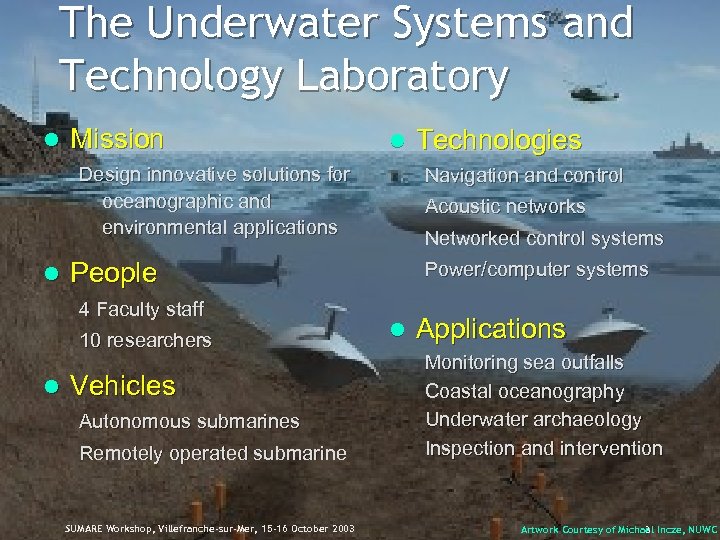 The Underwater Systems and Technology Laboratory l Mission l Design innovative solutions for oceanographic and environmental applications l 10 researchers l Navigation and control Acoustic networks Networked control systems People 4 Faculty staff Vehicles Autonomous submarines Remotely operated submarine Technologies Power/computer systems l Applications Monitoring sea outfalls Coastal oceanography Underwater archaeology Inspection and intervention SUMARE Workshop, Villefranche-sur-Mer, 15 -16 October 2003 3 Artwork Courtesy of Michael Incze, NUWC
 Cooperation l National l International Administração dos Portos do Douro e Leixões University of California at Berkeley, CA, USA Centro de Investigação Marinha e Ambiental Woods Hole Oceanographic Institution, MA, USA Instituto Superior de Engenharia do Porto Naval Postgraduate School, CA, USA Instituto Hidrográfico SUMARE Workshop, Villefranche-sur-Mer, 15 -16 October 2003 4
 Vehicles Autonomous Underwater Vehicles
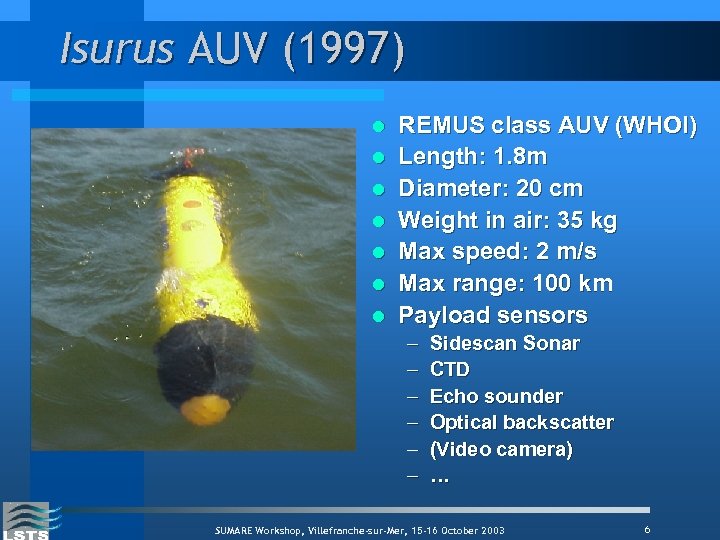 Isurus AUV (1997) l l l l REMUS class AUV (WHOI) Length: 1. 8 m Diameter: 20 cm Weight in air: 35 kg Max speed: 2 m/s Max range: 100 km Payload sensors – – – Sidescan Sonar CTD Echo sounder Optical backscatter (Video camera) … SUMARE Workshop, Villefranche-sur-Mer, 15 -16 October 2003 6
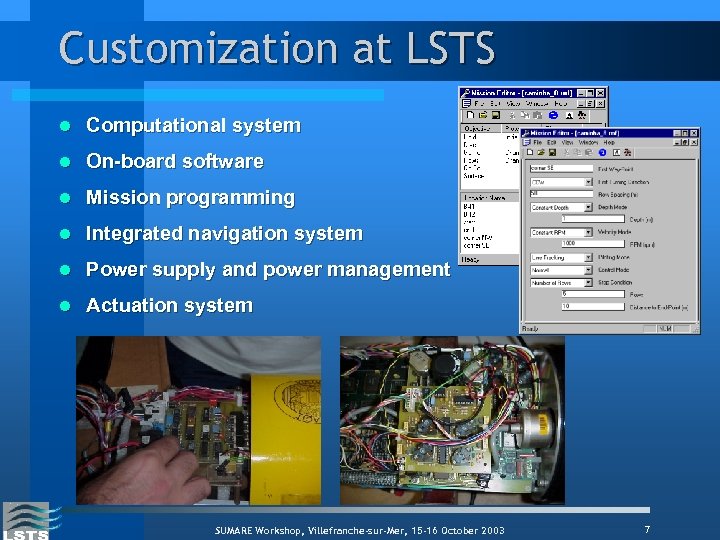 Customization at LSTS l Computational system l On-board software l Mission programming l Integrated navigation system l Power supply and power management l Actuation system SUMARE Workshop, Villefranche-sur-Mer, 15 -16 October 2003 7
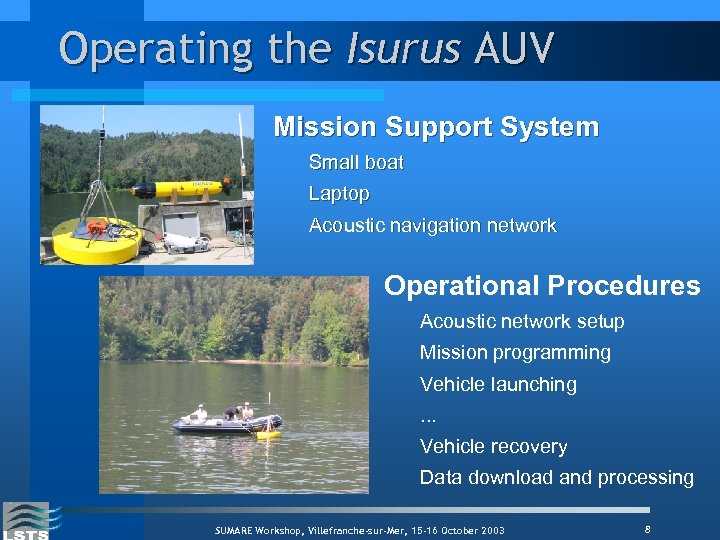 Operating the Isurus AUV Mission Support System Small boat Laptop Acoustic navigation network Operational Procedures Acoustic network setup Mission programming Vehicle launching. . . Vehicle recovery Data download and processing SUMARE Workshop, Villefranche-sur-Mer, 15 -16 October 2003 8
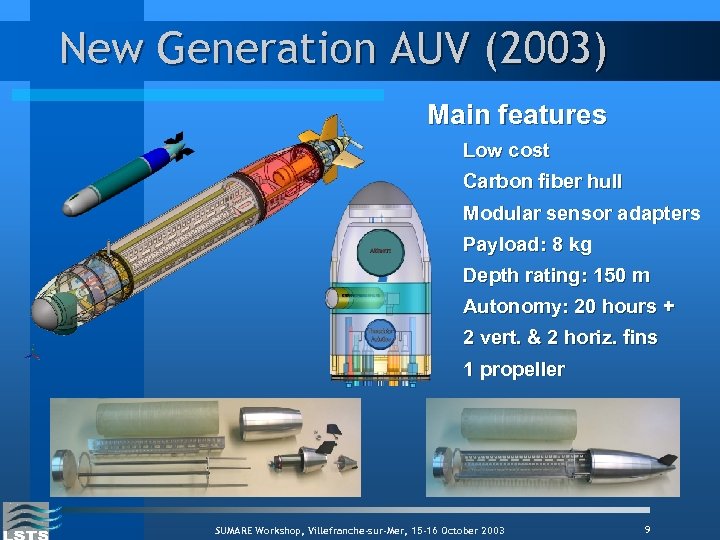 New Generation AUV (2003) Main features Low cost Carbon fiber hull Modular sensor adapters Payload: 8 kg Depth rating: 150 m Autonomy: 20 hours + 2 vert. & 2 horiz. fins 1 propeller SUMARE Workshop, Villefranche-sur-Mer, 15 -16 October 2003 9
 Isurus Missions l Bathymetry l Oceanographic data collection l Environmental monitoring
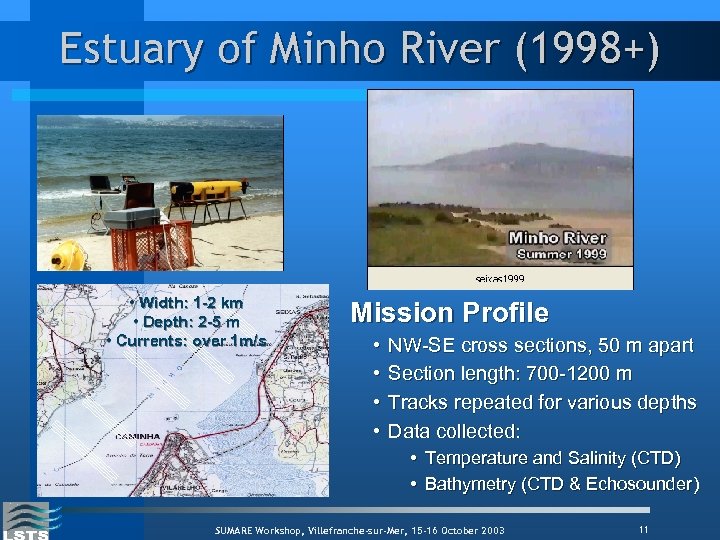 Estuary of Minho River (1998+) • Width: 1 -2 km • Depth: 2 -5 m • Currents: over 1 m/s Mission Profile • • NW-SE cross sections, 50 m apart Section length: 700 -1200 m Tracks repeated for various depths Data collected: • Temperature and Salinity (CTD) • Bathymetry (CTD & Echosounder) SUMARE Workshop, Villefranche-sur-Mer, 15 -16 October 2003 11
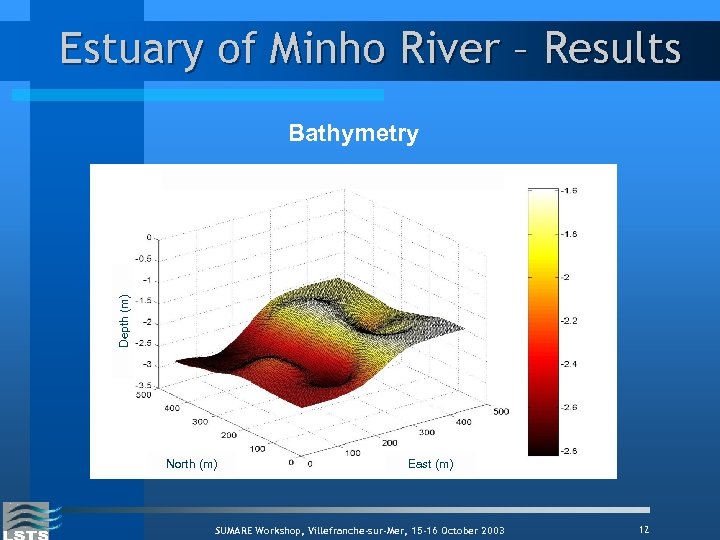 Estuary of Minho River – Results Depth (m) Bathymetry North (m) East (m) SUMARE Workshop, Villefranche-sur-Mer, 15 -16 October 2003 12
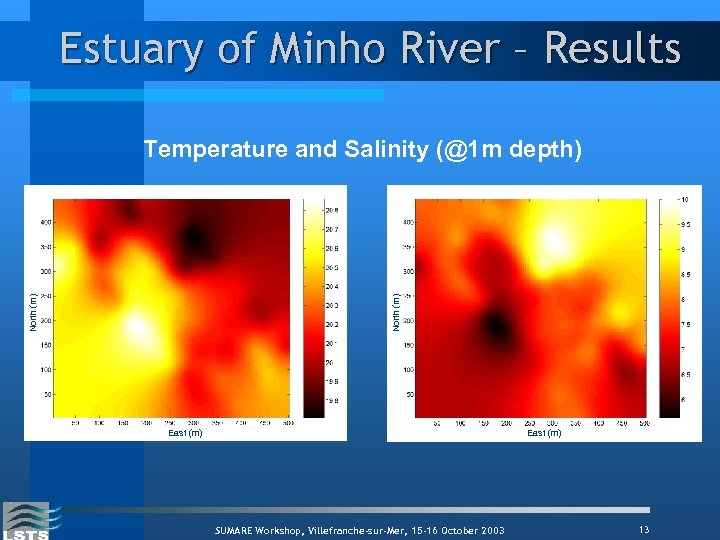 Estuary of Minho River – Results North (m) Temperature and Salinity (@1 m depth) East (m) SUMARE Workshop, Villefranche-sur-Mer, 15 -16 October 2003 13
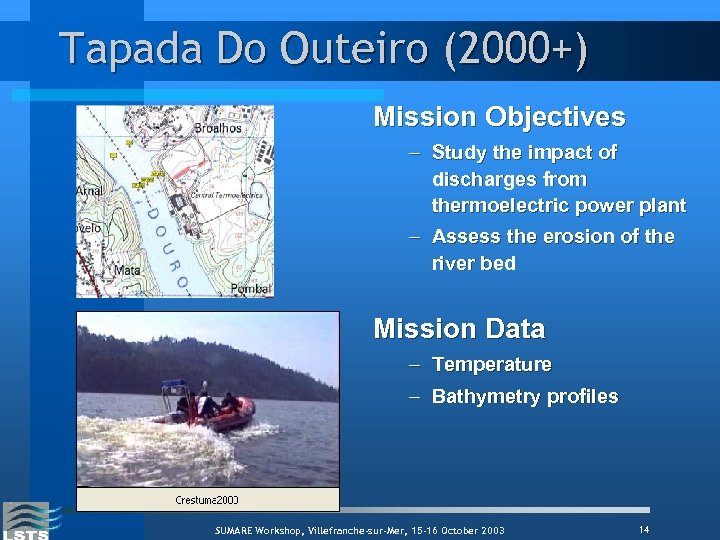 Tapada Do Outeiro (2000+) Mission Objectives – Study the impact of discharges from thermoelectric power plant – Assess the erosion of the river bed Mission Data – Temperature – Bathymetry profiles SUMARE Workshop, Villefranche-sur-Mer, 15 -16 October 2003 14
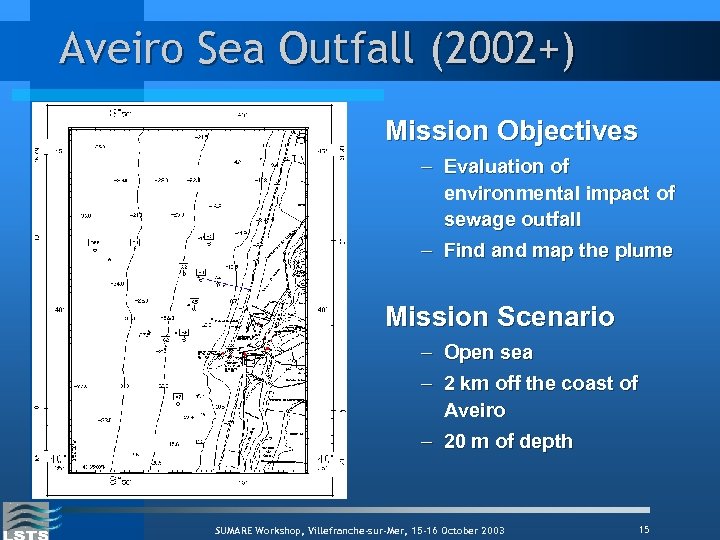 Aveiro Sea Outfall (2002+) Mission Objectives – Evaluation of environmental impact of sewage outfall – Find and map the plume Mission Scenario – Open sea – 2 km off the coast of Aveiro – 20 m of depth SUMARE Workshop, Villefranche-sur-Mer, 15 -16 October 2003 15
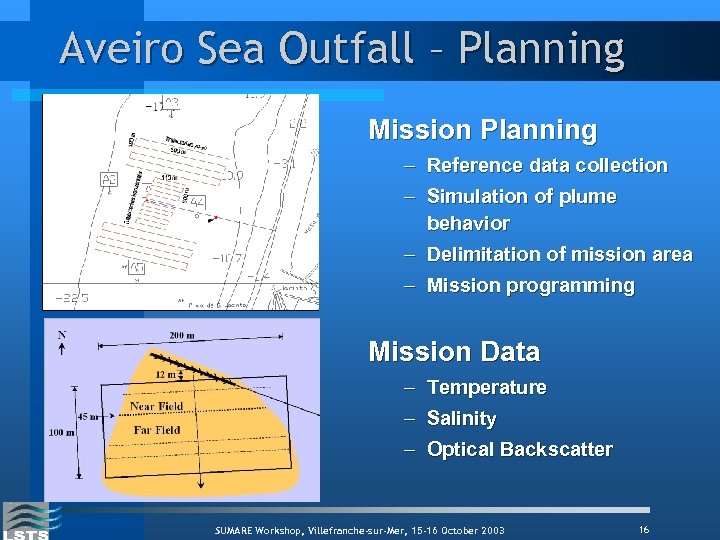 Aveiro Sea Outfall – Planning Mission Planning – Reference data collection – Simulation of plume behavior – Delimitation of mission area – Mission programming Mission Data – Temperature – Salinity – Optical Backscatter SUMARE Workshop, Villefranche-sur-Mer, 15 -16 October 2003 16
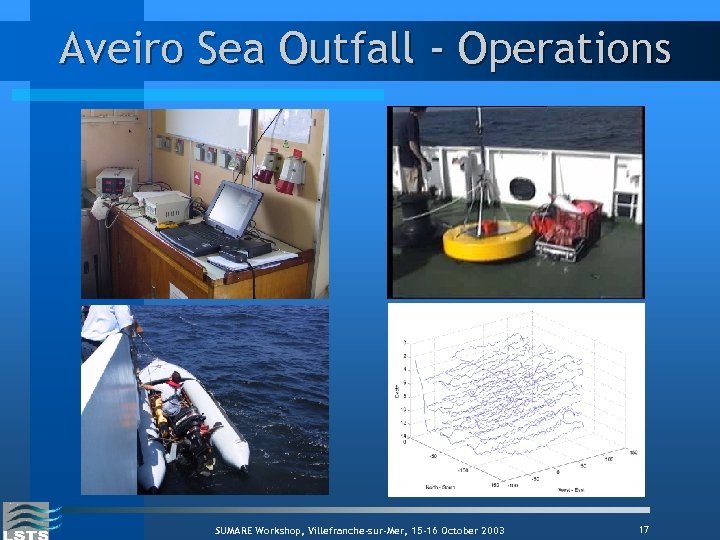 Aveiro Sea Outfall - Operations SUMARE Workshop, Villefranche-sur-Mer, 15 -16 October 2003 17
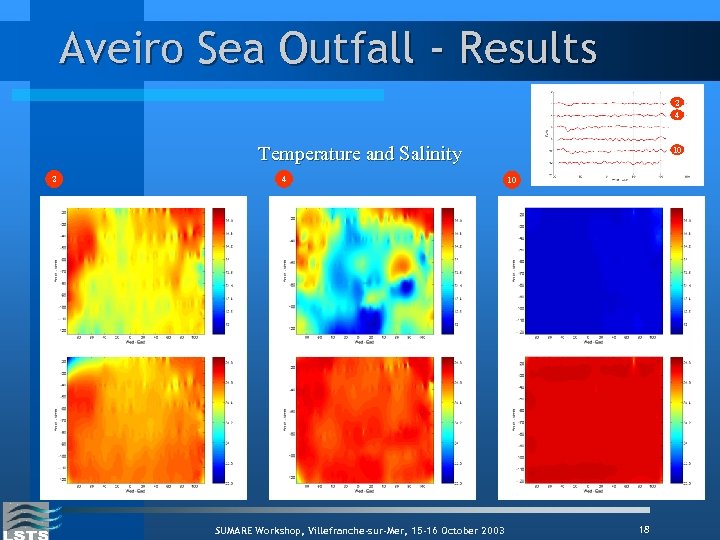 Aveiro Sea Outfall - Results 2 4 Temperature and Salinity 2 4 SUMARE Workshop, Villefranche-sur-Mer, 15 -16 October 2003 10 10 18
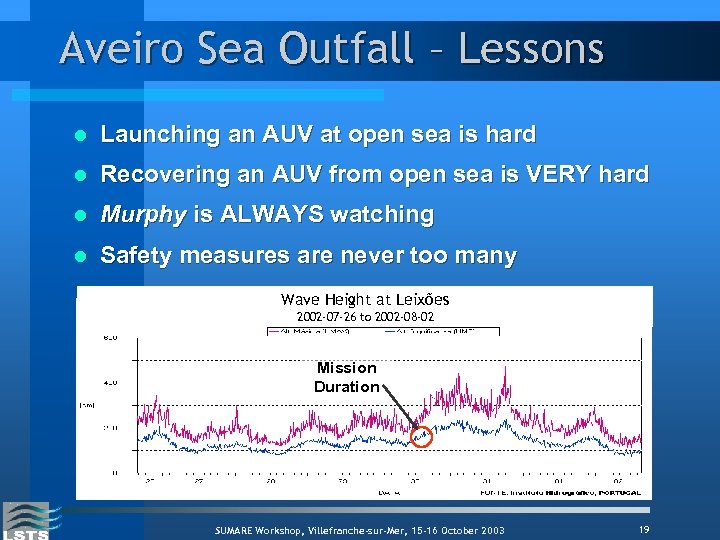 Aveiro Sea Outfall – Lessons l Launching an AUV at open sea is hard l Recovering an AUV from open sea is VERY hard l Murphy is ALWAYS watching l Safety measures are never too many Wave Height at Leixões 2002 -07 -26 to 2002 -08 -02 Mission Duration SUMARE Workshop, Villefranche-sur-Mer, 15 -16 October 2003 19
 Vehicles Remotely Operated Vehicle
 The IES Project (1999 -2002) l Objectives – Develop an automated system for the inspection of underwater structures – Provide non-trained operators with autonomous and semi-autonomous operation modes l Strategy – Acquire a customized version of a commercial ROV – Integrate on-board computational system – Install navigation and inspection sensors – Implement a set of automated maneuvers SUMARE Workshop, Villefranche-sur-Mer, 15 -16 October 2003 21
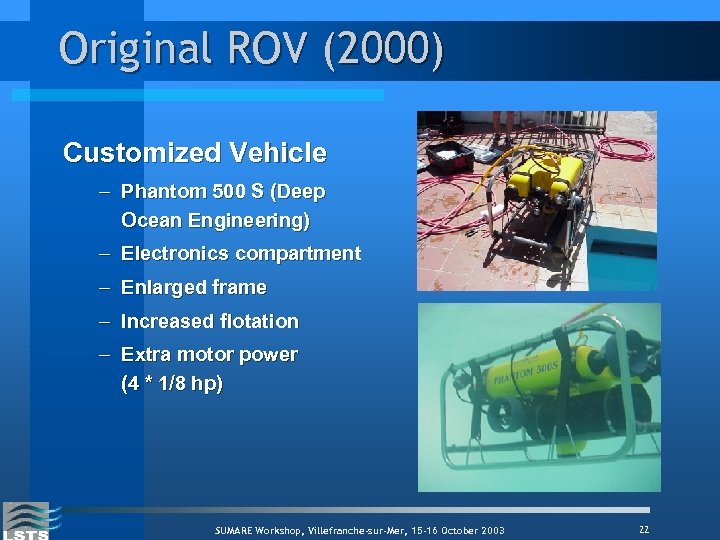 Original ROV (2000) Customized Vehicle – Phantom 500 S (Deep Ocean Engineering) – Electronics compartment – Enlarged frame – Increased flotation – Extra motor power (4 * 1/8 hp) SUMARE Workshop, Villefranche-sur-Mer, 15 -16 October 2003 22
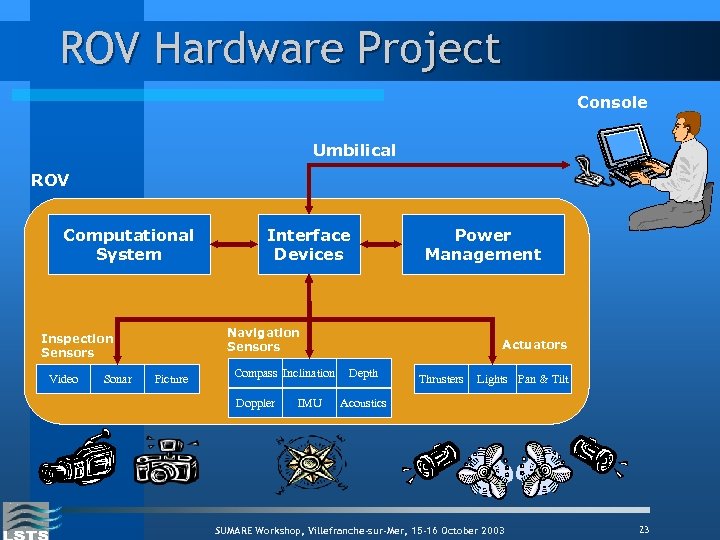 ROV Hardware Project Console Umbilical ROV Computational System Sonar Power Management Navigation Sensors Inspection Sensors Video Interface Devices Picture Compass Inclination Doppler IMU Actuators Depth Thrusters Lights Pan & Tilt Acoustics SUMARE Workshop, Villefranche-sur-Mer, 15 -16 October 2003 23
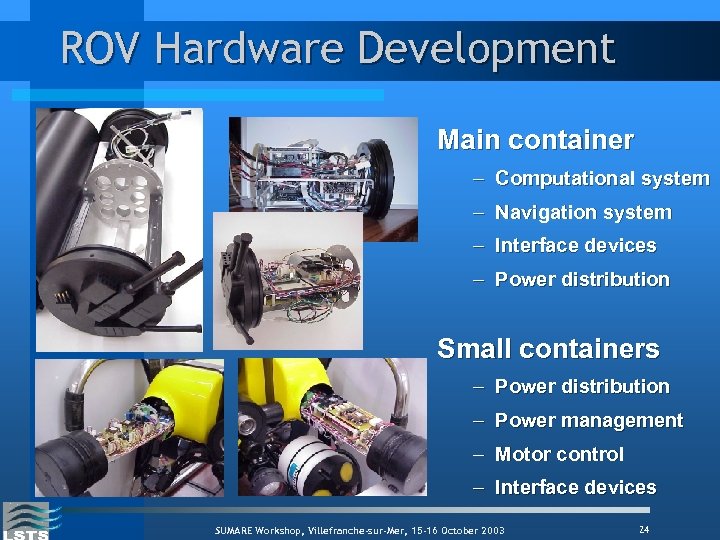 ROV Hardware Development Main container – Computational system – Navigation system – Interface devices – Power distribution Small containers – Power distribution – Power management – Motor control – Interface devices SUMARE Workshop, Villefranche-sur-Mer, 15 -16 October 2003 24
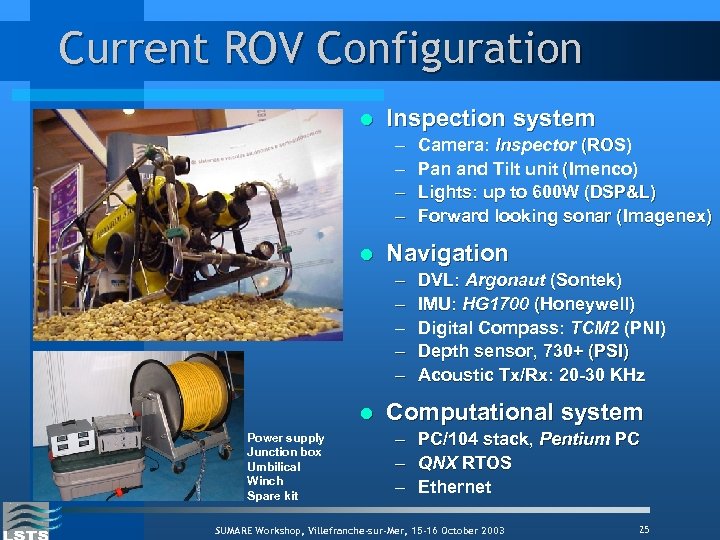 Current ROV Configuration l Inspection system – – l Navigation – – – l Power supply Junction box Umbilical Winch Spare kit Camera: Inspector (ROS) Pan and Tilt unit (Imenco) Lights: up to 600 W (DSP&L) Forward looking sonar (Imagenex) DVL: Argonaut (Sontek) IMU: HG 1700 (Honeywell) Digital Compass: TCM 2 (PNI) Depth sensor, 730+ (PSI) Acoustic Tx/Rx: 20 -30 KHz Computational system – PC/104 stack, Pentium PC – QNX RTOS – Ethernet SUMARE Workshop, Villefranche-sur-Mer, 15 -16 October 2003 25
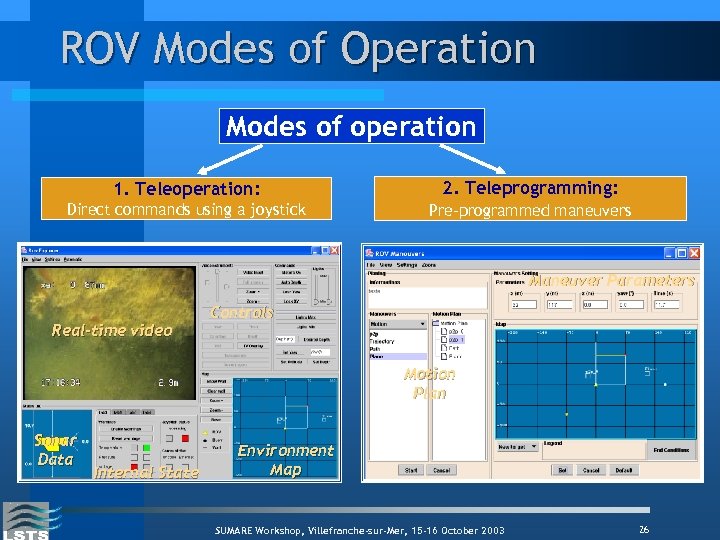 ROV Modes of Operation Modes of operation 1. Teleoperation: 2. Teleprogramming: Direct commands using a joystick Pre-programmed maneuvers Maneuver Parameters Real-time video Controls Motion Plan Sonar Data Internal State Environment Map SUMARE Workshop, Villefranche-sur-Mer, 15 -16 October 2003 26
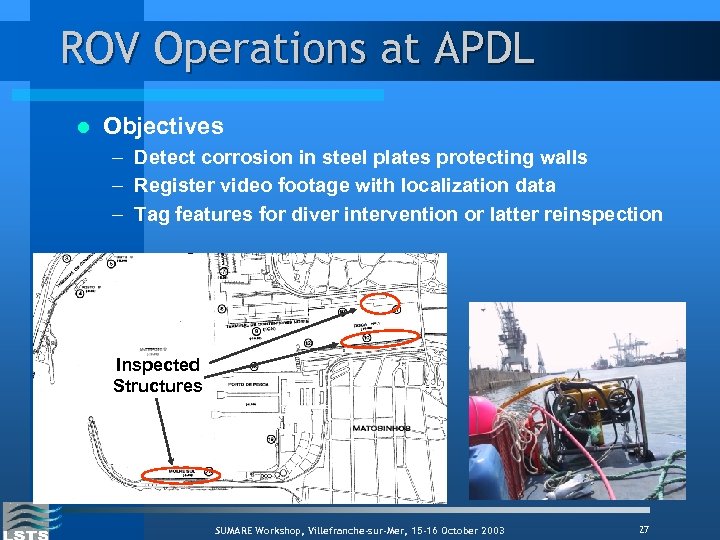 ROV Operations at APDL l Objectives – Detect corrosion in steel plates protecting walls – Register video footage with localization data – Tag features for diver intervention or latter reinspection Inspected Structures SUMARE Workshop, Villefranche-sur-Mer, 15 -16 October 2003 27
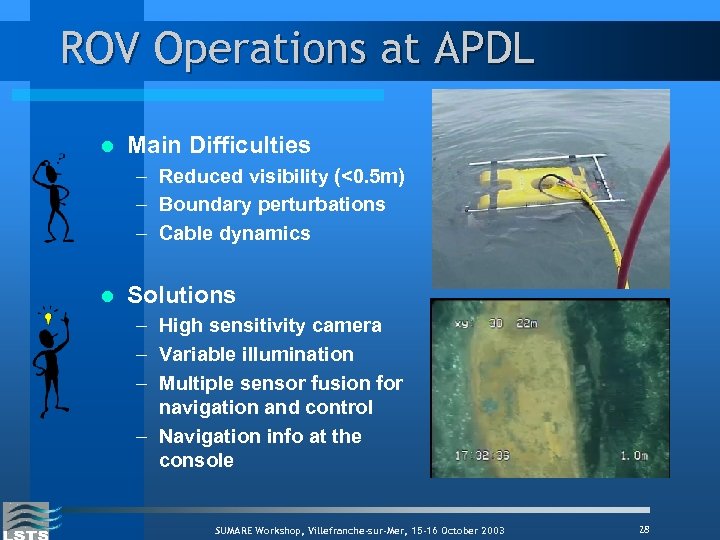 ROV Operations at APDL l Main Difficulties – Reduced visibility (<0. 5 m) – Boundary perturbations – Cable dynamics l Solutions – High sensitivity camera – Variable illumination – Multiple sensor fusion for navigation and control – Navigation info at the console SUMARE Workshop, Villefranche-sur-Mer, 15 -16 October 2003 28
 Systems and Technologies
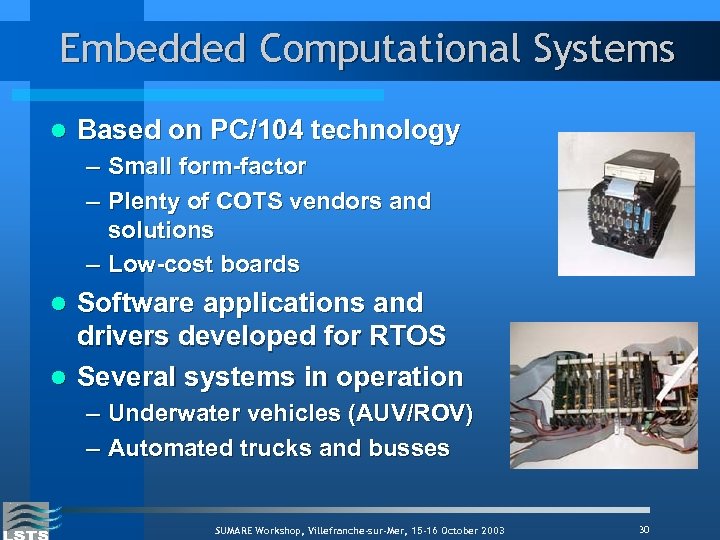 Embedded Computational Systems l Based on PC/104 technology – Small form-factor – Plenty of COTS vendors and solutions – Low-cost boards Software applications and drivers developed for RTOS l Several systems in operation l – Underwater vehicles (AUV/ROV) – Automated trucks and busses SUMARE Workshop, Villefranche-sur-Mer, 15 -16 October 2003 30
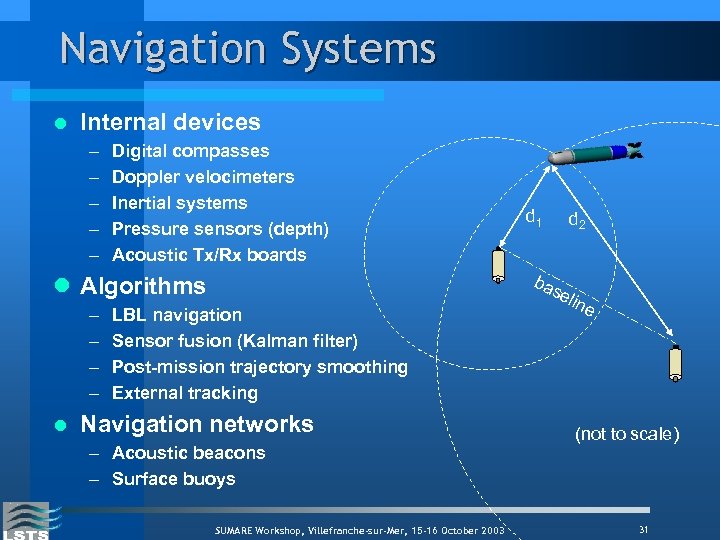 Navigation Systems l Internal devices – – – Digital compasses Doppler velocimeters Inertial systems Pressure sensors (depth) Acoustic Tx/Rx boards l d 2 ba l Algorithms – – d 1 LBL navigation Sensor fusion (Kalman filter) Post-mission trajectory smoothing External tracking Navigation networks – Acoustic beacons – Surface buoys SUMARE Workshop, Villefranche-sur-Mer, 15 -16 October 2003 sel ine (not to scale) 31
 Vehicle Navigation l Kalman filter based algorithm – – – l Filter state: horizontal position and water current High rate dead-reckoning data Low rate range measurements Real-time transponder selection – Covariance matrix updated in real time – Interrogation sequence driven by innovation potential SUMARE Workshop, Villefranche-sur-Mer, 15 -16 October 2003 32
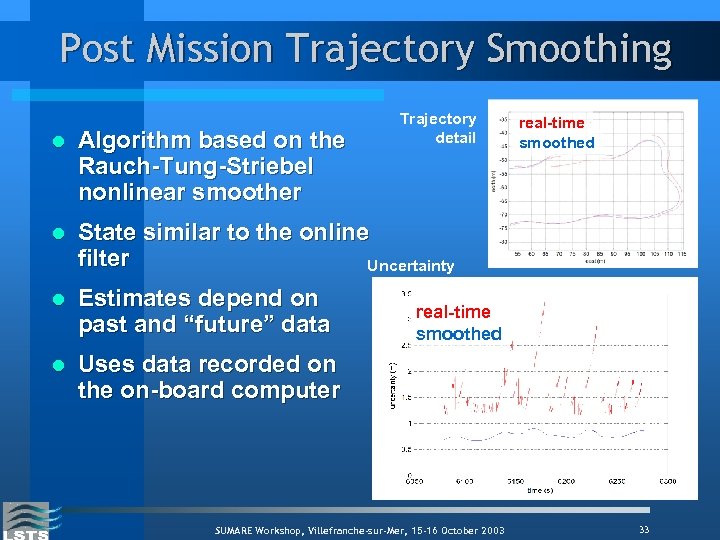 Post Mission Trajectory Smoothing Trajectory detail l Algorithm based on the Rauch-Tung-Striebel nonlinear smoother l State similar to the online filter Uncertainty l Estimates depend on past and “future” data l real-time smoothed Uses data recorded on the on-board computer real-time smoothed SUMARE Workshop, Villefranche-sur-Mer, 15 -16 October 2003 33
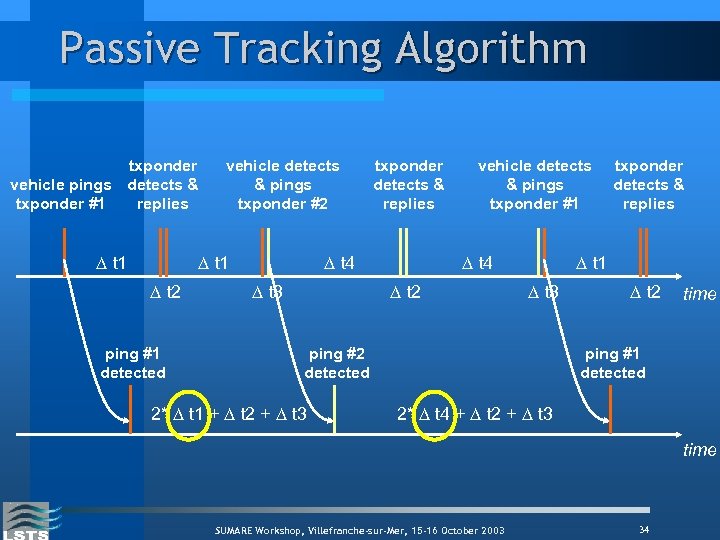 Passive Tracking Algorithm txponder vehicle pings detects & replies txponder #1 t 1 vehicle detects & pings txponder #2 t 1 t 2 ping #1 detected txponder detects & replies t 4 t 3 vehicle detects & pings txponder #1 t 4 t 2 t 1 t 3 ping #2 detected 2* t 1 + t 2 + t 3 txponder detects & replies t 2 time ping #1 detected 2* t 4 + t 2 + t 3 time SUMARE Workshop, Villefranche-sur-Mer, 15 -16 October 2003 34
 External Tracking Mechanism l Normal operation – – – Listenning device just detects pings sent by the vehicles After two interrogations, a range is computed Listenning device can be located anywhere within acoustic range (including other AUVs!) – Vehicles keep navigating at the end of mission l Emergency operation – – – Simple commands can be sent to the vehicles Vehicles carry an automatic responder Ranges can be estimated even with computer system shut down SUMARE Workshop, Villefranche-sur-Mer, 15 -16 October 2003 35
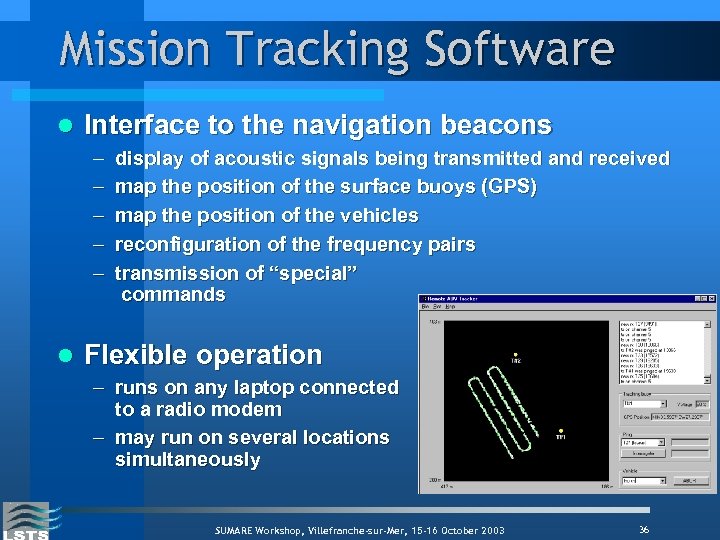 Mission Tracking Software l Interface to the navigation beacons – – – l display of acoustic signals being transmitted and received map the position of the surface buoys (GPS) map the position of the vehicles reconfiguration of the frequency pairs transmission of “special” commands Flexible operation – runs on any laptop connected to a radio modem – may run on several locations simultaneously SUMARE Workshop, Villefranche-sur-Mer, 15 -16 October 2003 36
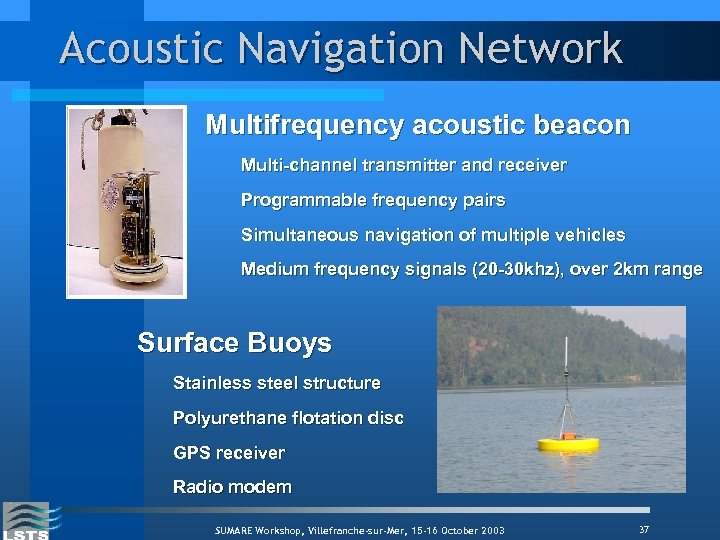 Acoustic Navigation Network Multifrequency acoustic beacon Multi-channel transmitter and receiver Programmable frequency pairs Simultaneous navigation of multiple vehicles Medium frequency signals (20 -30 khz), over 2 km range Surface Buoys Stainless steel structure Polyurethane flotation disc GPS receiver Radio modem SUMARE Workshop, Villefranche-sur-Mer, 15 -16 October 2003 37
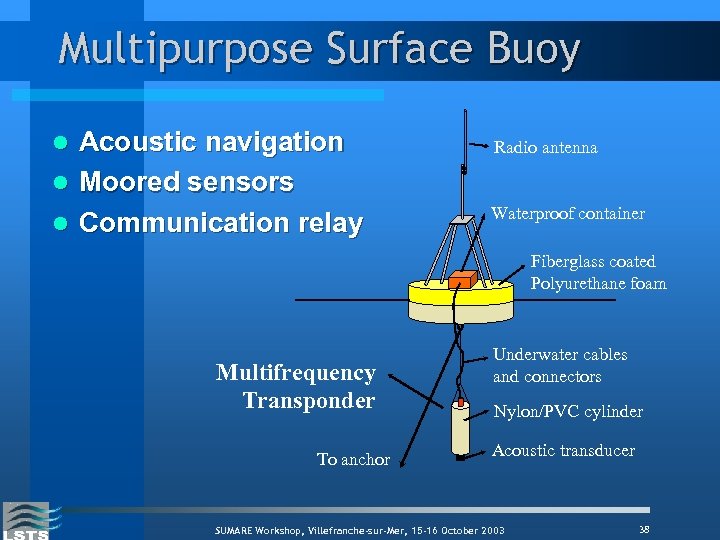 Multipurpose Surface Buoy l l l Acoustic navigation Moored sensors Communication relay Radio antenna Waterproof container Fiberglass coated Polyurethane foam Multifrequency Transponder To anchor Underwater cables and connectors Nylon/PVC cylinder Acoustic transducer SUMARE Workshop, Villefranche-sur-Mer, 15 -16 October 2003 38
 Advanced Mission Concepts
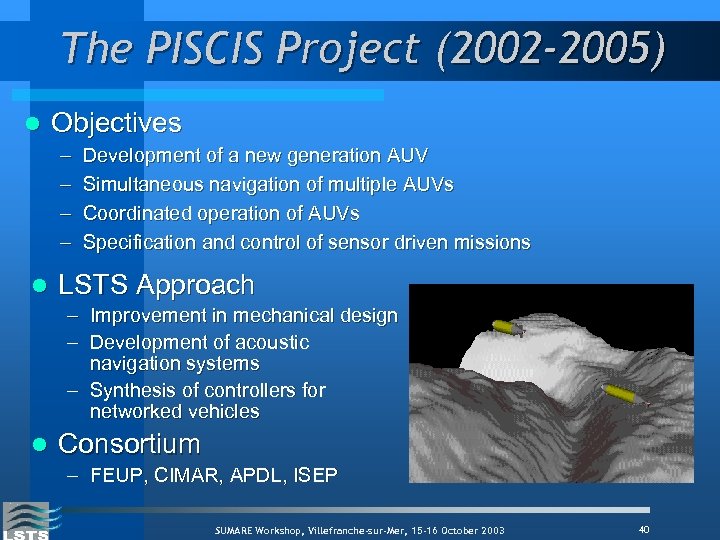 The PISCIS Project (2002 -2005) l Objectives – – l Development of a new generation AUV Simultaneous navigation of multiple AUVs Coordinated operation of AUVs Specification and control of sensor driven missions LSTS Approach – Improvement in mechanical design – Development of acoustic navigation systems – Synthesis of controllers for networked vehicles l Consortium – FEUP, CIMAR, APDL, ISEP SUMARE Workshop, Villefranche-sur-Mer, 15 -16 October 2003 40
 Advanced Mission Concepts l Real-time adaptive sampling – Model of oceanographic processes – Coarse survey to localize features – Track features and identify model parameters l Cooperative missions – Each vehicle makes a local measurement – Vehicles share a minimum of data l Gradient following – Detect and follow a given gradient – Possibilities for single and multiple vehicles SUMARE Workshop, Villefranche-sur-Mer, 15 -16 October 2003 41
 Conclusions and Future Work l Conclusions – The LSTS team has accumulated valuable expertise in development and integration of underwater systems and technologies – Low operational costs allowed for development validation by intensive field operations – Research has been driven by end-user requirements and strongly influenced by mission results l What’s ahead? – – – – New AUV expected to be tested during 2003 New AUV fully operational in 2004 Navigation of multiple AUVs expected during 2004 Coordinated operation of AUVs expected during 2004 Communication between AUVs, buoys and shore during 2004 New sensors for ROV during 2004 Intervention capabilities for ROV during 2004 SUMARE Workshop, Villefranche-sur-Mer, 15 -16 October 2003 42 Artwork Courtesy of Michael Incze, NUWC
 Thank You. Questions?