 Скачать презентацию THE UN GLOBAL COMPACT MODULE 4 FROM PRINCIPLE
06ece3d4defb6b1d2b26179de2cee188.ppt
- Количество слайдов: 17



THE UN GLOBAL COMPACT MODULE 4 FROM PRINCIPLE TO PRACTICE Session 1: Steps to Sustainability using the Global Compact Performance Model UNGC Module 4 – Session 1 1
From Principle to Practice: The GC Performance Model To participate in the Global Compact a company typically: – Sends a letter to the UN Secretary General – Publicly advocates the Global Compact – Posts material on the Global Compact website – Publishes an annual report – Joins with the UN in partnership projects – Sets in motion changes to its business operations The final point above is the most important, and is the focus of the rest of this session: moving from principle to practice Note: Updated details on the requirements for participating in the Global Compact are available from the Global Compact website UNGC Module 4 – Session 1 2
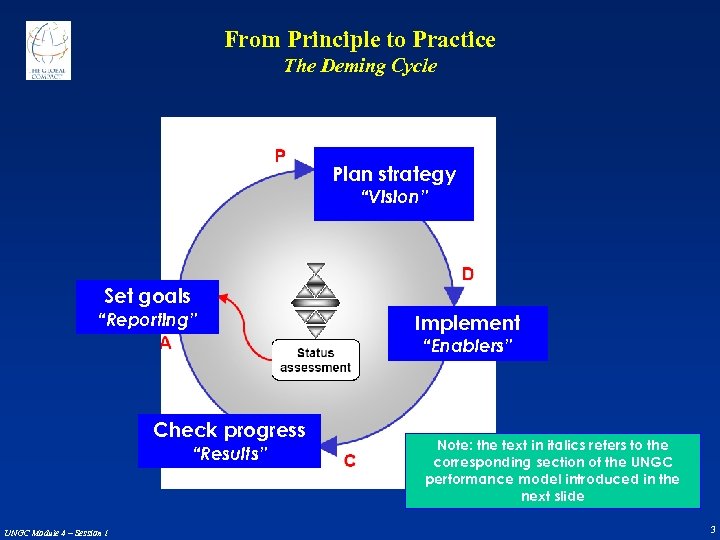
From Principle to Practice The Deming Cycle Plan strategy “Vision” Set goals “Reporting” Implement “Enablers” Check progress “Results” UNGC Module 4 – Session 1 Note: the text in italics refers to the corresponding section of the UNGC performance model introduced in the next slide 3
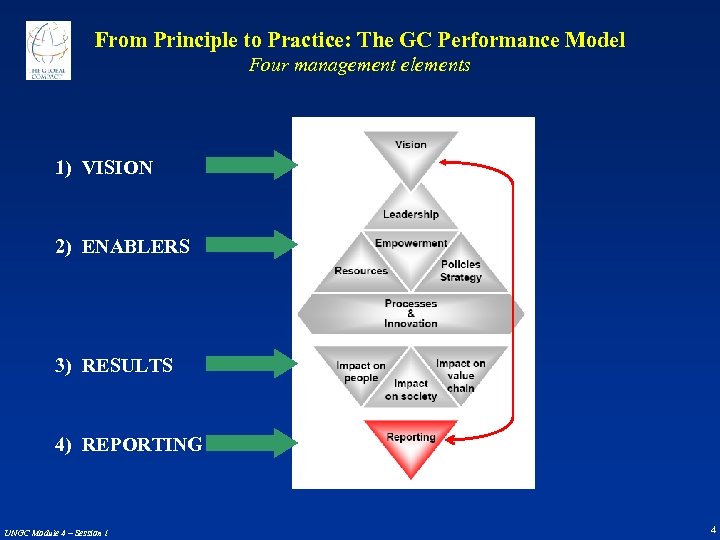
From Principle to Practice: The GC Performance Model Four management elements 1) VISION 2) ENABLERS 3) RESULTS 4) REPORTING UNGC Module 4 – Session 1 4
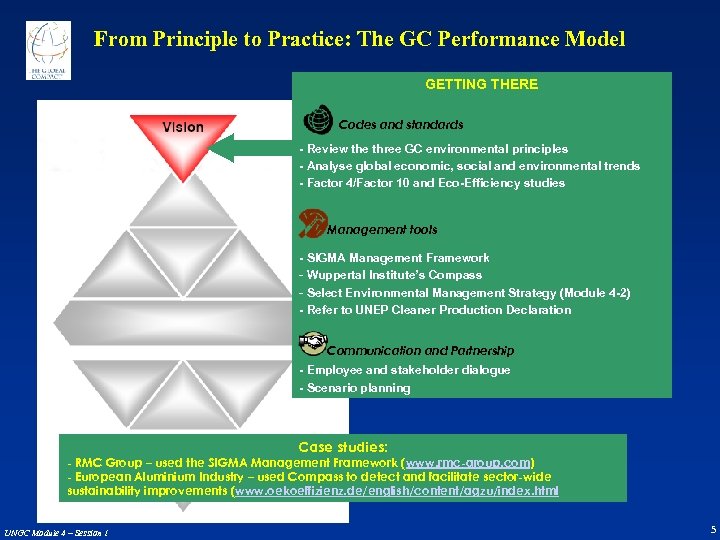
From Principle to Practice: The GC Performance Model GETTING THERE Codes and standards - Review the three GC environmental principles - Analyse global economic, social and environmental trends - Factor 4/Factor 10 and Eco-Efficiency studies Management tools - SIGMA Management Framework - Wuppertal Institute’s Compass - Select Environmental Management Strategy (Module 4 -2) - Refer to UNEP Cleaner Production Declaration Communication and Partnership - Employee and stakeholder dialogue - Scenario planning Case studies: - RMC Group – used the SIGMA Management Framework (www. rmc-group. com) - European Aluminium Industry – used Compass to detect and facilitate sector-wide sustainability improvements (www. oekoeffizienz. de/english/content/agzu/index. html UNGC Module 4 – Session 1 5
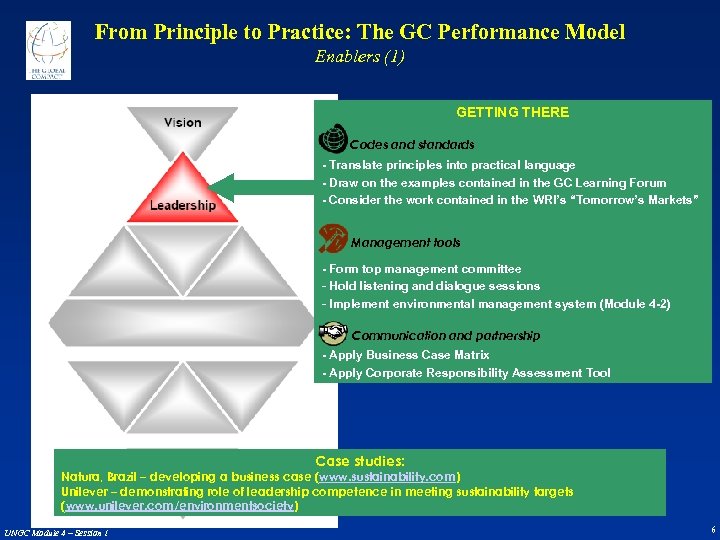
From Principle to Practice: The GC Performance Model Enablers (1) GETTING THERE Codes and standards - Translate principles into practical language - Draw on the examples contained in the GC Learning Forum - Consider the work contained in the WRI’s “Tomorrow’s Markets” Management tools - Form top management committee - Hold listening and dialogue sessions - Implement environmental management system (Module 4 -2) Communication and partnership - Apply Business Case Matrix - Apply Corporate Responsibility Assessment Tool Case studies: Natura, Brazil – developing a business case (www. sustainability. com) Unilever – demonstrating role of leadership competence in meeting sustainability targets (www. unilever. com/environmentsociety) UNGC Module 4 – Session 1 6
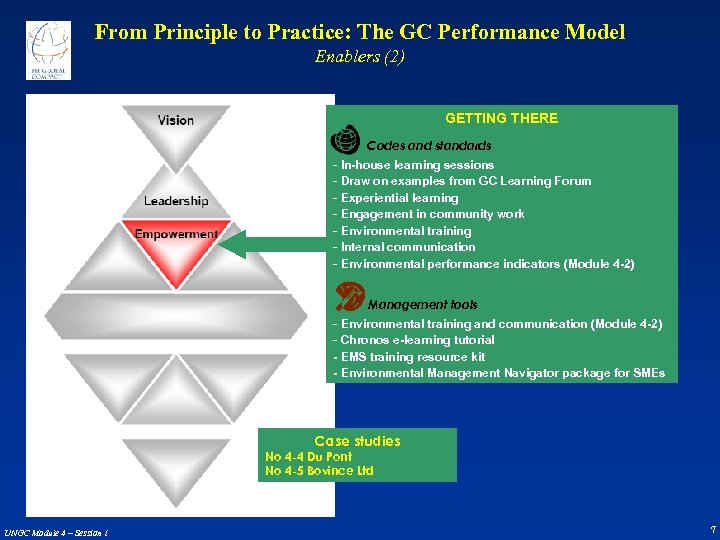
From Principle to Practice: The GC Performance Model Enablers (2) GETTING THERE Codes and standards - In-house learning sessions - Draw on examples from GC Learning Forum - Experiential learning - Engagement in community work - Environmental training - Internal communication - Environmental performance indicators (Module 4 -2) Management tools - Environmental training and communication (Module 4 -2) - Chronos e-learning tutorial - EMS training resource kit - Environmental Management Navigator package for SMEs Case studies No 4 -4 Du Pont No 4 -5 Bovince Ltd UNGC Module 4 – Session 1 7
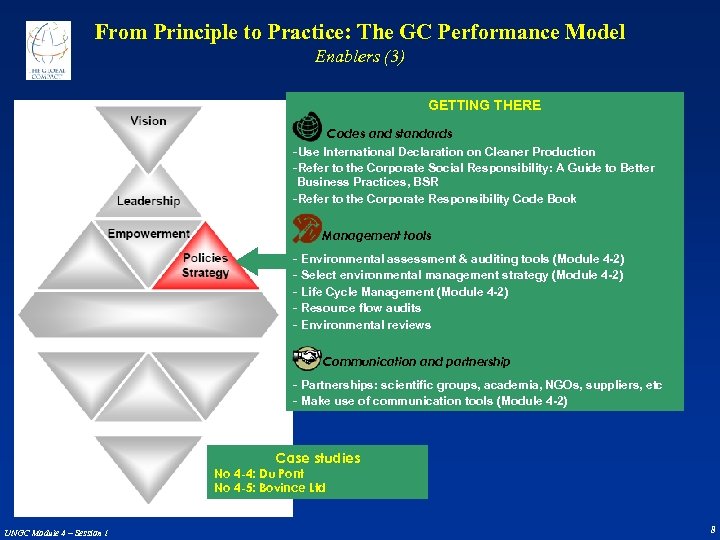
From Principle to Practice: The GC Performance Model Enablers (3) GETTING THERE Codes and standards -Use International Declaration on Cleaner Production -Refer to the Corporate Social Responsibility: A Guide to Better Business Practices, BSR -Refer to the Corporate Responsibility Code Book Management tools - Environmental assessment & auditing tools (Module 4 -2) - Select environmental management strategy (Module 4 -2) - Life Cycle Management (Module 4 -2) - Resource flow audits - Environmental reviews Communication and partnership - Partnerships: scientific groups, academia, NGOs, suppliers, etc - Make use of communication tools (Module 4 -2) Case studies No 4 -4: Du Pont No 4 -5: Bovince Ltd UNGC Module 4 – Session 1 8
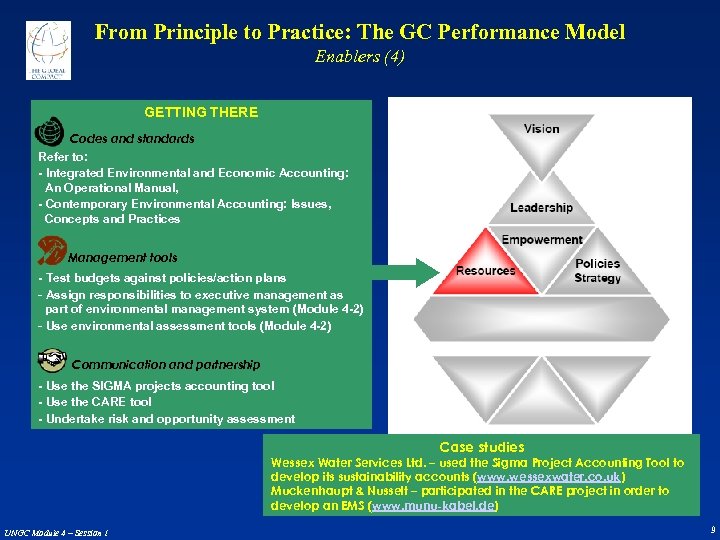
From Principle to Practice: The GC Performance Model Enablers (4) GETTING THERE Codes and standards Refer to: - Integrated Environmental and Economic Accounting: An Operational Manual, - Contemporary Environmental Accounting: Issues, Concepts and Practices Management tools - Test budgets against policies/action plans - Assign responsibilities to executive management as part of environmental management system (Module 4 -2) - Use environmental assessment tools (Module 4 -2) Communication and partnership - Use the SIGMA projects accounting tool - Use the CARE tool - Undertake risk and opportunity assessment Case studies Wessex Water Services Ltd. – used the Sigma Project Accounting Tool to develop its sustainability accounts (www. wessexwater. co. uk) Muckenhaupt & Nusselt – participated in the CARE project in order to develop an EMS (www. munu-kabel. de) UNGC Module 4 – Session 1 9
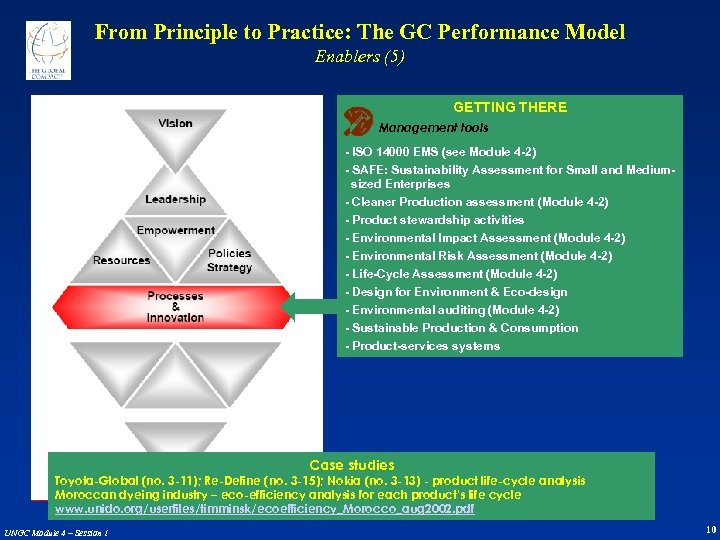
From Principle to Practice: The GC Performance Model Enablers (5) GETTING THERE Management tools - ISO 14000 EMS (see Module 4 -2) - SAFE: Sustainability Assessment for Small and Mediumsized Enterprises - Cleaner Production assessment (Module 4 -2) - Product stewardship activities - Environmental Impact Assessment (Module 4 -2) - Environmental Risk Assessment (Module 4 -2) - Life-Cycle Assessment (Module 4 -2) - Design for Environment & Eco-design - Environmental auditing (Module 4 -2) - Sustainable Production & Consumption - Product-services systems Case studies Toyota-Global (no. 3 -11); Re-Define (no. 3 -15); Nokia (no. 3 -13) - product life-cycle analysis Moroccan dyeing industry – eco-efficiency analysis for each product’s life cycle www. unido. org/userfiles/timminsk/ecoefficiency_Morocco_aug 2002. pdf UNGC Module 4 – Session 1 10
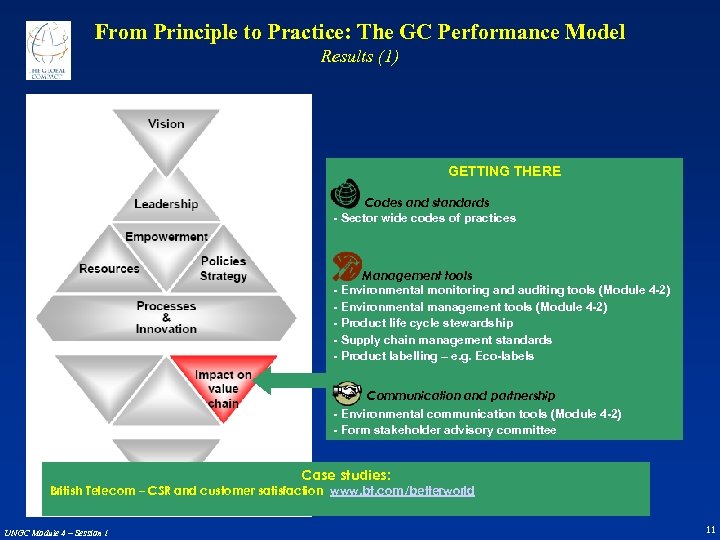
From Principle to Practice: The GC Performance Model Results (1) GETTING THERE Codes and standards - Sector wide codes of practices Management tools - Environmental monitoring and auditing tools (Module 4 -2) - Environmental management tools (Module 4 -2) - Product life cycle stewardship - Supply chain management standards - Product labelling – e. g. Eco-labels Communication and partnership - Environmental communication tools (Module 4 -2) - Form stakeholder advisory committee Case studies: British Telecom – CSR and customer satisfaction www. bt. com/betterworld UNGC Module 4 – Session 1 11
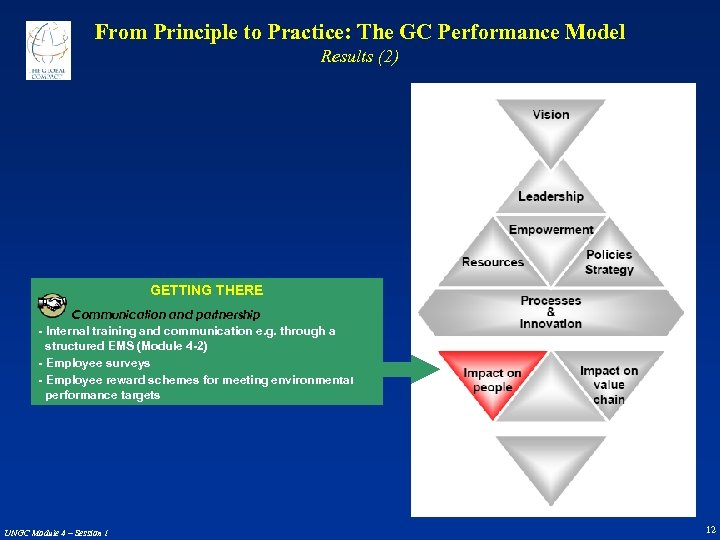
From Principle to Practice: The GC Performance Model Results (2) GETTING THERE Communication and partnership - Internal training and communication e. g. through a structured EMS (Module 4 -2) - Employee surveys - Employee reward schemes for meeting environmental performance targets UNGC Module 4 – Session 1 12
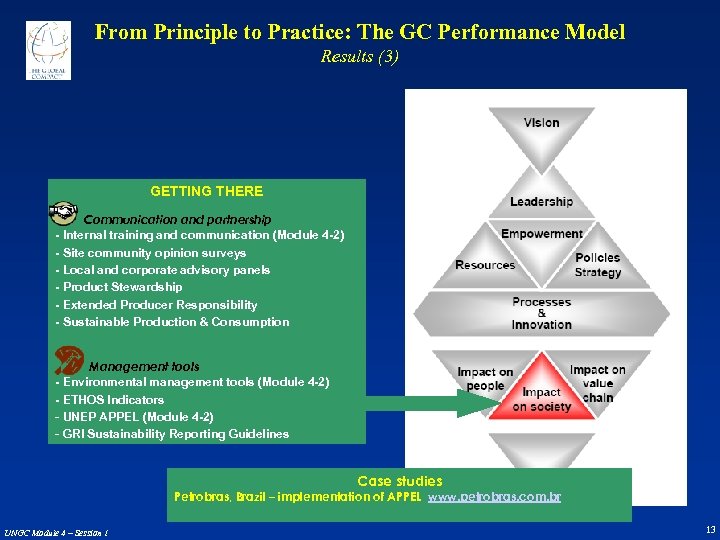
From Principle to Practice: The GC Performance Model Results (3) GETTING THERE Communication and partnership - Internal training and communication (Module 4 -2) - Site community opinion surveys - Local and corporate advisory panels - Product Stewardship - Extended Producer Responsibility - Sustainable Production & Consumption Management tools - Environmental management tools (Module 4 -2) - ETHOS Indicators - UNEP APPEL (Module 4 -2) - GRI Sustainability Reporting Guidelines Case studies Petrobras, Brazil – implementation of APPEL www. petrobras. com. br UNGC Module 4 – Session 1 13
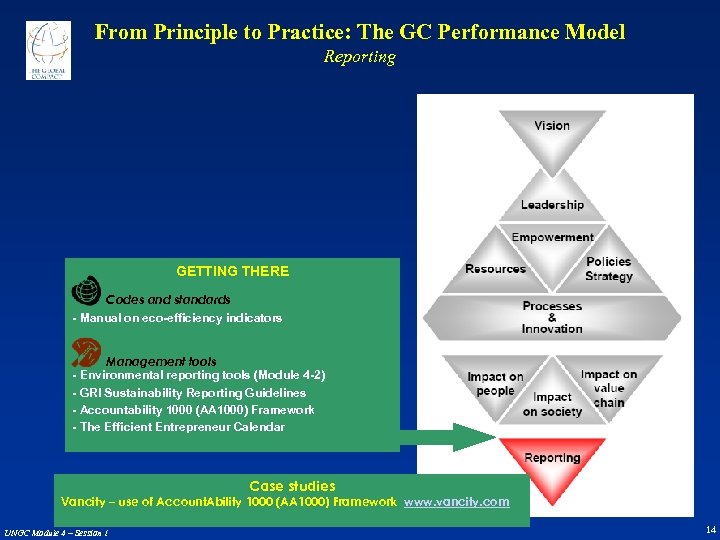
From Principle to Practice: The GC Performance Model Reporting GETTING THERE Codes and standards - Manual on eco-efficiency indicators Management tools - Environmental reporting tools (Module 4 -2) - GRI Sustainability Reporting Guidelines - Accountability 1000 (AA 1000) Framework - The Efficient Entrepreneur Calendar Case studies Vancity – use of Account. Ability 1000 (AA 1000) Framework www. vancity. com UNGC Module 4 – Session 1 14
From Principle to Practice: The GC Performance Model The Global Compact’s engagement opportunities: - Policy dialogue - Learning - Local Networks - Partnership Projects UNGC Module 4 – Session 1 15
From Principle to Practice: The GC Performance Model The Global Compact’s Learning Forum: - Examples of corporate experiences in implementing the ten principles of the Global Compact - Case studies of corporate experiences - Description of partnership projects - Research matching database - Learning Forum publications - Tools development UNGC Module 4 – Session 1 16
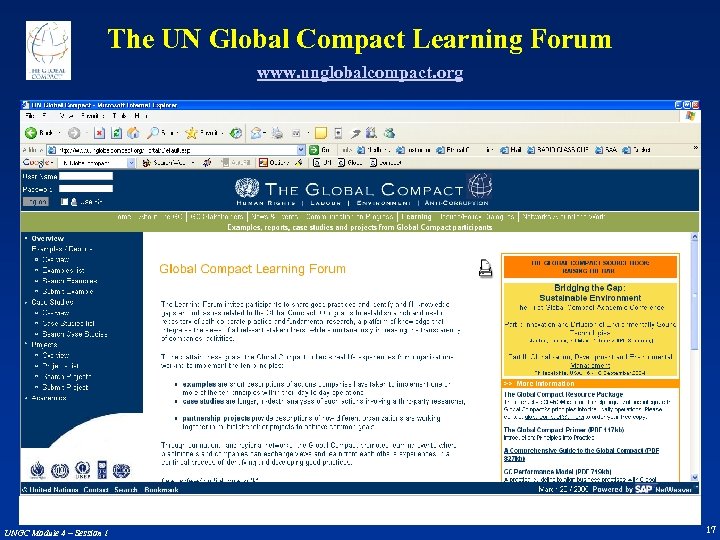
The UN Global Compact Learning Forum www. unglobalcompact. org UNGC Module 4 – Session 1 17
Скачать презентацию THE UN GLOBAL COMPACT MODULE 4 FROM PRINCIPLE
06ece3d4defb6b1d2b26179de2cee188.ppt