Скачать презентацию The UMLS Semantic Network Alexa T Mc Cray
c9ebdd6e6cbdf6e1220ccd3addb3950c.ppt
- Количество слайдов: 32
 The UMLS Semantic Network Alexa T. Mc. Cray Center for Clinical Computing Beth Israel Deaconess Medical Center Harvard Medical School mccray@bidmc. harvard. edu The Future of the UMLS Semantic Network National Library of Medicine, April 7, 2005
 UMLS Project • Begun in 1986 - Well before the advent of the World Wide Web • Goal - To provide intelligent access to biomedical resources in multiple, disparate databases • Language of those resources of primary interest • Methodology - Consultation with broad medical informatics constituency - Development of Knowledge Sources
 Initial Efforts • First versions of knowledge sources available to researchers in early 1990’s - Metathesaurus (1990) • Interrelate existing vocabularies, thesauri - Semantic Network (1990) • Assignment of semantic types to Metathesaurus concepts - Information Sources Map (1991) • Characterization of existing databases, including query syntax and Me. SH indexing - SPECIALIST Lexicon (1994) • Syntactic, morphologic, orthographic information about biomedical and general English terminology
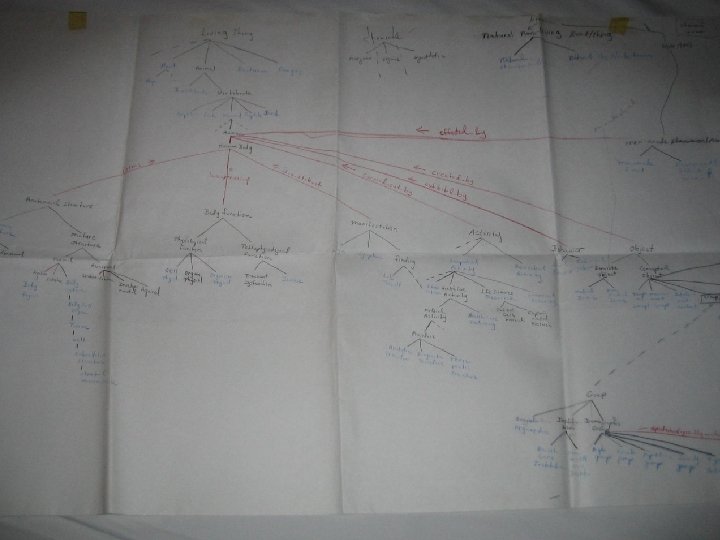
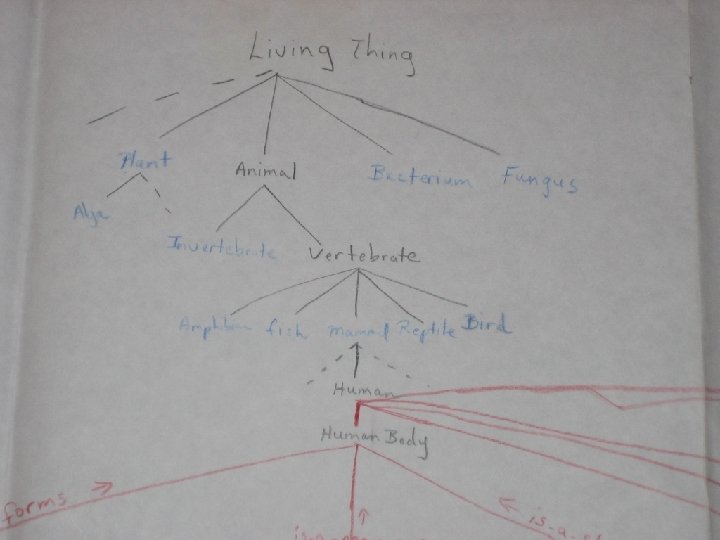
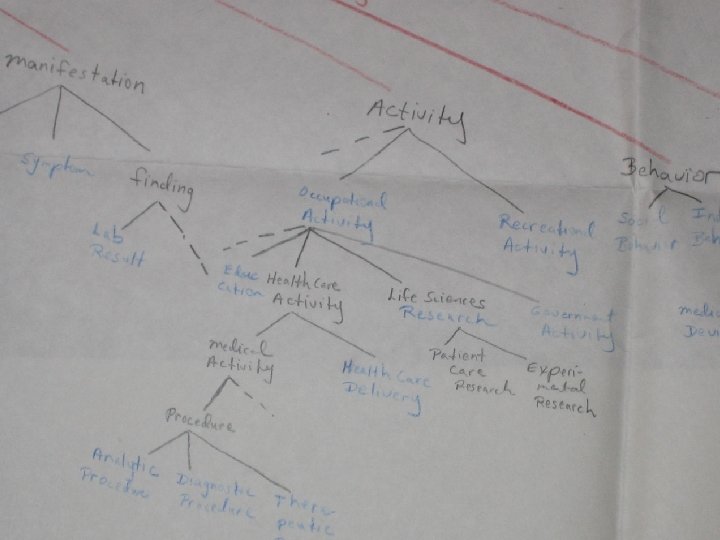
 Early Development of the UMLS Semantic Network (1988 -1989) • UMLSsemantic typesaskedpotential lists of collaborators to submit useful and relationships between them - Active participation by BWH, Yale, Pittsburgh • Purpose - Consistent categorization of all Metathesaurus concepts • Early into a network of interrelated types attempts at organizing the suggested types
 First Released Version of UMLS Semantic Network (1990) • 131 semantic types - Each Metathesaurus concept assigned one or more semantic types, according to definitions of the types and a set of guidelines • 35 relationships - Relationships developed by top-down and bottom-up approaches and included definitions • Those deemed to be important for information retrieval • Review of (implicit) relationships in Me. SH and in MEDLINE citation records
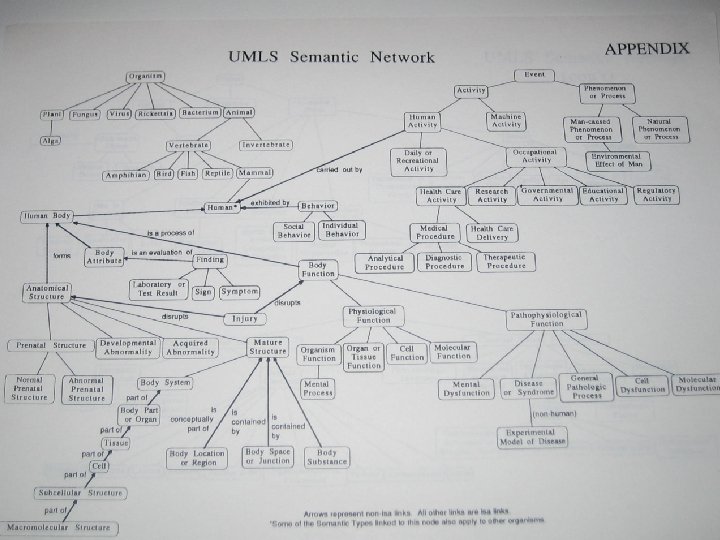
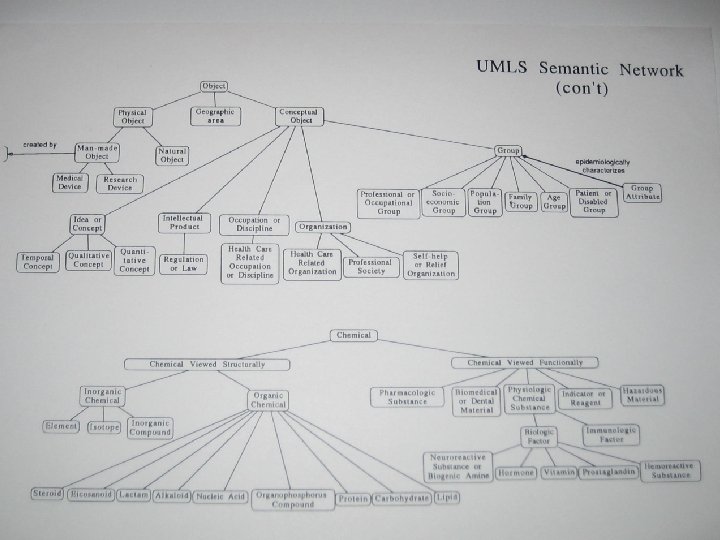
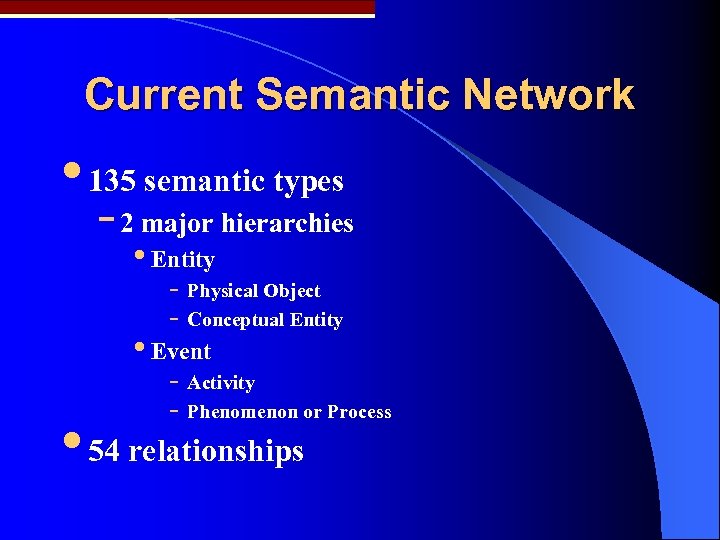 Current Semantic Network • 135 semantic types - 2 major hierarchies • Entity - Physical Object - Conceptual Entity • Event • - Activity - Phenomenon or Process 54 relationships
 Sample Semantic Type Definition UI: T 190 STY: Anatomical Abnormality ABR: anab STN: A 1. 2. 2 DEF: An abnormal structure, or one that is abnormal in size or location. UN: Use this type if the abnormality in question can be either an acquired or congenital abnormality. Neoplasms are not included here. These are given the type 'Neoplastic Process'. If an anatomical abnormality has a pathologic manifestation, then it will additionally be given the type 'Disease or Syndrome', e. g. , "Diabetic Cataract" will be double-typed for this reason. HL: {isa} Anatomical Structure; {inverse_isa} Congenital Abnormality; {inverse_isa} Acquired Abnormality
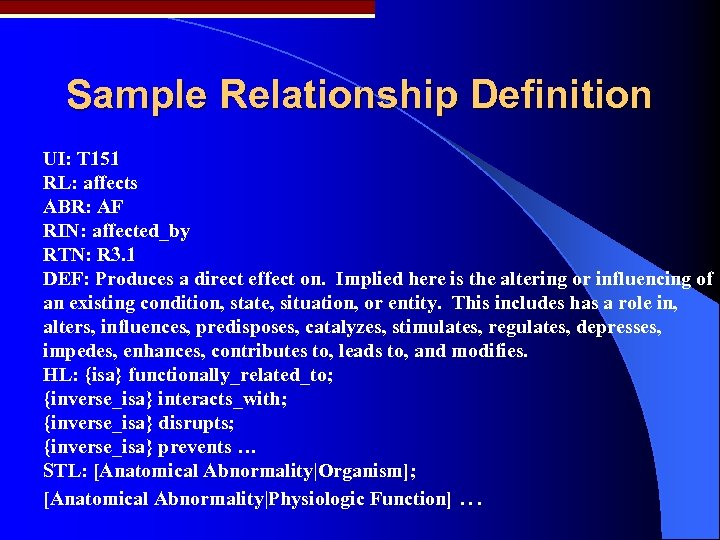 Sample Relationship Definition UI: T 151 RL: affects ABR: AF RIN: affected_by RTN: R 3. 1 DEF: Produces a direct effect on. Implied here is the altering or influencing of an existing condition, state, situation, or entity. This includes has a role in, alters, influences, predisposes, catalyzes, stimulates, regulates, depresses, impedes, enhances, contributes to, leads to, and modifies. HL: {isa} functionally_related_to; {inverse_isa} interacts_with; {inverse_isa} disrupts; {inverse_isa} prevents … STL: [Anatomical Abnormality|Organism]; [Anatomical Abnormality|Physiologic Function] …
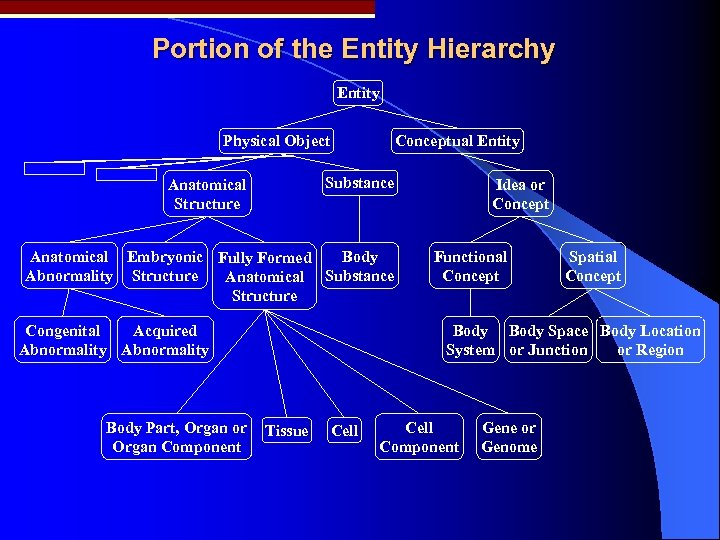 Portion of the Entity Hierarchy Entity Physical Object Conceptual Entity Substance Anatomical Structure Anatomical Embryonic Fully Formed Body Abnormality Structure Anatomical Substance Structure Congenital Acquired Abnormality Body Part, Organ or Organ Component Idea or Concept Functional Concept Spatial Concept Body Space Body Location System or Junction or Region Tissue Cell Component Gene or Genome
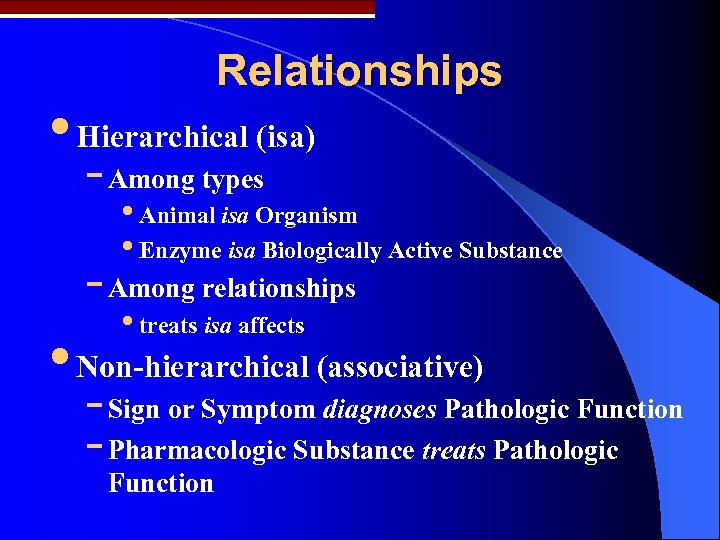 Relationships • Hierarchical (isa) - Among types • Animal isa Organism • Enzyme isa Biologically Active Substance - Among relationships • treats isa affects • Non-hierarchical (associative) - Sign or Symptom diagnoses Pathologic Function - Pharmacologic Substance treats Pathologic Function
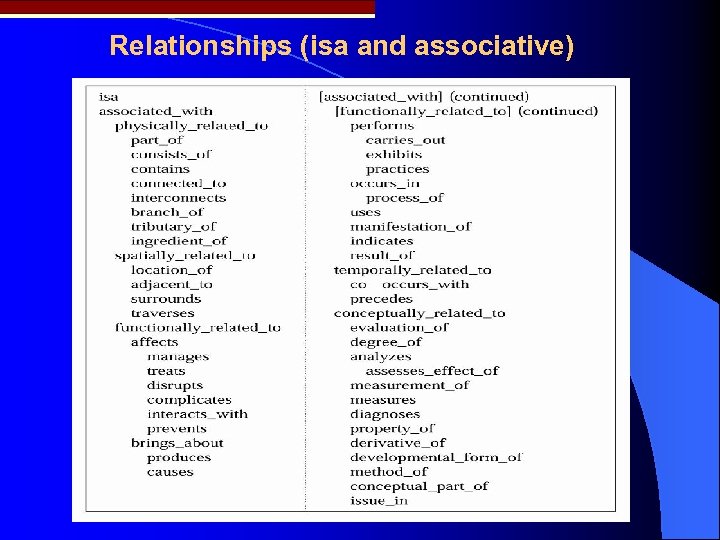 Relationships (isa and associative)
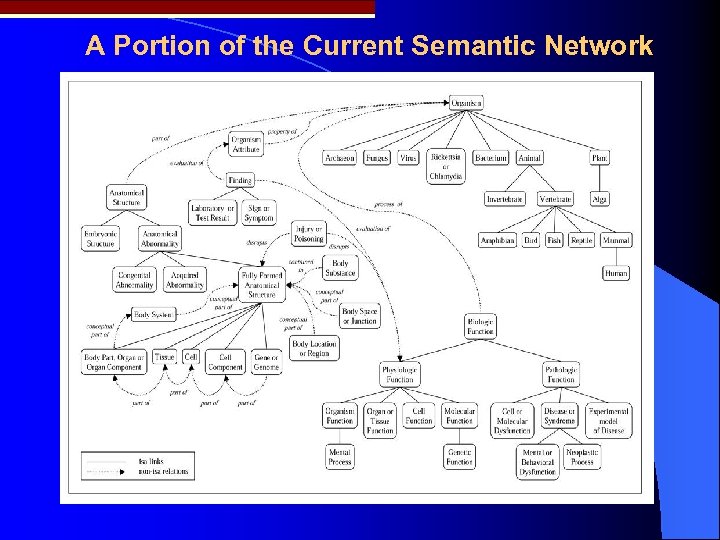 A Portion of the Current Semantic Network
 Relationships • Relationship between a pair of semantic types is a possible link between the concepts assigned to those semantic types - Relationship may or may not hold at the concept level • A child semantic type inherits properties from its parents
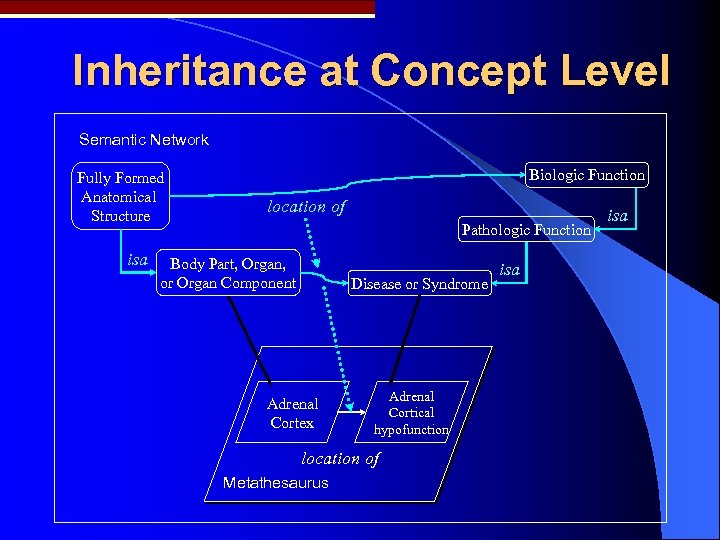 Inheritance at Concept Level Semantic Network Fully Formed Anatomical Structure isa Biologic Function location of Pathologic Function Body Part, Organ, or Organ Component Disease or Syndrome Adrenal Cortex Adrenal Cortical hypofunction location of Metathesaurus isa
 Grouping Semantic. Types • Complexity of domain makes it difficult to - Navigate and display the knowledge - Reason with the objects in the domain - Comprehend the conceptual space • Semantic Network reduces the conceptual complexity of the UMLS, but - For some purposes, smaller and coarsergrained groupings are needed
 Semantic Type Groupings (2001) • Clustered the larger set of semantic types into a small number of general groups • Total of 15 groupings • Effected an almost complete partitioning of the UMLS Metathesaurus
 Grouping Principles • Completeness - Groups must cover the full domain • Parsimony - Number of groups should be as small as possible • Naturalness - Groups must be acceptable to a domain expert
 Grouping Principles (cont. ) • Utility - Groups must be useful for some purpose • Semantic validity - Groups must be semantically coherent - Relationships shared by members of group • Exclusivity - Groups fully partition the domain
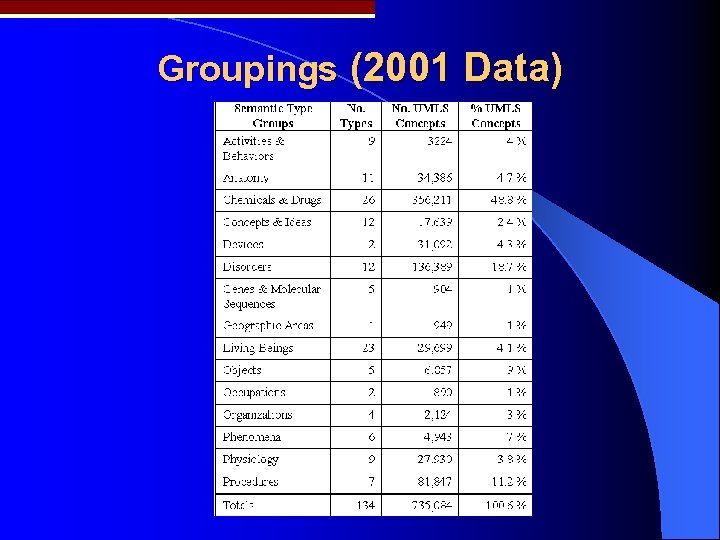 Groupings (2001 Data)
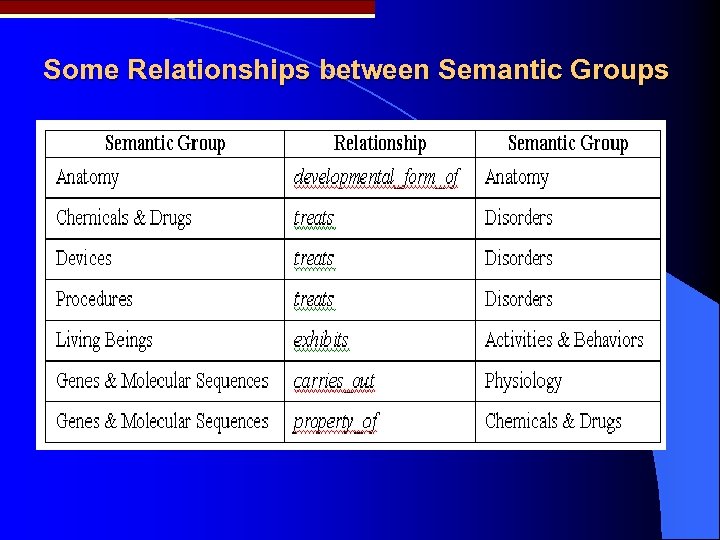 Some Relationships between Semantic Groups
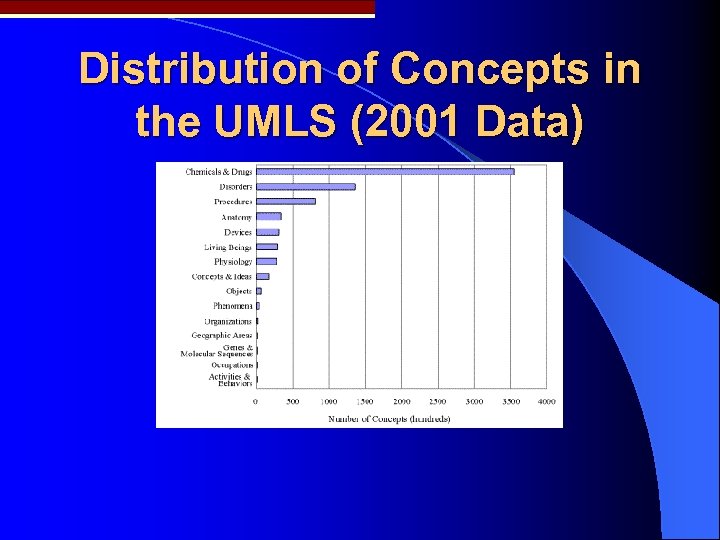 Distribution of Concepts in the UMLS (2001 Data)
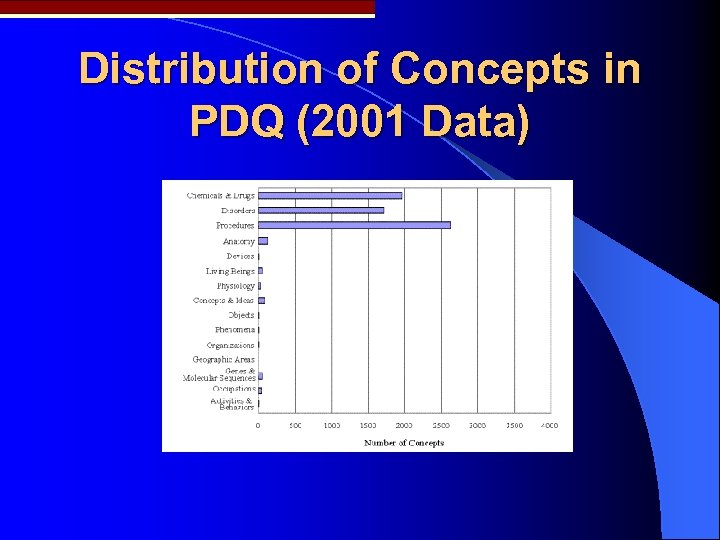 Distribution of Concepts in PDQ (2001 Data)
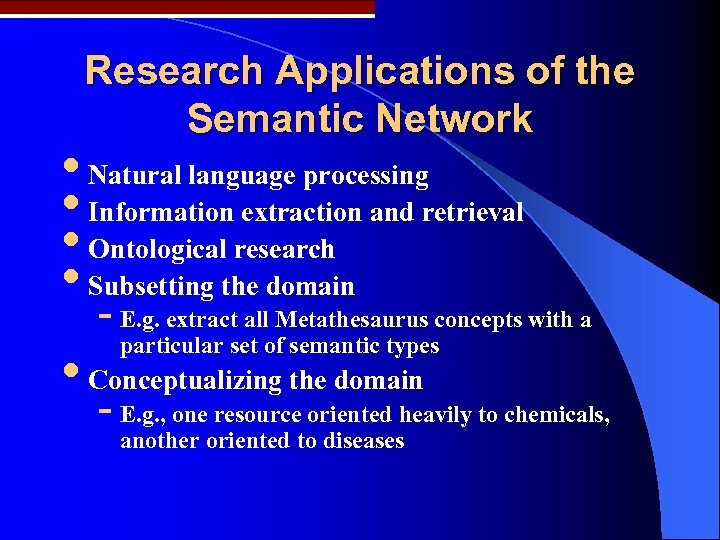 Research Applications of the Semantic Network • Natural language processing • Information extraction and retrieval • Ontological research • Subsetting the domain - E. g. extract all Metathesaurus concepts with a particular set of semantic types • Conceptualizing the domain - E. g. , one resource oriented heavily to chemicals, another oriented to diseases
 Summary • UMLS Semantic Network - Provides overall conceptual structure to the UMLS by • Linking semantic types to Metathesaurus concepts • Providing a set of relationships to interrelate the types and (by inference) the concepts • Allowing users to extract all concepts with a particular type - Used in a number of research applications - Variety of enhancements possible
 Some References • Mc. Cray AT, Hole WT. The scope and structure of the • • first version of the UMLS Semantic Network. Proc Annu Symp Comput Appl Med Care, 1990; 126‑ 130. Mc. Cray AT. The UMLS Semantic Network. Proc Annu Symp Comput Appl Med Care. 1989; 503 -7. Mc. Cray AT. Representing biomedical knowledge in the UMLS Semantic Network. High‑Performance Medical Libraries: Advances in Information Management for the Virtual Era. Westport: Meckler Publishing, 1993; 45‑ 55.
 Some References (cont. ) • Mc. Cray AT, Nelson SJ. The representation of meaning in the UMLS. Methods Inf Med. 1995; 34(1‑ 2): 193‑ 201. • Mc. Cray AT, Burgun A, Bodenreider O. Aggregating • • UMLS semantic types for reducing conceptual complexity. MEDINFO. 2001; 216 -220. Mc. Cray AT. An upper level ontology for the biomedical domain. Comp Funct Genom 2003; 4: 80 -4. Bodenreider O, Mc. Cray AT. Exploring semantic groups through visual approaches. Journal of Biomedical Informatics 2003; 36(6): 414 -432.