


 Скачать презентацию The UK competition regime an example of inter-institutional
6368295099c49e37f21a036583abc462.ppt
- Количество слайдов: 25
 The UK competition regime: an example of inter-institutional working Cathryn Ross Deputy Director of Remedies Competition Commission 2 February 2004
 Overview • Introduction • Structure of UK competition enforcement • The Competition Act 1998 • The Enterprise Act 2002 • Concurrency • Regulation and competition • EU modernisation • Conclusions
 Introduction: Who am I? Why am I here? Deputy Director of Remedies, CC § Overseeing provision of advice on remedies in merger inquiries and market investigations Head of Competition Economics, ORR § Overseeing competition analysis § Development of regulatory policy relating to competition Economic Adviser, Oftel § Competition analysis under competition law and sectoral legislation
 Competition enforcement in the UK (1) The Competition Act 1998 • Similar to Article 81 (EU) Article 82 (EU) • Ch I: Prohibition on anti-competitive agreements – Includes cartels, resale price maintenance etc. – Block exemptions possible (eg transport ticketing) – Land vertical agreement exclusion • Ch II: Prohibition on abuse of dominance – Includes excessive pricing, predation, discrimination, refusal to deal etc • Specific legal exclusion • Section 60 obligation
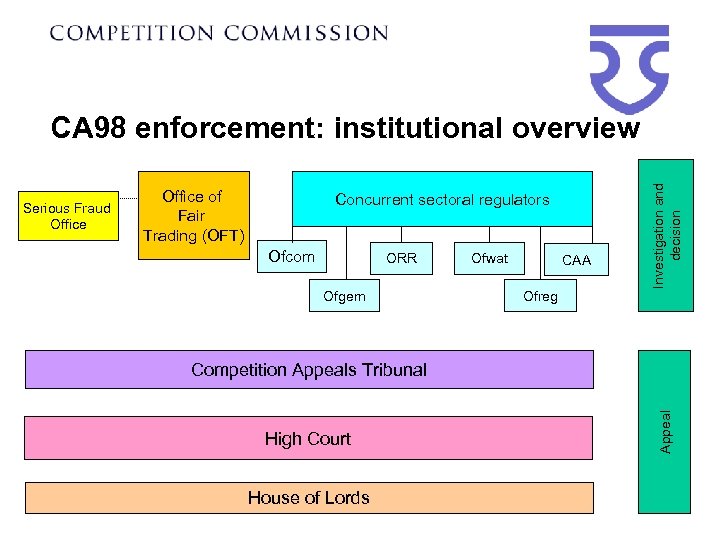 Office of Fair Trading (OFT) Concurrent sectoral regulators Ofcom ORR Ofgem Ofwat CAA Ofreg Competition Appeals Tribunal High Court House of Lords Appeal Serious Fraud Office Investigation and decision CA 98 enforcement: institutional overview
 Competition enforcement in the UK (2) The Enterprise Act 2002 • Amended the CA 98 – eg criminalisation of cartels (SFO involvement in investigation) • Established new merger regime: – ‘Substantial lessening of competition’ test (‘SLC’): phase 1 inquiry by OFT, possible referral to CC for phase 2 – CC assesses SLC, negotiates and implements remedies – OFT (still) monitors compliance – OFT can review remedies and request that the CC remove or alter
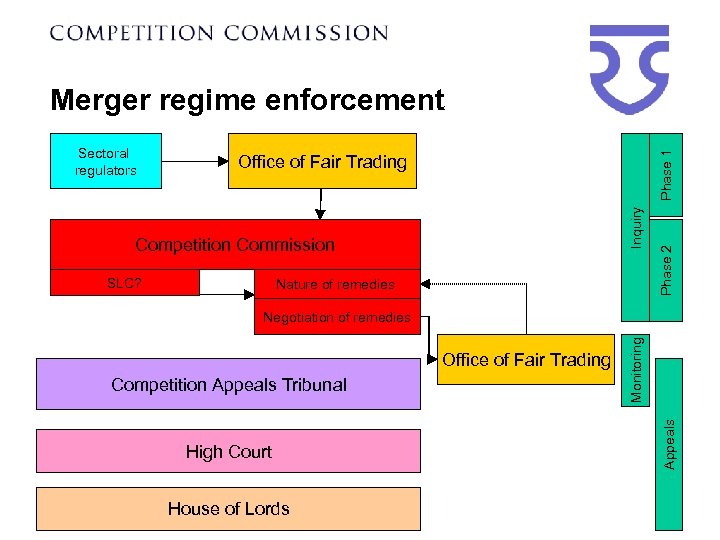 Competition Commission SLC? Nature of remedies Phase 2 Office of Fair Trading Inquiry Sectoral regulators Phase 1 Merger regime enforcement Competition Appeals Tribunal High Court House of Lords Appeals Office of Fair Trading Monitoring Negotiation of remedies
 Competition enforcement in the UK (3) The Enterprise Act 2002 • Market investigations – OFT/sectoral regulators can refer markets to CC for investigation – CC looks at whether any feature or combination of features of the market has an adverse effect on competition (‘AEC’) – CC can implement remedies and/or make recommendations (can modify licences) • Vitally important element of UK regime – allows action to be taken to make markets work better even where no breach of law (non-collusive oligopoly)
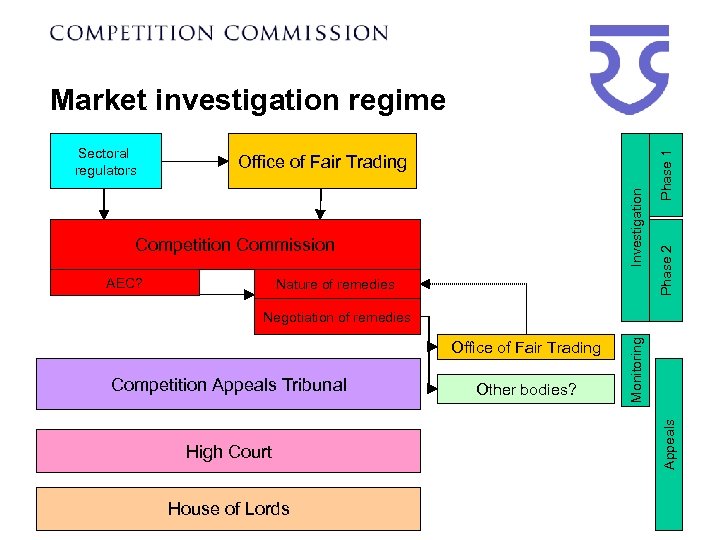 Competition Commission AEC? Nature of remedies Phase 2 Office of Fair Trading Investigation Sectoral regulators Phase 1 Market investigation regime Competition Appeals Tribunal High Court House of Lords Other bodies? Appeals Office of Fair Trading Monitoring Negotiation of remedies
 Competition enforcement in the UK (4) Summary • Legislative base: – CA 98: – EA 02: agreements and abuse of dominance mergers market investigations • Institutional base: – – Office of Fair Trading Sectoral regulators (Ofcom, Ofwat, ORR, Ofgem, Ofreg, CAA) Competition Commission Competition Appeals Tribunal and courts
 Concurrency (1) • Some sectoral regulators have powers to investigate suspected infringements of the CA 98 in their areas. Why? – Regulated industries often complex. Takes advantage of sectoral knowledge. Can use data gathered for regulatory purposes. – Complementarity of regulatory powers and CA 98 powers. ‘Joined up approach’. Regulators can choose most appropriate tool for the job (strategic decision). – Shifting regulatory focus towards ‘light touch’ regime?
 Concurrency (2) How does concurrency work? • Only one institution investigates – no joint investigations • If OFT becomes aware of possible breach (eg by complaint) which relates to regulated sector it will discuss with regulator who is ‘best placed’ to investigate. And vice versa • Discussions continue throughout investigation • ‘Concurrency Working Party’ aids consistency
 Concurrency (3) Issues to think about… • • • Expertise Conflicting concerns/priorities Flow of information Consistency of decision making Importance of good relationship between institutions There are trade offs!
 Concurrency (4) The merger regime: vertical concurrency? ! • Two stage merger inquiries: – OFT: Phase 1 (brief examination, clearance, undertakings in lieu, or reference) – CC: Phase 2 (in-depth examination, clearance or adverse finding, remedies) • • Differences in expertise Objective second look at merger But need consistency and good relations IBA appeal…?
 Competition and regulation (1) Competition law • General prohibitions on behaviour with anticompetitive effect (CA 98 and EA 02 merger regime); • Protects existing competition Sectoral regulatory legislation: • General and specific behavioural conditions, often concerned with effect in regulated sector • Mimics and promotes competition in sector • Move to lighter touch regulation?
 Competition and regulation (2) The merger regime • Allows prohibition of mergers generating substantial lessening of competition (SLC) • Protects existing levels of competition • But mergers which lead to SLC can be allowed subject to conditions: – Structural (eg divestment) – Behavioural (eg price control, commitment not to act anti-competitively) • Allows for blend of protection, promotion and mimicking of competition
 EC modernisation (1) Regulation 1/2003 means: • Abolition of notification of agreements • National Competition Authorities (NCAs) apply EU competition law in full (including Art. 81(3)) • Member states need to cooperate closely, exchanging information and assisting investigations (ECN) • European Commission’s powers of investigation are strengthened and clarified
 EC modernisation (2) Abolition of notifications • UK CA 98 allowed notifications in line with then EU regime • Now proposes to remove notifications • Firms responsible for assessing own behaviour • Competition authorities save resource • Benefit to business of alignment of regimes • But greater compliance cost?
 EU modernisation (3) NCAs apply EU competition law in full • Can apply Art. 81(3), individual exemptions. • Where NCAs apply national competition law to situations where Arts 81, 82 are applicable, they must also apply Arts 81, 82 where there is an effect on ‘trade between member states ‘ – widely interpreted! • Vertical exclusion? Specific legal exclusion? S 21(2) of RTPA (insignificant by direction)? • Exclusions by Secretary of state and for international obligations will remain
 EU modernisation (4) Closer cooperation between NCAs • Greater information exchange • Institutions to play role in each others’ investigations (UK NCAs will conduct investigations for the European Commission) • ECN will play a key role – Information exchange to take place via the network – ‘coordindation reflex’ – development of joint thinking – Only designated NCAs will participate
 EU modernisation (5) Stronger clearer European Commission powers of investigation • Eg to search domestic premises, to seal premises • OFT powers in many ways stronger than Commission • But when acting to enforce Arts 81, 82 (EU) OFT will have effectively same powers as the Commission • Some harmonisation of powers needed (eg site visits with warrants, sealing premises) - possible information leakage
 EU modernisation (6) Modernisation allows NCAs to enforce Arts 81, 82 and requires consistent application of Arts 81, 82 But NCAs impose penalties as allowed by domestic regimes • Current EC maximum penalty – 10% worldwide turnover in business year preceding breach • Current UK maximum penalty – 10% of ‘relevant turnover’ up to maximum of 3 years, options for change proposed • Possibility of forum shopping?
 Conclusions: lessons for Poland? (1) Commitment to competition: • High level political commitment … • …without political micromanagement • NCAs as competition advocates – espousing theory, exemplifying best practice • Possibility of a virtuous circle – if the regime works it gets political support
 Conclusions: lessons for Poland? (2) Benefits of effective inter-institutional working: • creates a whole greater than the sum of its parts • but to work it needs good working relationships common thinking and approaches, information sharing • inter-institutional system is inevitable postmodernisation…provides an opportunity to rethink?
 Conclusions: lessons for Poland? (3) Particular opportunities in broadcasting: • The EU Electronic Communications Directives… • The new Polish Broadcasting Act…. … Is a combined electronic communications regulator and competition authority the way forward for Poland?